A break from the usual subject matter. Do you have a brown bin? A while ago, our local council provided a brown bin for scrap food and organic waste like grass cuttings. They also gave us a wee small "caddy" bin for the kitchen that sits beside the sink, and when it's full it gets emptied into the brown bin (which is a mingin' job that none of our weans will do). The brown bin sits outside for two weeks between collections, festering away to the point where the stench would make you cowp (keel over). In the summer, the heat makes it ten times worse. The smell of ours was so bad the other day that I needed to (once again) bleach it and hose it out. Absolutely rank - I am convinced that the brown bin constitutes a health hazard and is indeed an evil scourge.
The only answer for the nation is for everybody to buy half a dozen hens and feed your leftovers to them. Hen dung isn't that much of an aroma improvement, but at least you can put it on your strawberries and also get fresh eggs every day - and when the hens get past their lay-by date they save you a few £ at KFC. A wee jar of this stuff and away you go.
I'm sure brown bins are great for the environment. As are the blue bins for cardboard and tins. As are the black bins for normal rubbish. And of course the various colour-co-ordinated bottle banks. My wife is a zealous recycler, and disapproves of my objections.
My main worry (apart from the smell) is that in our household the rubbish is now better looked after than the stuff we want to keep!
Monday, November 30, 2009
The evil scourge of the brown recycling bin


Tuesday, November 24, 2009
"Come Hame, Come Hame" - a wee song from Scotland
A man from Scotland phoned me tonight (I'll not mention his name, to keep him anonymous) to ask me if I'd ever heard this wee Sunday School chorus. He had been digging about on my Sacred Scotch Solos blog earlier today trying to find it. His mother, Margaret McKay, learned it as a wee girl in the Glasgow mission halls (Grove Street Institute and the Tent Hall) during the 1920s, and sang it to him when he was a boy. The words are:
Come hame, come hame, you're welcome hame
Your thochts'll no be syne
You'll bless the haun that guides ye tae
Your Faither's hoose abin
It goes to the tune of the Rowan Tree, but he thinks this is just the chorus part of a longer gospel song. If any of you know this, get in touch.
Monday, November 23, 2009
Ulster and Hillbilly Gospel music
As some of you will know, Graeme and I have had a busy Autumn on the road with our (very amateur) musical project, The Thompson Brothers. We have very limited ability, but people who are cut from the same cloth as us understand full well what we're doing - pointing towards a style and heritage of gospel music that used to be very prominent in rural Ulster-Scots communities. The musical style has a long pedigree here, going back to the hymns which sprang from the 1857 - 1859 revivals in Scotland, Ulster and America. These hymns then were published in hymnbooks in all three places, a variety of instruments added (pump organs and string instruments being the most obvious examples) - they were later recorded on 78s and LPs, and so we've all ended up with a transatlantic musical blend. Here's something I noted down a few years ago, in February 2005:
.......
During the 1920s and onward, recorded music started to make its way to Ireland. Old 78rpms were being recorded in the USA and were eventually turning up on this side of the Atlantic.
For Irish traditional musicians, the story goes that American recordings of the likes of Michael Coleman (see this page for a biography) were sent back to Ireland and had a major influence on the Irish traditional music scene.*
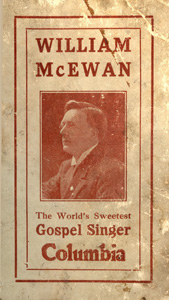
From our own family collections, it seems that the early American recordings of Hillbilly Gospel music had the same impact on evangelical Ulster Scots homes. For example, my grandfather’s collection was full of Carter Family, Hank Williams, McCravy Brothers and Southern Gospel Quartets - as well as Scottish music and hymns by William McEwan.
So it’s no surprise that if you were to listen to the hundreds of independently-produced Ulster gospel records of the 20th Century, you would hear echoes of Roy Acuff, the Carter Family and the Louvin Brothers, through the songs, the lyrics and the musical style. Hillbilly gospel music is essentially Scotch-Irish - no wonder people here love it!
.........
On Saturday night past Graeme and I were playing in Aughnacloy, County Tyrone. Also playing were other folk including the Pride of the Birches Accordion Band. The band are great, they play lovely sacred music and hymns in a sincere and non-showy style, and a lot of the members of the band are from a huge Murphy family! I took the opportunity to ask Alan and Joe Murphy if they had ever heard of The Murphy Gospel Group (old LP cover shown here). Sure enough, they told me that these Murphys were from around Lisburn and had a long career of playing hymns in wee churches and missions all around that part of the country in the 70s and 80s. Apparently the woman singer is still alive - hopefully still playing her mandolin!
We have long-dead relatives who played mandolin and guitar in wee gospel trios in the mission halls of the Ards Peninsula in the 1930s and 1940s; when my father was renovating the old farmhouse (built about 1800, he worked to the Ralston/Johnston family who owned it when he was a wee boy, and he then bought it when I was 2, in 1974) he found hidden in the rafters an old autoharp case and a hexagonal concertina. The tradition is there, someone just needs to spend time recovering the pieces before it's all swept away in an X-Factor tidal wave.
* for a very good analysis of this, see "Let Erin Remember - The Irish-American Influence on traditional music in Ireland" by Hilary Bracefield in "Writing Ulster No 5 - America & Ulster: a cultural correspondence" Belfast 1998 - ISBN 1 85923 102 0

Saturday, November 21, 2009
A museum with a fair-to-middlin' Ulster Scots story

Here it is. The Settlers Museum of SouthWest Virginia was one of our stopping points on our honeymoon back in September 1997. (I first wrote about it in this article in Feb 2007) It's a converted farmhouse, tucked away in the southernmost corner of Virginia. In one room there, converted into an exhibition space, I learned more about myself and my ancestors than I have ever done in any museum or heritage centre in Northern Ireland. The staff were all volunteers, courteous and knowledgable. I remember an elderly lady called Dorothy who referred to "Northern Ireland" on the map there as "Ulster Scots Land". Sounded good to me!
If you want to visit, here is a Googlemaps link:
View Larger Map
For US readers, I hope you enjoy your visit. For me however, it's approximately 4000 miles away. You can join their group on Facebook, and there are a few short movies on YouTube:
I think they've got a lot right. Community heritage makes so much more sense.
Tuesday, November 17, 2009
"The Secret History - Our Own"
As you know I've recently been drawing attention to the complete absence of any meaningful Ulster-Scots cultural history in Northern Ireland's institutions, whether in museums, education or the general media. Everything here is viewed through political glasses, and as a result cultural identity or history that doesn't neatly fit into the pre-determined political "two tribes" stereotypes gets suppressed, or scorned. (would it be too cynical of me to suggest that a lot of people have made careers and hefty incomes out of perpetuating "two tribes"? Flying round the world giving lectures on "conflict resolution" and "peace and reconciliation" must have its benefits...) So when I saw this large quote in an article in the Sunday Herald when I was in Dumfries, it caught my eye. Looks like the folk in Scotland are caught in a similar experience as we are ourselves. The article was entitled "The Secret History - Our Own", by Ian Bell. Try to find it online, it makes interesting reading.
Two great letters are available on The Scotsman website:
"...People are more interested in entertainment than sacrifice. Jacobites have good pub songs. Covenanters have hymns..."
FOOTNOTE: Back in 2006, when I was working on the Hamilton & Montgomery Settlement project, I had two sharp comments aimed at me. One was "you're just doing this to trump the Flight of the Earls in 2007", and another was "'Ayrshire to Ulster' doesn't have the same romantic appeal as 'Rathmullan to Rome'". My response to the first one was to laugh. My response to the second was "it really depends on your theological and cultural reference point".

James Hamilton, William Veitch, John Welsh, Alexander Peden, Robert Blair and William Adair

Wednesday, November 11, 2009
Vintage Jesus (by Mark Driscoll & Gerry Breshears)
I love this stuff - a great book, superb online resources, magnificent design and rock-solid theology - all with an edge.
Click here

Monday, November 09, 2009
BBC Scotland, Covenanters and Dumfries
Well, what did you make of the Covenanters programme on tv? You can watch it on iPlayer here. I thought it was visually superb, but in terms of storyline (dare I say, like the Ulster Museum...) there were a lot of big gaps. No mention of the two Margarets, of Richard Cameron, of the 18,000 martyrs, of Rullion Green, no images of the beautiful banners - of many of the big events that are in all of the best summaries of the Covenanters' story. I also thought that there were a few bizarre comments made, especially the closing remarks.
Nevertheless, on Thursday morning, Radio Scotland will broadcast a 30 minute programme about Alexander Peden.
Finally, I'm heading to Scotland this weekend, having been invited to speak at the annual Covenanters memorial service at St Michael's Kirk in Dumfries on Sunday morning. It's a special location, being the church that Rev James Hamilton of Ballywalter became minister of after his return on the ill-fated Eagle Wing. I'm going to spend 2 days in Scotland meeting people, visiting sites, and doing some photography. Will post a summary here when I get back.
Friday, November 06, 2009
Feedback from the Radio Ulster / Ulster Museum interview
Thanks to all of you who have contacted me today about the short piece on the radio broadcast this morning about the lack of Ulster Scots historical content in the new Ulster Museum. I've had emails, phone calls and at an event this evening 7 people came to talk to me about it - three of whom were strangers but recognised me. It is interesting that you're all "normal people" (ie sensible middle-of-the-road folk who can't be glibly dismissed as Ulster Scots "activists" or "lobbyists") and you feel as disappointed as I do that your story has been left out. All of us thought that Northern Ireland had moved on from the old broken "two tribes" past. Sadly it seems that the heritage sector is lagging far behind the people!
NOTE - Remember that "A History of Scotland" begins again on Sunday evening on BBC Scotland. For Northern Ireland viewers it's on the Sky digital channels away around 971. This Sunday night is "God's Chosen People" - the Covenanters!
Thursday, November 05, 2009
Belfast and the "Scotch"
The Public Record Office of Northern Ireland is full of great stuff. I was there for most of the afternoon. I found some correspondence between two of Ulster's great Victorian antiquarians - William Pinkerton (1809 - 1871, whose father was from Paisley in Scotland) and George Benn (1801 - 1882, author of A History of the Town of Belfast). While Benn was working on the later edition of the book in the 1870s, Pinkerton wrote to him to advise:
"...Belfast was founded by the English, but the Scotch element gaining the mastery, it became little more than a Scotch trading station in Ireland, the sole aim of the inhabitants being to make money and go back to Scotland again..."
These were men of what has been described as "the first Golden Age of historians of Belfast". When you add to the list men like Robert Magill Young, William Reeves, James O'Laverty, Classon Porter, W D Killen and Rev George Hill, you find that those great historians of 150 years ago were utterly convinced of the profound cultural and historic connections between Ulster and Scotland, and devoted large portions of their lives to researching and publishing these connections.
It is a shame that so many of today's professional historians and educators in Northern Ireland have made it their business to ignore their predecessors' monumental achievements and seek to airbrush Scotland out of our story; in doing so they perpetuate the failed and divisive political "two tribes" narrative, and hide from us our full cultural heritage.
Wednesday, November 04, 2009
Radio Ulster again
I was interviewed this evening, it might be broadcast on Good Morning Ulster some time soon. BBC NI phoned me this afternoon, having seen the blog post below about the Ulster Museum. So, once again, I end up on the radio unintentionally. Just hope it comes across sensibly - there's a huge Scottish dimension to the heritage of Ulster that is being ignored by not just the Ulster Museum, but by almost the entire heritage sector. It's funny that this blog has such a wide reach!
On a more constructive note, thanks to everyone who has been so positive about the Covenanters in Ulster programme which was broadcast on Sunday. You can still listen to it on BBC iPlayer by clicking here.
Tuesday, November 03, 2009
The Ulster Museum - Part Two - Ulster Tartan
(Let's take the issues one at a time, my response to what I saw at the Ulster Museum on Saturday.)
In his excellent book Intimate Strangers - Political and Cultural Interaction between Ulster and Scotland in Modern Times - Graham Walker begins by quoting ATQ Stewart: "At the core of the Ulster problem is the problem of the Scots".
The new Ulster Museum exhibition galleries and interpretation clearly have a problem with the Scots. Example One is the Ulster Tartan. As you know from previous posts, I'm not really into tartan. But it is a solidly Scottish cultural phenomenon. And as this article by Matthew Newsome FSA Scot says, "... The only Irish district tartan that is truly historic is the Ulster tartan...". In the Ulster Journal of Archaeology, 1961/62, there's a 23 page academic paper about the Ulster tartan. It was discovered, preserved intact, in 1956 near Dungiven. It was peat-stained and discoloured but was taken to (guess where) the Ulster Museum for examination. A textile specialist, Audrey Henshall, carried out a detailed examination and even produced samples of the original colours - a vibrant green and red with fine details in black and yellow. The clothing was displayed at the Ulster Museum in 1958 as part of the big Elizabethan Ulster exhibition. It was an Ulster icon and graced the catwalks of swinging sixties London. Then in the early 1970s the Scottish Tartan Authority acknowledged its importance and authenticity by registering it as Ulster Tartan.
Initially I was pleased the see the garments back on display, in a glass cabinet. The leggings of the mannequin are of the reconstructed red/green/black/yellow. But then I read the small interpretive plaque, which reads as follows:
Dungiven costume
The reconstruction is based on the remains of clothing (in front) that was found in 1958 one mile north of Dungiven, County Londonderry. The find included a cloak, coat, trews and shoes of the sort that would have been worn by a male member of a Gaelic Irish family in the first half of the seventeenth century.
- No mention of tartan.
- No mention of Scotland.
- No mention of the early 1600s Ulster-Scots settlements of County Down or the tartan industry that sprang up near Newtownards.
- The only cultural reference is "Gaelic Irish".
With an artefact with such an obvious, non-contentious, credible and already thoroughly researched Ulster-Scots story to tell, the Ulster Museum has chosen to apply cultural exclusion, and you might argue cultural displacement, asserting a "Gaelic Irish" cultural connection and removing the solidly Ulster Scots.
I am both disappointed and angry. More to follow through the week...
......
Postscript: Ulster tartan is now produced commercially and available in these three colour schemes:
Ulster Modern Red (click to enlarge)

Ulster District (click to enlarge)

Ulster Weathered (click to enlarge)

.
Sunday, November 01, 2009
Plantation Paradise?
(if you're reading this on Facebook, this is a post from my blog - http://clydesburn.blogspot.com. All my posts there now feed across to my Facebook page)
INTRO: When I was at Regent House (1983 - 1990), one of the few things that stick in my mind was when I spotted an error in the history text book. It had the wrong date for the burning of Ridley and Latimer - I had consulted some of my da's old Victorian books about the Reformation to check. My teacher, Mrs Groves, wrote to the publishers, who wrote back and conceded that I was right - and that the next edition of their book would have the date corrected. For a while Mrs Groves had the letter pinned up beside her desk on the classroom wall.
I was about 14 at the time, and it was a big lesson learned. Textbooks can be wrong.
PLANTATION PARADISE?: Next year - 2010 - is the 400th anniversary of the Plantation of Ulster. Textbooks (and historians) often simplify and stereotype the experience of the Protestant settlers who came to Ulster in the early 1600s - English and Scottish alike. So next year carries a massive danger in that a lot of the falsehoods that are spread about the Plantation may well, once again, be pumped into the public mind. (and of course, the real origin story of the Ulster-Scots is NOT the Plantation!)
Two types of people spread this stuff - 1) those who are either opposed to, or uncomfortable with, Protestants being in Ireland in the first place, or 2) by those who have believed the false spin and who, as a result, are either uninformed, or feel guilty about, the Plantation. The arrival of the Protestant settlers here is often stupidly (or cynically) presented as a kind of social paradise - an idyllic existence where the native Catholic Irish were subjugated and the Prods lived happily ever after as oppressors and land thieves. It's divisive and false.
In the case of the Ulster-Scots community, the 1600s was a century of unimaginable upheaval and turmoil. Most of them had originally left Scotland voluntarily through the appeal of cheap rent and the hope of a new life across the water. In a nutshell here's the brutal reality of what happened to them during the next hundred years - the State which initially approved their arrival here quickly turned against them, through religious repressions / it drove some to consider and attempt transatlantic migration / then large scale massacres / then a brief period of religious respite (but which included threatened deportations by state authorities of people from east Ulster to the farthest corners of the island) / then a new King brought renewed and intensified religious persecution / which eventually became state-sponsored oppression and executions in Scotland where 18,000 were either killed or sent into exile as slaves / then a brief respite when the King (James II) was overthrown in 1688 / but in the early 1700s the persecutions resumed when James II's daughter Anne became Queen / then about 250,000 Ulster-Scots had enough and left for America...
A Plantation Paradise? Maybe for a handful of wealthy individuals in the gentry who were top of the pile - but absolutely not for the 99.9% of the common people.
"Mined in Scotland, Forged in Ulster, Exported Worldwide" was a phrase I devised about 10 years ago, and which the then Ulster Scots Heritage Council adopted as their slogan. It was the intense white-hot furnace of the Ulster experience that forged the history, character and identity of the Ulster-Scots - not some false utopia.
Don't believe the hype.
Saturday, October 31, 2009
The Ulster Museum / Covenanters on Radio Ulster tomorrow
I went to the much-heralded new £17m Ulster Museum this morning. I spent about 2 hours browsing the displays and reading the interpretation. I know that there have been architectural concerns, there have been objections to its new closed-on-a-Monday policy, and bemusement that it downplays the thing that Northern Ireland is (unfortunately) world famous for.
But of FAR bigger concern to me is the Ulster-Scots component. Why? Because there isn't one.
This cannot be an accident. Museum people spend a lot of time, and money, considering what artefacts to show and how to display and interpret them. Therefore, there has been a purposeful decision to exclude a meaningful Ulster-Scots dimension from the new Ulster Museum. For all of the 21st century interior design and graphic design (both of which are excellent), I'm very disappointed to say that the Ulster Museum can be added to the list of those institutions still trapped in a medieval Anglo/Irish mindset.
I am working on a personal analysis of what I saw there today. I will cite a number of quite shocking examples later in the week - which you can go and see for yourself.
Watch this space.
......
Meanwhile, the special edition of Radio Ulster's Kist O Words, about The Covenanters In Ulster, with myself and Dr William Roulston, is broadcast tomorrow at 4pm.

Friday, October 30, 2009
Gressgaw, floormot, thaveless, haverel and attercap
Talking to my mother a while ago, I grabbed a pen and a bit of paper - because in the course of about 15 minutes she used these five words. She doesn't use dense Ulster-Scots, but English that's heavily peppered with a flow of words that aren't in the English dictionary. Why? Because they're not English words! Her definitions were:
Gressgaw: cut on or between the fingers
Floormot: garden
Thaveless: useless
Haverel: a thran big woman or man
Attercap: cheeky / smart alec
The foundation of any language is of course individual words. Nearly everyone in Northern Ireland (apart from the self-conscious-and-upwardly-mobile) says "aye" instead of "yes" and "wee" instead of "little". That's evidence of just how big the impact of Scots has been here over the centuries.
Hardly anybody in Northern Ireland nowadays knows who James Orr, the Bard of Ballycarry, is - never mind go to the linguistic depths of memorising his poetry. Outside of east Londonderry, Antrim and Down, maybe not many folk even use the obscure words that my mother uses. But it would be great if more people, young and old, came to recognise just how many Scots / Ulster-Scots words they naturally use every day.
(NB: This blog now feeds over to my Facebook page, where Robin has quite rightly posted about Ulster-Scots words being used in Donegal. East Donegal is of course another important language location given the early lowland Scots migrations there too. The post above was about NI, so apologies for leaving Donegal out!)
Thursday, October 29, 2009
Map of County Down, 1810, by James Williamson
Found this online today - enormous downloadable JPEGs of what I consider to be the most beautiful map of County Down I've ever seen. Small cropped section below; click to view it at full size.
Townlands are marked on it, and which are of course usually old Irish names. Some people point to this as evidence that the arriving Scots settlers of the 1600s had little or no impact on the landscape of Ulster. This is of course nonsense, because whilst the Scots were happy to use existing townland names, they also introduced endless amounts of what might be called sub-townland names all over Ulster which are clearly of Scottish origin. Here's a personal example - I live in the townland of Ballyhemlin, but the specific area I live in is called Clydesburn (hence the name for this blog). Williamson's map of County Down is available to download here, in four sections. Be warned - each JPEG is around 300mb when opened!
Vintage Travel Posters
Selection of posters below from the current auction at Onslows. Full catalogue online here Some are quite reasonably priced; as usual the famous ones are big money. Here's a selection that might appeal to the readers here at the 'Burn:


Tuesday, October 27, 2009
Radio Ulster - Covenanters this Sunday at 4pm
If you tune in at 4.00pm this Sunday you'll be able to hear the special edition of A Kist o Wurds about the Covenanters in Ulster. Here's a summary of the programme with some pics of us all at the various locations.
Sunday, October 25, 2009
New Alexander Peden (Covenanter) book - just £6.99!
I'll be advertising a few Covenanter related things over the next week or so. First up is the new 108 page book "Some Remarkable Passages of the Life and Death of Alexander Peden, Prophet and Covenanter, in Scotland and Ulster". It's a reprint of a 1755 Belfast edition, and has a new Foreword, Biography, selection of Historical Poems, an article entitled "The Unforetold Legacy" and an article entitled "Publishing Peden". It contains 26 photographs and illustrations. Put this on your Christmas list!
It's hot off the presses - copies are already available here from the Ulster-Scots Language Society - you can either buy online or from their premises. Alternatively, phone Derek on 028 9043 6716.
A big thank you to everyone who helped so willingly in its production - Jack, William, Glen, Alastair, Dane, Derek and the folk at the Ullans Press. (It's mostly in English, with just the historical poems and one quotation in light Scots). Click the photos to enlarge.

 From the back cover:
Alexander Peden - the man whose prophecies enthralled the rebels of 1798, who lived the life of a fugitive on the Glenwhirry moors, and whose memory is perpetuated by a faithful band of Covenanters who still gather at the Mistyburn in his memory. In the era of the “chapmen”, the door-to-door pedlars who sold cheap and popular literature, Alexander Peden fascinated readers in Scotland, Ulster and America for centuries after his death. This reprint of the 1755 Belfast edition contains many stories of Peden’s life in Ulster, and gives Peden his rightful place as one of the most important figures in Ulster-Scots history.
Friday, October 23, 2009
Neil Oliver again
This time it's not a spoof video, but a run-down of the new programmes which will be broadcast during November and December, beginning on Sunday 8 November:
• GOD'S CHOSEN PEOPLE: The episode looks at the Scottish Covenanters, and how they redefined their own place in Britain, and Britain itself. The programme claims they sparked the revolution that struck off the head of Charles I and ultimately led to Cromwell's conquest of Scotland to defeat the Stewarts.
• LET'S PRETEND: Covering the time from the wake of the 1688 revolution that brought William of Orange to power, through to Culloden, the episode looks at the Darien project and the 1707 Union of Parliaments.
• THE PRICE OF PROGRESS: Focusing on the years between 1754 and 1783, the programme looks at the riches Scotland made from transatlantic trade, but questions the moral cost. The episode also claims that the phrase from the American Declaration of Independence, "life, liberty and the pursuit of happiness", was coined by John Witherspoon, a minister originally from Paisley. It also relates the story of Joseph Knight, a slave brought to Scotland from Jamaica, who challenged – and defeated – his owner in court.
• THIS LAND IS OUR LAND: The episode examines the conflicts between those who owned Scotland and those who lived in it during the 19th century. It focuses on Sir Walter Scott, and the way his romantic image of Scotland emanated from his fear that revolutionaries in industrial towns would sweep away everything distinctively Scottish.
• PROJECT SCOTLAND: Examining how Scotland went from a pre-war industrial powerhouse to post-war marginalisation in the space of a generation, the episode will look at the mass exodus of Scots in the 1920s and 1930s. It goes on to revisit the work carried out by the Scottish Office in the 1950s and 1960s to reinvigorate the nation, followed by the impact of Lady Thatcher and the path to devolution.
Article from The Scotsman here
Article from The Times here