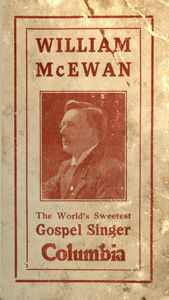


Regular readers will remember the series of posts here about William MacEwan during November and December. It was Macewan who popularised 'The Old Rugged Cross', which Joe tells me in decades gone by was regularly sung at social events across Scotland. Below is the Carter Family's version of a (lyrically) very similar piece, recorded in the 1930s. The guitar style (of picking the melody on the lower strings, but with rythym strumming as well), and the dead-flat male harmony sung by AP Carter) is superb. And Scotch-Irish of course. This was written in 1894, whereas 'The Old Rugged Cross' was written in 1913.
Monday, January 30, 2012
The Carter Family: 'On A Hill Lone and Grey'


Sunday, June 05, 2011
'Death Has Lost its Sting' - Psalm 3 via Isaac Watts (1719) to Sojourn Church, Kentucky (2011)
My God, how many are my fears
How fast my foes increase
Conspiring my eternal death
They break my fleeting peace
The lying tempter would persuade
My heart to doubt Your aid
And all my swelling sins appear
Much greater than Your grace
Chorus:
Arise, Oh Lord, fulfill your grace
While I Your glory sing;
My God has broke the serpentʼs teeth
And death has lost his sting
But You - my Glory and my Strength -
Will on my tempter tread
Will silence all my threatening guilt
And raise my drooping head.
Bridge:
And though the hosts of death and hell
All armed against me stand
No more will terrors shake my soul;
Secure within Your hand.
Here's an article about the history of the song, and the new version in the video above. And here is Watts' original, from his Psalms of David first published in 1719.
Tuesday, May 31, 2011
Tuesday, May 10, 2011
The Great Speckled Bird
This song was another one of my granda's favourites - he had the original Roy Acuff version on an old 78. If, like me, you've been mystified by the lyrics then you might be interested to listen to Russell Moore's analysis of it over on his podcast series The Cross and the Jukebox - click here.
Saturday, April 23, 2011
A soundtrack for Easter Sunday
A beautiful rendition from Red Mountain Music of an old English hymn from the 1780s. Just superb.
"...“It is finished,” O what pleasure,
Do these charming words afford..."
Full lyrics (and chords) available here.
Thursday, March 31, 2011
An easy life?
'Must I be carried to the skies
On flowery beds of ease,
While others fought to win their prize,
And sailed through bloody seas?'
- Isaac Watts, 1721
Recorded by The Carter Family as 'On the Sea of Galilee':
Sunday, February 13, 2011
Old-time Ulster music: The Harmony Trio, Newtownards, 1930s
When you hear or read of the old-time stringed music of the early 20th Century, it is of course the American artists that spring to mind. They were recorded and popularised on 78s and in the early days of radio - the record companies became professionalised and their musicians quickly became "golden geese" who were marketed, photographed and written about with care - selling millions of records and becoming multi-million dollar moneyspinners.
Over here on our side of the Atlantic there were many, but sadly now forgotten, musical groups. One of these was The Harmony Trio, who were three men from Newtownards and Belfast:
• Sandy McDonald (hammer dulcimer)
• Willie Gamble (1897-1985; hammer dulcimer and mandolin)
• Jack Noble (accordion)
In 1932 and 1933 they played on BBC Radio on a late night slot between 9pm - 10pm. Willie Gamble also made two dulcimers; during WW2 the Gambles were evacuated from Belfast to Newtownards, but upon their return to Belfast the dulcimers had become the home for an infestation of woodworm, and so were thrown out. However, the hammers have survived and are still with the family. The BBC Archive at the Ulster Folk and Transport Museum doesn't hold any recordings of The Harmony Trio, so apart from photographs, clippings and memories that the families still have, nothing remains.
(Thanks to the family for the information above which they gave me many years ago. Previous blog post about the famous Co Antrim dulcimer player John Rea, 1915-1983, available here)
Saturday, February 05, 2011
David Johnstone Beattie (1881 - 1964); author, hymnwriter and (Plymouth) Brethren historian from Langholm and Carlisle
The beautiful town of Langholm in the Reiver country of the Scottish Borders is nicknamed 'The Muckle Toun' and is perhaps best known as the birthplace of poet and Scots language activist Hugh MacDiarmid (real name Christopher Murray Grieve). The last time I drove through there were some large entrance signs commemorating this connection. Langholm is also the southernmost point of one of the most beautiful driving routes in the British Isles - the A7 through the Borders to Edinburgh, which has some stretches which are just as spectacular as the famous Skyline Drive in Virginia.
A lesser-known Langholm man, David J Beattie, first came to my attention when I was sent photocopies of a small gospel song book entitled "Songs of the King's Highway", a collection of 77 songs he had written which was published by Pickering and Inglis. It was undated but from the typographic style it looked to be from around the late 1920s or early 1930s - the same era when Pickering & Inglis first published the mighty hymnbook Redemption Songs, and also Duncan McNeill's Hymn Book. Seven of the pieces in Beattie's book were in light Scots rather than standard English, and I have posted them over at Sacred Scotch Solos.
I picked up an original copy of the book a few years ago, and to my surprise inside was a pencil inscription "Author's copy, Beattie lived in Carlisle", along with Beattie's signature. In the introduction Beattie describes the American hymnwriter Charles H Gabriel as his 'intimate friend', to whom Beattie 'owed much for help and encouragement during many years of close friendship'. Gabriel wrote three melodies for the book.
There's an article here entitled 'Langholm's Forgotten Son' which summarises Beattie's life. He and his brother joined the family stonemason/monumental sculptors business in 1898; during and after the two World Wars the firm was responsible for many war memorials in the south of Scotland.
He belonged to the (Plymouth) Brethren and wrote occasionally for the Brethren publication The Believer's Magazine, including articles about Scotland's 1859 Revival. Even though Brethren assemblies/halls had begun in Plymouth and Dublin among (affluent) disaffected Anglicans in the early 1800s, it was post-1859 Revival working-class Scotland and Ulster that was a seedbed in which they really flourished. Beattie's historical account of the growth of the Brethren movement, entitled Brethren - The Story of a Great Recovery (published by Brethren publisher John Ritchie of Kilmarnock in 1939, who also printed some of my grandfather's poetry, is freely available online here), carefully details the intimate connections between the halls of Scotland and Ulster. It tells the stories of men like Jeremiah Meneely, so closely associated with the initial Kells and Connor epicentre of the Ulster 1859 revival and who later led evangelical missions in Ayrshire and Glasgow, where his Antrim voice must have preached the hamely message of his own self-penned hymn "There's a gran' time comin, o brither dear, whun Jesus will tak us hame'.
In between times Beattie wrote six other books which spanned his interests of local history, language, music, the stories of hymnwriters, as well as the history of the "wee halls" - Oor Gate En' (1915), Psalm Singing Among the Scottish Covenanters: A Lecture (pamphlet, 9 pages, Steel Bros. Carlisle 1915), Prince Charlie and the Borderland (1928), Oor Ain Folk (1933), Stories and Sketches of our Hymns and Their Writers (1934; the frontispiece photo of which is Ayrshire hymnwriter Anne Ross Cousin), The Romance of Sacred Song (1935; in the Preface of which he wrote that 'my bookshelves already groaned under the weight of volumes on this engrossing subject') and Lang Syne in Eskdale (1950).
For those of you with an interest in gospel music, his chapter How We Got our Popular Gospel Song is a fascinating read - available here. In it Beattie rhymes off a "Premier League" list of hymnwriters of his time:
"...Among writers who laid the foundation of American Gospel hymnody the following names are familiar: W. B. Bradbury, P. P. Bliss, Philip Phillips, Ira D. Sankey, James McGranahan, W. J. Kirkpatrick, Robert Lowry, George C. Stebbins, H. R. Palmer, D. W. Whittle, T. C. O’Kane, J. R. Sweney, W. H. Doane, Fanny Crosby, E. O. Excell and Charles H. Gabriel. Of this group of sweet singers, whose songs have been carried to the ends of the earth, Mr. Stebbins and Mr. Gabriel alone remain...." - it's significant that of the 16 he listed, a quarter of them (the ones I've marked in bold) all had Ulster connections.
Beattie also contributed a hymn to The Believer's Hymnbook - 'Assembled, Lord, at Thy Behest' (no 367), a book which is still used in the simple Sunday morning 'Breaking of Bread' meetings in Brethren-minded gatherings around the world; Beattie is named in the acknowledgements section at the front of the book.
Beattie died in July 1964 and his funeral service was held in Hebron Hall in Botchergate, Carlisle. The stonemasonry business still operates from the same building, now under different management, but is still called Beattie & Co, shown below.
If you know more about him which could be added to this post, please get in touch.


Friday, January 28, 2011
"True Grit" and "Protestant Hymns"
This interview with the Coen Brothers on Telegraph.co.uk about their acclaimed remake of True Grit has an interesting excerpt:
'...The film is underscored by four different 19th-century Protestant hymns, the most notable of which, Leaning on the Everlasting Arms, builds slowly throughout the movie, rising in prominence as the story hurtles towards its action-packed conclusion, and the main characters learn to depend on each other. “Choosing that hymn was important,” says Ethan, “because that Protestant attitude is such a part of who Mattie is. The music speaks of faith and certitude, and that she has in spades.”...'
The film also includes What A Friend We Have in Jesus (written by Ulsterman Joseph Scriven of Banbridge), Hold On To God's Unchanging Hand and The Gloryland Way. It's good to see that even mega-famous directors have a regard for transatlantic evangelical culture. If you know the hymns already, then the style of the score on this clip will move you. (True Grit opens here in the UK on Feb 11th)

Thursday, January 27, 2011
RIP Charlie Louvin (1927 - 2011)
Charlie Louvin has passed away in Tennessee. He was one of the renowned Louvin Brothers. His brother, mandolin player Ira Louvin, died in the 1960s. Like many traditional country artists of the early 20th century, a large proportion of their repertoire was gospel music. Here are a few rare clips of them in their heyday:
"But now life's evening sun for me is setting, I have reached the ending of my way"...
Saturday, January 15, 2011
"The Cross and the Jukebox" - a new podcast
Thanks to Robert Campbell for letting me know about this, a new podcast from Russell D Moore. Hank Williams' I Saw the Light is the subject of this first episode, which he describes as "The National Anthem of the Christ-haunted South". "We need to pay attention to the theologies of John Calvin and John Wesley, yes. But sometimes we also ought to pay a little bit of attention to the theologies of Johnny Cash." Click here. It's an excellent, thoughtful, piece - and I hope future episodes are as good, if not better.

Sunday, December 19, 2010
Red Mountain Music - "All Things New"
I've mentioned Red Mountain Music from Alabama on previous posts; they've just released their seventh album, available now for download, with CDs available very soon. They are far better musicians than I'll ever be, and their reworking of old hymns is something I very much admire. Listen here for a merging (I think the cool term is "mash-up") of "Alas And Did My Saviour Bleed" with "I'm Not Ashamed to Own My Lord". Absolutely beautiful. Their haunting version of "Were You There When They Crucified My Lord" would be at home on any Wilco or Uncle Tupelo album. "Come All Ye Pining Hungry Poor" is another standout - it's an old hymn written in England by Anne Steele (1717-1778), originally entitled "Lord We Adore Thy Boundless Grace".
Some of the songs have an almost Low Anthem feel - overall this sounds more ethereal than previous Red Mountain Music albums, softer and more reflective, but that's maybe down to the production style rather than the songs. Sadly this seems to be the last album they intend to release, but hopefully someone else will take up the mantle. The whole album is available to listen to here.
> Full discography here
> Full list of recordings, with chords and lyrics, here

Thursday, December 02, 2010
Hank Williams classic with a tuba
Great clip of The Lower Lights playing the Hank Williams classic "House of Gold":
Wednesday, November 24, 2010
Edward MacHugh of Dundee, gospel singer and radio star (1893-1957)
Edward MacHugh/McHugh was another Scottish gospel singer of the early 20th century who, like William MacEwan (who was the first recorded Gospel singer in the world, cutting six tracks for Columbia in London in 1911) and Duncan McNeill, found fame in the USA. His father, Michael McHugh, is believed to have been from Galway (source here). Here's a brief biography from various online and printed sources:
MacHugh was born in Dundee on 26th May 1893. He emigrated to the USA aged 17 and initially took jobs in railroad yards and department stores. His singing talent was noticed and in 1927 he made his debut appearance on a radio station in Boston called WEEI (founded in 1924 and still going today). He sang "The Old Rugged Cross" and the next day the station received 2300 letters. The radio station sent people signed photographic postcards of MacHugh and his fame grew rapidly, even reaching back across the Atlantic to Scotland. There's a story of how his sister, listening to an American broadcast on a short wave radio in Glasgow, realised who she was listening to: "...as the rich baritone voice of Edward MacHugh filled the room, she realised that her beloved brother, whom she had not seen for so many years, was singing to her over three thousand miles of ocean."
In 1938 the Rodeheaver Publishing Company issued "Edwards MacHugh's Treasury of Gospel Hymns and Poems", a collection of 100 hymns and 103 short poems, all of which were in standard English apart from "My Ain Countrie", a Scots hymn which had first appeared in Ira D Sankey's world-famous hymnbook "Sacred Songs and Solos" in the late 1800s. It's either number 344 or 982 depending upon which edition you consult.
By the early 1940s MacHugh was a regular on NBC radio, possibly the biggest radio network in America. But despite his fame, he still lived on a smallholding of 8 acres in Connecticut where he raised poultry and pheasants, and referred to himself as "The Farmer" whilst the public of America called him "The Gospel Singer". People would turn up at the radio station in New York just to meet him - "every day those of his listeners who happen to be visiting New York City come into the studios to be present at his broadcast. They shake hands with him, speak to him, and go away feeling that Edward MacHugh is a man who is sincerely trying to bring happiness to people through his gospel songs."
There are a few of his 78s among my grandparents' collection, including a lovely version of Lady Nairn's "Land O' The Leal" (Columbia 37015-F / 108364) with "Lassie Would Ye Loe Me" on the other side. I also have a set of three MacHugh 78s in a folded album/wallet - one of these is his recording of "My Ain Countrie", which I think is better than MacEwan's original. These records were probably bought by my grandfather from a shop like the Anglo-American Gramophone Company in Belfast. I also have two of MacHugh's hymnbooks, one of which has the 1927 promotional signed photo inside it (not the one shown here).
In 1954, nearly 30 years after his first radio appearance, Billboard Magazine carried an article saying that MacHugh's show was named as the "2nd best of all non-network religious series" (see link here). Edward MacHugh died on 3rd February 1957.
If you know anything more about him, or if he has any descendants who are reading this, please get in touch with me.
LINKS
> Partial Edward MacHugh discography of his 1936 recordings available here

Listen to MacHugh's recordings of "Land O The Leal" and "My Ain Countrie" here:
Wednesday, November 17, 2010
The Twilite Broadcasters
Found this "brother duet" - The Twilite Broadcasters - from North Carolina on Vimeo!
Here's my best stab at the songs in the medley:
0.00 - 0.56 : Little Glass of Wine - The Stanley Brothers
0.56 - 1.34 : There's More Pretty Girls Than One - Doc Watson
1.35 - 2.04 : Instrumental
2.05 - 3.04 : What Would You Do In Exchange for Your Soul - The Monroe Brothers
3.05 - 3.45 : Midnight Special - The Delmore Brothers
3.46 - 4.44 : Don't Let Her Know - Buck Owens (beautiful harmony!)
4.45 - end : Instrumental
Thursday, November 11, 2010
Dust to Digital and my own "Atlantic Bridges"
Over the past couple of days, in addition to the local connections I've made and blogged about below, I've also made some brilliant links with people in the USA. Thanks to some old blog posts I'm now in direct contact with the grandchildren of Duncan McNeill, and once again with a nephew of the McCravy Brothers. I was able to send Paul McCravy six MP3s which I'd digitised from some McCravy Brothers 78s which had surfaced in a collection belonging to a man from Bangor - some of them Paul and the family never heard before. Likewise with the McNeills, I had digitised some old 78s and sent the MP3s to Stuart Eydmann who posted them on his website Raretunes.org - so the family were able to listen to their grandfather singing.
Here are two videos about a couple in the USA who have been nominated for Grammys for their work in digitising old 78s and making them available for the present generation - and in some of the most beautiful packaging design I've ever seen. Welcome to Dust to Digital. I was showing off my copy of the 6 CD box set "Goodbye Babylon" to a few fellow music enthusiasts last night!
Saturday, November 06, 2010
When did Gospel music really begin?
Over the past few weeks, I've caught a bit of the Radio Ulster programme "The Gospel Train", presented by American soul singer Mirenda Rosenberg, which is broadcast on Sunday afternoons. A good programme with a broad mix of blues/soul American gospel music and definitely worth a listen. I've got old LPs by Sister Rosetta Tharpe (that's her above), cds by groups like the Soul Stirrers and Dixie Hummingbirds, and even recorded the Thomas Dorsey song "If You See My Saviour" a few years ago. Michael W Harris' book The Rise of Gospel Blues (1994) is a superb study of Thomas Dorsey's life - and the film (now DVD) "Say Amen, Somebody" contains some marvellous footage of Dorsey and Sally Martin (see clip below).
In terms of pop culture today, the impression that is often given is that gospel music was created in the 20th century by American blues and soul performers like Dorsey, Aretha Franklin, Mahalia Jackson, etc. (here's an example - you'll come across this time and again).Brilliant and important as those artists were/are, the claim is false.
What would Ira D Sankey make of that claim? Or our own Robert Lowry? Or Isaac Watts? Or Charles Wesley? And of course there's this litte-known work from the 1700s. Or Martin Luther? Or the Psalmist - King David? Or, to go back even further, what about the "Song of the Sea" or "Song of Moses"?
Pop culture is a strange and highly selective thing. Meanwhile, enjoy these:
Thomas Dorsey & Sally Martin - singing along to a record of "If You See My Saviour"
Sister Rosetta Tharpe - Up Above My Head
"I Greet Thee, who my Redeemer Art" - believed to have been written by John Calvin

Sunday, October 24, 2010
The Lower Lights - A Hymn Revival
Thanks to Philip for sending these to me - beautifully filmed old-fashioned acoustic harmony-based sacred music - spectacular! The track listing reveals The Lower Lights to be a Mormon-based collective of musicians who mix old standard hymns with some specifically Mormon pieces, one of which - If You Could Hie to Kolob - sounds almost identical to The Star of the County Down - listen here for yourself. Visit the website | Visit Bandcamp.com site
Thursday, August 05, 2010
Jock Troup and Duncan McNeill on RareTunes.org

Photo © Jim Mayne, of Jock Troup leading a children's mission, circa 1920.
Thanks again to Jim Mayne from Bangor for lending me some of his old 78 collection some weeks back. I have digitised these and cleaned up some of the crackle; they have now been incorporated into the Scottish music archive RareTunes.org.
Jock Troup (1896 - 1954) was a very famous evangelist of his generation and spent much time preaching in Ulster. He is only known to have ever recorded two songs - "He Did Not Die In Vain" and "Unanswered Yet" (Beltona 1584). In 2002 George Mitchell wrote an excellent biography of Jock Troup entitled Revival Man - The Jock Troup Story. Recently, Sharon Wilkinson from North Carolina also sent me a biographical booklet by her father, a preaching colleague of Jock's called James Stewart, entitled Our Beloved Jock - Revival Days in Scotland and England - the Story of a Fisherman Revivalist.
Duncan McNeill / M'Neill (not sure of dates of birth or death) was described as "Scotland's Sweetest Gospel Singer" and "The Scottish Skylark", and for a time was also pastor of Bridgeton Baptist Church in Glasgow. Among Jim's 78s were two by McNeill - "Thou Remainest" & "Will the Circle Be Unbroken" (Beltona 1460) as well as "Don't Be Downhearted" & "The Gospel Ship" (Beltona 1620). I am not sure if he spent any time on this side of the water, but his records and his hymn book were certainly enjoyed here. Any information you might have about him would be appreciated.
With Jim's permission all of these tracks have been sent to Stuart Eydmann who runs the website RareTunes.org, to add to his collection there. RareTunes is an excellent growing archive of rare Scottish recordings.
Troup and McNeill, along with others like Seth Sykes, Charlie Mayne, W.E. Tocher and many others were all Scottish preachers who made a big impact on Ulster in the early 20th century. Another great example is the "Old Tent Evangel" which was founded in 1922 and moved around different areas of East Belfast - it was nicknamed "The Cloot Kirk" (the Cloth Church). In addition to their spiritual legacy they also left a collection of songs, hymns and childrens choruses, some of which used Scots language words and expressions. Perhaps the close relationship of the Belfast and Glasgow shipyards was a factor, but these are all evangelical evidences of how Scots speech was once a frequent feature of the working class life of Belfast.
NB - you can hear the Troup and McNeill recordings here, in the column on the right entitled "Latest Recordings". An excellent history of the halls and missions of Belfast is Belfast's Halls of Faith and Fame by Victor Maxwell (Ambassador 1999)
NB again - Jock Troup's understudy / successor as Glasgow's most renowned open air preacher was Raymond McKeown. His parents, Joseph and Margaret McKeown, were Ulster folk - Joseph had been in the Army and the Royal Ulster Constabulary but they moved to Glasgow in the 1930s because of the threat of terrorist attack on the family.
Tuesday, May 11, 2010
Shanties and Sea Songs
(NB: If you're reading this on Facebook, you can read this post in full on my blog). I saw a superb programme on BBC4 last night: Shanties and Sea Songs presented by Gareth Malone. You can watch it on BBC iPlayer here. It'll be downloadable for the next few days, so I strongly recommend that if you're into rural folk culture and traditional music that you get it while you can. Here's a summary from the BBC website:
The story of Britain's maritime past has a hidden history of shanties and sea songs, and choirmaster Gareth Malone has been travelling Britain's coast to explore this unique heritage. From dedicated traditionalists to groundbreaking recording artists, Gareth meets a variety of sea-singers from across the country.
His journey begins in Portsmouth where he meets a devoted shanty singer, before continuing on to Tyneside and the Yorkshire coast, where the Filey Fisherman's Choir, with an average age of 70, are determined to keep the tradition alive.
Gareth gets a fascinating insight into the songs of the Herring Girls when he visits Gardenstown in Scotland. In Whitby, he meets Kimber's Men, a local group who have dedicated themselves to writing and singing songs celebrating heroes of the sea, such as a rescue of 1881 when the sea was so rough the people of Whitby had to carry their 2-tonne lifeboat some six miles overland on a wooden trailer and in heavy snow to the bay where a ship had hit the rocks. Despite the exhaustion, they still managed to rescue the shipwrecked crew and passengers.
Gareth's journey ends in Port Isaac in Cornwall, where a group of local fishermen sing shanties and sea songs alongside their day job. Calling themselves the Fishermen's Friends, they have been so successful that they have landed a lucrative record deal.
Go to about 25 minutes in to hear a wee flash by Filey Fisherman's Choir of Londonderry man Henry Gilmour's mighty hymn "I've Anchored My Soul in the Haven of Rest". Great television, great music - a perfect example of how traditional cultures can be treated with respect and insight to produce compelling programmes.
Subscribe to:
Posts (Atom)