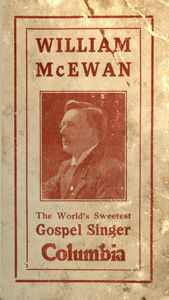

Working away on the next instalment of the McEwan story; meanwhile here's a local gem:
Wednesday, November 09, 2011
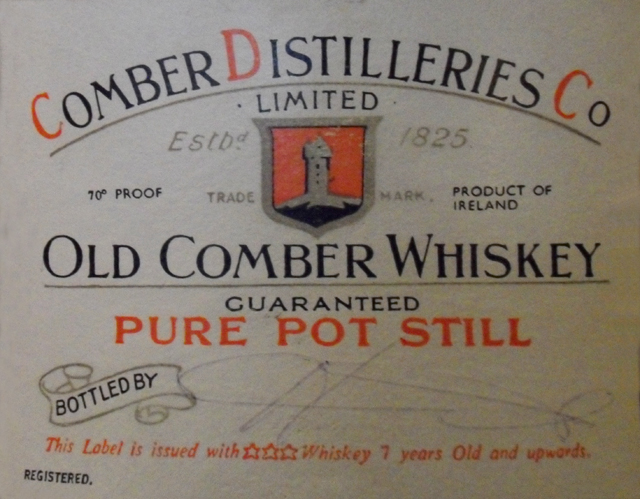
Comber whiskey label


Friday, October 07, 2011
Scrabo this afternoon
Computer screens just aren't big enough to show you the scale of this view. Ulster is a beautiful place... when the sun shines. (Click to enlarge.. and then put your nose against your screen.)

Sunday, October 02, 2011
"Ireland requireth rather lasting and warm clothes than gorgeous and dear garments"
So wrote Sir Thomas Smith in 1572, and it was a prophetic statement for our rain-drenched tour of the Upper Ards on Saturday morning! We had called the tour "A Forenoon Doon the Upper Ards", but with the weather forecast we joked about re-naming it "A Forenoon gettin' droont in the Upper Ards!". And by about 10am the forecast came true.
The tour included a visit to Newcastle to see the location where the Smith colony set up their first base-camp headquarters in their failed effort to establish an English community in the Ards which would oust the Clandeboye O'Neills. There were 31 people in total, drawn from four local historical societies (Ards, Loughries, Bangor and Comber), with various friends and other folk as well. We started at 9.00am in Newtownards and made numerous stops the whole way down the Strangford Lough shore to Portaferry and back up the other coast as far as Millisle, before heading back to Ards for 1pm. Plenty of crack and banter, a very welcome tea and scones stop, and great support from Ards Borough Council and the Northern Ireland Environment Agency.
I hope that the commentary was interesting for folk - we covered over 800 years of history, from the arrival of the Anglo-Normans in 1177 which brought the Savage family to Ulster, and of their tangles with the Clandeboye O'Neills, with the English Smith colonists and their later interconnections with the Scottish Hamiltons and Montgomeries, and also of 1798. The rendition of the poem 'Betty MacBlaine' went down well! We didn't bother making a few of the stops just because of the weather, but the stories were told and the places can be re-visited some day. Here's a pic of half of the group up in the lecture room building at Kirkistown Castle - the rest were in the castle tower! And Mr Balmoral was generous enough to foot the bill at Knott's Coffee Shop for a light lunch! So it was a wet day, but a good day - local folk visiting local places hearing local stories which can be shared with friends and family. And as usual, I learned as much from the group as they did from me. Great stuff!
Throughout the day quite a few people spoke to me of their frustration at shallow, narrow portrayals of Ulster-Scots heritage, as distinct from the deeply-rooted real stuff. This seems to be quite a widely held view among us plain folk.

Tuesday, September 27, 2011
The Auld Hoose, Donaghadee
Not sure of the date of this photograph, but would guess early 1900s. Men and boys hanging about outside James McDowell's billiards hall, with two women folk waiting for their workshy husbands? It was at the top of New Street, opposite Grace Neill's.
And here's the same building today:


Thursday, September 22, 2011
"On September 23..." The Harvest Fair in Newtownards
Yes, tomorrow is Harvest Fair day in the Square in Newtownards. What was once the big event of the year is nowadays not much different than the regular Saturday morning market. There are some great photos of it here from the 1950s and 1960s - I can remember we used to take the afternoon off primary school in the late 1970s to go up to it, and my uncle William had a candy floss and toffee apples stand at it for a few years.
Its origins are hard to trace. Unlike the other towns in Ulster which had been granted a Royal Charter in 1613, the charter granted to Hugh Montgomery's Newtownards did not specify a particular date for the annual fair. Maybe King James I was happy to let Montgomery run Newtownards his own way with minimum interference.
By the time that the Newtownards Chronicle and County Down Observer was first published in 1873, the Harvest Fair was embedded in local culture. The report of that year's fair is entitled "The Rowdies at the Harvest Fair" and tells the story of a group of drunken townies from Belfast creating disturbances after the Fair was over, including fist fights at the bus station and a few arrests - as well as a wee Ards woman who rolled her sleeves up and gave them a taste of their own medicine.
There's an interesting reference to the Fair in the famous local poem The Man from God Knows Where by Bangor poet(ess) Florence Mary Wilson, which is set in the years before and after the 1798 Rebellion:
"Well 'twas gettin' on past the heat o' the year
When I rode to Newtown fair;
I sold as I could (the dealers were near -
Only three-pound-eight for the Innish steer,
An' nothin' at all for the mare!)
I met M'Kee in the throng o' the street,
Says he, 'The grass has grown under our feet
Since they hanged young Warwick here."
It's hard to know how much creative license the writer used, but this implies a harvest fair existed in Newtownards around 1798. But let's be honest, there have been harvest fairs worldwide ever since harvesting began. And, as ever, the major commercial harvests in the Ards go back to the Scottish settlers of 1606 and 1607. The Montgomery Manuscripts record that:
"Now the harvests 1606 and 1607 had stocked the people with grain, for the lands were never so naturally productive since that time... to the degree that they had to spare and to sell to the succeeding new coming planters, who came over the more in number and the faster... the millers also prevented the necessity of bringing meal from Scotland"
A great local song, written sometime in the mid 20th century, tells the story of the Harvest Fair's heyday, but a heyday which even back then some regarded as a comedown from former glories:
On September 23 will you come alang wi me
And we’ll go and pay a visit to the Square
Everybody gathers in – tall and short and fat and thin
To join in the fun and see the Harvest Fair
Chorus:
There’ll be William James from Scrabo Hill and Hugh from Ballyhay
Mary Jane from Carrowdore and Sam from Drumawhey
Margaret Ann’ll leave the hens, she disnae seem tae care
For there’s none would take a pension for to miss the Harvest Fair
There’ll be piles of Yellow Man and we’ll buy some if we can
For the childer nearly ate the stall and all
Candy floss stuck on a stick, candy apples you can lick
We’ll enjoy ourselves beside the Oul Town Hall
You can buy a pound of pears or some second-handed chairs
You can listen to the preacher give the word
You can have your fortune toul by a gypsy brown and oul
You can pay 3d to see a four legged bird
If we talk to Farmer Fred he’ll say “The Fair is dead”
He’ll puff his pipe and nod his head and sigh
But he’s talking through his hat, aye I’m certain sure of that
For we’ll mind the Fair until the day we die
I don't think I'll be able to go to it tomorrow, but I know many folk of the older generation who still make a point of going. In our age of local produce, food miles and 'artisan' producers, there's a job for somebody to give the Harvest Fair its special status back again. Meanwhile here's a video clip of me playing the song's melody on the mandolin.
Wednesday, September 21, 2011
"Tam's New Boots" - an oul poem aboot shoon fae Newtown.
............................................................................................................................................................ 
This poem was given to me last Wednesday by a lady at Ards Historical Society, and I have her permission to post it here to share it with any readers who are interested.
A used tae buy grate muckle boots
That made my feet nae shape ava
An aye A stuffed the taes wi' cloots
But aye the heels wud gang athraw
A went tae Newtownerds yin Monday
An' jest whun passin' James McKee's
A stapt an glowered in his wunday
Thinks I 'There's sumthin there wud please'
A'm shair A seen a thoosan' pair
O' boots an' shoon o' ivery size
An' slippers bordered roon wi' hair
An' nice wee patent ankle-ties
A steppit in, a wee thin blate
The mester lauched - A think he pent me
He tell't me fur till tak a sate
An throwed a goat skin doon fornent me
My shoon amused him ower ocht
Sez he 'My dacent man, A tell ye
The shap, whauriver them was bocht
At ony rate haes gien ye velye'.
A wush ye seen the yins A tuk
An' whun he rowled them up in paper
He gied me sumthin back fur luck
Altho' A did not want them chaper
Man whun A put them on that nicht
A thocht A wuz some ither buddy
A felt that smart, an young an licht
A cudnae stan yin minit study
The fowk frae a' the country roon
Cummed in an' axed my boots tae see
An iver since they a' gang doon
An' fit themsels wi James McKee
James McKee, Practical Boot & Shoemaker, 80 High Street, Newtownards.
.......................................
(the advert above has been recreated from WG Lyttle's The Bangor Season (1885)
Wednesday, September 14, 2011
A 65th birthday, Ballyfrenis, and the Scotch tongue doon oor road
My mother is 65 today. Sadly she will be 'celebrating' it in the Ulster Hospital where she has been encamped since early May almost uninterrupted, except for a few days out at the 12th of July and the odd day out every few weekends.
She was rared at Ballyfrenis, one of a batch of nine, the same place as my oul school freen Darren Gibson (who blogs here as the Low Country Lad). Writer, poet, accordion player and singer Wilbert Magill also grew up brave an nearhaun - he tells me that the specific part of Ballyfrenis where our folk lived - Islandhill townland - was also called Blacktoun or Blackstown, a name which was brought from Ayrshire in 1606 by one of the Montgomeries (Blackstown was said to have been a small estate adjacent to Sir Hugh Montgomery's Braidstane).
Wilbert once told me a great story about a relative of mine from nearby Ballyraer / Ballyrawer who I'll not name, who became a preacher and was invited to London to speak. When he came back home to tell stories of his trip he gathered Wilbert and co together and advised them - 'young men, there are two words you must never EVER use on the platform... fornenst and oxter.' Wilbert's two books - his self-published family history story Blood Ties of Craigboy (2007) and his poems collection Aboot tha Airds (2009) are worth getting hold of. Wilbert was good enough to ask Graeme and I to play a wee bit of music at the launch of his second book, so we asked him to recite a poem on our Thompson Brothers CD 'Soda Farls and Redemption Songs'.
Not far from here is Ballyhay, where writer, storyteller and broadcaster Hugh Robinson grew up. I designed the cover of his book Across the Fields of Yesterday (1999) which he dedicated as being 'For My Ain Folk'. It's a great book with yet more Ballyfrenis references in it, including twa mair far oot freens o' mine who were the local pig-killers. Darren knows them well! You can listen to a wide range of clips of Hugh on the BBC Ulster-Scots web portal.
It would be a mistake to assume that these Ulster-Scots language writers and bloggers are a new phenomenon in this wee corner of the Ards; remember this is the landscape which inspired W.G. Lyttle's Ulster-Scots kailyard classic 'Sons of the Sod' which he published in 1886. Ballyfrenis Presbyterian Church was where our folk all went on a Sabbath, it was once a United Free Church of Scotland congregation, connected to an Ayrshire presbytery up until the 1940s. It was at Ballyfrenis where my mother remembers that the visiting Rev Moses Thompson would explain the gospel by using the wee rhyme "Three in Yin and Yin in three, but the middle Yin, He dee'd for me!", which I put a tune to a few years ago.
Just outside Carrowdore is the former Ballyboley National School, now an outpost for the local further education college, where Philip Robinson held a successful Ulster-Scots OCN-accredited course for some years, a school where Sheena McCullough had been principal for more years than she will probably admit!
I still pick up wee stories and expressions from family who live around Carrowdore and Ballyfrenis - and Darren's blog is a great example of just how rich it still is in our generation. In just this one wee pocket of the Ards there's a midden of vocabulary, language, literature, history and talent.
Wednesday, June 29, 2011
The story of Comber Potatoes
Comber Potatoes are soon to be a local product with 'PGI' (Protected Geographical Indicator) status, much like Champagne wine, Parma ham etc. This report from the Belfast Telegraph almost exactly one year ago gives a fascinating definition:
"...Only potatoes grown in the former Hamilton and Montgomery lands would pass muster — that is Ards Borough Council as far south as Ardkeen on the Ards peninsula and Crossgar and Killyleagh on the western side of Strangford, North Down Borough Council and the parts of Castlereagh, Belfast and Down District Councils that lie to the east of the A7 road between Carryduff and Killyleagh..."
This is a direct quote from the official DEFRA document (PDF here). The document goes on to quote from The Montgomery Manuscripts. And Ayrshire, where Hamilton & Montgomery came from, is of course also famous for potatoes - so it may well have been the early Scots who brought spuds to Comber.
There's an alternative story though, which is that some of the English colonists who came to the Ards with Sir Thomas Smith in 1572-1575 were farmers, and after Smith's 'official' colony collapsed they remained to farm the flat fertile land near Comber. When Sir Walter Raleigh brought the potato from the Americas to Europe (and specifically to Ireland) in the late 1580s, some of the seed crop were brought to the Comber area and were planted there by these English tenants. So maybe the Comber spud is Ulster-English in origin rather than Ulster-Scots.
Comber spuds are in season just now, but if you're driving along the M1 near Moira / Lisburn, keep an eye out for this poster I've just designed for one of my clients, local potato producer Wilson's Country, in a roadside field where they are currently growing a fresh crop. It's had quite a reaction from passing motorists!
(explanation for readers not from Ulster - 'peelers' is a nickname for 'police')

Thursday, May 05, 2011
RAF Ballyhalbert Christmas Pantomime, 1944
Continuing the wartime theme, here's a not very good digital photo of an old poster I have, which I found in an antique shop years ago. They'd bought the remnants of a defunct printers and this was in one of their old sample books. The books also contained a handful of old tickets and invitations to dinners and dances in the Officer's Mess. Click to enlarge.

Saturday, April 23, 2011
Ulster-Scots heritage of the Ards and North Down: Customer feedback
I really must give Mr Balmoral that fiver.
Wednesday, April 20, 2011
Ulster-Scots in the Ards and North Down - exhibition
Just a few days ago a new exhibition (which William R and I worked on) began at Ards Tourist Information Centre, and a smaller version at North Down Museum. Both will be touring local public venues over the summer months. A few pics of the exhibition being assembled at Ards TIC are below. The design style follows a pre-existing style which had been developed by another designer for the accompanying printed literature. Keep an eye on local press to see the exhibition when it's touring. It's great that both Councils are getting to grips with local heritage and telling our unique story. There are some events lined up for later in the year, and two bus tours being led by yours truly!


Tuesday, March 01, 2011
Mair maps - Ulster and Virginia
I love maps. When I was a wee lad I was very frustrated that the hardback atlas my parents bought me had a different country on every page, and the overview of each continent was tiny (having been squeezed onto one page). So I begged my mother to buy packet after packet of greaseproof paper sheets from Frankie Caughey's shop in Ballyhalbert. I then set about tracing each country very carefully, marking the main cities. I went through loads of pencils, and there were sharpenings in my bedroom carpet fibres for years afterwards. When I had completed Europe, feeling all pleased with myself, I tried to join the countries all up on the bedroom wall. I was devastated to find that the atlas had printed them all at different scales!
The two maps below date from the late 1500s / early 1600s, the era when Britain sailed West, first to Ulster and then to Virginia. Unsurprisingly, the cartographic style is similar - two distant frontiers, far from civilisation! To find out more about the historic connections between the two places, visit UlsterVirginia.com.
Virginia:
Ulster (Down and Antrim, sideways, with Scotland in the corner)


Thursday, February 24, 2011
Thursday, January 20, 2011
Hugh Montgomery's "green" found in Newtownards / the day Newtownards got flooded
It's effectively the first recorded golf course and football pitch in Ireland, beside the "great school" which Hugh Montgomery had built in Newtownards around 1620. In the latest edition of Ulster Folklife (Vol 54), historian Andrew Steven analyses all of the documentary and topographical evidence and concludes that it was in the area now known as Movilla Street and Greenwell Street. The school principal was John McClelland, who was one of the four ministers on board the emigrant ship Eagle Wing in 1636.
PS: As an aside, local folk will remember the day in the early 1980s when Strangford Lough, after centuries of retreat, suddenly reverted to its ancient high water mark and just kept coming in, flooding the flat ground of the whole Portaferry Road area, right up as far as the Old Priory where the Montgomeries had built the school and also their first house. The present-day floodgates were built shortly after this incident - but back in 1744, Walter Harris wrote that "the old house of the Mountgomery family stood pleasantly seated on the edge of the Lake". I'm trying to find the precise date of the flood - any help would be appreciated.
Friday, January 14, 2011
Sir Thomas Smith map detail, 1572
GCSE Latin was 24 years ago, so I won't hazard much of a translation of this - a detail from a beautiful map of Ireland dated 1572, referring to Sir Thomas Smith's attempt to colonise the Ards with Englishmen: "Hanc insule partem Anglis incolendam dedet Elisabetha Anglie regina Coloniaque duceta est Dno Smetho equite aurato 1572"

Monday, December 13, 2010
The Harvest Fair
As Mark Anderson mentioned on his blog, he and I are at the initial stages of a project about the annual Harvest Fair in Newtownards (on 23 September), which some folk claim goes right back to the 1613 Royal Charter of Incorporation that the town was granted. Here's a rough clip of me playing the tune for the song The Harvest Fair, passed on to me many years ago by the late George Holmes:
Tuesday, December 07, 2010
Upper Ards Historical Society: Sir Thomas Smith talk tonight
Just back in the door from giving my talk on the forgotten Sir Thomas Smith colony of 1572 to Upper Ards Historical Society in Portaferry. It went really well, and they've asked me to contribute a few items to the next edition of their Journal. This is an honour, as my grandfather's poems have appeared in previous editions, and I've spent many hours going through back issues in Portaferry Library, discovering gems of local history throughout its pages. Despite frosty car parks and slippy roads a good number of folk were there tonight and none of them fell asleep.
Tuesday, November 16, 2010
Tourism in our backyard (blog post no. 700)

(click pic to enlarge) I had lunch today at historic Grace Neill's in Donaghadee. It was a free lunch in one sense, in that I didn't have to pay for it... but I did have to work for it. I was invited by Ards Tourism to give a short talk about the Ulster-Scots story of the Ards for a "FAM" or "familiarisation" visit - to a group of over 30 tourism professionals and local tourism industry operators. What that means is that the audience spanned from people who work for local government to others who are right at the coal-face and run B&Bs for their livelihoods.
As they enjoyed their dessert I told them of how James Hamilton & Hugh Montgomery brought thousands of families across the water, families who worked hard, who rebuilt the ruined buildings and tamed the landscape. I even got one of the guests onto his feet to join me in a reading of an old local poem - "A Rustic Love Making". I took the part of the young man, and my volunteer/victim (a 60-something man who shall remain nameless!) took the part of the bashful young girl. So to the great amusement of the rest of the group we agreed that the poem's conclusion - a secret rendevous at Comber Burn for a kiss and cuddle - was highly inappropriate! Good job his wife was there!
"...Luik, see! There's fowk that gang this way
Whun gloamin'-time is nearin'
Come doon an' walk by Comber burn
That's oot o' sight an' hearin'!..."
Local amateur dramatic company Valhalla Street Theatre also took part, and after lunch they did some "living history" on Donaghadee harbour - bringing to life not only the "big names" of Lady Elizabeth Montgomery and Rev Andrew Stewart, but also a forlorn new settler called Maggie Wilson who wanted to go back to Scotland - "this isnae a land o' opportunity - it's a land o' pain an misery!" she declared. And as the wind whipped around us we all agreed with her.
Local folk, telling our own local stories - stories which have been brought back to local attention through research, scholarship and co-operation - is what it's all about. And if that can then be shaped to be of interest to visitors, then economic benefits can flow.
(nb - you can read the whole poem here on Fiona's blog)
Tuesday, November 09, 2010
"Home-grown" update
Following on from this recent post, here are two simple examples of the irreplaceable value of local communities, both of which happened earlier this evening:
Tonight Graeme and I were out singing for the PW at 2nd Newtownards. Many of the people who now live in towns will have grown up in the country, and that was the case with the audience tonight. We did nearly a full hour, so we dusted down some old stuff that we hadn't played in a while. One of these was "Running Over / Fu an Skailin" - written by the Glaswegian evangelist Seth Sykes, but taught to us in the 1970s by our Aunt Rhoda when we were wee boys, who had been taught it by another Scottish evangelist called Charlie Mayne during the 1940s. After we'd finished playing, a lady in the audience came up to us to say that she too had been one of the weans who was perched on the long wooden forms at Killaughey Mission Hall (near Ballycopeland Windmill), when Charlie Mayne taught it to them 70 years ago.
These types of connections don't live within textbooks or libraries, universities or museums - they live within people. The de facto Ulster-Scots library and museum is... the Ulster-Scots community itself. And there is much information in libraries and museums which should be returned to the people. In my experience our folk are canny, and won't glibly hand over traditions to outsiders who parachute in - but will share them among ourselves first, and then with others when trust has been established. These people are human beings to build friendships with, not "sources" to be milked dry and then discarded.
So I now have an invitation to meet the 95-year-old mother of the woman mentioned above, who is still as sharp as a pin and still lives out near the windmill, full of history, songs, stories and local Ulster-Scots vocabulary - but on one condition... the mandolin has to come too!
Thursday, October 21, 2010
Templepatrick, Donaghadee - the Taylor and Skinner maps of 1777
This map of the road from Portaferry to Donaghadee and Newtownards is from Taylor & Skinners Maps of Ireland, 1777. It has some interesting features:
- the road south of Donaghadee turns inland at where today's Millisle is, and goes through where Carrowdore is, but neither Millisle nor Carrowdore were signficant enough to be marked on the map, if they even existed at all
- the coast road south of Millisle (which today goes through Ballywalter, Ballyhalbert, Portavogie and Cloughey) wasn't significant enough to be mapped either. So perhaps that eastern part of the Peninsula was relatively underdeveloped or primitive compared to the upper and western parts
- the close-up is of the Donaghadee area, which shows "Temple Patrick" where St Patrick was reputed to have landed (having sailed from Portpatrick in Scotland, directly across the 18 miles of open sea), but which has been missed by all "official" versions of the Patrick story. It also shows the ruined church which was within the walls of Temple Patrick graveyard, and the house and orchards which had been founded by Patrick Montgomery who arrived from Scotland around 1606, which were big enough to be visible from the sea.
The Montgomery family had deep connections and commercial interests at Donaghadee, Newtownards, Greyabbey and Portaferry going back to 1606. This may be why these particular roads were so well developed and which by the time Taylor and Skinner mapped them had become the most important routes on the Peninsula.
You might be able to see a dotted line running across Strangford Lough just south of Newtownards - "Rd to Comber when the Tide is out" - there's a suicide mission! (Click the images to enlarge)

NB: Taylor and Skinner's Maps are available online here.
Subscribe to:
Posts (Atom)