Had an email response the other day to my post below entitled "Congratulations Londonderry" in which I referred to the early Lowland Scots settlers of North Down and the Ards (the Hamilton and Montgomery settlement from May 1606 onwards), their equivalents in Derry, Donegal and Killybegs (who came as tenants of Bishop George Montgomery from Spring 1607 onwards). On that particular post I left out the third wave of Lowlander settlement in Ulster which was encouraged by the Earl of Antrim, Randall MacDonnell in June 1607 (see previous blog post about this important story here).
The email was along the lines of "but there were Scots settling in Ulster long before 1606/1607, so how come you don't include them as 'Ulster Scots'".
Personally, it's because Ulster-Scots is not a geographical or racial term - it's cultural. The answer begins in Scotland. Around 1380, "two Scotlands" emerged, one Highland and one Lowland, with identifiable cultural and linguistic differences, one Highland and one Lowland. That year John of Fordun wrote in Chronicles of the Scottish Nation that "the manners and customs of the Scots vary with the diversity of their speech. For two languages are spoken among them". The Introduction of the Chambers' Concise Scots Dictionary says that "by the fourteenth century this language had become the dominant spoken tongue of all ranks of Scots east and south of the Highland Line..." (see map below). Fordun also described a range of cultural differences, outlining a Highland / Lowland cultural "divide". 
Throughout written history the term Ulster-Scots has overwhelmingly referred to the Ulster outworkings of these Lowland Scots - to their culture. If Ulster-Scots is to be stretched to become a racial or geographical term, then perhaps the 1200s-1400s Gaelic Gallowglasses/Gallóglaigh and 1400s-1500s Gaelic Redshanks from Argyll (which Barry McCain has explored well) should be included. However if it is to remain as a cultural term, then they should not.
1606/1607 was when Lowland Scottish culture arrived in Ulster. There was no meaningful Lowland Scots communal or cultural arrival in Ulster before this. That's why 1606/1607 is "The Dawn of the Ulster-Scots".
Food for thought. Your feedback would be appreciated.
Friday, July 30, 2010
Ulster-Scots: Culture v Geography & Race


Thursday, July 29, 2010
Any room for some jellied eels?
This handpainted sign in Paignton, Devon raised a smile last week...

Wednesday, July 28, 2010
Ulster Poetry Project - University of Ulster, Coleraine
This Friday evening sees the launch of a new initiative, the Ulster Poetry Project, at the University of Ulster (Coleraine). The project involves the digitisation of important Ulster poetry from the 1800s and 1900s. As you might imagine, many significant Ulster-Scots texts are included in the selection, such as:
• Campbell, James, The Poems and Songs of James Campbell of Ballynure : with additional songs not before published, (Ballyclare, 1870)
• Huddleston, Robert, A Collection of Poems and Songs on Rural Subjects, (Belfast, 1844)
• Huddleston, Robert, A Collection of Poems and Songs on Different Subjects, (Belfast, 1846)
• McKenzie, Andrew Poems and Songs on Different Subjects, (Belfast 1810)
• Porter, Hugh, Poetical Attempts / by Hugh Porter, a County of Down Weaver, (Belfast, 1813)
• Savage-Armstrong, George Francis, Ballads of Down, (London, 1901)
• Sloan, Edward L, The Bard's Offering : a Collection of Miscellaneous Poems, (Belfast, 1854)
Over recent months here at the 'Burn I've referred to both Savage-Armstrong and Campbell - it's great to see their work being brought to wider public availability. Dr Frank Ferguson is to be congratulated for developing the Project - and for delivering high quality, authentic, uncontroversial work with Ulster-Scots language and literature.
Monday, July 26, 2010
A conversation with a thatcher on the roof of King Billy's house
Now there's a surreal title for a blog post! It's all true - last week, while on a family holiday in south Devon, I visited a house at Aish (near Stoke Gabriel, outside Paignton) which is the location where William of Orange held his first Parliament having landed the day before at Brixham.The "Parliament Stone" outside the cottage marks the event and bears the inscription "William Prince of Orange is said to have held his first Parliament here on 6 November 1688". I'd seen a photo of the house in the Brixham Heritage Museum and decided to seek it out. (At nearby Totnes they have an annual orange rolling competition each August.)
The thatcher was very interesting to talk to - he uses Devon-grown materials with some items (spars) imported from Poland. He also said that about 50 years ago the local authorities offered grants for thatched houses to be preserved. I am pretty sure that here in Northern Ireland, their counterparts were offering grants to replace thatch with slates, a major reason why there are hardly any thatched cottages here any more. My overall experience of south Devon is one where local identity, history and produce are all valued, where organisations like the Torbay Coast and Countryside Trust are doing a good job. If only that were the case here in our increasingly suburbanised consumerised Northern Ireland. Click the pics to enlarge.


Friday, July 16, 2010
The Ulster-Scots origins of Golf
With the recent exploits of Ulster golfers Graeme McDowell, Darren Clarke and Rory McIlroy, I was reminded of this post on Nelson McCausland's blog. Whilst Nelson is right about Thomas Sinclair, golf actually appeared in Ulster much earlier than this. In the 1620s, Sir Hugh Montgomery (1560 - 1636) had a sports green created in his town of Newtownards, for the students at the classics school to enjoy golf, football and archery when taking a break from their tuition in Latin, Greek and Logycks. Not far away, at Mount Stewart, Robert Stewart (Viscount Castlereagh, 1769 - 1822) had a portrait painted of himself around 1780 playing golf, with club in hand and ball at his feet. You can see the painting if you visit Mount Stewart today. I've only ever played one round of golf, with a few schoolfriends at Kirkistown about 20 years ago, but the ball went at 90º to the angle I intended, so that was the end of that! But I've recently found my natural level - Pirate Golf at Dundonald, or the much cheaper putting green at Donaghadee Commons - with the three weans. Sometimes they let me win...
An excellent overview of Ulster-Scots and golf in Ulster can be found in Ullans, 1998 edition.

Thursday, July 15, 2010
Congratulations Londonderry
To be named as the first ever UK City of Culture is a remarkable achievement. I hope that the Scottish / Ulster-Scots contribution to the city's history and culture will be included in the activities and events in 2013.
Whilst the Ards and north Down holds the cherished position of "Birthplace of the Ulster-Scots" (note - awaits backlash from Co Antrim readers :-) ), Derry wasn't far behind. It's important to remember that while Hugh Montgomery was bringing lowland Scottish families into east Ulster (via Donaghadee) from May 1606 onwards, by Spring 1607 his younger brother George Montgomery was doing the same in west Ulster. Specifically, he brought people from Glasgow, Ayr, Largs, Greenock and Irvine into the ports of Donegal, Killybegs and Derry - all a good six months prior to the Flight of the (Gaelic Irish) Earls from nearby Rathmullan.
George had been made Bishop of Derry, Raphoe and Clogher and he took a great interest in the church lands which went with the job and in making them a commercial opportunity; his portrait still hangs in Clogher Cathedral today. George Montgomery is said to have kept records of the seamen and passengers who arrived - I don't know if these papers have survived, but what a discovery it would be to find them! However just a few years later Derry became a centre of English enterprise and the small Scots community was overwhelmed. Here's a glimpse of the early Scots in the city -
"...When Derry was granted to the City of London in 1610, the former residents had to be compensated. Among those were five or six men, about one tenth of the total, who were almost certainly Scots. Their names were preponderantly those of the south west of Scotland, such as Boyd, Patterson and Wray..." (from Perceval Maxwell).
Towards the end of the century, the English authorities' regard for the Ulster-Scots of the area hadn't improved. During the Siege of 1689, when thousands of Ulster-Scots from the surrounding hinterland sought refuge within the walls of the city (an exodus caused by the infamous Comber Letter which was addressed to Hugh Montgomery III, the Earl of Mount Alexander) a comment was made that "No matter how many of them die, they are but a pack of Scotch Presbyterians". Mount Alexander turned to the Covenanters of the Ards, led by their minister David Houston, for protection. So the ever-resolute Houston gathered a force of Covenanters and... headed for Derry, the city that his old friend and colleague Alexander Peden had foretold on 4 February 1685 (while at the mid-Antrim home of a Mr Vernor) as follows - "Oh hunger, hunger in Derry, many a black, pale face shall be in thee and fire, fire..."
So, the Ulster-Scots story of the city is (in my view) the mortar that holds the bricks of its many other stories together. Let's hope somebody does a brilliant job of bringing that story to life for 2013 and beyond.
(PS: it is of course tragic that Ballyhalbert's brave bid for the title was unsuccessful. Perhaps we will stand a better chance next time, now that the water treatment plant is finished. The untreated sewage in the bay meant that the first bid was just going through the motions...)

W Axl Rose and the first Bailies and Roses in Ulster
I was a teenage "metaller". My hair never got too long (my mother threatened to cut it in the middle of the night; my black Status Quo t-shirt mysteriously vanished in the laundry...), but I bought my copy of Kerrang! every Thursday morning at Page One Newsagents in Newtownards, had a tab at a dingy record shop in North Street in Newtownards called Music World, and bought my first guitar aged about 14 - a Yamaha acoustic that Graeme still has.
I was 15 when Guns N Roses hit the airwaves, and I was the first one in school (as far as I can remember) to buy Appetite for Destruction - on black audio cassette. Up until then, I'd never really got into the Iron Maiden and Metallica that my friends were into. But this was different - brilliant songs with melody and power, with anger and a fire that you'd never get from permed Bon Jovi or Def Leppard in a billion years. Appetite was like a musical petrol bomb (or, for those of you who know it, it was "a molotov cocktail with a match to go"). The video for Welcome to the Jungle had newsreel footage of Belfast riots - and the music media and UK tabloids went into overdrive. That summer I remember being chastened at a Christian youth event by a total stranger of around the same age as me because I was wearing a Guns N Roses t-shirt, who he loudly declared to be "the most immoral band in the world". (I think he was annoyed because he only had a Marillion t-shirt on...) Right enough, the amount of swearing on the album was unprecedented at the time (I'm not condoning it, but it added to the atmosphere around the band and just increased their notoriety), but it was the force and magnetism of the music that gripped me - Izzy Stradlin's rhythm guitar, Slash's lead guitar breaks, the quality of the songwriting... and of course the unique voice of their singer, W. Axl Rose, who could sing in about three different registers. His real name was William Bruce Rose, with the surname later changed to Bailey, and then back to Rose again. In a summer when the UK charts were topped by the likes of Rick Astley and the Pet Shop Boys, Appetite for Destruction was my soundtrack for 1987/1988. It signposted me towards Lynyrd Skynyrd, "Exile"-era Rolling Stones, and other great classics - real bands with guitars, bass and drums. No synthesisers, sampling or overdubbed nonsense. Appetite went on to become the best selling debut album of all time, selling 28 million copies. When they released their next album, a 4 track acoustic EP called "GN'R Lies", I tuned my Yamaha down a semi tone and mastered the EP's hit single "Patience".
Guns N Roses' epic double album - a far more polished release entitled Use Your Illusion I & II - was released on the same day in 1991 as Nirvana's Nevermind. Their singer Kurt Cobain soon replaced Axl Rose at the top of the rock music tree, with Nevermind selling 26 million copies to date. Earlier this year Cobain's roots were traced to County Tyrone.
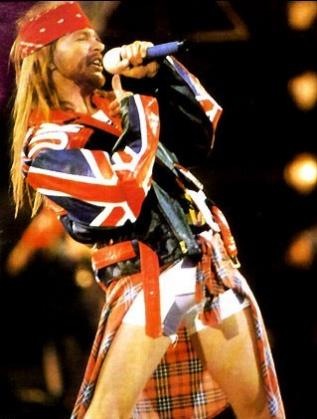
Fast forward 23 years and next month Guns N Roses (well, Axl Rose and a completely different band) will play in Belfast for the first time. At 38 I'm too old to be bothered going, and too skint to spend £55 on a ticket anyway. But when I heard they were coming, I remembered an old article which said that Rose had grown up as a member of a Pentecostal church in rural Indiana, and was of Scotch-Irish descent. He's in the Wikipedia list of Scotch-Irish Americans, and in the band's heyday was often pictured on stage wearing a long kilt. (Incidentally, another band I was really into at the time was superb Atlanta five piece The Black Crowes. I bumped into the two founder members and brothers, Chris and Rich[ard] Robinson, in the Virgin megastore in Belfast on the afternoon of their first concert here. In a magazine interview at the time they also said they were Scotch-Irish).
So what about Axl Rose's family tree? I don't know if he's ever traced his roots (Axl, if you're reading this, I can recommend the Ulster Historical Foundation as your best starting point!). In general terms, the first Bailies to come to Ulster from Scotland were tenants of Sir James Hamilton. In 1613 a William Bailie was one of the twelve burgesses of Bangor, later some Bailies settled at Inishargy (north of Kircubbin) and some sailed across Strangford Lough to Ringdufferin. Some later travelled to Hamilton's lands in County Cavan where they founded Bailieborough. There was also a Scottish settler called George Rose who had moved to Ulster sometime before 1641 and became a tenant on Sir Foulke Conway's estate at Lisburn. Around the same time back in Scotland a John Rose is recorded as writing Latin poetry for the King.
Nowadays in our house it's my oldest son Jacob who cranks up the Guns n' Roses (he's one of the Guitar Hero generation, who is now playing the real thing. His mates have guitars too and it's a billbate*), but the other day we played Sweet Child O' Mine together - me on the acoustic rhythm guitar and him doing the Slash impersonation. He has clips of himself on YouTube. I've posted one below of him playing along to the original.
So when Axl Rose arrives in Belfast in August, maybe he'll be yet another American descendant of that first generation of Ulster-Scots, walking in the footsteps of his forefathers.
And, with over 34.5 million views on YouTube, the original:
* I can't find the word billbate in any Scots dictionary, or The Hamely Tongue. Maybe it's unique to Ards Peninsula Ulster-Scots.
Saturday, July 10, 2010
Ulster-Scots and the Union

This is another example that demonstrates how cultural identity and political identity are not the same thing.
Thursday, July 08, 2010
"Soda Farls and Redemption Songs" - review by Diane Amov on Suite101.com
I'm absolutely blown away by a review of our new CD, by American writer and music blogger Diane Amov. Diane found us on YouTube a few weeks ago, bought the CD from iTunes and has written this amazing review on the website Suite101.com. I can't tell you how honoured I feel that someone who is clearly highly knowledgeable about early 20th century gospel musical styles, and who lives on the other side of the Atlantic, really gets what we're trying to do. Sometimes we've wondered if the songs we learned sitting at the stove at Ballyfrench, or at the wee simple mission halls around the country, are just special to our family or our locality. This review is another example of that cultural highway that links lowland Scotland, Ulster and America.
Diane has been kind enough to include further references to our music on her own (very impressive) blog, Jerusalem Tomorrow, where she has seen fit to place us among people we regard as the best in the genre and musical heroes - artists whose music we soaked up growing up, passed down to us from the older generation.
Sunday, July 04, 2010
Happy 4th of July
Today is of course Independence Day in the US; this short post is for all American readers.
"...Through the American War of Independence, the American Civil War and right up to the present day, the Ulster-Scots/Scotch-Irish influence upon the state of Virginia has been a constant factor. A popular quotation often attributed to General George Washington during the War of Independence is "...if defeated everywhere else, I will make my final stand for liberty among the Scotch-Irish of my native Virginia...", although it is more likely that he didn’t use those specific words, but something very similar. A book published in 1788 quoted Washington as saying, in November 1776, that if defeated everywhere else, he would make a stand in Augusta County, Virginia. Augusta County was a Scotch-Irish heartland...". With this landscape, you can clearly see the appeal of Augusta County for Ulster emigrants.
(Excerpt above is taken from a website I worked on in 2007, UlsterVirginia.com)

Thursday, July 01, 2010
Private James Thompson of Kirkistown, killed at the Somme, aged 20
With the Battle of the Somme commemorations today, I thought this would be a relevant poem to post here. As far as I know he was my grandfather's cousin. My grandfather, William Thompson (1901 - 1957) was just 15 when he wrote this memorial poem. It was typeset and printed by the Newtownards Chronicle for the family, who kept a framed copy on the wall for many years.
In Loving Memory of our Dear Son Private James Thompson, R.I.R of Kirkistown
Who was killed in action at the Battle of the Somme at Thiepval on 1st July 1916, aged 20 years
“What I do thou knowest not now; but thou shalt know hereafter” - John 13 v 7
A loved one has been called away, he’s in our midst no more
In a land afar his body lies far from his native shore
He bade us all a last farewell, a happy brave “Good-bye”
And with the gallant few went forth to suffer and to die
Upon the first day of July amidst the shot and shell
‘Twas in the battle of the Somme he in the conflict fell
What anguish fills each fainting heart and many cheeks grow pale
And in that sorrow-stricken home how many mourn and wail
None in that home shall e’er forget the one so bright and fair
Who young in years was called away, now sits a vacant chair
No one was near when in that hour he breathed his latest breath
But Jesus led him gently on thro’ the dark vale of death
He answered not the roll call here but in that world so fair
When Jesus calls the roll above he’ll not be missing there
We know ‘twas in that solemn hour his spirit took its flight
To dwell with God above the skies in realms of love and light
Oh, sorrow not, but cast your care on Christ, the Unfailing One,
Who ever doeth all things well and say “Thy will be done”
Let this a warning be to all to cease their sinful strife
Thy soul may be required of thee escape thou for thy Life
Oh, be prepared to meet thy God this warning he doth give
Consider now your latter end, believe and thou shall live
And then, where parting is unknown, all sorrow shall be o’er
For strife and conflict never come on yonder happy shore.
Note: according to the Commonwealth War Graves Commission, the memorial of rifleman James Thompson of the Royal Irish Rifles (A Company, 13th Battalion) is at Thiepval, Pier and Face 15A and 15B. His parents are recorded as William and Margaret Thompson, Kirkistown.
"I am not an Ulsterman but yesterday, the 1st. July, as I followed their amazing attack, I felt that I would rather be an Ulsterman than anything else in the world." - Captain Wilfred Spender.


Wednesday, June 30, 2010
Blurring the edges
There's an odd notion that the three main cultural communities in Ulster (English / Scottish / Irish) have hard defined edges which separate them. Whether language, cultural traditions, music, or landscape, this is nonsense. The edges are soft and blurred. One that I hear all the time, because of where I live, is that there's a hard cultural line that cuts across the bottom of the Ards Peninsula below Kir(k)cubbin and across to Cloughey/Kirkistown. Crudely put, the myth goes that around 1606, in an Ulsterised version of the "Operation Passage to Freedom" the incoming Scots struck an arrangement whereby the few resident Irish (that's polite code for Catholics) were moved south of this line to live on the Savage estates, and that all the incoming Scots (that's polite code for Protestants) settled north of this line. It's not true but it gets perpetuated all the time. There are concentrations of Ulster Scots above and Ulster Irish below, but there's not, and never has been, a hard division.
The Savages had arrived in Ireland as one of the new Anglo-Norman families in the late 1100s. Initially they had massive estates within the old Earldom of Ulster which more or less covered County Antrim and County Down, but as the centuries passed their lands were reduced to just the southern tip of the Peninsula and a bit of Lecale. Ongoing attacks from the Clandeboye O'Neills didn't help.
The truth is that there was a significant degree of co-operation between Hamilton and the Savages, and Montgomery and the Savages. In the 1640s a list of tenants on the Savage estates shows that between a half and a third had Scottish surnames. There are loads of examples of well-recorded overlaps and co-operation. The land boundaries of the Savage/Hamilton/Montgomery estates weren't even clearly defined (which is why Hamilton paid big money to get the Royal cartographer, Thomas Raven, onto the job in 1625. The original maps can be seen at North Down Museum in Bangor). And even where the boundaries were well understood, the three families exchanged and leased townlands with one another, with some Irish tenants on Scottish-owned estates, and as shown above, vice-versa. Henry Savage of Ardkeen gradually embraced the Protestant faith of his new neighbours - he was described as"...moderate in his Romish religion, and read the Holy Scriptures; and, on his death-bed, (whereon he lay long) assured me, that he trusted for his salvation only to the merits and mediation of Jesus Christ. He kept no images in his house, and if he had any picture (or such like) he said he would meditate on it, but not worship it. He used to say, that invocation of Saints was needless, although it were supposed they did hear us, or know our wants; because he was sure his Saviour was God all-sufficient..." (Montgomery MSS p 328). As the century drew to a close, in 1690 one branch of the Savages fought for King William III at the Boyne, while another branch fought on the other side for King James II - but some of this branch later changed their minds. Over the following centuries, many became famous high-ranking British military officers.
A while ago, over at Balmoral Perspective, Mark Anderson posted a clip of the slow Irish tune "Raglan Road". I posted a comment that there's a far faster, Ulster, version of the same tune which is used for the Belfast song "The Ballad of William Bloat". Renowned Scottish singer-songwriter Dick Gaughan points out here that the same tune might be Scottish in origin.
But it's easier to claim division and distinction, rather than to take time to explain the blurred edges. The result doesn't turn Northern Ireland into some bland whitewashed cross-community soup, but a place of interesting and myth-challenging contours. Some commentators need to stop pumping out dumbed-down lazy nonsense and take the time to read the early records for themselves. There's a far more interesting, and accurate, story just below the surface.
Sunday, June 27, 2010
Dave Rawlings Machine sing "He Will Set Your Fields On Fire"
Here's a 100mph bluegrass version of an old gospel song Graeme and I recently recorded on our new CD "Soda Farls and Redemption Songs". Dave Rawlings Machine are playing at the Open House Festival in Belfast in September.
Dave came to prominence as the guitar picker and harmony singer for Gillian Welch. Here they are together performing another gem (which we played at our wedding ceremony back in Sept 1997.) Gillian's album Revival is one of my all-time favourites.
Saturday, June 26, 2010
Carrowdore Lambegs
Here are some pics from a Lambeg drum demonstration last night in Carrowdore main street, County Down. Any readers from overseas might be astounded by the scale of the drums - they really are that size. Click to enlarge.


Tuesday, June 22, 2010
Dalway's Bawn and Cowboy Trail: The Irish Dimension
(NB: If you're reading this on Facebook, this is a post from my blog) It's great to see Philip Robinson bloggin' away like billyo; he has a great post here which will interest those of you who enjoyed the Sir Thomas Smith booklet, which tells some of the story of the Earldom of Ulster and of the Claneboy O'Neills' activities around Carrickfergus and south and east Antrim. Well worth a read!
Sunday, June 20, 2010
1798 and the massacres in Wexford
(NB: If you're reading this on Facebook, this is a post from my blog)
Some people eulogise about 1798 as some kind of eutopian cross-community moment. They wish for a time machine so that they, being from community A, could have stood valiantly alongside those of community B, through bonds of brotherhood and common cause that still resonate deep within them. Yawn. It's a nicely airbrushed tale.
I've just finished re-reading David Hume's booklet on the 1798 Rebellion, or "Turn Oot", entitled To Right Some Things We Thought Wrong (Ulster Society, 1998). David rightly points out that, after years of agitation and planning, the eventual Rising in Antrim and Down of June 1798 was suddenly undermined by what had occurred in southern Ireland just days earlier, actions carried out by those who claimed to be fighting for the same cause. Rather than a rising against the state, the headline news from Wexford was of brutal massacres of fellow citizens.
There are two lists online of those who were killed - here and here, giving their names, where they lived and in some cases how they died. Be warned - some make for very grisly reading. (ref: National Library of Ireland, Dublin NLI JLB 94107)
So, when the order was given for Antrim to rise on 7th June, many just stayed at home, hiding in byres, developing instant illnesses, or just staying at work in the fields. Just a week later, at Ballynahinch, hundreds of men deserted the night before the famous Battle at which Betsy Gray and so many others were killed. The Rising was roundly defeated by the government forces; the aftermath was many months of executions and deportations. Shortly afterwards, the Parliament of Ireland was abolished and in 1801 the United Kingdom of Great Britain and Ireland was born.
As Antrim poet James Campbell (1756-1818) later wrote:
In Ninety Eight we armed again, to right some things that we thought wrong
We got sae little for our pains, it's no worth mindin' in a song.
Thursday, June 17, 2010
Ulster-Scots and "The State"
(NB: If you're reading this on Facebook, this is a post from my blog)
This week Northern Ireland has been responding to the Saville Report. Some of the reactions are as you would expect. It's got me thinking about the relationship between "The State" and Ulster-Scots throughout history.
At this point in time, Ulster-Scots people are mostly Protestant and mostly Unionist. That cannot be denied and is nothing to be ashamed of. But far too often the modern, unthinking, presentation of Ulster-Scots has - tragically - been a trivial, trashy variety of Ulster Protestantism or Unionism, with a thin veil of newly-applied Scottishness. It might tick the boxes of the many funders out there, but it lacks depth, authenticity and knowledge.
As a result there are widespread false perceptions in the mind of the general public, providing fodder for the critics who demolish it with ease. Of even more concern, it has also dug a deep well of frustration amongst those quiet folk who loved and cherished their Ulster-Scots identity for decades and generations, before the money taps were turned on, and who now are turned off by much of what takes place under the Ulster-Scots label. The problems are not just presentational, but go right to the heart of how heritage is understood, protected and supported by "The State" - if it is at all. But if the apparatus of the state in Northern Ireland only understands the "two tribes" British v Irish political model, then who cares about the "three legged stool" English+Scottish+Irish cultural model?
Over the next few weeks I'm going to mull this over with the view of posting a series like last year's "Objections" series, which will highlight some important historic examples which show how the relationship between Ulster-Scots and the state has shifted over the years.
I'll not be able to examine every strand, but am posting this taster as an invitation for ideas or suggestions. Sharper minds than mine could do a far better job, but I hope to draw attention to some of the issues.
Tuesday, June 15, 2010
An important oul stane at Café Manor, Donaghadee
(NB: If you're reading this on Facebook, you can read this post in full on my blog)
Hilary and I were in Donaghadee at lunchtime, and went to the Café Manor beside the library (I'd just borrowed a few oul copies of WG Lyttle's Robin's Readings and Sons of the Sod to see if they were any different to my own copies). The sun was shining so we went through to tables in the walled garden. There, on two polished concrete plinths, was a big slab of cut stone about 4 feet long and a foot thick. I had seen it years ago - Donaghadee historian Harry Allen (author of this excellent history of the town) had told me about it, and had helped me track it down. It had been rescued from likely destruction from a back alley in Donaghadee, and bears the following inscription:
"The Manor Pound, Donaghadee, alias MONTGOMERY" - This commemorates Sir Hugh Montgomery's attempt in 1626 to rename Donaghadee as "Montgomery" and Portpatrick (on the opposite, Scottish, coastline) as "Port Montgomery"*.
So I lost all composure and in a loud voice I called out to Hilary - "LOOK - IT'S HERE, THIS IS THE STONE!! IT'S HUGH MONTGOMERY'S STONE!!".
That's not really the done thing on a sedate lunchtime in Donaghadee, and I startled the folk who were already eating their lunches in the garden. So a woman called over to me "So are you going to give us all a history lesson then?". Now I couldn't let an opportunity like that go, so in about 2 minutes I told all of the folk there the story of Hamilton and Montgomery and the attempt to rename the towns. The folk were delighted, and were going to head off to the Parish Church to see the stone above the church doorway which also commemorates Montgomery having built it too. One of the staff came to ask more, and so now she has a great story to tell their customers.
So, next time you're in the 'Dee, go to Café Manor and get a look at a great piece of Ulster-Scots history. However, thrifty Ulster-Scots beware, access to the walled garden costs an extra £1.50 a head!
(* the Glasgow General Assembly of 1638 included a Rev James Blair, minister of Port Montgomery - so the new name hung on for a while at least.)
Saturday, June 12, 2010
A petition from the inhabitants of Ballywalter and Ballyhalbert in response to the threat of danger from "our most treacherous enemies the French".
(NB: If you're reading this on Facebook, you can read this post in full on my blog)
If you surveyed the World Cup-watching public of Ballyhalbert and Ballywalter today, I think a fair proportion would see the French as their red-white-and-blue allies thanks to this incident!. Back on 13 April 1756 it was very different. On the eve of the Seven Years War, the men of middle of the Ards Peninsula weren't forging pike heads in the blacksmiths shops just yet, but they were concerned about the potential of a French invasion. So much so that they organised a petition and sent it to the Belfast News Letter (which then had been in print for only 19 years), who published all of the names. It's a good genealogical source for the period:
Bailie,William / Bailie,William / Bick,Hugh / Bigham,Archd. / Bodin,James / Boyd,James / Boyd,John / Boyd,Robert / Boyd,Samuel / Brown,Henry / Brown,Hugh / Brown,William / Brown,William / Causey,Andrew / Cauvert,Ed/Jr / Cauvert,Ed/Sr / Corran,Samuel / Corran,William / Coulter,John / Craig,Hugh / Craig,James / Craig,William / Doryan,Jas/Jr. / Doryan,Jas/Sr. / Drysdall,Henry / Dunbar,Francis / Gilmer,William / Glen,James / Glen,Michael / Glen,Robert / Gowan,David / Gowan,Jas/Jr. / Gowan,Jas/Sr. / Grey,William / Kennedy,Andrew / Kennedy,James / Kennedy,T/Jr. / Kennedy,T/Sr. / Kilpatrick,Hugh / Kilpatrick,John / Kilpatrick,John / Kilpatrick,Thos / Leeman,John / Leeman,William / Loughlin,Hugh / McCauvery,Jas. / McClements,Jas. / McClements,Jas. / McClements,Jn. / McCormick,Rob / McCormick,Thos. / McCormick,Wm / McDowell,Wm. / McKee,David / McKee,John / McKelvey,John / McMaster,Wm. / McWhur,Samuel / Miller,Henry / Miller,James / Miller,John / Miller,Rob/Jr. / Miller,Rob/Sr. / Moor,Henry / Murdagh,Robert / Palmer,Robert / Pue,Richard / Read,William / Reed,John / Ross,Robert / Small,Bernard / Stoop,James / Wilson,Hugh / Wilson,James / Wilson,James / Wilson,John / Wilson,John / Wilson,William
Why did they do it? What were they hoping to achieve? We may never know. Other Ballyhalbert men like Matthew Scott were emigrating to America around this time, and probably joined up with George Washington's army. The links between the 1798 Rising of Presbyterian Ulster-Scots in Antrim and Down, and the Presbyterian Ulster-Scots in the American Revolution of 1776, are crystal clear. But maybe this sets some context for the much-written-about sympathies with Revolutionary France.
A 1764 census for the Barony of Ards recorded a total of 16037 people, 15137 (95%) of whom were Presbyterian, 695 (4%) were Church of Ireland and just 85 (0.5%) were "Papists". In 1847, Henry Montgomery wrote that "...the rebellion, at the close of the last century was, in its origin and almost to its end... a Presbyterian rebellion…”.
The best book on the local 1798 events is Harry Allen's "Men of the Ards". I might blog a bit more about 1798 over the next while, but I'll wrap this post up with a story from Rev William Steele Dickson, Minister of Ballyhalbert (and later Portaferry). He was arrested the day before the planned attacks on Newtownards and Portaferry and was imprisoned in Scotland, where there were equivalent groups like the United Scotsmen. Dickson had been under surveillance for some time as he was suspected of forging links with these groups across the water. In prison, he was challenged by a Scottish inmate who had swallowed government misinformation that the rising in Antrim and Down was a "popish rebellion" (by spreading stories like this, the government was probably trying to undermine Ulster/Scottish Presbyterian co-operation). Dickson turned aside and wrote down the names and denominations of 20 of the leading United Irishmen in County Down. The list had 10 Church of Ireland, 6 Presbyterians and 4 Catholics. Dickson handed the list to him and said "look at that, and then tell me what becomes of your popish rebellion?".
In other words, stick that up your jumper!
(thanks are due to my good friend Dr William Roulston for drawing this petition to my attention. William's book - Researching Scots-Irish Ancestors, cites this petition among a huge collection of sources for the genealogy enthusiast who's trying to pin down their Ulster-Scots forebears)
Friday, June 11, 2010
"for twenty-four years I've been living next door to Alice"
(NB: If you're reading this on Facebook, you can read this post in full on my blog)
That's the name of an old 70s song. Sir James Hamilton's grandson, Henry Hamilton, was another man who was head-over-heels in love with a woman called Alice. Sadly for Henry, she destroyed his life.
Henry Hamilton was the 2nd Earl of Clanbrassil and had one of the biggest estates and fortunes in east Ulster. He met Alice Moore, a "very handsome, witty and well-bred lady" and was besotted. His mother (as mothers do) sized Alice up and was in "great grief" when Henry and Alice got married in May 1667. Alice was high maintenance and Henry racked up massive debts in trying to meet the costs her lavish, flirtatious, lifestyle. He sold off large parcels of the Hamilton estate to his tenants - and both Henry and Alice were at this stage just 28 years old. The Hamilton Manuscripts describe her as "beautiful and vicious".
In 1669, Alice ordered the Presbyterian meeting house in Bangor (at Fisher’s Hill now Victoria Road), whose minister was Gilbert Ramsay, be torn down. It broke Ramsay's heart. The following Christmas, Alice was among the audience at a new theatre in Smock Alley in Dublin which had three tiers of balconies - it was the Waterfront Hall of its day. The glitterati were there to see a satirical, mocking anti-Presbyterian play called “The Non-Conformist”. During the performance, the upper balcony collapsed into the middle balcony which then crashed down onto the lower balcony. Many people were killed, and Alice was badly injured.
However, that brush with death didn't hamper her selfish ambitions. The Hamilton will had been carefully laid out by Henry's father to ensure that, if Henry died, it would remain in the Hamilton family. Alice persuaded Henry to change his will, making her his sole heir. His mother saw the disastrous potential and warned him - "Son, expect that within three months after you perfect such deeds, you shall lodge with your grandfather and father, in the tomb of Bangor". On 27 March 1674, Henry's will was rewritten - "it is my will and pleasure to leave unto my dear wife, the Countess of Clanbrassil, her heirs and assigns, for ever, all my estate in the kingdom of Ireland..."
Henry had effectively signed his own death warrant. On 12 January 1675 he died suddenly in Dublin - and Alice ordered his body to be disembowelled within 5 hours of his death, and for a rush burial to take place at Christ Church in the city. Some time later, his body was reburied at Bangor, fulfilling his mother's prediction.
The suspicion is that Henry had been poisoned. However, the Hamilton family fought back, and Alice didn't get her hands on the estates. She remarried but died - miserable, alone and childless - on 13 Jan 1678.