(NB: If you're reading this on Facebook, you can read this post in full on my blog). ...An' I'll gang oot o'er the hills tae Gallowa'. I haven't posted any photos of the view to Scotland in a while, so here's one from this evening, with wee white houses in clear view - Ballyhalbert (Clydesburn) sand in the foreground, Galloway hills on the horizon. A pilot friend told me last night that industrial pollution has a major effect on visibility, and that hundreds of years ago clear views like this would have been much more commonplace than they are today. Click to enlarge:
Friday, April 30, 2010
Oh the Gallowa' hills are covered wi' broom, Wi' heather bells in bonnie bloom, Wi' heather bells an' rivers a'...


Sunday, April 25, 2010
"Scunnered" with elections?
(NB: If you're reading this on Facebook, you can read this post in full on my blog). The media here in the UK has been ablaze for the past few weeks analysing the live TV debates with the leaders of the three major GB political parties - Brown, Clegg and Cameron. And last week we had our own Norn Iron version on UTV, with another one coming next week. The Times has a story on the leaders debate in Scotland, with use of the word "scunnered" the main attraction. Click here.
Tuesday, April 20, 2010
Sir Thomas Smith’s forgotten English Colony of the Ards and north Down in 1572

(NB: If you're reading this on Facebook, you can read this post in full on my blog). This booklet (pic left - click to enlarge) is my latest historical project, and will be launched on Friday 14th May at Ards Arts Centre (the old Town Hall). It's taken the best part of a year to complete, and conscious of my own limitations I'm happy with the end result. Published through Loughries Historical Society (and without the help of Mr Balmoral the booklet would never have happened!), with the printing funded by Ards Borough Council, North Down Museum and the Ulster-Scots Community Network, it lifts the lid on what was going on in the Ards and north Down before the Lowland Scots arrived with Hamilton and Montgomery to settle exactly the same region in May 1606. The booklet has 40 pages in total, and is lavishly illustrated throughout with some very rare maps and portraits which took ages to track down. Here's the introduction:
...........
IN MAY 1572 around 800 young men gathered at the small town of Liverpool in the north west of England, bound for a new life in the Ards Peninsula and north Down.
Their venture had been planned with meticulous detail. The English authorities had been considering a scheme like this since at least the year 1515, so there was no shortage of either colonial theory or political will. It was 5 October 1571 when Queen Elizabeth I granted her Secretary of State, Sir Thomas Smith, 360,000 acres of land in this most easterly part of Ulster, “the nearest part of all Ireland to Lancashire.”
Smith and his 24 year old son, who was also called Thomas, had until March 1579 to successfully colonise the lands or else lose their grant. So, almost immediately, they began advertising their newly acquired estate to potential tenants across England, through the unique and imaginative step of publishing a range of promotional literature – a single page broadsheet, followed by a map of east Ulster accompanied by a 63 page promotional booklet. However, even though the land had been claimed by the English Crown since the late 1100s, it was disputed territory, having also been claimed by the Clandeboye O’Neills from around 1345.
The Smiths' objective was to establish a new English colony centred around a new fortress town called Elizabetha that was to be located at the upper end of the Peninsula where “it is joyned unto the rest of the Island”, and which would be defended by three major forts that the colonists would build. However, Sir Thomas was sent to France on Royal business, leaving the project in the hands of his son. But, due to delays, by the time the colonists set sail on 30 August 1572 the number of emigrants had plummeted to around just 100.
They arrived the next day and set up base camp at the small townland of Newcastle, between Cloughey and Kearney. However, a few months earlier Sir Brian O’Neill, the chief of the Clandeboye O’Neills, had acquired copies of the Smiths’ booklet. The discovery of their plan turned Sir Brian, who was described by the English authorities in 1571 as “a loyal and true subject” , into a man who “suddenly assumed a hostile attitude.” Knowing that Smith’s English colonists would make use of the vacant abbeys and any major stone buildings, O’Neill set fire to them all and left the English outpost town of Carrickfergus in ashes.
The Smith scheme struggled on, but it was doomed from the start, being dogged by both local Irish opposition and internal strife among the colonists themselves. On 20 October 1573, just over a year after arriving in Ulster, Thomas Smith jnr was killed by two Irishmen he had employed. The high profile murder sent shockwaves through the English authorities in London. The original Smith colony was then scattered, with most of the colonists returning home to England. After a few failed attempts to start afresh, by late 1575 the scheme was abandoned; Sir Thomas’ health deteriorated and he died in August 1577.
Sir Thomas Smith’s nephew and heir, Sir William Smith, had built a new church at Theydon Mount in Essex, and Sir Thomas was buried there. Sir William tried to revive the Ards project in June 1579, but it was too late. The deadline of the original grant had passed and the great adventure was over.
Nevertheless, Sir William Smith (and, later, his second son who was also called Thomas Smith) clung vainly to the hope that they might one day reclaim the family’s grant. However, after the Queen died in 1603, Sir William Smith was sent by the new Scottish King James I to Spain. Smith left his Ulster affairs in the hands of one of the King’s men - James Hamilton - giving Hamilton inside knowledge of lands in east Ulster which, once he had acquired them for himself, would make him famous. The failure of the Smiths’ English colony, and the destruction which it brought about, cleared the way for the success of the Hamilton & Montgomery lowland Scottish settlement of the same lands that would begin 34 years later in May 1606.
“Hamilton & Montgomery succeeded where Sir Thomas Smith failed. They created the bridgehead through which the Scots were to come to Ulster for the rest of the century.”
from The Narrow Ground by ATQ Stewart.
............
Copies will soon be available from Loughries Historical Society. Get in touch if you want to come to the launch evening.
The O'Neill burnings are referred to on the present-day interpretive signage at Newtownards Priory, Holywood Priory and at the new visitor centre at Grey Abbey (pic below - click to enlarge)
Tuesday, April 13, 2010
WG Lyttle's book covers - and Harry Creevy of Greyabbey
(NB: If you're reading this on Facebook, you can read this post in full on my blog). Wesley Greenhill Lyttle was a famous writer, performer and newspaper man in the late 1800s. There's a very good short biography of him here. He's probably best known for his books "Betsy Gray and the Hearts of Down" and "Daft Eddie and the Smugglers of Strangford Lough". Below are four covers from the paperbacks of some of his lesser-known (but in my own view, much better) writings - all have a good heavy dose of local Ulster-Scots dialogue. The illustrations and type on these are brilliant -
He also wrote a local tourism booklet called "The Bangor Season - what's to be seen and how to see it" in 1885. It contains short descriptions of the main towns and villages of the area, and includes the following about Greyabbey:
"A remarkable personage, known as Harry Creevy, resides in Greyabbey. He is pretty much a hermit, no-one being allowed to enter the humble house in which he lives. Harry is quite a favourite with the population, who liberally supply him with food. He possesses a remarkable memory and seems to never weary of reciting - in loud and gutteral tones - headstone inscriptions and local legends. His appearance as he saunters through the graveyard is calculated to alarm a timid visitor, but Harry is exceedingly gentle in manner, and the visitor who can engage him in conversation is indeed fortunate..."
Nowadays, Harry Creevy would probably get an ASBO.

Thursday, April 08, 2010
Johnny Cash - descendant of Scottish Covenanters?
(NB: If you're reading this on Facebook, you can read this post in full on my blog). There's a 30 minute radio programme on BBC iPlayer which I listened to today called "Johnny Cash Of Easter Cash". (click here to listen)
It traces Cash's roots to Easter Cash, near Falkland in Fife, to an ancestor called William Cash (1653 - 1708) who emigrated to Virginia in the 1670s and settled in Westmoreland County, where many Ulster emigrants later settled. Falkland was the birthplace of the famous Covenanter minister Richard Cameron (1648 - 1680). Maybe they were even boyhood friends; lots of Covenanters ended up being sent as slaves to Virginia during the 1670s and 1680s. Johnny Cash visited Falkland a few times, and some of the people he met are interviewed in the programme. Well worth a listen.
RELATED ARTICLES:
> Article "From Nashville to Govan" (with a Covenanter reference)
> Article "Johnny Cash's Scottish Roots Explored in New Documentary"
> Article "Scottish Roots of Johnny Cash - the man in black tartan"
(Pic above of Easter Cash from this article)

Saturday, April 03, 2010
Some music for tomorrow - Blind Lemon Jefferson - "He Arose from the Dead"
(NB: If you're reading this on Facebook, you can read this post in full on my blog). I went to a unique musical event last night to mark Easter, a Good Friday "Tenebrae" service at Portaferry Presbyterian Church - which included a certain Lambeg drummer creating an awesome sense of the thunder and earthquake that ripped through the earth and sky when Jesus died. The room was plunged into darkness and then the rumble of the Lambeg got louder and more intense to an almost ear-splitting crescendo. An amazing experience - and a great credit to Mark, to Neil McClure and the New Quay Singers who had the vision to make it all happen.
Just as impressive, but in a very different way, are the simple hymns and folk songs about Easter. Robert Lowry, son of Killyleagh emigrants, wrote the marvellous hymn "Christ Arose". For a simpler, acoustic sound, here's a bit of Blind Lemon Jefferson (1893 - 1929) playing a great old song for Easter Sunday - and another for every day of the year.
Thursday, April 01, 2010
Mars Hill Church does Easter
(NB: If you're reading this on Facebook, you can read this post in full on my blog). Some of you have been getting into the Mark Driscoll / Mars Hill Church material lately, which is great. Tomorrow they're launching their Easter activities at whokilledgod.com. They're premiering a film about the death and resurrection tomorrow night at 8pm.
Saturday, March 27, 2010
“Scotch-Irish Foodways in America”
(NB: If you're reading this on Facebook, the original post is from my blog). Ulster-Scots food? The usual knee-jerk response to this is some sneering comment about battered Mars Bars, the obvious haggis - or perhaps the glorious egg & onion sandwich! As ever with Ulster-Scots subject matter, in between the scorn - and the trivialisation - there's a deep and important story to be told.
Mary Drymon is an American writer, historian, museum educator and curator who has recently published an important book called “Scotch-Irish Foodways in America”. (I am glad she stuck with the historic term "Scotch-Irish" and didn't adopt the recent "Scots-Irish") She has based the book on the recipes known to have been used by Ulster-Scots emigrants who arrived in Maine in the early 1700s. Mary's research indicates that it was Ulster emigrants who brought rhubarb to America - as was the case with potatoes.
> Here's a brief article about the book
> Here's Mary Drymon's blog
> Buy the book on Amazon
There's a great quote on Mary's blog:
"Don't eat anything your great-grandmother wouldn't recognize as food"

Friday, March 26, 2010
"A tongue as broad as any Scot", Ballyhalbert, 1983
(NB: If you're reading this on Facebook, the original post is from my blog). This is a scan from the Ards Borough Council 1983 tourist's guide booklet. For the language enthusiasts, the last line is interesting:

Sunday, March 21, 2010
"When They Ring The Golden Bells for You and Me"
(NB: If you're reading this on Facebook, the original post is from my blog). John Gray sang this at Carrowdore Mission Hall last Sunday night - a lovely rendition of an old hymn from the late 1800s. I found this version by Natalie Merchant (who sang with Wilco and Billy Bragg on the great "Mermaid Avenue" album of old Woody Guthrie songs).
And here's a very impressive guitar / instrumental version:
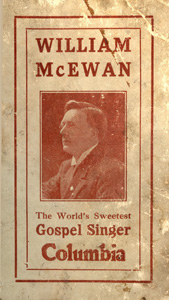
Glasgow man William McEwan, "the world's first great gospel singer", recorded a version in New York in May 1926; the brilliant Virginian singing Baptist pastor Alfred Karnes recorded it in 1927 (download his version free here) and the McCravy Brothers recorded it in 1930.
Saturday, March 20, 2010
A message from North Carolina
(NB: If you're reading this on Facebook, the original post is from my blog). A few days ago I was astounded to receive the following note on Facebook. The irony is that for a good few months now I've been thinking about deleting my Facebook page because people keep inviting me to play games or join causes that I don't really have the time or interest to get involved in, and so rather than risk offence I figured that shutting it down would be a good move.
Then, out of the blue, a complete stranger called Sharon Stewart Wilkerson emailed me from Asheville in North Carolina. For those of you familiar with the content of this blog and the kinds of projects I invest my spare time in, you'll have some idea of how blown away I was by this (reproduced below, unedited, with Sharon's permission):
.........
Mark,
I ran across your personal blog yesterday while searching for more information about the Ulster Scots language, and found a treasure trove. I ended up looking at your other sites and got such a blessing!
My Granny was born and reared on a farm outside Bushmills, County Antrim, and was converted at the age of fifteen in an evangelistic meeting. Her parents were saved through an evangelist at an earlier period. My grandfather, John Stewart, was born in Lurgan and was an orphan by the age of seven. My grandparents emigrated separately to Scotland. My grandfather was saved there and met my Granny. They married in 1904. My dad, James Alexander Stewart, was born in Glasgow and was "fitball daft". The Lord saved him when he was a teen and he became a boy preacher. He preached all over the British Isles as a boy. He met my American mom in Budapest, Hungary where she was ministering under the Southern Baptist. My parents travelled so I did not get to spend a lot of time with them. Dad also founded mission organizations and wrote many books.
I say all that to explain that I when I was with them, Dad read me stories about the Covenanters, and told me all about Revival. (He saw Revival under his ministry as a young preacher in Europe.) He taught me Scottish history and all about the great Scottish preachers etc etc. I also got to spend time with my parents during their meetings. Dad especially loved open air meetings.
I saw that you had "Fu an skailin" listed on your Sacred Scots Songs page. My husband and I still teach it to children along with "Come Awa the Noo". My family knew Seth and Bessie Sykes, as well as "Uncle Charlie' Main. Uncle Charlie was a mentor to Dad and I remember him even participating with Dad in the open air on the beach at Bangor as part of the Bangor Missionary Convention in 1965. Willie Mullan, Ian Paisley, WP Nicholson, Stanley Mawhinney, Herbert Mateer, and many more were part of the dear ones in Ireland.
Well, you see I got carried away! Thanks for posting all the articles, songs, poems etc. I enjoyed them so much! My husband and I live and minister in the mountains outside Asheville, NC, where the people have a lot of Scots Irish in their heritage. (The music!)
Well, "I'll Fly Away" now!
In Christ,
Sharon
.........
A lot of stuff has been written over the past 15 years or so about Ulster and America, much of it about centuries-old Presidents (whose Ulster links, in some cases, are pretty thin), much of it repetitive and very far removed from the common cultures of ordinary people. Sharon's email shows that there is still, alive and well today, a common evangelical faith and culture which spans Scotland, Ulster and America, and that some of the wee songs that I grew up with here in the Ards Peninsula, which had been taught to my parents and grandparents by the "oul Scotch preachers" like Seth Sykes, Charlie Main and Jock Troup, are still being sung today in the mountains of North Carolina.
Friday, March 19, 2010
Enough to start a riot in a Cathedral
(NB: If you're reading this on Facebook, the original post is from my blog). 1637 Book of Common Prayer, Scottish edition. As (not) recommended by Jenny Geddes. On eBay now for $900!
Thursday, March 18, 2010
Patrick at Immanuel Presbyterian Church
(NB: If you're reading this on Facebook, the original post is from my blog). On Monday evening past, I was a stand-in speaker for Immanuel Presbyterian Church PWA (now called Presbyterian Women) on Agnes Street in the Shankill area of Belfast. The speaker who was booked had to go gallavanting off to America last week, so the ladies at Immanuel put up with me instead!
I took a powerpoint along with lots of images but very little text, just as visual aids for the talk. I started (as you might expect) by pointing out a few of the myths and nonsense, then the Scottish stories and legends of Patrick, the Patrick-related placenames in Scotland, the early Ulster-Scots records of Templepatrick near Donaghadee, then onto the similarity of portions of his Confessio and Psalm 40, the Cross of St Patrick flag and its modern applications in logos (like the PSNI badge), Patrick Hamilton the first martyr of the Scottish Reformation and the origins of Scottish Presbyterianism, and finished with the work of Ulster-born hymn tune writer William James Kirkpatrick - "My faith has found a resting place not in device or creed...". A light and enjoyable evening for me, and apparently for the audience too!
Wednesday, March 17, 2010
From Patrick's "Confessio", circa 450AD
(NB: If you're reading this on Facebook, the original post is from my blog). "...For there is no other God, nor ever was before, nor shall be hereafter, but God the Father, unbegotten and without beginning, in whom all things began, whose are all things, as we have been taught; and his son Jesus Christ, who manifestly always existed with the Father, before the beginning of time in the spirit with the Father, indescribably begotten before all things, and all things visible and invisible were made by him.
He was made man, conquered death and was received into Heaven, to the Father who gave him all power over every name in Heaven and on Earth and in Hell, so that every tongue should confess that Jesus Christ is Lord and God, in whom we believe..."
Full text available here.
Tuesday, March 16, 2010
Mother's Day lunch - "Thon's a clooster!"
(NB: If you're reading this on Facebook, the original post is from my blog). My parents came off with this on Sunday, and I don't remember ever hearing it before.
Chambers Concise Scots Dictionary has it as:
• clooster n a mass of something wet or sticky, mud etc 19-, chf Galloway
James Fenton's The Hamely Tongue - a Personal Record of Ulster-Scots in County Antrim has it as:
• clouter [cf.Sc. cloiter a disgusting wet mess; possibly of Low German origin]
Hilary just hopes they weren't talking about the Sunday lunch she'd made that we were all eating at the time!
Global warming at the Ulster Folk Museum?
(NB: If you're reading this on Facebook, the original post is from my blog). I took this pic on my Blackberry a few weeks ago. Looks like the sea levels have risen and the Ards Peninsula has sunk into the sea... Lough Swilly and Inishowen look like they're in trouble too!
(from the Coalisland Spade Mill)

Sunday, March 14, 2010
Mark Driscoll (of Mars Hill Church) - coming to Belfast later this year
(NB: If you're reading this on Facebook, the original post is from my blog). Set aside all of your (perhaps valid) perceptions of US evangelists - the ones on tv with the scrolling information along the bottom with their credit card hotline numbers, who beg for donations and infer that they can arrange for a Divine blessing for every £ or $ you send them.
Mark Driscoll, of Mars Hill Church, is based in Seattle and has been described as "the fierce new face of American evangelism". He has become well-known around the world (thanks to the internet age, where he generates the occasional bit of controversy) for a frank and pull-no-punches preaching style, and is making his first visit to Northern Ireland for this year's annual Mandate event in Belfast on 13 November. Having been raised in wee rural halls, I tend to avoid big things like Mandate, but I hope to go this year to hear him preach.
His books, Vintage Jesus, Vintage Church and Doctrine - What Christians Should Believe - give a solid foundation about the Person we should follow, what Christians should believe, and how the local church should operate.
In particular, Mark Driscoll draws the listener's attention to Jesus. That might sound like a strange thing to say, but if you tune in to what's being said and sung in many churches today, you might conclude that the faith being presented should be called God-ianity. They might be unconsciously drifting that direction - but they should be into Christ-ianity. On the radio just this morning I heard a local minister downplaying the uniqueness of Christ. In his many online sermons I've heard and watched, Mark Driscoll's aim is (as Hebrews 12 says) to "fix our eyes on Jesus, the author and perfecter of our faith".
There's a huge back catalogue of Driscoll sermons on the MarsHillChurch.org website, and I often listen to them when I'm working at my desk - far better than Stephen Nolan! I get through maybe 4 or 5 of them every week. Some traditional Ulster folk (a solid, reliable and cautious breed which I count myself among) will find Driscoll's style a bit uncomfortable at first, but the substance of what he says, and all without notes, more than compensates.
Here are two recent sermon clips from a series he preached entitled "Luke's Gospel - Investigating the Man who is God"
There are hundreds more clips and sermons on the MarsHillChurch YouTube channel - take some time and enjoy them.

Friday, March 12, 2010
"A wheen o wee Scotch breek"
(NB: If you're reading this on Facebook, the original post is from my blog) About 12 years ago when we bought our current house and were doing some renovations, we found what one of the workmen called "a wheen o wee Scotch breek" - a few Scottish bricks, glazed firebricks to be precise. On the back they carried the moulded imprint of "J & M Craig Ltd., Kilmarnock, Scotland". So we got them built into some of the walls outside, with the lettering facing outwards. I did a bit of research at the time, and found that this particular imprint only existed for about 15 years, in the 1850s. On the excellent AyrshireHistory website they have a page about the Craig brothers. I gave them a lick of paint earlier in the week, so here they are, fresh and gleamin! (click to enlarge)

"The Eastern Gate", the Delmore Brothers
(NB: If you're reading this on Facebook, the original post is from my blog) This is a song that was played constantly in our house, on a tape by the old Belfast group the Echoes of Grace which they brought out ("released" is far too contrived a term for how it was done back then!) in the early 1980s. The Wee Echoes had mandolin, guitar, and lots of singers - usually 7 or 8 in the group at any time. My da still watches video tapes of their concerts, and herds visitors into the front room to watch them too!
It was only much later in life that I discovered that an enormous amount of the songs recorded by Ulster gospel groups in the late 20th century were originally old hillbilly and "brother duet" songs from the early part of that century. "The Eastern Gate" was written by Isaiah Martin in 1905 and was recorded a few times in the 20s and 30s, eventually made famous by the brilliant Delmore Brothers who recorded it in 1940:
Early American recordings of artists like the Delmore Brothers and Jimmie Rodgers travelled as far as the Shetland Islands off the north coast of Scotland, as shown in this advert from the National Theatre of Scotland, about Thomas Fraser, which features his version of the Delmores' song "The Mississippi Shore":
I hope that the forthcoming Ulster-Scots broadcast fund will enable projects like this to be produced, which delve into deep, rooted stories of real people and their culture.
.............
Here's some background on Thomas Fraser, presented by Rob Ellen of The Medicine Show:
Tuesday, March 09, 2010
"the pinnacle of thranness!"
(NB: If you're reading this on Facebook, the original post is from my blog) Wendy Austin said this today, to Danny Kennedy, on Talkback on Radio Ulster. Maybe you language enthusiasts out there should start to list the various Ulster-Scots terms that are used on the local media? It would be a quare gunk for a lot of folk! (you can hear it on iPlayer at about 40 min into the programme)
Subscribe to:
Posts (Atom)