

This map of the road from Portaferry to Donaghadee and Newtownards is from Taylor & Skinners Maps of Ireland, 1777. It has some interesting features:
- the road south of Donaghadee turns inland at where today's Millisle is, and goes through where Carrowdore is, but neither Millisle nor Carrowdore were signficant enough to be marked on the map, if they even existed at all
- the coast road south of Millisle (which today goes through Ballywalter, Ballyhalbert, Portavogie and Cloughey) wasn't significant enough to be mapped either. So perhaps that eastern part of the Peninsula was relatively underdeveloped or primitive compared to the upper and western parts
- the close-up is of the Donaghadee area, which shows "Temple Patrick" where St Patrick was reputed to have landed (having sailed from Portpatrick in Scotland, directly across the 18 miles of open sea), but which has been missed by all "official" versions of the Patrick story. It also shows the ruined church which was within the walls of Temple Patrick graveyard, and the house and orchards which had been founded by Patrick Montgomery who arrived from Scotland around 1606, which were big enough to be visible from the sea.
The Montgomery family had deep connections and commercial interests at Donaghadee, Newtownards, Greyabbey and Portaferry going back to 1606. This may be why these particular roads were so well developed and which by the time Taylor and Skinner mapped them had become the most important routes on the Peninsula.
You might be able to see a dotted line running across Strangford Lough just south of Newtownards - "Rd to Comber when the Tide is out" - there's a suicide mission! (Click the images to enlarge)

NB: Taylor and Skinner's Maps are available online here.
Thursday, October 21, 2010
Templepatrick, Donaghadee - the Taylor and Skinner maps of 1777


Wednesday, October 20, 2010
River Cottage future
When we were in Devon in the summer, we stopped off in Axminster to visit Hugh Fearnley Whittingstall's River Cottage Café. We arrived at 10am, there were very few people there, which gave me a chance to take some pics of the rustic eclectic interior. It has the feel of a church hall or old classroom, furnished with handmade tables and whatever wooden chairs that the local charity shop had:
The River Cottage series is one of the few things we make a point of watching on tv - the ethic and the aesthetic of what Hugh FW does captures a lot of how I grew up and of how we try to live as a family. However his vegetable patch is far more successful than ours... I also think that there are some markers in his work which show how those who seek to represent "the community" could work, or should work, especially within rural areas.
"...River Cottage is not a charity, but does aim to be a ‘more than profit’ organisation. This means, firstly, that we are ready to re–invest much of our income in developing our ideology and the base of our activities. It also means that we should be ready to hold back from, or turn down, business that conflicts with our ideology and our commitment to ethical business practice. Thirdly, we feel we should also be making links with, and finding ways to support, other organisations who share our ideas..." (from "About Us")
Perhaps our economic climate of cuts might cause us to stop and consider what "rich" really means - an ethic of local produce, sustainable living and homegrown austerity were things that our parents and grandparents treasured. In fact, they didn't actually treasure them at all, it was just how they lived. After all, "a man's life consisteth not in the abundance of the things which he possesseth."


Tuesday, October 19, 2010
"She roars wi' her elbows tae save her een".
This was a figure of speech used to describe my father's aunt Lucy (1893-1962) - she was renowned as somebody who pretended to cry when she didn't get her own way. Today she might be called a drama queen or an attention seeker. Picture somebody rubbing their fists in their eyes (to hide the lack of tears) and flapping their arms up and down at the same time, almost like wings, and you'll get the idea.
Monday, October 18, 2010
Jardine's Book of Martyrs
A few years ago I enjoyed a long lunch in Edinburgh with three young academics, all of whom are deeply knowledgeable about the 17th century, Presbyterianism, the Covenanters and the life and times of the common people of that era. One of them, Dr Mark Jardine, had just completed further studies into the Covenanters' "United Societies", and was also advising BBC Scotland on their television series Scotland's History which was presented by Neil Oliver. Mark recently began to blog in astonishing detail about many of his researches, which you can read here at Jardine's Book of Martyrs. Mark was also involved in the excellent BBC Radio Scotland programme about Alexander Peden which was presented by Richard Holloway (Chair of the Scottish Arts Council) and broadcast in November 2009. Work of this calibre, which informs the output the broadcast media, is badly needed on this side of the water.
Sunday, October 17, 2010
Anither wee yin fae Ballyfrenis
Another wee rhyme from my aunt Betty:
"Lift the tither fit, lift the tither fit, lift the tither fit my dear
Lift the tither fit, lift the tither fit, let the watter rin clear"
There were other lines that she can't remember just now - can you help?
Misquoting Macbeth
"Daddy, I know a line from Macbeth", said Charlie (7) to me on Saturday afternoon. "Bubble, bubble, toilet trouble..." - at which point I fell about laughing!
Friday, October 15, 2010
When they hanged Archibald Warwick in Kircubbin
Exactly 212 years ago on 15 October 1798, Rev Archibald Warwick, the 29 year old licenciate of Kircubbin Presbyterian Church was executed by public hanging. The gallows were raised between the church and the manse, in an area which today is a public car park. Thousands gathered to see their beloved minister die. His crime was his role in the 1798 Rebellion and the attempt to overthrow the government. His family were all from Loughriscouse outside Newtownards and he was buried in the family plot at Movilla Cemetery - the grave can still be seen there today.
Thursday, October 14, 2010
When Donaghadee was renamed "Montgomery", circa 1626
(Click the pics to enlarge)
Yes, it was, by none other than Sir Hugh Montgomery himself. And at the same time he decided to rename the opposite port, Portpatrick in Scotland, as "Port Montgomery". I've blogged about this stone before, but here's a photograph taken just a few weeks ago. Also below is a close-up from a 1734 book of the list of ministers who attended the famous 1638 Assembly in Glasgow, one of whom was James Blair, minister of "Port Montgomrie". His neighbour at Stranraer was John Livingstone, formerly minister of Killinchy; his colleague at Ayr (spelled here as "Air") was Robert Blair, formerly minister of Bangor. Blair, Livingstone, and John Stewart "late Provest of Air" had all been onboard the emigrant ship EagleWing. And Robert Adair of Kinhilt was probably living in Ballymena.

Wednesday, October 13, 2010
America's "Two Nations"
There's an interesting article here on the BBC website, which has some familiar echoes for those of you who, like me, are interested in the history and culture of Ulster. Whilst we have an historic triple-blend (which I'm told is how Lowland Scots produce their whisky) of Irish, Scottish and English, America has been presented as a much more exotic combination of cultural and racial groups - a "melting pot".
However, the article contends that America is "two nations", but neither divided by culture or race, nor neatly divided geographically down the Mason/Dixon line into the North and South of the Civil War / War Between the States of 1861-65. No, the division is by "their attitude to the state and its role in the economy". I haven't been paying much attention to the growth of the Tea Party movement in the US, but this article has made me take notice. Government should serve the people, rather than people serving the government. We only have to look south of our own border to see the impact of reckless economic policy and an out-of-control ruling class. In previous centuries the reaction of the general public would have been rebellion and revolution.
Let's see what next Wednesday brings to us here in the UK.
Tuesday, October 12, 2010
Sir Thomas Smith talk at Comber Historical Society
Last night I was at Comber Historical Society, telling the story of Sir Thomas Smith's forgotten colony of 1572-1575. There were just over 30 people in the audience, and even though the room was very warm, and the Spanish class in the adjacent room was noisy, it went well. 15 copies of the booklet were snapped up, nobody complained or heckled, and I renewed contact with some local people that I hadn't seen in a while. Just before heading out to Comber, I did a wee bit of revision on Smith's story and found this online reference to him which will tickle my Northern Ireland readers - "...he was a man of very uncommon qualities and attainments; an excellent philosopher, physician, chymist, mathematician, astronomer, linguist, historian, orator and architect; and what is better than them all, a man of virtue, and a good protestant..." (!) This is quoted from The Baronetage of England Volume II by William Betham, 1802 (p 300). See here on Googlebooks.
• Summary of the Smith booklet
Sunday, October 10, 2010
"Hae a Soo's Snoot Stewed"... (A Glossary of Words in Use in the Counties of Antrim and Down by W. H. Patterson, 1880)
I was talking to my aunt Betty this evening at Carrowdore Mission Hall, and earlier in the week she remembered a rhyme that her father (my grandfather, William James Wilson, 1906-1982) used to say:
Whither would you rither
Or rither would you whither
Hae a soo's snoot stewed
Or a stewed soo's snoot?
It makes no sense, but is just a bit of a tongue twister - and one that he had great fun with when his 9 weans were wee. So, as you do nowadays, I came home and Googled it. It's included in "A Glossary of Words in Use in the Counties of Antrim and Down" by William Hugh Patterson, on page 95. Patterson's glossary runs to 188 pages and was published for the English Dialect Society in 1880. Not all of the words he collected are of Scots origin, some are just general Ulster dialect. The introduction makes for interesting reading, telling in a very simple way the story of the huge migrations of "Scotch" and English into Ulster in the early 1600s. He states that some of the words had been gathered from printed sources, but that"most of the words and phrases have been collected orally either by myself or by friends in different country districts..." . Patterson uses the term "Ulster Scots" to describe the people (see his definition of the word "break").
As a certain Mr C.R. keeps rightly reminding me, the Antrim/Down bond is close - we are the two counties adjacent to Scotland - and the older generation in particular has a deep well of folk customs, local history and vocabulary which were carried across the narrow sea and which developed here. Patterson recognised this back in 1880; far more work needs to be done today among rural communities in Antrim and Down.
PS: Anybody for some pig nose stew?
• Patterson's Glossary is available here on Archive.org.
Friday, October 08, 2010
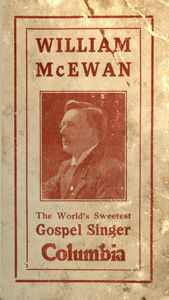
Duncan McNeill's Hymn Book, American edition, 1928

(click on the pics to enlarge)
I've blogged about Duncan McNeill (also spelled as M'Neil and McNeil) before - he was a Glaswegian Baptist Pastor (of a church in Orr Street near Bridgeton Cross) whose singing ministry in the early 1900s resulted in him recording a few 78s and in writing his own songs and hymns, which eventually became his own self-titled hymn book. 100,000 copies were printed and sold in Britain. People both in Ulster and Scotland have given me old copies, I think I have 4 or 5 of them now (you can see a scanned cover of one at the bottom of this post) and Graeme and I have recorded some of his songs over the years.
McNeill came back to mind recently when I was sent an American edition of his hymn book (cover shown here, published 1928). So I did a bit of desk research and it transpired that McNeill travelled across the Atlantic in 1926 and pastored in Kimball Avenue United Evangelical Church in Chicago from 1928 until 1933. As he says in the foreword "during the two years I have been singing and preaching the Gospel in America, I have received thousands of requests for copies of the words and music of my song testimonies. After singing them over the radio, from different stations, I am deluged with requests thru the mail for the book from which I sing..."
During his time at Kimball Street, the church history says that"...under his leadership the church continued to emphasize evangelistic meetings. Outreach continued with outdoor Sunday evening services at the corner of Kimball and Fullerton prior to the evening service at the church. Fellowship groups developed and thrived during this period. The Kimball Young People's Fellowship, led by church's young adults, provided Bible studies and social activities for the church's young adults. Relationships that formed in that group continued long after many of them had moved from the area. Christian Comrades, a group for women, began under the leadership of Grace Linden and others. The 'Cozy Corner' monthly newsletter continued for years and was sent around country, connecting friends to one another and Kimball Avenue. Other organizations included the Protheons, Philathea Club, Excelsiors (for men), Shipmates, Lifesavers, the Women's Missionary Socity and the Ladies Aid Society. The 40 voice choir, under the able direction of George Underwood and Clyde Barton, performed annual concerts and Easter cantatas. Several men entered the ministry..."
Fast forward to the present day. Last Sunday night at Maranatha Mission Hall in Carrowdore, the speaker was a man from Ahoghill in County Antrim. He brought a soloist with him, who sang the Duncan McNeill song "My New Address", which is more usually known as "Along the Glory Road". It was a favourite song of my grandfather's and is in the American edition of McNeill's hymn book, but not in the Scottish one - the chorus goes:
"My house is Free Salvation, tis on a good foundation
The doors are marked with Jesus' precious blood
My house is Free Salvation, near Hallelujah Station
Just a little bit along the Glory Road"
Also in the 1928 American edition of the hymn book is "Happy Joe", which I learned at Sunday School back in the 1970s when it had the very un-PC title "Darkie Joe" (lyrics here) and which might have been recorded in Belfast in the late 1940s and early 1950s.
• There's a compendium of McNeill's Scots language songs over on my "Sacred Scotch Solos" blog.
• Listen to Duncan McNeill singing on Raretunes.org
• If you know more about him, and if he has any descendants today, please get in touch.


Wednesday, October 06, 2010
True Grit by the Coen Brothers
Here's a trailer from their new movie - it may be a remake but it once again looks visually superb. Music is "Where No One Stands Alone" sung by The Peasall Sisters, it's almost as good as the version by The Calderwood Sisters from County Antrim.
Sunday, October 03, 2010
My great-grandmother, Martha Wallace.
This is a photo of my great-grandmother (on my mother's side), Martha Wallace. This is her in her garden at Ballyfrenis, "flowering" for an Ayrshire embroidery company. Like many women in the Ards, she worked for an agent in Donaghadee who in turn sold her work to companies in Scotland. She was born in 1889 and married on 19 March 1909 In Ballyfrenis Church, died on 20 April 1954 and was buried at Ballycopeland graveyard on the north side of Millisle. She and her husband, Vincent Hamill, had nine children - she taught all four of her daughters how to "flower" too. The last surviving daughter, Agnes, died at Ballyfrenis just a few weeks ago, aged 91 - this photo was found among her personal effects which older folk in the family are now working through.
(A famous account from 1843 calculated that in Ards, Castlereagh and Belfast, up to 16,000 women were employed by Glasgow companies - "...nearly the whole of the work sent from Glasgow to London and other parts of England is produced in this district. It is bleached in Scotland, and sold as “Scotch work"...).

"A Forenoon Aroon the Ards" - review of the bus tour

As you know, back in 2005 I began researching the story of the Hamilton & Montgomery Settlement of 1606. During 2006 these researches became the year's theme project when I was at the Agency (through newspaper articles, events and an embryonic heritage trail). Then came the illustrated Powerpoint talks, which I've now given over 20 times all over the country - most recently back in September to Ards Historical Society.
Yesterday it moved to a whole new level, getting away from the page, screen and lecture to forming the basis of a coach tour of the Ards, organised through Loughries Historical Society. I'll not say much more but will let my good friend Mark Anderson's account tell the story of how our "Forenoon" went.
As with Philip's explorations of Dalway's Bawn, you really need to be in the landscapes to fully grasp the meaning of stories and our history. To stand in the buildings our ancestors built, to hear the words they wrote, to hear stories of their lives and deaths, and in between the "big stories" to share wee nuggets about the places and townlands along the way. What I really enjoyed was that folk in the bus were happy to chip in extra strands into my narrative as we travelled, and who also pointed out other wee things at our stop-off points. The triangle from Newtown(ards) to Greba (Greyabbey) to the Dee is jam-packed with Ulster-Scots history.
No lavish funding is "inventing" this; this is just what happens when local folk who care about our own heritage, supported respectfully by staff at our Council and NIEA, work together. There are probably 3 or 4 other similar tours that could be done within our own locality - initially for local folk, but which then could be tweaked a bit to appeal to history-interested visitors as well.
Friday, October 01, 2010
When your church pastor gives you advice on how to get a Mistress, should that be cause for concern?
I was shocked too, but the more he talked the more I was persuaded. Actually seems like quite a good idea, with a lot of benefits. Great for keeping extra warm in the winter. So I thought about it and decided that if I got one, I'd prefer a black one, just for variety. He 'd had one for years when he was a lot younger, but got fed up with her and dumped her. He could remember helping his dad throw her out the door into the yard... but there was a hint of regret in his voice, she had left him many fond memories. So I looked in the paper and found one in Killyleagh but sadly by the time I phoned she was already taken. So if you know anyone that's getting rid of theirs, let me know. Ideally I'd like one that's about 100 years old but in perfect working order.
Here's a photo of the type I'd like - the Modern Mistress solid fuel stove, made by Smith and Wellstood in Bonnybridge, Scotland (and alternatively by the Columbian Stove Works, Falkirk). Here's another beautiful photo. My granny had one of these when I was wee, as did my parents in the "oul hoose" - I remember sticking my finger in the bright orangey bit when I was about 3. I only did that once.
I really am looking for one, so let me know!
Thursday, September 30, 2010
Stolen from CK on Facebook
"The past history of Ulster is but a portion of Scottish history inserted into that of Ireland - a stone in the Irish mosaic of an entirely different colour from the pieces that surround it."
~ James Godkin
Wednesday, September 29, 2010
Ulster-Scots Bus Tour - Reminder
I know some of the folk coming on the bus tour on Saturday are readers here, so this is just a reminder that the coach will be leaving Ards Square at 8.45am, first stop is Newtownards Priory, which the Northern Ireland Environment Agency are opening up specially for us. We plan to be back at the Square for 1.00pm. If you can't make it please get in touch as there are people on a waiting list in the hope of cancellations. If the weather holds it'll be a great forenoon... if it rains, well, Hamilton and Montgomery didn't go back home in 1606 because of a wee skiff now did they? :-) Will post a report and photos next week.
Tuesday, September 28, 2010
Ballyfrenis United Free Church of Scotland, 1916

(Click the image to enlarge).
While Ulster-Scots continues to be the easy target of choice for the Northern Ireland media and chattering classes, ordinary folk take very little notice. Because for them, the connection with Scotland is deep and real, with generations of unspoken understanding of their Ulster-Scots heritage. The here-today-gone-tomorrow stoked "controversies" just pass by like a mizzle in the forenoon. A wheen o' weeks ago, I spent an evening with a family who live near Ballyfrenis (I'm going to keep them anonymous just for their own privacy), who shared with me an Aladdin's cave of old photographs and paper records going back into the mid-19th century. They are readers of this blog, which led to the invitation to go round and see them, and have given me permission to copy and post here some of the items. So shown left is a 1916 baptism certificate from Ballyfrenis United Free Church of Scotland, dated 20 November 1916. This is the church that my mother grew up in, and countless generations of her family before. I have blogged about the church previously.
The only way that authentic, rooted, Ulster-Scots work will happen is at the firesides and kitchen tables within the Ulster-Scots community itself. Our folk are a canny, wary lot, but once trust and a bond has been formed, I have always found most people to be very willing to share their own knowledge, stories and collections. Just a few days ago, a man who I'd met for the first time just the previous week sent me an envelope packed with stuff he'd gathered up over the years. On Saturday evening, I bumped into an older man who I've got to know over the past few years who updated me about his relatives in Lanarkshire and how they are waking up to their Covenanter history. Another man passed on a few wee Ulster-Scots expressions from the area of Co Down that he lived in for a while.
This richness only exists among the ordinary folk - the kind of people who FL Owsley called "The Plain Folk" - and who, if treated with the respect they deserve, are the salt of the earth. The sort of people that the controversy-manufacturers look down their noses at.
Friday, September 24, 2010
Red Mountain Music (I want to move to Alabama)
I have a cousin who lives there, so maybe a trip should be planned?! Thanks to Crawford for sending me this ages ago, I've just refound it.
Looking for the song "Kate of Carrowdore"
If anyone out there knows where I can find the words and musical notation for this old County Down song please get in touch.
Thursday, September 23, 2010
Ulster-Scots: A Quiz from Burma
If you'd been stuck on the border between Burma and India in 1944, your thoughts would probably have been of life at home. This was exactly the case for Ulsterman Eric Clark, who during his time in the army in Burma in WW2 wrote three wee volumes called "Ulster Quizbook" - as it says in the foreword they were "begun while convalescing in a hospital tent and completed in a beleagured jungle box on the Assam-Burma border". They occasionally surface in second hand bookshops. Each book had 45 ten question quizzes, so 450 questions in total. Lo and behold in Vol 1, Quiz 5, Question 5 is:
Who are the Ulster Scots?
The answer given at the back is "descendants of Scottish Presbyterians who emigrated to Ulster". A simplistic answer perhaps, but it does show that in the 1940s there was a popular awareness of Ulster Scots identity. The booklets are full of simple history, vocabulary and expressions. They were published by the Galleon Press of Ormiston Drive, Belfast, with the first volume published in December 1944. Clark wrote that Vol II had been completed "on the road to Mandalay" and that Vol III was completed "sailing amid the peace and beauty of our own Strangford Lough - a far cry from the Burma jungle".
Try these -
Vol 1, Quiz 13, Q7: Can you say what a "wheen o herns" is?
Vol 1, Quiz 33, Q2: Whereabouts in Co Down is The Big Stane?
Vol II, Quiz 17, Q5: The Grahams, a Scottish clan, were deported to Ulster and so gave this seaside village its name.
Vol III, Quiz 25, Q5: What other King landed at Carrick as well as King Billy?
Monday, September 20, 2010
Bangor's Royal Charter, 18th March 1613

Pic above - fragment of the gravestone of one of Bangor's Provosts or "Provest" (see how the stonemason was in two minds about whether it should be spelled with an "o" or an "e" ! ) Photographed at Bangor Abbey, June 2010.
In my previous post, about John Luke, I included his mural of Belfast's Royal Charter. 2013 sees the 400th anniversary of King James VI & I granting Royal Charters to 14 towns across Northern Ireland and a further 26 within the Republic of Ireland. Locally, the three which are most relevant to me are the Charters for Killyleagh (10 March 1613), Newtownards (25 March 1613) and Bangor (18 March 1613). The full texts of the Bangor and Killyleagh charters are in The Hamilton Manuscripts - thanks to Ian Wilson for reminding me of that!
To summarise the Bangor charter, King James VI & I ("in the 10th year of our reign in England, France and Ireland, and in the 46th of Scotland") granted "the inhabitants of the village or town of Bangor" the following:
• Bangor would be an "entire and free Borough"
• A "body corporate and politic" would be set up with one Provost, twelve free burgesses and a Commonalty. John Hamilton was the first Provost of Bangor (He was Sir James Hamilton's brother). These positions were to be reappointed every year - for the Provost his election was to be on the Feast of St Michael the Archangel / Michaelmas (Sept 29); for the Burgesses their election was to be on the Feast of the Nativity of Saint John the Baptist (June 24).
• the right to elect two MPs to Parliament - "two understanding and fit men"
• the "Commonalty" was to be made up of "all the inhabitants of the said village, and all and such other men as the Provost and free Burgesses shall admit".
• safeguards were also built in to get rid of any of these appointments, for example that in instances of "mal-administration and ill-behaviour in that behalf be removed".
• a weekly civil Court to be held on a Saturday
• convene public assemblies to "statute, ordain and establish acts for the good rule and wholesome government of the said Borough", and appoint two "Sergeants at Mace and other inferior officers or ministers necessary for better government"
• establish a Merchant Guild with a seal and coat of arms
• hold a "free market" every Thursday, and two other annual fairs on 11 November "to be held yearly for ever" and 1 May "to be held yearly for ever". In a year where these dates fell on a Saturday or Sunday the fairs were to be held the following Monday. The Provost held the post of "Clerk of the Market".
A document dated 1833/1834 also contained in The Hamilton Manuscripts (entitled 'Corporation Commissioners Report on Bangor') shows that the town and Borough of Bangor was, over 200 years later, running more or less on the basis set up by the 1613 Charter.
Surely these Charters, and the stories of the towns, should be marked in some meaningful way?
Saturday, September 18, 2010
The Paintings of John Luke (1906 - 1975)

(Left: John Luke's mural at Belfast City Hall, showing Belfast's Royal Charter of 1613, painted in 1950. Click the image to enlarge).
Even though I went to the Art College in Belfast (UU at Belfast, 1990 - 1994) I have limited knowledge of our local artistic heritage. I opted to take a commercial route with my own career - solving other people's communication needs and helping them sell products, rather than the self-expression route of the fine artist. So I ended up as a graphic designer with a love of old tourism posters. (By the way, if you hire a graphic designer and they present concepts to you by saying "well, what I wanted to do with this was..." you have my permission to shoot them. Their job is to answer your brief, not indulge themselves or enhance their portfolio. Too many these days flounce around like they're presenters on Changing Rooms).
The Foundation and BAHons courses I took had no art history modules, but I made good money painting Iron Maiden album covers on schoolbags during my teenage years and can draw Gill Sans by hand - both of which I found far more useful than learning about dead Italian painters. However, one Ulster artist whose work I have always greatly admired is John Luke (1906-1975). The first painting of his that I saw was "The Road to the West" (painted in 1944) which was then (and might still be) in the UTV art collection.
John Luke has an interesting background, in that his parents were from Ahoghill (some say Randalstown) and moved to booming industrial Belfast where John was born in Lewis Street. Apparently his early works included painting King Billy on gable walls. Later he painted the magnificent mural in Belfast City Hall which shows the Royal Charter if 1613 being read (see pic above). So I Googled him the other day and found to my horror that one of his public murals, about 30 feet by 20 feet, languishes in the possession of a Belfast demolition firm (see story here) - a firm who were involved in a publicly funded £20m construction project and who then claimed the Luke mural under a salvage clause in the contract. (The mural was probably paid for out of the public purse in the first place, by the old Belfast Corporation. You might also think that a firm who have presumably done very well from the public contracts over the years might demonstrate some goodwill and return the mural to the people of Northern Ireland?).
Anecdotally, I am told that some of Luke's family were Brethren evangelists, but John became a vegan Buddhist and died in poverty from a malnutrition-related illness.
Rory Fitzpatrick speaks of Luke's work - "...how many people looking at the work of the Belfast artist John Luke would recognize in it a theme going back to the beginnings of the Scots-Irish?... it is always Sunday in Luke's work, families walking their dogs through the green, drumlin country in the warm afternoon, or evening after work as a father comes home to a white Ulster farmhouse set in formal idyllic landscape. Luke himself called it 'the eternal, now' but it is in essence that curiously innocent Scots-Irish vision, the land of peace and plenty, often expounded in the past from Presbyterian pulpits and expressed in Biblical language...". (from God's Frontiersmen, p 274).
If any of the Luke family read this, I would love to hear from you.
NB - As far as I know, all of these paintings are copyright of Luke's estate, these digital images been sourced from various websites.
> Ulster History Circle biography and plaque
> Wikipedia entry for John Luke
The Road to the West, 1944

The Old Callan Bridge, Armagh, 1945

The Lock at Edenderry, 1944

Ballygally Castle, 1939

Landscape with Figures, 1948

The Myth of the Ulster-Scots
"...The greatest of the myths is that of the non-existence of the Ulster Scots as a separate people with a distinguished history and rich traditions. Lip service is paid by British and Irish politicians to the idea of a Protestant cultural identity, usually by a polite mention of the Twelfth of July as a folk festival; no attempt is made to probe beneath the cultural surface..."
Rory Fitzpatrick wrote that, 21 years ago in his book God's Frontiersmen - the Scots-Irish Epic (Weidenfield & Nicholson, London 1989) p 274. It's almost a prophetic observation and it still applies today. The Twelfth is a fine day out, but as I've written before, there's far far more to our heritage than just one day in July.
...........
God's Frontiersmen is out of print and very hard to find, so click here to see if any are currently available on Abebooks.com
Friday, September 17, 2010
Ulster-Scots History at the British Library

I was pleased yesterday to receive an email from The British Library to say that they have selected three major projects I led during my time at the Ulster-Scots Agency to be included in their Web Archiving Programme. The websites for Hamilton & Montgomery (2006), UlsterVirginia (2007) and The Covenanters in Ulster (2008) have been chosen. The purpose of the Web Archiving Programme is to "... select and archive sites to represent aspects of UK documentary heritage and as a result, they will remain available to researchers in the future. The British Library works closely with leading UK institutions to collect and permanently preserve the UK web... We aim to develop preservation mechanisms to keep your publication permanently accessible as hardware and software change over time."
So these stories will now be permanently stored under the digital protection of one of the world's great learning institutions. With thanks to those who worked voluntarily with me on these three major projects, to Dr John McCavitt for his advice on the BL archiving programme, and to the British Library for deeming the projects to be important enough to preserve them for future generations.
Thursday, September 16, 2010
"So Mrs Morrow, how are your bowels?"
"Bouls doctor? We dinnae hae ony bouls, jist a wheen o plates".
(told to me tonight by Billy Morrow about his granny's report of a visit to her GP, about 60 years ago!)
Monday, September 13, 2010
Newtownards Ulster-Scots Concert Evening - Friday 15th October @ 7.45pm
A wee bit of a plug - As well as our usual church events across Northern Ireland throughout the Autumn, Graeme and I are delighted to be taking part in ‘An Evening of Ulster Scots Music and Crack’ which is part of Newtownards Ulster-Scots Festival Week organised by Loughries Historical Society. The venue is the Londonderry Room in the Old Town Hall Newtownards.
• Hosted by Newtownards man David Anderson MVO, MBE.
• Also performing will be Lord Londonderry’s Own CLB Band
• Wilbert Magill (local poet, writer, accordion player and radio star! Wilbert and I played together - accordion and mandolin - at the open air meeting in Carrowdore a few Saturday evenings in August)
• Newtownards Orange Male Voice Choir
• There will also be a talk on Asha Kiran School in India by Billy Curry. (a retiring offering will be collected in aid of the school).
Entry is £6.00 per person, pay at the door (no tickets). There will be light refreshments and, if you're lucky, you might even get to see the old jail cell (see photo below) where many a troublesome Ulster-Scot has been held over the years!
NB - numbers are limited, so please get in touch with me, or with Mark Anderson at Balmoral Perspective, if you want to go. Rumour has it that the refreshments might include proota breid which Mark will be making fresh that afternoon from spuds grown in his back yard, so he'll need to know how many drills to hoke up! I can vouch for his spuds - very good with some scallions and country butter. And his beetroot is very good too, but he hasn't disclosed his secret pickling recipe yet.
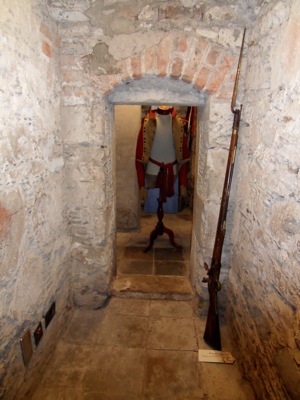
Wednesday, September 08, 2010
Off to Ards Historical Society shortly...
... I'm dusting down my Powerpoint talk on Hamilton & Montgomery (the second most important story in ever told). See you at 8pm in the Town Hall! Will post a report later on of how it went.
UPDATE - went really well, I spoke for my allotted hour (had to skip a few bits to keep it down to the hour!). Between 50 and 60 people there, lots of questions at the end and lots of very positive feedback all round. I met folk tonight who are friends of my parents but who I'd never met before, local teachers, parents of schoolfriends of mine, a woman from Edinburgh who now lives near Carrowdore, a man from Ballintoy who now lives near Newtownards, even a few folk who admitted to having heard me try to sing!. They've asked me back again - the ultimate accolade.
The critics of Ulster-Scots have no idea of how deeply our stories resonate within our local communities. Or maybe they do...? Media, politicians and assorted "experts" can spout whatever they like within their ivory towers. I know where I'll be - among my ain folk helping to preserve, recover and share our extraordinary heritage to whatever extent I'm able.
Tuesday, September 07, 2010
From Ballyhalbert to Galloway - a morning view from last week
The only sound was the put-put-put of the wee inboard engine, around 7.30am. I've lived all my life on the coast here, and the view to Scotland has been a regular feature of every one of my 38 years. Some of my first steps were taken on this very beach (when my parents lived along the front of Ballyhalbert, before they bought the farm from the Johnstons, a farm my father had laboured on since he was a wee boy. His father and uncles had laboured those fields as well, as did their parents, as far back as family tradition goes.). All three of my own children have learned to walk on the same stretch of sand. I think most folk have places which are special to them - for me, the coastline from McCammon Rocks to Mooney's Brae is almost part of my DNA. Click the photo to enlarge.
Sunday, September 05, 2010
The life and writings of James M'Henry of Larne (1785-1845)
"Work! An' was it for that, after a', that I left the snug toonlan' o' Maughrygowan, an' cam' owre the ocean, whan I thocht I wad become a gentleman on my very landin! Work! why what waur could I hae done at hame, than to hae laboured for my daily bread! But I was nae quite at that need either. Eh! Sirs - Nelly, puir lass! is as little likely to become a 'lady in Pennsylvania' as the sang we used to sing says, that she was in her ain country!".
............
These are the first words spoken by Gilbert Frazier, an Ulster-Scots emigrant who left the countryside between Coleraine and Londonderry in April 1723, and sailed with his wife Nelly to Philadelphia. Gilbert was the key character in the novel The Wilderness; or, Braddock's TImes - a Tale of the West, which was published in New York in 1823.
It was written by James M'Henry who was born in Larne on 20 December 1785, and may well have been inspired by his own life. He studied medicine at Glasgow University, while there he published a poem about the 1798 Rebellion - which he would have witnessed as a teenage boy - entitled Patrick: A Poetical Tale of 1798 (published by McKenzie, Glasgow 1810). M'Henry returned to Co Antrim and became a doctor in Larne in 1811 - he then moved to Belfast in 1814 and emigrated to Pennsylvania in 1817. He lived there for 25 years during which time he became one of the most celebrated writers and novelists of his generation. He was Editor of the American Monthly Magazine, first published in 1824 (first volume is available on GoogleBooks, featuring some of his own work, and runs to a colossal 574 pages). In 1842 he returned to Ulster and became American Consul in Londonderry, a post he held until his death on 21 July 1845.
The characters of M'Henry's works were predominantly Ulster-Scots - in the preface of Hearts of Steel (1825) he wrote that "the majority of actors in both works belonged to the population of Ulster; the lower and middle classes of whom speak a dialect very similar to that spoken by the Scotch Lowlanders, from whom they are mostly descended". When Lady Morgan / Sydney Owenson's 1806 novel The Wild Irish Girl characterised Ulster as "... a Scottish colony; and in fact, Scotch dialect, Scotch manners, Scotch modes, and the Scotch character almost universally prevail..." he may have been pleased by her recognition of the cultural distinctiveness of the Province - but when the description went on to attack the alleged "chill", "calculating industry" and "luxury" of Ulster he was far from happy.
He is said to have used the preface of Hearts of Steel to respond directly to Owenson, but also more broadly to writers of her ilk, who were elevating the idea of romantic Gaelic Ireland and lambasting Scottish Presbyterian Ulster . Have a read at the bottom of page vi and the top of page vii - doubtless Owenson was one of the "tribe of romance writers who have... spread this false notion of the Irish character which has gone abroad through the world. That these writers in general knew extremely little of the people they undertook to describe is evident..." - which of course, in the addition to my recent blog post entitled "He Shoots He Scores", is still an issue today.
Chapter Two of The Hearts of Steel has been described as a "tour de force" - the deathbed scene of an old Antrim farmer called John Rainey, in which he admits his part in a crime of passion that saw him commit a murder, which the dying victim mistakenly said had been carried out by Rainey's best friend. Rainey was then tasked with giving his friend fifty lashes at Carrickfergus Castle, during which the innocent man died - making Rainey a double murderer. The language is marvellous.*
M'Henry has also been described as a "personal friend and ardent admirer" of another son of east Antrim, President Andrew Jackson, and in 1829 published a volume entitled "Jackson's Wreath or National Souvenir" (available here on GoogleBooks). James M'Henry was a hugely significant figure of his generation, regarded as the first "Irish-American" novelist and deserves to be better known in Ulster today. Like so much of Ulster-Scots heritage M'Henry has been forgotten and ignored. Nobody is sure where he was buried - his brief entry in the Oxford Dictionary of National Biography says he died at Larne. A blue plaque either near Larne (if his birthplace or even grave could be traced) or the site of the former Consuls' premises in Londonderry should be considered.
(If M'Henry were alive today, he might even have been featured in an episode of "Jackie's the Boy".)
LINKS:
- Memoir of James M'Henry's life
- The Wilderness on Archive.org
- biography of James M'Henry (p43 - 55)
-The Wilderness as a searchable text base from Stanford University, California
* this chapter was featured in Frank Ferguson's Anthology of Ulster-Scots Writing (Four Courts Press 2008). This blog post was inspired by a series of old emails from 2005 that I recently stumbled over, from John Erskine, Philip Robinson and Richard MacMaster. With thanks to all of them for their interest and for sharing their thoughts and information.
Saturday, September 04, 2010
"...one more triumph for the crass stupidity rapidly replacing culture in this country..."
No, it's not about certain aspects of present-day Ulster-Scots activity (although you may feel that it could be), but is instead an excerpt from the football fanzine / magazine When Saturday Comes. Football isn't rocket science, and frankly it's not that important (even though I enjoy it immensely) however WSC has recently published two pieces ripping apart how even something as trivial as football coverage has been dumbed down. This article is about former Soccer AM presenter Tim Lovejoy, and this one is about the dire James Corden's World Cup programmes that dominated ITV's coverage of this years tournament.
Here are a few excerpts from the Corden article: "...a thickening culture of bullish arrogance, absolute pride in not thinking. This idea that it's all a laugh. It's eating away at everything now, and it's only getting worse..."Lovely stuff!" barked Corden, banging his cards on the desk. Somewhere in Britain, another library closed...
...no idea of his own limitations, never sensing when people are sick of him... underneath the insecure bluster, he may even be a nice guy... what he has to realise now, as he weeps over England's exit, is that he's part of the problem. Sure, it's only a laugh – but this overbearing oafishness bolsters the culture which has England stinking out one tournament after another, bullishly arrogant, proud of not thinking. Corden would probably scoff at the thought, but I guess you have a different perspective when you're making a career of it..."
The language in both pieces is rough in places, so be warned before you choose to click through. Apply the themes as you see fit.
"The Ulster Scot" - Home Rule era postcard

While hoking through some old books yesterday I found a clipping from the Belfast Telegraph, from 19th January 1998 to be precise, of an article entitled "Light Shed on Ulster and the Thistle Connection" which was published to promote the book Varieties of Scottishness: Exploring the Ulster Scottish Connection (published by the Institute of Irish Studies, Queen's University Belfast, 1997). The article was illustrated by an old postcard bearing the title "The Ulster Scot" in bold lettering - it has an illustration of a highland warrior with kilt, sporran, shield and sword, and the following verse:
This land oor heritage by richt
Priest ridden saints may grudge us
Three hunner years we hae been here
An deil th' fit they'll budge us
Not very PC, but I think a significant insight into popular feeling around 1912 and the "Home Rule is Rome Rule" fears of the time. I also vaguely remember seeing another postcard from the same era, I think recording the Larne gunrunning of 1914, which also bore an Ulster-Scots verse or poem. Maybe some readers know it and can send it to me to post here?
Friday, September 03, 2010
He shoots, he scores! (with new addition)
Over at Aiblins.com, Mr Ulster Scot looks like he's hit the target with this one.... PS - Also, check this out. Sadly this commentator perpetuates the nonsense about "manufactured identity". It's not the first time that academics have dismissed something just because they'd never heard of it before. I have left a comment there (which has to be approved before it will appear). Perhaps some of you might feel inclined to do likewise? Even academics still have a lot to learn.
Thursday, September 02, 2010
Wednesday, September 01, 2010
Testing testing
Oops - doing a few tests with Blogger at the moment as I'm weighing up an upgrade, so bear with me if things go a bit weird round here for a day or two.
Monday, August 30, 2010
The Reformation in Scotland
To mark the 450th anniversary of the Scottish Reformation the National Library of Scotland is holding a 2 month exhibition of some rare texts and manuscripts during September and October. Details available here. At the same time, BBC Radio Scotland are broadcasting a new series entitled Scotland at Prayer, beginning on Monday 6 September at 11.30am. Here's the press release I was sent last week -
"...In 2010 Scotland marks the 450th anniversary of the Reformation, an event which left an indelible legacy in Scottish society. Billy Kay tells the story of the Reformation through this new seven-part series, Scotland at Prayer, detailing its effects on Scottish culture and exploring the history of the major religious identities which emerged out of it - Presbyterian, Episcopalian, and Roman Catholic.
In this first programme Scotland at Prayer, examines the period of the Reformation itself, and the visionary nature of some of the innovations introduced by Knox and Melville. It also counters some of the myths, and discovers for example that John Knox was a claret drinking ladies' man who was regarded as one of the country’s first linguistic anglicisers.
Later in the series Scotland at Prayer, will explore the emergence of Evangelicalism in the Highlands in the Free Church and Free Presbyterian Church, and the survival of the tradition in Lewis. The story of other churches with a long pedigree in the country will be told - the Quakers, the Methodists, the Baptists and the Brethren - recalling the great religious revivals which swept through Scotland and the cultural forces which led to the spread of Brethren and Baptist churches in places like Ayrshire mining villages and fishing communities on the Moray coast.
Scotland at Prayer, celebrates the history of the churches, the faith of the people who belong to them, the local and national identity of their adherents, their influence on politics and culture, the effects of immigration, and the tension between the values of the past and the society of the present. For a majority of Scots, knowledge of other churches can be scant and based on stereotypes. This series will reveal the deep historic roots of all of the major Christian denominations in Scotland and explore their relevance to the future of the country..."
It'll be interesting to hear how the subject matter is handled. Part of me suspects that the Reformers (as usual) will be portrayed as iconoclastic vandals and dour-minded killjoys. I also suspect that Ulster will be a footnote, if we're even mentioned at all. Let's hope I'm wrong.
Friday, August 27, 2010
The Great Draught of Fishes
Just back in from Donaghadee, me and the two boys along with Andy Adair. Three fishing rods between us and landed a colossal 60 fish - mostly good sized mackerel and lythe (pollack), with some blockan (coalfish / coley) and one wee herring forbye. We just kept a dozen of them, the rest were thrown back in. It's hardly in the same league as the account of Jesus and the "great draught of fishes" from Luke chapter 5, but it's as close as we're ever going to get to it. Seafood barbecue tomorrow!
"...he was astonished, and all that were with him, at the draught of the fishes which they had taken..." - Luke ch 5 v 9 (KJV)
Monday, August 23, 2010
Local history talks and tour
I'm going to slow the blogging down a bit over the next few weeks, with weans going back to school and plenty of other things to be doing. As an "advert" of sorts, I'll be giving some illustrated talks in the local area, about 45 minutes each with an illustrated Powerpoint presentation (plenty of pics, not death by bulletpoint!), as follows:
Wednesday 8th September
Ards Historical Society
Hamilton & Montgomery Settlement of 1606
The Old Town Hall, 8.00pm
Monday 11th October
Comber Historical Society
The Forgotten English Colony of Sir Thomas Smith, 1572-1575
The Learning Centre, Comber, 8.00pm
(I'll be giving the same talk to the Upper Ards Historical Society in Portaferry on Tuesday 7 December)
In between these dates, I'm delighted to have been asked to be tour guide for a coach tour of the Ulster-Scots History of the Ards and North Down. This is being organised by Loughries Historical Society, from 9.00am - 1.00pm on Saturday 2nd October. There will be just 30 seats available. More details on this to follow.
Sunday, August 22, 2010
Killicomaine Baptist Meeting House, Portadown
"Meeting House" is usually a name associated with Presbyterians. This photograph, of the church in Portadown that my uncle Harvey Shaw is pastor of, shows that it's not limited to Presbyterians. In Greyabbey there's an old street sign for "Meetin Hoose Raa". As a name I like "meeting house" far better than "church", because the word "church" is meant to refer to a group of people, not a building. I'm sure somebody out there can tell me a bit about the history of the term.

Saturday, August 21, 2010
Roon roofed hooses
I was with two architect friends today, both of whom have won RIBA awards for their work, and who also share my love of rural vernacular Ulster. There aren't many folk today who know who Estyn Evans is, never mind architects who actively seek to integrate the folk customs Evans wrote about into their clients' buildings. Below are some photos that prove to me that tradition can be retained and honoured in a way that's relevant to today. There's no need to bulldoze heritage and import influences from afar - we have so much right here already that we should value more.


Friday, August 20, 2010
The Integrated Isles

One of the things that becomes clear when you travel within the British Isles is the huge amount of integration there is among the general population. The five main jurisdictions - England, Scotland, Wales, Northern Ireland and the Republic of Ireland - aren't as alien to each other as some politicians and commentators would have you believe.
IRELAND: Northern Ireland & the Republic of Ireland There are about 6 million people on the island of Ireland. As if by magic, there are 6 million Irish-descended people resident in GB who are entitled to Irish citizenship and Irish passports.
SCOTLAND 20% of the present day population of Scotland are said on this Wikipedia page to be of "Irish (either Protestant or Catholic) heritage"; that's about 1 million people. But close to the same amount - over 800,000 - of the present day population migrated southwards from Scotland into England and Wales (source here). In previous generations I suggest that that figure would have been much higher - meaning that a lot of English-born folk in fact have Scottish parents or grandparents - but this isn't recorded on any census so there are no stats available.
WALES A quarter of the population of Wales weren't born in Wales (that's about 750,000 people, the majority of whom were born in England) - with more or less the same number of Welsh-born folk living in England.
The idea of devolution - a bit of regional responsibility away from centralised London government - is in my view a good thing in that it should enable policies to fit with local differences within the regions. But when politicians use their wee devolved fiefdoms (whether Oireachtas,Assembly or Parliament) to build walls of division and nationalism they do so without any sense of the benefits of how connected the people are. The populations of the five "home nations" are deeply interwoven through the centuries-old whirlpool of internal migrations that continue right up to this generation.
Wednesday, August 18, 2010
The Broons - on their way to a tv near you
Yes, a live action TV version of the Broons (not an animation) is on the way. it could be absolutely dire, or brilliant. The programme makers, Baby Cow Productions, are one of the UK's major comedy factories and are planning a one hour pilot as a test. We got Broons annuals every Christmas when I was a wee fella; I remember back in 2006 or 2007 buying a copy for each member of an organisation I was involved in at the time, but only two of them had ever heard of the Broons!

Monday, August 16, 2010
Worlds at Aiblins.com
If you've missed it, be sure to get over to Aiblins.com to marvel not only at MrUlsterScot's generally successful stream of live blogging posts from last Saturday's RSPBA World Pipe Band Championships, but also the resilience and reserve he has shown in being badly let down by Easyjet. A few years ago I had a similar experience of dire customer service with them and had to stay overnight with my fraught wife and weans in an airport hotel in Luton - at our expense! I came home and registered the web address www.lousyjet.com, but did nothing with it in the end. MrUlsterScot writes, and photographs, very well. Hopefully his much-vaunted video clips will be worth the wait!
Well done to all of the Northern Ireland bands who did so well at the Worlds, and to the ever-energetic David Scott (Secretary of the RSPBANI) who managed to get a slot on Good Morning Ulster earlier today to gloat about the well-deserved triumphs!
JC Ryle
"Unfailing courtesy, kindness, tenderness and consideration for others are some of the greatest ornaments to the character of the child of God. The world can understand these things if it cannot understand doctrine. There is no religion in rudeness, roughness, bluntness, and incivility."
Bishop J.C. Ryle (1816 - 1900)
Thanks to Sharon Stewart Wilkerson for this great quote.
Sunday, August 15, 2010
Anne Rice, "The Church" and Jesus
It's been all over the media this week that American writer Anne Rice has "...quit Christianity and being Christian...". She said “I remain committed to Christ as always but not to being ‘Christian’ or being a part of Christianity. It’s simply impossible for me to ‘belong’ to this quarrelsome, hostile, disputatious, and deservedly infamous group.".
Jesus is the whole point of Christianity, not denominations or buildings, not financial contributions, not whether your family have been part of a particular congregation for many years. In fact, it's not even about what are sometimes called His "teachings" as if He were just a wise man. Jesus is not simply an example who shows us how to live a moral life - in fact, the reason the He came, died, and rose again was because people could never live truly holy lives. He demands far more than to be a template. He is Creator (John ch 1), He is the expression of the love of God (Romans 5v8), He is Redeemer (1 Corinthians 15v3), He is Advocate (Romans 8 v 34), He is returning King (John 14). He is not one of a number of options, He is absolutely unique (Acts 4v12).
The consistent message of the 66 separate books which form the Bible is to call people, not to believe in God, but to trust in Christ - in who He is, in what He did, in what He is presently doing and in what He will do upon His return. This old hymn, the music for which was arranged by Co Tyrone-born William James Kirkpatrick, puts it in a nutshell:
My faith has found a resting place,
Not in device or creed;
I trust the ever living One,
His wounds for me shall plead.
I need no other argument,
I need no other plea,
It is enough that Jesus died,
And that He died for me.
So maybe Anne Rice is heading in a better direction. I know plenty of people in Northern Ireland who, when the chips were down, discovered to their horror that their energies and faith had been in a denomination rather than in the Person and finished work of Jesus. "Let us fix our eyes on Jesus, the author and finisher of our faith".Hebrews 12 v 2
Friday, August 13, 2010
The Harvest Fair
One of the trends of recent years has been the "packaging" of culture, usually urbanised Belfast stuff, which is assumed by its' packagers to also apply to rural market towns of Ulster and so is then exported to those places with little consideration or thought. Following the Ulster Workers Strike of 1974, those towns were infected by the more unsavoury aspects of Belfast life due to the big population shifts and subsequent housing estates that were spawned by "The Troubles". In most cases this catastrophic Housing Executive policy didn't dilute the paramilitary influence but spread it wider. We all know too well the estates of Newtownards, Bangor, Dundonald, Lisburn, Carrickfergus, Glengormley, Antrim and Ballymena which suffer still.
These "mercat touns", and many like them, are mostly - historically at least - Ulster-Scots and so they have their own histories, stories and vocabularies. The song below was given to me many years ago by the late George Holmes (to give him his full title Dr George Holmes MBE, PhD FIPSM [Bel], FSA Scot, FHS [GB&IRE], FIHC, MICTM). He and I spent a cold night in the directors box at Windsor Park and talked about songs and local traditions throughout, not really paying attention to the match. It is sad that George passed away earlier this year - he had much knowledge accumulated and was generous to me with much of it. This oul Newtownards song he gave me, called "The Harvest Fair", is a simple telling of what was once the big date in the annual calendar. It also marked the date when blackberries had to be picked - any picked after Harvest Fair day were likely to be full of wee worms. Nae use for making jam in a pillow case - but that's another story, and who makes their ain jam now anyway?
On September 23, will ye come alang wi me
An we'll go an' pay a visit to the Square
Everybody gathers in – tall and short and fat and thin
To join in the fun and see the Harvest Fair
Chorus:
There’ll be William James from Scrabo Hill and Hugh from Ballyhay
Mary Jane from Carrowdore and Sam from Drumawhey
Margaret Ann I’ll leave ahin, she disnae seem tae care
For there’s none would take a pension for to miss the Harvest Fair
There’ll be piles of Yellow Man and we’ll buy some if we can
For the childer nearly ate the stall and all
Candy floss stuck on a stick, candy apples you can lick
We’ll enjoy ourselves beside the Oul Town Hall
You can buy a pound of pears or some second-handed chairs
You can listen to the preacher give the word
You can have your fortune toul by a gypsy brown and oul
You can pay 3d to see a four legged bird
If we talk to Farmer Fred he’ll say “The Fair is dead”
He’ll puff his pipe and nod his head and sigh
But he’s talking through his hat, aye I’m certain sure of that
For we’ll mind the Fair until the day we die
The spellings are as they were given to me, but it's easy to imagine that these have been "English'd" over the years and that the original version would have been a much fuller Ulster-Scots. My favourite part is where the oul farmer, even back when this was written maybe 70-odd years ago, was unimpressed by the state of the Fair and that it was no longer as good as it once had been. Some attitudes never change.
Live Blogging from the World Pipe Band Championships tomorrow

The last big local piping event is the North West Championships in Portrush on Sat 21 August beginning at 12 noon.
(pic above © Field Marshal Montgomery Pipe Band)
Sign up for RSPBANI Facebook here
Visit the RSPBANI blog here
Thursday, August 12, 2010
Simple things
I've spent a few late nights recently with my two boys doing a bit of pier fishing. We usually get there about 9pm (dusk at this time of year), and so far we've caught a load of lythe (English name - pollack) and blockan (English name - coalfish), with other local sea anglers telling us that they've managed to get rare varieties like cuckoo wrasse this summer too. Last night the clouds rolled away and the stars came out, so we stood fishing in the dark looking up at the Plough and other constellations. All good male bonding stuff, and the things that (hopefully) the boys will remember for the rest of their days.
Tuesday, August 10, 2010
"Cherryvelley" is alive and waaaal
Have you noticed how the accents of most Northern Ireland broadcasters are far more Anglified than ever before? What was once a James Young joke about the posh people of "Cherryvalley" is slowly becoming an everyday experience on the local media. Maybe it's just that I'm longer in the tooth now and tend to notice these things, but (and I'm doing my best not to name names and get into trouble) there are particular local broadcasters who nowadays sound far more English than I ever remember before.
Now, as many of you know, my wife is English, and "being convinced" of the merits of Unionism (I hope you picked up the source of that reference in bold), I have absolutely no problem with English people speaking with English accents. Or Northern Ireland folk who have spent time away from here and return with a hybrid accent. What gets my goat is Northern Ireland folk denying their own roots and pretending to be English, or even Anglo-Irish, in their speech. Fiona touched on similar themes in this recent post on her blog.
How-now-brown-cow, softened "r"s, "eight" being pronounced as "ayt" instead of "ee-it", even a simple inoffensive word like "well" has the vowel softened to become a kind of "waaaal"... just listen to your radio and tv tomorrow, particularly the current affairs coverage, and you'll hear loads of examples of this. The vast majority of Northern Ireland folk I know don't talk like this, so why do broadcasters feel that they need to?
Perhaps it's a sign of a major class divide? Does everyone who lives in a posh place speak with a posh accent? Does it come as a package along with the three cars, the Donegal weekend hideaway and the annual holiday in Tuscany / Lake Garda / this year's fashionable destination?
If it's not okay to speak with a fairly standard Northern Ireland accent (I know there are varieties within Northern Ireland, but you know rightly what I'm generally talking about) then what chance is there for the next generation to ever hear, or feel a fondness for, the simplest elements of Ulster-Scots vocabulary and speech? When did you last hear "Aye" for yes or "wee" for little on mainstream UTV or BBC programmes - except from listeners who had phoned the show and were on air?
Sim leowcahl broadcahstaahs seem to think thet they operayte on a raatha highaa playne then the rist of us meeah moahtils. Here's a similar post from 18 months ago.
Saturday, August 07, 2010
Field Marshal Montgomery & Simon Fraser University Pipe Bands at the Waterfront Hall, Belfast

Thursday, August 05, 2010
Jock Troup and Duncan McNeill on RareTunes.org

Photo © Jim Mayne, of Jock Troup leading a children's mission, circa 1920.
Thanks again to Jim Mayne from Bangor for lending me some of his old 78 collection some weeks back. I have digitised these and cleaned up some of the crackle; they have now been incorporated into the Scottish music archive RareTunes.org.
Jock Troup (1896 - 1954) was a very famous evangelist of his generation and spent much time preaching in Ulster. He is only known to have ever recorded two songs - "He Did Not Die In Vain" and "Unanswered Yet" (Beltona 1584). In 2002 George Mitchell wrote an excellent biography of Jock Troup entitled Revival Man - The Jock Troup Story. Recently, Sharon Wilkinson from North Carolina also sent me a biographical booklet by her father, a preaching colleague of Jock's called James Stewart, entitled Our Beloved Jock - Revival Days in Scotland and England - the Story of a Fisherman Revivalist.
Duncan McNeill / M'Neill (not sure of dates of birth or death) was described as "Scotland's Sweetest Gospel Singer" and "The Scottish Skylark", and for a time was also pastor of Bridgeton Baptist Church in Glasgow. Among Jim's 78s were two by McNeill - "Thou Remainest" & "Will the Circle Be Unbroken" (Beltona 1460) as well as "Don't Be Downhearted" & "The Gospel Ship" (Beltona 1620). I am not sure if he spent any time on this side of the water, but his records and his hymn book were certainly enjoyed here. Any information you might have about him would be appreciated.
With Jim's permission all of these tracks have been sent to Stuart Eydmann who runs the website RareTunes.org, to add to his collection there. RareTunes is an excellent growing archive of rare Scottish recordings.
Troup and McNeill, along with others like Seth Sykes, Charlie Mayne, W.E. Tocher and many others were all Scottish preachers who made a big impact on Ulster in the early 20th century. Another great example is the "Old Tent Evangel" which was founded in 1922 and moved around different areas of East Belfast - it was nicknamed "The Cloot Kirk" (the Cloth Church). In addition to their spiritual legacy they also left a collection of songs, hymns and childrens choruses, some of which used Scots language words and expressions. Perhaps the close relationship of the Belfast and Glasgow shipyards was a factor, but these are all evangelical evidences of how Scots speech was once a frequent feature of the working class life of Belfast.
NB - you can hear the Troup and McNeill recordings here, in the column on the right entitled "Latest Recordings". An excellent history of the halls and missions of Belfast is Belfast's Halls of Faith and Fame by Victor Maxwell (Ambassador 1999)
NB again - Jock Troup's understudy / successor as Glasgow's most renowned open air preacher was Raymond McKeown. His parents, Joseph and Margaret McKeown, were Ulster folk - Joseph had been in the Army and the Royal Ulster Constabulary but they moved to Glasgow in the 1930s because of the threat of terrorist attack on the family.
Wednesday, August 04, 2010
Ulster's musical history - The Anglo American Gramophone Co, Belfast
This is a detail from an old 78 record sleeve loaned to me recently by a friend from Bangor called Jim Mayne. Maybe someone out there can guesstimate the date from the four digit phone number? Belfast was one of the first 13 local authorities in the UK to be permitted to install its own local telephone system in 1899. I expect that this might well have been one of the shops who sold old hillbilly and American gospel 78s to my granda and his generation. Nowadays the address is occupied by the consultancy firm ASM Horwath, who I've done some work with in the past.

Tuesday, August 03, 2010
The MacLeod slaves at Donaghadee, 1739
BBCI's "The One Show" last Tuesday included a short 4 minute film about the famous Hebridean slaves who were landed at Donaghadee and were freed. My good friend Bill Montgomery, and Donaghadee historian Harry Allen, both featured in the piece. It's just been removed from the iPlayer this evening, so I hope you got to see it before it went! If not, here's a summary of the story. Harry Allen's excellent book on Donaghadee includes a lot of detail of the story as well as photographs of some of the sites and buildings.
Monday, August 02, 2010
"The Little Farm By The Sea" by Norman Wilkinson
Some of you might remember this blog post from 18 months ago. Well, I managed to track down another version of the poster: