Personal blog of Mark Thompson. Formerly Managing Director of GCAS Design in Belfast, Northern Ireland (from 1999 - 2006) and Chairman of the Ulster-Scots Agency (from June 2005 - June 2009). Thoughts on Ulster-Scots heritage, identity, evangelical Protestant faith, music and other stuff I stumble upon.
So says one of the reviews of the writings of Archibald M'Ilroy, which I came across a few weeks ago in an old periodical which has been on my shelves for donkeys years, and which I then scanned to eventually post here. They amazed me because as the self-professed 'clever' people keep telling us, the term 'Ulster Scot' was only invented about 15 years ago. So the appearance of the term, twice, in these reviews from 1899 must therefore be elaborate forgeries, akin to the Hitler Diaries. Or else, maybe the 'clever people' are wrong.
But since when was 'quiet country life' given much 'respect' anyway? McIlroy's work is top-notch and highly recommended - I'm re-reading 'The Auld Meetin Hoose Green' and 'The Humour of Druid's Island' at the moment. Click to enlarge.
The farm where Wesley sought refuge in the old stories (read one of them here) is named as "Island Barn Farm" near Killinchy. It has been pointed out to me today that there is an "Islandbane" townland near Ringhaddy, in Killinchy parish. It is a small outcrop of land into Strangford Lough. It appears to have had just one farmstead - see below an early 1800s map, and a present-day aerial photograph. I think that's the spot.
There has been a lot of froth on the media today about commemorations and centenaries. Westbourne Presbyterian Church on the Newtownards Road in East Belfast is taking the initiative this year. Known as 'The Shipyard Church' since it was built in 1880, it was the biggest signing centre for the Ulster Covenant in 1912 after Belfast City Hall.
• Starting on Thursday 22nd March is a series of four monthly evening talks on different aspects of the Covenant. Entry is free. Some well-known names will be speaking.
• And on Sat 31 March, and Friday 20 April, there are two concerts being held in the Church to mark the centenary of the Titanic. The men who built her would have sat on these pews on a Sunday. Suggested donations are £10 per ticket.
"...Charles Wesley (1707-1788) was conducting one of his many open-air meetings, this one near Killyleagh, (Northern) Ireland. During the course of his preaching, a number of persons who took exception to his views assaulted him. Unable to withstand the mob, Wesley fled for his life.
He took refuge in a farmhouse nearby. Jane Lowrie Moore*, a kind-hearted wife of a farmer, hid the panting evangelist in the milk house. She was barely in time, because at that moment some of Wesley’s assailants rushed up. Mrs. Moore tried to divert their attention by preparing refreshments. Fearful that they might search the premises and discover the harried evangelist, she went to the milk house on the pretext of getting a cold drink for her visitors.
Quickly, she bade him, get through the rear window, and hide under the hedge. He clambered through the window and found a little brook flowing beside the hedge, forming a pool with overhanging branches that afforded a pleasant and safe retreat. While waiting for the vindictive Irishmen to give up the search and leave, Wesley pulled a pencil and paper from his pocket and wrote out the immortal hymn, Jesus, Lover of My Soul.
Dr. George Duffield**, author of Stand up for Jesus, another of our famous songs, once said of Wesley’s hymn, If there is anything in Christian experience of joy and sorrow, of affliction and prosperity, of life and death—that hymn truly is the hymn of the ages..."
Jesus, lover of my soul, let me to Thy bosom fly, While the nearer waters roll, while the tempest still is high. Hide me, O my Savior, hide, till the storm of life is past; Safe into the haven guide; O receive my soul at last.
Other refuge have I none, hangs my helpless soul on Thee; Leave, ah! leave me not alone, still support and comfort me. All my trust on Thee is stayed, all my help from Thee I bring; Cover my defenseless head with the shadow of Thy wing.
Wilt Thou not regard my call? Wilt Thou not accept my prayer? Lo! I sink, I faint, I fall—Lo! on Thee I cast my care; Reach me out Thy gracious hand! While I of Thy strength receive, Hoping against hope I stand, dying, and behold, I live.
Thou, O Christ, art all I want, more than all in Thee I find; Raise the fallen, cheer the faint, heal the sick, and lead the blind. Just and holy is Thy name, I am all unrighteousness; False and full of sin I am; Thou art full of truth and grace.
Plenteous grace with Thee is found, grace to cover all my sin; Let the healing streams abound; make and keep me pure within. Thou of life the fountain art, freely let me take of Thee; Spring Thou up within my heart; rise to all eternity.
Jesus Lover of My Soul was one of the hymns associated with the Ulster Covenant of 1912 and was printed on the Ulster Day Service Sheet which was produced for the many church services held on the morning of 28 September 1912. I wonder if its Ulster origin is partly why it was chosen? It is also said that the Royal Welsh Fusiliers sang this as they went 'over the top' at Mametz Wood in World War One. The best-known tune for it is called Hollingsby, but with a bit of work it can be made to fit 'My Heart is like a Red Red Rose', Robert Burns' famous love song. One to be tried out this year I think.
Here it is to a new tune:
* The hymnwriter Robert Lowry's parents were said to have come from near Killyleagh. Were they related to Jane Lowrie Moore? ** Duffield was also of Ulster descent.
Now this is funny. There is a segment of the (Ulster) Protestant psyche which wants to be the faithful remnant, the chosen few, Gideon's 300. I suppose everyone thinks they're right. From The Gospel Coalition.
Old books are brilliant. I came across these great quotes recently:
'...through the overpowering trade of the Scottish merchants of Belfast the English trade of Lisburn is upon ruin… those Scotch have got all the general commissions from the London merchants for trade into their hands and so not one Englishman in these parts is so employed...’ (1679)
'...a little beyond Port Davy stands a promontory called the Black-head, whereon stands a lighthouse, and under it from the sea there is a large cave, where I have been told by the Country, a piper went in, and was heard at a place two miles form thence under ground; he must have been very little, for I have run fox into it with my dogs and killed him at the far end...' (1683)
I recently got hold of a copy of 'The Pikemen - A Romance of the Ards of Down', published in 1903, written by Samuel Robert Keightley (1859-1949, pictured here) of Lisburn. I had been trying to get a copy of this for a while, and when it arrived I wasn't disappointed. It's a classic 'kailyard' format novel, set around the time of the Battle of Ballynahinch, and purports to be a first-hand account of the events as told by a Rev Patrick Stirling who had fled Ulster for the USA (Sangamon County, Illinois to be precise - click here to read the History of Early Settlers of Sangamon County published in 1876 and you'll find plenty of references to Ulster emigrants). Keightley had previously published 'The Crimson Sign', a novel about the Siege of Derry, and other books as well. You can read more about him here. Here are some excerpts:
"...there was a fever in my own blood. My hands were shaking and my heart was beating like a sea in storm. I hardly knew myself. My forefathers had marched to the lilt of the Psalms under the blue banner of the Covenant, and had laid down their lives like men at Drumclog and Bothwell Bridge on the other side of the narrow sea...
... he turned suddenly and stood staring up the road toward Kircubbin as you go to Newton... 'Archie Spence gave a hunted man twa nichts' lodgin' - his guid woman is a kin' ov cousin ov my ain - an' noo they're payin' him fur the kindness that he showed me - harberin' rebels they ca' it. The white-heidit bairns are oot on the roadside noo, an' the bonny roof-tree that shud be as sacred as the wa's ov a palace are jist a wheen ov charred sticks... before ye gang tae bed this nicht ye'll see how Britain trates the honest men ov Ards, shud I hae tae carry ye ivery fut ov the road mysel...
...Here on this night of June burned the watchfires of liberty where eight thousand men of Down were gathered... It was a great and inspiring sight - great not in the pomp and splendour of war, but in heroic courage and noble self-sacrifice. Here were men from Killyleagh and Strangford shore, from hilly Dromara and Rathfriland, and the sweet valley of the Lagan; hardy fishermen from Portavogie and Ardglass; weavers from Lisburn and Newtownards and Bangor, all dressed in decent Sunday wear like men going to the last communion of death... here and there a Psalm tune was being sung by many voices to the tune of 'Martyrdom' or the 'Old Hundred'..."
I'm looking forward to reading it. For a Belfast-born academic living in Lisburn, with a Bangor JP for a father, Keightley has a brave hannlin' of the hamely tongue throughout the book, and as the excerpts above show he also had a firm grasp of cultural identity and history. Ask any of his present-day equivalents what happened at Drumclog and they'll struggle to tell you. 'The Pikemen - A Romance of the Ards of Down' might be another wee indicator of just how widespread Ulster-Scots speech was a century ago.
The Ulster Journal of Archaeology review of the book said:
The Pikemen. A romance of the Ards of Down. By S. R. Keightly London: Hutchinson & Co. 1903. This is a story of the year '98 in the county of Down, written in vivid and telling language by one who has an excellent knowledge of the period of which he writes, and a thorough grasp of local circumstances and the common dialect of the people. There is not a dry or uninteresting chapter throughout the hook, and it will afford ample pleasure to the general reader of romance, and more especially to those who are residing in the county in which the principal scenes described in the book are laid. We heartily recommend to the cultured author the desirability of a cheaper and more popular issue of this work, so as to make its pages accessible to everyone. The principal characters are painted with a decisive brush, but if anything, we consider the scene in the old meeting-house at Greyabbey a little over-drawn. Here we have the Rev. James Porter balloting in the communion cup for the name of him who was to do away with the informer Newell. We doubt the accuracy of this incident, and even the death of Newell at this place ; nor do we think this wretched man was such a character as is so skilfully portrayed by the writer. Be this as it may, it is ill to cavil with dry historical details in a work that has many charms, a store of information, and the deepest interest to even the most casual reader.
(PS - Here's another biography of Keightley - click here. A similarly-entitled novel about the events of 1798 in County Antrim is James McHenry's The Insurgent Chief, the Pikemen of '98 which you can read online here.)
‘...The English-planted districts in Ulster are still fragrant with fruits and flowers, no parishes being more noticeable in this respect that those in the Moira, Downshire and Hertford Estates, in South Antrim and Down. The Scotch-planted districts are the very opposite, there no gardens as a rule are to be found, and the filth of the cattle surrounds the dwellings. The most casual observer notices the changes at once when passing from one to the other, say from Carnmoney or Ballynure to Glenavy or Ballinderry...’
So you can now accumulate a dung midden at your door and claim that it is of cultural importance. You might even get a grant for it if you can persuade a neighbour of a different religious persuasion to help you to build it, and then claim that it is a cross-community initiative. From the Ulster Journal of Archaeology 1902, page 98.
An excellent find here by Robert Campbell over at his blog The Bog Myrtle. Whilst the Ulster Covenant was signed by over 470,000 people on Ulster Day in September 1912, that same evening there were bonfires and illuminations along the coasts of Antrim and Down. An enterprising boat owner organised cruises on Belfast Lough from 9pm - 11.30pm. Robert has also posted here a very interesting Belfast News Letter report of Ulster Day in Glasgow. And, like me, he has found that his great-grandfather signed the Covenant in Scotland. Closer to home, from Robert's own back yard, he has posted this advert for Ulster Day events in Ballyclare.
I spent a very interesting day today, with three people I had never met before who (later admitted that) at 10am this morning were fairly sceptical about the overall Ulster-Scots story, but by 5pm were totally convinced and even enthused. I managed to wipe away years of preconceptions just by showing them simple evidences and telling local stories - which just proves the depth of the authentic stories themselves and their power to persuade if reasonably well told.
We live in a time when some old prejudices are hopefully being rethought and reassessed, maybe because the full story is now being told, rather than the narrow, propagandised, selectively-edited versions. In light of this recent story, the headline of this posting is a quote from this article in the Daily Telegraph and I thought some of you would be interested in it. This book - The 6th Connaught Rangers: Belfast Nationalists and the Great War - is an excellent telling of very similar stories and is full of photographs of artefacts which had been kept by the families of the men who served.
Some of you will know that we are underway with building a house. Some of you have even helped me to source some materials! We are in no rush, and it will be done when it is done. It has taken a fair bit of time to try to get things right, and at the same time it has been a disappointment to find that the oldest of skills are dying out, that old products and materials are now either unavailable or astronomical in price, and that so much is controlled by regulations. But we live in 2012, not 1912 and so we've tried to make the best informed decisions we can at every stage, listening to both the 'oul hands' and the younger men who know about present-day improvements. We'll never do this again in our lives, so we'll take our time and try to get it as right as we can. It would be nice to be moved in later this year. (But 'boast not thyself of tomorrow...')
Vernacular buildings are very rare around the countryside of Ulster nowadays. Which is why I thought that posting this information here might be of interest to some readers. Some friends of ours (the husband is a Scot) tipped us off about a holiday house they had heard about on the Isle of Skye which is a combination of modern architecture and traditional forms. It is available to rent during the summer months upon request. Here is a photo:
What's really interesting is that the same firm also offer kit houses under the brand name Hebridean Homes. Any of these would look great nestling in between a few County Down drumlins, or on the foothills of County Antrim's hills and glens.
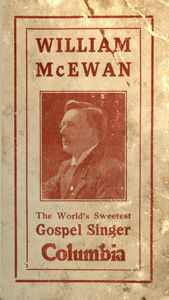
Regular readers will remember the series of posts here about William MacEwan during November and December. It was Macewan who popularised 'The Old Rugged Cross', which Joe tells me in decades gone by was regularly sung at social events across Scotland. Below is the Carter Family's version of a (lyrically) very similar piece, recorded in the 1930s. The guitar style (of picking the melody on the lower strings, but with rythym strumming as well), and the dead-flat male harmony sung by AP Carter) is superb. And Scotch-Irish of course. This was written in 1894, whereas 'The Old Rugged Cross' was written in 1913.
A lovely story of how Andrew Winton from Woolfords near Lanark found himself behind enemy lines in Germany in 1945 - where mutual admiration for the poems of Robert Burns created common ground between friend and foe. Click here.
The story goes that, shortly after Northern Ireland was established in 1921, the engineer and inventor Harry Ferguson approached the new Prime Minister, James Craig. Ferguson is said to have told Craig that to really put the new Northern Ireland on the map, what the country needed were glamourous world-class events.
"... British racing owes a great debt to Harry Ferguson, who was the moving spirit behind the revival of the Tourist Trophy. It was he who came to Brooklands one day in 1927 and approached Captain Phillips, Competitions Manager of the R.A.C. and later Clerk of the Course at all the Ards races. If the Ulster Government, Ferguson enquired of Captain Phillips, were to approach the R.A.C. with an invitation to run a race similar to Le Mans over closed roads in Ulster, how would they react? Ferguson was soon assured that they would warmly welcome the suggestion, and returned to Belfast to set the machinery in motion. It was originally intended that the race, like the French classic, should be a twenty-four hour affair, but this the Ulster Government would not permit..."
- from Tourist Trophy, the History of Britain's Greatest Motor Race by Richard Hough (1957)
The 1927 Le Mans 24 hour race was won by Bentley, and their driver Sammy Davis came over to look at the proposed Ulster circuit; he said it was 'fascinating, with every sort of curve a man could devise". And so the Ards TT race was born in 1928 (the same year that Ferguson invented the three-point linkage) and for 12 years glamourous Italian megastar drivers came to County Down to take part. The race carried on until 1936 when eight spectators were killed - it was then moved off-road to the track at Donington in England; but at its peak 500,000 people lined the roads to watch the Ards TT. Here's a pic of the Aston Martin Ulster from 1934:
Nowadays, the programme of world-class events for 2012 are different than they were back then. And I know some folk who get worked up about 'flashy events' and suchlike, seeing it all as trivial and definitely as a waste of money, and then harp back to 'the good old days when none of that oul nonsense was aboot'. For those of you who think like that, you'll enjoy this painting of the 1932 Ards TT - especially the advertising banner.
But it's an imagined nostalgia - people back in 1920s and 1930s had big ideas too, and that same thinking applies to the events calendar of today. So c'mon Northern Ireland, c'mon. (who's old enough to remember this ad from 1983?!)
I was pleasantly surprised to see a yard of Ulster tartan fabric inside one of the cottages, spread out on the window table. It wasn't labelled though, so there was no deliberate 'interpretive' contrivance about it. I knew what it was, and it seemed to belong there. Click to enlarge.
The recent blog posts on the US Ambassador coming to Belfast seem to have worked - they have attracted attention and a few people have asked if this blog is becoming the Ulster-Scots version of Wikileaks!
The truth of course is that those postings were set exactly 100 years ago in 1912, although I tried to avoid making that too obvious. The launch of the Titanic and the signing of the Ulster Covenant were just two of the big events that year - the newspapers of early 1912 show that the Ambassador's visit to Belfast was another high-profile occasion, and one which further demonstrated the historic and cultural links with Scotland, and also with America.
It seems that he originally planned to be here on 2nd April, the day that Titanic would set sail from the shipyard. Here is the first press release for the event:
It was announced yesterday at a meeting of the Presbyterian Historical Society that the Hon Whitelaw Reid, United States ambassador in London, will deliver a lecture on ‘The Ulster Scot’ under the auspices of the Society in the Assembly Hall, Fisherwick Place, on 2nd or 3rd April next. The Hon Whitelaw Reid has been Ambassador to the Court of St James since 1905, and was Special Ambassador to Great Britain for the Queen’s Jubilee and the Coronation of Edward VII. Being of Scotch Covenanter descent, his remarks on the Ulster-Scot, and the Scotch-Irish pioneers in America, will appeal with special force to an Ulster audience. He is the author of several works on historical and economic subjects. He will be the guest of Sir William Crawford during his stay in Belfast.
- from the Northern Whig, 15 February 1912
Reid had first given the address in Edinburgh in November 1911 (at the Synod Hall) for the Edinburgh Philosophical Institution. (this was the same month that Glasgow singer-evangelist William MacEwan was in London making what are said to be the first-ever gospel recordings for Columbia Records). Reid's family roots were in County Tyrone - his grandfather was from near Cookstown and his grandmother from near Omagh. So it was natural that Whitelaw Reid should deliver the same lecture in Ulster.
(PS - I hear that there are now thoughts in some quarters to mark the centenary of Reid's visit).
Below is a graphic from Reid's unsuccessful Presidential campaign of 1893, when he ran for Vice-President alongside Benjamin Harrison, who was also of Ulster-Scots descent:
"...The law could promise life to me, If my obedience perfect be; But grace does promise life upon My Lord’s obedience alone. The law says, Do, and life you’ll win; But grace says, Live, for all is done; The former cannot ease my grief, The latter yields me full relief.."
So Ulster groans with day after day of RMS Titanic coverage in the press, looking toward the much-talked about date in April when the action finally gets underway down at the old shipyard in Belfast. The pressure is now mounting to ensure that the investment of millions of pounds results in a scramble of ticket sales, and of course the long term 'sustainability' which will justify the money spent.
Meanwhile the future of the United Kingdom looks shaky, with prominent voices clamouring for independence and 'secession'. Ulster simmers with political discontent, affecting the economy, with strong rumours that massive public gatherings will be called in the Autumn. News coming out of Continental Europe just reinforces the climate of uncertainty.
Yet in the midst of all of this the US Ambassador sees an opportunity to change the story, to come to Belfast to remind us all of our cultural heritage and connections with Scotland. High profile politicians seem to be finally 'getting' the importance of our historic Ulster-Scots identity.
Publicity is embargoed until 15 February, but I may well leak some here later on...