Some of you will know that we are underway with building a house. Some of you have even helped me to source some materials! We are in no rush, and it will be done when it is done. It has taken a fair bit of time to try to get things right, and at the same time it has been a disappointment to find that the oldest of skills are dying out, that old products and materials are now either unavailable or astronomical in price, and that so much is controlled by regulations. But we live in 2012, not 1912 and so we've tried to make the best informed decisions we can at every stage, listening to both the 'oul hands' and the younger men who know about present-day improvements. We'll never do this again in our lives, so we'll take our time and try to get it as right as we can. It would be nice to be moved in later this year. (But 'boast not thyself of tomorrow...')
Vernacular buildings are very rare around the countryside of Ulster nowadays. Which is why I thought that posting this information here might be of interest to some readers. Some friends of ours (the husband is a Scot) tipped us off about a holiday house they had heard about on the Isle of Skye which is a combination of modern architecture and traditional forms. It is available to rent during the summer months upon request. Here is a photo:
(photo gallery available here)
SkyeShed itself (website here) might not be everybody's cup of tea, but the portfolio of the architectural firm who designed it, Dualchas Building Design of Glasgow (and Skye) is magnificent - click here and be prepared to spend a fair bit of time enjoying their work.
What's really interesting is that the same firm also offer kit houses under the brand name Hebridean Homes. Any of these would look great nestling in between a few County Down drumlins, or on the foothills of County Antrim's hills and glens.
Tuesday, January 31, 2012
Skye Shed / Dualchas Building Design / Hebridean Homes


Monday, January 30, 2012
The Carter Family: 'On A Hill Lone and Grey'
Regular readers will remember the series of posts here about William MacEwan during November and December. It was Macewan who popularised 'The Old Rugged Cross', which Joe tells me in decades gone by was regularly sung at social events across Scotland. Below is the Carter Family's version of a (lyrically) very similar piece, recorded in the 1930s. The guitar style (of picking the melody on the lower strings, but with rythym strumming as well), and the dead-flat male harmony sung by AP Carter) is superb. And Scotch-Irish of course. This was written in 1894, whereas 'The Old Rugged Cross' was written in 1913.
Wednesday, January 25, 2012
Burns' Night on the Oder, 1945 (from the Edinburgh Books blog)
A lovely story of how Andrew Winton from Woolfords near Lanark found himself behind enemy lines in Germany in 1945 - where mutual admiration for the poems of Robert Burns created common ground between friend and foe. Click here.
Tuesday, January 24, 2012
World-class events in Northern Ireland
The story goes that, shortly after Northern Ireland was established in 1921, the engineer and inventor Harry Ferguson approached the new Prime Minister, James Craig. Ferguson is said to have told Craig that to really put the new Northern Ireland on the map, what the country needed were glamourous world-class events.
"... British racing owes a great debt to Harry Ferguson, who was the moving spirit behind the revival of the Tourist Trophy. It was he who came to Brooklands one day in 1927 and approached Captain Phillips, Competitions Manager of the R.A.C. and later Clerk of the Course at all the Ards races. If the Ulster Government, Ferguson enquired of Captain Phillips, were to approach the R.A.C. with an invitation to run a race similar to Le Mans over closed roads in Ulster, how would they react? Ferguson was soon assured that they would warmly welcome the suggestion, and returned to Belfast to set the machinery in motion. It was originally intended that the race, like the French classic, should be a twenty-four hour affair, but this the Ulster Government would not permit..."
- from Tourist Trophy, the History of Britain's Greatest Motor Race by Richard Hough (1957)
The 1927 Le Mans 24 hour race was won by Bentley, and their driver Sammy Davis came over to look at the proposed Ulster circuit; he said it was 'fascinating, with every sort of curve a man could devise". And so the Ards TT race was born in 1928 (the same year that Ferguson invented the three-point linkage) and for 12 years glamourous Italian megastar drivers came to County Down to take part. The race carried on until 1936 when eight spectators were killed - it was then moved off-road to the track at Donington in England; but at its peak 500,000 people lined the roads to watch the Ards TT. Here's a pic of the Aston Martin Ulster from 1934:
Nowadays, the programme of world-class events for 2012 are different than they were back then. And I know some folk who get worked up about 'flashy events' and suchlike, seeing it all as trivial and definitely as a waste of money, and then harp back to 'the good old days when none of that oul nonsense was aboot'. For those of you who think like that, you'll enjoy this painting of the 1932 Ards TT - especially the advertising banner.
But it's an imagined nostalgia - people back in 1920s and 1930s had big ideas too, and that same thinking applies to the events calendar of today. So c'mon Northern Ireland, c'mon. (who's old enough to remember this ad from 1983?!)


Monday, January 23, 2012
Ulster American Folk Park cottage, November 2011

I was pleasantly surprised to see a yard of Ulster tartan fabric inside one of the cottages, spread out on the window table. It wasn't labelled though, so there was no deliberate 'interpretive' contrivance about it. I knew what it was, and it seemed to belong there. Click to enlarge.
Saturday, January 21, 2012
Update on the US Ambassador's visit to Belfast in March
The recent blog posts on the US Ambassador coming to Belfast seem to have worked - they have attracted attention and a few people have asked if this blog is becoming the Ulster-Scots version of Wikileaks!
The truth of course is that those postings were set exactly 100 years ago in 1912, although I tried to avoid making that too obvious. The launch of the Titanic and the signing of the Ulster Covenant were just two of the big events that year - the newspapers of early 1912 show that the Ambassador's visit to Belfast was another high-profile occasion, and one which further demonstrated the historic and cultural links with Scotland, and also with America.
It seems that he originally planned to be here on 2nd April, the day that Titanic would set sail from the shipyard. Here is the first press release for the event:

It was announced yesterday at a meeting of the Presbyterian Historical Society that the Hon Whitelaw Reid, United States ambassador in London, will deliver a lecture on ‘The Ulster Scot’ under the auspices of the Society in the Assembly Hall, Fisherwick Place, on 2nd or 3rd April next. The Hon Whitelaw Reid has been Ambassador to the Court of St James since 1905, and was Special Ambassador to Great Britain for the Queen’s Jubilee and the Coronation of Edward VII. Being of Scotch Covenanter descent, his remarks on the Ulster-Scot, and the Scotch-Irish pioneers in America, will appeal with special force to an Ulster audience. He is the author of several works on historical and economic subjects. He will be the guest of Sir William Crawford during his stay in Belfast.
- from the Northern Whig, 15 February 1912
Reid had first given the address in Edinburgh in November 1911 (at the Synod Hall) for the Edinburgh Philosophical Institution. (this was the same month that Glasgow singer-evangelist William MacEwan was in London making what are said to be the first-ever gospel recordings for Columbia Records). Reid's family roots were in County Tyrone - his grandfather was from near Cookstown and his grandmother from near Omagh. So it was natural that Whitelaw Reid should deliver the same lecture in Ulster.
(PS - I hear that there are now thoughts in some quarters to mark the centenary of Reid's visit).

Below is a graphic from Reid's unsuccessful Presidential campaign of 1893, when he ran for Vice-President alongside Benjamin Harrison, who was also of Ulster-Scots descent:

Thursday, January 19, 2012
With thanks to Ralph Erskine from Dunfermline
"...The law could promise life to me,
If my obedience perfect be;
But grace does promise life upon
My Lord’s obedience alone.
The law says, Do, and life you’ll win;
But grace says, Live, for all is done;
The former cannot ease my grief,
The latter yields me full relief.."
- from Gospel Sonnets by Ralph Erskine (1745). There is a statue of him in Dunfermline today; he was buried at the Abbey, where most of King Robert the Bruce is also buried.
"a triumph of small over large, right over might and local over global"
Excellent article here by Michael Hance on Scottish Review. And, to be fair, the initial article by David McVey here also rings true.
Wednesday, January 18, 2012
More about the Ambassador's visit...
So Ulster groans with day after day of RMS Titanic coverage in the press, looking toward the much-talked about date in April when the action finally gets underway down at the old shipyard in Belfast. The pressure is now mounting to ensure that the investment of millions of pounds results in a scramble of ticket sales, and of course the long term 'sustainability' which will justify the money spent.
Meanwhile the future of the United Kingdom looks shaky, with prominent voices clamouring for independence and 'secession'. Ulster simmers with political discontent, affecting the economy, with strong rumours that massive public gatherings will be called in the Autumn. News coming out of Continental Europe just reinforces the climate of uncertainty.
Yet in the midst of all of this the US Ambassador sees an opportunity to change the story, to come to Belfast to remind us all of our cultural heritage and connections with Scotland. High profile politicians seem to be finally 'getting' the importance of our historic Ulster-Scots identity.
Publicity is embargoed until 15 February, but I may well leak some here later on...
Monday, January 16, 2012
US Ambassador coming to Belfast...
... to give landmark speech on the Ulster-Scots to the Presbyterian Historical Society in Church House, Belfast. Date is 28th March, at 8.00pm. Subject 'The Ulster Scot'. Forget about the Titanic activities on April 10th, or the Ulster Covenant activities on September 28th, this is the event of the year. More to follow later.
Saturday, January 14, 2012
The Black Crowes
The Black Crowes (from Atlanta, Georgia USA) were one of the bands I discovered when in my late teens and early 20s. I've seen them in concert in Belfast at least once (maybe twice, memory's a bit rough nowadays). I remember reading an early interview with the core of the band, brothers Chris and Rich Robinson, in Kerrang! magazine in which they described their parents as 'Scotch Irish mountain folks'. Here are some clips from YouTube that some of you might enjoy. The Black Crowes are currently on a 'hiatus'.
"...Corporate sponsorship is just representative of the enemy, in the eyes of Robinson. "We are a band that has a problem with authority," he said. "For whatever reason - Scotch-Irish descent or Southern.." (full interview from 1993 here)
And here is Chris Robinson talking about the connection between the Scotch-Irish and alcohol:
"...My family are, like, Scotch-Irish mountain people, from Tennessee. It's sort of like a thing in the South when you're a kid - you want a drink? Then here. Hah! And you ******' drink, man, and then you throw up. It's like a dumb macho thing..." (from this 1994 article)
Friday, January 13, 2012
Scotland 2012

100 years on, the constitutional debate has shifted across the water to Scotland. Will the people of Scotland vote for independence from the rest of the UK? Will the terms of the referendum be fair and clear? I have friends in Scotland on both sides of the debate. I know some who vote SNP regularly (because they find the SNP to be a capable political party who get things done) but who wouldn't want independence.
Regardless of what happens politically, the historical connections between Ulster and Scotland will be unchanged and the cultural ties will still remain. Portpatrick will not float further away from Donaghadee. Kintyre will not drift further away from Antrim. We will continue to share a cultural inheritance across the narrow sea, a separation so small that it's often called The Sheugh (ie a field-drain) with the other side visible with the naked eye. In 1912 there were over 14,000 Ulster folk in Scotland who signed the Ulster Covenant. No doubt there were thousands more who didn't. But how many Ulster people live there today? Personally speaking, I would like to see the results of a future Scottish census which would ask the people there if their parents, grandparents or great grandparents were Ulster people, and/or Irish people. Now that's a statistic that would be really interesting.
(some readers will be interested in the story of the Scottish Covenant Association of the 1940s and 50s - click here for the Wikipedia entry)
(Ps - I will here admit to having a letter published in the News Letter when I was about 13, proposing that Northern Ireland and Scotland should get together and both go independent. I might have been mad... but maybe it just set a pattern which has stuck with me! If you are in the Newspaper Library in Belfast you'll find it if you scour through the letters pages covering the years 1985 - 1987)
Monday, January 09, 2012
"The Hillsborough By-Pass: a Conversation between the A1 and the Hillsborough By-Pass at the time of the opening of the latter" - Patric Stevenson, 1974
I came across this again recently, I have a pamphlet version of it dated 1974. It was written by the artist Patric Stevenson, who was inspired by the Scottish poet Robert Fergusson:
"Whilst a' ye dae is makin' Sunday
Jist like a Saturday or Monday,
Encouragin' the non-devout
Till mitch frae kirk an' gad about
Neglectin' a' religious duties
Fer picnic sites an' scenic beauties..."
For the full poem, click here.
Wednesday, January 04, 2012
1798 and The Ulster Covenant
2012 will be a year of important events - in Northern Ireland the centenary of the launch of the Titanic looks like the biggest event here, but later in the year there will also be the centenary of The Ulster Covenant. Below is an old photo I came across recently, which shows Lord Templetown signing the Covenant (presumably in Belfast) on a military drum from 1798, thereby invoking the ghosts of a century before. The family's Wikipedia entry says that the next Lord Templetown also had a role in Scotland - he was a member of the county council of the Stewartry of Kirkcudbright.
Today, 1798 is a story that still needs to be told, to preserve it from propagandists and also from over-simplification. Over the past few weeks I've been reading "Ireland and Scotland in the Age of Revolution" by Elaine McFarland - an excellent "east-west" telling of the links between Ulster and Scotland in the run-up to 1798, and its aftermath. I'm not sure if it is still in print, but if you are interested in the story I can highly recommend it as a refreshing break from the usual Hibernocentric viewpoint that is so dominant. This book - Rebellions: Memoir, Memory and 1798 by Tom Dunne - is another perspective, telling of how the bicentenary of 1798 was deliberately skewed and mishandled. I haven't read it, but might be worth picking up. [The three point summary at the bottom of the article is particularly apt].
UPDATE: Thanks to Robert, who has done some more digging and has pointed out that on the PRONI website you can see that Templetown signed at the family seat of Castle Upton near Templepatrick, not in Belfast as incorrectly stated in the publication I scanned the photo from. The 36th Ulster Division trained on the estate there, and it is also of course where a man of an earlier generation of people bound together by a Covenant, Rev Josias Welsh (John Knox's grandson) was buried. On the same sheet you'll see the signature of an Alexander Peden! 1301 people signed at Castle Upton, which was one of 20 signing locations in East Antrim alone.
NB: I wonder if a fuller, uncropped, version of the photograph might reveal that the long wooden shaft lying across the table in front of the drum was a 1798 Battle of Antrim pike - thereby uniting the people of both drum and pike, implacable opponents in 1798, in common cause in 1912? Now that would be an interesting bit of symbolism.

Thursday, December 29, 2011
"...In speech, in character, in looks, the people become Scotch..."
I have some clients here in Northern Ireland who find that doing business in the Republic of Ireland can be difficult. Maybe because of the economic downturn there's an upsurge in people in the Republic choosing to buy goods and products which are made down there. There's a new Guaranteed Irish logo which many companies there now brand themselves with, to reinforce their provenance. What these clients find is that when some ROI customers take the time to read the small print, and they spot Northern Ireland addresses, they regard the client and their products as not really Irish at all, not 'proper Irish'. I've seen some pretty hostile emails which have been sent by angry customers - simply because the product they have bought says 'Irish' on the front of the packet, but on the back there's a Northern Ireland address.
You'd hope that in this day and age neighbourly relations and co-operation are the direction we're all heading in. And I support 100% the simple idea of buying local, wherever in the world you live. The regional cultural differences here are maybe less nowadays than they once were - we're all, to some extent, Westernised consumers now. But here are some significant quotes from a tourism book by prolific Dublin-born writer Katharine Tynan, published just over 100 years ago, in 1909:
"... that north-east corner of Ireland which no Celt looks upon as Ireland at all. In speech, in character, in looks, the people become Scotch and not Irish. One has crossed the border* and Celtic Ireland is left behind...
...there is nothing Irish about north-east Ulster except the country itself...
...like his Scotch progenitors, he stands by the Bible. There is as much Bible-reading in the fine red-brick mansions of Belfast as there is in Scotland...
...the Belfast man has the Scottish love of education. He has many of the homespun Scottish virtues, and much less than the Scottish love of money...
...Finn, the Irish giant, invited a Scotch giant over to fight him... I believe that the Scottish giant came and stayed. You see his children all over North-East Ulster..."
However she does acknowledge some positive traits - "... I have known exiles of Dublin who went to Belfast in tears... when however, they came to know the man of the North - he takes a good deal of knowing - nothing would induce them to return to Dublin..."
* bear in mind there wasn't a political border in Ireland when this was written, but there must have been an evident cultural border to the writer.
From Peeps at Many Lands: Ireland by Katharine Tynan (London, 1909). Excerpts from Chapter VI, 'The North' (click here to read in full on Archive.org)
Saturday, December 24, 2011
Spurgeon and Cranmer on Christmas
Thanks to Wallace for this quote from Spurgeon:
"...This is the season of the year when, whether we wish it or not, we are compelled to think of the birth of Christ. I hold it to be one of the greatest absurdities under heaven to think that there is any religion in keeping Christmas Day. There are no probabilities whatever that our Saviour Jesus Christ was born on that day and the observance of it is purely of Popish origin; doubtless those who are Catholics have a right to hallow it, but I do not see how consistent Protestants can account it in the least sacred.
However, I wish there were ten or a dozen Christmas Days in the year; for there is work enough in the world, and a little more rest would not hurt labouring people. Christmas Day is really a boon to us, particularly as it enables us to assemble round the family hearth and meet our friends once more. Still, although we do not fall exactly in the track of other people, I see no harm in thinking of the incarnation and birth of the Lord Jesus..."
...........
And I'm re-posting this from the blogger Archibishop Cranmer:
"...The birth of the Son of God was heralded by the Angel of the Lord, accompanied by the Shekinah, the Glory of God, followed by a multitude of the Heavenly Host singing praises. Hallelujah!
And for whose benefit was this magnificent display?
Kings? Presidents? Politicians? Religious leaders?
No, it was all for a few lowly shepherds – humble, poor, obscure and unnamed rustics of whom nothing more is heard in Scripture thereafter. While today’s puffed-up prelates court the wealthy, famous and influential, so today’s wealthy, famous and powerful seek out the privileged counsel, private chapels and cathedral pulpits of those same prelates for their displays of religiosity.
But not these shepherds. No, the Lord deemed them worthy because they were lowly. They were not body-beautiful celebrities, gifted orators, powerful decision makers or authoritative opinion formers; they were simply ordinary men, and the Lord chose them to be among the first to know that the Christ was born; that the Messiah had entered history; that the Son of God had come to redeem mankind - Immanuel.
Hail the heav'n-born Prince of Peace!
Hail the Son of Righteousness!
Light and life to all He brings
Ris'n with healing in His wings
Mild He lays His glory by
Born that man no more may die
Born to raise the sons of earth
Born to give them second birth
Hark! The herald angels sing
"Glory to the newborn King!"
The real deliverer and the real fulfilment of the needs of humanity is human, one of us, flesh of our flesh. He is born to rule, born to be a king, conceived of the house and lineage of David. His name is Wonderful – a mystery of divinity in humanity; Counsellor – the oracle of wisdom; the mighty God – the Word was not just with God, but was God; the Everlasting Father – not the same person as the Father, but of one substance with the Father; the Prince of Peace – bringing a peace that passes understanding..."
...........
Thanks to all of you for visiting here at "The Burn" this year, and for those who have got in touch by email to encourage, to help, to improve, to share. But in picking through the wide range of stuff I post here, what matters most is Christ. Faith is not to be placed in a denomination, or an organised religion, or a system of morality, and not to be used to build a high horse from which to judge others. No-one deserves, or can earn, Amazing Grace. There is no "nice list" or "naughty list" with God. There's just sinful people... and then there's Christ in a category all of His own. My grandmother, long passed on, had these two verses hanging as a single text on her wall, from Matthew and the Song of Solomon:
"What think ye of Christ? He is altogether lovely".
Joy to the World. Merry Christmas.
Wednesday, December 21, 2011
Scottish independence comes to Northern Ireland
One country stands firm in opposing the global domination of Coca-Cola. That country is Scotland, where Irn Bru is the best-selling soft drink, with Coca-Cola second - everywhere else on the planet Coke is the top seller. The marketing people at Coca-Cola have even tried many ideas over the years to win this battle - including an attempt to invoke the spirit of Rabbie Burns.
Irn Bru are currently raising their profile in Northern Ireland and were recently announced as the new sponsors for football's Irish League Cup. Irn-Bru already sponsor the lower football leagues in Scotland and Super League rugby.
Here's Irn Bru's brilliant parody of the dire The Snowman nonsense which pollutes tv here in the UK every Christmas.
Saturday, December 17, 2011
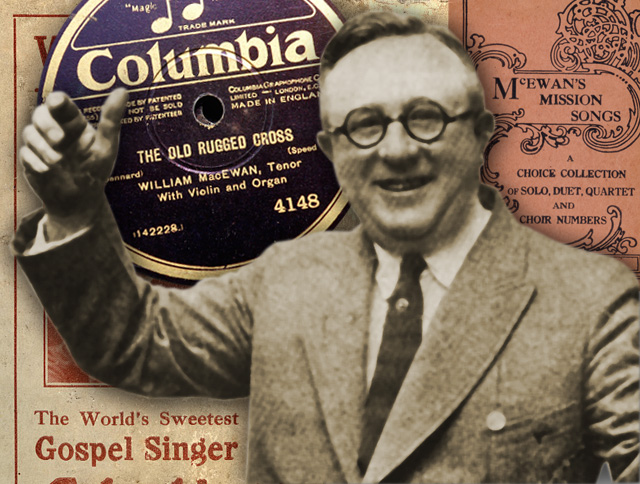
Part Ten: The story of William MacEwan / McEwan of Glasgow (1871 - 1943) the 'World's Sweetest Gospel Singer'
Introduction: The story below has been assembled from a variety of online sources - newspapers, censuses, marriage certificates and ships passenger lists. If any readers know of errors here I would be pleased to hear from you. This is one of a series of posts to coincide with the 100th anniversary of William McEwan's first recording session in London in November 1911.
........
Part Ten: Epilogue
This series of blog posts is as far as I can take the story of William MacEwan. Others more skilled than I should feel free to get in touch with me if they want to use these blog postings as a basis for more detailed research. I would hope that some of William’s descendants might even have an archive of his diaries, newspaper clippings, family photographs and other artefacts which one day could be published to tell his story with more accuracy than I have been able to. If you are a descendant of his I would love to hear from you. However, if all of these things are long-dumped then I hope that this ten part series is a useful memorial for readers.
During my researches I have found another recording, unlisted in any of Frank Wappat's releases, so perhaps it was one of the originally unissued and unnamed tracks from December 1929 or February 1930. It is "He Hideth My Soul" (written by Co Tyrone born William James Kirkpatrick), Columbia issue number 81511. Listen to it here, and to MacEwan rolling his "r"s in good Scots style:
• He Hideth My Soul (click the black arrow to download to your computer)
For me the story is personal, in that William MacEwan’s records were part of everyday life here in Northern Ireland, among the evangelical Protestant communities that I, my parents and my grandparents grew up in and are still part of. He did more than any other to give ordinary folk the ability to have recorded gospel music in their homes in the era when the gramophone was cutting-edge technology, and established a whole new collection of hymns in the hearts of the people, many of which are still sung today. The songs he recorded, whilst classics to us nowadays, were modern and contemporary for his times. It is a shame that his recordings are now so hard to find, all out of circulation and unavailable to be bought and enjoyed.
Many Scottish evangelists and gospel singers have had a close relationship with the Ulster-Scots folk of Northern Ireland over the generations. There are many more whose lives deserve to be remembered today. Perhaps there are a few other projects like this one which will emerge in future years.
Meanwhile, with Christmas coming, here are two of William MacEwan’s Christmas recordings for you to enjoy, from his London recordings of August 1927.
• Angels Song (labeled “a Christmas number" - click the black arrow to download to your computer)
(words and music by Robert Lowry, whose parents were from Killinchy in Co Down; date of publication unknown)
• Crown Him King of Kings (labeled “a Christmas number” - click the black arrow to download to your computer)
(words and music by Eben E Rexford, published 1912)
William MacEwan, the son of Ayrshire weavers, the grandson of a man from Ireland, the boy who grew up in a Psalms-only Covenanter congregation in Glasgow, became one of the most influential voices in gospel music across the western world. Thanks to everyone who has taken the time to give me positive and constructive feedback on this series. Please feel free to get in touch.
Mark Thompson,
Ballyhalbert, Northern Ireland,
December 2011


Part Nine: The story of William MacEwan / McEwan of Glasgow (1871 - 1943) the 'World's Sweetest Gospel Singer'
Introduction: The story below has been assembled from a variety of online sources - newspapers, censuses, marriage certificates and ships passenger lists. If any readers know of errors here I would be pleased to hear from you. This is one of a series of posts to coincide with the 100th anniversary of William McEwan's first recording session in London in November 1911.
........
Part Nine: The Frank Wappat releases
Over the years since William MacEwan’s death in 1943, his legacy has lived on in the record collections and memories of the older generation. However as the gramophone and 78s were superceded by LPs, there have been only a few re-releases of his music. I am indebted to Frank Wappat, formerly of BBC Radio North in Newcastle Upon Tyne, for the work he did over the years in making MacEwan’s music available again in three different formats in the 1980s and 1990s as audio technology developed:
1) a 13 track LP in the mid 1980s (released by Mawson & Wareham Music, Newcastle Upon Tyne, catalogue no MWM1029, in a shocking pink sleeve!)
2) an 82 track triple cassette box set in the late 1980s / early 1990s (released by Frank’s own FWM label),
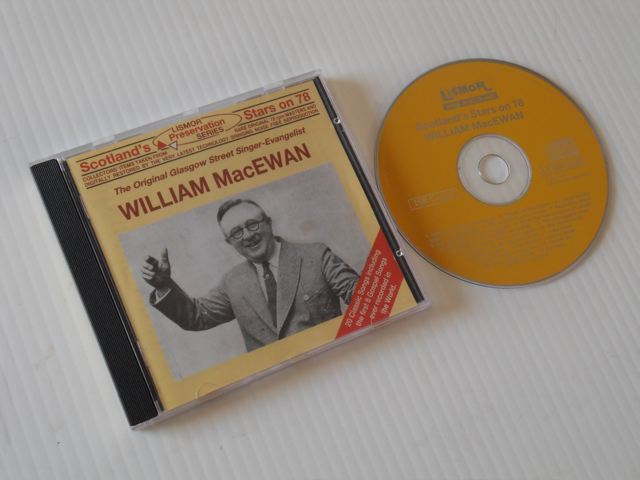
3) a 20 track CD (released by Lismor Recordings of Glasgow in 1994 as part of their “Scotland’s Stars on 78” series, catalogue no LCOM 5235).
Sadly all of these are now out of production and are hard to find. Frank’s notes on the insert of the cassette box set have been my single source of meticulous information about MacEwan’s recording sessions; his notes on the LP sleeve and the CD booklet have also given me more insights. I have been in touch with Frank directly to thank him, but sadly his health is poor at present. I wish him a speedy recovery and would like to take this opportunity to publicly acknowledge his work is carrying on an interest in the recordings of William MacEwan.
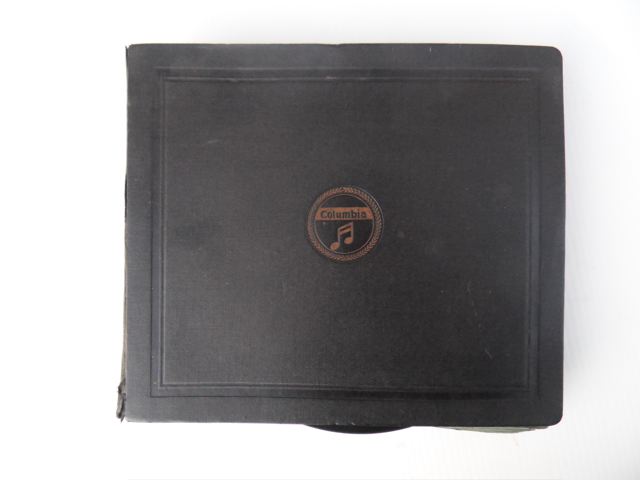
Below are pics of the albums which his early 78s were sold in, one with a portrait photo (this is probably the 'fine art album' referred to in the Columbia catalogue here) and the other a black leather Columbia one which Joe from Ayrshire loaned to me earlier this year. I have since tracked down another one of these for myself, which had exactly the same selection of MacEwan records in it as Joe's does).
Finally, a sheet music book from the early 1940s:
To be continued






Part Eight: The story of William MacEwan / McEwan of Glasgow (1871 - 1943) the 'World's Sweetest Gospel Singer'
Introduction: The story below has been assembled from a variety of online sources - newspapers, censuses, marriage certificates and ships passenger lists. If any readers know of errors here I would be pleased to hear from you. This is one of a series of posts to coincide with the 100th anniversary of William McEwan's first recording session in London in November 1911.
........
Part Eight: The final (London) recordings, death in 1943 and posthumous recognition in 1973
By the end of January 1931 William MacEwan’s American recordings were all completed. The last sea journey I can find for him is on board the SS Auranta on 27 April 1931, apparently alone, sailing from New York to Glasgow. He is listed as a singer aged 59, with the address 9 Leyden Street, Maryhill, Glasgow.
The Ninth Recording Session, London, December 1931
William’s ninth recording session was back in London in December 1931 at Methodist Central Hall in Westminster. Backed by a pipe organ and violin he recorded these six pieces:
• God be with you till we meet again
(words by Jeremiah Rankin, music by William Tomer, published 1880)
• When the roll is called up yonder
(words and music by James Black, published 1893)
• O Love that Wilt not let me go
(words by George Matheson, Music by Albert Peace, published 1882)
• Some time we’ll understand
(words by Maxwell Cornelius, music by James McGranahan, published 1891)
There were three other tracks recorded at this session, two by an ensemble called the “Savoy Hotel Orpheans” and one other simply called “test record”.
The Tenth and Final Recordings, London, March 1932
His last ever recording session was back at Christ Church on Westminster Bridge Road in London, around March 1932, again backed by pipe organ and violin. This time an entire gospel service was recorded. The Rev Harold Dixon Longbottom (1886 – 1962) prayed and gave the Bible reading.
(Note of interest to Ulster readers: HD Longbottom had been assistant minister of “Protestant Reformers Memorial Church” in Liverpool since 1913. He was also a leading Orangeman and local Councillor in the city. He was Leader of the now-defunct Liverpool Protestant Party from 1927 – 1964, and was Mayor of Liverpool in 1950-51. “Protestant Reformers Memorial Church” joined the Free Presbyterian Church of Ulster in 1982. I am not suggesting that MacEwan shared Longbottom’s views or interests.)
The service was released as a double sided 12” record and included MacEwan singing:
• God Will Take Care of You
(words by Civilla Martin, music by Walter Martin, published 1904)
• The Old Rugged Cross
(words and music by George Bennard, published 1913)
• My Mother’s Prayer
(J.W. Van de Venter - written 1895)
• I Heard the Voice of Jesus Say
(Words: Horatius Bonar, 1846. Music: John Dykes, 1868)
• We will talk it o’er together bye and bye
(words and music by Mrs C H Morris, published c. 1914)
• Abide With Me
(Words: Henry Lyte, 1847. Music: William Monk, 1861)
William’s voice was never again recorded, although I have no doubt that he would have continued to sing at public events as he had done throughout his life. There is now a gap of 11 years where at this point I have no other information about him.
Death in New York, 23 June 1943
The final document I have found is his death certificate; it says that he died of cancer on 23 June 1943 at 1.15am, at Kings County Hospital in Brooklyn, aged 71. He had been hospitalized for 6 days. The certificate is signed by his daughter Jean McEwan Roche and it seems that William had been living with Jean before he went into hospital – his final address is that same as Jean’s given address – 69 Lafayette Avenue, Brooklyn, New York. Today the building is Academy Restaurant - pic below from Google Maps Street View.
His trade/occupation is stated as singer/evangelist. Interestingly his first wife Jeanie, who had died about 20 years earlier, is stated as being his spouse – rather than his still-living second wife Mabel. Perhaps that is because the certificate was filled in by his daughter Jean, whose mother was Jeanie.
William MacEwan was buried at Cypress Hills Cemetery in Brooklyn. I have emailed the cemetery office to see if they can trace his grave and send me a photo of his gravestone, but have had no reply as yet.
Mabel seems to have lived to a ripe old age; I have found a death record for her dated February 1972 which gives her last residence at 10530 Hartsdale, Westchester, New York, SSN 451-38-7893. She was aged 78.
Royal recognition in Scotland
The following year, in September 1973, 30 years after his death, William MacEwan was officially recognised by the Crown when the Lord Lyon King of Arms in Edinburgh issued a Letters Patent and a new Coat of Arms to William’s daughter in law, bearing the motto “Crescendo”.
To be continued
