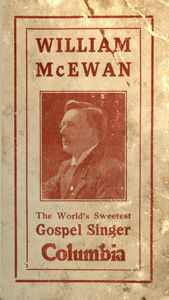


Great oul song, was also recorded by Ulsterman Richard Hayward. Happy Titanic centenary.
Friday, March 30, 2012
The Carter Family - "It Was Sad when that Great Ship Went Down"


An Ulster-Scots marriage
"A min' hearin' yinst," said Jock, "o' a man that marriet a wumman nearly twice his age. She was nae beauty ether, but she had a ferm o' lan'. The minister remonstrated wi' him aboot it; an' says he, 'A ken,' says he, 'that she's no young, an' the lan's hilly; but ye canna hae iverythin'."
- from the Humour of Druid's Island by Archibald M'Ilroy (1902)

Thursday, March 29, 2012
"Folk's wise that can content themsel's in their ain hames"
So says Widow M'Crum in Archibald M'Ilroy's collection of short stories The Humour of Druid's Island, published in 1902 and set in Islandmagee in County Antrim. After all our gallavantin' around the country lately it is nice for Graeme and I to be doing four consecutive nights just doon the road at the People's Hall, Portavogie, starting on Sunday at 8.15pm. If you have never been inside a traditional wee Ulster mission hall, with wooden floorboards, wooden forms (not plastic chairs) and a pot-bellied cast iron stove, then this is the opportunity you've been waiting for! We'll just be doing what we love, playing oul hymns from Redemption Songs for folk to sing along with - nothing fancy and nae nonsense. David Boyd is the speaker on all three nights, and we are very pleased he has asked us to help out. Hope to see you there.

Tuesday, March 27, 2012
President Woodrow Wilson, County Down and Scotland
"...James Wilson, his grandfather, was the first of the family to come to America. He set sail from County Down, Ireland, in 1807. On the ship that sailed to Philadelphia, came also Anne Adams, an Ulster young woman, bound also for the land of freedom and opportunity. A sea voyage is notable for intimate confidences.That voyage brought the young people into the haven of love which was followed by marriage the next year in Philadelphia. Good Presbyterians, both, it was Rev. George C. Potts, pastor of the Fourth Presbyterian Church, who performed the ceremony. The wife had vivid recollections of her North of Ireland home and loved to old age to talk of it, saying from that home she could see the white linen flying on the line in Scotland..." - from The Life of Woodrow Wilson, by Josephus Daniels.
Let me suggest that President Woodrow Wilson's grandmother might have been from the Ards. And that she had eyes like a hawk.

The Ulster Tune Book: A Selection of Tunes in full vocal score, specially adapted for use in Presbyterian churches - published April 1868
From the Preface - "...it is to be regretted that not a few tunes in general use are far from meriting the position they occupy in public esteem. Such compositions are light and irreverent, abounding in trills and repeats, being for the most part mere perversions of secular airs and totally unsuited both for the Church and for the holy words with which they are associated...". Compiled and edited by Mr William Moss, Precentor of Fisherwick Place Church, Belfast.

Monday, March 26, 2012
The Old Ulster Shirt - a "Fieldwear" product
With detachable collar and cuffs, this is the shirt for every gentleman.


Wednesday, March 21, 2012
The Inaugural Whitelaw Reid Memorial Lecture - Assembly Buildings, Belfast, next Wednesday evening.
It's good when folk take notice! I cannot claim much credit here but I am glad that others are paying attention to important historical events and are marking them appropriately. Nelson will do a fine job giving this lecture in the same building as Reid did 100 years ago.

Friday, March 16, 2012
Liberty and St Patrick, 17 March 1764 - "the Christian white savages of Peckstang and Donegall"
Benjamin Franklin wasn't overly fussed about the Ulster-Scots who were filling Pennsylvania. Some have said that he feared the strength of their numbers, and the decline of Quaker control (much of which had been built up by Ulster-born James Logan). A group of them, known locally as the Paxton Boys, had killed 20 Conestoga Indians around 1763. Outraged, Franklin put pen to paper and wrote a famous response entitled A Narrative of the Late Massacres, in Lancaster County, of a Number of Indians, Friends of this Province, by Persons Unknown With Some Observations on the Same (link here). Persons unknown? Hardly, he probably knew them by name. He described the Scotch-Irish as 'the Christian white savages of Peckstang and Donegall'.
Incensed by what he regarded as Franklin's one-sided account of the context and events, a Carrickmacross (County Monaghan) born Anglican itinerant missionary, Thomas Barton (1730-1780), responded with his own publication The Conduct of the Paxton-men, Impartially Represented (link here). He quoted a Quaker member of the assembly for Chester County, Nathaniel Grubb, who in 1755 in an 'unChristian and ungenerous speech' had described the Ulster settlers as 'a pack of insignificant Scotch-Irish, who, if they were all killed, could well enough be spared' (source here). Grubb later denied he had ever said such thing. Barton believed the Pennsylvania authorities had left the Scotch-Irish communities unprotected for many years, and therefore they had a right to self-defence.
Here's the main point for today. He signed it off as follows:
Dated from my Farm-House, March 17th, 1764
A Day dedicated to Liberty and St Patrick.
So in Scotch-Irish frontier Pennsylvania of 1764, St Patrick's Day was being observed.

Saturday, March 10, 2012
Mair fae MacIntosh, 1900

...to this present day the term "Ulster-Scot" is a very frequent one on the lips of the people found in County Antrim, County Derry, and County Down. In one of the leading journals of the North of Ireland for many years there appeared regularly articles from the pen of a well-known Presbyterian minister, who always signed himself "Ulster Scot"...'
From Scotch-Irish: The Term and the Fact by Rev J S MacIntosh (an Ulster-American if ever there was one), speaking in Knoxville, Tennessee in 1900.
Thursday, March 08, 2012
Something different
Rock band The Answer are from Downpatrick, their most recent album is called Revival. The video is of their second single, Nowhere Freeway. Great stuff! Some of you will enjoy the one below...
Wednesday, March 07, 2012
"The Making of the Ulsterman" by Rev Dr J S MacIntosh
'...What changed the Lowlander, and what gave us the Ulsterman? In this study I have drawn very largely upon the labors of two friends of former years Dr. William D. Killen of the Assembly's College, one of the most learned and accurate of historians, and the Rev. George Hill, once Librarian of Queen's College, Belfast, Ireland, than whom never was there more ardent student of old annals and reliable of antiquarians.
But more largely still have I drawn on my own personal watch and study of this Ulster folk in their homes, their markets and their churches. From Derry to Down I have lived with them. Every town, village and hamlet from the Causeway to Carlingford is familiar to me. Knowing the Lowlander and the Scotch-Irish of this land, I have studied the Ulsterman and his story of rights and wrongs, and that eagerly, for years. I speak that which I have seen, and testify what I have heard from their lips, read from old family books, church records and many a tombstone in kirk-yards...
...You can not measure aright his burning sense of wrong at a later day ; you can not understand his methodized madness till he shows his broken treaties and dishonored compacts. He had the right to expect the backing of England, the fullest enjoyment of his hard-won home, the co-equal privileges of citizenship, the largest possession of freedom in both church and state. This statement can be easily verified to the fullest from the family history of many old Ulster family histories, from the Montgomery and Hamilton MSS, from state papers, and from a proclamation inviting settlers for Ulster and dated at Edinburgh, 28th of March, 1609 (see here)...'
Short bio: John Samuel Macintosh was born in Philadelphia in 1839, but after the death of his father, he came 'home' to Ulster along with his mother. He became minister of Connor Presbyterian Church in 1862 - 1868, after which he succeeded the famous Henry Cooke at May Street, Belfast. MacIntosh returned to the USA in 1881 to become minister of Second Presbyterian in Philadelphia, and was a leading figure in the Scotch-Irish Society of the USA. He died in San Franscisco in 1906.
Here is a link to his 1884 book The Breakers of the Yoke - Sketches and Studies of the Men and Scenes of the Reformation.
Wednesday, February 29, 2012
'...it is a glimpse, and on the whole a fascinating glimpse, into the quiet country life of the Ulster Scot, well calculated to quicken the interest in and the respect for the sturdy race he represents...'
So says one of the reviews of the writings of Archibald M'Ilroy, which I came across a few weeks ago in an old periodical which has been on my shelves for donkeys years, and which I then scanned to eventually post here. They amazed me because as the self-professed 'clever' people keep telling us, the term 'Ulster Scot' was only invented about 15 years ago. So the appearance of the term, twice, in these reviews from 1899 must therefore be elaborate forgeries, akin to the Hitler Diaries. Or else, maybe the 'clever people' are wrong.
But since when was 'quiet country life' given much 'respect' anyway? McIlroy's work is top-notch and highly recommended - I'm re-reading 'The Auld Meetin Hoose Green' and 'The Humour of Druid's Island' at the moment. Click to enlarge.


Tuesday, February 28, 2012
Update on Charles Wesley and 'Jesus Lover of My Soul" (from two posts ago)
The farm where Wesley sought refuge in the old stories (read one of them here) is named as "Island Barn Farm" near Killinchy. It has been pointed out to me today that there is an "Islandbane" townland near Ringhaddy, in Killinchy parish. It is a small outcrop of land into Strangford Lough. It appears to have had just one farmstead - see below an early 1800s map, and a present-day aerial photograph. I think that's the spot.


Monday, February 27, 2012
Ulster Covenant evening lectures; Titanic centenary concerts
There has been a lot of froth on the media today about commemorations and centenaries. Westbourne Presbyterian Church on the Newtownards Road in East Belfast is taking the initiative this year. Known as 'The Shipyard Church' since it was built in 1880, it was the biggest signing centre for the Ulster Covenant in 1912 after Belfast City Hall.
• Starting on Thursday 22nd March is a series of four monthly evening talks on different aspects of the Covenant. Entry is free. Some well-known names will be speaking.
• And on Sat 31 March, and Friday 20 April, there are two concerts being held in the Church to mark the centenary of the Titanic. The men who built her would have sat on these pews on a Sunday. Suggested donations are £10 per ticket.
You can find out more at their new website here.


Charles Wesley, County Down and the Ulster Covenant
(story is quoted from this website)
"...Charles Wesley (1707-1788) was conducting one of his many open-air meetings, this one near Killyleagh, (Northern) Ireland. During the course of his preaching, a number of persons who took exception to his views assaulted him. Unable to withstand the mob, Wesley fled for his life.
He took refuge in a farmhouse nearby. Jane Lowrie Moore*, a kind-hearted wife of a farmer, hid the panting evangelist in the milk house. She was barely in time, because at that moment some of Wesley’s assailants rushed up. Mrs. Moore tried to divert their attention by preparing refreshments. Fearful that they might search the premises and discover the harried evangelist, she went to the milk house on the pretext of getting a cold drink for her visitors.
Quickly, she bade him, get through the rear window, and hide under the hedge. He clambered through the window and found a little brook flowing beside the hedge, forming a pool with overhanging branches that afforded a pleasant and safe retreat. While waiting for the vindictive Irishmen to give up the search and leave, Wesley pulled a pencil and paper from his pocket and wrote out the immortal hymn, Jesus, Lover of My Soul.
Dr. George Duffield**, author of Stand up for Jesus, another of our famous songs, once said of Wesley’s hymn, If there is anything in Christian experience of joy and sorrow, of affliction and prosperity, of life and death—that hymn truly is the hymn of the ages..."

Jesus, lover of my soul, let me to Thy bosom fly,
While the nearer waters roll, while the tempest still is high.
Hide me, O my Savior, hide, till the storm of life is past;
Safe into the haven guide; O receive my soul at last.
Other refuge have I none, hangs my helpless soul on Thee;
Leave, ah! leave me not alone, still support and comfort me.
All my trust on Thee is stayed, all my help from Thee I bring;
Cover my defenseless head with the shadow of Thy wing.
Wilt Thou not regard my call? Wilt Thou not accept my prayer?
Lo! I sink, I faint, I fall—Lo! on Thee I cast my care;
Reach me out Thy gracious hand! While I of Thy strength receive,
Hoping against hope I stand, dying, and behold, I live.
Thou, O Christ, art all I want, more than all in Thee I find;
Raise the fallen, cheer the faint, heal the sick, and lead the blind.
Just and holy is Thy name, I am all unrighteousness;
False and full of sin I am; Thou art full of truth and grace.
Plenteous grace with Thee is found, grace to cover all my sin;
Let the healing streams abound; make and keep me pure within.
Thou of life the fountain art, freely let me take of Thee;
Spring Thou up within my heart; rise to all eternity.
Jesus Lover of My Soul was one of the hymns associated with the Ulster Covenant of 1912 and was printed on the Ulster Day Service Sheet which was produced for the many church services held on the morning of 28 September 1912. I wonder if its Ulster origin is partly why it was chosen? It is also said that the Royal Welsh Fusiliers sang this as they went 'over the top' at Mametz Wood in World War One. The best-known tune for it is called Hollingsby, but with a bit of work it can be made to fit 'My Heart is like a Red Red Rose', Robert Burns' famous love song. One to be tried out this year I think.
Here it is to a new tune:
* The hymnwriter Robert Lowry's parents were said to have come from near Killyleagh. Were they related to Jane Lowrie Moore?
** Duffield was also of Ulster descent.
Friday, February 24, 2012
The faithful remnant
Now this is funny. There is a segment of the (Ulster) Protestant psyche which wants to be the faithful remnant, the chosen few, Gideon's 300. I suppose everyone thinks they're right. From The Gospel Coalition.
Wednesday, February 22, 2012
The overpowering trade of the Scottish merchants & the pygmy piper of Islandmagee
Old books are brilliant. I came across these great quotes recently:
'...through the overpowering trade of the Scottish merchants of Belfast the English trade of Lisburn is upon ruin… those Scotch have got all the general commissions from the London merchants for trade into their hands and so not one Englishman in these parts is so employed...’ (1679)
'...a little beyond Port Davy stands a promontory called the Black-head, whereon stands a lighthouse, and under it from the sea there is a large cave, where I have been told by the Country, a piper went in, and was heard at a place two miles form thence under ground; he must have been very little, for I have run fox into it with my dogs and killed him at the far end...' (1683)
Tuesday, February 21, 2012
Sunday, February 12, 2012
The Pikemen - A Romance of the Ards of Down, by S.R. Keightley (published 1903)
I recently got hold of a copy of 'The Pikemen - A Romance of the Ards of Down', published in 1903, written by Samuel Robert Keightley (1859-1949, pictured here) of Lisburn. I had been trying to get a copy of this for a while, and when it arrived I wasn't disappointed. It's a classic 'kailyard' format novel, set around the time of the Battle of Ballynahinch, and purports to be a first-hand account of the events as told by a Rev Patrick Stirling who had fled Ulster for the USA (Sangamon County, Illinois to be precise - click here to read the History of Early Settlers of Sangamon County published in 1876 and you'll find plenty of references to Ulster emigrants). Keightley had previously published 'The Crimson Sign', a novel about the Siege of Derry, and other books as well. You can read more about him here. Here are some excerpts:
"...there was a fever in my own blood. My hands were shaking and my heart was beating like a sea in storm. I hardly knew myself. My forefathers had marched to the lilt of the Psalms under the blue banner of the Covenant, and had laid down their lives like men at Drumclog and Bothwell Bridge on the other side of the narrow sea...
... he turned suddenly and stood staring up the road toward Kircubbin as you go to Newton... 'Archie Spence gave a hunted man twa nichts' lodgin' - his guid woman is a kin' ov cousin ov my ain - an' noo they're payin' him fur the kindness that he showed me - harberin' rebels they ca' it. The white-heidit bairns are oot on the roadside noo, an' the bonny roof-tree that shud be as sacred as the wa's ov a palace are jist a wheen ov charred sticks... before ye gang tae bed this nicht ye'll see how Britain trates the honest men ov Ards, shud I hae tae carry ye ivery fut ov the road mysel...
...Here on this night of June burned the watchfires of liberty where eight thousand men of Down were gathered... It was a great and inspiring sight - great not in the pomp and splendour of war, but in heroic courage and noble self-sacrifice. Here were men from Killyleagh and Strangford shore, from hilly Dromara and Rathfriland, and the sweet valley of the Lagan; hardy fishermen from Portavogie and Ardglass; weavers from Lisburn and Newtownards and Bangor, all dressed in decent Sunday wear like men going to the last communion of death... here and there a Psalm tune was being sung by many voices to the tune of 'Martyrdom' or the 'Old Hundred'..."
I'm looking forward to reading it. For a Belfast-born academic living in Lisburn, with a Bangor JP for a father, Keightley has a brave hannlin' of the hamely tongue throughout the book, and as the excerpts above show he also had a firm grasp of cultural identity and history. Ask any of his present-day equivalents what happened at Drumclog and they'll struggle to tell you. 'The Pikemen - A Romance of the Ards of Down' might be another wee indicator of just how widespread Ulster-Scots speech was a century ago.
The Ulster Journal of Archaeology review of the book said:

The Pikemen. A romance of the Ards of Down. By S. R. Keightly
London: Hutchinson & Co. 1903.
This is a story of the year '98 in the county of Down, written in vivid and telling language by one who has an excellent knowledge of the period of which he writes, and a thorough grasp of local circumstances and the common dialect of the people. There is not a dry or uninteresting chapter throughout the hook, and it will afford ample pleasure to the general reader of romance, and more especially to those who are residing in the county in which the principal scenes described in the book are laid. We heartily recommend to the cultured author the desirability of a cheaper and more popular issue of this work, so as to make its pages accessible to everyone. The principal characters are painted with a decisive brush, but if anything, we consider the scene in the old meeting-house at Greyabbey a little over-drawn. Here we have the Rev. James Porter balloting in the communion cup for the name of him who was to do away with the informer Newell. We doubt the accuracy of this incident, and even the death of Newell at this place ; nor do we think this wretched man was such a character as is so skilfully portrayed by the writer. Be this as it may, it is ill to cavil with dry historical details in a work that has many charms, a store of information, and the deepest interest to even the most casual reader.
(PS - Here's another biography of Keightley - click here. A similarly-entitled novel about the events of 1798 in County Antrim is James McHenry's The Insurgent Chief, the Pikemen of '98 which you can read online here.)
Monday, February 06, 2012
How does your garden grow? (1902)
‘...The English-planted districts in Ulster are still fragrant with fruits and flowers, no parishes being more noticeable in this respect that those in the Moira, Downshire and Hertford Estates, in South Antrim and Down. The Scotch-planted districts are the very opposite, there no gardens as a rule are to be found, and the filth of the cattle surrounds the dwellings. The most casual observer notices the changes at once when passing from one to the other, say from Carnmoney or Ballynure to Glenavy or Ballinderry...’
So you can now accumulate a dung midden at your door and claim that it is of cultural importance. You might even get a grant for it if you can persuade a neighbour of a different religious persuasion to help you to build it, and then claim that it is a cross-community initiative. From the Ulster Journal of Archaeology 1902, page 98.
Subscribe to:
Posts (Atom)