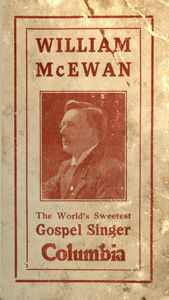

Introduction: The story below has been assembled from a variety of online sources - newspapers, censuses, marriage certificates and ships passenger lists. If any readers know of errors here I would be pleased to hear from you. This is one of a series of posts to coincide with the 100th anniversary of William McEwan's first recording session in London in November 1911.
........
PART TWO: His first trip to America, Fame and Marriage
In June 1889, a 17 year old millworker called William McEwan, travelling alone and carrying just one bag, boarded the SS Nestorian in Glasgow. The ship stopped at Moville in Donegal, and Galway, before heading across the Atlantic, arriving in Boston on 18 June. He headed to Lawrence, New Jersey, a town of 100,000 people, half of whom were described in 1890 as ‘foreign born’.
The ‘Keith - Proctor Circuit’ was a coming together of two great American entertainment promoters. Benjamin Franklin Keith and Frederick Freeman Proctor owned a chain of highly popular all-day theatres in the booming immigrant cities of Boston, Philadelphia, Newark and New York. McEwan signed up with them and sang in theatres all along the eastern coast states.
[The renowned Irish traditional fiddle player Michael Coleman (1891-1945) also played for the Keith circuit between 1914 and 1917. Coleman recorded around 80 78rpm records in the USA from 1921-1936, which were sent back home to Ireland and had a phenomenal effect in reviving Irish traditional music. Coleman is described on a memorial near his birthplace in Sligo as the ‘Saviour of Irish traditional music’ whose legacy is still revered today. Samples of his music are available here.]
William McEwan returned to Scotland and on 26 December 1890 was married at Chalmers Street Hall in Calton, Glasgow. His bride was Jeanie Robinson, a handkerchief hemmer; they were both aged 19. Jeanie’s parents were Joseph Robinson (deceased) and Jeanie Robinson (maiden name Scott). The wedding was conducted by Rev James Gage, Minister of Great Hamilton Street Free Church and the newlyweds settled into married life at 88 Brook Street, Glasgow.
The Scottish Census of 1891 gives the McEwans’ address as being 171 Wolseley Street, Govan, Glasgow, and state that William was a handmill warper. However, the draw of higher pay on the stages of America was strong and soon William and Jeanie sailed for America. The passenger list of another voyage of the SS Nestorian (sailing from Glasgow and arriving in Boston on 22 October 1891) includes a William McEwan, a millhand aged 20 who had been to the USA before. As time went by, the McEwans, now settled in America, had their first child - a daughter, who they named Jeanie after her mother and maternal grandmother, was born in Massachusetts around late 1892.
William certainly made more money in America, but the life of a professional entertainer brought him under other influences too:
“…(William McEwan) came to America when a young man, did a little concert work and returned to his native land where he found his sweetheart, as he put it. He was married and returned to America where he engaged in light opera and vaudeville work because it offered more lucrative wages.
McEwan said life ‘on the road’ was hardly conducive to Christianity. He declared people on the stage got together each Sunday and sang ‘Where Is My Wandering Boy Tonight’ [which was written by Robert Lowry, who was born in Pennsylvania of Ulster parents] and thought they were right with God until next Sunday. That’s all the religion, he declared, that is to be found among stage folks.
While on the stage, the chorister said, he learned to drink. Although he was never a drunkard, he said, he had been under the influence of drink. His wife traveled with him continually and after their first child was born, Mrs McEwan had a desire to return home. McEwan said he took her to New York and put her on a steamship. His desire was so great to return that he could not overcome it, and the next day he left on a boat sailing from Boston, arriving home a day after his wife…”
So whether it was just homesickness, or perhaps a young wife and mother struggling to cope with her husband’s lifestyle, Jeanie headed back to Scotland, taking their only child with her. The passenger records for the SS Circassia, sailing from New York to Glasgow, include a Mrs J McEwan aged 22 and Jeanie McEwan aged 17 months. They set foot on Scottish soil on 26 April 1894.
William followed them the next day. Now a married man with responsibilities, and back home in Scotland, William McEwan took a job as an insurance agent. They had another child, this time a son who they named William, born around 1899. The 1901 Scotland Census records that William and Jeanie McEwan, both aged 29, were living at 59 Landressy St, Greenhead, Glasgow, with their daughter Jeanie, aged 8, and their son William Jr., aged 2. And around 1902 a second daughter, Mary, was born.
McEwan's teenage years as a 'wandering boy', sailing twice from Glasgow to America and back again, may have seemed like the last and only opportunity he would have to become a world famous singer. Yet music was never far away, and William carried on singing on the stages of Scotland...
...but the biggest change in William McEwan’s life was yet to come.
.
Friday, October 28, 2011
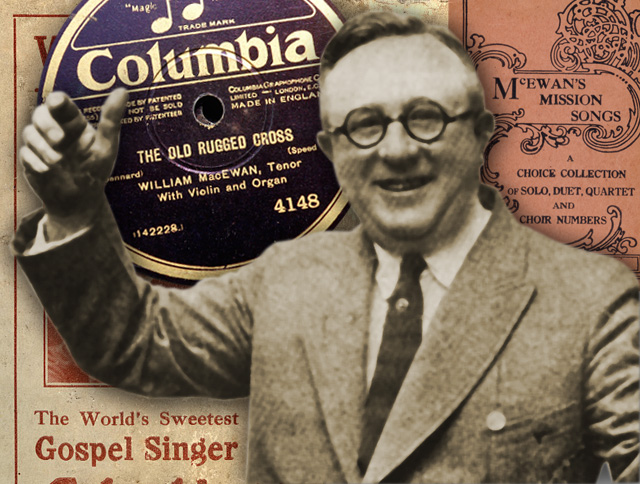
Part Two: The story of William MacEwan / McEwan of Glasgow (1871 - 1943) the 'World's Sweetest Gospel Singer'


Wednesday, October 26, 2011
Part One: The story of William MacEwan / McEwan of Glasgow (1871 - 1943) the 'World's Sweetest Gospel Singer'
Introduction: Back in the early 1990s during my student days at the Art College in Belfast, I did a fair bit of hoking in old second hand bookshops and junk shops around Smithfield and other places. This was before the prosperity bubble of the late 90s/early 2000s, and so it was still fairly easy to find remnants of bygone days. Digging through the piles of old 78rpm records, one name appeared over and over again - William McEwan. It seemed that every shop had some of his records, dumped by people who had forgotten him, a once-household name who had been left behind by the 'progress' of advances like the LP, the audio cassette and the CD. Around this time an audio cassette triple box-set of all 82 of McEwan's known recordings came out, on a limited-edition private release by Frank Wappat of BBC North in Newcastle Upon Tyne, England. A few years later I learned that McEwan's recording of the Scots language piece 'My Ain Countrie' had been one of my late grandfather's favourite songs.
Yet, despite William McEwan's apparent popularity and commercial success, I have never been able to find a definitive biography of him and so I had no idea of the scale of his musical achievements. Over recent months I have gathered up as much information about him as I could find. These blog posts are my attempt to piece together something of his story and to give him his place back for our generation - coinciding with the 100th anniversary of his first recording session, for Columbia Records in London, in November 1911.
This is the story of how a poor Glasgow boy, of Ayrshire parents, became one of the biggest musical names in the world.
........
PART ONE: Ayrshire Roots, Glasgow upbringing and early talent
William McEwan, the man who would be called ‘The World’s Sweetest Gospel Singer’, was born on 11th December 1871, in the Bridgeton area of Glasgow. William later described his upbringing as having been ‘of poor parentage’ and that his father was a hand loom weaver or pattern worker.
His parents were James and Margaret McEwen (maiden name McGhie); they had been married in the thriving fishing port of Girvan in Ayrshire on Hogmanay (31 December) 1858, aged 22 and 17 respectively and moved into a house in Wilson Street. James had been born in Girvan in 1837; James's father, also called James, had been born in Ireland (no precise location that I know of) in 1801. In an interview in the USA in 1912, William McEwan said that his family roots were in Ayrshire.
Some time between 1858 and 1871 (during the time of the society-transforming 1859 evangelical revivals in both Scotland and Ulster) the McEwen / McEwan family moved to Glasgow, where they attended First Reformed Presbyterian Church in Great Hamilton Street, a congregation which proudly traced its origins to the times of the Covenanters. William McEwan confirmed in later life that he had been raised in the ‘Reformed Presbyterian church’ and that “…he never knew what it was to sing a Gospel hymn in his boyhood days because the church to which he went always sang the Psalms…” (This is a distinction which is a factor in present-day growth of the Reformed Presbyterian Church in Scotland over the past few months).
However, his parents recognised that young William had great singing talent:
“…In early life his parents discovered that he had a sweet voice and his father’s ambition for him to succeed was so great that he contrived to arrange for him to study under one of Scotland’s great music masters. He learned fast, became a concert singer and won instantaneous success… ”
“… he studied music at an early age under the famous Baillie (George) Taggart of Glasgow and later received a certificate from the Royal Academy of Music in London. He traveled for years on the Keith-Proctor Circuit and later in Scotland where he traveled in Vaudeville…”
George Taggart was a shrewd choice by William's father - Taggart was the conductor of the Glasgow Select Choir, and also of Glasgow Glee and Catch Club. His daughter, Jenny Taggart, went on to become a famous soprano; another daughter, Rena, was a violinist. George Taggart is known to have taken Glaswegian artists to tour in North America and he may well have recommended the poor but brilliantly talented young McEwan to some of his contacts on the other side of the Atlantic.
Sometime around the years 1887 - 1890 the teenage William McEwan, a hand-loom warper from Bridgeton, was bound for the stages and concert halls of America.
..
Monday, October 24, 2011
The Latimers: A Tale of the Western Insurrection of 1794 by Rev. Dr. Henry McCook (Philadelphia, 1898)
This post is for Jenny in Alaska. Here are more examples of that Scotch-Irish symbol from the late 1800s. Here's a biography of Henry McCook, and here's a free online edition of the book.


Sunday, October 23, 2011

Thursday, October 20, 2011
Westbourne Presbyterian Community Church, Newtownards Road, Belfast
Blond wood, upholstered seats and mood lighting have their place, but there's nothing to beat the beauty of plain and simple.


Wednesday, October 12, 2011
Scotland's William MacEwan (or McEwan), the World's Sweetest Gospel Singer
I'm currently doing some research into the life of the tenor gospel singer William MacEwan (also spelled McEwan) from Glasgow. He was referred to as 'the world's first great gospel singer on record', issuing over 40 old 78rpms during his career. His first recording session was for the Columbia record company in London in November 1911, so exactly 100 years ago next month - this was the session which included my grandfather's favourite hymn, 'My Ain Countrie'.
I have a lot of information about McEwan's musical career, and of hymn books he published, but very little about his personal life - for example I've got conflicting birth dates (1870, 1872 or 1877) and death dates (1943 or 1949) for him, and no conclusive information if he was born in Bridegton in Glasgow or just outside the city. He certainly lived in Bridgeton in later life, but I have also seen a 1922 document with his address given as 90 Mevia Street, Glasgow (but can't find any other record of a street of that name ever having existed at all). I also have a reference to him dying and being buried in Los Angeles (in 1949) So this post is just to see if anyone out there knows much about him and would be interested in helping.
I will post what musical information I have in November. Maybe someone out there knows of a fuller biography? A man of his calibre and influence deserves to be remembered in the year of his centenary.
Tuesday, October 11, 2011
Monday, October 10, 2011
Wasted Years
When I was 14, this Iron Maiden song blew me away:
With me now on the brink of 40, Ryan Adams has somehow extracted this beautiful acoustic version from the bombast of the original. It's a masterful reworking, seemingly recorded for a Dutch radio programme called GI:EL. His new album, Ashes & Fire, is currently streaming free here; official release date is tomorrow. It sounds like a sparking return to the form he was in about a decade ago on his first two releases Heartbreaker (2000) and Gold (2001). A recent interview with him is available here.
Sunday, October 09, 2011
My kind of Apple Store
Not a shiny glass and steel place which sells over-priced gadgets, but a real handmade wooden storage system to put actual apples in. This is the 4 drawer version, the 10 drawer one is even better. Both are available here at GardenTrading.co.uk

Friday, October 07, 2011
Scrabo this afternoon
Computer screens just aren't big enough to show you the scale of this view. Ulster is a beautiful place... when the sun shines. (Click to enlarge.. and then put your nose against your screen.)

Thursday, October 06, 2011
"...but that's the price we have to pay..." - The Lost Notebooks of Hank Williams, new CD release
> Buy it here on Amazon.co.uk
> Review here
Wednesday, October 05, 2011
Gillian Welch, Belfast Waterfront Hall, Friday 18th November 2011
Thanks to Billy Kerr fae Irvine in Ayrshire for alerting me to this! Tickets are £27.50 which is far from cheap, but as all those shampoo adverts say, it's "because she's worth it". (Now if she changed her surname to 'Scotch-Irish' then we'd be getting somewhere!). The surname is similar to this great Ulster-Scots minister of Templepatrick. Just listen to this...
Tuesday, October 04, 2011
The greatest Lutheran bar band ever - The Jayhawks "Mockingbird Time"
So says theology & culture website Mockingbird about the wonderful Jayhawks. Or what about "jangly God-haunted Midwestern country-folk with fuzz guitars and harmonies that redefine the words “sandpaper-and-honey.” Mockingbird Time is The Jayhawks' new album. I remember around 1993 driving a carload of friends to Dublin one night to see them play, and I think we drove straight back home again after the show was over, getting back to Belfast as the sun was rising around 5am. Back then it was a hairy enough trip... Not many men can get away with wearing a cardigan over a checked waistcoat, but Mark Olson does. The vocal harmonies of Olson and Gary Louris can be beautiful - imperfect perfection.
One new video below of Mark Olson and Gary Louris playing live and simple for RollingStone.com, posted there just yesterday with five other clips and a short interview. Enjoy.
Sunday, October 02, 2011
"Ireland requireth rather lasting and warm clothes than gorgeous and dear garments"
So wrote Sir Thomas Smith in 1572, and it was a prophetic statement for our rain-drenched tour of the Upper Ards on Saturday morning! We had called the tour "A Forenoon Doon the Upper Ards", but with the weather forecast we joked about re-naming it "A Forenoon gettin' droont in the Upper Ards!". And by about 10am the forecast came true.
The tour included a visit to Newcastle to see the location where the Smith colony set up their first base-camp headquarters in their failed effort to establish an English community in the Ards which would oust the Clandeboye O'Neills. There were 31 people in total, drawn from four local historical societies (Ards, Loughries, Bangor and Comber), with various friends and other folk as well. We started at 9.00am in Newtownards and made numerous stops the whole way down the Strangford Lough shore to Portaferry and back up the other coast as far as Millisle, before heading back to Ards for 1pm. Plenty of crack and banter, a very welcome tea and scones stop, and great support from Ards Borough Council and the Northern Ireland Environment Agency.
I hope that the commentary was interesting for folk - we covered over 800 years of history, from the arrival of the Anglo-Normans in 1177 which brought the Savage family to Ulster, and of their tangles with the Clandeboye O'Neills, with the English Smith colonists and their later interconnections with the Scottish Hamiltons and Montgomeries, and also of 1798. The rendition of the poem 'Betty MacBlaine' went down well! We didn't bother making a few of the stops just because of the weather, but the stories were told and the places can be re-visited some day. Here's a pic of half of the group up in the lecture room building at Kirkistown Castle - the rest were in the castle tower! And Mr Balmoral was generous enough to foot the bill at Knott's Coffee Shop for a light lunch! So it was a wet day, but a good day - local folk visiting local places hearing local stories which can be shared with friends and family. And as usual, I learned as much from the group as they did from me. Great stuff!
Throughout the day quite a few people spoke to me of their frustration at shallow, narrow portrayals of Ulster-Scots heritage, as distinct from the deeply-rooted real stuff. This seems to be quite a widely held view among us plain folk.

Saturday, October 01, 2011
Royal Ulster Rifles original recruitment poster, 1920s
Currently available at Chisholm Larsson Gallery in New York for $400 (£250), size 30" x 20". Click here for full details.

Friday, September 30, 2011
100 years ago this month...
...the mighty Bill Monroe was born. He invented bluegrass music in the 1940s, which was (and still is) a high-octane fusion of a variety of styles including the Scotch-Irish ballads of his rural Kentucky upbringing, the (often dark and quaint) old hymns of the wee country Baptist churches he attended on Sundays, and of the 'brother duets' tradition which he and his brother Charlie had made famous as The Monroe Brothers, with Charlie on guitar and Bill on mandolin. NPR.org has posted this article and tribute online, along with an 8 minute audio clip. There's a brilliant 2.34 discussion about the Monroe Brothers, by Chris Thile and Michael Daves, further down the same page - click here to listen.
Bill Monroe often spoke of his Scotch-Irish cultural roots. I hope that this important musical centenary will be acknowledged on our side of the Atlantic in some way, by more than just this casual blog post.

Wednesday, September 28, 2011
"It taks langer tae clim the loanen whun the blackberry's on the bush..."
It's that time of year again; the hedges have been loaded with blackberries for the past few weeks. However, Harvest Fair day (23 September) was the deadline that the older folk round here had for picking blackberries, none were ever picked after that date. And of course there's the old tradition that Ulster-Scots Presbyterians were/are nicknamed 'Blackmouths' because of the quantity of blackberries they had to eat (the juice stained their mouths - there's an interesting piece on the BBC Ulster-Scots website with a fuller study of the term - click here and scroll down). And here you see the term being used on official government census forms in 1911. The great Scottish Presbyterian minister, Samuel Rutherford (1600-1661), uses the term 'black mouth' in at least two of his renowned Letters, but these might just be poetic references rather than cultural. A great wee fruit and seriously under-rated. It definitely does 'tak langer tae clim the loanen whun the blackberry's on the bush'.

Tuesday, September 27, 2011
The Auld Hoose, Donaghadee
Not sure of the date of this photograph, but would guess early 1900s. Men and boys hanging about outside James McDowell's billiards hall, with two women folk waiting for their workshy husbands? It was at the top of New Street, opposite Grace Neill's.
And here's the same building today:


Monday, September 26, 2011
The Harvest Fair and the Battle of the Somme
From Quintin Point to Carrowdore
Full many a lad will come no more;
In fields of France he sleeps serene
Nor heeds if fields of Ards be green
No more shall he behold with joy
The wooded heights of Clandeboye
Nor see, 'gainst burnished sunset skies
The bastioned bulk of Scrabo rise.
He does not hear the plover cry,
At daybreak, as his team goes by;
Now, on those wide and fertile lands,
His plough is steered by other hands
No more he loads, with ready art,
The soil's rich produce on the cart;
He goes no longer to the Fair;
Stilled is his voice in Newtown Square.
And many a maid, while drag the days
Broods upon bygone happier ways
And deep within her bosom guards
The memory of a Son of Ards
from Songs of a Port by W.H.F. (Belfast, 1920), a collection of poems written from Donaghadee and about many people and places of the Ards and north Down.
Thursday, September 22, 2011
"On September 23..." The Harvest Fair in Newtownards
Yes, tomorrow is Harvest Fair day in the Square in Newtownards. What was once the big event of the year is nowadays not much different than the regular Saturday morning market. There are some great photos of it here from the 1950s and 1960s - I can remember we used to take the afternoon off primary school in the late 1970s to go up to it, and my uncle William had a candy floss and toffee apples stand at it for a few years.
Its origins are hard to trace. Unlike the other towns in Ulster which had been granted a Royal Charter in 1613, the charter granted to Hugh Montgomery's Newtownards did not specify a particular date for the annual fair. Maybe King James I was happy to let Montgomery run Newtownards his own way with minimum interference.
By the time that the Newtownards Chronicle and County Down Observer was first published in 1873, the Harvest Fair was embedded in local culture. The report of that year's fair is entitled "The Rowdies at the Harvest Fair" and tells the story of a group of drunken townies from Belfast creating disturbances after the Fair was over, including fist fights at the bus station and a few arrests - as well as a wee Ards woman who rolled her sleeves up and gave them a taste of their own medicine.
There's an interesting reference to the Fair in the famous local poem The Man from God Knows Where by Bangor poet(ess) Florence Mary Wilson, which is set in the years before and after the 1798 Rebellion:
"Well 'twas gettin' on past the heat o' the year
When I rode to Newtown fair;
I sold as I could (the dealers were near -
Only three-pound-eight for the Innish steer,
An' nothin' at all for the mare!)
I met M'Kee in the throng o' the street,
Says he, 'The grass has grown under our feet
Since they hanged young Warwick here."
It's hard to know how much creative license the writer used, but this implies a harvest fair existed in Newtownards around 1798. But let's be honest, there have been harvest fairs worldwide ever since harvesting began. And, as ever, the major commercial harvests in the Ards go back to the Scottish settlers of 1606 and 1607. The Montgomery Manuscripts record that:
"Now the harvests 1606 and 1607 had stocked the people with grain, for the lands were never so naturally productive since that time... to the degree that they had to spare and to sell to the succeeding new coming planters, who came over the more in number and the faster... the millers also prevented the necessity of bringing meal from Scotland"
A great local song, written sometime in the mid 20th century, tells the story of the Harvest Fair's heyday, but a heyday which even back then some regarded as a comedown from former glories:
On September 23 will you come alang wi me
And we’ll go and pay a visit to the Square
Everybody gathers in – tall and short and fat and thin
To join in the fun and see the Harvest Fair
Chorus:
There’ll be William James from Scrabo Hill and Hugh from Ballyhay
Mary Jane from Carrowdore and Sam from Drumawhey
Margaret Ann’ll leave the hens, she disnae seem tae care
For there’s none would take a pension for to miss the Harvest Fair
There’ll be piles of Yellow Man and we’ll buy some if we can
For the childer nearly ate the stall and all
Candy floss stuck on a stick, candy apples you can lick
We’ll enjoy ourselves beside the Oul Town Hall
You can buy a pound of pears or some second-handed chairs
You can listen to the preacher give the word
You can have your fortune toul by a gypsy brown and oul
You can pay 3d to see a four legged bird
If we talk to Farmer Fred he’ll say “The Fair is dead”
He’ll puff his pipe and nod his head and sigh
But he’s talking through his hat, aye I’m certain sure of that
For we’ll mind the Fair until the day we die
I don't think I'll be able to go to it tomorrow, but I know many folk of the older generation who still make a point of going. In our age of local produce, food miles and 'artisan' producers, there's a job for somebody to give the Harvest Fair its special status back again. Meanwhile here's a video clip of me playing the song's melody on the mandolin.