

(this was sent to me a few years ago by David Gabbie - I'm posting it here in case someone in internetland might be looking for this information. Printed in a souvenir brochure to commemorate the opening of a new Church Hall at St. Mary’s Parish Church, Comber on Wednesday 8th June 1983)
I especially like the reference in point 4 to the Covenanted Presbyterians of Comber ripping the shirt off their minister in a near-riot!
1) Christianity Comes to Comber
Tradition has it that Christianity came to Comber about 1500 years ago. Apparently, Patrick having visited his favourite convert, Mochaoi (pronounced Maughee, or by the English – Mahee) of Nendrum (the island of the nine ridges), travelled north on his way to Donaghadee and hence to Scotland. When passing through the Comber district, Patrick was badly abused by Saran, one of the sons of Caelbadh, the local Chieftain of the district. Conla, brother of Saran, hearing with great sorrow, how uncivilly Patrick had been treated, went to apologise for his brother’s behaviour and to venerate Patrick. He consecrated himself and all his property to his service, offering to him a remarkable field called the Plain of Elom, for the purpose of erecting a church thereon.
Conla’s Church flourished and in the course of time became an Irish Monastery with many buildings for its many activities. Its situation was most likely on the plain across the river from the present Cricket Green. It was known locally as the Black Abbey, because of the black habit worn by the monks. The Abbey became obscured in later years by the fame of the Cistercian Abbey sited near the present Square, and it completely disappeared from history, the Cistercians taking over the townlands.
2) The Cistercian Abbey in Comber
The Cistercian Abbeys of the twelfth century are all remarkably alike in layout, as the plan was dictated by the rules of the Order. The architect was to strive for utility and simplicity and all unnecessary decoration was to be avoided. In Comber, the present site of St. Mary’s Parish Church (in the Square) was the site of the Cistercian Abbey. When it was built it was a virgin site with no buildings in the vicinity and it was the angle of two rivers – the Enler and the Glen. These rivers were essential, not only for fishing but also for sanitary purposes, as even in those days they had a crude but efficient type of flush toilet called the reredorter or necessarium. When the foundations of the new Hall were being dug out, traces of the bed of a fairly broad stream, in the form of a smooth damp clay, came to light. This came from the direction of the Glen River, which passes down the side of the Upper Distillery and can be seen from the present Car Park in Killinchy Street.
In the Cistercian Abbeys it was customary for the highest building – the Church – to be built on the north side of the Cloister, which was the centre of the Abbey complex. This enabled the monks to work or read there, profiting from the sun and sheltered from the wind; the Cloister also linked the various buildings that were sited around it. In Comber the present church probably occupies the site of the Nave and Choir of the Abbey Church and beyond the east end of the present church would be the Transepts, each with two chapels and a squat tower in the middle leading to the Presbyter containing the High Altar and the Abbot’s Chair. In the south Transept, that is towards the present graveyard, a doorway led to the Sacristy, where the Holy Vessels were kept and opposite would be the Night Stair leading to the Monks’ Dormitory.
In Comber, an abbey for the Cistercian Order was built in 1199 and it is generally believed that the man responsible for it was Brian Catha Dun, head of the O’Neills of Claneboye (not Clandeboye). In 1201, the founder had the misfortune to cross swords with de Courcy and perish in the conflict. The Abbey was occupied by monks from Caermarthernshire and it flourished until such establishments were dissolved by Henry VIII. In 1543, the last Abbot, John O’Mullegan resigned the Abbey and its possession to the Crown. It has seven townlands – Ballymonster, Carnesure, Cullintraw, Cattogs, Troopersfield, Ballynichol and half of Ballygowan. In previous years, when the Augustine Abbey closed it had taken possession of the townlands of that Abbey and later got possession of Ballyaltikilligan, where there had been a church and also claimed the tithes of the quarter “Kilmud”. So, by 1543 it was quite prosperous and a wealthy foundation.
3) The Abbey is Destroyed / A Church Arises
After 1543 Comber Abbey lay deserted and decaying rapidly. All the treasures had been removed and anything of any value or use had been plundered.
So in 1606 came the Hamiltons to Bangor and the Montgomerys to Newtown to find the place desolate. The only shelter Montgomery could find was the stump of an old Tower House in Newtown and a few vaults in Greyabbey. In Comber about 1610 a portion of the ruined Cistercian Abbey was fitted up as a Church for the increasing population. This is the site occupied by the present Church of Ireland, the Montgomery Church being in use until 1840. Sir Hugh also built a bell tower and provided a bell to call the people to worship.
In 1622 Sir Hugh Montgomery’s eldest son, also called Hugh, married Lady Jean Alexander, daughter of Sir William Alexander, Secretary for Scotland. As a wedding present Sir Hugh built a large Manor House on a gently rising hill outside Comber for the happy couple and called it Mount Alexander. From this we get Castle Street and Castle Lane. The stone for the building came from the ruins of the old Cistercian Abbey. Not all the stones were taken and some of them are in the walls surrounding the present church. One at least has been recognised as it bears a Mason’s Mark and it has been preserved. The same mark is on a stone in Greyabbey, showing that the same band of masons who built Greyabbey from 1193-199 also built Comber from 1199-1220 A.D.
4) Clergy of St. Mary’s
The first minister in the repaired monastery church in Comber was James Fresall, appointed there by Sir Hugh Montgomery, who, as a supporter of James 1st was careful that ministers under his patronage adhered to prelacy. Nothing is known of the Rev. Fresall’s ministry. Sir Hugh Montgomery died in 1636 and his son the second Viscount, who had married Lady Jean Alexander, died in 1642. His son also Hugh was very young when he succeeded to the title as third Viscount and his mother, the Lady Jean, succeeded in getting the Rev. James Gordon, a Presbyterian, appointed to the Church in Comber in 1645. The position of the early ministers of Down was peculiar, in that, while Presbyterian in Doctrine, they were admitted by the Bishops to the Parish Churches and received tithes. This period has been described as “Prescopalian”, for they were not ministers of “Non-Conformist” congregations. The “Form” used for ordination was one that satisfied the Bishops but at the same time enabled the Presbyterians to assert that they had received Presbyterian ordination. Trouble was bound to come and it did over the years until at last in the reign of Charles the second in 1661, the newly appointed Bishop of Down – Jeremy Taylor – gave the ministers the option of conform or suffer ejection. Thirty-six were ejected in one day and among them was James Gordon of Comber. His pulpit was given to William Dowdall and he remained until 1692. He met with much opposition at first, chiefly from women, whose attack on him in the pulpit led to prosecution. At the trial in Downpatrick one of the rioters boastfully informed the judge, “These are the hauns that poo’d the white sark ower his heid!” They were fined for causing a riot in the church.
After Mr. Dowdall, came a succession of ministers. The first was David Maxwell in 1692 and seven years later he was buried in Comber on the 30th July 1699. In 1700 came the Rev. Edmund Bennett. A stone attached to the gable end of the Church, facing the entrance gates, bears this inscription, “Near this place lyeth the body of ye Reverend Mr. Edmund Bennet ye late learned and Pious Minister of this Congregation and Chaplin to the Earle of Mount Alexander; he died the 15th Febry 1710-11 very much lamented”. James Montgomery came in April 1712 and was followed by Patrick Hamilton in May 1716. He resigned in June 1733 and was immediately succeeded by Annesley Bailie who was licensed the same day by Bishop Hutchinson. He died at Innishargie (his birthplace) in 1758 and was “universally lamented by all his parishioners for his many virtues”. It was during his term of office that the Glebe House was built in 1738 and had eleven acres of land attached to it.
The minister to succeed Mr. Bailie was the Rev. Guy Stone M.A. of Barnhill, who had been Curate in Newtownards for five years. He came to Comber in 1758. His daughter, Jane, married Robert Mortimer, Curate of Comber, and he succeeded his father-in-law as Rector in 1783. They had thirteen children and the third son, born in Comber, in 1796 became Incumbent of Magherhamlet. He died in 1876. The Rev. Robert Mortimer and his nephew were killed in the ambush at Saintfield in the 1798 Rebellion. They are buried at York Island in the river near the scene of the ambush. The story is told that the York Fencibles, a cruel, rough half-trained regiment of Militia (they had two weeks training each summer) stationed in the Market House (now Town Hall) in Newtownards, marched under the command of Colonel Stapleton to Comber on their way to Ballynahinch, where the main force of the rebels under Henry Monroe was assembling. When Stapleton’s force reached Comber they did not know which road to take for Ballynahinch, so they enlisted the help of the Rector of Comber, the Rev. Robert Mortimer, as the one they could trust. He saddled his horse and with his nephew conducted them on the way. The Mortimer Plate was lost in this rebellion, but was later found on the top of Scrabo Tower.
The remaining Rectors of Comber with date of appointment are as follows: 1799 – Rev. George Birch and his son in 1828 – George Watson Birch. He died aged 30 years. 1831 – Rev. Robert Ferrier Jex-Blake, an Englishman who resigned in 1851. It was at this time that the church was rebuilt – 1840. 1851 – William Thomas Delacherois Crommelin of Carrowdore Castle, a relation of the last Countess of Mount Alexander. 1868 – The Rev. George Smith. He died in 1911 aged 76. A new Transept to the church was erected as a memorial to him with a Mural Tablet in 1913. IN 1911 came Charles Campbell Manning, followed in 1918 by the Rev. John Sheffield Houston, and in 1954 by the Rev. Richard Clayton Stevenson. 1960 – Rev. Robert Joseph Norman Lockhart, 1962 – Rev. Hamilton Leckey, 1979 – Rev. F.D. Swann and 1984 – Rev. Dr. J.P.O. Barry. The Rev. Manning became a Chaplain to the Forces in 1914-18 War and a new Rectory was built for him.
Comber Parish are most fortunate in having a set of parochial records which go back to 1688. The Registers of Baptisms, Marriages and Burials are frequently consulted by those researching their family history; and contain many interesting facts about Comber families. Perhaps the most unique is the entry for 19th March 1946 when our present Queen, then her Royal Highness The Princess Elizabeth acted as Godmother at a baptism in St. Mary’s.
We are also fortunate in having a set of Vestry records covering a similar period. These make fascinating reading and cast an interesting light on parochial life in a bygone age.
5) The Present Parish Church
By the early 1800’s St. Mary’s was getting beyond repair, so it was decided to build a new church on the same site. This was done in 1840 and is the building that exists today. The bell in the tower was made by Thomas Mears of London in 1840 and is still calling the people to worship today. The clock made by Robert Neill of Belfast, has a pendulum ninety inches long, giving a slow even beat and is driven by two huge weights suspended on cables which take them to the roof of the clock-room and then begin a seven day descent to three heavy wooden beams on the floor. There is a brass inscription as follows “Upon the completion of the new church, this clock and chandeliers were presented to the parish of Comber by Viscount Castlereagh, 1841”. The chandeliers, holding many candles, illuminated the interior of the church in the evenings for many years.
6) Parish School
In 1813, a day school was established in connection with the Church and occupied the site of the present Hall. It functioned from that date until the new Primary School was opened on the Darragh Road in 1938. The school was built jointly by the Countess of Londonderry (her husband did not become a Marquis until 1816), and the executors of the Erasmus Smyth Charity. It was a single storey building, facing The Square and with a small playground in front. It had two rooms, one 40 feet long and the other 30 feet long and both 18 feet wide and 10 feet high. It had accommodation for 126 pupils. In 1837 the school had 233 pupils, 137 boys and 96 girls. They were all Protestant except 8 who were Catholic. The Master received £30 yearly from the Erasmus Smyth Foundation and one half-penny per week from such of his pupils as were able to pay it. In 1832 Lord Londonderry erected a house for the Master at the rear of the school. It has now been re-modelled as a house for the Curate.
Monday, April 06, 2009
Comber Abbey and Parish - a short history by Norman Nevin MBE


John Rea and the Hammer Dulcimer
I've been trying to find an old notebook of mine - about 15 years ago I did a wee bit of research in the BBC Archive down at the Ulster Folk & Transport Museum. I listened to an old radio interview with John Rea, the famous dulcimer player from Glenarm. I can't put my hand on the notebook at the minute, but to paraphrase, John said that all he grew up with was Scottish music and Scottish tunes, "...until the big book of O'Neill's came out and then everything went Irish..."
Here's a very interesting thesis about the hammer dulcimer in Ireland, in which John and some other Co Antrim players are mentioned.
Here's another wee bit of info about John and other Antrim players.
A Myspace page listing some of the Antrim players
Finally, John even has a page on Wikipedia
Here's what a hammer dulcimer sounds like:
...........
UPDATE - I found my notebook!
“The Dulcimer Man – John Rea”
Radio Ulster Broadcast recording from 1977, 40min, held in the recordings archive of the Ulster Folk and Transport Museum. To summarise:
• some dulcimers were known around Glenarm and Ballymena
• in 1924 John Rea’s uncle made a dulcimer
• Rea’s uncle played the dulcimer while his father played the fiddle
• sycamore and oregon pine gave the best tone
• hammers were made from bird cage wire
• played jigs, reels, hornpipes, highland music and strathspeys
• “Scotch music” was the most popular in the North of Ireland before Irish music was popularized “…before O’Neill’s big book came out…”
Partial Transcription:
Interviewer:
“Could you tell me what a Strathspey is and what a Highland is?”
John Rea:
“They’re Scotch music. They go something like a hornpipe but they’re very common in Scotland. Years ago it used to be very common music in Northern Ireland – here was Scotch music, but then when the radio came in and tape recorders and one thing and another, and then that big book of O’Neill’s coming out… well I’m speaking for my own part o’ the country where I know, I wouldn’t speak about any other part o’ Ireland, but in the country where I was rared it was mainly Scotch music when I was a young lad. We had Irish jigs and reels right enough, but nothing like what it is now – but you had no other way of learning them unless you knew somebody – some aul hand that had handed the music down…”
About Scotland, especially Renfrewshire, Rea said:
“ …there were some of them said there were dulcimers over there round Scotland but they hadn’t heard them played for a long time. Some of the elderly men were tellin’ me about hearin’ dulcimer players in Scotland…”
Friday, April 03, 2009
"When You See Those Flying Saucers" - the Buchanan Brothers
This song is on the soundtrack to the new kids animated movie "Monsters vs. Aliens". Hope you enjoy it:

 | Buchanan Brothers - (When You See) Those Flying Saucers |  |
 | ||
 | Found at bee mp3 search engine |  |
It was recorded by the brother duet act The Buchanan Brothers in 1947. It was the same year that Kenneth Arnold shot to global fame when he spotted a flying saucer in the skies over Washington state, so I suppose the subject was big news, and the Buchanan Brothers were swept up in it. Either that or they saw an opportunity to make some money! Here are the words:
You’d better pray to the Lord when you see those flying saucers
It may be the coming of the Judgment Day
It’s a sign there’s no doubt of the trouble that’s about
So I say my friends you’d better start to pray
They’re a terrifying sight as they fly on day and night
It’s a warning that we’d better mend our ways
You’d better pray to the Lord when you see those flying saucers
It may be the coming of the Judgment Day
Many people think the saucers might be someone’s foolish dream
Or maybe they were sent down here from Mars
If you’ll just stop and think you’d realize just what it means
They’re more than atom bombs or falling stars
And though the war may be through there’s unrest and trouble brewin’
And those flying saucers may be just a sign
That if peace doesn’t come it will be the end of some
So repent today, you’re running out of time
When you see a saucer fly like a comet through the sky
You should realize the price you’ll have to pay
You’d better pray to the Lord when you see those flying saucers
It may be the coming of the Judgment Day
The Buchanan Brothers seem to have had a fascination with Atomic Power - they recorded two songs "There is a Power Greater than Atomic" and also "Atomic Power" - and they're different songs from the Louvin Brothers' "The Great Atomic Power". Great wee commentaries on the generation in which they were written.
Thursday, April 02, 2009
Church of Scotland using yin o' ma sangs!
I received an email the other day to tell me that the Church of Scotland's Scots Language in Worship Group have selected another piece from my Sacred Scotch Solos website. This time they've chosen Linkin Hame by Alexander Halliday, which they've slightly amended for congregational singing for the Lent and Holy Week period. You can find it online here.
It's lovely to know that a wee bit of Ulster-Scots effort can have a productive impact back in Scotland.
(You might remember that just before Christmas the Group chose Dark Afore Dawnin for their Christmas repertoire)
Tuesday, March 31, 2009
Field Marshal Montgomery @ The Ulster Hall
The Ulster Hall concert went well last night. I took a few pics of the band rehearsing - here's one of them. On a previous post I said I'd take some pics of the crowd, but the house lights on the stage are so bright that there was no point trying to take a pic of the audience, so you'll just have to use your imagination!
Also on stage during the evening were Brian Kennedy (I must admit I'm not much of a fan, but he sang brilliantly last night) and Frank Cassidy (a superb 10 string bouzouki player). A big thank you to Field Marshal Montgomery Pipe Band for the opportunity, and to the audience for the unexpected cheer when I took to the stage! (I wonder if it was that Aiblins fellow who co-ordinated that?)
Sunday, March 29, 2009
My uncle Wully Gray
I was at a big family event in Portadown on Saturday night. Most of oor folk were there. I ended up sitting beside my uncle, Wully Gray.
It was a standard big Ulster sit-down-meal-in-a-church-hall-with-long-folding-tables-and-paper-tablecloths evening. There were about 150 folk there. Mountains of grub that a big team had been making since about 9 o'clock that morning. So we all queued up, filled our plates, and then filled our (ample) bellies. Good packin.
Wully had ate that much he was ready to burst. Then a wee woman came round offering everybody second helpings. He declined her offer, looked at her and said:
It's a gye full barn when ye cannae thresh anither stook at the door.
From Kintyre to Antrim
Places and culture are connected. You hear the name of a place, or see a dot on a map, and you jump to a particular cultural conclusion. In crude local terms, if someone introduces themselves to you as being from west Belfast, you'll make a cultural assumption. Likewise, if someone tells you they're from the Shankill once again you'll make a cultural assumption. You can apply this to any country or region in the world. It's human nature. But life's often more complicated and interesting than that.
The age-old Highland / Lowland divide in Scotland, and its impact upon Ulster-Scots history, is not always as clear cut as we might think. The broad view has always been that Ulster-Scots all have Lowland/Scots-speaking/Presbyterian origins. From 1640 when the term Ulster-Scots was first recorded, to the present day, this has been the dominant view.
So, when accounts of people from other, non-Lowland, parts of Scotland are found in old books, there's often a simplistic assumption that those folk are not Lowlanders. Maybe they're Gaelic, Highlanders etc.
Let me give you an example that shatters that assumption:
• KINTYRE 1599 - 1607: In June 1607, there was an outbreak of trouble on the Kintyre peninsula in Scotland. It's just 13 miles across the sea from County Antrim. The trouble was caused by the usual factors - competing land claims, two local lairds who both claimed the territory, things getting difficult for the people living there - so much so that significant numbers of the people upped-sticks and sailed over to the safety of north Antrim "with their goods and cattle to inhabit there". Then two of the warring lairds - Angus McConnell and Donnell Gorm - assembled their own fleet of boats and began to plan an "invasion" of north Antrim, maybe to round up their escaped tenants and bring them back over? It was a complex and messy time. But the refugee Scots stayed in north Antrim, on the MacDonnell estates.
At first glance, most would assume that the escaping refugees were Gaelic western isles people or maybe even highlanders, and that their migration would have established a Gaelic community in North Antrim. In this case, that assumption would be wrong.
To go back a few years, there had been an "insurrection" on Kintyre in 1599. Following this, the Earl of Argyle repopulated Kintyre with Lowland farmers - "presbyterians from the shires of Renfrew, Dumbarton and Ayr". They lived there in relative peace until 1607, at which point there was another uprising and the Lowland settlers looked like they were going to be booted out -
"the settlers, who indeed did not wait to be expelled. Fortunately for them, better lands awaited them on the Antrim coast, and many of them made their way with their cattle and goods across the Channel. Sir Randal MacDonnell received them, presbyterians though they were, and these people were the more welcome no doubt, because of their bringing with them the means of stocking their farms. In this came many Lowland settlers to the Antrim estates, who were literally driven thither by the circumstances above-mentioned..."
(references above are taken from The MacDonnells of Antrim by George Hill; the story is recounted in The Birth of Ulster by Cyril Falls, p 153)
The planting of people from the Lowlands to other parts of Scotland happened in other places too:
• ISLE OF LEWIS 1598 - 1610: Lewis is one of the islands known as the Hebrides, on the far north-west of Scotland. It was the focus of another settlement/plantation scheme of Lowlanders into the Highlands at exactly the same time. In autumn 1598, King James VI of Scotland invited a party of "gentlemen adventurers" from (Lowland) Fife to relocate to the isle of Lewis. The venture failed by about 1610, and it's fair to say that the cultural differences were a factor in that failure.
> Wikipedia link here
> Detailed chronology of the venture here
> PDF and list of the adventurers - it would be interesting to see if any of these had Ulster connections.
These stories both deserve further study, but they do show that a dot an a map, or a placename in an old document, is a shaky basis for cultural assumptions.
.............
As further illustrations, Sir James MacDonnell was described around 1597 in a Scottish document as: " ane man of Scottis bluid, albeit his landis lye in Ireland. He was ane bra man of person and behaviour, but had not the Scots tongue, nor nae language but Erse."
And elsewhere in Hill's Macdonnells of Antrim it says "...even until about the commencement of the last century, the lowland Scotch always spoke of their countrymen in the Highlands and the Isles as the Yrishe, or Yrischemen of Scotland..."
Thursday, March 26, 2009
Obituary notice: Old friend passes on
(I was sent this today by an unnamed source, who thought it would be perfect for my blog. He's right!)
Today we mourn the passing of a beloved old friend, Common Sense, who has been with us for many years. No one knows for sure how old he was, since his birth records were long ago lost in bureaucratic red tape.
He will be remembered as having cultivated such valuable lessons as:
• Knowing when to come in out of the rain;
• Why the early bird gets the worm;
• Life isn't always fair;
• and maybe it was my fault.
Common Sense lived by simple, sound financial policies (don't spend more than you can earn) and reliable strategies (adults, not children, are in charge).
His health began to deteriorate rapidly when well-intentioned but overbearing regulations were set in place. Reports of a 6-year-old boy charged with sexual harassment for kissing a classmate, teens suspended from school for using mouthwash after lunch; and a teacher fired for reprimanding an unruly student, only worsened his condition.
Common Sense lost ground when parents attacked teachers for doing the job that they themselves had failed to do in disciplining their unruly children.
It declined even further when schools were required to get parental consent to administer sun lotion or an Aspirin to a student; but could not inform parents when a student became pregnant and wanted to have an abortion.
Common Sense lost the will to live as the churches became businesses; and criminals received better treatment than their victims.
Common Sense took a beating when you couldn't defend yourself from a burglar in your own home and the burglar could sue you for assault.
Common Sense finally gave up the will to live, after a woman failed to realize that a steaming cup of coffee was hot. She spilled a little in her lap, and was promptly awarded a huge settlement.
Common Sense was preceded in death, by his parents, Truth and Trust, by his wife, Discretion, by his daughter, Responsibility, and by his son, Reason.
He is survived by his 4 stepbrothers;
• I Know My Rights
• I Want It Now
• Someone Else Is To Blame
• I'm A Victim
Not many attended his funeral because so few realized he was gone.
Donaghadee Sea Fishing
Ever caught your own dinner? Here's a quick advert for one of my favourite spring/summer activities - sea fishing from Donaghadee.
Quinton Nelson's wee boat runs from the harbour twice a day, at 10am and 7pm. It costs about £10 for the 2-3hr trip (duration is weather dependent) and is great fun. He can fit about 20 people into the boat, so group bookings must be a possibility.
Highly recommended - here's his website
I first went out on his boat when I was about 15 - and it's one of the things I've introduced my three weans to. And as the boat returns to the harbour when the fishing is done, it gives me a perfect opportunity to tell them the story of Hamilton & Montgomery arriving at Donaghadee with boatloads of their relatives in May 1606!
This also reminded me of some of the Scots language names for fish, names that are still used down the Peninsula. We call a pollock a lythe, and a coalfish is a blockan - there are probably mair. Herring are called hern, and folk that live in Portavogie are sometimes insulted by local outsiders by being called hern-hogs, which is the name for the variety of dolphin/porpoise that feeds on shoals of hern. A big crab (one that you can eat, no yin o the wee yins that skites aboot ablow the roaks) is a crubin.
Here are some pics from last August:
Jacob and his mate Andy -
Maggie-Jane and Charlie -
The box of mackerel!
UPDATE: In his Description of Ardes Barony, in the County of Down, 1683, William Montgomery - grand-nephew of Sir Hugh Montgomery - wrote that "...all the Eastern coasts thereof abounds with fishes, as herrins in harvest; also Cod, Ling, Graylords (which are near as big as Cod), whiteings, Bavins, large dog fish, Haddocks, Mackrells, Lithes, Blockans, Lobsters and crabs..."
Sunday, March 22, 2009
Josias Welsh's Letter - 1632
In two articles in recent editions of The Ulster-Scot newspaper, Nelson McCausland has dealt with the issue/myth that a substantial proportion of the first Scottish settlers who came to Ulster in the 1600s spoke Gaelic. There is virtually no evidence to support this claim.
Here's an example of the writing of the period. Rev Josias Welsh was the minister at Templepatrick in County Antrim. He was John Knox's grandson. This is a letter he wrote to Anna Montgomery, Countess of Eglintoun in Ayrshire, on 19 October 1632:
Madame - I have made bold to writte these few lynes to your ladyship, hauyng the conueniencye of this bearer. I confesse my neglect in this duetye; but truelie my indisposition and waunt of ane heart fit for anye good duetye hath beene my hyndraunce: but now, dead as I am, I aduenture, and speciallye beeying encouraged with good tydyngs that I haue to writte to your ladyship, which I know wil be as refreshyng as cold watters to ane wearye and faint person, to wit, the Lords worke prospereth gratiouslye in this countrey; it spreadeth abroad (blessed be His name!), and notwithstandpg the great opposition it hath, it flourisheth indeed lyke the palme tree : and euen the last Sabath in Antrim, ane English congregation, the superstitious forme of kneelyng at the sacrement put away, and the true paterne of the institution directlye followed, which was ane thyng that wee could neuer looke for in that place. It is true the worke hath beene opposed and sore set too, but, blessed be His Holines, it hath done no harme but good; for now the Lord worketh more in one day then in ten before; and where they flocked before, they flocke ten tymes more; sua that in this little church, Sunday was senyght, wee had aboue 14 or 15 hundreth at the sacrement; and neuer such ane day had wee from mornyng to nyght, without faintyng or wearines (prayse to His name). Such motion I never saw; new ones commying in that neuer knew Him before.
Your ladyship shal be pleased to marque Gods wisdome, that since the Bishop beganne to question us, there is, I dare say, aboue three hundreth that God hath taken by the heart that neuer knew Him before, and this within this 7 moneths : upon this condition long may we be in question, and neuer may the Bishop rest. And blessed be the Lord moroeuer, His wisdome hath sua disposed the matter that stil the scourge hath beene shakyng ouer our heads, and neuer remoued, but the execution delayed from tyme to tyme. He wil not let be laid on yet, hauyng ane respect of the weakenes of some who hath need to be better strengthned yet, and that others may yet be brought in ; neither wil be remoued altogether, and sua keepeth the people a flocht, and giueth them not leaue to settle in securitye, but maketh them greedye to use their tyme wich is allotted them : and sua our God is wise, and turneth their courses against themselfs for the furderance of His owne cause. Wee haue gotten tyme yet til May day, and that unexpectedlye contrarye to theer purpose ; and I hope more good wil be done in this tyme, then all the malice of both diuels and men will be able to undoe.
As for you, elect ladye, what shal I say to you but what the Apostle sayeth to the Thessalonians, I. ep. 5 ch. 24 v., Faithful is he that hath called you, that wil also doe it; and thynk not straunge that you be exercised with tryals within and tryals without : most you not be baptised
with the baptisme wherewith your Lord was baptised; if rare for grace, why not rare for crosses also? The Lord keepeth that wyse proportion with His owne : if you haue gotten the gold, will you not get the fyre also? I am of the mynd that yet greater tryals are abydyng us : The Lord prepare us and make us readye. Now I most draw to ane end, hauyng troubled your ladyship with these confused and undigested lynes onlye to show my duetye to your ladyship, wich, if they be seasonnable or acceptable, I shal endeaoure myselfe ofter in this.
Now the God of all grace, who hath called you to the fellowshyp of His Sonne, and endowed you with rare grace, after you have suffred ane whyle, make your ladyship perfect, stablish and strengthen you ; and with my dayly poor wysses to that effect for your ladyship, I rest
Your humble seruant in the Lord,
Mr Josias Welsch
Templepatrick, this 19th of October 1632.
.................
(Taken from the Memorials of the Montgomeries, compiled by Sir William Fraser, 1859. It is also quoted in full in the footnotes on page 18 of The Macdonnells of Antrim by Rev George Hill (1873). In Noble Society in Scotland by Keith Brown, it says that Anna had been converted in 1629 and "...became an active supporter of dissidents in Ayrshire and Ulster, using her household to promote their religious views..."
Saturday, March 21, 2009
Objections to Ulster-Scots: Part Three
because the Ulster-Scots "industry" itself makes Ulster-Scots look stupid and controversial
Call me a coward, but for the time being all I'm going to say here is that yes, it occasionally does - and I know that the vast majority of you will agree. And the low-quality high-profile "fluff" is sometimes all that the wider public see. So the flip side of that - the high-quality, low-profile work - has little or no impact.
And therefore the public perception of Ulster-Scots is badly skewed. People aren't stupid, but when the only encounter that they have with Ulster-Scots subject matter is trivial and lacking in depth, they then assume that Ulster-Scots as a whole is trivial and lacking in depth. Which is a disgraceful disservice to a wonderful legacy.
Back in February 2007 I wrote this article for AgendaNI, which concludes with:
"...To be fair, most people I’ve met in my time with the Ulster-Scots Agency have an open mind, and are open to being persuaded that Ulster-Scots has depth and credibility. But they have no time for nonsense and fluff – and neither do I. Our story is too important to be cheapened, or to allow it to be denigrated..."
More to follow once I've worked out how to tiptoe through this particular minefield...
Further Reading: What exactly is Ulster-Scots?
Friday, March 20, 2009
By the Mark - Dailey & Vincent
Here's a clip of great harmonies (brother duet style again) and very simple instrumentation of the Gillian Welch song "By the Mark". This is one of the songs we played at our wedding back on 26 Sept 1997. Great song.
And... proof that you're never too young to get into the Carter Family - a great version of "On the Sea of Galilee"
And a classic archive clip from the Grand Ole Opry tv show, presented by Roy Acuff, of Hank Williams and a galaxy of other hillbilly stars singing "I Saw the Light". Turn your speakers up!!
Great stuff!
Wednesday, March 18, 2009
Ulster Hall - coming soon
If all goes according to plan, I'll be on stage in Belfast's spectacular, newly-refurbished Ulster Hall on Monday 30th March, with my good friends in Field Marshal Montgomery Pipe Band. It's all still to be finalised, but I'll let you know more once I've negotiated my five figure appearance fee, and when all the brown M&Ms have been removed from the bowl.
The evening is entitled "Traditional Acoustic" and is a sell-out. I'll maybe take a few pics from the stage and post them here.

Tuesday, March 17, 2009
Charlie and St Patrick
Charlie (6) came bouncing in from school this afternoon -
"Daddy, daddy, we learned all about St Patrick today - he was from Wales, he was kidnapped and came to Northern Ireland, and then he escaped and went back home, but then God spoke to him in dreams and told him to come back. And he did - he came back and preached to the people in Northern Ireland and told them all about God. It was a really long time ago, and he died and was buried at Downpatrick and that's where his grave is...
...and now he's in Heaven as a leprechaun"
I kid you not.
1859 Revival, Dr J Edwin Orr and Ulster-Scots
Here's a small excerpt from the next edition of ReachOut magazine, from an article by the current Moderator, Dr Donald Patton:
J Edwin Orr quotes one example of homely testimony by a man who declared,
“God is aye ready to pardon ye, but God wunna drag ye into Heaven by the nape o’ the neck. Ye maun come to Him yersels, my freens.”
Nice to see a wee bit of Ulster-Scots in print. From "Every Member Ministry", ReachOut Magazine, April/May 2009 edition.
A wee thought for St Patrick's Day
I know, I know... but I hope you'll let me off with this. Compare and contrast, the writings of two ancient shepherd boys:
“...I was like a stone that lies in deep mud, and he who is mighty came and in his compassion raised me up and exalted me very high and placed me on the top of the wall...”
from Patrick's Confessio
“...I waited patiently for the LORD; and he inclined unto me, and heard my cry. He brought me up also out of an horrible pit, out of the miry clay, and set my feet upon a rock...”
Psalm 40 v 1&2
Pic below is of Slemish, from June of last year.
Update: On Talkback today, Malachi O'Doherty said that Patrick's theology was essentially Protestant, and that if he came back today he'd be more at home in a mission hall than in a cathedral!

Monday, March 16, 2009
Objections to Ulster-Scots: Part Two
because the media makes Ulster-Scots look stupid and controversial
There is no doubt that this is generally true, and no doubt that this then makes the job of convincing people of the merits of Ulster-Scots far more difficult. The media does not simply reflect public opinion and interests - it shapes public opinion and interests. In the case of Ulster-Scots, the sheer volume of the media's scorn and mockery is colossal. And, if we're going to be honest about it, the quality of how Ulster-Scots presents its own message is often sorely lacking, and is often put forward by people who don't know much about it in the first place (now if that statement doesn't get me into bother, what will? :-) )
If you're familiar with this blog you'll know that the media and its influence are regular topics. But that's a story that's far too big a subject for this wee post. If you want to look at it in detail I'd recommend you start with Neil Postman's writings.
The focus of this post is to show that today's hostility and scorn is a recent phenomenon.
1) THE EARLY YEARS
• "Ulster Speaks", BBC Radio Ulster, 1935 - a series of six programmes presented by Rev W F Marshall, "The Bard of Tyrone". In 1936 they were published in a booklet. One of the talks was entitled "The Brand of the Thistle": He said:
"...Tonight we'll look at Scottish speech in Ulster... Lowland Scots is a language. It's far more than that, it's a literary language..."
Marshall went on to compare the speech of Comber with the Ards, then with Ahoghill and the Braid, then over to Claudy and the north of Co Londonderry. A simple, well presented, interesting and respectful series of programmes.
• Ulster Links with the White House, Belfast Telegraph, 1945 - this was a series of articles about the Ulster-American Presidents, published at the end of WW2 and after General Eisenhower's visit to Belfast. These were also published later that year in a booklet. Its mission was to set the record stright - its preface begins:
"Time and again the Irish-American link is stressed, while the contribution of the Ulster Scots to the foundation and development of the United States is forgotten..."
• Lays of an Ulster Paradise, Irish News, 1960 - this book published hundreds of poems which had appeared in the Irish News from 1938 onwards. Most are satirical commentaries from (as you might expect) an Irish nationalist point of view. There are some interesting insights:
A poem from 1945 begins:
"Repeat I may, my Loyal tots
How foes decay, dear Ulster Scots"
An another, from 1952, when the Royal Commission on Scottish Affairs visited Stormont:
"Nights with Burns are all the fashion"
Said the host, "our Province o'er
Bonnie Scotland is our passion
Ulster Scots we, to the core"
The examples above show that, at various points during the first half of the 20th century, the mainstream broadcast and print media were at ease in talking about Ulster Scots, indicating that their readers and listeners had an existing awareness. And as this recent post shows, Ulster-Scots was even invoked during the Civil Rights marches of 1968.
2. 1960s - 1980s
As the world knows, life in Northern Ireland in the first half of 20th century was very different to the second. The slaughter and terrorism of the "Troubles" fostered a generation of NI media channels, journalists and a general public who were each day fed a dual diet of politics and violence - which reinforced the two-tribes British/Irish narrative. The historical Scottish connection was hardly mentioned at all.
And so a generation grew up who were more detached from their Ulster-Scots roots than any previous generation. These roots were neglected by the media, the schools, and (in my case, as touched on in the first post of this series) even parents too, who failed to pass on aspects of Ulster-Scots heritage to those of us who grew up during these dark years in Northern Ireland.
3. THE LATE 80s AND 90s
Thankfully there were a few wee flickers of Ulster-Scots life in the media in the late 80s and early 90s. Rory Fitzpatrick's acclaimed book and four part series God's Frontiersmen - The Scots-irish Epic was broadcast on UTV in 1989. In the same year Billy Kay presented a six part radio series on The Scots of Ulster which won a silver medal at the New York Radio Festival. Six years later in December 1995 Wendy Austin presented the excellent Pioneers and Presidents six part series for BBC Radio Five and Radio Ulster. A further four years passed with nothing on air until Helen Mark's Radio Ulster six part series in 1999 entitled The Ulster Scots. One obscure gem from this era was filmed for RTE up in the hills of County Antrim, an intimate portrait of two elderly brothers which had to be subtitled in English, such was the density of the language they spoke (I've only seen this once - let me know if you can get me a copy).
All of these were solid, informative, respectful broadcasts. No hostility or mockery - just sensible treatments of the subject. But four short series in a decade is still little more than crumbs from the table.
4. TROUBLES, POLITICS, MEDIA AND THE AGREEMENT
Ulster-Scots traditions continued to exist quietly throughout the whole period of the Troubles, far from the airwaves and the opinion columns, far from the urban violence and urbanised political reporting - in peaceful, rural Ulster. In a sense Ulster-Scots had retreated, perhaps Ulster-Scots was dwindling - but at the same time the low profile of Ulster-Scots probably preserved it.
Then suddenly, out of thin air, Ulster-Scots was thrust centre stage following the political trade-offs which brought about the Belfast Agreement, one of the outworkings of which was the formation of the Ulster-Scots Agency in 1999. The urban/suburban Northern Ireland media went into cynical overdrive about this new-fangled thing called Ulster-Scots which they had never heard of before, and which they immediately selected as the whipping boy of the post-Agreement period.
In the main, a patronising, sometimes vicious, smugness characterised how the modern media in Northern Ireland has treated Ulster-Scots from that point to the present day. The very few Ulster-Scots programmes - either on tv or radio - can't even begin to counterbalance the relentless negative prime-time output.
With a general public who were largely unaware of the authenticity of Ulster-Scots, the media set the agenda, and created an environment of ridicule. This made the task of convincing what you might call "middle Ulster", the folk who had lost their roots, even more difficult. A few high-profile scandals and controversies (which I'll not give oxygen by describing here) did further damage and handed the hostile elements in the media yet more juicy ammunition. And as everyone knows, controversy sells newspapers...
5. CHINKS OF LIGHT
But, believe it or not, there are good reasons to be optimistic! There have been a few positive moments through the gloom. The viewing figures which have been published prove the huge appetite that persists for Ulster-Scots - for example the only Ulster-Scots programme broadcast in 2000 was BBC NI's "A Nicht O Ulster Scotch", and attracted the third highest viewing figures of the entire year. You might think that this would encourage the broadcasters to produce more, and quickly? Nope. It was four years until another Ulster-Scots television programme was made and broadcast. Sadly for the viewing public, I was in it...
6. MOUNTAINS OR MOLEHILLS?
The mainstream media is facing huge challenges right now. The economic downturn, the hundreds of competing channels and the dominance of the internet all threaten the existence of television, radio and newspapers as we know them. It's very likely that the MSM's impact is reducing by the day, and that it increasingly merely feeds itself. So perhaps the impact of the traditional media is declining and we shouldn't worry overmuch about it.
7. A MOMENT'S SYMPATHY
In the media's defence, I'll acknowledge one other issue - a glimmer of sympathy for those who may well want to produce quality Ulster-Scots material for tv, radio, print or online. Producers and editors can only work with what's available. In my own world of graphic design, over the years I've had starry-eyed prospective clients show up with big ideas - but without the content (eg the quality of concept, the depth of information, the creativity of image, the relevance of message) never mind the budget - to achieve what they have in mind. This is absolutely critical point for the Ulster-Scots community to grasp. Sow's ear and silk purse.
Personally, I do believe that the quality of material is available - if the media have a willingness to present Ulster-Scots to the standard that it deserves.
8. CONCLUSION
Overall, the presentation of Ulster-Scots heritage across every media platform needs to move up about 5 gears - from being presented as stupid and controversial, or trashy throwaway kitsch, or (as a good friend often says) akin to a "pigs in the parlour" low-grade cliché - to a new quality-focussed, knowledge-rich approach.
The range of output needs to be broad, from light entertainment to solid factual stuff, from animation to documentaries, from huge epics to wee 5 minute "Days Like This" style personal insights. Half an hour on radio once a week and a very limited freesheet 9 times a year is quite simply not enough.
That kind of broad mix will interest the public, convince the skeptics and maybe repair some of the harm that's been done over the past number of years. And it's what we all deserve.
Further Reading: What exactly is Ulster-Scots?
Thursday, March 12, 2009
Calvin 500 Lectures - Belfast, Fri 20 & Sat 21 March
Got an invite to this event in the post today:
Calvin 500 - Exploding the Myths
Venue: Shaftesbury Square Reformed Presbyterian Church
• Fri 20 March 7.30
Calvin's Missionary Zeal
Prof David McKay
(Shaftesbury Square RP Church)
Calvin's Preaching
Rev Gareth Burke
(Stranmillis Evangelical Presbyterian Church)
• Sat 21 March, 10.00am
Calvin's Pastoral Care
Prof Robert McCollum
(Lisburn Reformed Presbyterian Church)
Calvin's Doctrine of the Holy Spirit
Rev Stafford Carson
(1st Portadown Presbyterian Church - incoming Moderator)
A bit more info available here.
Wednesday, March 11, 2009
Objections to Ulster-Scots: Part One
(because I didn't grow up wearing tartan or eating haggis and to start doing that now would be ridiculous)
This is one I hear now and again, and I have a certain degree of sympathy with it. Ulster-Scots, visually speaking, is to a large extent still stuck on the shortbread tin.
INTRO AND CONTEXT:
Much of Ulster-Scots cultural iconography and history has been lost over the generations - but particularly so during "The Troubles" - and so there is a need for cultural restoration, putting back the things that have been almost forgotten. For example, my parents (born at the end of WW2), grew up with all of the New Year traditions like first footing, but they didn't pass them down to us weans. From speaking to many folk over the years, this seems to be a common experience across Ulster. Consequently when cultural icons are restored, many people who are unfamiliar with the pedigree of these icons wrongly assume that they have been recently invented - or else recently imported from Scotland by people who want to create a non-Irish cultural identity for themselves.
TARTAN:
I'm not a member of a pipe band, I didn't grow up around the pipe band or Scottish country dance communities, both of which use tartan to powerful effect. But, there's not a sight that can compare with 120 pipe bands on Glasgow Green every August. Both of these cultural traditions has an authentic Ulster pedigree - the Royal Scottish Country Dance Society (Northern Ireland) was founded in 1923, and the Royal Scottish Pipe Band Association (Northern Ireland) was founded in 1950 as an umbrella body for the pipe bands, who had been holding competitions since the 1920s. Over the past few summers I've started to go to pipe band competitions, in sunshine and torrential rain, and I am mightily impressed by the dedication of the bands, their families and devoted following of spectators. The standard of musicianship is proven year after year to be truly world class. There are more pipe bands per capita in Northern Ireland than there are in Scotland. So there clearly is a credible tartan tradition, which countless thousands of Ulster-Scots folk have worn for generations.
Exhibit A: White's Speedicook Pibrocht Porridge Oats (taken from an advert in the 1957 Ulster Ideal Home Exhibition Programme), milled in Co Armagh
I don't have a kilt - the farthest I go into tartanry is two pairs of knackered old Nike trainers and maybe four tartan ties. I'd feel strange covering myself in tartan now - it would feel put-on, made up.
Exhibit B: press clipping from 4 November 1968, reporting on the "Fashions in Fabrics from Ulster" exhibition in London which was opened by the Duchess of Kent.
The article refers to the famous Ulster tartan which was found on the Dickson farm at Flanders townland near Dungiven - I have visited the farm, and have met the man who as a small boy made the discovery. I have also seen and held fragments of the fabric (these really should be DNA tested to identify the breed of sheep the wool came from) - the article concludes by saying "...it is known that tartan cloth was woven in Ulster during the 17th century by the Ulster Scots..."*
Which is absolutely correct - The Montgomery Manuscripts refer to linen, wool and breakens, which in the footnotes is defined as being "tartan... commonly worn by Ayrshiremen at the commencement of the 17th century. Lady Montgomery's breakens were tartans, and the wearers... were settlers from Ayrshire...". I'm told that there were some "bog bodies" found in the peat bogs around the Peninsula side of Newtownards a generation or so ago, which are said to also have been clad in tartan.
Here's another article, this time from 2 January 1970:
[You'll notice the bit at the end that says "...perhaps, in order to ensure that the promotion of Ulster tartan never diminishes, a relevant government body should stage an annual contest for suggestions as to new applications for Ulster tartan cloth..." Hmmm...]
When I visited, Mr Dickson took me out to the spot where the tartan clothing was found. Growing on the very spot was a single thistle. I asked him if he'd planted it earlier that morning just to impress me! When the tartan clothing was found - a large cloak, a jacket, a pair of trews - there was huge local interest. Radio and tv crews landed in on the small farm, newspapers were full of stories about the discovery. It was whisked off to the Ulster Museum for extensive testing by Audrey Henshall, who reproduced the fabric for the Museum's 1958 Elizabethan Ulster exhibition (see the invitation below), and a 23 page paper about the tartan was published in the Ulster Journal of Archaeology 1961/62 edition.
As I've shown above, by the end of the 60s the Ulster tartan was gracing the fashion shows of chic "swinging sixties" London, around the time that our own George Best scored in the European Cup Final for Manchester United. This was all before I was born, before the mayhem of the Troubles. The story and the knowledge was lost...
Coming right up to the present, tartan was loud and proud once again last autumn - but even when high fashion welcomes tartan onto the catwalk, there's still a possibility that it's still perceived to be a cultural cliché.
There are thousands of tartans today, for families, corporate organisations, and as far as I know every county in Ireland has its own tartan too. There has been a degree of commercially-minded tartan invention over the years. But for Ulster, the historical pedigree is 100% sound, from the 1600s right through the 20th century to the present day. There is no lack of historical credibility for Ulster-Scots folk to wear and enjoy tartan. Tartan in Ulster was not a 1998 post Belfast Agreement invention.
When it comes down to it, the cringe factor with tartan is either:
a) a lack of knowledge about the historical pedigree, or
b) a simple matter of fashion sense and personal taste.
HAGGIS:
Robert Burns, and haggis, suffers a similar fate. There's a sound Ulster pedigree - the third edition of Burns' poems was published in Belfast, the first newspaper to print some of his works was the Belfast News Letter, his daughter moved to Dundalk and is buried there, his son spent time in Belfast, his granddaughter lived in Belfast and so on. The Ulster-Scots Community Network produced a superb booklet and exhibition back in January entitled "Burns Belfast", in conjunction with Homecoming Scotland.
But I didn't go to Burns suppers when I was growing up - I'd never even heard of one. The first haggis I ever tasted was when I was about 25. At first it was strange for me, as an adult, to graft Burns onto my annual calendar - but now I'm utterly convinced of his importance and lineage. Exactly 150 years ago, in 1859, there was a Burns Festival in the Belfast Music Hall, and the Belfast Burns Club - which still exists to this day - was founded in 1872.
Burns' Ulster connection is yet another example of cultural restoration - not invention - with a solid gold historical pedigree.
It's very simple - like with tartan it's a matter of personal taste - you're either into Burns and all that goes with him these days, or you're not. The kneejerk autopilot mockery of Ulster-Scots by some people will continue regardless of the evidence that can be presented. For the rest of you, perhaps for whom this post is new information, read it over again a few more times, do some research, and like me you'll slowly be persuaded.
CONCLUSION:
For some Ulster folk, not having grown up with tartan or haggis, these can seem a bit too Scottish, a bit too clichéd, a bit too obvious to comfortably embrace as personal cultural statements. I can understand that, because I partly feel that way too. But let there be no doubt as to their historical pedigree - both are powerful, irrefutable, examples of the authenticity of Ulster-Scots identity.
Further Reading: What exactly is Ulster-Scots?


Tuesday, March 10, 2009
Objections to Ulster-Scots - the topics
Last post of today, and it might whet your appetite - here's a summary of the forthcoming series of posts:
Part One: because I didn't grow up wearing tartan or eating haggis and to start doing that now would be ridiculous
Part Two: because the media makes Ulster-Scots look stupid and controversial
Part Three: because the Ulster-Scots "industry" itself makes Ulster-Scots look stupid and controversial
Part Four: because the whole language / dialect debate is ridiculous
Part Five: because it's just a politically motivated recent invention
Part Six: because it doesn't really exist "on the ground"
Part Seven: because I know quietly, inside, that I am an Ulster-Scot, but I don't feel any affinity with what is now packaged and presented to me as Ulster-Scots culture and heritage
Part Eight: because Ulster-Scots stuff is all low-quality and Mickey Mouse
There may be other posts to follow. Some of the above are the opinions of people I know - others are my own opinion. Speaking freely on these topics could also get me into some serious hot water with a wide range of people, but the appeal of blogging is that it provides an independent, unedited, uncensored platform. Keep checking back over the coming weeks to see the articles unfold...
Ballycopeland Windmill
Was driving from Millisle to Bangor today, and had the camera in the car. Here are two pics of Ballycopeland Windmill for y'all.

My mother's family were all from nearby here (about 6 fields away) at Islandhill or Blacktoon to be precise, and I still have relatives who live along the Killaughey Road. The windmill can be clearly seen from my mother's old family house (just a wee three room cottage which even today still has a corrugated iron roof and an outside toilet). Leading from the house towards the windmill is a small country lane that they all used to call the Scotland Road - because on a clear day, on the horizon, you can see Scotland as you look down the lane.
Killaughey Mission Hall is a few hundred yards away from the Windmill. It's only open in the summer months, but still works, and is one of the few real landmarks on the Ards Peninsula.
Objections to Ulster-Scots - part one
I had a few interesting emails in response to my post below. These have got me thinking, and whilst I'll spare the blushes of the folk who have emailed me, the points they raise are worthy of further exploration. So I'm going to roll some thoughts around in my head over the next few weeks, with the aim of posting a series of connected pieces under the broad title "Objections to Ulster-Scots". I imagine some of those thoughts will be similar to those that I touched on in this post from May of last year.
Saturday, March 07, 2009
Robert Burns and the Covenanters - again
I've blogged about this before, but have just found some new information in The Covenanters of Ayrshire by Rev R Lawson (Paisley, 1887). On page 14 he says:
"...the Kirkoswald copy of the Covenant is inserted in the Kirk Session Records there, and is signed, amongst others, by the maternal ancestors of Robert Burns..."
Kirkoswald is between Maybole and Turnberry, on the A77 that many Ulster folk will be familiar with when driving from Stranraer to Glasgow.
Friday, March 06, 2009
The cultureless, consumerist, middle class, erstwhile Ulster-Scot
How many people do you know who fit this description? The reason I ask is that I spent a fair bit of time earlier this week with a man not much older than me who grew up not that far away from where I grew up. Spent much of his life in a farming community (like me), went to the local secondary school... but has completely rejected his own Ulster-Scots language and identity.
He's in some warped but slightly smug kind of denial, never missing an opportunity to scorn and ridicule Ulster-Scots and those of us who are into it. He excels in this when taking a hand out of me (translation - making fun of me), but especially in public when there are other folk within earshot. Fortunately I'm fairly accomplished at slapping people like this (verbally of course), but it's got to the point where I meet so many of them that I have decided there is clearly some kind of widespread cultural identity malaise within Ulster Prods.
So, for the time being and until I can think of a better acronym, I'm going to call these people CCMCEUS - cultureless consumerist middle class erstwhile Ulster-Scots. (It trips of the tongue as easily as UCU-NF - which is another good example of Ulster Prods and identity crisis).
Self-loathing is not a pleasant sight. For example, some folk I know from the posher bits of Belfast really wish they were English - they want it so bad it hurts, and they Anglify their accent as part of this ambition.
Listen for words like "great" being pronounced "grayt" instead of "gree-it" - it's a dead giveaway.
Real English people are no doubt really glad that these Belfast wannabes (and the other similar UK-based wannabes, like the ones in Edinburgh) are NOT English. And anyway, many English folk I know who live in southernmost England don't want to be English - they want to be French - nipping across the Chunnel for cheap wine and a weekend break in Brittany a few times a year. Air kissing is uncomfortably frequent in the south of England... this is not a practice an authentic Ulsterman can tolerate. Either do it right (and only with a woman you have a romantic attachment to) or don't do it at all. Mind you, it's hilarious seeing an Ulsterman frozen in terror having received his first air-kiss, and not knowing how to retaliate - will he reciprocate or head-butt?
There is a bit of a class dimension to this, because ordinary folk are too busy working and making ends meet to wallow in self-analysis. And they have far too much common sense forbye.
Wednesday, March 04, 2009
Do we want to claim this one?
One of the royalist troops who killed Richard Cameron on Airds Moss in 1680 could be described as an Ulster-Scot. Hmmm....
Captain John Creighton's great grandfather was Alexander Creichton. He was from Dumfries and had become embroiled in a classic Lowland Scots / Reiver clan feud between the Maxwells and the Johnstons. He was on the Johnston side, and killed some of the Maxwells himself. So he had to flee Scotland, and came to Ulster around 1603. He settled near Caledon in County Armagh, but about 2 years later he was hunted down by some of the Maxwells who set an ambush and shot him dead on his way to church.
His son, John Creighton, lived through the brutalities of the 1641 Massacres - his house is said to have been the first one that the Irish attacked - and he joined up with Sir Robert Stewart's army.
Captain John Creighton was born in Castlefin in Co Donegal on 8 May 1648. About 1674, right in the middle of "The Killing Times" he was invited to join the army in Scotland.
His first mission was to capture a Covenanter field preacher called David Williamson ( Williamson features in the 1847 book Scotch Presbyterian Eloquence Display'd ). This was just the start - what followed was a long military career of anti-Presbyterian persecution. He even took one of his Ireland-born soldiers, James Gibb, who Creighton knew "was skilful in praying well in the style and tone of the Covenanters" and sent him as a decoy to infiltrate the Covenanters of Kilmarnock. Gibb did so by claiming that he had come across from Ulster to join the fight at Bothwell Bridge. The story was so plausible that he was welcomed with open arms. Inside a month Gibb had gathered full intelligence of the Covenanters activities in the west of Scotland.
Creighton claimed to have shot dead two of the nine Covenanters who died at Airds Moss with Cameron. After the Glorious Revolution, Creighton was imprisoned for a time and was refused bail or pardon "...if Captain Creighton should obtain his liberty, he would murder all Scotland in one night...". He was eventually released and returned to Ulster to live in County Tyrone with his father. Aged 83, he said "...I am still hated by those people who affirm the old Covenanters to have been unjustly dealt with..."
(Source: The Memoirs of Captain John Creighton from his own materials, by Jonathan Swift, 1731. Available here on GoogleBooks. During a visit to meet Sir Arthur Acheson at Markethill in County Armagh, Acheson advised Swift to visit Creighton)
Tuesday, March 03, 2009
Presbyterian Church House advert - "Reached a major Crossroads?"
Here's a computer mock-up of a project I've just finished, which might be going on-site this coming weekend. It'll be the biggest advertisement in Belfast, and therefore probably Northern Ireland, dominating the city centre over the coming months.
For those of you who don't know the location, it is indeed on a major crossroads.

Saturday, February 28, 2009
The Bible in Glasgow Scots on DVD
Here's a story about a forthcoming update to Jamie Stuart's "A Scots Gospel", which is a paraphrase of the Bible into Glasgow Scots. I haven't seen the earlier video version, but I do have a copy of the book somewhere roon aboot. Funny enough it was an earlier James Stuart who commissioned his own Authorised Version of the Bible in 1604, which was published in 1611.
The DVD will include a strange array of Scottish celebs, including Sir Alex Ferguson, Billy Connolly, Sean Connery, David Tennant and Duncan Bannatyne.
It's common for conservative Ulster Prods to jump to criticism of a project like this, and I'm sure some of you will, but read the Evening Times interview linked above and it'll give you a fuller picture than this short post can. Jamie was interviewed in the Church of Scotland magazine "Life and Work" in the May 2008 edition, and came across really well. I hope I'm doing creative stuff like this when I'm 89.
> Click here to buy the book "A Glasgow Bible"
> Click here to buy the CD "A Glasgow Bible"
"Little Farm by the Sea" by Norman Wilkinson, and other vintage Ulster travel posters
I have a small collection of old Ulster Tourism Development Association posters from the 1920s, 30s and 40s. This one is by far my favourite:
Norman Wilkinson was one of the greatest artists of his generation, which speaks volumes for the vision of the UTDA. They weren't satisfied with three-tenders-and-the-cheapest -price-from-the-wee-man-down-the-road-gets-the-job-and-by-the-way-we'll-tell-him-what-to-do-anyway-even-if-he-knows-better. They wanted the best and they went out and got him.
"Ulster for Health" is a message you don't hear too often these days! Ulster for hypochondria is more likely.
This poster for the Scottish ferry operator MacBrayne plays the highland stereotype very well, but what I really like about it is the blue flag that looks like a hybrid Cross of St Andrew and Cross of St Patrick. Caledonian MacBrayne still run many ferry routes along the west of Scotland, and also the Ballycastle to Rathlin ferry. Mind you, it looks like a band of hard as nails armed lowland Covenanters are creeping up the hill to take out the "Highland Host"!


These two are in our hallway - massive posters about 4 1/2 feet wide.

These and many more (both originals and good quality prints) are available to buy online here.

Thursday, February 26, 2009
Back to music
Some of you know that Graeme and I are out singin' again, this time as a simple "brother duet" style two piece. I'm just back in from a really special night at Greenwell Street Presbyterian Church in Ards, where we played a 45 minute set. It's hard to describe just how welcome we were made, the real sense of connection in the room between our singing and the audience, and the virtual stampede at the end for the box of leaflets (Hamilton & Montgomery, Covenanters and Scots in Ulster surnames). I even met two women who were wee girls that took part in the 1948 Presbyterian Pageant! And another lady, Marie Montgomery, who used to live next door to Newtownards Priory and who played in it as a wee girl when it was still open to the public, and when it had manicured ornamental gardens inside it. Hearing the people (I'd guess about 200 - 250) joining in with our singing was really special.
Then last Sunday morning we were at Willowfield Parish Church in Belfast and played 4 songs - again a wonderful response from the people, and they want us back next month! They even served us a sausage bap and cup of tea for breakfast, and playing some of the old hymns went down really well - two men told us it was like being back in the City Mission when they were wee lads! Another man gave me an extra verse for "Running Over".
Faith+culture+heritage=identity - it may not be PC, but it's the authentic combination for the Ulster-Scots people (from Hugh Montgomery's restoration of the Priory as soon as he got off the boat in 1606, through the 1625 Revival, the 1859 Revival, and right up to the present day.)
It's a humbling privilege and joy to get the opportunity to take that three-part message out to oor ain folk, folk who have a massive appetite for their ain story, having been starved of it for so many years.
Monday, February 23, 2009
"...a frenzy of gospel halls and hallelujahs!.."
Click here for the brilliant second programme of Grace Notes, presented by Phil Cunningham, on BBC IPlayer. It'll only be online for about a week, so I strongly urge you to watch it quickly! It summarises the post-Reformation religious music in Scotland:
• the Wedderburn brothers and their Gude and Godlie Ballades
• the Covenanters
• the Psalm singing traditions and how they changed during the 1600s - 1800s
• the emergence in the 1870s of hymnwriters like Horatius Bonar (significantly, this was after Scotland's 1859 Revival - the same thing happened in Ulster after our own 1859 Revival, and in America too.)
• DL Moody and Sankey's preaching and music in Britain, beginning in November 1873. Sankey was of Ulster descent, and famed for his superb hymnwriting which was backed by organ playing
• Salvation Army and the concertina in the early 20th Century mission halls and open airs of Glasgow
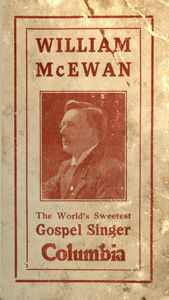
• William McEwan and "Will the Circle be Unbroken", 1919
• American influences like Billy Graham
(I was amazed when Phil himself commented on the previous post I had about the series a few weeks ago, so I hope he picks up on these positive comments. One of the programme's researchers has also been in touch with me, passing on some great information about other evangelical Scottish music, and a brilliant article about the concertina in Scottish evangelical outreach).
Any criticism is very minimal - but sadly the programme avoids the Scots language hymns and songs outside of the mainline Kirk, the writers like Seth Sykes and so on, who DID rework Scottish folk tunes with gospel lyrics in the first half of the 20th century. It also misses out most of the smaller Protestant denominations and organisations, like the Faith Mission. Pardon the bold caps, but - THIS IS THE BEST PIECE OF TELEVISION I HAVE SEEN IN DONKEYS YEARS!. Seriously, watch it while it's still online.
............
On Radio Ulster this morning, there was a clip of an Australian Prime Minister Kevin Rudd speaking at the memorial service to the people who died in the recent bush fires. He quoted Martin Luther when describing the steely bravery of the Aussie firemen - "Here I stand, I can do no other".
Wednesday, February 18, 2009
Covenanters in Ulster - free information day in Coleraine this Saturday
Over the coming weeks, there will be a number of Covenanter Information Days, staffed by members of local Reformed Presbyterian congregations. The days will include:
- 30 minute drama
- exhibition
- interactive timelines
- DVD presentation
- heritage trails and leaflets
The next one is at Coleraine Town Hall, this Saturday (21 February), from 10am - 4pm. The drama will be performed three times, at 10.30, 12noon and 2.00pm. Admission is free
Later that evening there will be "An Evening of Psalm Singing - Christ and His Suffering Church", also at the Town Hall, beginning at 7.30pm. Admission free - singing will be led by the Northern Presbytery Choir.
Shown below are some photographs from the drama being performed during February in schools in the Carrickfergus area:
(wearing black, from left: Alexander Peden, Robert Blair and David Houston. Also pictured are fictional couple Andrew and Sarah, members of Blair's congregation in Bangor and passengers onboard Eagle Wing)
(Robert Blair explains his arrival in Ulster, and his plan to sail on Eagle Wing)
(the cast close the play at a Carrickfergus school in February 2009)


Sunday, February 15, 2009
The Panic of 1857
Two years before massive spiritual revival swept across Britain and America in 1859, there was a massive economic collapse.
The Panic of 1857 followed a recession in 1856, with banks and businesses failing in the US. 5000 American businesses collapsed in one year - and the effects soon spread to Europe.
Just prior to the Panic, there had been the famous Californian Gold Rush - get rich quick schemes, rising wages and retail prices fuelling what looked like unprecedented prosperity and affluence.
Then overseas investors started to withdraw from American banks, the global value of the dollar went down, property and land prices collapsed - and to top it all a huge shipment of US gold bullion was lost at sea.
Google it for yourself. There's nothing new under the sun.
Thursday, February 12, 2009
And another thing...
Another big debate that's been bubbling away over recent years is reaching a high point this year. Evolution - Darwinism. The Ulster Museum seem to have got into a bit of a tangle with their announcement today. The BBC are going into overdrive on the subject this year to mark the 200th anniversary of Darwin's birth
About 20 years ago I heard Prof John Lennox of Oxford University speaking in a masterful series of lectures on the subject - I still have the audio tapes in the roofspace somewhere. Like with the climate debate in the blog post immediately below, the Norn Iron MSM (mainstream media) revel in pitching an academic or scientist against a politician - just as they did on Radio Ulster this morning on the Ulster Museum thing - and all stoked up by the presenter whose job often seems to be to create an on-air storm, to generate heat but not necessarily light.
With this approach, the subtle subtext to the general public is one of fresh voice versus not yer man again / intelligent person versus professional mouthpiece / softly spoken versus one of those people that usually rants. Hardly the standard of presentation that the subject often requires, or that the public deserves.
What we hardly ever get at all is well informed discussion and debate. However, at the end of last year, John Lennox debated Richard Dawkins in the USA (an audio clip of the complete discussion is on Google Video here).
John Lennox's website is an excellent source of some short video clips where he tackles some of the biggest ethical issues of our age. Take a few minutes and have a look for yourself. And he has the added bonus of not having lost his Ulster accent!
And if you want to find out a bit about how a wee Belfast Presbyterian is to blame for Darwin's theory, this website by Rev Keith Drury of May St Presbyterian Church will tell you the story - click here for the PDF.
.............
PS - I forgot to say that the ship on which Darwin made his famous trip to the Galapagos Islands was yet another Belfast man - Captain Robert Fitzroy (1805-1865). More info about Fitzroy is available at the top of the Google rankings here - it'll download a PDF.
Sammy and the Climate Debate
Sammy Wilson is all over the news - worldwide in fact - having banned the broadcast in Northern Ireland of a UK Govt television advert which links global warming to man-made causes and CO2 emissions. Here it is:
I hear that today his Stormont committee has passed a vote of no confidence in him, and that according to the front page of tonight's Belfast Telegraph, his position is now under real pressure.
The weird thing is, that on the letters page of the same paper is a letter entitled "Sammy's right, man is not responsible for global warming", written by Terry Jackson, founder of the Energy Group at the Institute of Physics in London. Immediately underneath that letter is another one, this time from Scotland, entitled "The Climate Change Scam".
Jackson's letter ends: "Friends of the Earth and the Greens can attack Sammy Wilson as much as they like, but his analysis on climate change is dead right and they are wrong". The letter from Scotland quotes a Professor James Lovelock who said "it is an elaborate scam in the interests of a few nations whose economies are enriched in the short term by the sale of wind turbines, biofuel plants and other green-sounding energy equipment".
Sammy's big enough to look after himself, and if this comment piece from the Daily Telegraph is anything to go by, there are plenty of people out there who agree with him.
(Has anyone noticed the irony of a Unionist minister opposing a UK government advert - which is a modern day example of the Covenanter-inspired Ulster-Scots concept of conditional loyalty - and a Nationalist/SDLP motion which supports the UK government position?)
Anyway, here's a clip from the documentary The Great Global Warming Swindle:
What shocks me is how difficult it has become in today's society to hold a different opinion, to challenge orthodoxy, to question "accepted wisdom". If anyone speaks out - on almost any issue - they are immediately flamed by the rest of society and the myriad of media producers who struggle to fill airtime, column inches and web pages.
Tuesday, February 10, 2009
Amy Carmichael and the Covenanters
Another wee post about Ards Peninsula woman and famous missionary Amy Carmichael (1867-1951)
"...her first journeys (from Millisle) were by horse and sidecar along the coast road to her grandmother's house at Portaferry. Among the treasures in that house was a sampler made by her great-great-grandmother, Jane Dalzell... a General Dalzell was a friend of Claverhouse, who persecuted the Covenanters. My father's people were Covenanters in the Lowlands of Scotland and they fled to the North of Ireland because of these persecutors. When my mother married my father, it was as if persecutor and persecuted were united..."
from I Remember Amy Carmichael by Margaret Wilkinson
Friday, February 06, 2009
Charlie Louvin "Sings Murder Ballads and Disaster Songs"
I had a good response to the recent Hillbilly Murder Ballads post, so here's another. Charlie Louvin, the surviving half of the Louvin Brothers (the best brother duet group of all time), is 82. Just before Christmas he released an album entitled Sings Murder Ballads and Disaster Songs. The first Louvin Brothers album was called Tragic Songs of Life (1956), so the new one carries on the proud tradition.
Each track has a small sound clip on the Amazon.com page - listen to "Down with the Old Canoe" - it's a tale of Belfast's own Titanic which sank nearly 100 years ago.
The other side of Charlie Louvin can be heard on the other album he released in 2008 - Steps to Heaven, where he sings with a black gospel choir and band - on Precious Lord he really sounds like Thomas Dorsey. Back in 2007 he was nominated for a Grammy with this album - check out his version of the old Jimmie Rodgers song "Waiting For A Train" - it has a great country bluesy swing.

Thursday, February 05, 2009
"If it's not on tv, it's not real"
I can't remember whose quote that is, but it was proved to me in glorious HD ready technicolour last night.
I took Jacob to a cold, snowy Ibrox to watch Rangers playing AC Milan - a friend of mine had organised both tickets and hotel for us, and we negotiated a day off school with Jacob's P6 teacher.
AC Milan have a dazzling array of world-famous players in their squad - Beckham, Ronaldinho, Kaka, Inzaghi, Shevchenko etc - so last night was a big glamour match which brought a new audience of celebrity-watchers never mind football fans to the match.
Sitting just behind us were two brothers - about 14 and 6 - and the wee one had clearly never been to a real football match before. The wee one was asking all sorts of very loud and (for his big brother) embarrassing questions like "who are these two teams?", "are Rangers the ones in red and black?", "which team does Ronaldinho play for?". The older brother's answers got snappier and angrier as time went on.
But the wee brother kept the best till last:
"Hey Davie, why's there nobody saying things like 'Kaka to Beckham', 'Beckham to Pirlo', 'Pirlo to Ronaldinho'?"
This was the last straw for the big brother, who nearly busted a blood vessel when he shouted in a fit of rage "BECAUSE THAT'S A COMMENTATORS JOB - YOU ONLY GET THEM ON TV!"
It finished 2-2 (the match that is, not the fraternal argument!) Here are the goals from some foreign tv station on YouTube. Kaka's goal was great:
Wednesday, February 04, 2009
Revival!
News has reached me just this morning that an astounding 1200 people turned up at an 1859 Revival themed church service in Connor at the weekend - the building was bursting at the seams and no room anywhere for car parking. I know that some of you readers are based in mid-Antrim - I'd appreciate more detail form any of you!
As I've blogged before, Connor was a highly significant location back in 1859. Great news!
More info about the local events here - there are many more happening Provincewide throughout the year.
.
Martin Luther on Music
"...I have no use for cranks who despise music, because it is a gift of God. Music drives away the Devil and makes people happy; they forget thereby all wrath, unchastity, arrogance and the like. Next after theology, I give to music the highest place and the greatest honour..."
More info on Luther's writings about music is here
"Grace Notes" on BBC Scotland
"I'm not finished learning about our church music. In my ignorance I didn't know about the Covenanters. There wasn't much Scottish history taught in my school. It was all Henry VIII and Good Queen Bess."
So says Scottish folk music icon Phil Cunningham, during an interview to promote a two-part tv series he's presenting called "Grace Notes", which starts on BBC2 on 14 Feb. It's a short history of Scottish religious music.
Let's see if the Prods and Presbyterians get a fair crack of the whip - I'll be surprised and delighted if any of the many Scots language evangelical hymnwriters like Seth Sykes or Alexander Halliday get a mention.
.