Saturday, November 22, 2008

The Ulster Scots in America

USClassics Reid Cover Col.jpgWhitelaw Reid was US Ambassador to Britain. He was of Co Tyrone Covenanter descent, and his ancestors emigrated to the USA in 1795. When they got to the US, they bought a farm - but soon after discovered that part of the sale included the running of a ferry service on a Sunday. So they sold the farm!

Whitelaw was deeply interested in his Ulster roots, and after unsuccessfully running for US Vice-President, he became US Ambassador to Britain. Shortly after taking up his post, he gave a series of lectures in Edinburgh and Belfast entitled "The Scot in America and the Ulster Scot". This is the Northern Whig editorial on 2 November 1911, the morning after Whitelaw Reid’s lecture in Edinburgh, entitled "The Ulster Scots in America". The editor at that time was Joseph R Fisher:

"...Let us now praise famous men and the fathers that begat us’ is a command not unhonoured in Ulster. But it is even better when others praise us as well as ourselves, and every Ulsterman will read with a thrill the eloquent and vivid tribute paid last night by Mr WHITELAW REID, the United States ambassador, to the men of our race and blood for the part played by them in the building up of the great Republic. That tribute is intensified by Lord ROSEBERY’s comment that, though he loved Highlanders and lowlanders, when he came to the branch of the Scottish race that had been grafted on the Ulster stem he took off his hat in veneration and awe.

Speaking at Edinburgh, Mr WHITELAW REID naturally gave precedence to the Scots, but the Ulster Scots were the burden of his theme, and men from North of the Tweed had to yield to men from north of the Boyne. The Puritan in America, said the lecturer, had had his day, and so had the Cavalier, and it was full time for the Scot and for the Ulster Scot. Part of the tale has been told before in PARKMAN’s vigorous prose in ‘The Conspiracy of Pontiac’ and in Mr ROOSEVELT’s epical ‘Winning of the West’; but the value of Mr WHITELAW REID’s address is that it throws the facts into new perspective, and gives us an admirable summary of what Lord ROSEBERY aptly described as ‘a long catalogue of splendid achievements’.

Since the day in 1718 when the first flight of Ulster emigrants arrived in Boston in five small ships to found an American Londonderry, Scoto-Irish influences have had their full share in moulding the destinies of the New World. Not that the lines of the pioneers were laid out in pleasant places. PENN’s rule was a mild one, but, as Mr WHITELAW REID reminds us, he was a man of business and he used the Ulster Scots as a kind of buffer between the Quakers and the Indians. They held the frontier, stood siege in their rude log cabins, ambushed and were ambushed by war parties, while the Quakers, well out of harm’s way, preached the doctrine of gentle treatment of the tribes. It may be that the Ulster settlers were more prone to use the steel gauntlet than the velvet glove, but they ran all the risks, and it is directly to them that the success of the first great movement westward is due.

They were soon to prove that they could cope with trained soldiers as well as with armed savages. When the agitation that ended in the Revolution began the Ulster Presbyterians numbered one sixth of the population of the American colonies. But, in Mr WHITELAW REID’s words, their intellectual and moral responsibility for the War of Independence was far greater than their numbers would seem to warrant. They were the heart and soul of the movement from the first, partly on account of the wrongs they had suffered at home, still more because, as BANCROFT says, ‘their experience and religion alike bade them meet oppression with prompt resistance’. GEORGE the THIRD and his Cabinet comforted themselves with the thought that the American would not fight, or if they did that the first skirmish would find them clamouring for mercy. The Ulster Scots, having put their hands to the plough, were not of a stock that turns back before the work is finished. When taxed with breaking their oath of allegiance they answered ‘The oath binds only while the KING protects’; and the Declaration of Independence was written by the hand of an Ulster Scot who was Secretary of the Congress, was read to the people by an Ulster Scot, and first printed by an Ulster Scot.

In the field they gave as good an account of themselves as in the council chamber. Almost half of WASHINGTON’s general officers were Scots or Ulster Scots, and in his catalogue Mr WHITELAW REID did not mention perhaps the most brilliant of them all, the ill fated RICHARD MONTGOMERY, who fell in the attempt to capture Quebec. The Irish contingents were the backbone of the American army, noted marksmen, indefatigable marchers, cool in advance and cooler in retreat, signalising themselves equally in affairs like the dash on Trenton or in the pluck with which they endured the horrors of the terrible winter months at Valley Forge. The Virginian sharpshooters, Ulster Scots almost to a man, are bracketed in military history with CRAUFORD’s Light Brigade in the Peninsula.

When peace came at last it brought to the front men of the same race, who handled with notable courage and skill the most momentous experiment in democratic government the world has seen. It is a big score for Scotland and Ulster that of the twenty-five Presidents of the United States almost half have hailed from one or the other.

Despite the stream of fresh blood that has poured into the States during the period between the Revolution and the Civil War, Scots and Ulster Scots still maintained their supremacy in that struggle. In GRANT on one side and STONEWALL JACKSON on the other they produced two leaders who are universally recognised as amongst the greatest soldiers of the nineteenth century, while it is a matter for legitimate pride that the anti-slavery movement had its origin among the Covenanters of South Carolina and East Tennessee twenty or thirty years before there was any organised opposition even in Massachusetts. It is always risky to draw modern lessons from the record of past events: many more elements enter into the problem than the average man is accustomed to allow for.

But if the record of the Ulster Scots proves anything it proves beyond doubt that they are a race who may be led, but will not be coerced, and, having once settled in their own minds the rightness of a course of action, will pursue it to the bitter end..."


................

Excerpt from the reprint's introduction:

The widespread interest in the Ulster-Scots at that time was reflected in a letter from Alice L. Milligan (1865-1953) that appeared in the Northern Whig on 2 October 1912: She wrote:

"...I would like to know to what extent the history of the Ulster Plantation occupies the history curriculum of Belfast University. Ulstermen should know how their ancestors came to live here. The Right Hon Whitelaw Reid dealt with the mysterious exodus of Ulster Scots to America in his recent lecture in the Assembly’s Buildings. The young Ulster Scots of today should understand how it was that men of their race in such numbers took part in the upbuilding of the American Commonwealth..."


This recognition of the Ulster-Scots is particularly significant since Alice Milligan was an Irish nationalist, a friend of James Connolly and a Gaelic League organiser. Moreover her plea that young Ulster-Scots should be taught about their history is just as valid and necessary today.

................

Copies of the reprint are still available from BooksUlster.com.


A Land Where We'll Never Grow Old

Another old hymn I grew up with, written by James C Moore around 1914. It was first recorded in the late 1920s (the best early version is by Alfred G Karnes) and then by the Carter Family in February 1932:

Friday, November 21, 2008

Too many James Hamiltons

I'm giving a short talk tonight on the Covenanters in Ulster, to Loughries Historical Society in Newtownards. I've decided to anchor it around the life and times of one man - Rev James Hamilton of Ballywalter (1600 - 1666) - to give the talk some local relevance.

But there are far too many James Hamiltons in Scottish and Ulster-Scots history:

1. James Hamilton arrived in Ulster with Hugh Montgomery in May 1606
2. When he needed to invite Robert Blair across the water to be his minister at Bangor, he sent James Hamilton of Kirktonholm as messenger
3. When Blair arrived, he mentored James Hamilton's nephew James Hamilton (the man I'll be taking about tonight).
4. Later in life, this James Hamilton was a minister in Edinburgh. There was at least one other Rev James Hamilton in Edinburgh at the same time

And there are more. Nearly as common back then as Mark Thompson is now! I'll hopefully post some pics later on to show you how the event goes.

.........

Just back in. Went well. Forgot to take photos!

Thursday, November 20, 2008

Membership list leaked

Was sent this earlier today:

CONFIDENTIAL MEMBERSHIP LIST LEAKED ON WEBSITE
A disgruntled ex-fan has published the Celtic season ticket list on his website. This leak has been criticised by the Celtic FC board and management who said that this could lead to serious damage to reputation, with people losing their jobs and their families.

Forums on the internet have been inundated with comments such as 'I could lose my job over this' and 'How can I show my face in public again'. One poor soul even threatened suicide if his friends and family ever found out.

The leaked list contained some surprises. It included a doctor, three policemen and even someone who lives in Glasgow. It also included the name of a 'major TV personality', believed to be Wee Jimmy Krankie. The other 5 people on the list have yet to be named.

A spokesman for Rangers said 'It is hard to imagine why these individuals became Celtic season ticket holders but in this day and age of depraved morality nothing surprises us anymore. Our thoughts are with the friends and families of all those involved, for the shame and embarrassment that this dreadful incident must have caused them. '

The Police have so far refused to rule out placing all those named on the list on the Football Supporters Offenders Register. However they did say they would also offer counselling and referrals to mental health authorities for all those involved.

........

(ps: this is just a joke, based on this recent incident. Feel free to substitute other teams names!)

Monday, November 17, 2008

Cheap Rangers Kits!

This is a community service post - any of you looking for Rangers shirts or leisurewear should get down asap to your local outlet of JJB Sports. I was in the Connswater shop today and all of the Rangers products are massively discounted - kids shirts (this seasons) are just £12.99. I got home and away for my two boys (the ones without the Carling sponsor).

20F5CBE3-DE9F-4EC8-9A24-862FA0BB1981.jpg
82B98D2C-AD12-46B7-9839-0EC9AF6DDF91.jpg
E2D7D1C4-0CA5-4DEF-8AA8-DC3F0EDF475C.jpg


Seems like there are serious business problems with JJB, with plummeting share prices, and there may have been some contractural problem between them and Rangers. Either way, they've decided to sell as much stock as they can as quickly as possible. A cheaper Christmas is good news all round!

(John - pity you don't have a JJB in Alabama! You could try their website instead?)

A Kist o' Words

I was recently interviewed for the BBC Radio Ulster programme "A Kist o' Words", talking about 3 old books - my Belfast printing of Robert Burns' poetry from 1793, my edition of Robert Dinsmoor from 1828 and the New Testament in Scots translated by Murdoch Nisbet. You can hear it again on Wednesday evening, and for all of this week on BBC iPlayer.


(if you're quick, there's an original edition of Dinsmoor available here for $200)

Sunday, November 16, 2008

Don't Believe the Hype

Too often we do believe the hype - because of its sheer quantity. However now and again evidence appears which challenges the modern orthodoxy. One of the most powerful and relentless of these orthodoxies is man-made climate change.

Recently, famous botanist and tv personality David Bellamy revealed that he had been dumped by the BBC about 10 years ago because he disagreed with the climate change lobby.

A couple of years ago, Channel 4 broadcast a documentary called "The Great Global Warming Swindle" - which is now available on DVD. Worth sticking on the Christmas list - but remember to recycle the wrapping paper and any unwanted packaging by putting it carefully in your blue bin. Not the black one. Or the brown one. Or the green one (if you have one of those)

Before today's era where every home has a row of multi-coloured bins, growing up on our wee 45 acre farm we often had small bonfires to get rid of the rubbish that was building up. It was great fun, watching tyres, plastic fertiliser bags, scrap wood and all sorts of agricultural waste go up in smoke. Big black billows of belching smoke towering up into the sky and probably visible for miles around.

Mind you, whilst dodging the exploding aerosol cans as they zoomed past your head was one of the highlights, it was probably not such a good idea. I'm pretty sure farmyard bonfires are illegal now as well.

Friday, November 14, 2008

The slow death of congregational singing

My good friend Robin Fairbairn recently introduced me to The Briefing, a magazine from Matthias Media. The few editions I have read articles from have been magnificent. This one really made an impact on me, as it's a bit of a personal soapbox:

"...whether you travel across the urban areas of Asia, Africa, North America or Australia, everywhere you go, increasingly, the singing in the church—both the songs that are sung and the style of music—is the same. It's the McDonaldization of our world.

And in every church you visit across the world, the music is just the same. I'd describe it as the ‘Hillsongization’ of music except that it's such a clumsy word. Oh, the words of the songs might differ, but it's the same music team singing the same way.

There's the obligatory leader with the obligatory two or three singers accompanying her, the obligatory drummer, the obligatory keyboard player and the obligatory two guitarists. You're allowed some freedom in your choice of a sax or a flute, depending on the resources available, but it's all exactly the same for every song in every place..."

Full article is available here

Predestination

Inching away from a dispensational upbringing to a more Reformed position has its challenges. I had two communications in the past 48 hours about predestination:

1. A text message which said: Presbyterian Mutual Society has collapsed. No surprise really - it was predestined.

2. An email about William of Orange:

"...William’s formidable invasion fleet first set sail from Den Briel, near Rotterdam, on 20 October in fine weather but encountered such a severe storm that the fleet was scattered. Barrels broke loose and rolled around below decks and perhaps as many as 1,300 horses were killed, suffocated below battened down hatches or as a result of having their skulls smashed against the sides of the ships. William’s flagship was almost wrecked. The fleet was obliged to return to various Dutch ports. Although only one ship had been lost in the storm, the loss of so many horses was a serious blow. When Gilbert Burnet, William’s chaplain and the future Bishop of Salisbury, who had been on the same ship as William, gloomily observed that it seemed predestined that they should not set foot on English soil, William made no reply.

William was not so easily disheartened nor was he about to give up on his great enterprise. All the damage was made good with incredible speed and the fleet set sail again on 2 November. On 3 November the Dutch fleet sailed with all flags flying through the Straits of Dover with crowds watching from the cliffs on both sides of the Channel. From the mast of Den Briel, William’s flagship, streamed a banner with the motto of the House of Orange: ‘Je Maintiendrai’. From the masts of other ships streamed banners with mottos such as ‘Pro libertate et religione’ and ‘Pro religione protestante’.

On 5 November – the day after William’s 38th birthday and the exact anniversary of the Gunpowder Plot – William’s fleet dropped anchor at Torbay. Count Solms, one of William’s commanders, was rowed ashore by ten grenadiers, and encountered no resistance from the people of Brixham. Shortly afterwards William followed Solms ashore. Recognising him, some local women rushed into the sea to kiss his hands, saying ‘God bless you!’.

William and Schomberg observed the disembarkation of their troops. A relaxed and unusually happy William greeted Dr Burnet, when he came ashore, with the words, ‘What do you think of Predestination now, Doctor?’..."

TWO FOOTNOTES:
I forgot to say that I got an email last night from an American Reformed Baptist Pastor who had just recieved a Covenanters in Ulster heritage trail, and was delighted with it - so much so that he ordered 50 more copies! In his email he described himself as a "5 pointer".

Finally, is it too much to reveal that I came very close to calling our two sons Luther and Calvin?... for Jacob and Charlie it was a very close call!

Wednesday, November 12, 2008

Yet more BBC!

It's not often that you wake up on a Sunday morning to hear yourself singing on the radio. Thanks to Philip Orr, author of "The Road to the Somme - Men of the Ulster Division Tell Their Story" (who was on "This New Day", presented by Kim Lenighan, on Radio Ulster last Sunday morning) for the wee musical plug:

"...if some of those young, unsophisticated rural boys who went off to the Ulster Division had been around today, this is some of the kind of music they would have enjoyed and listened to..."

And I was singing again on the media, this time on BBC Northern Ireland's "Stormont Live" short piece on the 1859 Revival:


Rest of the discussion is on this clip:


The musical side of things is coming together pretty well at the moment following the success of Bangor Abbey a few weeks ago. Watch this space for a musical announcement or two around Christmas.

Monday, November 10, 2008

Sacred Scotch Solos

For the past few weeks I've been overhauling my "Sacred Scotch Solos" blog. The new site went live last week and is already getting about 30-odd unique visitors a day, most of whom are spending a fair bit of time on it - an average of 15 minutes each. It's only about 1/6 of the visitors that Bloggin fae the 'Burn gets, but its a good start.

There are now over 70 songs uploaded, most with original musical notation. There are also audio clips of an old LP entitled "The BIble in Scots" from 1963. To visit the site for yourself, click here.

SSS Screenshot .jpg

.

Sunday, November 09, 2008

Private James Thompson, R.I.R of Kirkistown, killed at the Somme, aged 20

travel-graphics-200_429800a.jpg

The photo above is of the poppy fields of the Somme in France. As it's Remembrance Day, I thought this would be a relevant poem to post here. As far as I know James was my grandfather's cousin - my granda was 15 when James was killed aged 20 on the blood-red battlefield of the Somme.


In Loving Memory of our Dear Son
Private James Thompson, R.I.R of Kirkistown


Who was killed in action at the Battle of the Somme at Thiepval
on 1st July 1916, aged 20 years
“What I do thou knowest not now; but thou shalt know hereafter” -
John 13 v 7


A loved one has been called away
He’s in our midst no more
In a land afar his body lies
Far from his native shore

He bade us all a last farewell
A happy brave “Good-bye”
And with the gallant few went forth
To suffer and to die

Upon the first day of July
Amidst the shot and shell
‘Twas in the battle of the Somme
He in the conflict fell

What anguish fills each fainting heart
And many cheeks grow pale
And in that sorrow-stricken home
How many mourn and wail

None in that home shall e’er forget
The one so bright and fair
Who young in years were called away
Now sits a vacant chair

No one was near when in that hour
He breathed his latest breath
But Jesus led him gently on
Thro’ the dark vale of death

He answered not the roll call here
But in that world so fair
When Jesus calls the roll above
He’ll not be missing there

We know ‘twas in that solemn hour
His spirit took its flight
To dwell with God above the skies
In realms of love and light

Oh, sorrow not, but cast your care
On Christ, the Unfailing One,
Who ever doeth all things well
And say “Thy will be done”

Let this a warning be to all
To cease their sinful strife
Thy soul may be required of thee
Escape thou for the life

Oh, be prepared to meet thy God
This warning he doth give
Consider now your latter end
Believe and thou shall live

And then, where parting is unknown,
All sorrow shall be o’er
For strife and conflict never come
On yonder happy shore.


Note: according to the Commonwealth War Graves Commission, the memorial of rifleman James Thompson of the Royal Irish Rifles (A Company, 13th Service Battalion, County Down) is at Thiepval, Pier and Face 15A and 15B. His parents are recorded as William and Margaret Thompson, Kirkistown, Kirkcubbin.

.......................

There have been many songs written about war and sacrifice over the years. Here are two clips of an old song called "When the Roses Bloom Again", firstly by Johnny Cash and secondly a more mournful, thoughtful version by the American "alternative country" band Wilco:


In a similar vein, here is 10 year old footage of the (throughothersome) American band Whiskeytown, performing their song "Houses on the Hill" which has a verse about a young American soldier at the Normandy landings of 1944:

"...Eisenhower sent him to war
He kept her picture in the pocket that was closest to his heart
And when he hit shore, it must have been a target for the gunman.
There were stars in the sky
There were bunkers on the hill and there were caskets to fill
Where he would lie, shrouded in the red white and blue, with the stripes..."


Outside Belfast City Hall is a monument which was unveiled by General Eisenhower in 1945. At the end of his speech, he said "...My Lord Mayor, in inviting me to return here to become an honorary Burgess you have given one further proof of the ties of affection which bind the American Army to the people of Northern Ireland. I trust that you look upon it, as I do, as a token of our common purpose to work together for a better world..."


Friday, November 07, 2008

Politics and Branding

2408156019_1bb7faf403.jpg
Politics is the purest form of branding. In the commercial world, brands are created to give products personality and distinctiveness. There's little difference in the quality or performance of the product any more - for example the main difference between Coke and Pepsi is the brand, ie the personality that's been carefully constructed around the product, the way it looks, the way it speaks through its advertising, the way its packaging is designed, and the sponsorship it chooses to associate with. All of these things are very carefully crafted by marketing departments to reinforce what the company wants you to "feel" about its product. The feelings of the customer are to some extent manipulated through careful "brand positioning".

If you think that the notion of giving soft drinks a personality is a shocking example of how empty our era is (how or why can fizzy brown sugared water command such attention and loyalty?), then politics takes the whole thing a step further.

Politics doesn't even have a product like fizzy brown water - all it has are ideas, policies... and personalities to convince us of the merits of those ideas.

America has voted for a black man to be its next President. The media has, throughout the Obama/McCain campaign, reduced the whole thing to this single issue. But again, what people have done is voted (to a large extent) based on "brand" - colour, personality, characteristics, presentation - rather than quality or performance. That is not to say that either Obama or McCain lack quality or performance (who am I to judge that?) but the primary decision presented to the global public by the media over recent weeks has been one of brand: black or white / young or old / dynamic or boring / old has-been or a new thinker. The substance of policy has been waaaaay down the list. It would require some very late night viewing of some very obscure news channels to find a policy analysis.

This of course is nothing new, and is certainly not limited to the USA. In Northern Ireland we also vote based on colour - but rather than black v white, it's red white & blue v green white & gold. An old observation in Northern Ireland unionist politics was that if the Unionist Party had fielded a donkey with a red white and blue rosette, people would have unthinkingly voted for it.

Neil Postman, again in Amusing Ourselves to Death, wrote that in the 1858 US Presidential race, the two candidates would engage in one-to-one debates of up to 7 hours in length, using elaborate and complex language. These debates were attended by thousands of people who listened in rapt attention. By contrast, in his victory speech Barack Obama quoted the lyrics from a Sam Cooke song.

The Obama "brand", like all brands, is about emotion and feeling - a very carefully constructed brand strategy. Think I'm wrong or bonkers? Check this out - and especially this.

Sadly, brands are all that today's over-marketed and over-sentimentalised Western public can understand.

Wednesday, November 05, 2008

Radio Ulster today

An interesting wee Freudian slip on BBC Radio Ulster today - during the Obamania coverage they referred to John F Kennedy as both the first Catholic US President and also the first US President of Irish descent.

Which must therefore mean that these 17 Presidents of Presbyterian Ulster-Scots descent aren't Irish?

Which reinforces my point made here.


Great quote...

"Whenever you find youself on the side of the majority, it's time to pause and reflect."

Mark Twain

Monday, November 03, 2008

The Dollar and the Devil

I was going through some old stuff over the weekend, and found this old song in a 1933 book by Frank and Jim McCravy - another brother duet. They were from South Carolina and recorded during the 20s and 30s. Graeme and I learned some McCravy Brothers songs at Carrowdore Sunday School in the 1970s and 1980s - so they had quite an impact.

The song was originally called "Two Rulers [The Dollar and the Devil]", and was written by James Larkin Pearson in 1911. It was first recorded by a Henry Whitter in 1924 - here's a link to his version.


IN THIS WORLD of frill and fashion where the churches are so fine
And the trademark of religion is the classic dollar sign
There's a rule that never faileth and you'll always find it true
Where the dollar rules the pulpit there the Devil rules the pew

Chorus:
There may be a lot of singing and an awful lot of pray'r
And the sermon may be answered by an Amen here and there
But as sure as I'm a-talkin' and your taxes will come due
Where the dollar rules the pulpit there the Devil rules the pew


When the money gets to talking and the Master's voice is still
And the preacher swaps his sermon for a twenty dollar bill
That's the time old Mister Satan gets the churches in a stew
Where the dollar rules the pulpit there the Devil rules the pew

When religion goes a-begging and the Bible is forgot
And the preacher preaches nothing but a scientific rot
Then the faithful old believers they are getting mighty few
Where the dollar rules the pulpit there the Devil rules the pew

© 1932 Southern Music Publishing co. Inc


Sunday, November 02, 2008

The wonderful word of God

This old Sunday School chorus came to mind the other day. Between my mother and I we managed to remember all of the words:

I have a precious Book, it's the word of God
It's the only book that God has given
As I read God speaks to me, I see Christ and Calvary
The wonderful word of God

Forever it will stand as the ages roll
It's the living and eternal Word
It's my guiding light each day, and without it I would stray
The wonderful word of God

Dear Lord may I each day read Thy precious Word
May I love it and obey it too
May I grow to be like Thee, may my friends see Christ in me
In Jesus' name, amen.


I've only found two other references to it online, Perth Gospel Hall in Scotland, and this blog from Washington state USA.

Amusing Ourselves to Death


180px-Amusinghkn.jpg

One clear message from the recent Russell Brand / Jonathan Ross controversy is that the media loves nothing better than to talk about itself. A media-created celebrity in some kind of trouble will generate mountains of pointless coverage, airtime and column inches throughout the media kingdom. The media loves to do this because in a way this cements its' own importance, justifies its own existence, asserts its' own supremacy. And the more media channels there are, the more stories it needs to talk about. And so the cycle of banality goes on and on.

A great story is told of an announcement made in the US Congress in the late 1800s, declaring that the building of the telegram network had been completed, and that Washington could now communicate with everyone in the United States from Maine to California. One wise old Congressman, unconvinced by the wonder of this technological achievement, rose to his feet and said "But what if Maine and California have nothing useful to say?". And so it is with the ongoing increase of media channels in our generation.

The best analysis of the influence of the media that I have ever read is Amusing Ourselves to Death: Public Discourse in the Age of Show Business by the late American author Neil Postman. I first read it about 15 years ago. But as the dumbing down of the Western world charges on at an alarming pace, its' message is more relevant now than ever. Buy it here. Other excellent books by Postman are The Disappearance of Childhood and How to Watch TV News.

Of course, blogs are a new, independent, alternative media - and just as prone to pumping out garbage as any other. Back in 1995, Postman gave this interview about the internet:


Put "Amusing Ourselves to Death" on your Christmas list. It'll be like a dose of reality as everyone else in your house dozes through the James Bond re-runs.

Saturday, November 01, 2008

James Hamilton, from Wodrow's Analecta


Here's a lovely story about Rev James Hamilton of Ballywalter, from the latter years of his life in Edinburgh after he had been ejected from his pulpit in the city in 1662. The story takes place sometime between 1662 and Hamilton's death in March 1666:

"...Mr James Hamiltoun, Minister at Edinburgh, was outed and lived at Mortounhall under very great straites. One night, his wife and family and he had noe meal than they gote their supper of, and yet he still kept up his confidence in God. That night, Sir James Steuart of Gutters (Goodtrees)*, who lived not farr from him, but kneu nothing in particular of his present straites, told his Lady**, when in her bed, that he was troubled in his mind about Mr Hamiltoun; and again and again it was born in upon him that he was in straits; and caused his Lady rise out of her bed, and give orders to the servants, early nixt morning, to cary a load of meal to Mortounhall, which was accordingly done, and it came most seasonably.

And he himself came over to dinner to Sir James's, and told him his straites, and that for all his straites, he thought shame that he had not a farthing to give the servant that brought the meal. This I heard the Lady Pollock tell severall times. And Mr Steuart heard it from his grandmother..."

from Wodrow's Analecta or Materials for a History of Remarkable Providences; mostly relating to Scotch ministers and Christians (1842 edition), p 91

With thanks to Alastair Bonar for the quote from Wodrow, and also the illustration (from the Presbyterian Map of Ireland, 1886)

----------------------------------

* Sir James Steuart (1635 - 1713) was Lord Advocate of Scotland 1692 - 1709 and 1711 - 1713. Goodtrees is now called Moredun, in the parish of Liberton. He authored many of the most important books of the era - including:
• Naphtali, or the Wrestlings of the Church of Scotland for the Kingdom of Christ (1667, jointly with Mr James Stirling)
• Jus Populi Vindicatum; or, the People's Rights to defend themselves and their Covenanted Religion (published 1669)
• An Account of Scotland's Grievances (1675, allegedly co-authored with William Carstairs) - after which he was ordered to be arrested.

Steuart and many other Scottish nobles later fled to exile in Holland, but returned in 1688 after the Glorious Revolution. His father, Sir James Stewart of Coltness, had been Lord Provost of Edinburgh from 1648-1649 and again in 1658-59.

** Stewart's wife was Agnes Trail (1646-1690), sister of the famous Covenanter Robert Trail (1642–1716). Robert and Agnes Trail's eldest brother, William (1640-1714), was a Presbyterian minister at Ballendrait in Donegal from 1672 - 1683 and was arrested for his involvement in Blood's Plot. (see Seaton Reid's History of the Presbyterian Church in Ireland, p 422-3)

So once again, the minister from Ballywalter turns out to be a very well-connected and influential man of his time.

Friday, October 31, 2008

Russell Brand and me

I really probably shouldn't stoop to this level. I have never followed the "career" of Russell Brand and have done my level best to avoid the past seven days of relentless, wall-to-wall media coverage. However, it seems that he and I have something in common... we're both very ropey mandolin players:

Irishness and Identity

I've spoken to some people over recent weeks who have been out to the USA during this autumn to the big Scottish Games festivals that are held there every year. Tens of thousands of Scottish and Ulster-Scots descendants attend these. Among the Ulster-Scots-American diaspora in the USA, at least on a popular level, there seems to now be a trend away from the historically-used term "Scotch Irish", to "Ulster-Scots". The explanation given to the folk I've spoken with was that these Americans said "we're not Irish in any way - Irish is not who we are". The term "Irish" creates an impression, sends a cultural and historical signal - a signal that these people feel no affinity with.

So, are you Irish? It sounds like a simple question, but in fact is deeply complex. Identity - your sense of who you are, and of your origins - is not cut-and-dried, especially in a contentious and multi-cultural place like Northern Ireland in 2008. Our sense of identity has been pulled apart by violence, politics and a fair degree of purposeful social engineering.

Without getting into a definition of what "Irish" means (faaaaar to big a subject for a blog post, or for my wee brain) I see "Irish" being generally used today as a description in four main contexts:


Geographically Irish - ie belonging to the landmass referred to as the island of Ireland, which comprises the two separate jurisdictions of the Republic of Ireland and Northern Ireland;

Politically Irish - ie a citizen of the Republic of Ireland (because if you're from Northern Ireland, you're politically British, whether you like it or not. But of course the edges on this are blurred - for example people in Northern Ireland can apply for Republic of Ireland passports);

Culturally Irish - ie embracing of Irish traditional culture, from bodhrans to the GAA and a lot of things in between;

Linguistically Irish - ie a user (reader or speaker) of the Irish language


There are probably other contexts too. However, most people I know feel no sense of connection with political, cultural or linguistic Irishness - it's not who they are, or where their family heritage lies, or where their aspirations take them. As a result they are reluctant to describe themselves as being Irish, even in a geographical sense, because doing so would send a completely false political, cultural and linguistic signal about their identity. So some people now use the term "Northern Irish" - a term that has become more commonplace over recent years.

Which are you?

(With apologies to my many overseas readers who are no doubt bewildered by this post!)

Thursday, October 30, 2008

In Search of Ulster-Scots Land

books.jpeg

This 2008 book"In Search of Ulster-Scots Land: The Birth and Geotheological Imagings of a Transatlantic People, 1603-1703" looks very interesting, and much better than the author's previous one. The new one is on GoogleBooks, and you can flick through it in the viewer window here.

Wednesday, October 29, 2008

Can a sword really be worth £10,000?

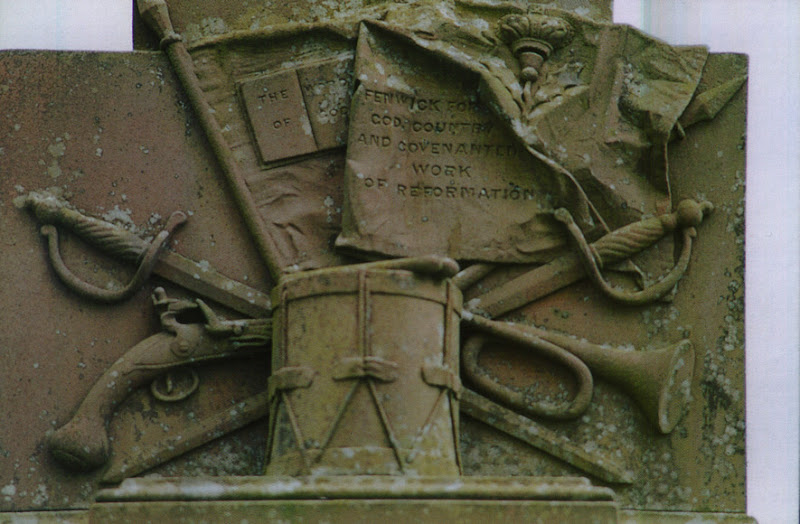
Yes, if it's the sword of the Covenanter hero Captain John Paton!

You can visit the Lochgoin and Fenwick Covenanters Trust Museum here - they have some of Paton's other artefacts on display.

Here's a photograph of Paton's superb memorial at Fenwick Parish Church in Ayrshire:gallery_1_l.jpg

Monday, October 27, 2008

Can a mandolin really be worth $225,000?

Apparently this 1924 Gibson F-5 can be....

Radio Ulster "The Book Programme" last Saturday

Dr Ivan Herbison, Dr Frank Ferguson and I were recently interviewed for BBC Radio Ulster's "The Book Programme", presented by William Crawley. The bit we were in was produced and presented by Robbie Meredith, an oul freen o' mine. Here it is on the BBC iPlayer - click here.

The relevant part starts at 19.30 in, about the recent Anthology of Ulster-Scots which was edited by Frank. It's an excellent collection, worth putting on your Christmas list if you're into books.

Saturday, October 25, 2008

"Hunger" update

Ever since my unexpected Talkback début earlier in the week, I have had numerous phone calls, emails and text messages from people supporting my comments in my original post about "Hunger" and the wider context. And not just hard-headed unionists. Quite a surprising number of professional people in the media and television industry (both broadcasters and independent production companies) have gone out of their way to phone me. I would like to thank them all for doing so. Meanwhile, courtesy of The Watchmen, I see that Gail Walker expressed similar views in the Belfast Telegraph about a month ago.

Friday, October 24, 2008

I'm a Pepper, He's a Pepper, She's a Pepper....

...if you drink Dr Pepper you're a Pepper too!

That was the slogan of an old 1970s tv ad that I (and maybe you) grew up with, for the strange-tasting soft drink Dr Pepper. Well, in a publicity stunt a few months ago, the company said that if the 17-years-in-the-making-and-subsequent-music-industry-joke new Guns n' Roses album came out this year they would give everyone in America a free bottle of the stuff!

It probably seemed like a good idea at the time. The problem is that the album, entitled "Chinese Democracy" is now complete and will be released at the end of November. Oops! Cue emergency board meetings of the Dr Pepper Snapple Group Inc...

So around 350 million bottles of Dr Pepper are potentially going to be offered free - available via a downloadable voucher on the company's website when the album is released. I say potentially, because the snag is that the offer will only be on the website for 24 hours.

Never mind being free, you couldn't pay me enough to drink a bottle of Dr Pepper - it's mingin', honkin, or in Belfast-speak, ratten. As someone who spent many wasted teenage hours on my guitar trying to learn to play the intro to the Guns N Roses song "Sweet Child O' Mine", I hope the album's a lot better than the soft drink.

Here's a YouTube clip of the old ad:


Here's the video for Sweet Child O' Mine (from 1988 I think):


And here's some headcase playing the same song using only his hands!...


Thursday, October 23, 2008

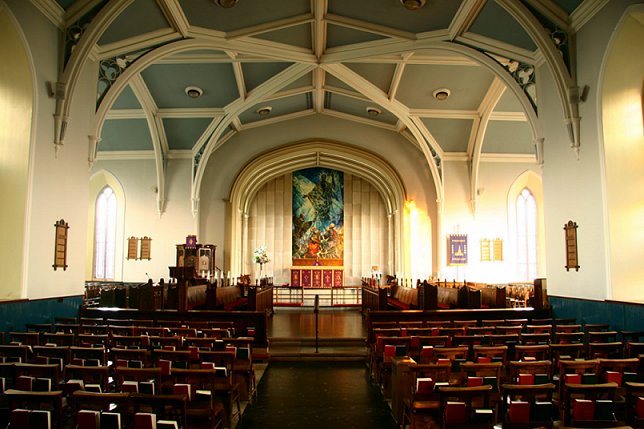
A special night at Bangor Abbey

Bangor Abbey - East End - Feb 2008.jpg
.
SNC13594.jpg

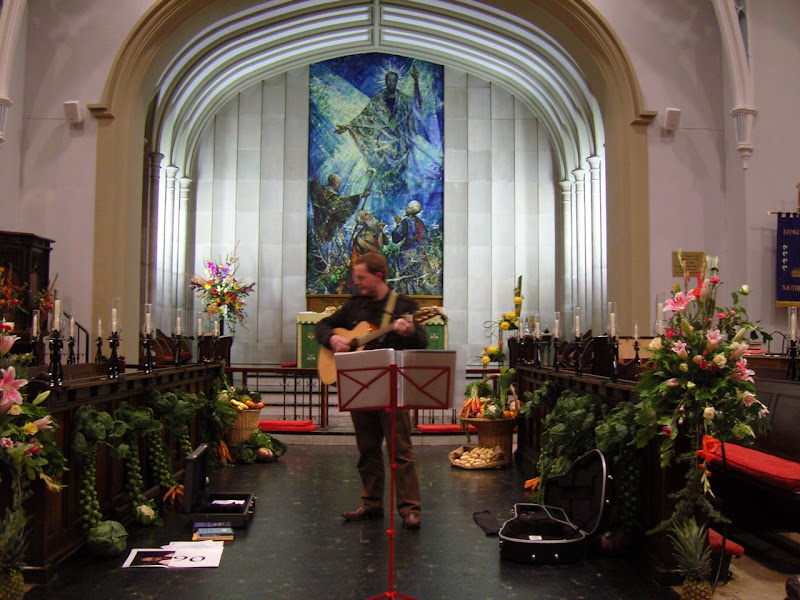
Here's a pic of Graeme getting tuned up. We had a marvellous time here last Saturday night - we played for about an hour and a quarter in the most magnificent setting I've ever had the privilege of playing in.

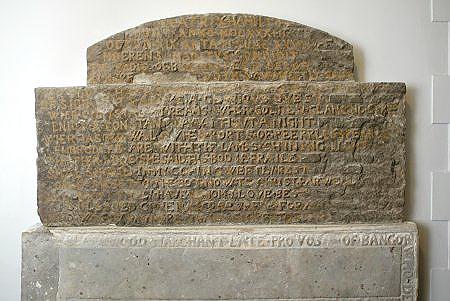
Sir James Hamilton, Founding Father of the Ulster-Scots buried below us, (and also in real life before our very eyes, greeting the audience as they came in!) in the church where the mighty Robert Blair had his Ulster ministry. There's a memorial to Blair's first wife, Beatrix Hamilton, in the vestibule (see pic below).

For me the experience was literally spine-tingling - to play and sing and to read from Blair's biography in the very place where he preached is hard to explain. And the reaction from the people who were there, the Abbey's congregation, choir members, and the organisers of the event was marvellous. To be enthusiastically complimented on our two part "brother duet" harmonies by experienced, trained, choral singers is quite something for us! Buildings this old were designed to be acoustically perfect, and a single strum of the wee mandolin filled the place.

I was very impressed that everyone going in was given a leaflet about Hamilton & Montgomery. It was a joy to be there, and thankfully they've asked us to go back. Next time we'll film the concert and put it up on YouTube!

Beatrix Hamilton Stone.jpg

Wednesday, October 22, 2008

So when exactly was Ulster-Scots invented?

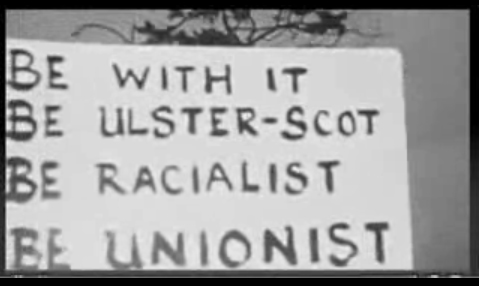
This was brought to my attention a few weeks ago. This is a still image from the recent BBC documentary "The Day the Troubles Began" which was broadcast earlier this month. In the middle of the archive footage was this close-up - a placard being carried by the civil rights marchers, using the term "Ulster hyphen Scots", and as might be expected, linking it to politics (unionism) and discrimination (racialism):

Placard.jpg

Nowadays the opponents, sceptics and critics of Ulster-Scots regularly allege that it's all false, and was invented in 1997 - and one of the callers to Talkback yesterday repeated this stereotype.

However, the opponents, sceptics and critics of forty years ago were clearly very aware of the term.

So when did this alleged invention take place?

Few of these lemming-like critics will be convinced by the inconvenient truth that the term was first recorded in 1640, around the high point of Scotland's National Covenant and its impact on the Ulster Scots population. Click here for the full reference.

Tuesday, October 21, 2008

Talkback

So I unintentionally hit the big time today - a piece on Radio Ulster's Talkback on the blog post about "Hunger" and the general media trends that are out there at the moment. Just goes to show how widely read this wee personal blog actually is! The playwright Gary Mitchell was on Radio Ulster just last week talking about the same issues - partially covered here by the News Letter.

Sunday, October 19, 2008

The Origins of Vernacular Scots Gospel Music? : The "Psalms of Dundee" or "The Gude and Godlie Ballates", Dundee, 1546


"...a little volume which, after the Bible itself, did more for the spread of reformation doctrines than any other book published in Scotland..."

............................

As the Reformation began to take hold in Scotland in the early 1500s, the area around Fife, St Andrews and Dundee became a hotbed of Reformation activity. Patrick Hamilton was burned at the stake in St Andrews in 1528, aged just 24, and his successor, George Wishart, suffered the same fate in the same town in 1546.

The early Scottish Reformers in the area used what even today would be regarded as creative techniques to spread the gospel – street theatre and contemporary songs.

In the History of Dundee, Robert Small (first published 1792) wrote of satirical plays and dramas being written and performed in Dundee in 1540 – in conjunction with Wishart’s preaching they had a huge impact on the local people.

Much of this material was written by three local brothers named Wedderburn, who had been students at St Andrews University, and two of whom may well have been there when Patrick Hamilton was martyred. Two of their dramas included a satire about the beheading of John the Baptist, and a comedy about Dionysius "...in which also he handled the Papists severely...". The Wedderburns also turned their creative energies to writing and compiling popular songs, often using existing folk tunes but writing sacred and pro-Reformation lyrics for them. In essence, they hijacked the popular culture of their generation to spread the gospel. Reformers in Italy and Holland were already doing the same (see Laing’s preface in the PDF link below)

James Wedderburn was the oldest of the three; the middle brother John had to flee to Germany where he continued the work – there he “…changed many obscene songs and rhymes into hymns…” (Small, p 96). They “…turned the tunes and tenor of many profane ballads into godly songs and hymns, which were called the ‘Psalms of Dundee’, whereby he stirred up the affections of many…” (Small p 97). The youngest of the three, Robert Wedderburn, the Vicar of Dundee, ended up in Paris and joined with the leaders of the French Reformation. Robert had written a scorching document entitled "The Complaynt of Scotlande" (PDF link here), in which he stated that it was "...unpossible that Scottis men and Inglis men can remain in concord under ane monarchy or ane prince, because ther naturis and conditiouns are as indefferent as is the nature of scheip and wolvis....".

Robert had had been fined in 1543 for destroying images in the local monasteries. When the troops of Henry VIII invaded Dundee in 1547, they burned Robert's house to the ground as they retreated, with the English officer, Sir Andrew Dudley, writing to his superior to plead that they must send to Dundee "a good preacher and good books, for they desire it much here, and I think it would do more good than fire and sword". The creativity and dedication of the three Wedderburn brothers was having a revolutionary effect in Scotland.

According to Prothero's The Psalms in Human Life, the night in December 1545 before George Wishart was arrested, he and a group of friends sang Psalm 51 from the Wedderburn brothers' collection (see Prothero p 262 & 263)

The collection was first published sometime between 1542 and 1546, and was entitled A Compendious book of Psalms and Spiritual Songs Commonly Known as "The Gude and Godlie Ballates". The book contained 112 different pieces and was described as “Presbyterian propaganda”, with various editions printed up until 1621. It was reprinted again in the mid 1800s (PDF version available here - printed copies of even this later edition are rare and it took me a fair while to track one down at a reasonable price. The only one on Abebooks will set you back £65.00, but reprint editions are cheaper.)

The Wedderburn strategy wasn't to make the church worldly, rather it was the other way round - they seized hold of elements of the world's secular culture and turned them into powerful tools for Reformation and the gospel.

Their approach has been analysed in an article by Anne Geddes Gilchrist entitled 'Sacred Parodies of Secular Folk Songs: A Study of the Gude and Godlie Ballates of the Wedderburn Brothers' (Journal of the English Folk Dance and Song Society, vol III no 3, 1938, pp 157-182).


Here's a great quote, reinforcing the importance of the Gude and Godlie Ballates, from The Cambridge History of English and American Literature in 18 Volumes (1907–21). Volume III. Renascence and Reformation.

"...It was about the year 1546 that there appeared a little volume which, after the Bible itself, did more for the spread of reformation doctrines than any other book published in Scotland. As no copy of this edition has been preserved, we can only conjecture its contents from the first edition of which we possess a specimen—that of 1567, apparently an enlarged edition of the original. The book generally known in Scotland as The Gude and Godlie Ballatis is, next to Knox’s Historie of the Reformatioun, the most memorable literary monument of the period in vernacular Scots..."

LINKS:
- The Wedderburns and their Work (1867)
- the image of the three Wedderburn brothers above is from this website)

Friday, October 17, 2008

Hunger

There appears to be a carefully co-ordinated revisioning of the Irish Republican movement going on.

• A few weeks ago there was widespread public outrage at the BBC programme about the IRA escape from the Maze prison in 1983.

• then the alleged IRA Northern Bank £26m robbery trial collapsed

• next, last night the film "Hunger" was premiered in Belfast, about the IRA hunger strikes of the early 1908s...

• which coincided with the opening of a photographic exhibition about the decay of the Maze in what is left of the prison itself.

One of the defining characteristics of the overwhelming majority (but of course not all) of Northern Ireland's unionist population has been its' ability to absorb and thole a generation of bloody terrorism - and not lash back, not vote for political parties aligned to terrorist groupings, not retaliate. To sit back and endure plays like "A Night in November" which demonise us, and which diminish our right to exist unless we become like "the other side".

I just wonder when that same unionist population will finally crack, when will it have had more than it can bear, when will it finally stand up. Like the people of Chile eventually did when they finally realised the horrific price that "peace" had cost them when they let General Pinochet away with murder (he struck a sordid deal to allow the Chilean people a form of democracy - as long as they agreed to give him immunity from prosecution for the official figure of 3,197 murders he had presided over. He was later stripped of immunity and put on trial).

Away from all the red carpets, the popping flash bulbs, the clinking glasses and the chic suits - here's a reminder from David Todd of what the hunger strike "heroes" were in prison for in the first place.

So when does crime cease to be crime? When can murder become art? And when is it acceptable for a public body like Northern Ireland Screen to fund and publicise this type of revisionism and soft-focus arthouse propaganda - again and again and again. Dig through their website for yourself.

And meanwhile the youth wing of Sinn Fein are painting Northern Ireland's standard "pillar box red" Royal Mail letterboxes green and get away with publicising their vandalism on the internet and radio, while the party itself is preparing to protest against the Royal Irish Regiment troops returning home from Iraq and Afghanistan. Even the IRA are suffering because of the credit crunch.

You couldn't make it up if you tried. Welcome to the new Northern Ireland. Do I feel the temperature dropping even further in our cold house?....

Friday, October 10, 2008

Stairway to Heaven?

Whilst Western news is dominated by financial meltdowns, foreign news is more interesting. The Japanese government are going to reveal plans in November to build what they're calling a "space elevator", which was first conceived by a Russian scientist in the 1960s. It'll be nearly 36,000 km high and will take a week to get from the surface of Earth to the top of the elevator, where there will be a platform of some type. However, what would it be used for? Seems strange to me, but is pretty close to Charlie's recent explanation of how to get to Heaven!

space_elevator2.jpg

Thursday, October 09, 2008

Never a truer word spoken...

Protestants are a peculiar people, with minor theological differences becoming great unspannable chasms. This joke was claimed in 2005 to be the best religious joke in the world. It was written by the very strange American comedian Emo Philips. It's a brilliant insight into the complexity of intra-Protestant denominational attitudes:


Once I saw this guy on a bridge about to jump.

I said, "Don't do it!"

He said, "Nobody loves me."

I said, "God loves you. Do you believe in God?"

He said, "Yes."

I said, "Are you a Christian or a Jew?"

He said, "A Christian."

I said, "Me, too! Protestant or Catholic?"

He said, "Protestant."

I said, "Me, too! What denomination?"

He said, "Baptist."

I said, "Me, too! Northern Baptist or Southern Baptist?"

He said, "Northern Baptist."

I said, "Me, too! Northern Conservative Baptist or Northern Liberal Baptist?"

He said, "Northern Conservative Baptist."

I said, "Me, too! Northern Conservative Baptist Great Lakes Region, or Northern Conservative Baptist Eastern Region?"

He said, "Northern Conservative Baptist Great Lakes Region."

I said, "Me, too! Northern Conservative Baptist Great Lakes Region Council of 1879, or Northern Conservative Baptist Great Lakes Region Council of 1912?"

He said, "Northern Conservative Baptist Great Lakes Region Council of 1912."

I said, "Die, heretic!" and I pushed him over.

Saturday, October 04, 2008

The Day my Kids killed my camera?

This bit of footage was rescued from the SD card on my now-deceased Kodak digital camera which sadly passed away in February 2008. I suspect that these were its dying moments - be careful where you leave your gadgets!

Tuesday, September 30, 2008

The Comeback Tour!

Well hardly, that's a bit grand, but Graeme and I will be playing this Saturday evening at the Carrowdore Mission Hall monthly "Gospel Rally" at 7pm - if you're available feel free to drop in. You'll be made very welcome and there'll be plenty o tay and buns afterwards, including Ulster's National Dish! We'll be playing five or six songs and hymns.

The following Saturday night, 11th October we're playing at a special event at Bangor Abbey - a deeply historic location of massive Ulster-Scots significance. You can click here to see what'll be happening on the night. Hilary took the photos, and my good friend Gifford Savage did the write-up! Gifford and I worked together on the reprint of the Abbey's historical book a few years ago. When Gifford asked us to play at this, there was no way I could turn it down!

Musically, it'll be similar to what we did before as the Low Country Boys, but simpler in that it'll be pretty close to the "brother duet" style of the 20s and 30s - two voices, mandolin and guitar. We're still debating over the track listing, but there's plenty to choose from!


Saturday, September 27, 2008

A bit of light relief

226421_f260.jpg

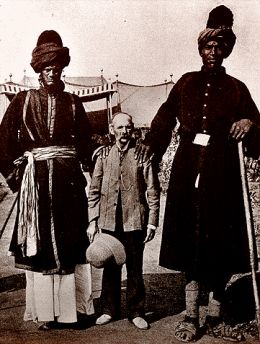
My grandfather was a very tall man (that's not him in the pic!) - they say he was around 6' 8". Whilst he grew vertically, I seem to have grown horizontally. Anyway, here's an article about giant people and their bones which have been found in the USA, Peru and Hawaii. Some great pics from National Geographic too.

So that set me Googling. Here's an incredible list of reported giant remains in the Ohio Valley, USA, from the mid 1800s.

Many years ago I found an intriguing old book in a now-long-gone dark musty (foosty) bookshop in Smithfield called The Giant Cities of Bashan and Syria's Holy Places by the Presbyterian minister Rev Josias Leslie Porter (1823 - 1889), published in 1863. Porter (whose address in the foreword is given as Brandon Towers, Belfast - just off Connsbrook Avenue in Sydenham) seems to have been an explorer / adventurer as well as a clergyman, as well the second President of Queen's University from 1879 until his death in 1889. He spent time in the Holy Land long before the turmoil and wars of the 20th century took hold; he spent 10 years as a missionary to Syria from 1849 - 1859.

The book is dedicated to the Right Honourable Lord Dufferin and Clandeboye, who himself was a renowned international diplomat and antiquarian, who has a large statue to his memory in the grounds of Belfast City Hall. His estate at Clandeboye even to this today contains a breathtaking collection of ancient artefacts that he accumulated during his time spent overseas.

The Holy Land was a largely deserted, abandoned place then, with its antiquities still standing, although by then many were in ruins. Strangely though, Bashan itself was very much intact. Porter wrote in the book that "...the cities built and occupied some forty centuries ago by these old giants exist even yet. I have traversed their streets; I have opened the doors of their houses; I have slept peacefully in their long-deserted halls..." A PDF version is available free on GoogleBooks.

He also wrote: "..."Moses makes special mention of the strong cities of Bashan, and speaks of their high walls and gates. He tells us, too, in the same connection, that Bashan was called the land of the giants (or Rephaim, Deut. iii. 13), leaving us to conclude that the cities were built by giants. Now the houses of Kerioth and other towns in Bashan appear to be just such dwellings as a race of giants would build. The walls, the roofs, but especially the ponderous gates, doors, and bars, are in every way characteristic of a period when architecture was in its infancy, when giants were masons, and when strength and security were the grand requisites. I measured a door in Kerioth: it was nine feet high, four and a half feet wide, and ten inches thick, - one solid slab of stone. I saw the folding gates of another town in the mountains still larger and heavier. Time produces little effect on such buildings as these. The heavy stone slabs of the roofs resting on the massive walls make the structure as firm as if built of solid masonry; and the black basalt used is almost as hard as iron. There can scarcely be a doubt, therefore, that these are the very cities erected and inhabited by the Rephaim, the aboriginal occupants of Bashan..."

So maybe the old Finn McCool / Giant's Causeway legends are right?!

GiantCitiesOfBashan.jpg

Friday, September 26, 2008

Don't believe everything you read in the newspapers

I am told the News Letter are continuing their shabby campaign in today's paper by continuing to stoke up controversy around A Danner With Drennan. Sickening - particularly when they know the truth. I spoke to one of their journalists by phone last week, later emailed him and copied it to the Editor. But still the campaign continues. Newspaper sales must be down for them to resort to this...

Thursday, September 25, 2008

The power of music

A few weeks ago I spent an afternoon in Ballykeel with the local Presbyterian minister Martin McNeely and two men from the Kirk Session. To sit in a Starbucks coffee shop with three men I'd never met before on a drizzly Monday afternoon, talking about Robert Murray McCheyne (and other things too), was just great. I hope I was of some use to them.

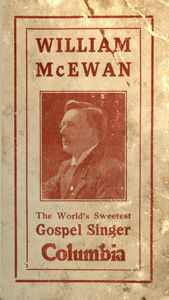
As we left, Martin loaned me two things: his copy of Memoir and Remains of R M McCheyne, and a CD entitled "Preachers and Congregations Volume 5: 1926 - 1931" (Document Records DOCD 5559). It took me a day or two to find a bit of clear time to sit down and listen to it, and it is superb. For me the standout track by far is "He's The One" (written by J B Mackay) sung by Rev H B Jackson and recorded in 1929. It's the best version of this hymn that I've ever heard, an old gem that we often listened to at home either on vinyl records or being sung by my mother. I've listened to it every day since, and have even played it to people who've called into the house. It has an almost William MacEwan vocal style, and just an old pump organ playing simple chords and melody. Hearing it is like time travel, to an era before electrified praise groups, when the old hymns of the faith were sung with pathos and sincerity. Here are the words:

Is there anyone can help us, one who understands our hearts,
When the thorns of life have pierced them till they bleed;
One who sympathizes with us, who in wondrous love imparts
Just the very very blessing that we need?

Refrain:
Yes, there's One, only One,
The blessed, blessed Jesus, He's the One!
When afflictions press the soul, When waves of trouble roll,
And you need a friend to help you, He's the One.

Is there anyone can help us, who can give the sinner peace,
When his heart is burdened down with pain and woe;
Who can speak the word of pardon that affords a sweet release,
And whose blood can wash and make us white as snow?

Is there anyone can help us, when the end is drawing near,
Who will go thro' death's dark waters by our side;
Who will light the way before us, and dispel all doubts and fears,
And will bear our spirits safely o'er the tide?


Great stuff! (PS it's 91 in Redemption Songs)

Wednesday, September 24, 2008

US Election again

I see that John McCain last night spoke of his Scots-irish roots, and has pledged to appoint a special envoy to Northern Ireland. Meanwhile over at The Independent, they see the Appalachian region as a place where Obama will struggle...

Monday, September 22, 2008

A Dairk July Mournin

(I'm not sure that I should be posting this at all.)

This is something of a sequel to A Bricht February Mournin, and is about my cousin Adrian. He was 2 years older than me and I grew up in his hand-me-downs. When we were wee his nickname was "Drain Drain". He died in July 2003 and I wrote this shortly after.

It's never been published, and has only been shared with a few people. Comparisons have been made with James Fenton's Minin Bab, but the similarity was unconscious on my part, and I would never claim to be anywhere near James' league.

I'm not going to say much about this, and given the circumstances it's better that way. Even though many of the references in this are too personal to be fully understood by people outside of our family, I'm sure you can work out what happened.

.........................

A cairryt
Her wae him. Doon tha brae
Past tha fiels whaur we kepped tha beese.

A cairryt
Him forbye. Alang tha shore
An pit him nearhaun her.

Tae leeve an dee
Siccan a road as thon
Must be dairk.

Whit for?
A'll niver fin oot
Yin big happy cratur... wae the worl' on his shouthers

Whit happent?
Hunners o tales noo.
Likely nane o them richt.

A wheen o nichts aforehaun
A taaked tae him for oors
Staunin an lauchin ootside - gettin caul.

13t o July. Black Day.
A pit my haun on his broo.
Caul. Nae lauchin.

A jist wush
A cud hae stapped him.
Listen't tae him.

A jist wush
He cud hae taaked tae yin o us
An no daen it ava

But we're aye that busy.
Nae time fer yin anither
Nae time.

Nae shoartbreid noo
Nae tay
Nae Drain Drain
Nae mair

A'll see him
Whaur he's wae her noo
Nae worl' on his shouthers ony mair
So there isnae


Sunday, September 21, 2008

The Scriptures in Scots

A few people have asked me recently about Scots language translations of the Bible. Here are my recommendations, with links to Abebooks where you should be able to buy a copy (if the sellers currently have any copies listed).

1. For a general overview of the various translations there have been:
• Graham Tulloch's A History of the Scots Bible (first edition 1989) - click here

2. For the most accessible and most appropriate for Ulster readers:
• William Wye Smith's New Testament in Braid Scots (1901) - click here
• William Wye Smith's Four Gospels in Braid Scots (1979 edition, extracted from the above New Testament) - click here

3. For the technically brilliant, but hard to read (in my own opinion)
• William L Lorimer's New Testament in Scots (first edition 1983) - click here

4. A more recent paraphrase (ie, not a verse-by-verse translation, but a blend of all four Gospels into one story)
• Jamie Stuart's A Scots Gospel (first edition 1985) - click here

5. An old classic:
• P Hateley Waddell's The Psalms in Scots (1987 reprint of 1871 first edition) - click here

6: Obscure but very good:
• Henry Scott Riddell's The Book of Psalms in Lowland Scotch (1857) - click here

There are many more (including a reprint of Murdoch Nisbet's translation which he may have worked on for a time in Ulster) but these are the most well known.

For first timers I'd advise getting Smith's Four Gospels in Braid Scots as a starter and then see how you get on from there.

Saturday, September 20, 2008

How do you get to Heaven?

Last week at bedtime, after we did what we call "nighttime prayers" with the boys, I asked Charlie "Now Charlie, how do you get to Heaven?". Expecting a simple, spot-on, theologically sound answer I nearly collapsed with both shock and laughter when he looked up at me and replied "You need a really big rocket with loads of petrol!". He then went on to explain that because Heaven is past space, that a normal rocket wouldn't be good enough. Thankfully, eventually, he got the answer right. Weans have a way with words.

Give Up Yer Aul Sins is a series of recordings from Dublin classrooms of the 1960s, of children re-telling Bible stories to their teacher. The audio has been set to new animations, and whilst the theology and cultural context leaves much to be desired (just one example from the voiceover "...when you want a miracle done you can ask the Blessed Lady, for she's His mother...", and the depiction of Christ is dreadful), otherwise the overall effect is lovely. Here's a YouTube clip on the life of Lazarus:


I notice from the endframes that these were funded by RTE and the Irish Film Board. What chance of getting BBC Northern Ireland and Northern Ireland Screen to fund and support sympathetic productions of the Protestant equivalent - stories of martyrs, missionaries and the Bible, with a rock-solid gospel message at their foundation? Parity of esteem? Not likely!

Scottish football

Rangers are playing Motherwell this weekend, in a game at Ibrox being marked by the fans as "Ulster Day" to commemorate the players from Ulster that have worn the famous blue shirt over the years. I am sure that sections of the Scottish media will go buck daft at the sight of the evil flag of Northern Ireland being flown at Ibrox by the thousand.

Anyway, in 1599, King James VI of Scotland wrote his Basilicon Doron, Book III. In it he warned his son to avoid "...all rough and violent exercises, as the football...". When he became King James I of England in 1603, he soon after commissioned his own translation of the Bible in order to replace the Geneva Bible.

I wonder what King James thought around 1620 when he found out that his old pal Hugh Montgomery had given personalised Geneva Bibles* to all of the churches he had built in his Co Down settlement estates, and installed a football pitch** in front of the "classics school" he had built in Newtownards? The school's first headmaster was John McClelland of Kirkcudbright. It was said of him that "...He was a most streight and zealous man; he knew not what it was to be afraid in the cause of God, and was early acquainted with God and his ways..."

Funny enough, an Ulsterman called John McClelland was Rangers captain during the early 80s. But I wonder how many of those Rangers fans will be reading from any version of the Bible tomorrow, whether the Geneva Bible, the King James Version or some other?

------------------------

* "...furnishing all those six houses of God (Newtownards, Comber, Greyabbey, Donaghadee, Kilmore & Portpatrick) with large Bibles, of the new translation, and printed Ao. 1603... which hath his Lordship's coat of arms, as Laird of Braidstane, stamped on the cover with leaf
gold..." from The Montgomery Manuscripts p 124/125

** "...built a great school at Newtown... allowing the scholars a green for recreation at golf, football, and archery..." from The Montgomery Manuscripts p 126

Tuesday, September 16, 2008

Torchlighters: John Bunyan and William Tyndale

When I went to Sunday School we got great stuff - I still have my illustrated Pilgrim's Progress, my Pictorial Old Testament (which is like a cartoon strip of the key events, book by book, from Genesis to Malachi). In my final year of Sunday School I asked for a copy of Hislop's "The Two Babylons" - not the typical read for a 13 year old! (I can hear the men in white coats coming for me now....)

For today's generation,Torchlighters is a series of children's animation DVDs about 'Heroes of the Faith". I bought two of them for our weans a few weeks ago, on the lives of William Tyndale and John Bunyan. Produced by the Christian History Institute in the USA, they are excellent and worth recommending as a Christmas gift for children in your family. They would also be good as an outreach tool for churches, perhaps run as a "Saturday morning cinema" in a church hall for kids to come along to.

I'm usually very dubious about this kind of thing, as they usually:

a) dilute the power of the original story to make them "relevant to today", which is usually coded language for "so as not to cause offence to anyone", and

b) the technical quality is usually poor, and a pale imitation of the standards of animation that children today are used to, and expect - thereby defeating the purpose of the whole thing.

The DVDs are available in the UK as a triple set (including Eric Liddell of "Chariots of Fire" fame) for £30 through Trinity Vision. Here are two preview clips from YouTube:


Our kids (10, 5 and 3) were enthralled. It's just a shame there are so few in the series - I can imagine a whole raft of these on Ulster-Scots-Gospel themes (the 1625 revival, the four ministers and Eagle Wing, The Covenants etc etc!). Maybe one day...

The Languages of Europe, 1951


The map above is a detail from a large wall chart map entitled The Languages of Europe that I found in Stacks Bookshop in Dundonald about 15 years ago. Dated 29 September 1951, it shows that the language of Ulster and lowland Scotland was/is Scots. The map was produced just after WWII following the Paris Peace Conference of 1946, by a Dr Aldo Dami of the University of Geneva. It was issued free with a publication called Map Review, edition 141.

Monday, September 15, 2008

A Bricht February Mournin

Philip and Maynard reminded me of this poem over recent weeks. I wrote it in 1995, following my grandmother's funeral - she died on 12th February, and I had to break the news to my father. He had turned 50 just 3 days before. The funeral "service" was held in her home, with friends and neighbours jammed into the wee room with the stove. We buried her at Ballyhalbert alongside her husband William, who'd died 48 years before.

The whole experience was deeply intense for me, I'd never experienced the death of a close family member before, and I'm not the type to go to every funeral in the locality. Maybe that's a generational thing - I know folk, like my da, who feels the need to be present at as many as possible, to show his respect and sympathy. I've not been at the funerals of a few elderly relatives over recent years, maybe that's bad.

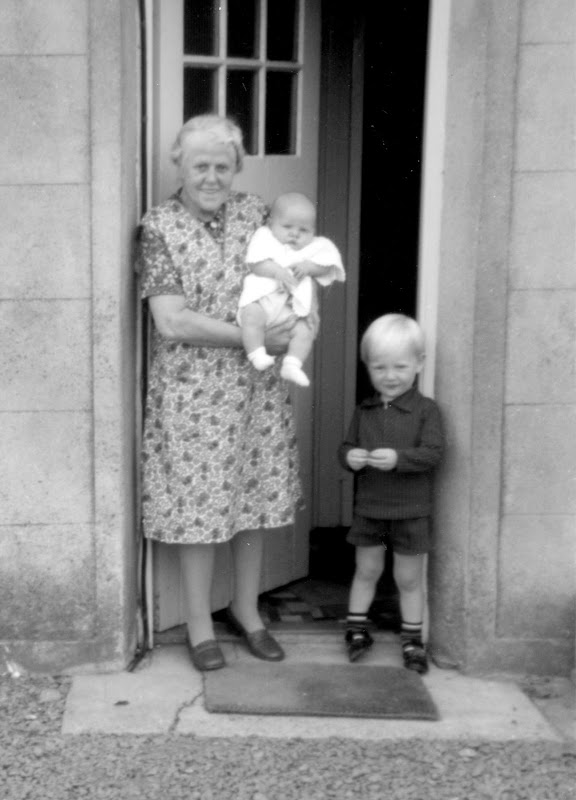
My granny lived just over the fields from us, and was a big influence on me when I was growing up. Her husband, William Thompson, was the poet and he died in 1957, leaving her to rear five weans. The photo below is of her and me at the door of her wee house at Ballyfrench, around 1975, with her holding my brother Graeme.

The poem was written as a bit of catharsis, but to my surprise when I showed it to some other folk they liked it, and it was published in Ullans Nummer 7, 1999 and then in the 2003 book A Blad o Ulstèr-Scotch. For Maynard and Philip to be talking about it lately must mean it's had some kind of lasting impact on both of them, so here it is:


We cairryt her
Doon tha brae
By tha fiel whaur we kepp tha beess
Dizens o fowk ahin us forbye,
An tears wallin up in ma een.

Past tha enn o Skelly’s road
An by Sam Beggs’s loanen
Tha wun wus coul on Bellyfrench
Thon bricht February mournin

A wheen o fiels an a dizen o hens
She spent her days leukin efter
It gien her hauns somethin tae dae
Amang tha tears an tha lauchter

A hae mynn o tha day she wus bakin
Her shoartbreid wus burnt
A filled ma pokits
Wi black shoartbreid
Feart
Ma granny micht greet

We taen her tae Bellyhailbert
An laid her alangside her man
Whaur he wus waitin foarty-echt year
Leukin ower tha Sheugh tae Scotlann

A miss her
Whiles
A quair wee woman she wus
Bot A’ll see her yin day
An ma granda forbye
A’ll tell her o aa tha fuss
She gien us whun she left,
As intil tha grun she wus lowerin
An we happed her ower wi flooers an tears
Yin bricht February
Mournin.

ABrichtFebruary.jpg

Saturday, September 13, 2008

Red Hand Rednecks™?

This is an interesting story from the BBC website on the McCain/Palin republican Presidential election candidates, who the author claims have : "...white Southern Scots-Irish values - redneck values..." He goes on to say "...The essentials of redneck culture were brought to America by what we call the Scots Irish, after first being shipped to the Ulster Plantation, where our, uh, remarkable cultural legacy can still be seen every 12 July in Ireland. Ultimately, the Scots Irish have had more of an effect on the American ethos than any other immigrant group..." And after all, McCain's election compaign has included the "No Surrender Tour", and he has an ancestor (Captain John Young from Armagh) who apparently fought with William of Orange at the Boyne. There's a recent thread on Slugger all about it (with all the usual tit-for-tat chitterin' reader postings too).

So as usual, everything that matters has an Ulster connection. To wrap up, here's another McCain who was in Ulster a few months ago, talking about his family heritage and politics.

...............

™ (I made that name up, so it's mine. The trademarked Ulster-Scots-American giftware range is currently in production)

Thursday, September 11, 2008

Hae a luk at these!

Blogs are dangerous: look at this and this!!

Address to a Nintendo DS

Here's another effort to inflict on you! A Nintendo DS is a wee hand-held computer game that has infested the younger generation, increasing the poverty of parents, and the disobedience and selective hearing of weans, the world over. This is about our Charlie (5 1/2) and his DS fixation:

nintendo-ds_lite.jpg

Charlie an' thon oul' Nintendo
He near haes his ma roon the bend-o
Killin' things fae ooter space
Gubbin' them richt in the face
Ye cannae fin' him roon the place
He's awa' playin' thon oul Nintendo

Ye cannae get near the Nintendo
Charlie'll no gie ye a lend-o
Ye dinnae hae a chance ava
He's jumpin' left an richt an aa'
Spongebob Squarebreeks taks a fa'
Fae Charlie wi' thon oul Nintendo

Ye'd think it was glued tae his hands-o
Lego Star Wars an' then Super Mario
Cloddin' fireballs at fowk
Fechtin' Darth Vader's nae joke
His ma says he's goin' tae get choked -
If he disnae quat playin' Nintendo!

He cannae pit the thing doon-o
Even whun he's in the bathroom-o
He couped - it went fleein' across the room
It hut the toilet an' went doon
It gien a splash, an then it droon't
He kill't his beloved Nintendo

(but a wheen o' months later, efter weerin' doon his ma' an' da wi' gurnin' an' gan on, he got anither yin...)

When it's time tae go tae his bed-o
Charlie hides it richt unner his pillow
The blanket's pu'd up ower his heid
Ye cannae see him, jist his feet
Whit's that lit up alo the sheets?
It's Charlie wi' thon oul Nintendo

Nae doot Charlie's hooked on Nintendo
He's nae need tae even pretend-o!
Ye'd think he'd naethin else tae dae
But sit on his rear-enn an' play
"A'll redd ma room some ither day...
A'm on Level Five on Nintendo!"

Wednesday, September 10, 2008

Address to an iPod

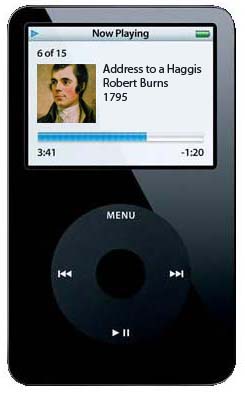
ipod.jpg
Here are two quick poems I wrote tonight (when I should have been doing real work) and when panged with guilt looking at the iPod I hardly ever use any more. These are in my best pigeon Ulster-Scots, and inspired by Gary Blair, who was rightly complaining that Ulster-Scots has more to it than prootas and kye. (potatoes and cows)

Address to an iPod, version 1

Fair fa' yer fancy, shiny face
Chief gadget o the modern race
Aboon them a' yer thumpin' bass
Through white ear plugs
The status symbol o' the tasteful
An the smug


(that was with apologies to Robert Burns)
..............................

Address to an iPod, version 2

A langed tae buy an iPod
For aa ma favourite sangs
A wud pit aboot ten thoosant on't
Tae listen a' year lang

A seen ither fowk wi iPods
So A wanted yin masel
Wi wee white wires hanging fae mae lugs
Amang the sproots o' hair

Oh hoo A yearned for an iPod
A thocht A wus missin' oot
Wi' adverts on the television
iPod fowk aa jumpin' aboot

So A bocht masel an iPod
It wasnae very big
A cud pit it in ma pokit
Wi room for 80 gigs

Boys A loved ma new wee iPod
It haed a colour screen
It wus wee an black an shiny
An powerfu' on the een

Admirin' ma new iPod
A thocht A wus some boy
A footer't at it, och, for oors!
It wus my pride an joy

But, the coast o' ma new iPod
Weel it was far fae chape
Three hunner poun' A pairted wi'
Tae be redd o' CDs an' tapes

So for weeks A fill't ma iPod
Wi' aa' o my CDs
A burnt an burnt and fill't it
Tae the gills wi MP3s

But efter weeks an' weeks o' wantin'
It wusnae lang afore
A loast the notion o' ma iPod
Noo it sits here, getherin' stour

Noo A niver luk near ma iPod
A jist dinnae hae the time
Weel thon wus yin dear Aipple!
Three hunner poun'? A wusnae wise!

Burns he wrote o' the haggis
An Orr o' prootas an hills
But siccan a waste o' money!
O' gadgets A hae had ma fill

Yinst we jist haed grapes and prootas
Noo Ulster-Scots hae iPods forbye
But we irnae ony mair content
For we hinnae ony time.

Tuesday, September 09, 2008

There I was, stuck in traffic on the way home one evening last week, when an Ulsterbus pulled out...

Thankfully the only thing that hit me was the relevance of the message in the advert...

Wednesday, September 03, 2008

Away for a few days

Aye, will be away from the computer till Saturday night, so no blogging for a wee while. Meanwhile here's a link to a blog post which was a real encouragement, from Magherafelt Reformed Baptist Church.