Thursday, January 29, 2026

Isaac Barré's 1765 Speech in Parliament – "Sons of Liberty"

It wasn't Britain v America, Liberty v Tyranny - on a transatlantic scale. Here's an audio recording of the famous speech given in the London Parliament in February 1765 by Dublin-born MP Isaac Barré, in which he coined the phrase 'sons of liberty'. Barré had been a soldier in a British regiment in America during the French & Indian War. The speech was reprinted in newspapers in America, where the colonists adopted his expression "sons of liberty" as the name of a new organisation.


“They planted by your care? No! your oppressions planted them in America. They fled from your tyranny to a then uncultivated and unhospitable country where they exposed themselves to almost all the hardships to which human nature is liable, and among others to the cruelties of a savage foe, the most subtle and I take upon me to say the most formidable of any people upon the face of God’s Earth. And yet, actuated by the principles of true English liberty, they met all these hardships with pleasure, compared with those they suffered in their own country, from the hands of those who should have been their friends.

They nourished up by your indulgence? They grew by your neglect of them: as soon as you began to care about them, that care was exercised in sending persons to rule over them, in one department and another, who were perhaps the deputies of deputies to some member of this House sent to spy out their liberty, to misrepresent their actions and to prey upon them; men whose behaviour on many occasions has caused the blood of those sons of liberty to recoil within them; men promoted to the highest seats of justice, some, who to my knowledge were glad by going to a foreign country to escape being brought to the bar of a court of justice in their own.

They protected by your arms? They have nobly taken up arms in your defence, have exerted a valour amidst their constant and laborious industry for the defence of a country, whose frontier, while drenched in blood, its interior parts have yielded all its little savings to your emolument. And believe me, remember I this day told you so, that same spirit of freedom which actuated that people at first, will accompany them still.

But prudence forbids me to explain myself further. God knows I do not at this time speak from motives of party heat, what I deliver are the genuine sentiments of my heart, however superior to me in general knowledge and experience the reputable body of this House may be, yet I claim to know more of America than most of you, having seen and been conversant in that country.

The people I believe are as truly loyal as any subjects the King has, but a people jealous of their liberties and who will vindicate them, if ever they should be violated, but the subject is too delicate and I will say no more.”


Sunday, January 18, 2026

Tad Stoermer on the mythological retro-fitting of Thomas Paine

Brilliant summary here. This year, the 250th anniversary, there's going to be a lot of myth-reinforcement. Few will be interested in challenging the two and a half centuries of nationalistic baggage with which the American revolution has been subsequently packaged. Challenging orthodoxy is tricky when reinforcing orthodoxy pays the bills. 

There's been a bit of highly selective Paine-worship over the past week, marking the 250th anniversary of his pamphlet Common Sense. Here's a corrective dose of reality –


John Dickinson's writings were more influential than Paine (see previous post here), and had put in place a decade of thought and philosophy, grounded in the previous Glorious Revolution; Paine arrived very late to the party, in November 1774, and only publishing from spring 1775 - as Stoermer correctly says here "most of the real American revolution had already happened before Paine ever set foot on America's shores", between 1765-1775.

So, as Tad Stoermer explains above, the myth of Paine began almost at day one, when John Page selectively extracted the politically useful parts of Common Sense, and printed it in newspapers which had a far wider readership than the print run of the complete pamphlet itself. 

The Scots-Irishman poet, David Bruce, refers unfavourably to Paine in his 1801 collection. Check out Brother Tamie, A Song. 

• A more substantial Common Sense is the philosophy that emerged as part of the 1700s Scottish Enlightment (which sounds a bit fluffy as a term anyway) - Scottish Common Sense Realism. That's a subject for another day...


Saturday, January 17, 2026

Revolutionary Psalms – Isaac Watts, the Glorious Revolution and the American Revolution


Isaac Watts' The Psalms of David was first published in 1719. His father, also called Isaac, had been a local 'nonconformist' church pastor in Southampton, who was imprisoned at least twice during the regime of King Charles II. When James II became monarch in 1685, the public executions of his Bloody Assizes began.

Just 12 miles north of Southampton is Winchester where, on 2 September 1685, Alice Lisle was the first to be beheaded. She was 67 years old. The conveyor belt of state-sanctioned killings included two locations along the south coast not very far from Southampton; 12 men at Weymouth and five men at Wareham were hanged, drawn and quartered by order of his majesty.

Isaac junior had just turned 11 years old when the hanging, drawing and quartering began.

"... The trials of the parents made, as may be conceived, a deep impression upon the mind of the son; the adversities of his early years were remembered by him in after life ; and doubtless here originated that ardent attachment to civil and religious liberty which marked his character, and which led his muse to hail its establishment with exultation, when the dynasty of the tyrannical Stuarts was driven from the throne..."*


So, when Isaac published his The Psalms of David, he added a dedication to Psalm 75 which read:


Power and Government from God Alone 
Apply'd to the Glorious Revolution of King William, 
or the Happy Accession of King George to the Throne


Watts' The Psalms of David was probably the most-used sacred song book in the English-speaking Atlantic World; the first edition to be printed in America was by Benjamin Franklin in Philadelphia in 1740. The Psalm 75 dedication remained throughout an estimated 39 editions that were printed on both sides of the ocean.

After the American Revolution, with America newly independent, the first edition of Watts to be printed was in Newburyport, Massachussetts in 1791. The printer, John Mycall, revised the intro to Psalm 75 to reflect the new era –


Power and Government from God Alone 
Apply'd to the glorious revolution in America, 

 July 4th, 1776 


Ezra Stiles, the President of Yale, wrote this summary in his diary:

"This year has been published the fortieth Edition of Dr. Watts's Psalms: it was printed at Newburyport in Massachusetts by Mr. Mycall, Printer. He with the Advice & Assist of neighbors ministers & others, has made some Alterations in Psalms where G. Britain is mentioned, & references to the King of Gt. Britain as in the 75th Psalm. At first it may seem as if these alterations were many: however they really are but few. Thus the Ps. Book is well adapted to the Ch in America"


• * The Life, Times and Correspondence of the Rev. Isaac Watts, D.D. by Thomas Milner (1834) is online here

• The American Revisions of Watts's Psalms, by Louis F. Benson (1903) is online here.


Below: The American edition with the revised dedication


Friday, January 16, 2026

John Adams on David Hume – "varnishing over the crimes of the Stuarts" (King Charles II and King James II)

Most people today have little or no idea about the 'Stuart' kings' tyrannies of the 1600s. It is easier to promote the concept of loyalty (or, as we'll see below, passive obedience) if the evils of all monarchs are airbrushed away, or "varnished over" as John Adams says in the quote below, which is from this famous and sparkling letter of 1818.

Adams takes aim at the mega-history that had been published before the Revolution, at the key moment when King George III settled onto the throne in 1760, written by the Scottish writer David Hume.

The rewriting of history is nothing new. History is often appropriated, not to inform about the past, but to recruit in the present. Here is Adams' own copy, sold a while ago at Christies.


"...Another gentleman who had great influence in the commencement of the Revolution, was Doctor Jonathan Mayhew, a descendant of the ancient Governor of Martha's Vineyard. This Divine had raised a great reputation, both in Europe and America by the publication of a volume of seven sermons in the reign of King George the Second, 1748, and by many other writings, particularly a sermon in 1750, on the thirtieth of January, on the subject of Passive Obedience and Non Resistance, in which the saintship and martyrdom of King Charles the First are considered, seasoned with witt and satyre, superior to any in (Jonathan) Swift or (Benjamin) Franklin. It was read by everybody, celebrated by friends, and abused by enemies. (see previous post on the Boston pastor Mayhew here).

During the reigns of King George the First and King George the Second, the reigns of the Stewarts – the Two Jameses, and the two Charleses – were in general disgrace in England. In America they had always been held in abhorrence. The persecutions and cruelties suffered by their ancestors under those reigns, had been transmitted by history and tradition, and Mayhew seemed to be raised up to revive all their animosity against tyranny, in church and state, and at the same time to destroy their bigotry, fanaticism and inconsistency or David Hume's plausible, elegant, fascinating and fallacious apology in which he varnished over the crimes of the Stewarts had not then appeared (Hume's multi-volume history was published from 1754-1761).

To draw the character of Mayhew would be to transcribe a dozen volumes. This transcendant [by choices] threw all the weight of his great fame into the scale of his country in 1761, and maintained it there with zeal and ardour till his death in 1766..."


• Adams was of course creating a narrative too. His thinking and justification for the 1776 revolution in America leaned heavily upon the 1688 revolution in Europe. It doesn't matter that there was a revolution - what matters is why there had to be one. Or two.


Thursday, January 15, 2026

"and can speak broad Scotch" – from Magheralin to Maryland, escaping with a man from Madagascar - 1739

St Mary's County on the western shore of Maryland is just across the Chesapeake Bay from Somerset County, the location of the first major Ulster-Scots community settlement in America, where the renowned Francis Makemie from Donegal became the minister in 1683.

Thomas Macoun was (very likely) from Magheralin / Maralin. He spoke “broad Scotch” and went to America as an indentured servant. In 1739 he, and a Black slave from Madagascar known as Robin, escaped together from their master’s plantation on the banks of the Potomac River, in a stolen boat with a pile of flamboyant clothes and a silver hilted sword.

This notice appeared in a few newspapers - if anyone in Pennsylvania found the two of them, Benjamin Franklin the printer was to be informed.

• the famous scientist John Macoun emigrated to Canada; his autobiography tells of the family's Scottish roots and of how they joined the resistance against King James II's army at The Break of Dromore in 1689. 


It would be worth fact-checking this interesting summary, from The Days of Makemie –

Much is said of his fairness in dealing with the Indians, but it is a fact, about which there has been no boasting, that our own province is nearly a half century ahead of Penn in setting the example. At St. Mary's no land was taken but was paid for, and the pleasantest relations of amity were established between the two races. The village of Yowacomaco was sold to the whites and became their capital, and there the English and Indians lived side by side in the rude huts constructed by savage hands, the one teaching the art of hunting the deer and planting the maize and preparing the succotash and hominy, the other teaching the lessons of civilized life and religion.

Monday, January 05, 2026

Prof. Gordon S. Wood on how 1776 was born in 1688 - "a revolt on behalf of the English Constitution"

Professor Gordon S Wood is one of the world's foremost experts on the Declaration of Independence. In this new podcast clip he summarises some of how the 1776 American Revolution was based upon the 1688 Glorious Revolution, at 20 minutes in –


 "... They talk in terms of 'we're the defenders of the English Constitution'. It's a curious Revolution in that sense. It's undertaken on behalf of the uncorrupted English Constitution, that they are a free people just as the English used to be. But now 'we are the free Englishmen. We're saving you from your own corrupt system'.

And so they don't see themselves until the very end as needing to be independent. They're defending themselves as Englishmen. And in fact, you could you make a case and they understood the irony of this, that we're revolting on behalf of the English Constitution. And it's a curious kind of thing ...

... they're talking about English rights, all of their rights. And the English had this tremendous tradition of rights. The first Bill of Rights that we talk about is in the 1688 Glorious Revolution, they get a Bill of Rights against the Crown.

The only thing that's unique about American rights is the right of religion because the English keep an Established Church, but all the other rights - jury trial, all that stuff that's in the 10 amendments, The Bill of Rights - are English rights..."

Tuesday, December 23, 2025

Ulster-Scots speech in Colonial America: 1700s newspaper sources

Here's a potentially rich seam of research which, as far as I know, has never been looked at. The pre-1776 newspapers are gradually being digitised, and far away from the 'high politics' of Founding Fathers, Generals and Presidents, they tell a more grounded story of daily life. A few searches have revealed people from the north of Ireland who spoke "Scotch". Here are just two examples:

Pennsylvania, 1759: 18 year old Martha Steward, a runaway "Irish servant girl ... she came from Antrim, in the North of Ireland, and talks much in the Scotch manner".

She had run away from a plantation owned by Joseph Sims in Passyunk Township outside Philadelphia, with 20 shillings offered to anyone who could return her to her Master.


Pennsylvania, 1766:
RUN away from the Subscriber in Newport, an Irish Servant Man, named John Purday, and Mary, his Wife, the said John Purday is about 5 Feet 9 Inches high, and about 27 Years of Age, is pitted with the Small pox, has strait pale Hair commonly tied behind; had on, when he went away, a light coloured Coat, and Thickset Jacket and Breeches, Worsted Stockings, his Hat sharp cocked, and appears very neat in his Clothes, has been a Soldier in Flanders, speaks very good English, ***a little inclined to the Scotch Accent. His Wife is a little short thin woman, dark Complexion, dark frizled hair, speaks broad Scotch***. They are about 6 Weeks in from Ireland, and came in the Ship Marquis of Granby. Whoever takes up the said John Purday, so as his Master may have him again, shall have Twenty Shillings Reward, and reasonable Charges, paid by me ROBERT ALL, or by applying to Mr. JAMES ALEXANDER, Merchant in Water street, Philadelphia.

It seems that the ship, Marquis of Granby, operated from Londonderry.


Geographically Irish, linguistically "Scotch".

Saturday, December 20, 2025

1688 & 1776 – The Official UK Government publication "Parliament and the Glorious Revolution: The Influence of the Revolution"

In 1988, to mark the Tercentenary of the 1688 Glorious Revolution, HMSO produced this official brochure to accompany an exhibition that was held at the Houses of Parliament. Published under the auspices of the Lord Chancellor, Baron Mackay of Clashfern, and the Speaker of the House of Commons, Lord Bernard Weatherill, it had a double page spread about the American Revolution which describes the indelible umbilical connection between 1688 and 1776:

"... When Britain tried to impose more of the financial responsibility for maintaining the empire on the colonists in the period after 1763, the Americans viewed the moves as an attempt to overthrow their liberty much in the way that James Il's policies had seemed an attack on English liberties 80 years before.

And when the American Revolution finally erupted, the issues involved would have been very familiar to the participants in the Glorious Revolution: the proper distribution of governmental power, and the rights of subjects and citizens. Moreover, in making their new constitution the Americans drew on the English constitutional documents of 1689, notably the Bill of Rights, even to the extent of using some of the same phraseology.

The American Revolution was an inspiration to the French revolutionaries of 1789, and when they drafted their Declaration des Droits de l'homme they consciously followed the American Declaration of Independence. In the process, they were also harking back to the Declaration of Rights of 1689, a fact which some Frenchmen at the time recognised and which the Revolution Society in England was keen to point out..."


Friday, December 19, 2025

Smithsonian "One Day in History", published 2006

This book published by the Smithsonian Institution has a preface by Gordon S. Wood (Wikipedia here), the author of the landmark The Creation of the American Republic, 1776-1787 (online here).


"THE AMERICAN Revolution has been called a conservative revolution, which seems to be a contradiction in terms. However, there is a large body of literature that supports the fact that the colonists seceded from Britain not because they wanted to overturn the existing social and political order, but because they were being denied the rights guaranteed to English citizens.

The rationale for the secession was in great part based on the theories of English philosopher John Locke, who believed in the natural rights that were given to all humans by their Creator.

It is significant that the government created by the states when the Constitution was written in 1787 was based in large part on the English system of government that had been instituted after the Glorious Revolution (1688) and the recognition of the English Bill of Rights. The most notable difference in the American and English political systems, of course, was the absence of the monarchy in America."


From the same publication:

"... These ideas were not original to Thomas Jefferson. These truths, which had not always been quite so “self-evident,” are usually credited to John Locke, a British writer and philosopher of the Enlightenment. Locke was a revolutionary and a political activist who had supported Britain’s Glorious Revolution of 1688. Unlike some of his contemporaries, Locke rejected the theory of divine monarchy, which held that kings had been appointed to their positions by God. 

Divine monarchs ruled— or so they told themselves — at the will of God and were thus responsible to no one but Him for their actions. Locke opposed the very idea of divine monarchs and also rejected the belief, deeply held by the Stuarts, as well as by many other European rulers, that monarchs should have absolute authority over their subjects and did not need the permission of others before putting their will into action.

Locke instead posited a different basis for government, one that was postulated on the existence of what he termed “natural rights.” According to the theory of natural rights, all people possessed rights that had been given to them by God simply because they were human. These “rights” were those that allowed people to ensure their survival: life, liberty, and the property needed to maintain life. Because these rights were given to people by God, not by a monarch, they could not be taken from them. They were thus “unalienable.”

Although Jefferson, in his Declaration, proved to be a faithful copyist of Locke, there is one significant way in which Jefferson’s conception of “unalienable rights” differed. While Locke asserts that one’s natural rights consist of life, liberty, and property, Jefferson omits any reference to property and instead proclaims that people have a right to life, liberty, and the pursuit of happiness. This change, many scholars believe, was made to indicate that in a nation built on the concept of freedom, the protection of slave property would not be considered a fundamental right and would not be among the foremost concerns of the new nation."


Thursday, December 18, 2025

Virginia and Philadelphia 1775: Standing armies - "the last arguments to which kings resort" - the Monmouth Rebellion, and a visit to Bath


In his renowned "Give Me Liberty or Give Me Death" speech of 23 March 1775, Patrick Henry (depicted above, by Peter Frederick Rothermel) made this stark observation of the standing army, of around 7,000 men, that was being assembled in the Colonies –

"... warlike preparations which cover our waters and darken our land. Are fleets and armies necessary to a work of love and reconciliation? Have we shown ourselves so unwilling to be reconciled that force must be called in to win back our love? 
Let us not deceive ourselves, sir. These are the implements of war and subjugation; the last arguments to which kings resort. I ask gentlemen, sir, what means this martial array, if its purpose be not to force us to submission? Can gentlemen assign any other possible motive for it? 
Has Great Britain any enemy, in this quarter of the world, to call for all this accumulation of navies and armies? No, sir, she has none. They are meant for us: they can be meant for no other. They are sent over to bind and rivet upon us those chains which the British ministry have been so long forging ..."


Henry was right. Less than a month later the armed Revolution formally began, at Lexington and Concord on 19 April 1775 - the famous "shot heard around the world". Among the colonists was David Spear who had led a company of 44 "minutemen" from Ulster-Scots areas of western Massachussetts who were present at Lexington that historic day (see previous post here).


A few months later, on 21 August 1775, the newspaper of Strabane-born John Dunlap, entitled Dunlap's Pennsylvania Packet and General Advertiser, reprinted a long letter by an anonymous writer called Caractacus. The choice of classical pseudonym, which was the name of an ancient British hero who resisted the invading Roman Empire, is tantalising – it was also the name of Thomas Jefferson's horse. The letter reminded the reader to "beware of standing armies" and of how King James II had used a relatively small army to crush a far larger number of mobilised civilians during the Monmouth Rebellion back in 1685 – 

"... A standing army in a part of a country which is not the immediate seat of war, is attended with all the inconveniences and dangers of a standing army in the most profound peace. History is dyed in blood when it speaks of the ravages which standing armies have committed upon the liberties of mankind. Officers and soldiers of the best principles and characters, have been converted into instruments of tyranny, by the arts of wicked Ministers and Kings. Cromwell overturned the commonwealth of England with the remains of his army of Saints. Nor is the small size of a standing army any security again the dangers to be apprehended from them. 
King James the Second, at the head of only 2000 mercenaries, defeated the popular Duke of Monmouth at the head of 8000 men, and was led from his success in this battle to trample under his feet the most sacred rights of his country. It is true the same mercenaries afterwards threw down their arms, and refused to oppose the landing of King William – but ... in a word – had I the wings, and tongue of an Angel, I would fly from one end of the Continent to the other at the present juncture, and proclaim constantly in the ears of my countrymen – BEWARE OF STANDING ARMIES..."

......................

King James II's brutal use of the army against civilians had - theoretically - been dealt with after his ousting in the new 1689 Bill of Rights – which stated "Standing Army: By raising and keeping a Standing Army within this Kingdome in time of Peace without Consent of Parlyament and Quartering Soldiers contrary to Law." 

King James II's standing army had carried out his monarchical, maniacal, orders. I was back in Somerset a few weeks ago, we drove through Corston and stopped to photograph the 1685 Hanging Tree location. In Bath city centre I visited the open pedestrianised piazza-like space called Saw Close, which was where the Monmouth Rebellion public executions had taken place in November 1685.


Saw Close was the location of the old city timber yard, so maybe the easy availability of both wood and sharp tools made it a logical location for a round of public hanging, drawing and quartering - following exactly the grisly instructions which had been relayed to the Sheriff of Somerset. Six men were hanged almost to death, then cut down, and slowly chopped to pieces before a crowd of onlookers. Their names are here, on historian Steve Carter's excellent website.

Some signage in Bath recalls Monmouth and his ill-conceived attempt to overthrow the tyranny of James. It's no surprise that the American colonists saw the potential for the bloody 1685 that their grandparents' generation endured to be repeated upon them in America in 1775.


Wednesday, December 17, 2025

Gustav Mahler on tradition


Tuesday, December 16, 2025

The Virginia Gazette, 8 June 1776 - "An Address to the Convention of the Colony and Ancient Dominion of Virginia"


It is always worth pointing out that narrow nationality wasn't the reason for the American Revolution, but rather transatlantic liberty - liberties which, although imperfect, had been secured in law on both sides of the Atlantic in 1688 & 1689, but which the new 1770s London government of Lord North's Tory Party was taking away.

Almost half of the MPs in Parliament were supportive of the stand for liberty being taken by the American colonists.

There will always be a ruling elite of some kind, no matter what form of government is in place - the real issue is how much liberty does the citizen have.

This is what Northern Ireland's nationalistic binary mentality does not compute. Some people here have been so irreparably moulded by nationalistic thinking that they would happily choose chains, as long those chains had their preferred national flag attached, and their preferred tyrant in charge.

However, if government truly serves the people, then nationality is not the end goal, the people's liberty is. Here's a t-shirt I photographed in Colonial Williamsburg on 4 July 2016.


For example, why was there such widespread opposition to Home Rule for Ireland in the late 1800s and early 1900s? The text of the Ulster Solemn League and Covenant gives four reasons, the second of which was liberty. The likelihood was that the form of Home Rule that would be implemented across Ireland would be "subversive of our civil and religious freedom".

As Rev John Pollock, the minister of Ireland's largest Presbyterian congregation said in 1914, "I am a Home Ruler on principle ... I have no objection to a free Parliament on College Green in Dublin, but I do object to Italian rule". Here's the introduction from the rare 1913 book Intolerance in Ireland; by an Irishman …


They expected that the 20th century (Free State / Republic of) Ireland would be ruled by Catholic integralism; 21st century Ireland is ruled by what the author Paul Kingsnorth calls an authoritarian progressive integralism. In the 21st century United Kingdom you can be imprisoned for tweets. 

Back to 1776. The American colonists weren't rejecting British rule, they were reclaiming their full British liberties. Had those liberties been restored to them, there would never have been a Declaration of Independence. Independence became necessary, not as an end in itself, but in order to pursue liberty.*

Below is the voice of an anonymous writer, described only as "A Native", in The Virginia Gazette (Dixon & Hunter Edition) on 8 June 1776 - less than a month before the Declaration of Independence would be published. 

..................

"What has been the government of Virginia, and in a revolution how is its spirit to be preserved, are important questions. The better to discuss these points, we should take a view of the constitution of England, because by that model ours was constructed, and under it we have enjoyed tranquility and security.

Our ancestors, the English, after contemplating the various forms of government, and experiencing, as well as perceiving, the defects of each, wisely refused to resign their liberties either to the single man, the few, or the many. They determined to make a compound of each the foundation of their government, and of the most valuable parts of them all to build a superstructure that should surpass all others, and bid defiance to time to injure, or any thing, except national degeneracy and corruption, to demolish.

In rearing this fabric, and connecting its parts, much time, blood, and treasure, were expended. By the vigilance, perseverance, and activity of innumerable martyrs, the happy edifice was at length completed under the auspices of the renowned King William in the year 1688. They wisely united the hereditary succession of the Crown with the good behaviour of the Prince; they gave respect and stability to the legislature, by the independence of the Lords, and security, as well as importance, to the people, by being parties with their Sovereign in every act of legislation. Here then our ancestors rested from their long and laborious pursuit, and saw many good days in the peaceable enjoyment of the fruit of their labours. Content with having provided against the ills which had befallen them, they seemed to have forgot, that although the seeds of destruction might be excluded from their constitution, they were, nevertheless, to be found in those by whom their affairs were administered...

... However necessary it may be to shake off the authority of arbitrary British dictators, we ought, nevertheless, to adopt and perfect that system, which England has suffered to be so grossly abused, and the experience of ages has taught us to venerate..."

..................

* of course, with human nature as it is, the newly independent ruling class of the new United States of America began to accumulate power to itself, and began to look not much different to the overlords which it had just thrown off. After all, it was the same men in the same wigs meeting in the same buildings, but now with no London to answer to or to be taxed by. Another story for another time... 

Saturday, December 13, 2025

Another early 1700s usage of the term 'Scotch Irish'

With thanks to the friend who sent me this:


"They call themselves Scotch Irish, and the bitterest railers against the Church [of England] that ever trod upon American Ground. I wish I had better neighbours or keener weapons to stop their career."
- Rev. George Ross, Delaware, September 1723

Other examples are listed here, compiled by the late Michael Scoggins.

Friday, December 12, 2025

Jake the Lawyer - breaking down the Declaration of Independence, and explaining the Bill of Rights

 These YouTube presentations are excellent – energetic, detailed, fun where appropriate, informal, yet information-rich.


Thursday, December 11, 2025

William Findley, Ulster-born, Scotch Irish, Pennsylvanian 'Anti-Federalist'

William Findley was born in Co Antrim, and was one of the strongest voices to challenge the potential overreach of the proposed new United States Constitution of 1787. He and the other 'Anti-Federalists' eventually secured a new Bill of Rights in 1789 to help safeguard the rights of the individual.

In an autobiographical letter written in 1812, Findley said – 

"I arrived in Pennsylvania in August 1763 in company with a great number of protestant emigrants from the North of Ireland who are chiefly the descendants of those who fled from the persecution of the Presbyterians, carried on in Scotland during the reigns of the two last of the Stuarts, therefore frequently called Scotch Irish.

They are the majority of five or six Counties of the Province of Ulster, in the north of Ireland. My grandfathers both came from Scotland in early life, and him of my name assisted in the memorable defence of London derry, the only place that was successfully defended against King James army.

I being a younger son of a younger son, is the reason why I am only the second in descent during more than 120 years. The descendant of those Scottish emigrants to Ireland have contributed exceedingly to people this Country and composed a great proportion of the Pennsylvania line including several Generals during the revolutionary war".


Tuesday, December 09, 2025

Fascism thrives on "Mythic History - a Golden Age that never really existed"

Here's another short video from Professor Tad Stoermer, majoring on the 1789 Bill of Rights as an act of resistance against the possible tyrannical abuse of the United States Constitution. He talks about the present day, and the very obvious 20th century regimes which re-created a mythical past to suit their own agendas. It's part of the centuries of social toxicity in Ireland too.

As he says "it's not just about making up history, it's about selectively remembering the parts that justify your power ... things were better back then because the right people were in charge, and we need to put them back in power".

Maybe as humans we all do that to some extent in our own individual lives. But when "power" does it, the results can be catastrophic. 


Monday, December 08, 2025

December 1775 and the US Navy: From the "Colonies" to the Copeland Islands


250 years ago this month, the American 'Continental' Navy was born and a new flag, "The Grand Union" was created.

It was a normal red Royal Navy ensign, but with 6 new white stripes sewn onto it, which in turn made 7 red stripes, which together represented the 13 Colonies. Previously the Colonies had been separate, individual, commercial rivals and culturally different – but the oppressive London government policies of the Tory Party, eroding their liberties, had brought them together.

The visual message was one of self-defence, hope of reconciliation, but NOT independence –  "The rebels declared their loyalty was to the king while asserting their independence from the British government." (source here). The East India Company used the same flag design.

The new navy's leaders were John Paul Jones (originally from Kirkbean on the south west coast of Scotland) and John Barry (originally from Wexford).

The first victory for the US Navy would take place in 1778, just off the Copeland Islands - in waters that Benjamin Franklin would have sailed across in 1771 on his way from Hillsborough, via Donaghadee, to Edinburgh (see page 169 here). Still today, US Naval Academy graduates revere Jones; his remains were interred in Annapolis.


In the intro to his book A Deeper Silence, ATQ Stewart described the 1778 battle between Jones's ship 'Ranger' and HMS 'Drake', and the aftermath –

"At sunset the gentlemen of Donaghadee watched the Ranger tow her prize through the still sound between the Great Copeland and Orlock Head, and the following day both ships were hove-to off Ballywalter. On that day Jones achieved two other feats of incidental significance. He gave his name to a dance in which you capture a new partner when the music stops. And he changed the course of Irish history."

Sunday, December 07, 2025

Patrick Henry - Liberty's Champion – from Declaration to Revolution to Constitution to Bill of Rights

Patrick Henry is one of the biggest names in the story of the American Revolution.

His father, Colonel John Henry, had been born in Aberdeen in 1704. John's parents, Patrick Henry and Jean Robertson, were born in 1670s Scotland during the bloody persecutions of King Charles II against the Presbyterian Covenanters. One of the most infamous prisons where Covenanters were held was Dunnottar Castle just south of Aberdeen (see here), in a dungeon known as the "Whigs Vault" - many of them were transported as slaves to North America.

A branch of the Henry family came to Ulster in 1616 and settled at Loughbrickland in County Down; a Rev William Henry from Loughbrickland became minister of Dromore Presbyterian Church in 1753.

Patrick was born in Virginia in 1736; his two sisters married 'sons of Ulster' – Annie married William Christian (his parents were from the Londonderry area), and Elizabeth married William Campbell (his parents were Ulster Presbyterians). In later life Elizabeth became a dynamic Methodist lay preacher across America.

In the early 1770s, Patrick lived on the plantation estate known as Scotchtown.


1) 1775 – Patrick was just 39 years old when he took his seat on a pew of St John's Church in Richmond, Virginia, on 23 March 1775. He famously rose to his feet and gave the historic speech which closed with the immortal lines "Give me Liberty or give me Death". You can visit the church today - there was a re-enactment of the event on the 250th anniversary earlier this year. 

..................................


2) 1776 – Henry wrote two of the articles of the Virginia Declaration of Rights, which was published in Williamsburg in June 1776, during the Fifth Virginia Revolutionary Convention (depicted above). A later author examined the text, which had mostly been written by George Mason, and said this –

"... When we look at the Declaration of Rights prepared by him, and which, with a few alterations, was adopted by the Convention, we shall find it a condensed, logical, and luminous summary of the great principles of freedom inherited by us from our British ancestors, the extracted essence of Magna Charta, the Petition of Rights, the acts of the Long Parliament, and the doctrines of the Revolution of 1688 as expounded by Locke—distilled and concentrated through the alembic of his own powerful and discriminating mind. There is nothing more remarkable in the political annals of America than this paper ..."

Henry's most acclaimed biographer, his grandson William Wirt Henry (Wikipedia here) wrote this in his three volume Patrick Henry, Life, Correspondence and Speeches (1891; online here):

"... The Bill of Rights of 1689, upon the accession of William and Mary, was the most complete statement of the principles of government ever attempted. This was written by the great Lord Somers, and it embodied the Pettion of Right of 1628, written by Sir Edward Coke. The Virginia Bill of Rights contained all that was of value in these celebrated papers, and much more, and as a summary of the rights of man, and of the principles of free government, stands, and is destined to stand, without a rival in the annals of governments..." 


When I was in Williamsburg in 2016 I bought one of these in the historic printers shop:


  ..................................

3) 1788 – Patrick Henry may have thought that the subsequent Declaration of Independence of 4 July 1776, his election as the first post-independence Governor of Virginia, the Revolutionary War (which ended in 1783), and his re-election as Governor for a second term in 1784, might all combine to secure the liberties he had long sought. Not a bit of it.

However, with his second term expired, it looked like the fledgling United States of America was about to install a new élite with centralised power that was not much different than the London version they had overthrown, with power in the hands of the few.  George Washington sent Henry a copy of the emerging new Constitution and Henry had grave concerns at what he read. As the famous quote by Mather Byles says:

"Which is better—to be ruled by one tyrant three thousand miles away, or by three thousand tyrants one mile away?" 


So in June 1788, the Virginia Ratifying Convention gathered to debate the Constitution. Once again in Richmond, Virginia, 52 year old Henry delivered another historic speech, asking the audience what it was that the new United States truly wanted – Liberty or Empire? Perhaps shockingly to his post-Independence audience, Henry invoked ancient British liberties –

“We are descended from a people whose government was founded on liberty; our glorious forefathers of Great Britain made liberty the foundation of everything. That country is become a great, mighty, and splendid nation; not because their government is strong and energetic, but, sir, because liberty is its direct end and foundation. We drew the spirit of liberty from our British ancestors ...

... Will the abandonment of your most sacred rights tend the security of your liberty? Liberty, the greatest of all earthly blessings—give us that precious jewel and you may take everything else. But I fear I have lived long enough to become an old-fashioned fellow. Perhaps an invincible attachment to the dearest rights of man may, in these refined, enlightened days, be deemed old-fashioned: if so, I am contented to be so..." 

It's another brilliant example of how - even after the War was over, and the British government had been defeated by her own colonial subjects - a change of nationality was not the essential point, securing liberty was. The Constitution's famous introduction "We the People of the United States..." was insufficient rhetoric. A new national government in America was no guarantee of liberty for ordinary Americans.

Here's the plaque in Richmond:


The outcome was that an additional, new, document, would be required to protect the freedoms of the individual citizen from American Federal government overreach – the 1789 Bill of Rights (Wikipedia here). The Anti-Federalists, of which Henry was one, had succeeded. Unsurprisingly, sections of it were pretty much directly lifted from William III and Mary II's previous 1689 Bill of Rights. The Bill of Rights lacks the poetry and drama of the Declaration and the Constitution, but it has substance. It begins with these words:

Congress of the United States begun and held at the City of New-York, on Wednesday the fourth of March, one thousand seven hundred and eighty nine.

THE Conventions of a number of the States, having at the time of their adopting the Constitution, expressed a desire, in order to prevent misconstruction or abuse of its powers, that further declaratory and restrictive clauses should be added: And as extending the ground of public confidence in the Government, will best ensure the beneficent ends of its institution.


..................................


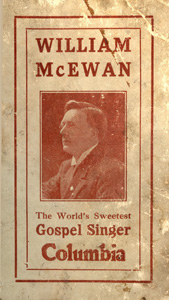
4) 1889 – Exactly a century later, Patrick Henry's grandson, William Wirt Henry, addressed the very first Congress of the Scotch-Irish Society of America, which met at Columbia in Tennessee in May 1889. He delivered a presentation entitled The Scotch-Irish of the South.

Far bigger than the title suggests, it's a broad sweeping narrative through centuries of history. He quoted John Knox confronting the Queen - "if princes exceed their bounds, no doubt they may be resisted even by power",  he quoted Andrew Melville confronting the King - "there are two kings and two kingdoms in Scotland".

It's good solid stuff, and as an intro to the grand story of the Ulster-Scots / Scotch-Irish, its a pretty good starting point and ticks most of the boxes, with a few tastefully low-key references to his august ancestor. It also includes a superb account of a "Whig Wedding" in Pennsylvania in 1778 of an Ulster-born couple, Jane Roan and William Clingan. It's online here, from page 110 – 131.

"... the earliest Scotch-Irish emigrants to America were men who had been participants, or children of those who were participants, in the terrible drama which closed with the battle of the Boyne. Accordingly we find that these men were among the earliest champions of freedom, and the most earnest and persistent defenders of the rights; of the people, as against the unjust actions of the British government ... These devoted men kept alive the flame of liberty ..."

• Two years later, in 1891, William Wirt Henry's three volume biography of his grandfather, entitled Patrick Henry: Life, Correspondence and Speeches was published and is online at HathiTrust here.

"... Jefferson in after years said that the members from the upper counties invariably supported Mr. Henry in his revolutionary measures, and there can be no doubt they did so on this occasion, and that to the Scotch-Irish; and Huguenot members he was indebted for his triumph..."

• In 1898, he visited Belfast to continue his researches (see page 33 here) 


Friday, December 05, 2025

Tad Stoermer – "Resistance is not defined by what it opposes - but by what it refuses to surrender" - two videos.

• Why The Founders Feared You

This video is a superb summary of the 1786 Daniel Shay's Rebellion in western Massachussetts (Scotch-Irish country - the epicentres being Colrain, New Lisburn, Palmer and Blandford), the 1787 US Constitution, and the consequential 1789 Bill of Rights - and the ideological battles and manipulations among the new power structures and ruling class.

The role of Patrick Henry in securing the Bill of Rights based upon the threat of his popular support – "he had come close to toppling Virginia's Royal government in 1775 ... mobilising the same sort of people who followed Shays ... protect our rights and liberties or there will be consequences for the Constitution" – is fascinating stuff. And look at this quote below – resolutely Ulster-Scots covenantal philosophy:

"... The awareness that the people can revoke the consent that they give to the government, and return it to their own hands to redeploy it wherever they like, is a human political right - one of those pesky 'inalienable' things Jefferson wrote about in the Declaration, and its a real legacy we have contend with as a reality today" (14:25)


• The Book that Reframed How I Understand Resistance: Halik Kochanski's Resistance: The Underground War in Europe, 1939-1945 (published 2022)

This is another fascinating video, mainly about how this author described "conditions, choices and consequences" of the French Resistance movement under Nazi occupation. As Stoermer says at around 4:00, "Resistance is not defined by what it opposes - but by what it refuses to surrender".


Thursday, December 04, 2025

1776 and the (Scots) Irish - presentation by Professor Richard Bell


 Loads of first class content in this sweeping overview - a Zoom presentation by Professor Richard Bell of the University of Maryland. His personal website is here.