Tuesday, February 20, 2024

Declaration of Independence - Part One: "Every Man is Born Free" (1644) = "All Men are Created Equal" (1776)

It's well established, but little-known today, that in the 13 Colonies of America (during their decade of activism and protest from the Stamp Act of 1765 through to the summer of 1776), what the colonists sought were their full British liberties, but not independence. When the Crown rejected those demands, independence was the necessary last resort for the colonists to secure their liberties. 

In Professor Garry Wills' landmark 1978 book Inventing America: Jefferson's Declaration of Independence he says that independence was only eventually agreed by all of the representatives of the colonies on the 2 July 1776. The book is a brilliant phrase-by-phrase analysis of the language in the 1776 Declaration of Independence, the story of its development, and of the literary influences which shaped the thinking of 33 year old Thomas Jefferson. Jefferson wasn't the sole author of the Declaration - there was a Committee of Five - but he is credited with being the key figure among them.

It takes many streams to form a river, and as Wills shows, the Declaration can be seen as the confluence of a wide range of classical thought.

It's not a purely Scottish / Scotch-Irish / Ulster-Scots document (but the many preceeding, regional, Resolves and Resolutions from across the 13 Colonies are). Of the three names printed on the first edition, two were Ulster-born - Charles Thomson and John Dunlap. But the Scotch-Irish / Ulster-Scots, of all of the British Isles immigrant groups in the 1700s, brought with them a 'lived experience' which made them uniquely equipped to insist upon liberty, before loyalty. They had been, literally, scarred by the Siege of Derry, and were instilled with philosophical fortitude. As my old slogan says, they were Mined in Scotland, Forged in Ulster, Exported Worldwide.

So, I'm piecing together a brief outline of the Scottish and Ulster-Scots philosophical strain - not just airy-fairy hypothetical cerebral concepts, but from actual documents which had already been written down at previous key moments of conflict between the Crown and the People.


• 1579: GEORGE BUCHANAN

There had long been a tension between the reach of the Crown and the rights of the people, and two centuries before the Declaration of Independence that tension was a central theme of the Scottish Reformation. John Knox and Andrew Melville confronted Scottish monarchs, at risk of their lives.

The publication of the Geneva Bible in 1560 included marginal notes, which, around 400 times, informed its readers that the word king can be translated as tyrant. The Bible is packed with kings and rulers who were precisely that, so all that the Geneva translators were doing was emphasising the point. Over and over and over again.

Back in 1579, in his De Jure Regni: The Rights of the Crown in Scotland, the 73 year old Scot George Buchanan (Wikipedia here) defined the limits of the monarchy. This was radical stuff in that he was the highly-educated personal tutor of both Mary Queen of Scots and also her young son and future King, James. Buchanan asserted that a monarch only reigns with the consent of the people. So, 'loyalty' is always conditional in that it is based upon a two-way bond. A 'social contract'. A covenant. One translation from Buchanan's original Latin puts it like this –

"... the people, from whom he derived his power, should have the liberty of prescribing its bounds; and I require that he should exercise over the people only those rights which he has received from their hands."

Or, as this book explains –

"... the Scottish people have always retained the right of calling bad kings to their account. In virtue of their relation to the law, the people may deal with the king who breaks it. There is one law for king and private citizen. If the king refuse to submit to a trial, force may be applied, as in that case he has broken his compact with the people and become a tyrant."

It's impossible to understate Buchanan's influence. He was a major figure in Scottish society - not only for his roles with the Scottish Royal family, but also as a Principal of one of the colleges at St Andrews University, and also Moderator of the Church of Scotland.

.............

These Crown v People issues simmered away for decades, and reached boiling points when various kings interfered in how the people wanted to operate their local churches, resulting in The King's Confession of 1581, and the two national momentous declarations of Scotland's National Covenant of 1638 and the Solemn League and Covenant of 1643. These two covenants had Ulster fingerprints on them, and were circulated and signed at public events in Ulster too.

In the heat of these times, in 1644 a Scottish Episcopalian bishop, John Maxwell (Wikipedia here - who was from Kirkcudbright, was a graduate of St Andrews University, and who held various clerical positions in Ireland) published Sacro-Sancta Begum Majestas, or the Sacred and Divine Right, and Prerogative of Kings (online here). 


• 1644: SAMUEL RUTHERFORD

In response to this, 44 year old Rev Samuel Rutherford went to print. He was a Scottish Presbyterian who had been minister of the tiny rural hamlet of Anwoth between Kirkcudbright and Dumfries, close to Bishop Maxwell's birthplace.

Rutherford had already tangled with the King and bishops, and had been sent to Aberdeen for six months exile, during which he was banned from preaching. Soon after, Rutherford's impressive intellect saw him appointed Professor at John Maxwell's alma mater of St Andrews University; around this time Rutherford married for a second time – a widow called Joan McMath/Montgomery, who had lived among fellow Scots settlers near Newtownards in County Down for a while. 

Rutherford's reply to Maxwell was the momentous 1644 book Lex Rex, the format of which was 44 questions followed by detailed answers to each. In it, Rutherford pulled no punches. He specifically named Bishop John Maxwell and invoked the memory of George Buchanan: "Buchanan and Mr Melvin were doctors of divinity; and could have taught such an ass as John Maxwell... Buchanan knew the power of the Scottish parliament better than this ignorant statist".

Rutherford had worked on Lex Rex when he had been in London taking part in the Westminster Assembly. He asked Rev Robert Blair, formerly of Bangor, to review and critique the manuscript. Blair told him to not waste his energy on it, and to stick to theology.

Rutherford had it published anyway. Lex Rex developed the arguments that Buchanan had laid out 65 years before, back in 1579. It included this statement –

EVERY MAN IS BORN FREE

Another response to Maxwell written by Rutherford was subtitled A plea for the peoples rights (see here). Rutherford had shaken the kingdom and was accused of treason.

A new King, Charles II, came to the throne in May 1660. Almost immediately he began arresting his opponents. On 19 September 1660, a royal proclamation was published against Lex Rex for 'laying the foundation and seeds of rebellion', and a one month deadline was issued for anyone who owned a copy to deliver it to Robert Dalgliesh, the King's solicitor. Anyone who retained a copy would be 'esteemed enemies of the King, and punished accordingly'.

Copies of Lex Rex were publicly burned at the market cross in Edinburgh, at the gate of the New College of St Andrews University, in London and at Oxford University. 

Rutherford was charged with high treason. Soldiers were sent to his home to arrest him, only to find him already on his death bed - his message to them was ‘I have got a summons already from a superior Judge’. 

Rutherford died of natural causes on 29 March 1661, before he could be put on trial. His grave is at St Andrews. Two months later, royal-decreed public executions began in Edinburgh, commencing with the beheading of the Marquess of Argyll at Edinburgh's Grassmarket. This began the 27 years known as 'The Killing Times'.

In 1664 the state banned Buchanan's writings too – by then De Jure Regni had been translated into English by Rev John Crookshanks of Raphoe in Donegal. Crookshanks would be killed on the slopes of the Pentland Hills outside Edinburgh in 1666.

................

Many of Rutherford's writings are known to have made their way to New England in America, because he corresponded directly with people on that side of the Atlantic who were grappling with similar issues over there, such as Cotton Mather. Rutherford was also aware of the 1636 voyage of Eagle Wing from County Down to Massachusetts, and wrote to the minister of Holywood in County Down, Rev Robert Cunningham, that “if I saw a call for New England, I too would follow it”. Rutherford didn't cross the Atlantic, but his ideas did.

Rutherford's 1644 statement – "Every Man is Born Free" – is almost identical to a part of the Declaration of Independence's opening sentence in 1776, "All Men are Created Equal".

• Here is a 2016 article by David Kopel in the Washington Post: 'Origins of the Declaration of Independence: Samuel Rutherford’s ‘Lex, Rex’

• Part Two to follow soon.....


Sunday, February 18, 2024

Hello to my new readers - if you are real humans

Since December 2023, visitor figures and page views here have skyrocketed - have a look at the page views counter on the left for the stats for the past 30 days. At time of writing this post there have been over 500,000 page views in the last month. I'm not sure what to make of this – either I have been hacked in some way, am subject to a prank which is hitting me with some kind of DDOS, or I'm an actual overnight online sensation. If the stats are genuine, then may I welcome you all and I hope that there's something here that's of interest. 


Saturday, February 17, 2024

CS Lewis: "We all, therefore, need the old books" /// King Josiah, Hilkiah the High Priest, and re-finding the original Book.


World renowned Belfast-born author C.S. Lewis (shown left) was of Scottish County Down Hamilton ancestry on his mother’s side. He described his tutor William Kirkpatrick as an ‘Ulster Scot’. Lewis wrote an article in 1944 entitled ‘On Reading Old Books’: 

“Every age has its own outlook… We all, therefore, need the books that will correct the characteristic mistakes of our own period. And that means the old books”.

I used this quote in the article that RTE published recently. Stepping out of our own era enables us to see different, sometimes forgotten, realities.

...................

This is of course what the 16th century theological Reformation was essentially about - a return to the original texts, and a rejection of the traditionalism which had been grafted onto them. 

It is human nature to forget, and to add. An example of the necessity of recovery can be found in the Old Testament, in 2 Kings 22 and also 2 Chronicles 34.

Josiah became King of Judah around 630BC as a boy of just 8 years old. He was the first 'good' King after two very bad ones. Under his reign, he began a country-wide project of removing all sorts of pagan stuff. In the city, the religious life in the temple of Jerusalem trundled along for 18 years pretty much as it had been doing for generations before.

By this stage Josiah was just 26 - even though this scene is often depicted in Bible story books with him looking like an ancient Gandalf type character (see the two examples with this post). People have big ambitions at 26, so he commenced repair work on the temple building, during which Hilkiah, the High Priest, discovered the long-lost original 'Book of the Law' of Moses. It had been lost for an unthinkable 600 years, yet religious practices had continued without being able to refer to it as the benchmark. And so those practices had become distorted. Their Bible was lost for 600 years - lost within their own religious system.

The book was brought to King Josiah, and was read aloud to him. In hearing its words, he realised that their national religiosity and tradition had departed very far away from what it was originally meant to be. 

Josiah then instituted a complete national Reformation, a return to the original, and smashing up every remnant of the things they had invented for themselves.

• Josiah was a direct ancestor of Jesus, as shown in Jesus' genealogy in Matthew chapter 1.

...................

The lesson for us all is that things we assume, having been passed down to us, might be wrong. They might be centuries old, and feel important, but they might be totally wrong.

Seek the old books. Dig up the original sources. Smash what needs to be smashed. Restore what needs to be restored. Reform what you need to reform. Semper Reformanda.

...................

• Here is a summary of the story from the Ligonier website, whose late Dr RC Sproul was of Donegal ancestry. 

• Here it is again, from Tabletalk Magazine.

• Engraving below from this website.


Tuesday, February 13, 2024

13 February 1689, the Bill of Rights of William III and Mary II


335 years ago today, 13 February, was when the 1689 Bill of Rights came before the new King William III and Queen Mary II, two months ahead of their formal Coronation. It was a huge statement on their part, overturning many aspects of the previous monarch's oppression of the people.

There were 13 'grievances' of the reign of the previous King James II, and 13 subsequent 'clauses' to address those grievances. From our perspective, it's not a perfect list. From their perspective it was enough. Among these rights was one which I mentioned in a recent post here and which came up in conversation with some friends last week:

Right to petition.
That it is the Right of the Subjects to petition the King and all Commitments and Prosecutions for such Petitioning are Illegall.

Thanks to that Bill of Rights, subjects were given the right to complain about the state, to the state, and it was against the law for them be prosecuted for such complaints. The previous King James II had his opponents rounded up and slaughtered in public (see another recent post here about the 'Bloody Assizes' in south west England).

In our era, should that principle be applied to this recent news story? If I only approve of free speech for those I agree with, then I don't approve of free speech.

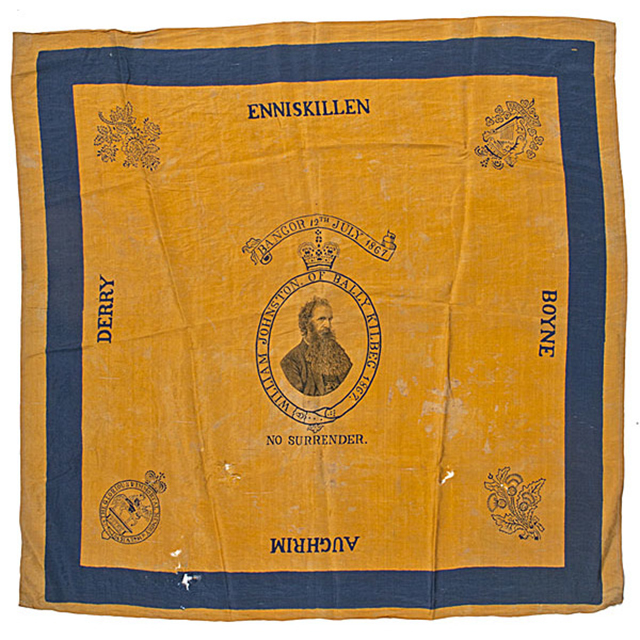
I don't read much Troubles era material, as I am fortunate enough to not have had direct experience of those dark years, even though many of my friends tragically did. However, a while ago I was recommended Owen Dudley Edwards's 1970 book Sins of Our Fathers: Background to Crisis in Northern Ireland, which I have dipped in to. There is a fascinating section in which he quotes William Johnston MP of Ballykilbeg on 'freedom of assembly':

"Protestantism does not consist in doing injustice to our Roman Catholic fellow-countrymen. ...  I stand for justice for the Protestants and for the removal of injustice from the Roman Catholics of Ireland". (1868)

"The man who calls himself a Protestant and attacks a peaceable Roman Catholic procession is doing as much as lies in him to destroy the liberties of his fellow Protestants". (1869)

Check out William Johnston's Wikipedia here – he went to prison for freedom of assembly, and was an early campaigner for women's 'suffrage' to get the vote.

King William III and Queen Mary II set the template for America – their 1688-91 Declaration, Revolution, Bill of Rights, and War against the previous King, would all be echoed in 1776-1783 across the Atlantic in the 13 Colonies.

What does liberty look like today? 


Thursday, February 08, 2024

Everything we know is wrong - the first two designs of the Tricolour

One for my RTE viewing friends. The Tricolour of Ireland that we are all familiar with seeing isn't the first design, and it's not even the second design. 

Away back last October, two former Ireland rugby internationals, Andrew Trimble and Barry Murphy, came round to our house for a long chat about all sorts of cultural - NOT political - stuff, and some of that conversation has made the final edit for a TV programme which will be shown on RTE next Monday night, timed to coincide with the Six Nations.

The flags segment was the most visual part of the conversation, and TV is a visual medium. So, RTE asked me to write an article a few days ago, which they have posted on their website here, with some stills from that particular bit.

'Andrew Trimble: For Ulster & Ireland' is on RTE One next Monday 12 Feb at 9.35pm.
Made by NPE Media.
Funded by the Northern Ireland Screen Ulster-Scots Broadcast Fund.


Tuesday, February 06, 2024

The 1850 Tricolour of Ireland – coming soon....


Monday, February 05, 2024

Alan Rickman - The Power of Stories


Sunday, February 04, 2024

The Scotch-Irish community Resolves and Resolutions, 1774-1776


Here's a broad calendar of the many Resolves and Resolutions which were issued, by largely Ulster-Scots / Scotch-Irish communities, charting a course from the Boston Tea Party of 16 December 1773 to the Declaration of Independence of 4 July 1776. (Many others were passed in communities which were not substantially Scotch-Irish, such as at Orangetown in New York).

31 January 1774
Colrain Resolves, MA
Short film launched last week, see previous post.

MARCH 1774
BOSTON PORT ACT
London government passes law to blockade Boston harbour.

21 May 1774
Chestertown Resolves, MD

1 JUNE 1774
BOSTON PORT BLOCKADE BEGINS

June 1774
Sons of Liberty ‘Solemn League and Covenant’.
(Westford and Concord Massachusetts versions still exist).

4 June 1774
Hanover Resolves, PA

10 June 1774
Middletown Resolves, PA

26 June 1774
Lebanon Resolves, PA

4 July 1774 York Town Resolves, PA. On 4 July 1774 at York Town Court House, James Smith was one of the committee who endorsed the “York Town Resolves”.  Two years later he would sign the Declaration of Independence.

9 July 1774
Lancaster Resolves, PA

12 July 1774
Carlisle Resolves, PA
Venue, Carlisle Presbyterian Church, still exists. James Smith may have been present.

13 July 1774
Chester Resolves, PA

18 July 1774
Fairfax Resolves, VA

9 September 1774
Suffolk Resolves, MA 

14 OCTOBER 1774
DECLARATION AND RESOLVES OF THE FIRST CONTINENTAL CONGRESS, PHILADELPHIA

20 January 1775
Fincastle Resolutions, VA
Rev Charles Cummings log cabin still exists.

22 February 1775
Staunton Instructions aka Augusta Resolves, VA
Museum of American Frontier Culture, with an Ulster farmstead, is at Staunton.

19 APRIL 1775
WAR BEGINS AT LEXINGTON OUTSIDE BOSTON

16 May 1775
Hanna’s Town Resolves, PA
Colonel John Proctor unfurled the first ‘Don’t Tread On Me’ flag.
See images above of 1975 publications.

20 May 1775
Mecklenburg Declaration, Charlotte, NC

12 June 1775
Virginia Declaration, Williamsburg, VA

12 April 1776
Halifax Resolves, NC
One of the signatories was William Thompson from County Down.

4 JULY 1776
DECLARATION OF INDEPENDENCE PRINTED, PHILADELPHIA
Ulstermen Charles Thomson & John Dunlap named on the printed edition.

....................

Multiple events were taking place in and around these documents, by major Ulster-Scots / Scotch-Irish personalities. As a basic chronology of local community written resistance it's pretty impressive.

Wednesday, January 31, 2024

'The Colrain Resolves, 31 January 1774' - short film released today.

On this day 250 years ago, the Scotch-Irish community of Colrain in western Massachusetts committed their post-Boston Tea Party resolves to paper. I was delighted to be involved in this new short film, made by Blue Eagle Productions for the Ulster-Scots Agency. The film is below – to see the shorter 2 minute trailer, head over to the Agency's Facebook page here.


The narrative for the film is closely based on the 1885 book The Early Settlers of Colrain, Massachusetts, by Charles H McClellan - online here. All of the characters in the film are from McClellan's book, with some additional biographical information of each person from other sources too.

The film tells just one small, hyper-local, but important, story. From 1774-76 there were dozens of similar communities across the 13 colonies who produced their own equivalents of these Resolves too.

Far away from the usual 'greatest hits' approach of familiar celebrity Americans – like the multiple Ulster-American Presidents, or the Born Fighting approach of war heroes and battles – there is a much deeper and emotive tale of the grassroots Scotch-Irish population. Unwelcome, marginalised and pushed to the edges of society, and far away from formal influence and power, they stood their ground and shaped the new nation. Values and ideas sustained them. 

The people of 1776 were the heirs of 1688 – the Prince of Orange's Declaration, Revolution, and Bill of Rights which ended a tyrannical monarchy in Great Britain and Ireland, became their American triple template. The people of Colrain might have thought "We did it before. We can do it again".

The values that these Scotch-Irish communities lived for transcended the limitations of ancestry and ethnicity. They became the values and rights aspired to by all Americans. The America 250 website is here.

• “He who has a why to live for can bear almost any how.”
 ― Friedrich Nietzsche


Monday, January 29, 2024

Hugh Miller Thompson (1830-1902), Bishop of Mississippi

"I have always been proud to call myself an Ulsterman, proud that I am a born Derryman, a son of the men that starved and prayed and fought, but never surrendered."

Hugh Miller Thompson,
Bishop of Mississippi,
1889

(quoted from the first edition of the Proceedings of the Scotch-Irish Society of America, online here)


Sunday, January 28, 2024

The Presbyterian General Synod in pre-Revolution America - "it was the only organisation which embraced all the colonies" / "the grandest conception of civil liberty that the human race was ever blessed with"

So said Rev John H. Bryson (1831-1897) of First Presbyterian Church, Huntsville, Alabama (minister there from 1880–1897) in his address to the Fourth Congress of the Scotch Irish Society of America in Atlanta, Georgia, in 1891. In our secularising age it is easy to forget the social cohesion that church structures provided. 

"This distribution of the Scotch-Irish over the whole country made it possible for them to exert a most powerful influence when the occasion should arise. So soon as they were settled down in their new homes they organised themselves into Churches and Presbyteries (for they were Presbyterians), and in 1717 a General Synod was founded. By 1770, this delegated Synod was the most powerful religious organisation in the country. Indeed, it was the only organisation which embraced all the colonies. The ministry were an able body of men, graduates of Edinburgh, Glasgow, Dublin, Harvard, Yale, and Princeton."

Bryson had seen a lot in his lifetime. He was a minister in the Associate Reformed Presbyterian Church, as was his father Rev Henry Bryson (1799–1874). John had been born in Fayetteville, Tennessee, in 1831 and in 1854 became minister of Hopewell in Maury County, Tennessee. He was a chaplain to the Confederate Army during the American Civil War. Here's a portrait, from this book, which is also in the Proceedings and Addresses of the Fifth Congress. He died in 1897 in Shelbyville, Tennessee.


Here is an article from The Anderson Intelligencer, Anderson, South Carolina, 7 June 1888, some 23 years after the Civil War –

The Blue and the Grey.

Many persons in South Carolina will remember the Rev. Dr. Bryson who was several years pastor of the Presbyterian Church at Columbia. Dr. Bryson was during the war chaplain in chief of the Confederate army of Tennessee. He was in Philadelphia during the recent Centennial Assembly of the Presbyterian Church. The Philadelphia Times last week says: 

"At the Tabernacle Presbyterian Church, 37th and Chesnut, the Rev. J. H. Bryson, of Alabama, ex moderator of the Southern General Assembly, preached an eloquent sermon to a crowded congregation. In alluding to his presence there that morning, Dr. Bryson said that but a few minutes before the commencement of the service he had learned that pastor, the Rev. Dr. McCook, had been a chaplain to the Union forces during the late war, while he had been chaplain to the Confederate forces. He alluded to several incidents of that bloody feud, and then turning to the pastor, in a voice trembling with emotion offered the band of peace and friendship, and in the presence of the congregation, who rose as a body, the two clergymen shook hands and blessed each other. It was an impressive incident and many of the congregation were visibly affected by it."


This encounter took place in the years when the concept for the Scotch-Irish Society of America was taking shape. The idea for the Society had been floated at the Pan-Presbyterian Council in Belfast on 4 July 1884, and the Society held its inaugural Congress at Columbia in Tennessee on 8-11 May 1889.

This same Rev Dr Henry McCook would soon be, along with Bryson, a leading figure in the Society. McCook was also the author of several historical volumes such as the 'Whiskey Rebellion' novel The Latimers - A Tale of the Western Insurrection of 1794.

The Scotch-Irish Society of America was born a generation after the 1861-65 Civil War, where the nation sought narratives to bind up the remaining wounds of past conflict. Its membership and annual Congresses seem to have been almost equally organised on a North / South basis. A series of Presidents in the late 1800s and early 1900s asserted their own Ulster roots in speeches and books.

To some extent, Scotch-Irishness provided an 'Old World' story for the new generation in post-Civil War America. And the various forms of Presbyterianism were the bedrock.

............

At the Second Congress of the Scotch Irish Society of America, held in Pittsburgh in 1890, Bryson's address included these remarks –

"... There is yet to be written for the American people — and when I say for the American people, I do not limit it to this country — but there is yet to be written for the American people a history that will thrill this world with its wonders, and wondrous thought at its grand and great conceptions, and it will lay bare the foundations of civil and religious liberty ...

The Scotch -Irish race is a people that have the strongest, that have the truest, that have the grandest conception of civil liberty that the human race was ever blessed with...

It was by reason of that long series of struggles through which our people were compelled to go when they came first to the American borders that they were taught and realised the infinite value of freedom...

In every nation and in every age that preceded us, the church and state were united, but it remained for the Scotch-Irish of America to say that they should be separated from one another...

Teach your children to love the blood that runs in their veins. Teach them to love its history ; to love its people..." 


Wednesday, January 24, 2024

The 'Newton Resolves', Massachusetts, 1774


On our visit to Boston we passed through Newton, a very beautiful residential suburb which looked to me like a movie set. I have found that, following the Boston Tea Party of 16 December 1773, the community of Newton issued a set of 'Resolves'. Here is the manuscript but it appears to be undated, and with no location specified, but evidently the people at Digital Commonwealth have seen fit to make an informed decision on both the place and the date. Below is the text, with two words italicised which I wasn't totally sure about from the handwriting.

Once again, these people are not yet appealing for independence, but their full British rights and liberties.

.............

Resolved that the People of this Province, and as we conceive, of every other British Colony, are by their several Charters and other Institutions of Civil Government, Entitled to all the Rights and Liberties of the British Constitution which is Eminently Founded in Nature and has the Right of Nature so far as consists(?) with the original Design of Government which is the Good of the whole Community for its object. 

Resolved that it is an essential principle of the British Constitution adopted by our Fore Fathers in the Several Charters of this Province to be Governed only by such laws as are or shall be made by their own Consent in Person or by Representatives of their own free Election.

Resolved that the acts of the British Parliament made to tax the Americans to which they have not and could not give their Consent are infractious of the Rights of the British Constitution, and of the Charter of this Province and Destructive of Freedom.

Resolved that the acts of Parliament made in the Last Session empowering the East India Company to ship their teas to America Subject to a Duty for the purpose of Raising a Revenue appears to have been Designed to Confirm and establish the Grievance the Americans have so long and justly Complained of.

Resolved that this town Do approve of the opposition to the landing the East India Companys teas made by the people of Boston and other other adjacent towns was manly and necessary that their endeavours to preserve the Said tea and Return it Safe to London was manly and just and that whoever obstructed and frustrated their Rational and Laudable Efforts Reduce the people to the necessity of Either Destroying the property of the East India Company or Suffer that to be the means of Revisiting (?) their slavery.

Resolved that the use of tea while it is Subject to a Duty as aforesaid in the opinion of this town argues a total want of publick virtue and ought to Be condemned.

Resolved that we the Subscribers of this town Carefully avoid Purchasing any kind of articles of Such Shopkeepers as do or hereafter shall practice the Selling of Tea while it remains Subject to a Duty imposed or is for the purpose of Raising a Revenue without the Consent the Representations of this Province in General Court assembled.

Resolved that we will treat with the utmost Contempt all such people as shall attempt, abet, advise, Consent, or in any way whatsoever Design or endeavour the introducing into America or vending or selling any tea Charged with this Detestable Duty Looking upon them as inveterate Enemies of our Common Rights and Liberties . 


Monday, January 22, 2024

Henry Thomson & Co Irish Whisky of Newry // LOL 1738 'The Cumberland True Blue' of Dublin, and the lodge members who served in the Great War


Following the booklet I published about the Newry whiskey millionaire Henry Thomson (see previous post here), just before Christmas I designed and had manufactured a large commemorative mirror in the style of the famous Victorian originals, and hung it on the wall at home. It's not pretending to be a fake repro, it's very obviously a modern recreation, an homage.

Henry was a member of LOL 1738 in Dublin, and he died half way through the Great War. In the Museum of Orange Heritage they have the official Roll of Honour for the City of Dublin Grand Lodge. Henry's lodge is included in a list of the members who served, and died.

Here are photos. I've typed up the names and regiments for the benefit of the search engines, for anyone who is trying to trace these men.


George A. Bowen
Private, Black Watch

G. W. Ebbs
Sergeant, Royal Inniskilling Fusiliers

J Hutchinson (Killed in Action)
Private, Army Service Corps Mechanical Transport

J Kirk
Private, Canadian Expeditionary Force

T. Long
Private, Royal Army Medical Corps

W. J. Lorromer
Lieutenant, Royal Dublin Fusiliers

H. T. Maude
Corporal, Royal Dublin Fusiliers

C. E. McCormack
Private, Royal Army Medical Corps

H. C. McCormack
2nd Lieutenant, Royal Inniskilling Fusiliers

T. Poynter
Able Bodied Royal Navy

Alfred Ruddock
Corporal, Royal Inniskilling Fusiliers

F. G. Smith
Lieutenant, Royal Dublin Fusiliers

W. J Spray
Private, Royal Dublin Fusiliers

J Stewart
Private, Canadian Expeditionary Force

B. Todd (Killed in Action)
Private, 2nd Grenadier Guards

W. A. Walsh (Killed in Action)
Gunner, Royal Field Artillery

W. R. Walton
Sapper, Royal Engineers

G. H. Woods
Sergeant, Royal Garrison Artillery 

.......................................................


Sunday, January 21, 2024

St Peter's Church, Tiverton, Devon - the 'Bloody Assizes' of 1685 - and Freedom of Speech


This is St Peter's Church, Tiverton. It has been a place of worship since the 11th Century; the current building is largely the result of restorations and improvements from the mid 1800s.

Tiverton is 13 miles north of Exeter, and was one of the places where the body parts of the hundreds of people who were executed were displayed in autumn 1685 for having supported the failed rebellion of the Duke of Monmouth (see previous post here). 

"... Hangings were followed by the gruesome business of drawing and quartering: entrails were removed from the hanged corpse and burnt, and the corpse was they beheaded and quartered, the head and limbs being boiled in salt and then tarred for preservation. Finally these remains were set up for public view in towns and villages of the county ...

The remains were still on poles at Tiverton more than three years later when a troop of cavalry, bringing news of the landing of the Prince of Orange at Torbay in November 1688, took them down and buried them outside the little south door of St Peter's church ..."

 – from The Monmouth Rebellion- a Guide to the Rebellion and the Bloody Assizes by Robert Dunning (1984).


At Exeter, 500 names appeared on a list of those merely suspected of treason. 28 were tried as having been actual rebels. A further 12 were tried for having used seditious words and were hanged at Honiton, Ottery St Mary, Colyton and Axminster. For using words.

This is why freedom of speech always has been, and always will be, the benchmark for personal and communal liberty. Just over three years later, in the Bill of Rights of 1689, enshrined in law by William of Orange and his co-monarch Queen Mary II as their very first Act of legislation, was the right to complain to the King –

Right to petition.
That it is the Right of the Subjects to petition the King, and all Commitments and Prosecutions for such Petitioning are Illegall.

Freedom to criticise. To 'speak truth to power'. Freedom of speech.


Friday, January 19, 2024

Scotch-Irish in Boston - the 'Church of the Presbyterian Strangers' in Federal Street (illustration from 1812)


Illustration from DigitalCommonwealth Massachusetts Collections Online, captioned 'View of the Presbyterian Meeting House, formerly standing in Federal Street, Boston'. This is the congregation which had been founded in 1720-ish with Rev John Moorhead of Newtownards as its first minister.


Monday, January 15, 2024

Before Billy // the 'bastard' Dutchman who tried to take King James II's Crown: 1685 and the 'Bloody Assizes'

Intro: In the Constantijn Huygens Jr diary I posted about recently, there's an account of the public reaction to the arrival of 'King Billy' in the south west of England in 1688. At Newton Abbot, where William Prince of Orange's Declaration was first read aloud (previous post here), the people were simultaneously joyful and fearful. Why?

Because in the very same region just over three years earlier in May 1685 another Dutch-born soldier hero had already tried to overthrow King James II, but failed. The reprisals were horrific. 1300 people rounded up - hundreds publicly hanged, drawn and quartered by King James II's rigged courts and the royal army, their remains and body parts displayed as grotesque warnings to their surviving families and neighbours.

Huygens recorded that the people said 'If this should fail, we are all undone' They told me about the invasion of Monmouth, when many people were hanged in Plymouth and elsewhere'. They had lived through it before. 

...........

The 'bastard' Dutchman in 1685 was James Scott Fitzroy Crofts, the eldest of at least 14 illegitimate children of the previous king, Charles II. James's mother was Lucy Walter. Charles had gone to Holland to hang out with his sister Mary and met Lucy when he was there. Some claimed that they had actually married, and that the marriage contract had been hidden in a long-lost 'black box'. James was born in Rotterdam in 1649 and raised in Paris by the Crofts family.

"Mr Crofts the King's Bastard" was how he was described by another diarist, Samuel Pepys. The full reference is this – "Here I also saw Madam Castlemaine, and, which pleased me most, Mr. Crofts, the King’s bastard, a most pretty spark of about 15 years old, who, I perceive, do hang much upon my Lady Castlemaine, and is always with her; and, I hear, the Queens both of them are mighty kind to him". Here is a 1929 biography which adopted that as its title.


He became a celebrated military man on the continent and had the title Duke of Monmouth. He had even been heroically depicted on a white horse. Look familiar? 


He was sent to Scotland to defeat the Covenanters at Bothwell Brig in 1679 - and he had probably been invited to do so by his uncle James, the Duke of York, whose regime there was encapsulated in his statement that “there would never be peace in the country until the whole south of Scotland had been turned into a hunting field” – not hunting deer or grouse, but Covenanter Presbyterians, during 'The Killing Times'.

King Charles II* died in 1685, with no legitimate heir. Even though the Duke of Monmouth was an illegitimate son, he had ambitions and reckoned that he should be next in line for the crown - and not his uncle James the Duke of York. In actual fact, Monmouth had been accused of trying to assassinate them both whilst they were travelling back together from Newmarket racecourse in the 'Rye House Plot' of 1683.

A vacant throne. Two ambitious Dukes. One crown.

................

The dead King's brother moved first and was crowned on 23 April 1685.

The dead King's illegitimate son, Monmouth, was in Holland. He sailed from Amsterdam with three ships and around 300 men, and landed at Lyme Regis in Dorset on 11 June 1685 - the location today is called Monmouth Beach, a fossil hunters haven. According to the biography above, these ships bore blue ensign banners with the slogan 'Pro Religione et Libertate' (yes THAT slogan again), and Monmouth published a declaration - its full title "Declaration for the defence and vindication of the protestant religion and of the laws, rights and privileges of England from the invasion made upon them, and for delivering the Kingdom from the usurpation and tyranny of us by the name of James, Duke of York". It had probably been written by Scottish minister Robert Ferguson.

So, Monmouth declared his uncle to be 'the present usurper, James, Duke of York' and himself to be the rightful king, and there was even a coronation among his supporters outside the White Hart Inn in Taunton on 20 June 1685. But on 6 July his small force was crushed at Sedgemoor near Bristol and he was arrested two days later. He was publicly beheaded in London on 15 July. It took quite a few chops. Grisly stuff. Jump to 6min on the video below: 

................

Even worse were the merciless reprisals across Dorset, Devon and Somerset. King James II started to round up hundreds of his opponents, exactly as he had done in Scotland with the Covenanters when he was the Duke of York. In Scotland, James made a point of being present for the torture sessions -

"he not only came to Council when the torture was to be inflicted, but watched the agonies of the sufferers with that sort of interest and complacency with which men observe a curious experiment in science."

Nobles could pay a fine to get off, however the 'lower orders' suffered violent death or exile to a place where they were likely to die. The rigged court proceedings were overseen by five judges led by Lord Chief Justice George Jeffreys, and were known as the 'Bloody Assizes'.

Symbolically, one of the places where he set up shop for his pop-up courtroom was at the White Hart Inn in Taunton where Monmouth's coronation had taken place. The pub sign-board was taken down and 'rebels' were hanged on it:

"... The sign-board of the inn where they took up their abode, in Taunton, swung on hinges between two posts, exhibiting on its face a white hart. These posts, after removing the sign, he made to support a gallows, and on it he hung victim after victim, calling their struggles, when in the agony of death,dancing, and mockingly ordering suitable music for such an exercise. 
One of the rebels, being known to feel more than ordinary affection for his leader, the duke, was suspended by the neck, and when his struggles became indicative of the last agony, he was barbarously cut down and mocked with a show of mercy, then, when a little recovered, again hung up; then cut down a second time, and asked if he repented going to fight against the king? Firmly and bravely he replied, "No!" Then followed immediately the final drop. Several were hanged and quartered, others, beside that, seethed in pitch..."

Stats vary, but not by much. 1300 people were found guilty of treason, in mass court hearings - 500 people in two days at Taunton, 540 in one day at the town of Wells. 800 sent to the plantations of Barbados where the life expectancy of Europeans was measured in months. Some say that King James II's wife, Mary of Modena, made a profit from shipping them off. 320 people were publicly hanged at various towns and villages across the region, with disembowelled quartered bodies and pickled heads put on display.

"... Jeffreys made all the West an Aceldama ('field of blood'); some places quite depopulated and nothing to be seen in them but forsaken walls, unlucky gibbets and ghostly carcasses.  The trees were loaden almost as thick with quarters as leaves; the houses and steeples covered as close with heads as at other times with crows or ravens.  Nothing could be liker hell than all those parts; nothing so like the devil as he.  Caldrons hissing, carcasses boiling, pitch and tar sparkling and glowing, blood and limbs boiling and tearing and mangling, and he the great director of all ..." (from 'A New Martyrology' by John Tutchin, 1689)

Here is Jeffreys' written instruction to the Sheriff of Somerset on 16 November 1685:

"These are, therefore, to will and require of you, immediately on sight hereof, to erect a gallows in the most public place to hang the said traitors on, and that you provide halters to hang them with, a sufficient number of faggots to bum the bowells, and a furnace or cauldron to boil their heads and quarters, and salt to boil them with, half a bushell to each traitor, and tar to tar them with, and a sufficient number of spears and poles to fix and place their heads and quarters, and that you warn the owners of four oxen to be ready with dray and wain, and the said four oxen, at the time hereafter mentioned for execution, and you yourselves, together with a guard of forty able men at the least, to be present by eight o'clock of the morning to be aiding and assisting me or my deputy to see the said rebels executed. You are also to provide an axe and a cleaver for the quartering the said rebels."

That quote is from this book. The first was the 71 year old widow Alice Lisle who was thought to have harboured fugitives, she was sentenced to be burned at the stake but was instead beheaded, on 2 September 1685, at the Old Market House in Winchester. Among her final words were these –

I dye in expectation of the pardon of all my sins, and of acceptance with God the Father, by the imputed righteousness of Jesus Christ, he being the end of the law for righteousness to every one that believes

 
A group of young girls were scooped up - known as the Taunton Virgins - who had greeted Monmouth and gifted him with an embroidered banner. One of them was just 8 years old when she died in custody. 

Daniel Defoe was a supporter of Monmouth, but he escaped arrest by hiding in a graveyard, behind a gravestone of a man called Robinson Crusoe, which inspired the famous novel which was eventually published in 1719.

The executions continued to the end of 1685. Many of those executed had their biographies and final words published in the years that followed, as a body of 'martyrology' booklets and pamphlets. This 1929 book has a chapter entitled 'The Reign of Terror', an appalling summary of these events

With all of this going on, across the channel in France, King James II's cousin, Louis XIV of France, revoked the religious tolerance of the Edict of Nantes and unleashed hell on the Huguenots...


• A primary source, The Western Martyrology or Bloody Assizes is online here.
• This website is an excellent resource, listing all of the executions.
• This book names all of those executed.

................


1685 becomes 1688
The utter barbarity of these events showed Europe that whoever might be thinking about deposing King James II in future was going to need unprecedented military might, a network of high level political influence, and massive public support. King James II's nephew had failed to do the job, with just three ships and very little resources.

Three years later, King James II's son-in-law, William Prince of Orange, would almost follow Monmouth's template, but he would bring the biggest invasion force England had ever seen - 450 ships, a vast army twice as big as the Spanish Armada. He also sailed from Holland, landed further along the same coastline, and under the same slogan.

As the people of Newton Abbot said to Huygens when William arrived in their town – 'If this should fail, we are all undone'.

I'll be back in Devon soon. More to discover.

"... The execution of Monmouth had this of good, that it left his cause in the hands of William of Orange, a far more worthy champion, and towards the end of 1088, the career of James II., as King of England, was closing fast ..." - from this book


................

PS: (Of course this often all gets reduced to the usual shorthand of being a Protestant v Catholic thing, but some say that King James II, and his cousin Louis XIV of France, weren't technically Catholic at all - they were both in fact Gallican [Wikipedia here] because they wanted to be independent from the authority of the Pope. Which is why William of Orange had such extensive support from mainstream Catholic Europe.)

................

* King Charles II's actions in Scotland against the Coventanter Presbyterians are well known. In England, his 'Act of Uniformity' ejected an astonishing 2,000 Puritan ministers from the Church of England, and the package of laws known as 'The Clarendon Code' saw almost 15,000 non-conformists imprisoned between 1660-85. See John Coffey's book Persecution and Toleration in Protestant England, 1588–1689.

Friday, January 12, 2024

Aaron Lewis 'Let's Go Fishing' // Henry B Lewis and the 1850 'History of Blandford' in Western Massachusetts

So, having mentioned western Massachusetts singer-songwriter Aaron Lewis here recently, just today he released this new track. A language warning for those who need it, and some thinly-veiled satire too for those who are informed. Back in 1850 a man with the same surname, Henry B Lewis, was Secretary of Blandford Literary Association, who published this booklet, which included this reference –

"The first settlers of this town were called "Scotch Irish," ... their ancestors migrated from Scotland to Ireland ... deprived of civil and religious freedom, their descendants fled to this country and settled in Hopkinton (now Sutbury). Thence they removed to Blandford..."


Thursday, January 11, 2024

Boston to Belfast and Londonderry – World War 2 and the Allied navies

One of the things with history is that it's stupid to focus on one era, say 250 years ago at the American Revolution, and pretend that those same circumstances still apply today, and that nothing else happened in between.

Yes, the 'son of Ulster' Henry Knox forced the British Army to its 'Evacuation of Boston' on St Patrick's Day in 1776.

But in Boston Common today, there is a 1945 plaque expressing the thanks of the Royal Navy for the assistance of Boston Navy Yard and the people of Boston for their 'hospitality and friendship' in the Battle of the Atlantic in World War 2 in defeating the evils of Nazi Germany - many of those Boston-built ships came to Belfast and Londonderry in preparation for D-Day on 6 June 1944. 

A joint stand for liberty.


Monday, January 08, 2024

Ulster-Scots Presbyterians in pre-Revolution Boston & Massachusetts – Rev William McClenachan of Chelsea and Blandford


In the rural mountainous west of Massachusetts, close to the town of Colrain, is a settlement that's now called Blandford (named in 1741) but which was originally New Glasgow, or Glascow. The stories of this region were written up by Sumner Gilbert Wood, who wrote Ulster Scots and Blandford Scouts in 1928. I bought a copy of it from the late great Belfast bookdealer Jack Gamble about 30 years ago, but have never sat down to read it. What a treasure trove it turns out to be, and is online here.

Wood understands the great epic adventure, from Scotland to Ulster to the Siege of Derry to America:

To Londonderry fled those people of the Bann waters who might be able to reach that city of refuge. Her heroic stand is the story of the fathers and mothers of the New Hampshire Londonderry, of Blandford, and of many another New England village. Nothing in all history surpasses it in heroism — not Thermopylae, not Rheims... I wish I might here display the roster of the men and women who, later climbing the hills of New Glasgow and building their log houses there, had been crowded behind the bulwarks of that famous “City of Refuge.”

As context, Murray Rothbard, in his Conceived in Liberty (1979), probably drawing upon this speech to the Scotch-Irish Society of America by Prof A. L. Perry, says this:

It might have been expected that the Ulster Scots would choose to settle in Calvinist New England, which was closest to them in religious conviction. But subtle religious differences meant a great deal to the Puritans, and they made the Presbyterians decidedly unwelcome. Indeed, one of the first groups of Ulster immigrants, several hundred strong, arrived at Boston in 1718 to face a decidedly hostile reception. Most were shunted off to Maine and ended in New Hampshire. 
One group settled in the frontier town of Worcester, Massachusetts, but was promptly persecuted by the Puritans there. They were coerced into merging their Presbyterian church into the Puritan church and found themselves forced to pay tithes to support their persecutors. To the Presbyterians' petition for relief from the tax, the Worcester township denied their right to independence from the established Puritan church. When the Scots began to build their own church, the Puritans destroyed the building. The hapless Scots were thus forced to move to the more remote western frontier and there founded settlements at Warren and Blandford.

............

New Glascow was formed around 1735, by Ulster-Scots families heading westwards and inland. Town meetings were held in 1742, and a Presbyterian congregation soon after, with a John Caldwell preaching to them. They sought permission from the Boston presbytery 'to send to Ireland for a minister'.

A series of candidates appeared and in 1744 the Rev William McClenachan (sometimes spelled as McClenathan) was accepted. He had been living in the Chelsea district of Boston and a few years earlier had married Ann Drummond who had been born in Tyrone. McClenachan was a tempestuous sort - changing denomination a few times in his life. He returned to Chelsea and had a fairly checkered career.

Boston's Presbyterians were pretty much solidly Ulster-Scots:

The Irish Presbytery is mentioned in the Colman MSS in the Massachusetts Historical Society's Collection but its real name was the Presbytery of Boston and the date of its origin and its extinction are alike unknown Among its members were the Rev John Moorhead of Boston, William Johnston and Davidson of Londonderry, William McClenaghan of Blandford Massachusetts,  James Morton of Coleraine, Rutherford, Urquhart, John Harvey, and John Caldwell. The Rev Mr Lemercier of the French church in Boston was also a member... The ordination of David McGregoire over the second congregation in Londonderry was accomplished with out the consent of the presbytery... (from here).

The 'French meeting house' in Boston was a Huguenot congregation. As French Calvinists, and as descendants of those who had fled persecution by the French state, they found common interest with the Ulster-Scots Presbyterians in jointly opposing the imperial ambitions of France in North America.

This is an excellent example of where liberty is more important than nationality. The French monarchy and state had a vision for the nation which was narrow and exclusionary. By nationality, the Huguenots were French, but culturally and religiously they were unwelcome within the French state, and so they were excluded and persecuted by the state. The Faneuil family, of the historic Faneuil Hall in Boston, were refugee Huguenot emigrants from La Rochelle to Boston.

• Here's a link to McClenachan's 1745 sermon The Christian Warrior, which he preached on St Patrick's Day in the French meeting house and which was dedicated to General William Pepperel who led an attack on the French in Canada.

• Find out more about Blandford on this Wikipedia page


Sunday, January 07, 2024

The Battle of Alamance of 1771, by Marjoleine Kars - "the interplay of religion and rebellion"

This online introductory lecture for the American Revolution Institute of the Society of Cincinatti (website here) is very interesting – by Marjoleine Kars, then of the University of Maryland and now of MIT. She thinks beyond the usual assumptions of "class conflict, paranoia, or farmer aspirations". At 12:00 she explains – "the farmers quickly figured out that these backcountry elites were using their political offices to enrich themselves at the expense of the great majority of people". And at 19:40 - "I argue that Piedmont farmers found inspiration and justification for their political activism in 'Great Awakening' Protestantism".


Her book on the subject, Breaking Loose Together; The Regulator Rebellion in Pre-Revolutionary North Carolina was published in 2002 by the University of North Carolina Press.