

(this was emailed to me by a friend a few years ago)
After the so-called ‘Ill Week’, when the riding clans of the Scottish borders raided deep into England after the accession of James I in 1603 in search of plunder, radical measures were taken to bring law and order to the Borders.
In the crackdown that followed ‘terror tactics’ were used. ‘Clan leaders, were dealt with. Thirty-two Armstrongs, Batys, Elliots, Johnstons and others were hanged. Fifteen more were sent into exile and 140 outlawed and in that year alone a force of 2,000 Scots left the region to fight for the Dutch in their war with Spain’.
The Graham family were singled out for ‘transportation’ or ‘transplantation’ to County Roscommon. They were to be settled together in order ‘the better to conserve their language and manners without mixture’. It proved impossible to keep the Grahams in Roscommon.
There was later a formal proposal to transplant them to Ulster in 1610. In practice, this was to happen unofficially. While keeping the Grahams together did not work in practice, the manner in which so many Scots were planted together in Scottish precincts during the Plantation of Ulster may well have helped to ‘to conserve their language and manners’.
Sources: Calendar of State Papers Ireland, James I, 1603-6, 1606-8, 1608-10; Michael Perceval Maxwell, Scottish migration to Ulster; Robert Bell, 'Sheep Stealers from the North of England': The Riding Clans in Ulster: History Ireland, Vol. 2, No. 4 (Winter, 1994), pp. 25-29
Thursday, February 14, 2019
The 'Border Clearances' and the Graham Reivers in Roscommon


Tuesday, February 05, 2019

Saturday, February 02, 2019
Telling stories today
Over the past year or so, I’ve noticed that people now respond to stories in very different ways than they used to.
Stories of victory are now a turn-off. But stories of struggle and suffering really grip people.
Stories of triumph and success bring assumptions of domination and exploitation. But stories of oppression and injustice create empathy and support.
Most stories can be told both ways. If you tell yours the wrong way, you will lose your audience.
John Colter & the Blackfeet escape
When recently watching an episode of Steven Rinella’s brilliant Netflix series Meateater, (some clips on his YouTube channel here) he mentioned John Colter’s remarkable story.
Born in 1774 in Stuart’s Draft in the Shenandoah area of Virginia, and of Ulster-Scots descent on both sides of his family, his tale is one of heroism in the face of barbarism and brutality. When he was young the family moved to frontier Kentucky and in 1803 he signed up to be one of the “Nine Young Men of Kentucky” who joined the Lewis & Clark expedition which headed into the then unknown West from 1804-1806. The other eight were William Bratton, Joseph Field, Reubin Field, Charles Floyd, George Gibson, Nathaniel Pryor, George Shannon, and John Shields.
In 1808 John Colter and John Potts were attacked by a war party of Blackfeet Indians. Potts was cut to pieces, Colter was stripped naked and Potts’ blood and remains wiped all over Colter's body. The Blackfeet allowed Colter a head start but then pursued him, intending to kill him too. An experienced trapper, he found refuge in a beaver dam which he hid inside and eventually escaped.
Not for the squeamish!
Saturday, January 26, 2019
Dr Samuel Greenfield (1899–1952) aka Sam Carson - Belfast's Orange, Folk and Sacred singer


Carson's real name was actually Dr Samuel Greenfield, born in North Queen Street in north Belfast in November 1899. He went to Queen’s University Belfast, served in the Royal Army Medical Corps during World War I, then was appointed to Purdysburn Fever Hospital before setting up his own GP practice in the house he was born in.
He was also an accomplished singer; in the 1920s he was taking part in and winning folk song singing contests at music festivals. At some stage in the 1930s he began singing on BBC radio broadcasts and soon was recording 78s for a number of record companies, of Orange ballads, Irish folk songs (as either ‘Dan Quinn’ or ‘Barney O’Leary’) and also popular hymns.
He was President of Castleton Male Voice Choir, a member of Fortwilliam Golf Club, Whitehead Golf Lub, and County Antrim Yacht Club at Whitehead. He died at his home at 56 Cable Road in May 1952, with his funeral service being held at St John’s Church, Ballycarry.
His wife was Kathleen Alexander from Whitehead; their children were John, Geoffrey and Mary. Kathleen became the first woman chairman of Whitehead Urban Council, she died in 1967.
I am pretty sure that his original recordings were just a bit earlier than the more celebrated ones by Larne man Richard Hayward (1898–1964) who was probably a more accomplished singer, writer, broadcaster and playwright with broader cultural interests than Greenfield, all of which would have helped keep Hayward’s profile high. This Belfast Telegraph advert from 18 November 1932 includes Carson’s rendition of ’The Hat My Father Wore’.

This web page has a list of Carson recordings for the Regal Zonophone label among others which were issued in October & November 1933. This page has another Regal issued in 1933. There’s another selection here for Regal in 1934 with some as Barney O’Leary. There are some hymns listed here on Columbia in 1936.
PS: His father Robert Greenfield was celebrated in the Belfast Telegraph of 19 December 1946 as ‘our oldest bather’ - aged 86, he was a frequent swimmer in the sea at Whitehead.
• Advert from the Belfast Telegraph, July 1936

• An interesting 1938 article


Monday, January 14, 2019
Revival Hymns & Plantation Melodies (1882) - Part Two
As a brief update to this recent post, this website gives a really interesting overview of this important Kentucky hymnbook, compiled by Marshall William Taylor who was mixed-race, part Scotch-Irish.
It includes an early version of Wayfaring Stranger, (called ‘I’m Just a-Going Over Home)
“… as the ancient Hebrews perpetuated the plaintive songs of their captivity, so the freedmen of the South, by this volume, will keep in mind their longings for freedom and their spiritual - joys dominating over their oppressed and afflicted condition. It is a valuable contribution to the history of the colored race in America…"
Wednesday, January 09, 2019
"Live free or die: Death is not the worst of evils."
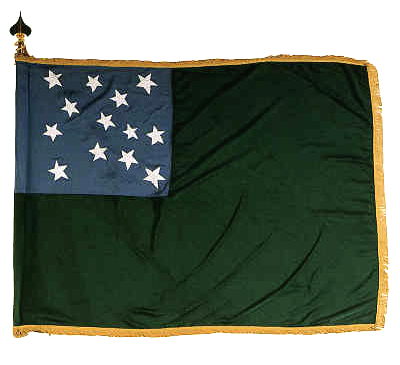
So said General John Stark whose parents were from Londonderry. He was born in Nutfield, New Hampshire, which was later renamed Londonderry, in 1728. Nutfield commemorates its 300th anniversary this year. More info here.
Monday, January 07, 2019
Lyle & Kinahan Belfast - Old Scotch Malt
Spotted these two photos on Facebook - another example of a Belfast drinks firm who also produced a brand of Scotch.


Thursday, January 03, 2019
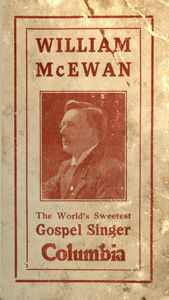
Charles McCallon Alexander (1867-1920) - Tennessee Scotch-Irish pioneer of Gospel music, and his 1905 Columbia recordings.

A Presbyterian Tennessee farm boy of Ulster-Scots descent. A big personality - ‘jovial, gregarious and outgoing’. World-famous singer of his generation who toured the globe. Frequent visitor to Ulster. Publisher of a series of much-loved hymnbooks. Pioneer recording star. Preferred ‘percussive piano’ instead of stately organ music.
Those of us who grew up in the ‘wee halls’ rather than the ‘big churches’ will be familiar with the (usually red) series of Alexander’s Hymns books which first appeared in 1902 and remained as firm favourites well into the 1980s - they’re still used today in some places. These were published by Charles McCallon Alexander, a world-famous singing evangelist, a towering figure in a truly transatlantic gospel world. This book summarises his life very succinctly; I’ve dug a bit deeper for what follows below –
[NB the biography that is quoted from extensively below was written by Charlie’s widow, the wealthy English chocolate millionaire Helen Cadbury, who he had met following one of his major events in Birmingham in England. They married in 1904, he died on 12 October 1920 and the biography appeared in autumn 1921. So the quotes below are ‘filtered’ through Helen’s understanding and words, edited from Charlie’s diaries and his extensive library. It’s a well-crafted and content-rich tribute to him, but I hope that interviews with Charlie might exist somewhere, to hear his story as the Tennessee mountain boy would have told it himself, in particular his understanding of his ancestry and varied musical influences]
1.'In My Tennessee Mountain Home’
Charlie, as he liked to be known, was born at a place called Meadow, near Cloyd’s Creek, near the town of Maryville in Blount County on the edge of the Smoky Mountains in east Tennessee (I spent a week in a log cabin in nearby Townsend back in 2002) - the family attended Cloyd’s Creek Presbyterian Church, which is shown below. Charles' posthumous 1920 biography traces the ancestry of both his father and his mother; his father John Darius Alexander was descended from
'… John McKnitt Alexander, one of the famous family of seven brothers who had fled from the North of Ireland to escape religious persecution. Everywhere they carried their staunch Presbyterian faith, providing many a minister to teach the evangelical truth so dear to their fathers. Young John Darius had been educated in a Quaker school at Friendsville, not far from Cloyd's Creek. He had set his heart upon being a minister, but finding the difficulties in his way too great, he had devoted himself to farming. Comfort came to him in his disappointment through the love of the gentle girl who eventually became his wife. Martha McCallon came of a Scottish-Irish farming family, and lived with her mother and grandfather, her father having died early …'
I’ll not recap Charles’ life - you can read the biography here - as what is of most interest to me is his role in gospel music history.

Charles recounted that his first exposure to popular hymns was at the family fireside:
‘… in our log home amid the hills of Tennessee. My mother sang sweetly and my father was famous throughout all the region round about as a musical leader. He purchased the first book of modern Gospel songs that came out when Moody and Sankey were doing their work ...”
That would have been in the early 1870s; the family had been to hear Moody and Sankey in Knoxville in 1870. He studied for a while at Maryville College, and then taught music in the area for a time. In the early 1890s Charles relocated to Chicago to the Moody Bible Institute - which as far as I know was a mixed-race/integrated college. Charles Alexander, who had been to hear the legendary duo in Knoxville as a 13 year old, was now one of their staff. Dr James M Gray, whose parents had emigrated from Gray’s Hill in Bangor, was one of the senior figures at the Institute.
3. From Chicago to the World - the early repertoire
He was by now a mighty soloist, in the days before electrical amplification, with a loud rich voice. He teamed up with a few different evangelists until, in 1902, he joined Dr Reuben Torrey - their first overseas mission was in Australia, with the famous little red hymn book a key tool in their arsenal. Their repertoire on the Australian tour included ‘God Be With You Till We Meet Again’, ‘Oh That Will Be Glory For Me’, ‘Give Me That Old Time Religion’, ‘Oh Wonderful Story’, ‘Count Your Blessings’ and ‘A Little Talk With Jesus Makes It Right All Right’, of which Alexander said
“...Now this is a song with a hook in it, it will get hold of you and do you good! It will stick to you like a burr!…"
Here is a version of that song, as recorded a generation later by Ernest Phipps during the famous 1927 'Bristol Sessions’, close to where Alexander had grown up.
They then sailed for India, and then to England. Alexander understood the supernatural power of music - its ability to touch the heart and soul. And he had a method of sorts:
“… There is a wonderful influence in song, and that influence spreads with great rapidity when once it gets started. To become quickly popular, songs must be easy to learn; there must be a simple, easy, flowing melody, and a small range, not much over an octave, and a picture in every line of every verse. The words must be simple, but full of faith, hope and promise. I never make up any final list of songs before I go to a meeting. As soon as I come on the platform I begin to study my audience, and then select my first song in accordance with my impression of what the people desire, or of what may reach them. If the first verse does not go well, I go no further with it, and sing something else. It is not my method to sing new songs exclusively ; I frequently have a new one first, in order to get the people interested, and then follow with an old one which has appropriate relation to the other. For instance, what can be more effective than to begin with ' He will hold me fast,' and follow with ' Safe in the arms of Jesus ' ; or, after the solo, ' Is He yours ? ' ' Blessed assurance, Jesus is mine ' ? "
The cynical will say that Alexander and others used music to manipulate their audiences. I think that’s unfair when you read his biography and appreciate the roundedness of what he was aiming to achieve.
“… It was a great discovery for Charles Alexander, when he realized that busy men who thought they could not sing, or take time for singing, were like a crowd of boys, when they came together in a meeting, and sang just as heartily. He found that down in every man's heart there is a love of song, and that even the men who had no sympathy with Christianity as they knew it, liked the Gospel hymns, and would come to hear them …"
4. A fusion of Scottish Psalms and songs – and ‘negro melodies’
Then there’s this brilliant summary of the development of popular hymns:
“… This brings to mind the way in which Charles Alexander always traced the music of Gospel songs, which was wafted over the British Empire from America, to the influence of the negro melodies. In contrast to the regular rhythm of the older standard hymns, a Gospel song has a lilting swing and flow that is essentially American, and owes its origin to the pathetic strains of the days of slavery. Yet there must have been some other influence behind those negro melodies, for they are nowhere found amongst the Africans in their own continent. Charles Alexander's theory was that they were built up by the Southern negroes, in the pathos of their helpless condition, upon the foundation of those minor strains of the old Scottish psalms and songs, brought over by the pioneer settlers from the land of their birth to the Southern mountains of their adopted country. Whenever he wanted to train a writer of Gospel hymns, Alexander would always try to get him saturated with the rhythm and bubbling freshness of the music of the coloured people. Another thing he learned from this source was the constant reiteration, in the words of a hymn or chorus, of some one main thought that he wished to lay hold of the mind. This may be seen in his choice of the hymns he made use of, and in those which he helped to inspire.
... he always insisted that, to a very large extent, children get their theology from the hymns which they sing. As this again is true of grown-up people as well, Alexander felt that no pains should be spared to ensure that the teaching of the hymns in his collections was strictly in accordance with that of the Word of God ; and he preferred, wherever possible, the actual words of Scripture. This was the reason why he loved so dearly the hymns written by his old friend Major D. W. Whittle, so often set to music by his co-worker James McGranahan ..."

5. 1903 - the first tour of Britain and Ireland
McGranahan’s ancestors were from Belfast, where he later sang. The city was on the Torrey–Alexander schedule - they had already packed the Royal Albert Hall to the rafters (free of charge to all who attended - story here); they had 7000 people in St Georges Market in Belfast in 1903. They also held campaigns in Bangor, Dundalk and Londonderry. Thomas Sinclair, who would later write the text of the 1912 Ulster Solemn League & Covenant, had this to say:
“… I have been much struck with the great sanity with which this mission has been conducted. We sometimes associate such movements with extravagances. There was absolutely an absence of anything of the sort in these meetings," Rev. W. H. Brownrigg, of the Church of Ireland, said : " The time through which we have passed has been one of marked spiritual revival such as I have never before been connected with."
The five weeks in Belfast were followed by ten days in the adjoining coast town of Bangor, where the rising tide of blessing overflowed again into the larger city. Here an instance of Alexander's tact occurred, during a visit to the home of a Christian family whose members were church-workers. While looking in a drawer for some photographs, a pack of playing-cards was discovered. Said the lady of the house : "I hope you do not think we play for money. We have a friendly game now and then amongst ourselves, or when the young folks have friends to visit them." Alexander replied, smiling, " I didn't say anything about the cards. Why do you apologize for them ? " " But surely you do not think there is any harm in playing, do you ? " was the question asked after a short interval. " Do you think it would help you to get your friends to surrender to Christ ? Would it be easy, after a game of cards, to start a conversation which would lead them to Jesus ?..."

6. The 1905 Recordings
In early 1905, apparently after much reluctance, he was persuaded to enter a recording studio. ‘Talking Machines’ had become popular and record companies sprang up to feed the demand, constantly on the look for popular singers to record, market and profit from:
“… London was already ringing with the new melodies which had captivated the great throngs at the Royal Albert Hall day after day. The (Columbia) Gramophone Company approached Alexander with a handsome business proposition for the making of a number of records, which, with the additional royalties, would have brought him in a large sum of money. To their surprise he definitely refused at first. On further persuasion he said : "I will not accept one penny for myself, either now or later. But I'll give you some records, both in song, and in spoken incidents, if you will take a big space in one of the leading London dailies, and print the " Glory Song " above your advertisement, also adding that I am giving you the records free, without remuneration or royalty. Astonished by the unselfish generosity of the proposal, and finding it useless to persuade him to receive any payment, the conditions were readily acceded to, with the result that the "Glory Song" entered hundreds of thousands of homes in Great Britain; while, by means of the gramophone records, the very voice of the singer carried its message in song, and told incidents of the meetings to people even in far-off lands. It was reported at the time that the sales during the first few days amounted to ten thousand records…"
He recorded ‘The Glory Song’ on a Monday afternoon, the manufacturing began straight away, and records were being delivered to shops on the Friday. I’ve found adverts in newspapers in Omagh and Newry, as well as Belfast and Bangor, announcing the availability of the famous Alexander debut recordings. It was a phenomenon, and hundreds of thousands of copies were sold.


Here are two of Alexander's 1905 recordings, from Archive.org. You can imagine the huge anthemic chorus of 'The Glory Song' being belted out by thousands of voices:
• ‘The Glory Song'
• ‘Tell Mother I’ll Be There'
This webpage by Norman Field catalogues all of Alexander's known recordings, also listed on this page.
Demand was huge, there are various newspaper reports saying that the company was inundated with orders and that the song was re-recorded by other artists almost immediately. And back in Nashville in October 1906, Torrey and Alexander would take the stage which their evangelist friend Sam Jones had helped to establish - the Ryman Auditorium, which later became the home of the world-famous Grand Ole Opry. More to follow...


Hugh Newell (1830-1915); Belfast-born American artist

Hugh Newell is said to have been born in Belfast on 4 October 1830 but studied as an artist in London, Paris and Belgium, so he must have been from a relatively wealthy family. He emigrated to Baltimore, Maryland, in 1851 and exhibited there until 1858. He then became Head of the Women’s School of Design in Pittsburgh, Pennsylvania from 1869–1878. His wife was Mary McCrum, they seem to have lived for a time in western Pennsylvania around Wilkinsburg - today part of Pittsburg - and a region heavily settled by Ulster-Scots a century or so before. They bought a farm in 1869 but left it to their son around 1893 when they relocated to Newark in New Jersey.
This website says he was “...a member of the American Watercolor Society, also exhibited with the Washington Art Association (1857), National Academy of Design (1858-1891), Pennsylvania Academy of the Fine Arts ((1860-1880), Brooklyn Art Association (1876-1884), Boston Art Club (1881-1886), and at the Art Institute of Chicago (1910-1914). His works are found in the collection of the Peabody Institute in Baltimore and the Shelburne Museum in Vermont…"
He died in 1915 in Bloomfield, New Jersey.
Wednesday, January 02, 2019
The 1907 Belfast Water Scare - Lyle & Kinahan
I’ve mentioned Lyle & Kinahan here before - hard to know if this advert was exploitative and opportunistic, or a legitimate health benefit. Lyle & Kinahan was another beverage firm founded by a prominent Presbyterian (Lyle) and Orangeman (Kinahan), but they didn’t move into alcohol until after the death of Lyle as far as I can tell.

Sunday, December 30, 2018
'American Negro Folk Songs' - Harvard University Press (1928)

Ironically, written by someone called Newman I. White (the Professor of English at Duke University in Durham, North Carolina), this book is obviously of its time in its usage of particular terminologies. Where it gets really interesting is in the chapter entitled ‘Religious Songs’ (online here) and specifically of the cultural sharing of music and hymns which took place between what the author terms ‘mountain whites’ and black people.
In our era, claims of ‘cultural appropriation’ between people groups insist that there must be a negative context - of the power of one group, who oppress and exploit another group - for what would previously could well been regarded as 'cultural sharing'. This controversy over a statue of songwriter Stephen Foster in Pittsburgh provides one example of that.
Yet there is plenty of evidence to show that class is/was as much of a social issue as race - and that musically speaking, poor people shared songs and tunes and playing styles across imagined racial divides. White complains that often there was little distinction between the religious songs of the blacks and mountain whites. Exactly.

African-American Kentucky Methodist minister Rev Marshall William Taylor published a volume of ‘Revival Hymns and Plantation Melodies’ in 1883, which is online here. Taylor’s biography is fascinating:
“...Marshall William Boyd (alias) Taylor was born July 1, 1846, at Lexington, Fayette County, Kentucky, of poor, uneducated, but respectable parents. He was the fourth in a family of five children, three of whom were boys, viz.: George Summers, Francis Asbury, and himself; and two girls, Mary Ellen and Mary Cathrine. He is of Scotch-Irish and Indian descent on his father's side. Hon. Samuel Boyd, of New York; Joseph Boyd, of Virginia; and Lieut.-Gov. Boyd, of Kentucky, were blood-relations of his, and all descended from the "Clan Boyd" of Scotland. His mother was of African and Arabian stock. His grandmother, on his mother's side, Phillis Ann, was brought from Madagascar when a little girl, and became the slave of Mr. Alexander Black, a Kentucky farmer, who at his death willed his slaves free…” - full bio online here
Poor people survive together. They fall in love together, make families together, they share life together. Cultures blend around the edges and so the races mix too. Music is one perfect example of that, as is Marshall Taylor’s complex ancestry - and above all, spiritual songs express a shared human condition, a shared hope, and a ‘for whosoever believeth on Him’ gospel. Here’s another Kentucky pastor - Claude Ely - with his raw and raucous 1934 composition ‘Ain’t No Grave’ that proves that fusion.
Saturday, December 22, 2018
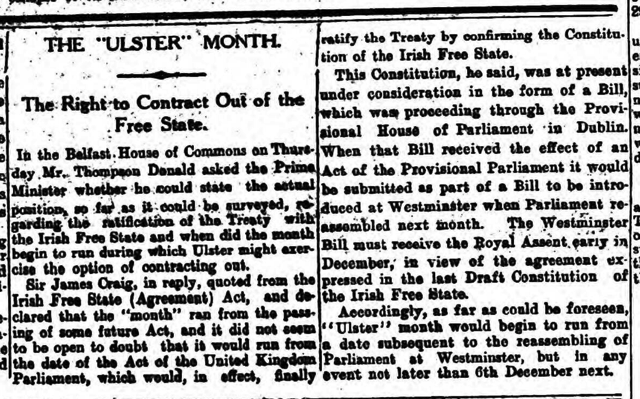
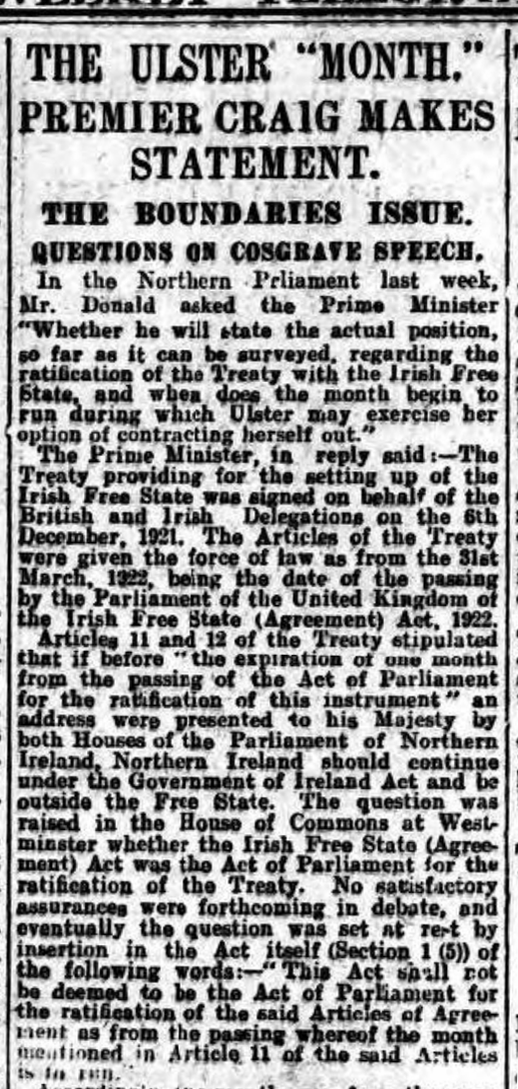
'The Ulster Month' in 1922: When Ireland opted to 'Leave' but Northern Ireland opted to 'Remain'
The present day has echoes of nearly 100 years ago. Here’s a repost of this from September 2014. Ireland had opted to “Leave" the UK and set up the Irish Free State. But the Northern Parliament was given a month to decide what to do. it decided - by a vote of 40 for and 12 against - to ‘Remain’ in the UK:
………...
Few people appreciate that Northern Ireland also seceded, from the Irish Free State, which had been effectively formed by a Treaty on 6 December 1921. A year later it had been adopted. During the following four weeks of 1922 - known as 'The Ulster Month' - provision was allowed for the Houses of Parliament of Northern Ireland to opt out of the new state. The inevitable happened - an address was presented to the King the next day which said:
"... MOST GRACIOUS SOVEREIGN, We, your Majesty's most dutiful and loyal subjects, the Senators and Commons of Northern Ireland in Parliament assembled, having learnt of the passing of the Irish Free State Constitution Act, 1922, being the Act of Parliament for the ratification of the Articles of Agreement for a Treaty between Great Britain and Ireland, do, by this humble Address, pray your Majesty that the powers of the Parliament and Government of the Irish Free State shall no longer extend to Northern Ireland ..."
The King's response on 8th December 1922 was:
"... I have received the Address presented to me by both Houses of the Parliament of Northern Ireland in pursuance of Article 12 of the Articles of Agreement set forth in the Schedule to the Irish Free State (Agreement) Act, 1922, and of Section 5 of the Irish Free State Constitution Act, 1922, and I have caused my Ministers and the Irish Free State Government to be so informed ...'.
The vote in the Northern Ireland Houses of Parliament had been 40 for secession to 12 against.
………...
Political historians will know far more about this period than me. I think this story deserves to be better known. And there are a whole series of “what if” scenarios to speculate about… perhaps if more flexible solutions had been offered, or found, the 20th century might have worked out differently.
Friday, December 21, 2018
The Scarvagh 'Sham Fight' was saved in 1904 by Henry Thomson's whiskey money
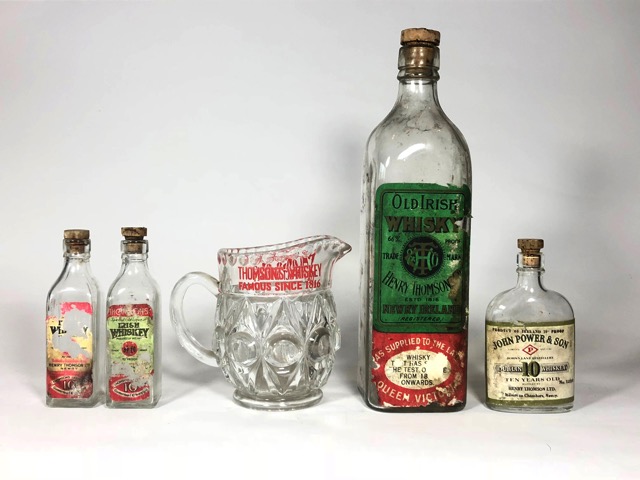
Often Ulster’s unionist story is told as a selective, religious and conservative tale. But that’s not the full story - the more I read the more I’m finding whiskey money all over the place. James Craig, the future Prime Minister of Northern Ireland was part of the Royal Irish Distilleries global empire, and he even bought a hot water geyser in Iceland in the 1890s with a view to setting up a plant there (link here - a story widely known in Iceland).
• Further south, I recently discovered that Abbey Presbyterian Church in Dublin was built in 1864, entirely by the money of Glasgow-born Dublin wine and spirit merchant Alexander Findlater - at a cost of £13,000 which today is around £1.25million. His brother William Findlater was a merchant in Londonderry, and their sister Helen Findlater also settled in the Maiden City.
• Dublin's Christ Church Cathedral was restored in the 1870s by whiskey distiller George Roe to the tune of £230,000 - around £21.5million today.
• Interestingly, even the Irish whiskey giant John Jameson (1740-1823) whose surname is probably the most famous Irish whiskey brand, was actually a Scottish lawyer and distiller based in Dublin. He was born in Alloa, where he later died and was buried.
The annual ‘Sham Fight’ at Scarvagh House has been going for 185 years, re-enacting in very small scale the Battle of the Boyne. In the mid 1800s there were similar fights at Gilford and Banbridge. Tradition tells that in 1690 when William III’s army was camped at Scarva, a local man called Reilly brought cherries and fresh eggs to the troops, and as a reward William promised him as much land in the area as he could walk in one day. So Reilly set about it the very next morning, staking out the boundaries and later planting marker trees where the stakes were. The famous old manor house was built in 1717. A newspaper report of 1939 said that the trees were then still standing.
The ‘Sham Fight’ was originally held in the open at Aughlish crossroads. However according to the Dublin Evening Mail of 16 August 1865 a ‘counter-demonstration’ was held in the village by a group of around 350 ‘Fenians’, who marched from Laurencetown to Gilford and then towards Scarva. The 60th Rifles from Newry were sent to keep the peace, along with local police.
The Reillys then offered that the event be relocated to within their estate for 1866 - seemingly with Mr Reilly himself performing the role of William III. The Dublin Evening Mail gave an amusing account on 6 October 1866 of the first one -
‘… a most alarming condition of good feeling and jocularity was proved to exist between the Protestants and Roman Catholics of the district. The Roman Catholics and Orangemen are good friends at Gilford ...'
The 1867 Scarva events - as reported in the Newry Telegraph - read like a full-scale day-long carnival with 15,000 visitors and the fight lasting for just over an hour. Scarvagh estate remained in the Reilly family until 1904, when it was put up for sale and the future of the ‘Sham Fight’ was at risk.
Enter Henry Thomson Jr (1840-1917), a local whisky millionaire (see previous post here) and prominent Unionist and Orangeman, who had been an MP in the 1880s as well as High Sheriff for County Down. He bought the Scarvagh estate and in doing so preserved the future of the ‘Sham Fight’ in perpetuity - he also gave land for Scarvagh Orange Hall to be built and which opened in 1908.
Other Thomson properties included Ballyedmond Castle, Downshire House and Altnaveigh House where in 1884 a vast 12th demonstration was held, with a reported crowd of 50,000 people and participants. Another branch of the Thomson family lived at Ravensdale in County Louth.
Henry Thomson died in Scarvagh House in 1917, was buried in St Patrick’s churchyard in Newry. His coffin was carried into the church by the officers of Altnaveigh LOL. and his obituary in the Belfast News Letter stated:
‘he secured to the Orangemen the right to use for ever eight acres of the Scarvagh House demesne for celebrations on the 12th and 13th July and the 12th of August each year. By this and other gracious acts he earned the undying gratitude of the Orange Institution, and his memory will be fondly cherished by the members of that Order in all parts of the Empire.
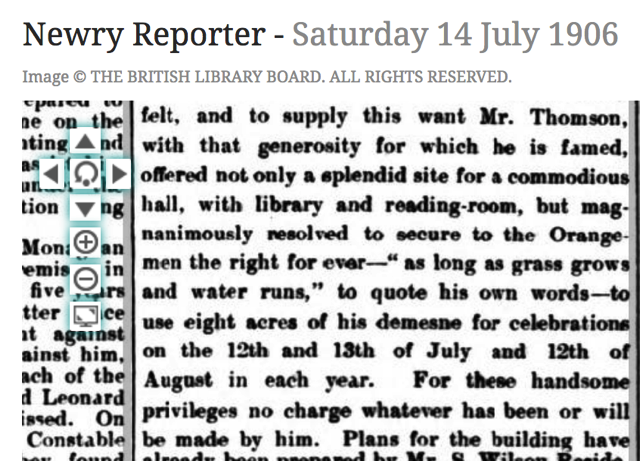
A memorial Orange hall in Newry was built in his honour. His properties, and seemingly the whiskey business, were inherited by his nephew, Henry Broughton Thomson (1870-1939) who became a politician in British Columbia, was Food Controller for Canada during the Great War and later the Chairman of the Liquor Control Board.
In 1936, just three years before Henry Broughton Thomson died, Scarvagh estate was sold again, this time to Alfred Buller of Orangefield in Belfast, a land steward for Major Blakiston-Houston.

Tuesday, December 04, 2018
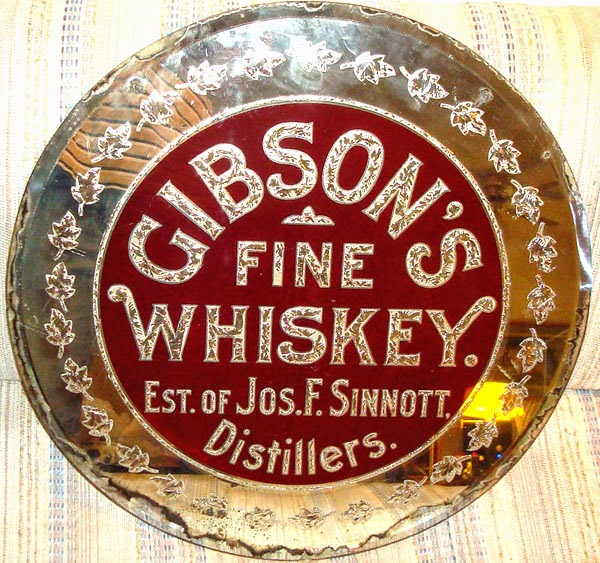
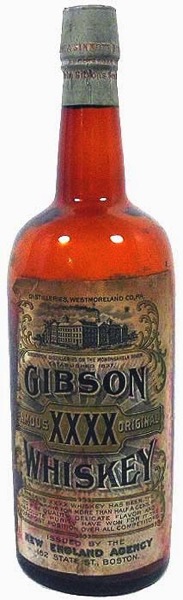
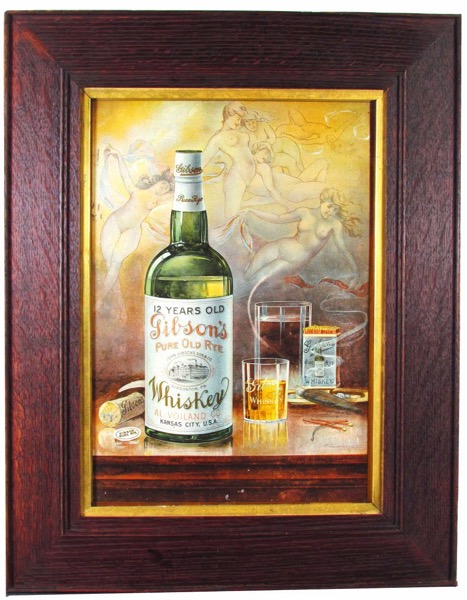
Gibson Monongahela Pennsylvania Whiskey - the biggest distillery in America in 1900
This brand is now owned by a Canadian company but its origins are in 1856 when Ulsterman John Gibson (born in Belfast in 1794) bought 40 acres to build a distillery on the banks of the Monongahela River. He had been active in the spirits industry in Pennsylvania since about 1837. It became a huge operation and a settlement called Gibsonton Mill grew up around it. His son 22 year old son Henry inherited the business in 1883 and renamed it John Gibson’s So & Co. Prohibition killed the business until 1972 when the brand name was revived.
(The ‘Gibson’ script logo on the bottles looks suspiciously similar to the one which Orville Gibson would later stamp on the headstocks of his guitars and mandolins)

Sunday, October 21, 2018
John White Geary - from Pennsylvania to San Francisco
Born in Westmoreland County in 1819, the son of Richard Geary and Margaret White, John White Geary has been described as ‘a giant of his times’. Literally so - he was 6’ 6”, and his life intersected with many of the most pivotal moments in American history. His brother Edward became a Presbyterian minister and was later a pioneer in Oregon.
John became an engineer, joined the Pennsylvania militia, led a regiment in the Mexican War of 1846, became US Postmaster for California, reaching the state via Panama just in time for the Gold Rush of 1849. In 1850 he was elected the first Mayor of San Francisco, but the family returned to Pennsylvania in 1852 for health reasons. After the death of his wife he was offered the governorship of Utah (which he declined) and then Kansas (which he accepted). He found himself embroiled in the early tensions of pro and anti slavery factions, and when Civil War broke out in 1861 he began recruiting troops for the Union Army, becoming a Colonel at the head of the First Brigade of the Eastern Army of the Potomac. When the war was over he became Governor of Pennsylvania.
He died in 1873 aged just 54. He had a state funeral; there are various monuments, streets and counties named after him.
‘… Geary possessed an ego to match his great stature. He shared the traits typical of the hearty Scotch-Irish pioneers of his Western Pennsylvania home. Stubborn to a fault, self-sufficient, of fiery independence, plain spoken, and possessed of a pride that countenanced no affront; these attributes, coupled with his, at times, shameless self-promotion invited envy, bitter rivalries and personality conflicts … As a staunch Presbyterian Christian, he came naturally to his aversion to slavery and had personally witnessed the excesses of the 'peculiar institution’...'

Friday, September 28, 2018
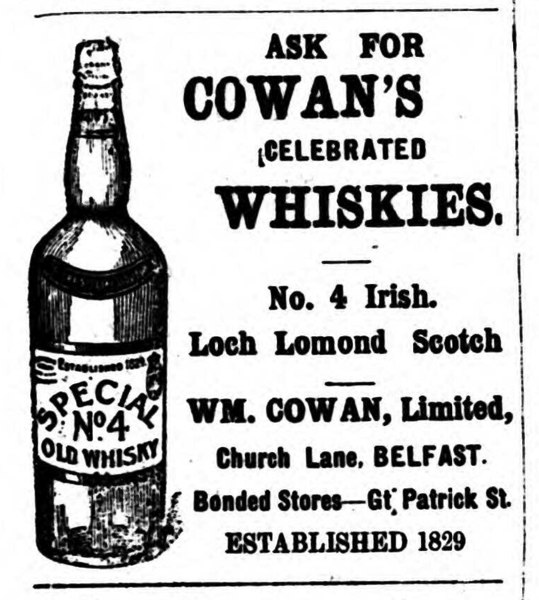
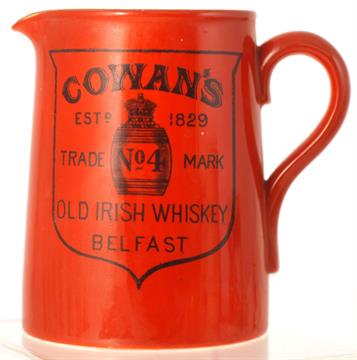
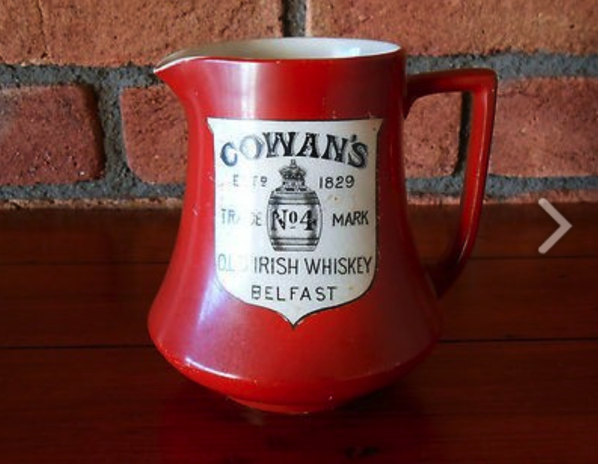
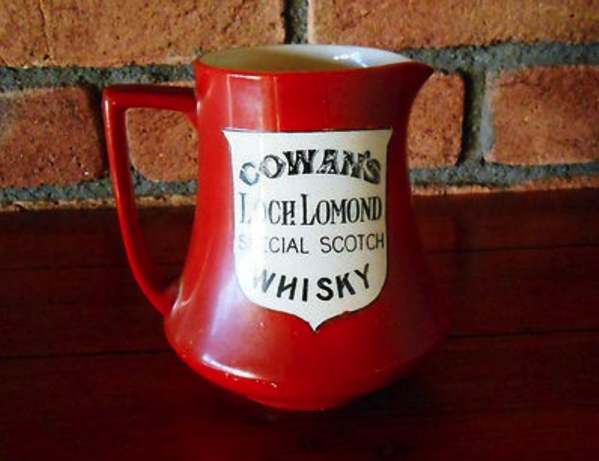
William Cowan - Distillers of Belfast and Glasgow - No. 4 Irish Whisky & Loch Lomond Scotch Whisky
Yet another large distilling firm with operations on both sides of the North Channel.


Monday, September 24, 2018
Judge Joseph Neilson (1813-1888)
"In January, 1888, that well-known American jurist and illustrious Brooklynite, Judge Joseph Neilson, died. He was an old friend of mine, of everyone who came upon his horizon. For a long while he was an invalid, but he kept this knowledge from the world, because he wanted no public demonstration. The last four years of his life he was confined to his room, where he sat all the while calm, uncomplaining, interested in all the affairs of the world, after a life of active work in it. He belonged to that breed which has developed the brain and brawn of American character - the Scotch-Irish."
Neilson’s funeral service took place at 2nd Presbyterian Church, Clinton Street, Brooklyn, in January 1888. His father was Dr Samuel Neilson and his grandfather John Neilson, who emigrated from Ulster in 1760.

Wednesday, September 19, 2018


Tuesday, September 11, 2018
Elizabeth Jane Cochrane - 'Nellie Bly' - the journalist who travelled around the world in a record-breaking 72 days (1889-90)
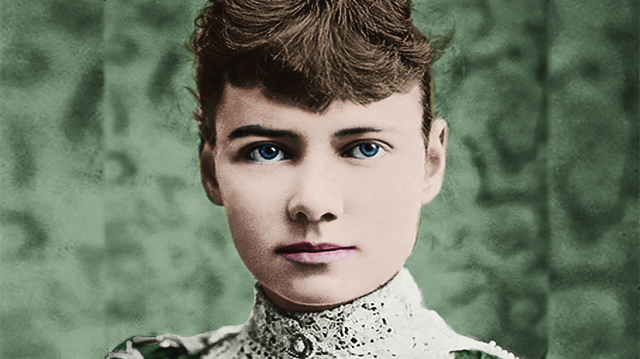
She was born in 1864 in the town of Cochran Mills in Armstrong County on the outskirts of Pittsburgh. It had been named after her father Judge Michael Cochran (1810-1871). His father Robert Cochran had emigrated to Pennsylvania from County Londonderry. Her father died when she was just a child and her mother re-married, so it’s hard to see a direct family environment of distinctly Scotch-Irish values, but the community and region had been strongly so for over a century.
You’ll find references to her very easily online - a journalist who wrote under the pseudonym ‘Nellie Bly’. She first came to the fore through her championing of women’s causes and challenging what she saw as negative portrayals. She famously pretended to be insane in order to infiltrate an asylum for ten days, which she later wrote up as Ten Days in the Madhouse.
She travelled the world in 1889-90, beating Phileas Fogg’s famous 80 days achievement by doing so in 72 days, which was briefly a world record.