Saturday, August 11, 2018

An account of Scotch-Irish Women Psalm singers in the Carolinas, 1760s: 'The women sing as well or better than the Girls at the Magdalene Chapel, London'

9781609499532

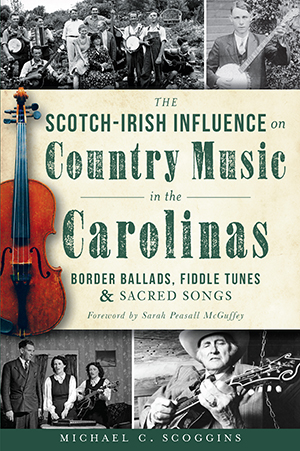
Michael Scoggins’ book The Scotch-Irish Influence on Country Music in the Carolinas’ was one of the first on my list of summer reading. I have dipped into it a few times over the years but had never read it cover to cover. It is excellent, and I plan to post a few things here from it - but you really should get a copy for your own library.

Rev Charles Woodmason (1720–1789) frankly despised the Scotch-Irish. He was an Episcopalian from England, sent to frontier South Carolina. His intention was to limit the spread of 'backcountry revivalism’ which many scholars say fed into the 'Regulator Rebellion’ and Battle of Alamance, of which Rev David Caldwell was a key figure - I have mentioned him and his wife Rachel here in previous posts.

Here is Woodmason's account of Scotch-Irish women, a combined group of Baptists and Presbyterians:

‘On the 31 (Sunday) I gave service to about 400 people among whom a great number of Baptists and Presbyterians… excellent singing. The women sing as well or better than the Girls at the Magdalene Chapel, London – they all come from Virginia and Pennsylvania – not an English person or Carolinian among them’.

Woodmason’s famous quote – 'a set of the most lowest vilest crew breathing Scotch Irish Presbyterians from the North of Ireland’ – needs to be borne in mind here. To have given such praise to to singing of a people he had no time for speaks volumes.

37584495 10156710222992878 7491968040054030336 o

Friday, August 10, 2018

Where exactly is 'Trump Country'?

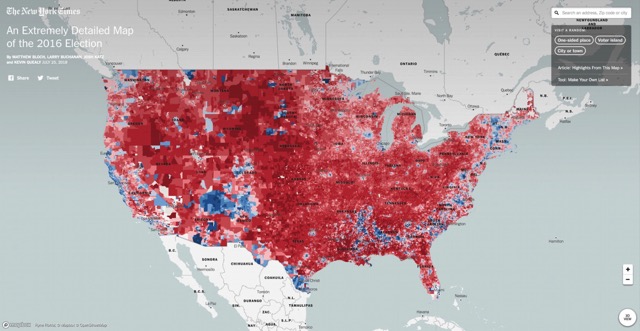
Nyt 2016 election precinctsBack on 25th July, the New York Times published a truly phenomenal piece of electoral cartography - a zoomable, detailed, precinct by precinct map of the 2016 US Presidential election results. It is visually stunning and technologically pretty breathtaking. Have a look here. Look at the ocean of Trump red. Or, as many in the US media have called it, ‘flyover country’, ie the places and people you can avoid as you jet in business class between the ‘progressive' coastal conurbations.

Readers here will know that JD Vance’s book Hillbilly Elegy: A Memoir of a Family and Culture in Crisis caught my interest through the media reports around the time that it came out - when I was on holiday in the USA in July 2016 - journalists were intrigued by its references to the 'Scots-Irish', a group which the metropolitan media class by and large didn't know. Initially I saw this as a good thing, a profile-raiser for Ulster-Scots / Scotch-Irishness generally, but when I got the book and read it I was very disappointed.

51gufUMfXZL SX328 BO1 204 203 200

I’ve been through Appalachia - a vast region which straddles maybe 10 states - four times over 20 years. I don’t think that Vance or his publishers set out to make Hillbilly Elegy what the media turned it in to - for him it was a 'memoir of a family', but the urban media made it first a regional characterisation, crudely broad-brushing its social breakdown and disintegration themes across all of Appalachia - and then worse still, they used it later in 2016 as a political explanation of how the Trump victory had happened.

‘Trump Country’ became a euphemism for Appalachia and the ‘Rust Belt’. It was, and is, lazy and untrue. But many American commentators still perpetuate the myth - such as this article from just two days ago. All this does is show how little the supposedly educated city dwelling ‘opinion formers' understand and care about the rest of their nation. I watched online how smart, rooted, Appalachian bloggers and journalists - both progressives and conservatives - expressed their rage at the stereotype. It was Deliverance for the 21st century - an easy trope which gave the upper middle class permission to once again blame and mock the poor ‘basket of deplorables’ whites. The South as America's scapegoat yet again - Rod Dreher's 2014 piece summarises this theme well.

This map destroys that notion. Outside of the big cities, and the Democratic Party strongholds, all of America is ‘Trump Country’, for better or worse. I have regular readers here who I know are pro-Trump, and also regulars who are anti-Trump. I have no particular ‘truck’ with Trump as a personality, but I can very much see how he became a lightning rod for a population who looked at Hilary Clinton and saw her as the embodiment of a failed, entitled, insider-elite political class and system. He just exploited it. He defeated all of the establishment Republican Party candidates as well the Democratic Party’s chosen candidate Hillary Clinton. Sanders might have been a stronger choice for them. The map shows the scale to which Trump succeeded.

Ironically, the map also confirms one of Trump’s soapboxes - that you can’t trust the experts. If supposed or assumed experts are still talking about ‘Trump Country’ then new experts need to be found. The pollsters and commentators were wrong pre-election - and some persist in their prejudices and wrongness post-election.

The Scotch-Irish / Appalachia / The Rust Belt / The South are neither responsible, nor to blame, for Trump. The system made him and he took full advantage, coast-to-coast, north, south, east and west. 

There is a simple principle in politics - if you malign people, you might well mobilise them against you. That doesn’t matter if the numbers are heavily in your favour, but when it’s a close-run thing then that’s a disastrous strategy. As an outsider looking in from this side of the Atlantic on the relentless media ridiculing of Trump voters, the media class could well be ushering in a second term.

• This came up in the enjoyable discussion I had on BBC Radio Ulster with Bruce Clark and Dr Brian Walker, chaired by William Crawley, earlier in the year. You can listen to that on iPlayer here.

• the video below by the libertarian-leaning Cato Institute gives some interesting analysis:

Wednesday, August 08, 2018

1683/1684 - Thomas Ferguson and the forgotten Scotch-Irish emigrants of Charleston, South Carolina?

CharlestonSC1733

The more you read the more you find. Numerous reputable sources refer to a Sir Richard Kyrle, who was based in County Cork but was also Governor of South Carolina and who was involved in an Ulster emigration led by a Thomas Ferguson in 1683 or 1684. 

This website lists some surviving primary records of the Ferguson venture - " Mr. Thomas Ferguson and other families from the north of Ireland, being desirous of settling in Carolina, in compliance with their request, some small river to be reserved for them for seven years. Instructions thereupon”. The land grant which they were attracted to seems to have been formalised in 1702, to a Hugh Ferguson.

The settlement appears to have been where the Ashley River meets the Cooper River. You can see ‘Ferguson’s’ marked on the 1733 map shown above, just outside the town walls. Interestingly, Dr Mark Jardine’s wonderful blog refers to a shipload of Covenanter prisoners being banished to the Carolinas from Scotland in 1684.

The first Presbyterian church in Charlestown was organised in 1685, its congregation made up of people from Scotland and also some who had come down from New England. The original building was just outside the town walls; it is long-gone but there are today a number of Presbyterian churches in the same area as Ferguson’s settlement. American Presbyterianism, its Origin and Early History (published 1885, online here) features a map which shows a lot of Presbyterian activity in New England, and with Charleston as an outlier much further south.

A 1710 letter refers to ‘five British Presbyterian’ ministers active in Charleston. In June 1714 the records of the General Synod of Ulster refer to a Rev John Jarvie, ordained by the Presbytery of Belfast, being onboard a ship sailing from Belfast Lough ‘bound for South Carolina; the seamen and passengers amount to the number of 70”. This ship arrived in Charleston in summer 1714.

So, another important story which needs some scholarly attention, another very early connection. 

• NB the primary source reference mentioned above is "Papers in the State Paper Office London: 1684, July 11. Craven and others, to Sir Richard Kyrle. Mr. Thomas Ferguson and other families from the north of Ireland, being desirious of settling in Carolina, in compliance with their request, some small river to be reserved for them for seven years. Instructions thereupon. 4 folios; p. 38"

Presb USA map

Maude Glasgow (1876-1955) - 'The Scotch-Irish in Northern Ireland and in The American Colonies' (1936)

Maudeglasgow watermark

Dr Maude Glasgow (1876-1955) is known for her 340-page 1936 book The Scotch-Irish in Northern Ireland and in The American Colonies (published by G.P. Putnam’s Sons, New York), which was favourably reviewed in the newspapers of Ulster, Scotland and America, as well as in the 1936 annual year book of the Ulster-Irish Society of New York. I have an original copy, stamped ‘Linen Hall Library Belfast’ which I bought from a local bookseller maybe 20 years ago. Presumably the library had a clearout at some time. I can’t find an online edition, probably as it’s not yet 70 years since the death of the writer.

She is an interesting and unexplored figure. Born in Cookstown, her father was Silas Glasgow of Killycurragh where the family seem to have been members of Orritor Presbyterian Church. She studied in Dublin and then went to New York, graduating from Cornell University in 1901. She became a medical examiner for New York City Health Department. She was also prominently involved in some Suffragette activity in the city from 1908–10.

She wrote a series of books and papers championing women’s rights and freedoms, such as The Subjugation of Woman and the Traditions of Men (1940). Various newspaper obituaries described her as ‘retired physician and feminist’.

• Biography here on the American Medical Women’s Association website
• short obituary below from the Ballymena Weekly Telegraph, 9 December 1955 

Glasgow Obituary

Maude glasgow

Ellen Glasgow (1873-1945) Pulitzer prize winning author

Ellen Glasgow was born in Richmond, Virginia, just 8 years after the American Civil War. Her father, Francis Thomas Glasgow, was a Presbyterian who had been raised in the Shenandoah Valley. Ellen wrote 20 books, winning the Pulitzer prize for her novel In This Our Life. Her autobiography The Woman Within was published posthumously in 1954. She is credited for having ‘helped direct Southern literature away from sentimentality and nostalgia’.

She seems to have had a strained relationship with her old-fashioned father who was the manager of Tredegar Iron Works; the family were members of Second Presbyterian Church in Richmond. It is said that she inherited his ‘iron will and philosophy irrevocably tied to his Calvinistic beliefs’ - it was said that he ‘never committed a pleasure’.

Her Civil War novel Barren Ground (1902) was focussed around Scotch-Irish mountain communities, a setting where this review observes there were no slaves or plantations. She regarded her 1935 novel Vein of Iron as her best work - a story set in rural Presbyterian Virginia about the significantly-named Fincastle family.

NewImage

Monday, August 06, 2018

Joseph Earl Dabney (1929–2015) – 'Mountain Spirits: A Chronicle of Corn Whiskey from King James' Ulster Plantation to America's Appalachians and the Moonshine Life' (1974)

2018 08 06 17 50 44

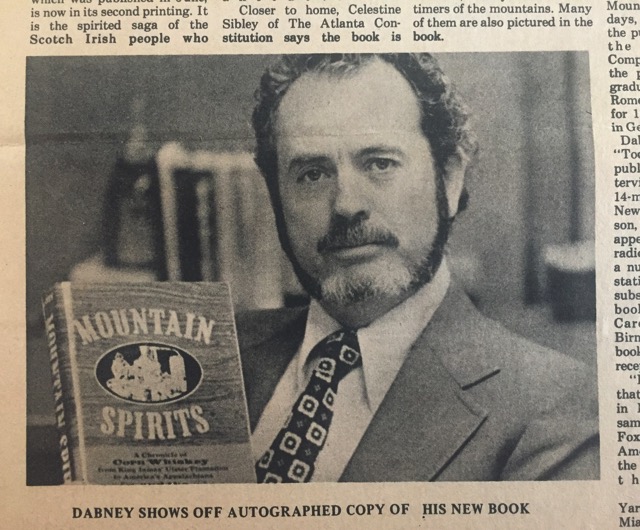
In 1974, Joseph Earl Dabney, an award-winning author, newspaperman and PR executive (who was also a member of Dunwoody Baptist Church in the state of Georgia) published this book. His biographical obituary is online here. He is one of those people who I now wish I had contact with when they were still alive.

I am reading my way through Mountain Spirits: A Chronicle of Corn Whiskey from King James' Ulster Plantation to America's Appalachians and the Moonshine Life. I'm not a teetotaller (until fairly recently the occasional cold cider would do the job for me; I now do some design work with two local distilleries) but I have found this book to be superb - Dabney was very well-informed on the history and culture of Ulster, and he uses the terms Ulster-Scots and Scotch-Irish throughout.

It's scholarly yet accessible. Philosophically you can tell that Dabney was taken by the craft of the distillers and the relentless individualism of the push to the frontier and the defiance of government - initially the British Crown but then also the punitive measures introduced by George Washington and Patrick Hamilton, who redrew the boundaries of Pennsylvania, making the Virginian frontiersmen subject to Pennsylvanian land payments literally overnight, and of course the 'whiskey tax’ the government introduced to raise funds for the new republic. Dabney also traversed rural communities to talk with the moonshiners of the older generation to record their stories. A second edition - More Mountain Spirits - was published in 1985.

Dabney authored a number of other successful titles, including food books Smokehouse Ham, Spoon Bread & Scuppernong Wine (1998) and The Food, Folklore, and Art of Lowcountry Cooking (2010). He won the Jack Daniel Lifetime Achievement Award from the Southern Foodways Alliance in 2005.

His obituary describes him as 'A devout Christian, Dabney was a member of Dunwoody Baptist Church where he enjoyed the Young at Heart seniors group and sang in the choir.' In a Northern Ireland context, this is quite unusual for somebody fascinated by whiskey! One of the figures the book refers to was a Baptist pastor, a Rev Elijah Craig who some say invented bourbon whiskey in 1789 (Wikipedia entry here). A brand exists today which was named after him.

As is so often the case, traditions shorthanded in America these days as geographically Irish, turn out to be predominantly culturally Scotch-Irish. Spirit distillation is one of those things, at least in its earliest days. It is important to retain these distinctives where possible, not to claim that the Scotch-Irish are superior to others, but to acknowledge their role in the overall story.

Mountain Spirits: A Chronicle of Corn Whiskey from King James' Ulster Plantation to America's Appalachians and the Moonshine Life - is a first-rate book. Highly recommended for a taste of the pioneering independent spirit.

"The Scotch-Irish proved their mettle. They were a new kind of pioneer, who brought strong convictions to America, including a love of whiskey and a love of liberty’ - page 41

37849305 10156724477087878 3499167949778845696 n 15 09 26 RalfR WLC 0107 37904293 10156724458867878 1036949038198423552 n

Sunday, August 05, 2018

Summer 1718 - The Scotch-Irish 'hurricane' makes landfall in New England, 300 years ago

Hurricane earl nearing massachusetts 2010 25579 600x450

In summer 1718, the long-awaited Scotch-Irish cultural, spiritual and ideological hurricane reached America, making landfall in Boston and then dispersing to a number of points in New England.

The first attempt by the ship Eagle Wing had famously been driven back by an actual hurricane in 1636; during the 1670s an Ulster-Scots emigrant community from the west of the province had organically developed on the eastern shore of Maryland, for which in 1680 a Presbyterian minister was sought; in 1683 Rev Francis Makemie arrived. It is plausible that 1718 was possible because there were already kinfolk who had made the crossing to Maryland a generation before.

The New England states are where the serious impact tremors would be felt, a ’storm surge’ which would gradually reach all of the then 13 colonies, and which reverberates to the present day. There is a big job of research and digital bridge-building to be done.

John Hopkins Morison (1808-1896) was a significant figure in Peterborough, New Hampshire, and was descended from these early settlers. His posthumous biographical memoir from 1897 (online here) traces:

a) his paternal line to a John Morison who was born in Aberdeen in 1628, who came to Londonderry where he endured the Siege. His son, also called John, recalled trying to catch mice to eat for survival. The son, his wife Margaret Wallace, and grandson emigrated to America in August 1718, to Casco Bay, and John sr. joined them in 1720. He died in Londonderry New Hampshire on 16 February 1736, aged 108 years.

b) his maternal grandfather was a John Hopkins who could 'sing Scotch songs all day long without repeating a single song', and wife Isabella Reid, who also sailed for America.

John Hopkins Morison visited Londonderry in 1876 during a tour of Europe - his impressions of the city are on page 229 here. But he left disappointed as so much heritage and memory of the Siege had been lost.

Morison is another of those, often nowadays despised, 'old white men' - whose ideas and anti-slavery convictions transcended their own gender, ethnicity, cultural ’tribe' and skin colour in a way that their present-day critics are seemingly unable to understand or value. In 1839, aged 31, he organised a centennial celebration in Peterborough which I have blogged about before. A General John Hardy Steele (1789–1865; Wikipedia entry here), who five years later would become Governor of New Hampshire, had this to say of the Scotch-Irish women of that early hurricane:

“… We look back to the wives, sisters and daughters of the early settlers of this town. No hardship could discourage, no allurements divert them from industry. Although all their industry could not procure them costly attire, it gave them and their families comfortable clothing, and assisted their husbands and brothers to convert the wilderness into a field for the growth of rye, potatoes, and flax, and aided in the raising of sheep and cows to help in the support of the family.

The mother taught her children that strength, honesty, and virtue were the rubies that were highly to be valued ; that virtue and industry were the smoothest path to journey through life. They took much pride in keeping their children trim and neat, and regularly sent them to meeting. If they had shoes it was well ; if not they must so that part of the season which was comfortable without … After meeting, inquiry was made of the children about the text and sermon, and they were seated to say the catechism.

Let us look back to the time when the eighty- three husbands and sons signed the virtual Declaration of Independence which was read this day by one of the signers. Cut off from all connection with the parent country, they were deprived of every article not only of luxury but of clothing. They had to depend entirely on the large or foot-wheel, with their skill in turning them. Not one word of complaint was heard. When a neighbor or friend came in, the buzzing wheel was set aside, and a cheerful conversation introduced. Soon came the song, very often the " Battle of Boyne," and many others, as each one had a store of them. They passed the evening in cheerfulness. If a stranger was among them they made great exertions to treat him with the best they had …"


• The family traditions of the Siege of Derry were written down by Morison in his 1845 biography of relative Hon. Jeremiah Smith, who had been a member of Congress under George Washington, which is online here, from page 10 onwards. Their ancestor, John Morison, also claimed to have been at the Battle of Boyne where he saw the Duke of Schomberg die.

‘it is difficult for those born in cities to understand the intense interest excited among children in the country, and especially at that period, by incidents like these, related by one who had been personally engaged in them more than three quarters of a century before'

• Morison's grave can be seen here.
• Interestingly another John Hopkins Morison was buried there in 2013, aged 100 (see entry here).

John Hopkins Morison

Brown, Corbett & Co - The Ulster Old Irish Whisky (Belfast)

Brown Corbett Ulster

Tuesday, July 31, 2018

Catherine Wasson / Clyde, New Hampshire & New York (1737–1824) - and a reference to 'Scotch-Irish' from 1831

I think it’s quite right that in recent years there has been an interest in finding and telling the women’s stories from history - without those we have only half of the picture. However, often they are hard to find as history has often been written, not just by men or for men, but focussed on the major political or military events. Plenty of men are also invisible within that historical record because they were ordinary, unimpressive, lower-class and - for publishers and writers at least, with books to sell - uninteresting. These men enjoy no ‘privilege’ either - forgotten and left out, or mere cannon-fodder statistics.

The American Revolution is something of an exception in that you do find women’s stories more frequently there. The 1848 three volume set Women of the American Revolution (online here) is a good example of that.

Catherine Clyde (1737-1824) (original surname Wasson) is a woman I have just recently found while researching Matthew Thornton, the Ulster-born signer of the Declaration of Independence.  Here is a long extract about her, from this 1903 biography of Thornton.

Matthew Thornton had a niece, named Catherine Wasson, who bore a brave and useful part in the Revolution. She was the daughter of a sister of Matthew Thornton, named Agnes, who married Dr. James D. Wasson, and she was born in Leicester, Massachusetts, in 1737. Dr. Wasson and his wife were among the early settlers of the New York frontier, where their home was at Amsterdam, near the Mohawk River. There Catherine Wasson knew as a playmate of her brothers, Joseph Brandt, or Thayendanegea, who, as chief the Mohawks, subsequently wrought such havoc throughout the New York frontier.

Catherine Wasson was married in 1761, at Schenectady, to Colonel Samuel Clyde, whose father, Daniel, had emigrated from Londonderry, Ireland, to Londonderry, New Hampshire, about 1732. The Clydes came originally from the River Clyde in Scotland. In 1762 Colonel Clyde and his wife moved to Cherry Valley, where six years, later he purchased a farm about a mile from the present village, the ownership of which has to this day remained in the Clyde family ...

Mrs. Clyde took charge of the farm, with her young children. She did all she could to redeem it from the wilderness and to encourage them in their labors. Colonel Clyde, by his kindness of heart and sympathy for unfortunate debtors, became financially embarrassed, and after his death in 1790, his farm was sold at sheriff's sale. Mrs. Clyde bought the farm, and by the help of her children paid for it. She died on May 31, 1824, at the age of 87, and was buried in Cherry Valley on the ground occupied as a fort at the time of the massacre.

Morrison, in his history of Windham, New Hampshire, says of Mrs. Clyde that she was patriotic, resolute, energetic, had a fine education, and was a woman of fine character. Hon. J. D. Hammond, who was personally acquainted with her, said of her :

"During the revolutionary war she embraced every opportunity to converse with young men, and to impress on their minds the inestimable value of the rights for which America was contending, of the duty of all citizens to hazard everything, even life itself, in their defense, and of the glory which would be the reward of patriotism. These conversations are said to have had a great effect on the minds of those to whom they were addressed."

Many of the children of Mrs. Clyde, whose lives were so bravely saved by her, and their descendants, afterwards attained distinction, both in civil life and in the service of their country in the Civil War.


The Clydes were caught up in the Cherry Valley massacre of 1778, in Otsego County, New York State, when the heavily Scotch-Irish fort and settlement was attacked by a combined force of British and Native Americans. Catherine and her children hid in a nearby forest. A detailed description is online here.

The 1831 book Annals of Tryon County; the Border Warfare of New York During the Revolution by William W. Campbell (online here) has further accounts, including yet another early usage of ‘Scotch-Irish’:

In New-York, Mr. Lindesay became acquainted with the Rev. Samuel Dunlop … he was an Irishman by birth, but had been educated in Edinburgh; had spent several years in the provinces, having travelled 'over most of those at the south; and at the time of his first acquaintance with Mr. Lindesay, was on a tour through those at the north. He went to Londonderry in New-Hampshire, where several of his countrymen were settled, whom he persuaded to remove, and in 1741 David Ramsay, William Gallt, James Campbell, William Dickson, and one or two others, with their families, in all about thirty persons, came and purchased farms, and immediately commenced making improvements upon them.

They had emigrated from the north of Ireland several years anterior to their removal here; some of them were originally from Scotland; they were called Scotch Irish—a general name given to the inhabitants of the north of Ireland, many of whom are of Scotch descent; hardy and industrious, inured to toil from their infancy, they were well calculated to sustain the labours necessary in clearing the forest, and fitting it for the abode of civilized man.

• Further biographical information on the Thorntons is available online in this 1905 book The Family of James Thornton.

Saturday, July 28, 2018

John Davidson, born Massachusetts, 1750 - 'they call us Scotch Irish so we are called so to this day' - the founder of Belfast, Maine

John Davidson

John Davidson's family emigrated from Moneymore in 1728, in very bloody circumstances. His reminiscences were written in 1832 when he was 82 years old and are online here. Below is a recent talk about his life and times in New England, and his founding of the town of Belfast, Maine.

Charlene Knox Farris: John Davidson, Belfast Founding Father from Belfast Community Media on Vimeo.

Wednesday, July 25, 2018

Ernest Milligan, his 1907 'Up Bye Ballads' and Sir John Byers

Earlier in the year I posted a series of seven articles on Ernest Milligan’s 1907 collection of North Down Ulster-Scots flavoured Up Bye Ballads. I’ve since found that there is a copy in the Princeton University Library collection which bears the handwritten inscription:

"21/12/07, to Sir John Byers with the author's compliments."

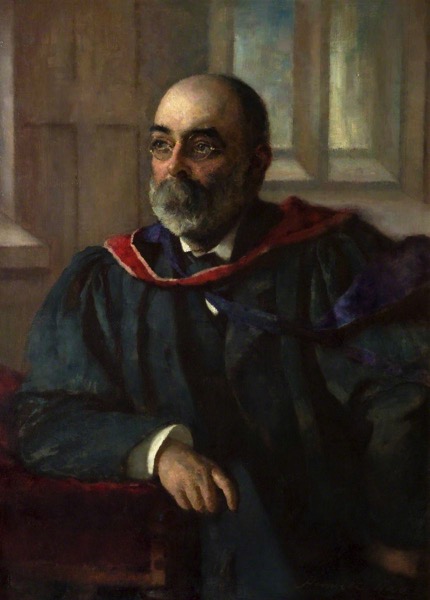
Sir John Byers (1853-1920) was an important figure at the time - a biography is online here. The Ulster Folk & Transport Museum has Byers’ collection of what it describes here as:

Collection of Ulster Dialect items manually recorded by Sir John Byers, c 1890-1910, and examples of proverbs and sayings (dialectal and otherwise) and folklore. The material was collected by Byers, a medical doctor, out of personal interest in this subject area and was recorded from the dialect content of the speech of his patients and from items found in the local press, in particular the Ballymena Observer. The collection consists of Byers' original hardback notebooks and typescript transcriptions of same prepared by his daughter.

A portrait of Byers is below. 

NID QUB QUB 66

Monday, July 23, 2018

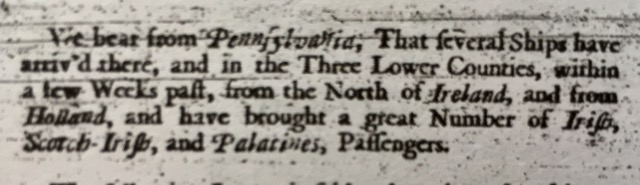
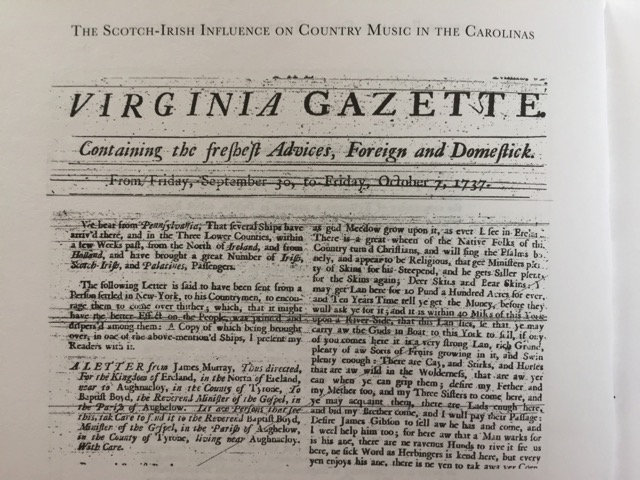
The Virginia Gazette, 'Irish and Scotch-Irish', 1737 - "there is a great wheen of the native folks of this country turn'd Christians, and will sing the Psalms bonely"

Yet another extremely early example of the use of the term ‘Scotch-Irish’, and in this case, being used in distinction from ‘Irish’. The context as you'll see below is a letter from an Ulster-Scot called James Murray, who had emigrated to New York, to a minister called Rev Baptist Boyd near Aughnacloy. The full letter is online here, and also on the Ulster-Scots Academy website here.

IMG 7072

IMG 7071 IMG 7073

Thursday, July 19, 2018

Northern Visions TV interview, summer 2009

Here’s an interview that Pete Bleakley of Northern Visions TV did with me back in summer 2009, just after I had finished my term as Chair of Ulster-Scots Agency. How time flies.

Monday, June 25, 2018

'There my burdened soul found liberty - at Calvary' - William Reed Newell

This is an old hymn I’ve known forever, one that’s deeply embedded in small evangelical halls around the country. It’s a classic of the genre, its words written by William Reed Newell (1868–1956). So, having noticed the potential in his name, I started digging for his ancestry.

He was born in Savannah in Ashland County in Ohio, the son of David Ayers Newell and Elizabeth Reed Newell. William went to Princeton and became the assistant superintendent of the Moody Bible Institute in Chicago, and later the minister of a Presbyterian church in Leesburg, Florida where he died in 1956 aged 87. He also wrote a number of Bible commentaries. His son - the significantly-named David McCheyne Newell - died in 1986. As you can see here in David’s obituary it confirms that ‘his father’s family is of Scotch-Irish blood’.

Elizabeth’s brother, Congressman Joseph Rea Reed (1835-1925) was a figure of some repute as his Wikipedia entry explains; he was also a member of the Scotch-Irish Society of the USA (see page 296 here).

Scotch-Irish people don’t ‘own’ the gospel, but as with most other subjects it’s becoming increasingly clear that their influence in many walks of life has been vast.

Years I spent in vanity and pride,
Caring not my Lord was crucified,
Knowing not it was for me He died
On Calvary.
 
Chorus:
Mercy there was great, and grace was free;
Pardon there was multiplied to me;
There my burdened soul found liberty,
At Calvary.


By God’s Word at last my sin I learned;
Then I trembled at the Law I’d spurned,
Till my guilty soul imploring turned
To Calvary.

Now I’ve giv’n to Jesus everything,
Now I gladly own Him as my King,
Now my raptured soul can only sing
Of Calvary.

Oh, the love that drew salvation’s plan!
Oh, the grace that brought it down to man!
Oh, the mighty gulf that God did span
At Calvary!


And - so many of the old gospel songs of the late 1800s were written for ordinary folk to easily remember and sing along with - as 3 chord wonders, in 4/4 time - so it's dead easy do this kind of thing with them... Simple words, repeated choruses, and 'hooky' melodies that stick in your head for a lifetime.

They say that this kind of hymn started to appear in the 1850s. It's no wonder then that 100 years later in the 1950s when singers like Johnny Cash, Hank Williams, Patsy Cline and even Elvis Presley came along, who were all reared in the kind of churches where these 3 chord hymns had been sung for a century - that many of their own songs followed a similar format. Here's my brother and I having a bit of fun with it, and below that, a Mennonite choir.

Sunday, June 17, 2018

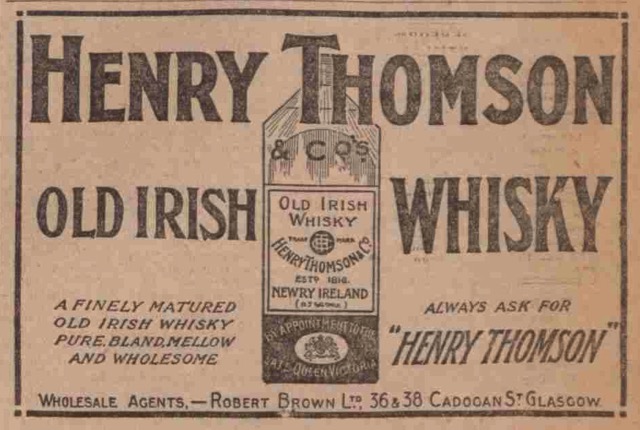
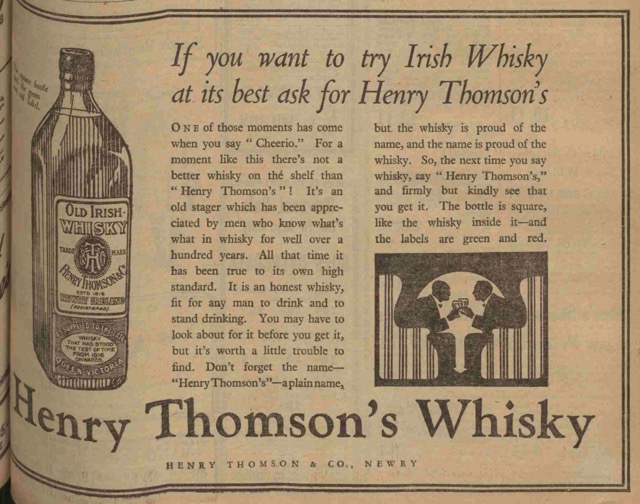
Henry Thomson & Co - Old Irish Whisky, Newry, Ireland

Henry Thomson Bottles

This firm was a big brand in its day, seemingly advertising itself heavily in Scotland. Henry Thomson senior is a bit of an unknown; he died in 1859 and must have made a vast fortune from whisky. The distillery seems to have been on Trevor Hill in Newry. However his obituaries make no mention of this. He lived from 1797-1859 (see grave reference here), but the brand claimed an origin date of 1816, when Henry senior was just 19 years old. Perhaps a previous generation of Thomsons were also in the Newry drink trade.

Interestingly, just a few miles away, Dundalk County Museum has in its collection a buffalo skin coat, worn by William of Orange at the Boyne, which was owned by a Robert Thomson of Ravensdale, a large estate just a few miles south of Newry.

Henry's second son, also Henry Thomson (1840-1916), took over the business and in the 1880s became Unionist MP for Newry (Wikipedia here). During his lifetime the family owned an impressive number of properties - Scarvagh House (best known as the location for the annual ’Sham Fight’ on 13th July), Altnaveigh House, Downshire House and Ballyedmond House. They gave land for the building of Scarvagh Orange Hall (opened in 1908).

When Henry Thomson junior died in 1916, the local community set about establishing the Henry Thomson Memorial Orange Hall which was opened in June 1921. The opening event included a presentation of a portrait of Thomson and his Orange sash. A Royal Black Preceptory Henry Thomson Memorial RBP No 1000 was also established. To clear the debts from the building of the Hall, a two day bazaar was held in November 1923 which was opened by Lady Craig, the wife of Sir James Craig who had of course been involved in the Dunville’s Whisky empire. When you also consider the drinks empire of Lyle & Kinahan, and the Orange connections of the Kinahan family, an unexpected picture emerges of the spirits industry in Victorian Ulster in which, like many industries of the time, senior Unionists and Orangemen played a leading role. Presumably they were mostly ‘temperance’ people rather than ‘total abstinence’.

BL 0000563 19141218 115 0005

Thomson’s quality must have been good as they secured the ‘By Royal Appointment’ status, and supplied Parliament.

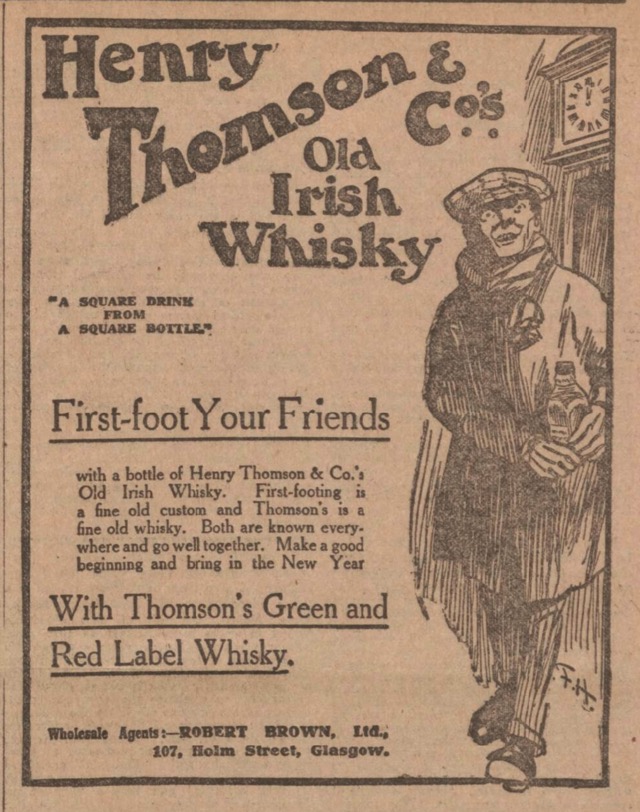
Henry Thomson & Co seem to have had a particularly energetic agent in Scotland - Robert Brown & Co of Glasgow. They even had a brand of Scotch, and a ‘Fine Old Demerara Rum’. Their advertising in the early 20th century is as strong as many of the big brands of that era. Some examples are below, a few of which are from ‘Burns Chronicle’ publications.

I am not clear on when the brand went into decline. The ‘Ulster Pavilion’ at the British Empire Exhibition in London in 1925 had an area devoted to promoting Ulster whiskies, but perhaps the Prohibition era in the USA from 1920-33 had an impact on the global market. A search of the British Newspaper Archive shows no adverts for the brand beyond 1929.

 • Some more Thomson items are online here at IrishPubCollections.com

Im20100527Big ThomsonHenry Thomson 1910

Greater Britian Sat Feb 15 18901940s HENRY THOMSONS LTD NEWRY SCOTLAND SCOTCH WHISKEYBL 0000563 19241127 111 00111903 6Henry Thomson 1908 v2Henry Thomson 1908

Henry Thomson Poster

12 10 framed advertising print hen 360 c8f62c2274581aa386295c57e95dcf38

Henry thomson newry ltd demerara rum 360 00005758f19995555220e75e5dbc2360

Monday, June 11, 2018

Ulster 71 exhibition

Various Ulster-American figures featured here:

Thursday, May 31, 2018

Before The Throne of God Above - the 'sympathy marriage' of Charitie Smith / Charitie Lee Bancroft De Cheney

It’s become one of the most popular hymns of recent years. Before The Throne of God Above was originally written by a teenage girl from County Fermanagh around 1860 which she then published in a collection of poems in 1867. It lay pretty much in obscurity until it was recovered around 1997 by American songwriter Vikki Cook of Sovereign Grace Music, who composed a new tune. It has since become a worldwide favourite.

The quality and simplicity of the words have brought wide acclaim from seasoned theologians, an excellent summary of the basics of the Reformed faith. It is remarkable that a teenager had such understanding and expressive skills.

• Charitie Smith
The writer was Charitie Smith (1841-1923; Wikipedia here). She was born in Dublin, the daughter of a Scottish-born Church of Ireland rector called Sidney Smith who ministered at Colebrooke and later Drumragh near Omagh. So Charitie’s childhood and early life was spent in the rural west of Ulster within the communities of these two churches. There is a memorial stained glass window to Sidney in one of them. She married former Royal Navy man Arthur E. Bancroft from Liverpool on 21 October 1869 at St Thomas Episcopal Church in Corstorphine, Edinburgh. His father was Peter Bancroft (1809–97), a prominent merchant. However, Arthur Bancroft died some time in the 1880s.

A dig around Newspapers.com reveals more detail...

• Prison Philanthropy
Charitie went to America, possibly with her doctor brother Thomas. In newspaper records from California she was described as ‘a woman of considerable means’ who became involved in philanthropic prison reform work in the famed penitentiaries of San Quentin and Folsom. She didn’t only invest her time and goodwill there -  ‘a large part of her personal fortune was spent in the reformation of former inmates’. 

• Marriage
She married Frank Lees De Cheney. He was 27 years younger than her, a ‘mining man and rancher’. Some accounts date the marriage at 1891 when she would have been 50 and he 23. Other accounts say 1901, when she would have been 60 and he 33. It was definitely 1901 when the marriage broke down.

• Divorce
On April 17 1915, aged 75, Charitie, described as ‘a familiar figure in the exclusive set’, was served with divorce papers. They were pushed through an open window by Sheriff Michael Sheehan while she was asleep on the front porch of her summer home at Moss Beach in San Francisco.

The divorce was on the grounds of ‘desertion - the claimant is from San Francisco, and claims that his wife refused to live in San Francisco but preferred southern California’.

The divorce was granted in infamous Reno, Nevada (where the song famously says ‘romances bloom and fade') on 29 May 1915; newspaper reports reveal some context – 'there was a touch of religious difference between the two. Mrs De Cheney is a devout woman while he is a professed agnostic. Her nephew testified along this line saying that he did not think Mrs De Cheney had ever been in a theater in her life.' The wedding was described as ‘a sympathy affair; he had just emerged from a long illness at the time and she had been exceeding kind to him. After the wedding she thought that he would be better away from the temptations of a large city, but he did not agree to that. De Cheney went to Nevada shortly after they parted in 1901’.

She died on 20 January 1923, aged 82, and was buried at Mountain View Cemetery in Oakland.
Her brother Thomas Orde Smith also died in Oakland, California in 1931.


…………………..

Before the throne of God above 
I have a strong and perfect plea 
A great High Priest whose name is love 
Who ever lives and pleads for me 
My name is graven on His hands 
My name is written on His heart 
I know that while in heav’n He stands 
No tongue can bid me thence depart 

When Satan tempts me to despair 
And tells me of the guilt within 
Upward I look and see Him there 
Who made an end of all my sin 
Because the sinless Savior died 
My sinful soul is counted free 
For God the Just is satisfied 
To look on Him and pardon me 

Behold Him there, the risen Lamb 
My perfect, spotless Righteousness 
The great unchangeable I AM 
The King of glory and of grace 
One with Himself, I cannot die 
My soul is purchased by His blood 
My life is hid with Christ on high 
With Christ my Savior and my God 
With Christ my Savior and my God

Monday, May 21, 2018

E. Estyn Evans on Ulster's three traditions (1951)

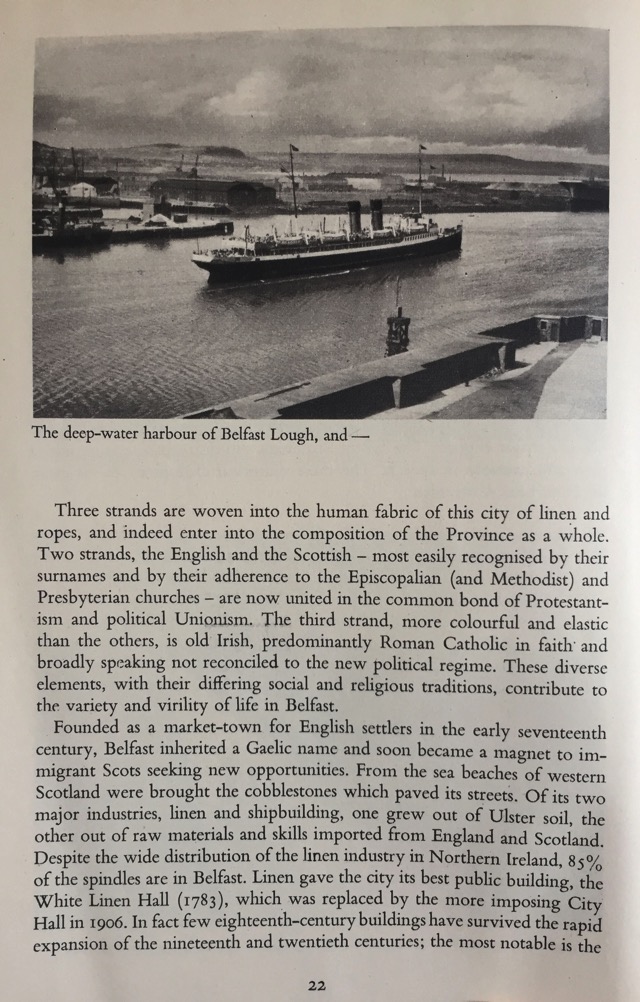
E. Estyn Evans (1905-1989; Wikipedia here) was one of the foremost figures of his time - I know some who studied under him at Queen’s University - he was a recognised authority on folklife and tradition, an academic and author. His Irish Folk Ways (1957) is a classic text. Here is his take on the three traditions concept, from a book published for the Festival of Britain in 1951. We might take a softer view, in that there are overlaps across all three, but you can see that he was aware of the 'model' as a way of explaining Ulster's story. It is interesting that the cobbled streets of Belfast were paved with Scottish stones.

IMG 5488


IMG 5487

Nesca Robb on Ulster's three linguistic traditions

The family of Nesca Adeline Robb (1905–1976) ran the once-famous Robb's Department Store in Belfast city centre. She was a friend of the likes of John Hewitt and Sam Hanna Bell, and was effectively the founder of the National Trust in Northern Ireland, and an important figure in the arts community here, with international recognition for some of her writings. Her unpublished manuscripts in PRONI are a cultural goldmine - she could see that an understanding was being lost in the rush towards modernity. Here she is explaining our three traditions. Nesca Robb 3 traditions

Nesca Robb cover

The Scotch-Irish of Northampton County, Pennsylvania

Northampton County has a Belfast, a Bangor, a North Bangor, and not far beyond is Milford. This 1879 book is subtitled A Record of those Scotch-Irish Presbyterian Families who were the First Settlers in the Forks of Delaware. A quick flick through the text shows frequent usages of the term Scotch Irish and also one of Ulster Scot. So once again the terminological pedigree is evident.