Monday, March 26, 2018

The folk aboot Hame

I’m happy - and relieved - at the response to Hame. I am so very much an amateur at all of this, but trusting the experience and skill of professionals who have proven themselves over and over again with the highest quality work. Friends and neighbours are talking to me, Portavogie folk are very happy with how the village was portrayed, and the early word on the Raphoe programme is full of the same positive ‘happy vibes’. I can’t list them all here. But here is just one.

On Saturday, a now-elderly gentleman, with flowing white beard, came up to me in Donaghadee. At first I didn’t recognise him. He’s 81 now but I remember him from when I was wee, as he was a builder by day but also a frequent, very powerful, preacher in the halls around here. In later years when I saw pictures of John Caldwell Calhoun, he reminded me of this man.

‘Are you that Thompson fellow?’ he said to me, introduced himself and then flowed into a few minutes of fond warm reminiscence. 

He spoke at my grandmother’s funeral, both up at the wee house at Ballyfrench and down at the graveside in Ballyhalbert after we had cairryt her doon tha brae. He also spoke at my aunt Doris’s funeral service at the People’s Hall in Portavogie. He was thrilled by the programme.

I am reassured that television professionals and culturally-minded people are happy with the series. I am humbled when local folk whose place and story we all sought to tell are happy with the end result.

But when a man like this, whose voice I sat under frequently on Sunday evenings for maybe 20 years, tells me with excitement how he sang along with Pull For The Shore, with a twinkle in his eyes and a big beaming smile on his elderly bearded face, I know we’ve done a good job.


Monday, March 19, 2018

"Scotch Irish ... heathen Republicans and Presbyterians"

Now that might look like a quote from a very long time ago, but in actual fact it’s from just a few days back. The remark was made by Phildadelphia Democratic State Rep Mike O’Brien, about the Irish-American ‘Caucus’ in Washington DC. The interviewer from The Inquirer newspaper asked him:

When I looked up the caucus, I couldn’t find any list of Republicans. Why’s that?
Because they’re ashamed of it. [Note to reader: There’s no indication this is true.] Because there’s Irish, which means they’re all Dems. But then there’s Scotch Irish, who are not God-fearing Democrats, but heathen Republicans and Presbyterians.

Make of that what you will! Full interview is here.

NewImage

Saturday, March 17, 2018

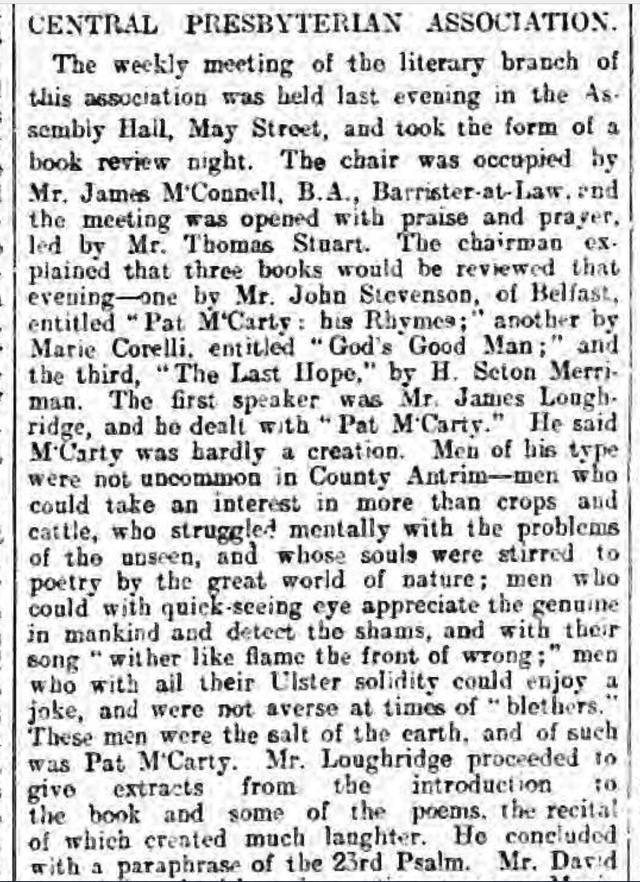
'Hame' by John Stevenson, aka Pat M'Carty, Belfast (1903)

John Stevenson (1851-1931) is another of our under-appreciated writers. He was one of the partners of the renowned printing firm McCaw Stevenson & Orr, which still exists today as MSO Cleland and was fairly high profile in Ulster business and literary life.

He was born in Rostrevor in 1851 ‘where his family were temporarily residing’. His father, also called John, had been the manager of Linfield Mill in Belfast, and the younger John took a job with Barbour’s Linen Mill at Hilden. He lived in Bangor briefly (the family had a property near the Dufferin Demesne called ‘Everton’ which was sold in 1874) but for most of his life he lived at a house named ‘Coolavin' on the Malone Road in Belfast. He was a Fellow of the Royal Society of Antiquaries, Chairman of the Board of the Ulster Hospital for Children and Women on Templemore Avenue, a member of the Kirk Session of May Street Presbyterian Church and later Fisherwick Presbyterian Church. He was also involved in the Belfast City Mission.

He died at ‘Coolavin' in early June 1931 and had an ‘eloquent tribute’ at Fisherwick by Rev John Waddell, and was buried at the City Cemetery. ‘Coolavin' had a summer-house decorated in scriptural and literary inscriptions. His wife Catherine died at Coolavin on 28 February 1954; the house was replaced by ‘Queen’s Elms’ in the 1960s.

He wrote the excellent popular history Two Centuries of Life In Down, 1600-1800, published in 1920 (online here) and a number of other books. His first was a collection of poems and short stories using an alter-ego character called Pat M’Carty. These had first appeared in a periodical called The Pen, and so impressed was the Marquis of Dufferin and Ava that he called at Stevenson’s office to find out who Pat M’Carty was!

The full volume appeared in 1903, entitled Pat M’Carty - His Rhymes, and included some Ulster-Scots translations of some of the Psalms. I have made good use of these over the years. An online edition is available here.

Some of the Rhymes were later set to melodies by Sir Charles Stanford, and sung by Harry Plunket-Greene - the British Newspaper Archive refers to ‘Cushendall', 'The Crow', ‘Night' and 'Daddy Long Legs' being performed in the Aeolian Hall in June 1910 as an 'Irish Song Cycle' - and also at Devonshire Park in September of the same year. Following a concert in the Free Trade Hall on 30 January 1911 a review in the Manchester Courier described them as ‘excellent examples of the peasant lore of the country’, giving special mention to pieces entitled 'Did You Ever’ and ‘How Does the Wind Blow?’.

Stevenson’s A Boy in the Country was published in 1912 and is online here. He also published his own 1917 translation of De Latocnaye's A Frenchman’s Walk Through Ireland, which dates from 1796-7 (online here). This includes the now almost immortal line ‘Belfast has almost entirely the look of a Scotch town and the character of the inhabitants has considerable resemblance to that of Glasgow’.

Prominent people of yesteryear were completely comfortable with all aspects of their Ulster-Scots heritage. Here is how John Stevenson / Pat M’Carty expressed the concept of ‘hame’. Really good stuff.

IMG 4431

IMG 4432

1904 mccarty

Sunday, March 11, 2018

Welcome 'Hame'

2018 03 08 16 20 24 2

Well this week will be interesting! After many months of filming, working with really great people, travelling across Ulster to six places seldom seen on tv, ‘Hame’ will go on air next Sunday night, on BBC2 Northern Ireland, at 10pm. We recorded the promo adverts at our kitchen table last Friday so I think they’ll be broadcast over the next few days.

I like Belfast. I chose to stay here to study and work when many of my peers went to Scotland or England. There’s life beyond greater Belfast, but greater Belfast issues, voices and viewpoints tend to dominate our airwaves. It’s as much about the mindset as it is the geography. Ulster-Scots exists in the city too, but well below the usual media ‘radar’. It is indeed a ‘very Scottish city’.

But there’s another, rural, world here in which authentic Ulster-Scots lives and breathes. Ulster-Scots works best when it’s expressed at grassroots, even when those grassroots are imperfect and maybe not as knowledgeable as they might be, or as their grandparents were. But they are still the 'keepers of the flame'. You can’t invent authenticity and enthusiasm. The best thing to do is to meet those folk on their own terms and let them speak for themselves. And that’s pretty much what we did.

I am glad that Sean and Fiona and Michael coaxed me into doing it. I'm co-presenting with the very wonderful Ruth Sanderson, well-known to viewers of HomeGround already. I'm just the new boy! It’s been hard work, but an honour and pleasure to have been involved in. It’s taught me a lot about how tough it is to make a tv series. It’s shown me that within the broadcast sector there are people who care (my experience over the years of trying to engage with that world has been pretty mixed). I think that their professionalism, talent, care, attention to detail, empathy, and understanding of tradition, shines through.

But ultimately, Hame is about the people and the places that we visited and spent time with. Tune in and see for yourself.

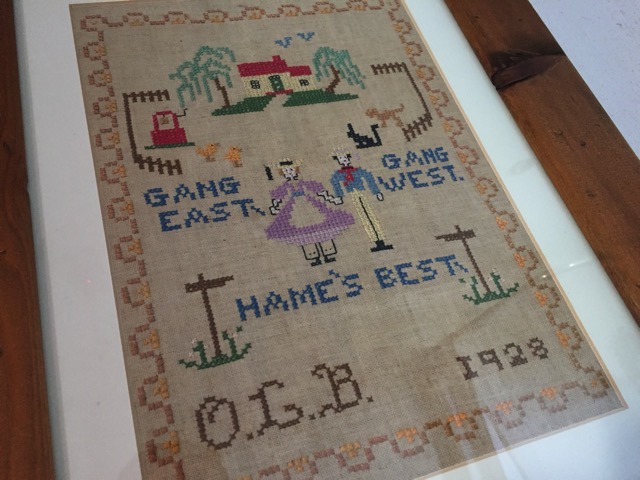
As the old motto says, Gang East, Gang West – Hame's Best.

IMG 4427

Monday, March 05, 2018

Part 7: Ernest Milligan's 36 'Up Bye Ballads': review

Milligan

Wrapping this story up. What we’ve seen in this series of posts is that the Milligan family as a whole - mainly through the influence of their antiquarian and wealthy father Seaton - had a very wide range of cultural interests and allegiances. The best known of these are Alice’s celebrated Irish nationalist cultural activities and sister Charlotte’s work on Irish traditional song. An Ulster History Circle blue plaque in Omagh Library recalls them (image here).

Yet to us today it might be a surprise to find that there were also brothers, William and Charles, who served in the British Army and Royal Navy respectively. Charles lived until 1983, and served for over 40 years as an Alderman and Councillor in Bangor. Alice’s Shan Van Vocht magazine touched a little on what she called ‘broadest County Down Scotch’, and as a short-lived publication it deserves further investigation, as do her archives. But younger brother Ernest’s 1907 booklet Up Bye Ballads is the strongest example of Ulster-Scots awareness and appreciation within the family circle. As far as our understanding of ‘identity’ goes, the Milligan family pretty much has it all.

My take on the 36 poems and songs which make up Up Bye Ballads as a collection of poems is that they're a good quality appreciation of rural, Ulster-Scots tinged, life in Ards and North Down. I don’t think Ernest Milligan was setting out to be a major league poet, perhaps the collection was just intended for a fairly limited readership in the area. It’s interesting that they were widely reviewed but that could have been as a result of the Milligan family’s wider social influence. It would be particularly interesting to see if the North Down Herald reviewed it. So it’s unwise to retrospectively invest Up Bye Ballads with huge literary or cultural significance. It’s also a shame that Ernest's 2 or 3 youthful years of socialist activism with James Connolly add an extra reason for interest, because the poems themselves warrant their own attention.

They’re not great but they’re good and I enjoy them. They are a positive addition to the local ‘canon’ of Ulster-Scots creative writing from the late 1800s/early 1900s. I’ve read them through a few times, and at the moment the most interesting are:

• Gangin Up Bye – a romantic story of a young man helping a farmer’s daughter bring the kye hame, wooing and eventually marrying her. The story is set at ‘Portavoe wood’ which is where the Milligans’ first holiday home, called ‘Angus Cottage’, was situated. It has a chorus so was intended to be sung. Pretty good Ulster-Scots, with the possible hint of it being autobiographical of a teenage romance Ernest may have had, or observed.

• The Whin Bush – Mostly standard English, making the case for the whin bush as the true emblem of Ulster - ‘Men of Ulster, let your token be the braw whin bush!’. Located in the Castlereagh hills, naming Ballylesson, Drum(beg), Purdysburn and ‘Minnieburn’ (Minnowburn)

• The Auld Red Cart – Farming reminiscence, reflecting on childhood around the farm and of how both things and people get old and worn out. A bit of anthropomorphism in the last verse - ‘for carts, with men an’ living things, then one down way must gang … I hae a corner in my memory for the auld red cart'

• Kate of Carrowdore – A standout piece, one I had been searching for for many years.

• M’Cready’s Call – A conversation of a much-loved minister accepting a call to move to a bigger, and more lucrative, congregation. Touches of the structure Robert Burns made famous, ‘standard habbie’. 

• Crossin' the Sound – A foreboding tale of a young man living with his widow mother on the Copeland Islands, who has promised to meet his true love in Donaghadee. His mother warns him not to go, he goes on regardless, and ends up lost at sea just as his father had been. 

• The Baker’s Man – A horse & cart bread delivery man’s story of his daily journeys, with a romance incorporated - ‘but de’il the bit she’ll stir, fu’ weel, she ken’s it’s nae her master’.

• Johnny Grumps – Meant to be a comedy piece, but from today’s perspective it could be about someone struggling with depression - ‘what’s gane wrang, what’s gane wrang, that makes yer face sae sour an’ lang, when ither folk make cheer?'

• Sing Bonnie Bird – A three verse song, more references to whin bushes, nice turn of phrase when he refers to ’the moss yestreen’.

• When Daddy to the Town has Gane – A girl’s romantic rendezvous with her boyfriend when her father is away. 

• Six Road Ends – Another standout piece, humourous and with a simple repeated rhythm. Packed with colour and similar to later local songs by other writers such as ‘The Harvest Fair’ and ‘The Big Stane’. You can see why it was later republished in The Book of Irish Poetry in 1915

• Christmas Eve – An interesting one, 11 verses long, blending Biblical references with local tradition and social reunion. References to parlour games.

• The Bonnie Birdie – Simple, with some light touches of real wordcraft - ‘Me heart’s sae sair and’ lonesome now, mair mournfu’ tune were fitter’.


The Ulster-Scots is pretty good, although inconsistent. You can tell he was learning, rather than had grown up with, the words and expressions. He uses English words in places where a ’native speaker’ just wouldn’t, for example ‘own’ instead of ‘ain’. But he deserves full credit for them.

And it is tantalising that in the 1930s, as an England-based doctor and occasional playwright and broadcaster, his radio programme The Ballad Singer was made up of songs that he had written. Perhaps some of the Up Bye Ballads were used. The performers were of a credible standard - Charlotte Tedlie would appear alongside Richard Hayward in the 1936 film The Luck of the Irish. Hilda Johnston, James Stewart, J.R. Mageean and the others listed in the radio schedule below were all frequently featured on BBC programmes of the era.

Ballad Singer

I’ve wondered what the tunes might have been, and until some ancient recording surfaces we’ll never know. So for now I have begun to compose simple melodies and have performed ‘Kate of Carrowdore’ and ‘Six Road Ends’ at a few local events, where they’ve gone down really well. It’s a joy to take Ernest Milligan’s Up Bye Ballads back to the people and places they were first inspired by, and intended for. 

They work well as songs for a present-day audience, whose Ulster-Scots is light-touch, and a kind of speckle of words within their everyday speech. That being said, the words are an audible enough kenspeckle (definition here) to be noticed as unique local Ulster-Scots landmarks in their own right. There is still enough of what Alice called 'broadest County Down Scotch' to make the poems, or songs, special, and to stamp them with rich local provenance.

Thursday, March 01, 2018

Part 6: Ernest Henry Marcus Milligan (1879–1954), his pseudonym Will Carew, and his 'Up Bye Ballads' (1907)

(It is very possible that Ernest Milligan’s children, and certainly grandchildren, are still alive today. If so, I would be delighted to hear from them, especially to correct any errors in the attempted biography below, and indeed in this series of posts. This one has been assembled from two interviews Ernest gave in ‘Irish Freedom’ and a fairly thorough trawl through the British Newspaper Archive.)
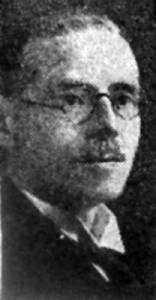
Milligan

Ernest Henry Marcus Milligan (1879–1954) was born in Belfast. He was educated at Methodist College Belfast, after which he went to Queen’s University to study medicine, passing his first medical examination there in July 1899. It seems that he also studied Law for a time at Trinity College Dublin.

In early 1897 his influential sister Alice Milligan (14 years older than Ernest) recommended that when he was next in Dublin he should meet with James Connolly, who had been contributing to her magazine Shan Van Vocht. Ernest also contributed to Shan Van Vocht. Ernest’s reminisces of his time with Connolly were published in June and July 1943 in a two part article in the pages of Irish Freedom magazine (PDFs are online here). A mixture of youthful exuberance and ideology would drive Ernest’s energies for a number of years.

Ernest Milligan and James Connolly
When he and Connolly first met in early 1897, Ernest was 18 and Connolly was 26. In that interview Ernest described himself as –

‘a member of the Gaelic League and an ardent Nationalist, with my head full of ’98 and its horrors … I was more or less a Socialist, of the Christian Socialist type … I could not understand why all true Christians were not communists!’.

Ernest echoed Alice’s activism, which he surely would have observed and learned from. Even though just 19 years old, he founded the Belfast Socialist Society in September 1898, with members such as Robert Lynd and Arthur Gaffikin, a former Salvation Army man. This book also refers to Samuel Porter and James Winders Good, and Milligan made efforts to recruit William Walker (Wikipedia link here; one interesting text of later dispute between Walker and Connolly is online here.). There was also a 'Christian Social Brotherhood' in Belfast at the time and Milligan joined it as well. Gaffikin and Milligan took to the streets, attracting crowds in Sandy Row (but they were soon chased out) and the poorer parts of the city. Milligan’s mother Charlotte came along too and supplied refreshments to the crowds.

Ernest Milligan and James Connolly were in regular contact through 1897 and 1898; Milligan sold The Workers' Republic newspaper around Belfast, but he said that the Catholic Church banned the paper and sales fell. In 1898 he was a committee member of the Belfast Gaelic League and also a key member of the Irish Socialist Republican Party.  His signature appears on an Irish Socialist Republican Party accounts book, from the years when he sold the newspaper on the streets.

Ernest Milligan

But in 1899 Ernest Milligan fell ill, he recalled that this happened just a few hours after a meeting with Connolly. It resulted in Milligan being bed-ridden for six months, with an enforced break from his university studies for a further 18 months, not fully recovering until 1902–3.

Less Radical
Perhaps this illness dulled some of his ardour for the ‘cause’, or at the very least took him away from revolutionary politics, as he appears to have settled down into comfortable Belfast and north Down life. In 1902 The Northern Whig printed a letter from Milligan as a member of Bangor Rugby Football Club, complaining about a technicality in the rules of the game. That same year he was a founder member of Ballyholme Sailing Club, and in 1903 was pictured at a club meeting, sitting right beside James Craig, the future first Prime Minister of Northern Ireland.

2018 01 26 08 42 16

Ernest Milligan resumed his studies and passed his second medical examination at QUB in April 1902, his third in May 1903, then Trinity College final professional examinations in January 1906, for which he was congratulated by his fellow members of Ballyholme Sailing Club. He finally gained his Royal University of Ireland M.B. B.Ch. B.A.O. in May 1906. 

Ernest Milligan’s Ulster-Scots influenced Up Bye Ballads (December 1907)
I don’t yet know when he began to write the poems which would eventually form Up Bye Ballads, but some began to appear in the Northern Whig. 'The Braw Whin Bush' appeared in the Whig on 22 June 1907, openly attributed to Ernest Milligan, composed in praise of the humblest of all hedgerow flowers, with the final line urging ‘Men of Ulster, let your token be the braw whin bush!’ A few weeks later on 6 July, 'The Auld Red Cart' appeared in the same paper, again with Ernest Milligan named as the writer. There may have been more in the Whig, but it was December 1907 when a 54 page collection entitled Up Bye Ballads was published, printed by W&G Baird, under the pseudonym 'Will Carew', with a cover price just one shilling. I’ll work through them in the next, final, post in this series.

What the significance of ‘Will Carew’ was as a choice of name, I’ve yet to discover, and it's all the more odd given that Ernest Milligan had already been named in the Whig as the author of some of the individual poems. There had been a character of that name in a boys' adventure story from 1884 entitled Charlie Asgarde: The Story of a Friendship.

Media Reviews
Press reviews were positive. The Tyrone Constitution reproduced a few verses of ‘The Braw Whin Bush’ and said it was a

’neat little volume … the majority of the poems are written in the County Down dialect, and it will be found that the author has been true to the characteristics of that county … delightfully characteristic ballads.

The Londonderry Sentinel said it was –

’… a collection of quaint Ulster verses, of tuneful rhythm and much readableness. The writer has a good style and tells his little rural stories well’.

The Irish News also reproduced some of ‘The Braw Whin Bush’ and said the collection was –

‘… sparkling … an Ulster work if ever one was published. The writer we believe knows and loves Co. Down best; though we venture the opinion that the “dialect” which he uses in many of these poems is more redolent of Ayrshire than of Banbridge … Carew’s “dialect” may be that of the Mourne Mountains or the Antrim Glens, or the “banks and braes of bonnie Doon” … Mr Carew’s printed speech of the North-East differs little from that of South-West Scotland; and Ayrshire recalls Robert Burns. The clever author of 'Up Bye Ballads' has read the immortal Ploughman, but he has not once consciously imitated him … charming little treasury of Ulster song ...'

By far the most interesting review I have found, yet again quoting ‘The Braw Whin Bush’,  appeared in the Dublin newspaper Freeman’s Journal and National Press on Burns Day 1908, which in many ways reinforces the ’three cultural strands’ concept, with Ulster-Scottishness a distinct element –

In these days, when the chief city of Ulster and many towns and country districts all over it are become working centres of the Gaelic revival, a book of verse like this will almost a shock to the Irish-Ireland reader. He has been busily working for the de-Anglicisation of the Irish nation, looking forward to an era when the West British shoneen will be extinct, end behold here is reminder that there exists within the borders of our island country population which is not West British nor shoneen, which has not got to be de-Anglicised, for the simple reason that its speech is not English, as we know it, but Lowland Scotch.

The people speaking tongue are to found mainly Antrim, Co. Down, but also on extensive tracts of land in the North-West, coming right against the Gaelic frontier of Tir-Conal, in the Laggan district, it is called, in Donegal. But let not the Irish-Irelander brand those survivors the Ulster Plantation as aliens and foreigners. This Scotch-Irish dialect, so ragged and almost distasteful to our hearing, was the speech of men who stood side by side with the Northern Catholic Gaels on the battlefields Antrim, who camped on the wooded height of Ednavady, and lined the ditch behind “Saintfield Hedge in the County Down.” was the mother tongue James Hope, and the congregations of those United Irish Presbyterian worthies, Porter, and Steele, Dickson, Kelburn, and Warwick.

It a pity that there is nothing in the little volume before us to recall the patriotism the men of Down, not a single verse echoing the spirit of fine old street-ballad that might well have served as a model:

All the same we welcome this volume as evidence of the fact that the Scotch-Irishman has not lost the gift of song. The subjects are homely and natural; the verses fluent and tuneful. The satire in “The Ministers Call” and “The Six Road Ends” will be appreciated in Presbyterian circles. There are local poems for many of the North Down villages – Carrowdore, Comber, Donaghadee, Ballylesson and Bangor.

Marriage in 1908 – departure for England 1911
In December 1908 he married Sara M’Mullan of Grange, Armagh, at Grange Parish Church. As a newly qualified doctor he was involved in the establishment of the new Belfast branch of the Womens' Health Association at a high society event in City Hall in October 1907. On 12 October 1909 the Irish News printed a poem he had written in praise of Queen’s University, entitled 'Welcome! Q.U.B.'. In 1910 he was a member of Royal Belfast Golf Club, among the cream of Belfast merchant wealth and gentry. In July 1911 he gained a Diploma in Public Health from Dublin University.

Medical career in England, 1911
Summer and studies over, he and his wife Sara moved to England. In September 1911 he was appointed as Certifying Surgeon for the Long Eaton district of Derbyshire. He was a medical officer in Bath from August 1917-1920 (there are suggestions that Alice and their brother William stayed in Bath around these years). In August 1920 he took what might have initially have been a part-time role in Glossop on the east side of Manchester, but eventually he moved back north permanently, becoming a well-loved figure in the Glossop community and medical professional circles in England for the rest of his life. You can read his biography here on www.GlossopHeritage.co.uk, including an article about his invention of a toffee sweet, fortified with whey and peanuts, to give wartime children extra nutrition. Products like this are still used in Africa by aid agencies today. Here is a 1943 newspaper photograph:

Milligan Toffee

The Book of Irish Poetry, 1915
During all of this, his poem ‘Six Road Ends’ from Up Bye Ballads was selected for inclusion in The Book of Irish Poetry, a collection (online here) dedicated to Douglas Hyde, son of a Church of Ireland rector who became the first President of the Gaelic League, and first President of Ireland. Perhaps he and Ernest were friends.

July 1927: Letter for ‘improving partition relations between the North and South of Ireland’
This letter, to William X O’Brien, would be worth a read, written from Ernest’s home of Spire Hollin House in Glossop. 

1930s playwright and BBC Radio broadcasts
Even though now he was focussed on a busy medical career in Glossop, in the 1930s Ernest Milligan found the time to write a number of plays, some for BBC Radio - tantalisingly The Ballad Singer (June 1933; of which a Belfast News Letter review said that ’the majority of the songs in this play were collected and arranged by the author himself). Here’s an advert which lists some of the performers:

Ballad Singer

He also wrote Muggleston on the Map: A Municipal Mockery (1934), The Mayor Chooses A Wife (1935) and ’Twas In Old Ireland Somewhere (1936; said to be set in ‘an Ulster farmhouse not far from a thriving town on the evening of the monthly fair). Below is an extract of a Whig article from 24 April 1936.

Whig 24 April 1936

1938: ‘An Ulsterman’s Plea’
On 27 October 1938 a letter of this title from Milligan appeared in the Northern Whig, a powerful appeal to God’s providence, to prayer, and to the growing threat of Germany and Nazism, stating ‘these are grave times. The very fundamentals of religion as well as our liberties are in danger… Ulster can initiate a new and better epoch in a troubled world…’.

The deaths of Alice and Ernest Milligan
When Alice died on 13 April 1953, Ernest made contact with a well-known Irish Republican Brother W.P. Allen to ask him to write a biography of her. Allen collected all of her papers and stored them, but never wrote the biography. Apparently these archives are now in Omagh Library (see page 97 here).

Ernest died less than a year later, at Hadfield in Derbyshire on 21 March 1954, aged 75, and was buried at Glossop cemetery. You can read his obituary here on GlossopHeritage.co.uk. An obituary also appeared in the Belfast News Letter.

Final post to follow...
Monday, February 26, 2018

Part 5 - The Milligans in North Down

Hamilton Villas

Seaton F Milligan (1836 –1916) was a key figure in Ulster Victorian society. His father was Kennedy Milligan from Glencon near Dungannon, his mother was Sarah Ann Boyd, On 28 January 1862 he married Charlotte Elizabeth Burns from Omagh, in the ‘Wesleyan Chapel’ in the town. Her parents Samuel Burns (d. Feb 1860), and Letitia Burns (d. May 1858) had owned the Scotch Haberdashery Warehouse, Main Street, Omagh.

Seaton was a Sunday School teacher in the church and an insurance agent in the town. He and Charlotte went on to have a reported 11 children; they relocated to Belfast where he took the position of Managing Director of Hawkins, Robertson & Ferguson, of Bank Buildings in the city centre.

He began to give historical lectures in the city, for Belfast Natural History and Philosophical Society, on exotic subjects such as Peruvian textiles (one of Charlotte’s Omagh cousins, named Alcorn, was a civil engineer working on railways in Peru - he came home with a pile of stuff from antiques and rugs to shrunken heads in jars) but mainly on Irish antiquities such as giant’s graves Seaton had visited in Sligo, standing stones and Irish mythology. He donated objects to the Royal Irish Academy such as an ancient cauldron he had found at Drumlane Lake in County Cavan. He gave many lectures, such as ‘The Forts of Erin, from the Firbolg to the Norman’, and ‘Ireland and the Scottish Isles: Ancient Connection’. He wrote a paper for the Ulster Journal of Archaeology about one of my interests, the Clandeboye O’Neills and their Coronation Chair. He led at least two steamship cruises around the entire coast of Ireland, for the Royal Society of Antiquaries of Ireland. He rubbed shoulders with the best historians and antiquarians of the day. So the children were raised in this environment – with a fascination and reverence for history and tradition.

He was a successful businessman, well used to the company of the gentry and entrepreneurial élite of the times, a respected antiquarian, a frequent public speaker at august gatherings around Ireland on antiquarian subjects, and well-regarded author.

16872sm1 98a7f61c16bd472551bf72344845a6ee 1In 1888 he and his daughter Alice Letitia Milligan (1865–1953; Wikipedia here) co-authored a book called Glimpses of Erin (online here). She went on to become a significant figure in the Irish nationalist and cultural movements. In 1896 she began to publish a magazine called Shan Van Vocht (online here). Another daughter, Charlotte Milligan Fox (1864–1916) was a trained classical singer. She authored Songs of the Irish Harpers (online here) and was highly influential in the preservation of Irish traditional music, founding the Irish Folk Song Society. Both are remembered on an Ulster History Circle blue plaque on Omagh Library (see here). One of the songs they published, around 1903, was written by another sister, Edith, and was entitled Ochanee: Ulster Folk Song. As far as I know, 'ochanee' is an Ulster-Scots term, one my mother used in short rhymes as various weans and grandweans were being bounced on her knee:

Ochanee when I was wee
I used tae sit on my grannie's knee
Her apron tore, I fell on the floor
Ochanee when I was wee 

It's also in the Dictionary of the Scots Language here, and on the Ulster-Scots Academy textbase here.

IMG 4299


• Holiday homes in north Down
The Milligans had a few different holiday properties around North Down, the first of which was ‘Angus Cottage’ in the countryside near Portavo north of Donaghadee in the 1870s and early 1880s. Next was ‘Hamilton Villa’, part of the ‘Dufferin Villas’ terrace along the seafront at Ballyholme (as described by Charles F Milligan (1883-1983) in his three memoir booklets: My Bangor from the 1890s, Second Thoughts and Bangor and Belfast Lough Yesterday and Today). The last was a house called ‘Eastward’, one of the 'Ward Villas' on the Clifton Road, overlooking Royal Ulster Yacht Club, which they bought around summer 1906. They are recorded as living there in the 1911 census. The Milligan parents both died at ‘Eastward’ in 1916.

All three were fairly prestigious addresses, suited to a wealthy Belfast merchant family. Back then Ballyholme was its own distinct community, not yet swallowed up by the expansion of Bangor. According to Charles they ‘came down about Easter and stayed until Halloween’, from their city addresses at 1 Royal Terrace, a 9-bed 3-reception property which they sold in August 1899, and later 1 Malone Road. But they mingled with County Down locals as well as the swish Belfast vacationing set. 

• A Bangor network of cultural writers
Even though Methodists, Charles recalled that the family had some involvement in the Parish Church and also Presbyterian Church in Groomsport, and various churches in Bangor. In October 1892, young Ernest Milligan is recorded as manning the ‘flower and candy stall' for Groomsport Presbyterian Church Bazaar, an event at which both Mr and Mrs W.G. Lyttle were on the ‘refreshment stall’. Whilst the Milligans summer residence was at the country end of the Ballyholme Road, Lyttle’s property ‘Mount Herald’, his home until his death in 1896, was at the town end, at the junction of Clifton Road. Sadly the building is long-gone, its site supposedly a car park today (see here).

[In later years, both Sean Lester (1888–1959; a Carrickfergus-born Protestant who joined the Gaelic League, the IRB, and had a political career which took him to the position of Secretary General of the League of Nations) and Ernest William Blythe (1889–1975, a Lisburn-born Protestant Irish Nationalist, a one-time Orangeman, IRB member and eventually senior figure in the government of the Irish Free State) would both work for the late Lyttle’s North Down Herald newspaper.]

Another Bangorian at the time was Florence Mary Wilson (1870-1946, link here), best known as the author of the poem The Man From God Knows Where, a tale of the United Irishman Thomas Russell who was hanged in Downpatrick in 1803. It, and some of her other poems, include a sprinkling of Ulster-Scots vocabulary - the 1918 edition is online here. She lived in the same part of Bangor, on the Groomsport Road. In July 1907, Florence, Alice Milligan and Ernest Milligan are recorded as having worked together on a ‘Carnival and Fancy Fair’ bazaar handbook to fundraise for Bangor Endowed School, later Bangor Grammar. The venue was the grounds of Bangor Castle, with the ‘great and the good’ thronging the place. The school was also on the Clifton Road, just behind the Lyttle home.

This was an impressive network of north Down literary neighbours, and all with a deep interest in local history and traditional heritage, with what we would today regard as a culturally Irish nationalist perspective – yet also all with varying degrees of Ulster-Scots influence in their writings, with Lyttle’s of course the most important.

If you broaden the catchment area just a little more, it’s very likely that they would also have known William Hugh Patterson (1835-1918; previous post here), his 1880 Glossary of Words in Use in the Counties of Antrim and Down, and Patterson’s relatives by marriage, the Praegers. It’s not just the geography, it’s the social world of golf clubs, rugby clubs, sailing clubs and antiquarian societies.

• 12th July and the 1798 Rebellion
But the Milligan family must have a very broad range of cultural interests - Charles wrote fondly of his memories of the 12th July mornings:

“I have a very high regard for the people of Groomsport and for the Orangemen there, in fact as a very small boy the highlight of a summer holiday at Dufferin Villas was to go down to the end of the laneway joining the county road and watch LOL 589 pass by on its way to join the brethren at Bangor. I also remember a lady who marched with the lodge dressed for the occasion with a hat in the colours of the day and a blouse to match’.

Charles also visited, and photographed, the reputed home of 1798 heroine Betsy Gray at Six Road Ends, around the time that Lyttle had immortalised her story and Alice had been involved in centenary commemorations at Betsy’s grave site (previous post here). Here’s the photo and caption from Bangor and Belfast Lough Yesterday and Today:

Betsy Milligan

The caption above indicates that Charlotte Milligan knew W.G. Lyttle, who died when Charles was just six years old. However Charles here also repeats an error that W.G. was from Omagh - he definitely wasn’t.

• Military Service
In 1914, Charles joined the Royal Navy, following in the footsteps of his brother Captain William Hanna Milligan RGA (1872–1937) who had served in the Boer War in 1900 and had been stationed in Chicago for a time. William’s knowledge of the city led to the arrest and execution of a German spy in 1914; Carl Hans Lodz had been in Belfast, masquerading as an American called Charles Inglis, but was actually gathering intelligence on the city’s shipyards. Both Charles and William are named on the roll of honour in Wesley Centenary Methodist Church, Hamilton Road, Bangor.

In later years, Alice Milligan looked after William - that particular story is touched on here. They had lived in Dublin from 1917-1921, but had to flee within 24 hours due to William receiving a death threat from the IRA due to his earlier British Army career. They went to Bath in England where younger brother Ernest Milligan (1879–1954) worked as a School Medical Officer around the same time. Perhaps Ernest was the first safe haven that came to mind in this emergency. Alice, William, his wife and son later returned to Ulster and settled in Omagh. (A PDF of a biographical booklet by Dr Catherine Morris is online here).

• Ernest Milligan
So Ernest Milligan had also grown up in the midst of all of this cultural milieu. He was a bright young man, like the other Milligans he had been educated at Methodist College Belfast, and then studied medicine at Queen’s. He had passed his First Examination in July 1899 – and around that time he was introduced to an emerging radical political movement through his increasingly activist older sister Alice...


Friday, February 23, 2018

Part 4: Ernest Milligan, aka 'Will Carew', and his Ulster-Scots influenced 'Up Bye Ballads', 1907

IMG 4282• Introduction: A search for a song
In the 1940s, Burma-based Ulster soldier Signalman Eric Clark from Ormiston Drive in Belfast, while convalescing in a hospital tent and ‘in a beleaguered jungle-box on the Assam-Burma border’, wrote and later published three little pocket-sized Ulster Quizbooks. I bought them all in a second hand shop about 20 years ago, fascinated by what must have then been regarded as general local knowledge. A fair amount of it is today knowledge which has long-faded and is no longer in our ‘head space’.

In the first booklet, quiz 45 question 4 asks:
‘There’s a song about a Carrowdore lady – what is it called?’.

The answer, given in the back pages, is:
‘Kate of Carrowdore’. 

A fair bit of my life is still spent around Carrowdore, through my family involvement in founding, and still running, the mission hall there. My mother's family are all originally Carrowdore and Ballyfrenis folk, as regular readers here will know. My brother lives just on the outskirts, as does one elderly aunt. Many friends and family live in the general area. But nobody I knew had ever heard of the song. Even a now-deceased, but once-renowned, Carrowdore traditional ballad singer, who used to be visited by music students and of whom tape recordings are believed to exist somewhere, wasn’t known to have sung it.

• Discovering ‘Will Carew’, Ernest Milligan’s pseudonym
But then, about a year ago, I encountered a 1907 publication entitled Up Bye Ballads, all written by a 'Will Carew'. It’s a collection of north Down and Ards Peninsula themed ballads, with good authentic Ulster-Scots vocabulary and expressions throughout. And there within its pages was ‘Carrowdore Kate'. So, therefore, for nearly 40 years ‘Kate of Carrowdore’ or ‘Carrowdore Kate' was well enough known that a soldier in the sweaty fearful jungles of Burma recalled it when thinking of home.

It turns out that 'Will Carew' was a pseudonym - a name adopted by the 28-year-old Ernest Henry Marcus Milligan (1879–1954) – a younger brother of Alice Milligan. Like Alice, he was a close friend of James Connolly, with whom Ernest was a founder of the Irish Socialist Republican Party and Belfast Socialist Society, and on behalf of whom Ernest did a fair bit of street activism in areas of working class Belfast around the turn of the century.

Yet here he was, comfortably and confidently, using lovely touches of Ulster-Scots in a collection of very good poems and ballads - and in doing so, challenging a lot of present-day perceptions.

Ernest Milligan's use of vocabulary in the two verses shown below isn’t perfect. You can tell he was ‘learning’, rather than had grown up with, the language. The same verses written by a ‘native speaker’ would have used different words - ‘tae’ or ’til’ instead of ‘to’, ‘ain’ instead of ‘own’, ‘whaur’ instead of ‘where’, etc. Yet in the subsequent verses he does get some of these important subtleties right - ‘sae’ is used instead of ‘so’, but then falls back into rhyming ‘hold’ and ‘cold’ where it really should have been ‘haud’ and ‘cauld’, or possibly ‘houl’ and ‘coul’.

2018 02 23 18 50 122018 02 23 18 48 59

But as a collection the poems are really very strong, lyrical, and full of empathy. He must have spent a lot of time observing and absorbing the world of his rural north Down neighbours, a world which - through his writing at least - he briefly became part of. Perhaps Ernest had been influenced by the Ulster-Scots literature of family friend WG Lyttle who had died in 1896; and maybe also George Francis Savage-Armstrong, author of Ballads of Down (1901) who had died in July 1906. In many ways, Ernest Milligan’s modest 1907 collection Up Bye Ballads deserves to be placed alongside them.

More to follow...

Saturday, February 10, 2018

Part 3: Alice Milligan and Ulster-Scots in 'Shan Van Vocht', 1898

Untitled 3

There are two plausible origins for influential Irish Republicans Alice Milligan (1866–1953, shown above) and her brother Ernest Milligan (1879–1954) being interested in Ulster-Scots. It is possible that their mother, Charlotte Elizabeth Burns, who was the daughter of a Samuel Burns (who ran the ‘Scotch Haberdashery Warehouse’ in Main Street, Omagh) may have been of Ulster-Scots or Scots origin themselves. Charlotte married Seaton Milligan on 28 January 1862 at Omagh Wesleyan Chapel. If there’s a biographer out there somewhere who knows I’d appreciate being corrected on this.

The more likely connection is that their County Down summer homes – seaside escapes from their moneyed Belfast lifestyle thanks to their father’s 50-year career with the linen firm Hawkins, Robertson & Ferguson, later renamed Robertson, Ledlie, Ferguson & Co in the city centre – brought them into close contact with Ulster-Scots speaking locals. The first of these was described by another brother, Charles Forest Milligan (1883–1983) who served in the Royal Navy during the Great War, later became a Councillor and Alderman for Bangor Council from 1934–1973, and was awarded an OBE in 1966. In his 1975 memoir booklet entitled My Bangor from the 1890s he said it was:

‘a cottage at Donaghadee known as Angus’s Cottage on the Warren Road near the standing stone’.

The standing stone was at the junction of the Warren Road and the Stockbridge Road. Here's an 1800s map of the area, with the stone in the top left corner. A development called ‘Rock Hill’ is there today.Ballywilliam

This is exactly the geography and scenario described by Alice in her tale The True Story of a Grey Mare of Ballywalter, and a member of the Royal Irish Academy - the ‘member' being the Milligans’ father, Seaton Forest Milligan. It was first published in Alice’s periodical Shan Van Vocht on 12 December 1898, which is online here.

She begins with a description of the cottage, confirming Charles’ account –

“Along the coast of North Down there runs a road skirting the sea, from Bangor, past Groomsport, past Donaghadee, and away round to Ballywalter, at the head of the Ards Peninsula. For many summers the chosen sea-side residence of my people was a picturesque cottage a mile or so beyond Donaghadee. It was separated from the road merely by a walled garden, beyond the road was a low wall, and over that wall you could roll into the waves when the tide was in. Honeysuckle and roses grew up the walls and peeped in at the sky-light windows. It was a delightful little cottage, and how we all fitted into it I have often wondered since."

The story continues that one summer evening Seaton was outside reading the newspaper on a garden bench; a horse-drawn cart stopped outside their house; stopped for a while but the people - a red-bearded man and a very old woman all dressed in black - didn’t get out. Seaton was concerned and went to see if something was wrong. 

“Something is wrong with the cart, thought our practical man, and jumping from his seat, he asked if he could be of any assistance. The red-bearded man was gathering words to answer when the old woman got ahead of him and in shrill brisk accents of broadest Co. Down Scotch, gave the following amazing explanation:

“We’re no botherin oursels tae hurry, mon dear. The mare has jist stappit, and I wudnae hae John whup her on. She’s an unco wise beast an’ kens there’s some ill afore us, so we’ll e’en bide here till she gangs on o’ her ain free wull"

She spoke so rapidly there was no chance of interruption, and our practical man fumed with indignation at the idea of anyone delaying by the roadside to humour the vagaries of an old grey mare. He scorned to address himself to the woman who was the victim of so crazy a delusion.

“Good gracious man,” he said, shouting at the son, “How far have you to drive?"

“We hae tae mak Ballywalter the nicht"

And so on. The tension rises, Seaton intervenes, the horse gets cross and bares its teeth

“Obstinate brute,’ said her foe, “Does she bite?"

“I hae never kent her tae bite onybody, but nae doot she wad bite you, guid mon, afore she’d gang on frae here, supposin she kens there’s some danger lourin’.

By this stage a crowd had gathered, both of Milligan family members and ‘some country neighbours’ who ‘shook their heads and advised no interference with the mare, whilst they recounted similar supernatural occurrences and gave instances of the prophetic instincts of sundry collie dogs, cows and ganders’.

Enraged, Seaton then gathered up his sons, and returned with large buckets of water, and lashed them at the horse which took off in fright. The boys then turned the buckets into drums to make a lot of noise, which kept the horse going to escape the din.

The country folk shook their heads in awe and doubt, and which a self-satisfied smile the head of the house returned to the garden seat. Perhaps he drafted in his mind a lecture or paper for a learned society of which he was a member on the subject of ‘Some Surviving Ulster Superstitions’.

It’s a great wee story in itself – but it’s not over yet, because the same horse is back again later that day, with the same passengers, and the old woman speaking yet more Ulster-Scots… read it for yourself. (It was reproduced in the Cork Examiner on 28 April 1900).

• RESPECT AND RECOGNITION FOR TRADITION
The importance of all of this is Alice Milligan’s recognition, and respectful treatment, of the Ulster-Scots speech of her summer neighbours. She could easily have ‘Anglicised’ their words as so many writers of that period were prone to. But we know that the Milligans were friends of W.G. Lyttle, and so perhaps his influence and work had rubbed off on them too.

Tradition matters. Everybody who cares about tradition should value all forms of it, both their own and the traditions of others. Empowering one over another, advantaging one over another, legislating for one over another, is a road to nowhere. In former times, language and culture and politics did not align the way they are presented today. Sometimes it take an old wise grey mare to stop on the road to reflect before going any further.

……….

• In 1888 Seaton Milligan and his daughter Alice co-authored a book called Glimpses of Erin (online here).
• Alice Milligan’s biography by the Royal Irish Academy is online here

UPDATE: Alice’s brother, Charles Forest Milligan, published a standard English version of the same story in his Bangor memoirs booklet Second Thoughts, published around 1980.

Tuesday, February 06, 2018

Part 2: Alice L Milligan and the Scottish St Patrick traditions

This from Alice L Milligan’s periodical Shan Van Vocht, 6 March 1896. I have tons of research and references to these Scottish traditions, once widely-known, now almost vanished. Another project… more Milligan material to follow.

Milligan Patrick

Monday, January 29, 2018

Part 1: Irish Republicans and 'broadest County Down Scotch' - the writings of Alice L. Milligan and Ernest Milligan

Major blog post brewing which might raise a few eyebrows.

In the recent, wonderful, Radio Ulster broadcast A Birl for Burns (online here) Seamus Heaney remarked in a 2012 interview that ‘the Nationalist side are identified with the Irish language, and the Unionists would be more inclined to Ulster-Scots. That’s a relatively recent development. For senior persons … there was no question of that, it was just part of their language’.

I recently found that the Milligan family, steeped in Irish history through their renowned antiquarian father, Seaton Forest Milligan, had a summer cottage on the shore of Ballywilliam townland just north of Donaghadee, along today’s exclusive Warren Road. His famous daughter Alice was at ease with including Ulster-Scots dialogue in some of her published stories; the less well-known son Ernest published a very strong collection of his own self-penned Ulster-Scots poems and ballads.

Both Alice and Ernest were close to James Connolly. Ernest was a founding member of the Irish Socialist Republican Party and its Belfast Socialist Society in 1898 - yet around the same time he was also a member of Ballyholme Sailing Club in Bangor where he was photographed sitting next to a young James Craig, future Unionist MP for East Down who would go on to become the first Prime Minister of Northern Ireland.

The Milligans were upper middle class, you might even say today that they were ‘champagne socialists’. Yet the usages of Ulster-Scots in their writings shows a pretty credible connection with the common folk, a mode of speech that Alice described as 'broadest County Down Scotch’, and the existence of which a 1908 Dublin review of Ernest’s collection said:

“… will come almost as a shock to the Irish-Ireland reader … there exists within the borders of our island a country population which is not West British or shoneen … its speech is not English, but Lowland Scotch … the mother tongue of James Hope and of the congregations of those United Irish Presbyterian worthies Porter, Steele-Dickson, Kelburn and Warwick … we welcome this volume as evidence that the Scotch-Irishman has not lost the gift of song. The subjects are homely and natural; the verses fluent and tuneful ...'.

More to follow...

2018 01 26 08 42 16Ernest Milligan

Monday, January 22, 2018

“Mr. Gookin out of Ireland wholly upon his owne Adventure…” - a Puritan English-Irish settlement at Newport News, Virginia, 1621

There is an old cliché - ‘never let the facts get in the way of a good story’. It’s amusing, but it’s also dangerous, because the short-term gain is very likely to be exposed and therefore discredit any truth that the story contained.

12039618 1502968393355733 3935785143482763988 n

Winchester, Virginia, is a place that’s been mentioned here a few times. Its Old Stone Presbyterian Church (pic above) still stands, a beautiful building in simple form, in the middle of the historic town. It was built in 1788 and has a classic barn-style form, not unlike Presbyterian churches in Ulster. One of its early ministers was Rev William Hill, who, in 1839, published History of the Rise, Progress, Genius and Character of American Presbyterianism (online here).

The book has lots of interesting stuff, including a reference to a settlement in 1621 at Newport News in Virginia, just south of the Jamestown settlement, which seems to have been the first successful voyage from Ireland to America –

In the year 1621 a gentleman of some note came over, with a number of servants and labourers in his train, and, among the rest, eighty Irish settlers, Who these Irish were we are not told; but as Catholics were forbidden to enter the territory, we know they were not of that class. They were not likely to be Episcopalians, for that denomination were rarely found in Ireland in that day among the lower class of society. The probability is, they were Scotch Irish Presbyterians, as far as they had any religious preferences. Where Master Gookins, as he is called, located his plantation, we are not told; it is probably that it was upon some outskirt of the then settlement, where they would be less likely to attract notice, or meet with disturbance for the want of conformity in the established worship … there is reason to believe that they had not become extinct when the memorials Makemie arrived ...'

- from History of the Rise, Progress, Genius and Character of American Presbyterianism, William Hill, 1839 (online here)

What is doubly significant is that this is another pre-Famine usage of the term ‘Scotch Irish’. However… in terms of his analysis, it looks like Hill was making a major creative leap. For it turns out that this settlement wasn’t Scotch-Irish at all, it was English-Irish.

DANIEL GOOKIN
A bit of digging around shows that ‘Master Gookins’ was Daniel Gookin (1582–1633), an English Puritan from Kent, who had briefly relocated to Carrigaline in County Cork, as part of the second Munster Plantation of around 1604, when around 4,000 English settlers relocated to there (others more knowledgable than I can clarify this). He also had some land in County Longford.

(The Winthrops, best known for their activity in Massachusetts in the 1620s & 1630s, had also been part of the Munster Plantation, settling at Baltimore in Cork in 1606. They would later play a key role in the organising of Eagle Wing’s voyage from north Down in 1636)

The Gookins became very influential in Cork society; Daniel’s brother Vincent would become High Sheriff of the County. Daniel Gookin’s transatlantic voyages were primarily to transport ‘fair and large cattle of our English breed’, to sustain the existing English colonies at Jamestown, but some passengers went too.

THE NEWCES
His neighbours and fellow Englishmen Sir William Newce and Captain Thomas Newce had already founded an English settlement at Bandon, County Cork known as Newce’s Town, and they came forward with a scheme to transport up to 1000 people to Virginia. The Newces' first ship landed in October 1621, naming the location New Port Newce (today Newport News) but the passengers were ‘very few people, sicklie, ragged and altogether without provision’, and all died a few days later.

THE SUCCESSFUL VOYAGE
Gookin’s expedition landed nearby a few weeks later on 22 November 1621 on a ship called The Flyinge Harte, captained by a Dutchman called Cornelius Johnson. News of Gookin's success reached the Virginia Company in London in March 1622, which was ‘hailed with joy’. Gookin bought 150 acres of land outright and named his settlement ‘Marie’s Mount’, after his wife.

His second voyage, on a ship called Providence, arrived in Virginia on 10 April 1623, led by Captain John Clarke, who had famously captained the Mayflower.

Some of the passengers names are given here - but they seem to me to be mostly English names, rather than obviously Scottish or Irish.

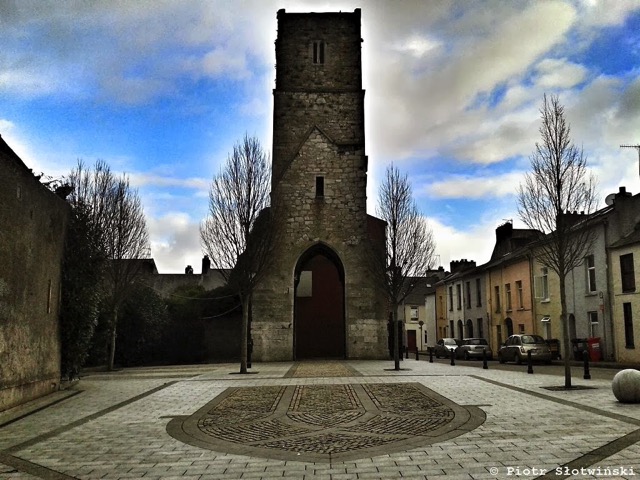
Red abbey

Gookin also sought a Royal grant for the mythical Saint Brendan’s Island (Wikipedia entry here), said to be in the middle of the Atlantic Ocean (and thought to have been recently discovered). Gookin returned to Ireland not long after a significant Indian attack on his colony. He is thought to have died in Cork in 1632/33 and was buried at Red Abbey (shown above). However in later years the abbey suffered a major fire and so as far as I can find he has no known grave or memorial there.

…………………….

Ireland’s stories are not always Irish. Neither are they automatically Ulster-Scots or Scotch-Irish. There is always a need to take a broader view.

PS:
•  His son, also called Daniel Gookin (1612–1687), followed in his footsteps and eventually became major general of the Massachusetts Bay Colony (see biography here).
•  A PhD Thesis on Gookin and archaeology in Cork is online here.

PPS: the plaque below from the Old Stone Presbyterian Church shows that it was used by the Baptists from 1834 onwards, and from 1858–1886 by the ‘Old School Baptist Church of Color’. 

5985888990 d87e4e522e o


Sunday, January 21, 2018

Johnny Cash - from the 19th Century to Nine Inch Nails.

81wd8hY0jJL SL1200

Johnny Cash was a regular in our house when I was growing up. Not in person of course, but his voice was a frequent soundtrack. I remember being a bit shocked when I first paid attention to the words of Delia’s Gone. Burl Ives or Jim Reeves this was not. I don’t think Johnny Cash ever ‘shot a man in Reno just to watch him die’, but it was easy to believe that he might have done.

As Cash’s long career rose and fell, and rose again and fell away again, it was towards the end that he soared and some of his best work was recorded.

One of his famous American Recordings albums contained the multi-award-winning version of industrial rock band Nine Inch Nails’ track Hurt (released 2002). After he died, a box set called Unearthed was released, including a set of 15 hymns recorded during 2003.

The track listing is below, along with the year the hymns had either been first published or first recorded

1  Where We'll Never Grow Old (1914, James Moore)
2  I Shall Not Be Moved (traditional, first recorded 1929)
3  I Am A Pilgrim (first recorded 1917, Imperial Quartet)
4  Do Lord (c. 1950, V.O. Fossett)
5  When The Roll Is Called Up Yonder (1893, James M. Black)
6  If We Never Meet Again This Side Of Heaven (1945, Albert E Brumley)
7  I'll Fly Away (1931, Albert E Brumley)
8  Where The Soul Of Man Never Dies (first recorded 1928, written by William M Golden)
9  Let The Lower Lights Be Burning (1871, Philip P Bliss)
10  When He Reached Down (1947, JFB Wright)
11  In The Sweet By And By (1868, Sanford F Bennett)
12  I'm Bound For The Promised Land (1787, Stennett)
13  In The Garden (1913, C. Austin Miles)
14  Softly And Tenderly (1880, William L Thompson)
15  Just As I Am (1835, Charlotte Elliott)

For an artist to encompass nearly 200 years of song, from 21st century alternative rock to early 19th century hymns, is utterly remarkable. It is hard to imagine any other performer being able to carry that off, and to in fact make these songs his own.

Perhaps, as track 6 above begins, ‘when we come to the end of life’s journey’, it will be songs which will come to mind, bringing reminiscence, joy, and comfort. Because by that stage, as the emotional sledgehammer line from Hurt says, ‘You can have it all, my empire of dirt’.

Today, in a world where the line between sacred and secular seems to be getting more sharply defined, it is hard to imagine a time when there were crossovers. Yet when you really delve into the history of the music, crossovers were the fertile ground that brought freshness. Many of the writers of popular hymns in the 1800s were also secular songwriters, skilled practitioners, commercially successful, bringing their gifts and talents to a range of genres.

How many of today's songs will still be sung in 200 years' time?


Wednesday, January 17, 2018

Murray Rothbard and The Ulster Scots – Conceived in Liberty: "the revolutionary and even libertarian roots of America" (1975)

RothbardChalkboard

Murray Rothbard’s landmark 4 volume set from 1975 about the birth of American democracy, Conceived in Liberty, (Wikipedia entry here) includes a chapter entitled 'The Ulster Scots'. You can read it on Google Books here. Rothbard (1926-1995) was a hugely influential figure in 20th century libertarian thought (Wikipedia entry here).

‘The Ulster Scots were the largest immigrant group in the eighteenth century. These men were, in the main, intense Presbyterians from lowland Scotland whose families had been settled in Ulster in northern Ireland during the seventeenth century …'

The Mises Institute describes their recent combined edition as follows:

There's never been a better time to remember the revolutionary and even libertarian roots of the American founding, and there's no better guide to what this means in the narrative of the Colonial period than Murray Rothbard.

Rothbard's ambition was to shed new light on Colonial history and show that the struggle for human liberty was the heart and soul of this land from its discovery through the culminating event of the American Revolution. These volumes are a tour de force, enough to establish Rothbard as one of the great American historians.

It is a detailed narrative history of the struggle between liberty and power, as we might expect, but it is more. Rothbard offers a third alternative to the conventional interpretive devices. Against those on the right who see the American Revolution as a "conservative" event, and those on the left who want to invoke it as some sort of proto-socialist uprising, Rothbard views this period as a time of accelerating libertarian radicalism. Through this prism, Rothbard illuminates events as never before.

NewImage

Tuesday, January 16, 2018

Coming soon: Samuel Rutherford Crockett Society – 'Glenhead Stories' by Joe Rae

NewImage

I am thankful to my freen Joe Rae who lives near Beith in Ayrshire for this information. Over the years Joe has introduced me to countless stories, songs, traditions, places and histories, including the writings of Samuel Rutherford Crockett (1859–1914). He was a master storyteller, a bestselling author in his day, selling hundreds of thousands of copies of his books. He has been described as ‘Galloway’s Best Kept Secret’, doing for Galloway what Sir Walter Scott did for the Borders. Crockett was a friend and correspondent of Robert Louis Stevenson - Crockett dedicated The Stickit Minister to Stevenson, who in turn dedicated Songs of Travel to Crockett. Unsurprisingly, adverts and reviews of Crockett’s works appear hundreds of times in the Ulster newspapers of his day.

Joe has been working lately with the S.R. Crockett Society (society website here) to help with a new publication called Glenhead Stories, which is due out in April 2018. The book will feature fifteen stories, in Scots, remembered and retold by Joe.

Rutherford was a prolific author (see bibliography here) but one story which really stands out for me is the tradition mentioned in a recent post here about John Thomson leading Bruce’s defeated troops back to Scotland, giving rise to the expression in south west Scotland that ‘we’re aa Jock Tamson’s bairns’.

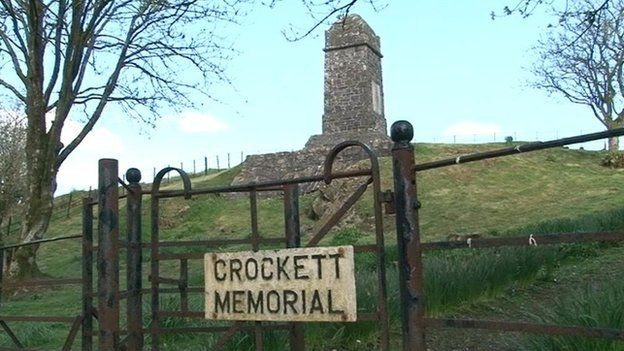
The story was told to Crockett by John MacMillan, a farmer from Glenhead. Glenhead is near Glen Trool, the scene of the Bruces’ famous victory in 1307 right after they returned to Scotland after wintering on Rathlin Island. There is a Covenanter memorial still at their farm of the Caldons, again close to Glen Trool, erected by the famous ‘Old Mortality'

NB: The very first Reformed Presbyterian minister was also called John MacMillan. He was born at Minnigaff just 14 miles from Glenhead, and was one of the founders of the Reformed Presbytery in 1743. He is known to have come to Ireland to minister to ‘United Society’ Covenanters in 1707 and 1715. Crockett wrote a dramatised account of MacMillan’s life, a novel entitled The Standard Bearer in 1898. There is a monument in Dalserf to MacMillan with numerous inscriptions, including:

A public tribute to the memory of the Rev. John Macmillan,
minister of Balmaghie in Galloway, and afterwards first
minister to the United Societies in Scotland, adhering at
the Revolution to the whole Covenanted Reformation in
Britain and Ireland, attained between 1638 and 1649. An
exemplary Christian ; a devoted minister ; and a faithful
witness to the Cause of Christ : died December First,
1753, aged eighty-four.

…………………….


WE'RE AA JOCK TAMSON'S BAIRNS.
  
Carrick wis for lang counted pairt o Gallowa an the premier title o the heir tae the Scottish throne wis Earl O Carrick. The Bruce an his youngest, an only surviving, brither, Edward, Earl O Carrick, gaed ouwre tae Irelan in the year 1316 an met wi a wheen o the native chiefs. At the final getherin it wis agreed thit Edward wid return the neist year wi an airmy an jine forces, ourthrow the English usurpers, an then he wad be crooned king o irelan.

The Yearl an King agreed that the airmy wad be recruited fae Gallowa an word wis sent aa roon the cuntryside that ilk able man atween the age o saxteen an saxty wid hae tae gether et the Turnberry on the 21st.o Mey 1317, this gein time tae get the lammin bye an the feils plood an sawn. Whun the carls hid aa gethird the force cam tae 2000 men, noo boys ye micht think that this wis a gey smaa numer fur the hale o Gallowa, bit jist conseeder this, for twenty years the Southerin hid been butcherin Scotsmen like lambs et the slaughter an the hale population o Scotland et that time numbered 220,000 say 2000 fae sic an ootbye laun wis nae sae bad. Amang the thrang there wis thirty lords wha wur mounted.
Sailin fae Turnberry the airmy landed at Carrickfergus an sterted thir mairch Sooth aa the wey bein jined bi the native chiefs wi thir followers. Cumin tae the breist o a brae et a place caad Dundalk, an luikin doon there they saw a sicht thit garred some o them grue, fir

Doon the brae lined up in rank upon rank wis 20,000 Englishmen airmed tae the teeth an led bi a chiel caad Sir Jhone De Bermingham a notar loon. Weel the native Irish wi scant thoucht meltit awa like snaa aaf a dyke, bit whit dis thet daft chiel Edward dae? raisin his sword an gein it a sweep roon cries follow me men, an wi his thirty muntit men gaes gallopin doon the brae like some gommeril taen wi a brain storm, The Gallowa men on fit hadny gotten faur on there wey effter him whun even they could see it wid be like cuttin their ane thrapples tae gyang ony further. Say there they ur stottin aboot like a heedless corps whun oot o the thrang  steps ane Jock Tamson an he wi a voice like a foghorn gars them tak heed gin they didna move richt smert back the wye they hid cum they wid gang the wye o their faaen leader, naethin like self preservation tae spur a man on an ye cun be gye share they didna count the thistles on their wye back tae Carrickfergus an wi a guid win they wur nae lang in reachin Turnberry an sae hame wi very few missin et the hinneren.

Noo fur generations efter whun fermers an herds fae Gallowa met et mairkets or fairs they wad drink a toast, an the toast they drank wis:--We”re aa Jock Tamsons Bairns”----aye an ye ken it wis literally true, fir hud it nae been for Jock Tamson there widna hae been an indigenous buddy in Gallowa this day.

Meanwhile Sir Jhone De Bermingham examinin the bodies o the thirty slayn horsemen, discoverin thet yin wis the corps o yin o the hated Bruces, cuts aaf the heid pits it in a pyock an maks speedy arrangements tae gyang ouwre tae Lunnon wi his trophy.

Arrivin in the kings chaumer he coups the heid oot o its pyock ontae a table fornent the king an sez, whit dae ye think o that my liege, {this bein that English king wha cam tae a painfu en et the hauns o his ain courtiers, a rid hot poker bein involved.}  man, man sez the king aa hae lang soucht the sicht aa see noo.  Weel as a reward he fills the empty pyock wi goud, dubs Sir Jhone on the shooder an sez arise Sir Jhone, Earl O Meath wi the braid lans o Meath tae you an yours fir as lang as grass grouws an waater rins.

Back hame in Irelan ye wad hae thoucht thit the new Earl wid hae hid nae a care in this worl, bit ye ken things in this life dinnae aye turn oot as ye plan or expect.

Nae lang efter the new Earl tuik possession o his new launs, did his faimily no aa gyang native an they refused to speak English an wid only communicate in Erse which garred the faithers blood pressure rise tae sic a level thit he sune deit. Efter that did they no chinge the faimily name tae McJorris an they leived as sic tae the middle o the 18th.C. whun they decided tae emigrate, an whaur did they emigrate tae---why Gallowa, an there they thoucht the name McJorris a wee bit outlandish even fur they pairts an they chinged their name again—this time tae McGeorge an this name is still quite common in Gallowa even untae this day.         

…………………….

• Wikipedia entry for S.R. Crockett is here

• You can join the S.R. Crockett Society for free here, which will give you access to regular updates and stories.

NewImage

Thursday, January 11, 2018

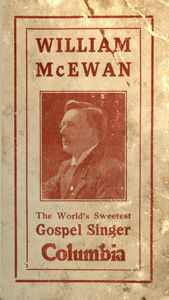
William McEwan (The World's Sweetest Gospel Singer) - the Joe Nabney recordings, wartime service, and obituary

Exactly 100 years ago William McEwan was training American soldiers to sing, having been inspired by seeing the Argyle and Sutherland Highlanders parading through Glasgow in full voice, on their way to the Second Boer War in South Africa, around 1900. Apparently American soldiers didn’t sing, they were known as the ‘silent army’, and William McEwan’s task was to change that. He had them smiling, whistling, and singing, often in quartet style harmonies!

I think I’m now pretty much finished with McEwan’s story, having posted some articles about him here in 2011, then collating and tidying those up into a blog of their own in 2016, and now recently having located a few missing pieces in the puzzle. Hopefully some biographer or broadcast producer can now pick up on it and do something more professional with him (hint hint).

• JOE NABNEY ALBUM
What gee’d me up to finish McEwan was finding, on Apple Music, the Joe Nabney tribute album from apparently 1978, but I thought was a fair bit older than that, which you can listen online here. I am pretty sure Nabney was from Belfast, perhaps somebody out there can let me know more about him, I am familiar with him from my parents having talked about him.1200x630bb

• WARTIME SERVICE
I had known that McEwan enlisted with the US Army, but nothing more. I've now found out that he was recruited to be a singing instructor to help with morale, firstly at training camps in the USA and then in France. His son William had enlisted as a medic on 21 July 1917, just a few months after the USA entered the Great War. By 1st August William senior was marching squads of men around training yards, singing their hearts out. A month later he was off to France. There are some brilliant stories about his time in the army from digitised newspapers. I’ve added a complete page to the McEwan blog here.

Below: from The Leaf-Chronicle (Clarksville, Tennessee), 29 August 1917

McEwan Lauder


• OBITUARY
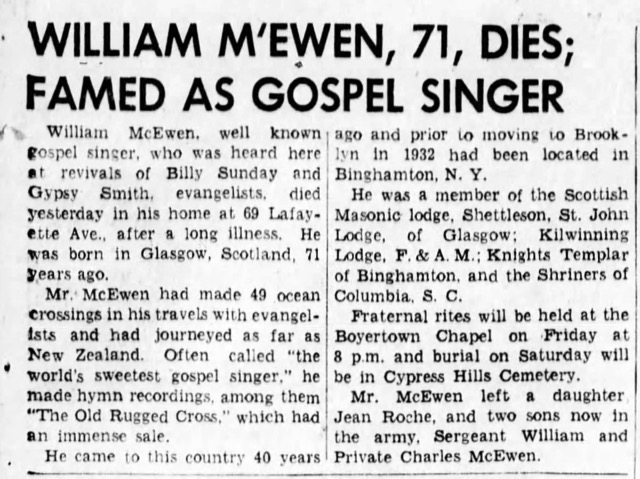
Here is his obituary from the Brooklyn Daily Eagle newspaper, 24 June 1943. OBIT

Advert from The York Daily newspaper from York, Pennsylvania, from 19 November 1915 below. Gospel music, and popular hymnwriting, is/was a combination of the spiritual (in the words – but some of course legitimately view them as ‘uninspired’ when compared with the Psalms), the secular (maybe again in the words, but definitely in the melodies, tunes, tempos, songwriting approaches and instrumentation) and the commercial (because publishing houses, copyright firms and record companies all make money). That 'tension' leads to some interesting discussions even still today. 1915

Wednesday, January 10, 2018

'Address of the Inhabitants of the County of Somersett', 28 November 1689

(As referred to in the previous post. It’s impossible to know how many of these might have been early Ulster emigrants. Presumably most were English. Maybe an expert in Maryland / Delaware has already done that research).

To the King and Queen most Ext Majty.
Wee your Majesty's Subjects in the Somersett and Province of Maryland, being refreshed and Encouraged by your Majestys great and prosperous undertakings, and by your late gracious letter to these of this Province, do cast ourselves at your Majesty's feet humbly desiring and hopefully expecting the continuance of your Maj care of us, as our Case and Circumstances doe or may require, in the confidence whereof wee resolve to continue (by the grace of God) in the Profession and defence of the Protestant Religion and your Majesty's Title and interest against the French and other Papists that oppose and trouble us in soe just and good a cause not doubting but your Majestys wisdom and clemency will afford unto us all needful suitable Aid and Protection for securing our Religion, lives and liberty under Protestant Governors and Government, and for enabling us to defend ourselves against all Invaders. Thus praying for your Majestys long and happy Reigne over us, Wee know ourselves to bee (with due Reverence and sincerity.), Your Majestys Loyall Obedient and humble Subjects

John Huett Wm Coulbourne jun Thomas Wilson Henry Philips John Parsons Thomas Shild Thomas Stivenson James Knox John Browne Wm Alexander Randolph Revell Peter Elzery James Smith Epraem Wilson Thomas Smith John Knox Thomas Wallr John Knox Thomas Wallr Alexander Knox Alexander Procter John Renshaw James Conner William Wilmot Micayah Sadler John Chanceleer John Smoche Nicholas Cornwell Robert Cade John Miller Adam Spence Tho. Midgley John Baron John Deale Martin Curtis Clement Giles Robert Johnson William Bowen Devoraux Diegas Robert Simson Edward Evans Hugh Jingle John Coltston Richard Warren Mathew Jones Richard Hill John Goldsmith John Browne WilIm Owen Malcom Knox William Knox William Hacaland Richard Jarrett Nathaniel Clark George Boyman John Nelson William Waller George Phebus John Rawley John Jones George Park Wm Polk Wm Wilson Edward Surnam Charles Ractlife William Melvell William Smith Richard Mackclure John White John Rowell John Killam John More Sam1 Hopkins junr Benjamin Keyar Ralph Milbourne Henry Hall Francis Heap John Pope Thomas Oxford William Hearne Richard Pepper John Saunders Nathaniell Abbott William Coard William Hall William Davis Joshua Light John Rust Nathaniel Vesey Richard Woodcraft Tobias Pepper WaIler Read John Peterfranck Stephen Page Thomas Edwards Alexander Mackcullah George Beniam Andrew Miller Patrick Reed John Steell William Browne Thomas Bromley William Wouldhave Richard Wildgoose John Lucas John Johnson Richard Cole William Oswell John Snow George Latham William Law William Alexandr Junr John Gray Robert Polk Thomas Pollett Charles Mullen Arnold Elzey Alexander White William Nelson Michael Hannah William Lawrence John Swaine Ambrose Archer William Stevenson James Barber Samll Showell William Jurvill John Mcknitt Wm Coulbourne James Marrah John Roach Owen Mckgraw William Round Richard Farwell Alexander Kyll Thomas Poynter John Strawbridge Adam Fitch William Burch Thomas Gordon Nicholas Carpenter John Hepderson John Tarr Richard Hill Edmd Beachamp Allen Ross Geo. Nobell Richard Britten Peter Whaples William Layton William Boyman Geo. Lane John Crawley Samll Worthington Robert Peny Moses Fenton John Porter Ninian Dulap James Henderson James Duncan John Barber John Hicks William Mead Robert Neame Henry Mills Richard Dennis Thomas Morgan Humphrey Read William Shankland David Dresdan John Watt John Ellis Thomas Ellis John Starret William Fossit Thomas Delahide Arthur Hanley John Christopher Philip Askew Roger Phillips Robert Crouch George Bayley Lazurus Maddux John Davis Henry Hamon Miles Harrison Tho. Dixon Alexander Maddux John Frankland Wm Coulbourne. Francis Joyce Robert Boyer Nicholas Jodvin Geo. Layfeild Comtr [sic] Michael Clugstone Laurence Crawford Wm Traile Thomas Wilson Samll Davis Peter Dent John West John Boyman James Sangster John Tayler Edward Jones Thomas Poole Roger Burkham John Emmit John King William Planer William Planer junr Richard Tull Thomas Tull Robert Hall John Braughton William Nobell John Colhoune John Williams Richard Chambers John Trupshan Mathew Dorman James Langreene Nathll Horsey Alexander Thomas John Mackbride David Brown Francis Jenkins William Brerton John Winder Robt King James Dashiell Stephen Suff Thomas Newbold James Round Samll Hopkins Edmd Howard Thomas Jones Henry Smith.

Address of the Inhabitants of the County of Somersett to their Majties. Recd. from my Lord Shrewsbury, 7th Febry. 1689.

Maryland