Wednesday, December 13, 2017

Here We Still Stand - Jared Wilson

Jared Wilson's book The Imperfect Disciple: Grace for People Who Can't Get Their Act Together is on my to-read list. He visited Belfast not that long ago but I wasn't able to get there. He's one of the freshest (that means most authentic) voices in the Reformed world these days. Have a listen to this, from the Here We Still Stand conference from just a few weeks ago. Website here.

Jared Wilson | Here We Still Stand from 1517. on Vimeo.

Tuesday, December 12, 2017

No Scotch-Irish need apply (Welcome to New England & Philadelphia)

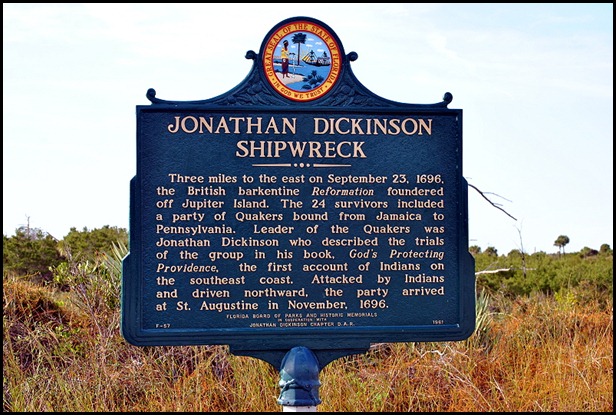
05b Jonathan Dickinson Shipwreck S 1

Yes, the title of this post is a deliberate rework of the infamous mid-1800s slogan which was aimed at Irish immigrants fleeing famine for what they thought was refuge in either Britain or America*. The more I read about the first waves of Ulster-Scots / Scotch-Irish migration into New England over a century earlier, from 1718 onwards, a similar slogan could easily have been applied to them as well. And maybe was, but just hasn’t been recorded for us. The era was different, the context was different, but the human experience seems to have been pretty much the same.

Those first Ulster-Scots emigrants faced sectarianism from those whom they might have regarded as fellow Non-Conformists, class discrimination from an élite establishment who had previously indicated a welcome, and commercial exploitation due to the local grain supplies being bought up by New Englanders just before the arrival of the Ulster families, which almost doubled the market prices (see here). They were outcasts from the beginning.

The Quakers from Philadelphia were shocked and scandalised by the clothing they wore as the ships landed, or in the case of the Ulster-Scots women, didn’t wear: "full bodices, tight waists, bare legs and skirts scandalously short". Well that’s what poverty and the quest for survival during two months starving at sea during the summer does to the dignity of once-modest, once-muscular, country Presbyterian women. It's life or death and they have no plans for dying just yet. You get a sense from that particular account of the disgust and social disdain which their new 'superiors' had for them.

For the emigrants it must have felt like ‘meet the new boss, same as the old boss'.

This all goes against the grain of the many of the old-fashioned ‘heroic narratives’ of say the past 100+ years, when hagiographies were being fervently penned, of people stepping purposefully ashore and conquering all in front of them and constructing the greatest nation the world has ever seen.

But we have to be careful here too, as this now plays too easily into our present era’s fixation upon ‘victimhood’ – which is actually faux victimhood – where to be a victim (or even a descendant of a perceived victim group) is not only fashionable but it also secures a privileged status in what has been called the ‘Oppression Olympics’. As the adverts ask, “Suffered an injury? You may be entitled to compensation”. Nowadays that injury might just be hurt feelings. The compensation is that you get a seat at the big table. Victimhood = entitlement = power. Even perpetrators have learned to present themselves as victims. That’s how warped our era is.

I am certain they were hard done by. I am also certain they were instilled with a fair amount of ‘No Surrender’ given their experiences from the Siege of Derry and of the post-1702 ‘establishment' in Ulster.

In his oft-quoted letters of 1718 & 1719, Jonathan Dickinson, the Philadelphia Quaker hinted at above, could see that too:

“a swarm of people … the speech of these people was English, but they spoke with a lilting cadence that rang strangely in the ear … but even in their poverty they carried themselves with a fierce and stubborn pride that warned others to treat them with respect’.

That "strange, lilting cadence" was of course Scots, or Ulster-Scots, words, expressions and language.

So what had they left behind? In 1928, in a Northern Whig article entitled 'Education In the United States: Ulster’s Contribution’, Dr John S. MacIntosh wrote that leading up to the emigrations of 1718, Ulster Presbyterians had suffered ‘Five Wrongs’ at home:

- wronged by the State
- wronged by the Church
- wronged in the home (by landlords and bishops)
- wronged in trade (rising taxation)
- wronged in death (denied recognition of burials and graves) 

It’s not a case of comparing oppressions - either with the later ‘Famine Irish’ or with any other group - but rather a recognition that human history repeats its experiences over and again, both the good ones and the bad ones. We are all very much the same. Our stories are very similar.

PS: This article from the New England Historical Society helps explain more

……………….

* In 2002, the famous slogan was claimed by an academic to have been a myth, but in 2015, largely thanks to digitised newspaper research, his claim was proven to have been demonstrably false by a smart, highly dedicated 14 year old student (article here).
Saturday, November 25, 2017

The Devoys of Portavogie, Anglo-Norman influences, and Mount Stewart

Devoy

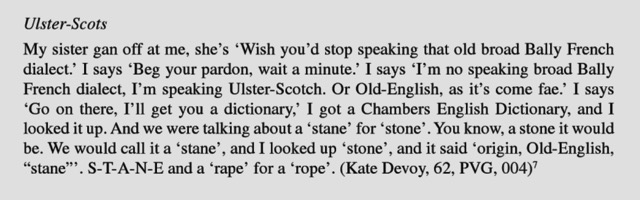
• Extract above from Roots of English; Exploring the History of Dialects, Cambridge University Press (2012)

The townland I live on is called Ballyfrench, but the placename experts think that the ‘French’ part is a corruption of a name like ‘Ballifranish’ or ‘Balleffringe’ - perhaps itself a variant of something like ‘Frenes’ townland’. Some of the names around here do indeed date back to the arrival of the Anglo-Normans in the 12th century - and it’s known that there was a John de Freines and Henry de Frenes in the Anglo-Norman settlement area around Dublin in the 1300s. So maybe some of them came north in the wake of De Courcy & co.

As far as the Ards Peninsula goes, the surname Devoy is pretty unique to the Portavogie and Ballyhalbert area. The tradition I have heard is that sometime in the 1700s a French ship was wrecked off the coast at Ballyfrench and the survivors came ashore, some of who were called Devoy. They were welcomed by the Ulster-Scots inhabitants and settled here. The name does appear elsewhere in Ireland, such as the prominent Irish nationalist John Devoy who was from Kildare (Wikipedia here). There’s a Devoy family today in Dublin in the midst of a high profile crime gangland dispute (see here). So maybe the shipwreck story isn’t true, but has emerged as somebody’s attempt to explain the name.

The book extract shown above is an excerpt of an interview with a Kate Devoy from Ballyfrench about speaking ‘Ulster-Scotch’. The same page compares Cumnock in Ayrshire - a place I know fairly well and visited just a few weekends ago - with Cullybackey, Portavogie and Maryport in Cumbria.

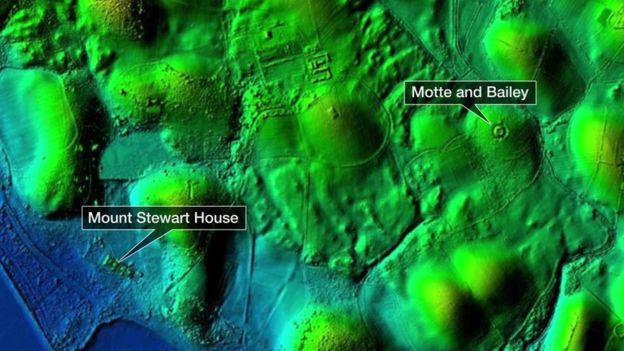
The Anglo-Norman influences here in the Ards Peninsula were on the news during the week, with the discovery of a major motte at the National Trust property Mount Stewart (see BBC report here). No wonder that when the Scots arrived they called it Mount Pleasant for about 150 years, until the Stewart family arrived from Donegal, bought it from the Colvilles, and renamed it after themselves.

Northern Ireland today needs to understand that we have multiple, interwoven, cultural and linguistic influences.

98788688 mountandmotte

Monday, November 20, 2017

BBC language controversy, Christmas 1933

On Christmas Day in 1933, the BBC broadcast a programme to the nation, made up of items from its various regions. The Northern Ireland segment was in Ulster dialect, and had an item within it called ‘The Wee Wean o Bathleamm’. When the Belfast newspapers hit the streets on December 27th there was a flood of letters, which are fascinating to read from today’s perspective. Many had their addresses printed alongside, and these show two broad reactions:

1) the urban and suburban middle class reaction was one of equal outrage and cringe.
2) the rural working class reaction was that the dialect didn't sound authentic enough 

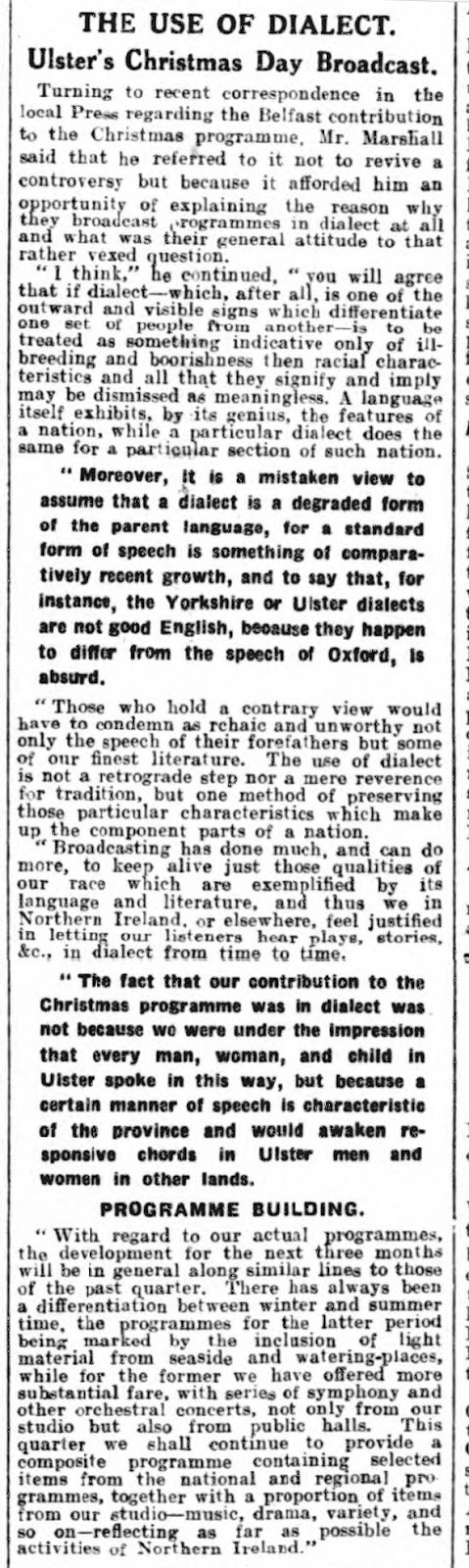
It seems that it was a hybrid of Hiberno-English and Ulster-Scots, further interpreted through the hand of a scriptwriter, and so perhaps akin to the writings of WF Marshall. Some of the complaints were also that it was ‘too Irish’. The letters pages raged back and forth until early January, when the editors decided to publish no more. A few weeks later, Mr George Leslie Marshall, the BBC Belfast Station Director, issued a statement defending the decision to broadcast Ulster dialect to the rest of the world. The clipping below is from the Northern Whig on 10 January 1934, via the excellent British Newspaper Archive.

It just goes to show that language/dialect along with demographics and broadcasting has always been a difficult arena!

GL MArshall


Saturday, November 18, 2017

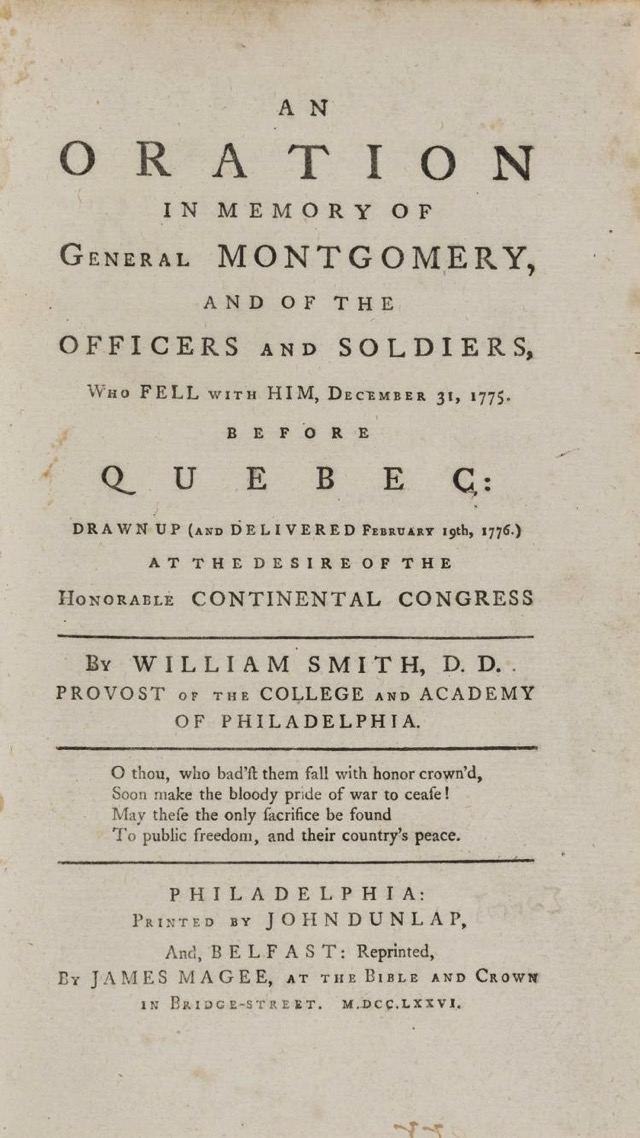
Montgomery, Dunlap & Magee - Quebec, Philadelphia, Belfast (1775)

H20198 L130684337

1775 - Belfast & Philadelphia - a Fast before Revolution

H20198 L130684335

Wednesday, November 15, 2017

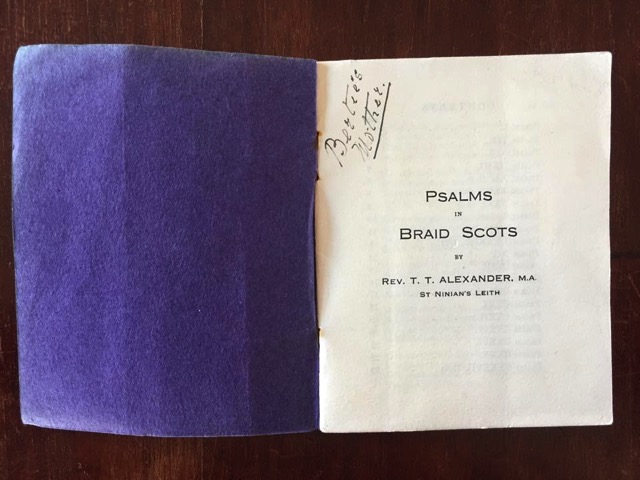
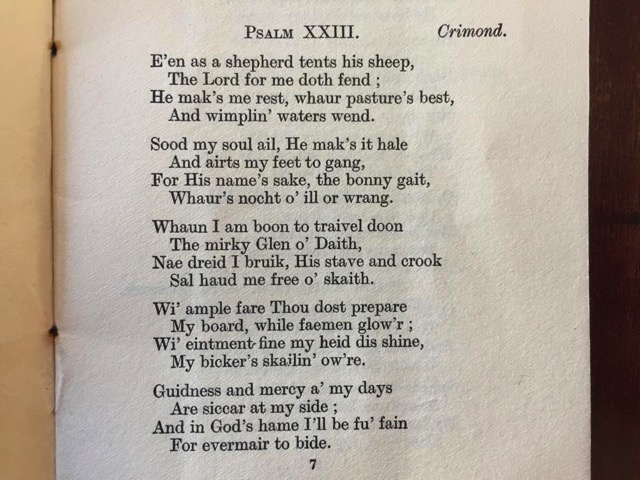
'The Psalms in Braid Scots' by Rev TT Alexander (St Ninian's, Leith), c. 1930

My brother was given this by a friend from Donaghadee a few weeks ago. It had been in his mother’s collection of stuff and they thought we might appreciate it. I’d not heard of it before, and so I went for a hoke in Graham Tulloch’s excellent History of the Scots Bible (1989) but it wasn’t mentioned in there either. So it must have been a fairly local edition - pocket sized, priced at one sixpence.

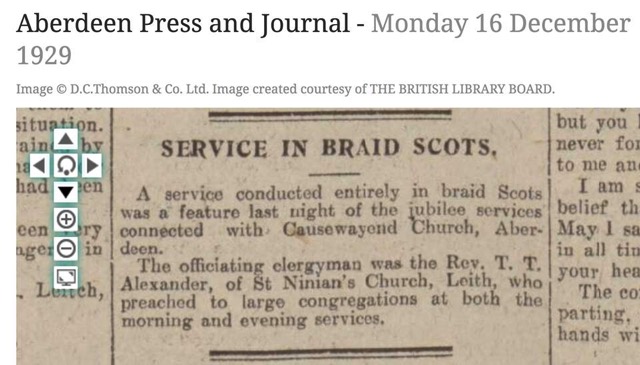
A bit of digging shows that Alexander was minister at St Ninian’s from 1926-1932. In 1931 he stood as an SNP candidate in the East Edinburgh constituency. The BNA has some adverts for him preaching church services in Braid Scots, one of which is below.

Just last weekend my brother and I were in New Cumnock in Ayrshire, playing and singing a bit in the Baptist Church there. We were nearly tripping over folk from Ulster or with Ulster connections. One New Cumnock couple we met are good friends and frequent visitors to neighbours of ours who literally live a few fields away from me.

Maybe four of the church pastors in the town are Ulstermen - certainly we met three of them. One man there was thrilled to hear a few sangs in the hamely tongue, as he was born and raised outside Larne. He recounted a story to me of a time when he was asked to preach in a church in Belfast, and so very naturally just used a brave wheen of Ulster-Scots words in his sermon. However one of the church elders, as we say, 'boned' him at the door and made it very clear that he'd caused great offence by using such irreverent and disrespectful language in the pulpit. Sometimes there are just thran individuals who like to be seen to be in charge.

I am pretty sure that the 'Man of Galilee' spoke like a country man from Galilee. There is much academic and theological writing on the subject (example here and another similar article here). The most famous example of this was when his disciple Peter, then in the metropolis of Jerusalem, denied knowing Christ, he was confronted by a servant girl who said - according to the old King James Version translation of 1611 - "Surely thou also art one of them; for thy speech betrayeth thee" (Matthew 26:73). Country folk often stand out like sair thumbs in the city.

Rev TT Alexander worked in historic Leith, a suburb of Edinburgh. Language usage has changed a lot in the past 100 years, Scots and Ulster-Scots have been diminished and spread very thin by a whole range of factors. Both remain at their richest in the country, the folk in New Cumnock confirmed this to me over tay and pieces after the meetings.

23244446 10155942406757878 8524362131346438193 n23231114 10155942406852878 1505383854666271418 n23131884 10155942407182878 514943815045918293 n23131027 10155942406937878 8510012082221654884 n23131647 10155942447532878 785525763206946393 n

Here is the church today, built in 1816: NewImage

And here is the much older manse building. The congregation at Leith dates from 1493, the year after Christopher Columbus is said to have discovered America.St Ninian s Manse North Leith

Friday, November 10, 2017

The Mystery of 'Redemption Songs' hymnbook

Its red cover was in nearly every mission hall and gospel hall when I grew up. The softback ones were like velvet to hold. The hardback ones had posh gold foil blocking on the cover. The music edition was beautifully designed, a real retro classic of its time.

But nobody is sure exactly when it was first published.

Hymnary.org says 1937 but that’s far too recent, it was definitely older than that. There may have been later additions/editions.

The British Newspaper Archive as ever has some tantalising research references, the earliest being in Scotland in 1910 in Aberdeen Press and Journal newspaper, an advert for a place called Gordon Evangelistic Hall which proudly advertised the Sunday evening service with ‘Hymns from Redemption Songs”. The publisher, Pickering & Inglis, was based in Glasgow - “largely for the non conformist church in Scotland with many Brethren publications”.

A few weeks later the Ardrossan and Saltcoats Herald was advertising the hymn books, with a free sample copy being offered by bookseller R L Allan & Son of Glasgow to any “mission leaders” who applied for one.

The earliest Ulster reference is from October 1912,  where it is listed in an advert from the Northern Publishing Office (NPO) in Ann Street, Belfast, along with Songs of Victory, Sankey’s Sacred Songs and Solos and various Psalters.

NewImage

Thursday, November 09, 2017

Preachers, Coal Miners and Singers - BBC documentary about the Everly Brothers

Wednesday, November 08, 2017

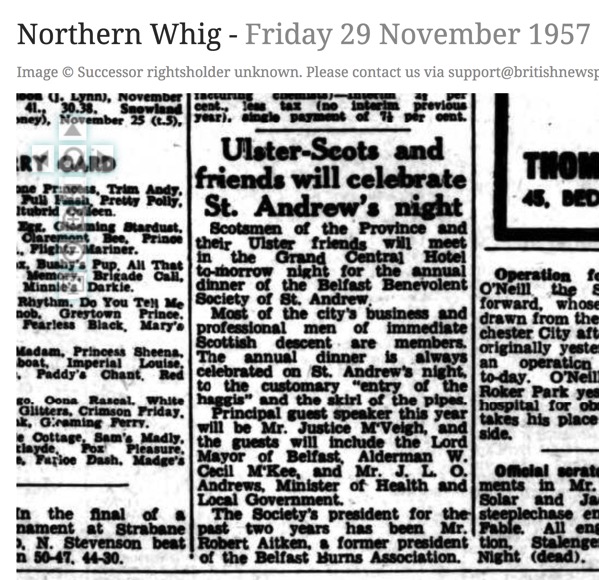
Ulster-Scots in the 'Northern Whig', 1957 (from the British Newspaper Archive)


Whig 1957

Monday, November 06, 2017

Lights, Camera, Action!

Some of you will know that throughout the autumn I have been filming a new 6-part series for BBC Northern Ireland. It’s been bubbling away since first discussions in the month of May, and at the time of writing we have four programmes done and two to go. I’ve been interviewed for a few things over the years, but have never been in a presenter role before. It has been a massive eye-opener, an insight into the vast amount of work, planning and logistics - never mind creativity, flair and expertise - that a quality series demands of its producers, creatives and organisers. I have met so many great people in interesting places, with new stories, and big discoveries. I will say no more for now. It’s not a new day job but it’s been pretty demanding for me as a total novice. Watch this space!

Bbc logo11

Portavogie Harbour opening, 1955

Smithfield Plantation House: home of Colonel William Preston and the Fincastle Resolutions

697bcaa2cef20246a58276c0561c7ed3

Situated in Blacksburg, Virginia. Find out more at the museum website here. William Preston was from Limavady, born there on Christmas Day 1729. Here's his Wikipedia entry.

Sunday, November 05, 2017

Green Grow the Laurels / Willows / etc.

This is another very old song that pops up on both sides of the Atlantic in slightly different guises. I was surprised to find recently there was a Dublin version which has an Orange variation to it. The broadside below is from the Bodleian Libraries website Broadside Ballads Online, and dates from 1858–1885. It is listed in Cox's Folk Songs of the South (1925, online here) as 'The Green Laurels (The Orange and Blue)’, collected in West Virginia. 

19114

Saturday, November 04, 2017

Songs My Mother Bought Me & "Songs Our Daddy Taught Us" - The Everly Brothers (1958)


I was I think about 12 years old. That Christmas my mother bought me a cassette tape of a greatest hits compilation by the Everly Brothers. I wish the cover had been more cool and retro, but it was a late 70s or early 80s re-issue. Ah well. But the music, the songs, the harmonies. Their music was, and still is, a masterclass.

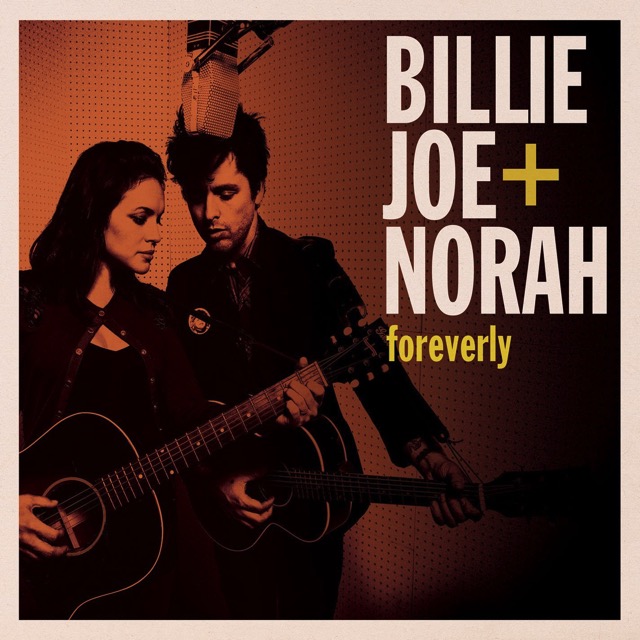
So I was amazed to only recently discover that Billie Joe Armstrong of Green Day and Norah Jones teamed up to record a new version of the Everly Brothers’ second album Songs Our Daddy Taught Us, from 1958. It’s a really important album as it connected the brothers back to their father’s childhood - songs like Down In The Willow Garden (which the superb  BBC tv series 'Wayfaring Stranger’ from earlier this year traced back to Coleraine, and Barbara Allen (a song so old it can be found among old song manuscripts from the Scottish Borders and parts of England), Bailes Brothers songs, songs recorded by Bill Monroe and Bradley Kincaid…  it’s wonderful. It was a shocking move in its day, a bold move for the record company, for a couple of fresh-faced chart-topping pop sensations to record oldies and dark murder ballads. 

The Billie Joe Armstrong and Norah Jones update, entitled Foreverly, is very good. Stick it on your Christmas list. Rockin Alone in an old Rockin Chair would bring tears from a stone - for me it brings back vivid memories of a mother who loved music and who once upon a time bought me an Everly Brothers’ compilation album for Christmas.


81YVHV5sIWL SL1425


Everly brothers

Friday, October 27, 2017

'Donald McElroy, Scotch Irishman' (1918) a novel by Mrs. Willie Brown Walker Caldwell (1860–1946)

McElroy


Willie Brown Walker was born in Wytheville in south west Virginia in 1860. She also wrote The Tie That Binds (1895) a love story set during the American Civil War;  and Stonewall Jim, a biography of her father, the Confederate General James Alexander Walker.

She seems to have been what some in Northern Ireland would call a ‘mad Prod’ - she got in trouble in 1928 for declaring that American women needed to save the country from being ‘Romanized and rum-ridden’ following the Democratic Party selecting Al Smith, a Catholic, as a potential candidate for President. She was strongly rebuked for this by Herbert Hoover.

Donald McElroy, Scotch Irishman is interesting as it has touches of attempted Ulster-Scots dialogue and a clear sense of cultural identities. There are tinges of clichéd Ulster Protestant v Irish Catholic tensions for some of the characters (you wonder how those kinds of ideas could still be persisting in late 1800s rural Virginia - these people were probably over 100 years away from an actual experience of living in Ulster). In the story a young Catholic girl called Ellen O’Neil from Baltimore enters the McElroy family circle (her parents had died of smallpox) and the McElroys decide to take her in - they also to try to “make a good Presbyterian of her in no time”.

Donald McElroy and Ellen O’Neil eventually fall in love, get married and agree to tolerate each other’s faith. Although in the final paragraph it seems like she does become Presbyterian. 

Willie Walker married local lawyer Manley Morrison Caldwell in 1887 and the couple moved from Wytheville to Roanoke around 1906, where she became Vice President of the Woman's Civic Betterment Club and joined the Daughters of the American Revolution. The Walker family ancestry is in the Virginia Valley Records (online here), as far back as a John Walker who left Scotland for Ulster in the 1600s.

• Donald McElroy, Scotch Irishman is  online here.

Pic below is from the Library of Congress here.

36383u

Saturday, October 14, 2017

Things that need to be done - reprint 'Poems on Different Subjects' by Francis Boyle (1812)

This letter in the Brooklyn Daily Eagle of New York in 1916 refers to one poem (in standard English) from this almost-extinct edition. There is one copy in Belfast Central Library, or there was about 5 year ago. There had been one in Linen Hall Library but when I went looking back then it couldn’t be found. Over the years libraries have been the subject of ‘steal-to-order’ rumours but I have no evidence of that. Certainly there used to be books in libraries which now can’t be found. Hence the absolute urgency of getting them back into the public domain again.

I had a call from a reporter a few weeks ago, he wanted some comments for a piece he was writing. The question was “what needs to be done to support the language?”. Dead simple. Put the historic printed literature back into the hands and homes of the places it sprang from in the first place. In a form that people will find engaging, persuasive and relevant.

It’s not a hard thing to do. But it hasn’t been done.

Clipping 14413297

Friday, October 06, 2017

Early Bluegrass / Old-Time String Bands in Ulster, 1900?

This from The Northern Whig, Belfast, 1900. Fascinating, and maybe significant, selection of instruments.

Belfast 1900

Were there Pipe Bands in Ulster before the Great War?

There is a general assumption that pipe bands didn’t really exist here until thousands of soldiers returned from the Great War, where they had seen Highland Regiments being led into battle by pipers and with regimental pipe bands. I have blogged a bit about this before. Certainly there was an upsurge following the War, but it was not the beginning.

Thanks to the Aladdin’s Cave that is the British Newspaper Archive, it is now possible to peel back the layers of history to reveal much deeper stories. A number of Scottish pipe bands visited Ulster in the 1890s, such as Dumfries Pipe Band and the Black Watch Pipers’ Band, but there was also a movement to form local pipe bands, seemingly mostly in Belfast and County Tyrone in particular:

1893 : the Belfast City Pipe Band took part in a works excursion of the Brookfield and Agnes Street Weaving Factories in Belfast
1896 : the 13th Belfast Company Boys’ Brigade Pipe Band (Mountpottinger Presbyterian Church) played at a major BB event in the Ulster Hall
1897 : Fintona LOL 169 founded the Jubilee Pipe Band
1900 : the City Temperance Pipe Band played at half time in a Glentoran v Cliftonville match
1902 : Début concert by Castleton Pipe Band at the Parochial Hall, Greencastle
1902 : Fintona - Killaliss Coronation Temperance Pipe Band founded
1902 : Bushmills - report of a pipe band in the village
1904 : a ‘Band Promenade’ in Botanic Gardens, including Belfast Pipers’ Band 
1905 : Omagh Coronation Pipe Band
1905 : Pipe Band of the Portrush Company
1905 : Throne Pipe Band active in Belfast
1905 : Belfast Total Abstinence Pipe Band played at an Orange concert in the YMCA Hall
1906 : Magheracross Pipe Band parade in Trillick
1906 : Highland Games event in Newtownstewart, with unnamed Pipe Band
1907 : Advert in Belfast Telegraph for ‘instructor for pipe band’ for the east of the city 

These are just a result of a quick surface-skim, and are in addition to visits by regimental and Scottish bands. What they do show is that there appears to be a vibrant pipe band scene in Ulster for a full generation before the Great War.

There is also a reference to a solo piper walking on the 12th July demonstration of 1849 in Downpatrick.


Monday, October 02, 2017

Billy Caldwell, Alexander Robinson and the Treaty of Chicago (1833)

NewImage

Two mixed race Ulster-Scots & Native Americans: Billy Caldwell (1782–1841) had an Ulster father and a Powatomi mother, and was known as Sauganash. Alexander Robinson (dates uncertain) also had an Ulster father and a Native American mother, joined the Powatomi tribe and was known as Che-che-pin-qua (‘Blinking Eyes’). They were both fur traders, and became the principal negotiators in the ceding of the last Native American lands in Illinois to the United States Government in 1833, known as the Treaty of Chicago. 

• A fuller story is available in this article and also in this one