Saturday, April 29, 2017

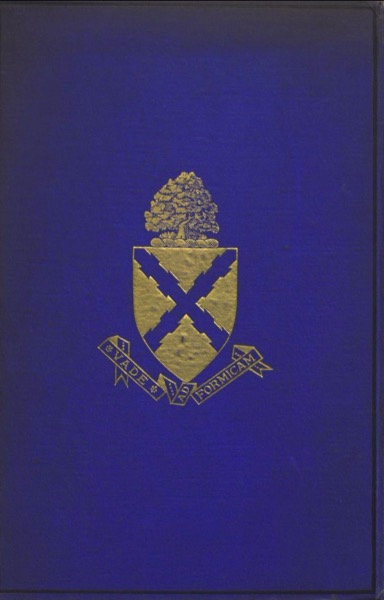
"The Adventures of Mick Callighin, M.P., a Story of Home Rule" - William Robert Anketell / Ancketill (1874)

Shamrock Rose Thistle

William Robert Ancketill (1820–1889) lived in the Ards, at Quintin Castle which he rented from his in-laws. His wife Madelina Selina Ker was the daughter of David Ker MP of Portavo, Donaghadee and Montalto. They married at St George’s Church, Hanover Square, London, in October 1844 (his brother Matthew-John Ancketill had married her sister, Catherine-Ann-Francis Ker, in 1840). By the late 1850s he was a JP, based in Ballynahinch it seems, presiding over local events such as sectarian skirmishes in the town. He was also a member of the Board of Guardians for the workhouse in Downpatrick.
On 11 June 1874 William Robert, and a number of his relatives who were living in England as well as Monaghan, changed their surname spelling from Anketell back to what is said to have been the more ancient spelling, Ancketill.
According to the Belfast News Letter on 31 July 1874 he bought Quintin Castle and estate (the townlands of Newcastle, Dooey, Kearney, Knockinelder and Ballymartyr - totalling 1013 statute acres) at auction for £2650. The estate was reckoned to be worth £1283 per annum in yearly rent to tenants. In 1879 he was reported in the Belfast Weekly News of having given in Portaferry ‘a very able lecture on tenant right’, of which he was said to be ‘one of the best authorities on the Irish land question’. Around this time it seems that he had sub-let the castle including the rights for ‘sea-bathing’ on its shoreline over a few consecutive summers.
The Adventures of Mick Callighin, M.P. is interesting as it uses the shamrock, rose & thistle device to communicate our three cultural traditions. It includes a character from Killinchy called Campbell who speaks excellent Ulster-Scots:
"I'm frae the Noarth, frae Killinchy in the coonty o' Doon, an' I'm wan o' thae lint instructors that's sent doun frae Belfast to lairn the folk in the wast to grow lint; hae ma doots aboot it ... Cawmil thay ca' me in Coonty Doon; we're a' Scoatch in thae pairts … A’m a covenanter, an’ aye adjure wi’ uplifted haun’ … Mr. Campbell is a type of that active, intelligent class of Irish-Scotchmen who have made Ulster what it is ; they are always moving, always "aff" about their business. Were all Ireland inhabited by such a race, it would be second to no other country in the world ...".
It also includes a brilliant reference to Old Comber / Auld Cummer whiskey –
Coomber
On page 85, the 'Honourable Member for Dheree' says that he is 'sib' to Margaret Wilson the Covenanter martyr. And so on.

DIGITAL EDITIONS & REVIEWS:
The Pall Mall Gazette was not impressed. It said ‘a worse novel than “Mick Callighan” it has not been our lot to meet with for many years’.
• The adventures of Mick Callighin, M.P., a Story of Home Rule (1874) is online here.
* His next novel, Dowdenham, a Tale of High Life in the Present Period (1879) is online here and has a has a five page Glossary of Scots words, spoken by a Scottish character in the book. However one reviewer called it ‘a dull and maundering book’, another said it was ‘pleasantly written, but not strong enough’.
Ancketill, despite being ‘landed gentry’, was therefore publishing Ards Peninsula Ulster-Scots six years earlier than May Crommelin (1880) and four years before WG Lyttle’s first newspaper stories appeared in 1878, and 12 years before Lyttle’s first novel, Sons of the Sod, was printed in 1886.
• The reviews below include one presumably by Rev Henry Henderson of Holywood, whose nom-de-plume in the local press at the time was 'Ulster Scot'
Clipping 10618677
………………...
FAMILY BACKGROUNDWilliam Robert Ancketill was seemingly born at the family seat of Anketell Grove in Monaghan, on 31 March 1820. His father was William Anketell, and his mother was Sarah Maxwell of Finnebrogue, near Downpatrick (whose grandfather was Robert Stewart, the First Marquis of Londonderry).
W.R. went to Trinity College in 1838, he later served as Captain with the Monaghan Militia. He became a JP, but died (perhaps in London) on 9 March 1889, aged 69. His funeral took place in Leatherhead, Surrey, on 14 March and was attended by numerous leading Conservatives from London.


It must have been a fairly sudden death as just a week before, on 2nd March, he was named in the West London Observer newspaper as selling tickets for a concert on behalf of Kensington Conservative Working Men's Club:


The year before this, on 3rd March 1888, a Maxwell Ancketill of Willow Cottages, Leatherhead, had died aged 61. This may well have been a brother of William's.


William's son, Amyatt William Ancketill, joined the Royal North Down Rifles around 1874 and served for five years, resigning his commission in 1879. He continued to live at Quintin Castle until his death in August 1915. He was one of a large contingent chosen to represent Portaferry at the Ulster Unionist Convention of June 1892.
In September 1916 W.R's daughter Ada Ancketill is recorded as one of the hundreds of donor to the ‘UVF Patriotic Fund’ from the Portaferry district.
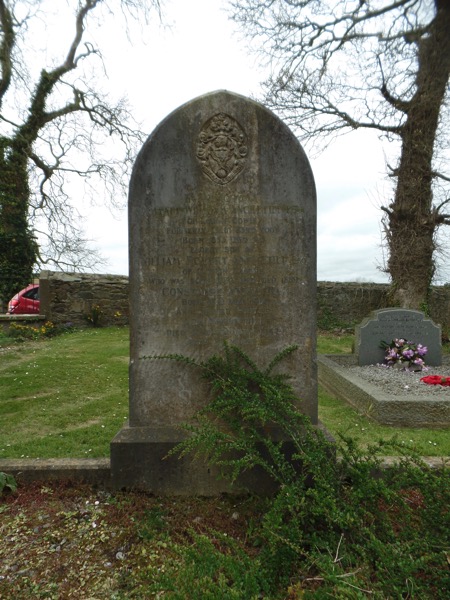
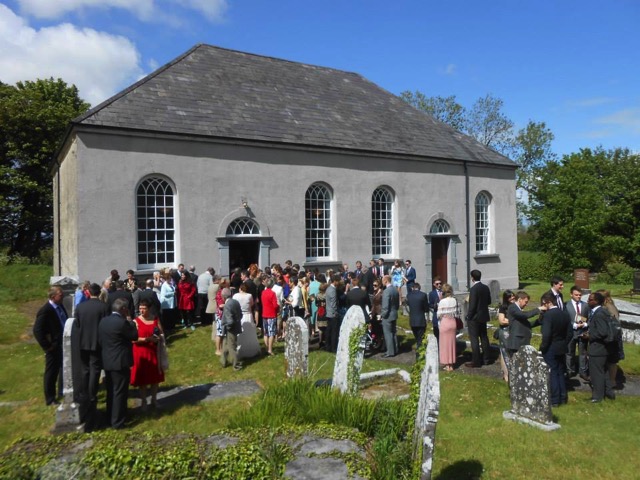
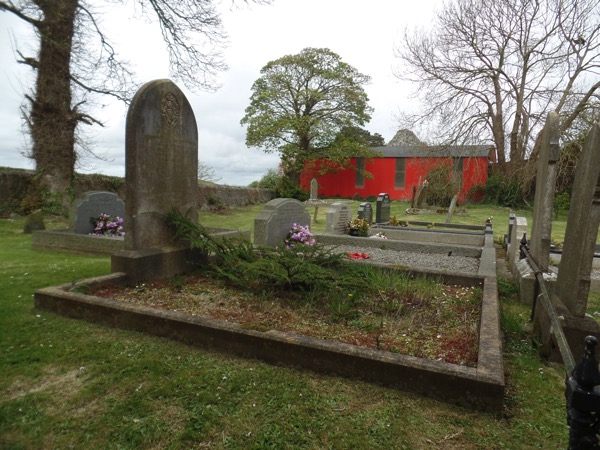
They and their sister Constance (d. 11 June 1914) are all buried in the family plot at Ardquin Parish Church between Portaferry and Kircubbin, pictured below. Constance had signed the Ulster Covenant in Portaferry.
The three siblings had helped in the dramatic rescue of the crew of an Italian ship - the Terazesna – which was wrecked on the coast beside the Castle, in January 1895, saving the lives of 8 men.
SAM 1402
SAM 1405
SAM 1403
Dowdenham front
Dowdenham back

Friday, April 28, 2017

"Don't talk about what you do, talk about what you believe"

Simon Sinek has become one of the world's most famous business and organisation advisers. Here he is, simple yet sparkling, on why what you believe is more important than what you do. Belief motivates you and others around you. Emotional beats rational. Purpose beats work. Culture beats politics.

Sunday, April 23, 2017

The Regulator Movement and the Battle of Alamance

The Regulators - Extended Promo from Chris Laforet on Vimeo.

Saturday, April 22, 2017

A Scotch-Irish leader in pre-Revolution North Carolina: Rev David Caldwell (1725–1824) and the Battle of Alamance (1771)

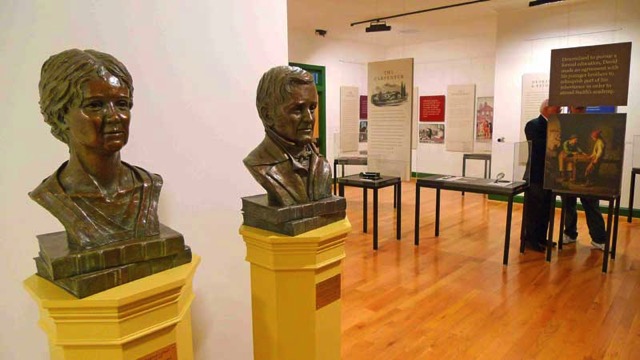
Caldwell rachel david busts

Rich coastal elites with their rigged political systems.
Lower class rural mountain communities, growing disaffected and resentful.
A huge culture gap.
Simmering tensions.

This basic storyline sounds very familiar to us today, sounding a lot like the Hillbilly Elegy 2016 narrative. but this was North Carolina in the 1770s. The state was being run by those on the east coast, with scant regard for the folk in the hill country in the west towards Appalachia. It was a ‘jobs for the boys’ culture – this website says that North Carolina was –

"divided into two generally different societies, an eastern seat of government appointing or controlling local officials, and there being confusing tax laws in place, it is easy to understand the feeling of alienation the backcountry people experienced.”

In the thick of it all was Presbyterian minister Rev David Caldwell (1725–1824). This biography gives us some insight –

“… In December 1775 delegates of the Continental Congress met with Rev. Caldwell. Although seemingly isolated on the frontier, Rev. Caldwell joined an intercolonial movement that aided attainment of America’s independence. Beginning in January, 1776, his sermons from the pulpit inspired wary and disaffected Scotch-Irish to take up arms and fight against British oppression …" 

‘PRINCE OF ORANGE ... LONDONDERRY AND ENNISKILLEN’
And here is part of a sermon preached in this Revolutionary environment by Caldwell, in which he cites the Glorious Revolution as a template for liberty and the justified overthrow of the tyrannical Crown of his day, nearly 100 years later and half a world away –

“… The sin and danger of sloth, in relation to our civil liberty, or of yielding to the unjust demands of arbitrary power, is further evident from the fact that those in high life, or who administer the government, have all the allurements …

When James II abdicated the throne of England and raised an army of papists and confederate French, to establish popery and slavery, the British nation did not betray their religion or their liberty by an inglorious submission, nor did they desert the mighty cause of truth and freedom through sloth or cowardice …

They valiantly repelled the force and fury of his attacks and fearlessly proclaimed the Prince and Princess of Orange the King and Queen of Britain. They our forefathers, or many of them, sacrificed at Londonderry and Enniskillen their lives, that they might have down to us the fair inheritance of liberty and the Protestant religion; and in the whole course of their conduct in the support and defence of their rights they have set us an example which ought not to be disregarded … “

It is interesting to me to see again the Williamite Revolution presented in this way - not unthinkingly loyal to the Crown, but rather consciously pro-liberty and willing to rise up against the Crown. There is still something important to be done with that story for our time.

IMG 6687

INFLUENCE AND DONEGAL ANCESTRY
Caldwell was a massive influence on North Carolina, making a huge impact as a community leader, physician and educator, as well as minister. He and his wife Rachel were both of Ulster parentage - David's father Andrew was from Ballycogan near Lifford, and Rachel's father was Rev Alexander Craighead from Donegal - a minister who required parents of children requesting baptism to swear the Solemn League and Covenant. So it's no surprise to see Londonderry mentioned in the sermon extract above. Their families had arrived in America and settled at Drumore Township in Pennsylvania, land which had been granted for an Ulster-Scots community by William Penn in February 1739.

BATTLE OF ALAMANCE, MAY 1771
Caldwell was involved in the Battle of Alamance on 16 May 1771, when the backcountry ‘Regulators’ (effectively the North Carolina version of the 'Sons of Liberty’, who were seeking to introduce regulations to root out political corruption and élitism) took up arms against a coastal militia. This is sometimes claimed to be the first battle of the Revolution.

Alamance

Alamance full

‘BROAD SCOTCH ACCENT’
One of Caldwell’s students was John Morehead (1796–1866) who later became Governor of North Carolina. He recalled that Caldwell spoke with a “…broad Scotch accent which he often assumed, when he desired to be humorous or to worry a laggard pupil with a bad lesson…"

THEOLOGY
The other surviving sermon that I know of is orthodox theology, entitled The Doctrine of Universal Salvation Unscriptural. It seems that Caldwell’s time at Guildford, North Carolina, also included some of the Second Great Awakening revival, in 1791, by which stage he had been joined by another Ulster-descended minister, James McGready.

In 1842 Caldwell's successor and biographer wrote of the “Scotch-Irish Presbyterians” being “the most efficient supporters of the American cause during the struggle for independence”. A more recent and detailed biography is online here.

DAVID & RACHEL CALDWELL HISTORICAL CENTER
David and Rachel Caldwell are honoured still today with a heritage centre and park in Greensboro.

Images

Caldwell Center Interior Rachel Caldwell plaque PHILOSOPHY AND LIBERTY
Biographer Finis Jay Caldwell has concluded that Rev David Caldwell would have developed his ideas of political liberty from John Locke’s Two Treatises on Government (1689), including that people may justifiably raise armed resistance to the state. This was required reading at the College of New Jersey when Caldwell was educated there as a young man.

And Locke’s concepts of liberty can be traced back to Lex Rex, the famous 1644 work by Samuel Rutherford (see here), and which just last summer the Washington Post connected with the Declaration of Independence (see here). And once you get to Rutherford, the philosophical lineage carries on back through Andrew Melville, John Knox and George Buchanan. Rutherford even quotes from Aristotle.

For today, one of the sharpest minds on these liberties is David Robertson, until relatively recently the Moderator of the Free Church of Scotland, and also until recently a very much pro-Independence voice in Scotland. These two articles, on his ‘Wee Flea’ blog, will give you a flavour:
• A Warning for Scotland (March 2017)
• Scots Calvinists were no Tartan Taliban (December 2015)

Thursday, April 20, 2017

Foghorn Stringband - "I'm Longing For Home"

This superb old-time band have played in Northern Ireland a few times over the years, and are back again in a few weeks time on our side of the Atlantic but not north of the border this time, so I will be heading south to see them. What a glorious sound. Hoke around YouTube for loads of their music. Visit their website here. 17990178 1475868829098826 5060891437793644787 o

Wednesday, April 19, 2017

Gibraltar: Turks, Scots and an 'Orange' Lodge - Belfast 1784 (as reported in the Pennsylvania Packet)

Gibraltar 1779

Gibraltar is in the news again due to 'Brexit' and the fallout from the ‘triggering' of Article 50. Just over 230 years ago, at the tail end of the American War of Independence, France and Spain tried to re-take Gibraltar from British control (who had held it since 1713) in a siege which lasted 3 1/2 years. During the siege, this particular story unfolded.

Surreal as the title of this post might sound, this is a true story. In the mid to late 1700s there were Masonic fraternities who used the name 'Orange'. People who know about these things tell me that they might in some way have honoured the memory of King William III, Prince of Orange – although some online Masonic sources say that lodges used colour as a naming system. There was one at Doagh in County Antrim and a more well known one in Belfast; there may have been others.

Whatever the background, in 1784 Captain Abraham Rahash and his son Ali Rahash made use of the generosity of Belfast's Orange Lodge No 257. Read the story for yourself, from the Pennsylvania Packet newspaper on Saturday 19 June 1784. Here is the full text:

Belfast, April 2. Last Monday captain Abraham Rahash, and his son Ali Rahash, two Turks, taken prisoners by the Spanish in attempting to bring relief to the garrison of Gibraltar, and had afterwards escaped and got to Leith, from whence they came to the town, well recommended by the grand lodge of Scotland, - visited the Orange Lodge No. 257. where they were treated with every respect, civility, and love, by the brethren of that numerous and respectable body ; who gave them a recommendation to other lodges, and a sum of money to enable them to return to Constantinople, the place of their nativity. How greatful to the liberal mind, to perceive the distinction of Turk and Christian, in short, all local and religious prejudices sunk in the more sublime affection which, as the offspring of one common parent, we all owe to one another ; and which every sound principle of religion and virtue never fails to heighten into pure philanthropy, when not obscured by the rankest bigotry and ignorance.

The story was retold in Historical Collections Relative to the Town of Belfast by Henry Joy (1817) - online edition here. The Packet had been founded by Ulsterman John Dunlap in 1771, and in 1784 it became the first daily paper in America. Even an experienced newspaper man like Dunlap, looking for content to fill the demanding pages of his daily newspaper, must have raised an eyebrow at this story from his homeland.

Orange Lodge No 257 is said to date from 6 June 1755. According to this 1782 source, the lodge met at the Donegall Arms once a fortnight. A Past Master of the lodge was Amyas Griffith, a prominent figure in Belfast's social and literary circles, who famously observed shortly after his arrival in Belfast in 1780 that 'the common people speak broad Scotch'. On 28 April 1783, John Brown, the worshipful master of the lodge laid the foundation stone for the Belfast White Linen Hall. The original copper plate bearing the inscription is said to be in the collection of the Ulster Museum. Here is an article about another of the lodge's members, William Todd Jones; and another here, on the consistently excellent Eddie’s Extracts, of lodge member Rev James Bryson. who was minister of 2nd Presbyterian Church, Belfast. The lodge was closely associated with the Belfast Volunteers.

Further research is needed into this unusual story.

Clipping 8286170

Tuesday, April 18, 2017

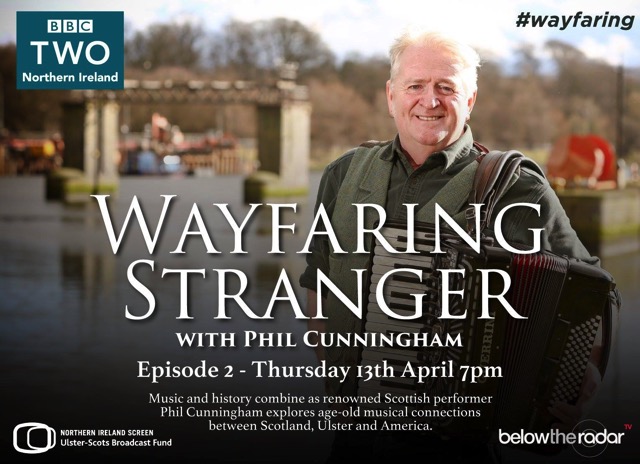
Wayfaring Stranger with Phil Cunningham - BBC (Episode 2)

17880235 10155251771357878 3419343576724069774 o

'Authentic, emotive and true'.

That's part of what I tweeted as the end credits rolled on episode two of 'Wayfaring Stranger' when it aired last Thursday night. It is hard to describe what it is like to wait nearly all your adult life for a programme of such quality and depth and to see it materialise in your own living room. A lifetime of listening, tracing the origins of early recorded music and before, years of reading, a honeymoon and also family holidays in Appalachia which were actually thinly-veiled research missions, years of seeing many of the jigsaw pieces but with no author or producer to have ever found the missing ones and then assemble them into a single picture. Until now. Until 'Wayfaring Stranger'.

Never underestimate the power of nostalgia to evoke memories. When Sheila Kay Adams sat on her porch with a five string banjo, playing 'Where the Soul of Man Never Dies' with Phil Cunningham pulling sweet yet sombre chords from his piano accordion, this was my mission hall life transported thousands of miles from where I and my ancestors were rared to a New World of rural North Carolina - and yet a world to which none of us truly belongs. I'm getting emotional just writing this blog post.

Why? Because music and stories can do that. You can hit me with a thousand facts, or just sing me one song. The song has the power.

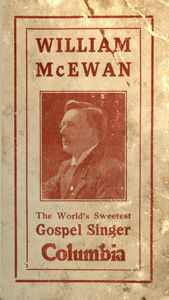
And then came Ricky Skaggs, and Jerry Douglas, and Tim O'Brien, and Frank Newsome, and Fiddling John Carson, and Jimmie Rodgers, and the Carter Family, and William Walker, and - look, if you don't know who these people are then you owe it to yourself and your heritage to find out.

Many of the songs and tunes played were ones that I grew up with, that my late mother sang, that her mother sang, that her father collected on 78s, that I now have, and which appeared in popular hymnals on both sides of the Atlantic from the mid/late 1800s right up to the present day.

It was an honour to see my scratchy old 78 of Fiddlin John Carson being played on the programme, which I had loaned to the producers, Fiona and Sean. Last July I saw Carson's Ulster fiddle in the Country Music Hall of Fame in Nashville (my photo is below). ‘Pluperfect awful’ it might have been to Ralph Peer’s New York ears, but it meant something deep and powerful to Scotch-Irish country folk. I have now seen his musical story – our musical story – at long last properly told.

And the closing sequence, with the distinctive instrumentation of Johnny Cash’s superb, mournful, American Recordings version of Wayfaring Stranger as an outro, brings the whole story right up to the beginning of the 21st Century.

……………………………….

BBC iPlayer logo svg copy

• Watch Episode One of 'Wayfaring Stranger' here on BBC iPlayer
• Watch Episode Two of 'Wayfaring Stranger' here on BBC iPlayer

……………………………….

Tim O'Brien plays some of this song in the programme, this is a live version from YouTube:

IMG 5243


'Our State' magazine & Ulster Scots

Pamlico blue logo


‘Our State’ is the official state magazine of North Carolina. Recent editions have included interesting references to Ulster Scots. 

• The Carolina Scots
• A Tartan of Our Own
• Glory Bound
• Moonshine Gets A Modern Twist

Thursday, April 13, 2017

Frank Newsome - 'Beulah Land'

The very wonderful Frank Newsome, an elder in the Old Baptist Church, appeared on 'Wayfaring Stranger' tonight in episode 2. Here he is, filmed around 2008.

Tuesday, April 11, 2017

"... Ulster Scots ... dissenting traditions ... broadly suspicious of central authority ... unwillingness to accept the political authority of urban elites ..."

Gettysburg Confederate flag


Now doesn’t that sound familiar, and as if it were written just in the past few months? So says this article on the website Journal of the American Revolution from May 2014, entitled ‘Ireland and the American Revolution’, by Matthew P. Dziennik.

Over the past few months regular readers will have seen the vast Ulster-Scots imprint along the road towards the American Republic. On 28 July 1775 the leaders of the emerging new nation wrote an Address to the People of Ireland (online here), which was signed off by John Hancock. It is easy to imagine that the many Ulster-Scots around him were at his elbow as the words were being penned. Similar addresses were written to the people of Great Britain, Canada and Jamaica.

It also raises an interesting question - that for our ancestors, and the global diaspora, liberty was/is more important than nationality. Even in the Thomas Sinclair-penned words of the 1912 Ulster Covenant, ‘civil and religious freedom’ came before ‘citizenship’ and ‘Empire’.

Let’s be honest, some ‘Ulster-American’ stuff is pretty poor. I am ever more convinced there is a vast and credible story still to be fully uncovered, by people much smarter than me.

'The Gude and Godlie Ballates', Scotland, 1542-6

I have posted here before about the Lutheran-inspired Wedderburn Brothers of Dundee and their collection of ‘Gospel-ised’ folk ballads of the 1540s (see here for previous article). They used the familiar tunes of the day and changed the words to contain Reformation and Gospel themes. A stroke of genius.

This 1897 edition by the Scottish Text Society is brilliant – A Compendious Book of Godly and Spiritual Songs – containing bucketloads of wonderful contextual history and examples of similar things happening around the same time across Europe. The chapter entitled The Spiritualising of Secular Songs and Appropriation of their Tunes in particular is worth a read - click here.

Songs carry stories – around the world, and across the ages. Stop singing the songs which have meaning, and you dam the river of tradition. You cut off your own source.

NewImage

Monday, April 10, 2017

Wayfaring Stranger with Phil Cunningham - BBC

The first episode aired last Thursday and is currently available on BBC iPlayer here. It is a superb telling of our musical heritage. Previous attempts in years gone by - such as Bringing It All Back Home (1992) and the Translatlantic Sessions - have not understood - and therefore left out - the Ulster-Scots dimension, and so became merely Scottish and Irish. This puts 'us' centre stage, with groundbreaking research and marvellous new discoveries. You just have to watch it - drink it all in with a Parting Glass at the end of episode one. Just wonderful!

WFS Ep 1 TX card 1

Friday, April 07, 2017

That elusive George Washington quote - and his letter to the "Yankee Club" of Stewartstown, County Tyrone

David reed marker

You know the one. That one. It’s mentioned in this excellent article by Dr Donald Fortson of Reformed Theological Seminary in Charlotte, North Carolina. I have never been able to find a primary source for it, and neither have any real scholars who I have known for many many years.

But, as they say, absence of evidence is not evidence of absence. It might yet turn up. Here is a very similar account, quoted by the then Governor of Ohio, and future President, William McKinley, at Springfield in 1893, addressing the Congress of the Scotch-Irish Society of the USA –

“… While he is distinctive as a type, the Scotch-Irishman is a racial evolution the result of a slow fusion of diverse characteristics. It is said of the Scotch-Irish that they are doers rather than talkers or writers. True, they have been builders; and their foundations were deep and strong and enduring. They have builded for the ages, but they write and talk quite as well as other races. Their deeds in behalf of American independence should ever be cherished in patriotic remembrance; and it is a remarkable fact as observed by those who have taken the trouble to examine the matter that it is only within the past few years that recorded history has given just credit to the sturdy race, to whom Washington looked as his never failing support and as his forlorn hope when all others should have left him, when defeat should have encompassed him. Representatives of the Scotch-Irish race are among the brightest names in American history. They have shone in every great epoch of national life. So long as there is a struggle for human liberty, so long as patriotism has a place in the American heart, that long will the name and fame of your ancestors be preserved and enshrined…"

Washington’s 1932 Bicentennial publication has a small section entitled ‘The Scotch Irish’ (click here) which refers to the David Reed in the signpost marker above.

,,,,,,,,,,,,,,,,,,,,

Washington received a letter from Ulster in 1784:

THE BELFAST MERCURY, TUESDAY, OCTOBER 5, 1784
(or Freeman's Chronicle)

To the PRINTER of the BELFAST MERCURY

Sir,
You will be pleased to convey through the medium of your
extensive paper the following Address of the Yankee Club of
Stewartstown, to George Washington, and his Excellency's
Answer; as I am sure it was the intention of Mr. Campbell
Dick, of Philadelphia, my brother-in-law, the transmitter
(who is a strenuous advocate for Independence) to pay at
least equal respect to your paper, which was purposely set
up to support the expiring Freedom of the Press, in this
part of the Kingdom
I am, Sir, with every testimony of respect,

Your sincere friend and very humble servant,

Saintfield THOMAS BIRCH
Sept. 29, 1784

,,,,,,,,,,,,,,,,,,,,

To which this reply was sent:

To the Yankee Club of Stewartstown, in the County of
Tyrone, and Province of Ulster, Ireland.

Gentlemen,

It is with unfeigned satisfaction I accept your
congratulations on the late happy and glorious revolution.
The generous indignation, against the foes to the rights of
human nature, with which you seem to be animated, and the
exalted sentiments of liberty, which you appear to entertain;
are too constant to the feelings and principles of the.
citizens of the United States of America, not to attract
their veneration and esteem; did not the affectionate and
anxious concern with which you regarded their struggle for
freedom and independence, entitle you to their more
particular acknowledgements.
If in the course of our successful contest, any good
consequence have resulted to the oppressed Kingdom of
Ireland, it will afford a new source of felicitation to all
who respect the interests of humanity.
I am now, Gentlemen, to offer you my best thanks for the
indulgent sentiments you are pleased to express of my
conduct; and for you benevolent wishes respecting my
personal welfare, as well as with regard to a more
interesting object - the prosperity of my country. I have
the honour to be, with due consideration, gentlemen, your.
most obedient servant.

G. [George?] WASHINGTON

Mount Vernon in Virginia, Jan. 20, 1784

Sunday, April 02, 2017

Thomas Young - the Man who Invented Vermont?

Yes, the ‘Sons of Liberty’ man of Longford/Belfast parentage is said in various sources to be the one who proposed the name for the state. He did so in a document written from Philadelphia, first dated 11 April 1776, which Young addressed 'To the Inhabitants of Vermont, a Free and Independent State, bounding the river Connecticut and Lake Champlain’. The name is a translation of “Green Mountains” and a reference to the pre-Revolutionary “Green Mountain Boys” who were led by Young’s friend and fellow Deist, Ethan Allen.

Young was one of a group who worked with Benjamin Franklin on the Pennsylvania Constitution of 1776. Tragically he died on 24 June 1777 of yellow fever which he had contracted while serving as senior surgeon in a hospital in Philadelphia, so he never got to see the full outworkings of American Independence for himself. However, his contribution to Vermont was acknowledged in a document dated 20 October 1786 –

“We beg leave to represent our former worthy friend, Dr Thomas Young, now deceased, who pointed out the system to be pursued in establishing the state and to whom we stand indebted for the very name of Vermont”.

This document was a petition to the Honorable Assembly of the State of Vermont, brought forward and signed by Ethan Allen, Thomas Chittenden and Joseph Fay.

The 11 September 1891 edition of The Burlington Free Press contains a ‘trailer’ of sorts for a forthcoming series entitled 'The Scotch-Irish in Eastern Vermont' by “A.D.B.” which proposed to highlight in particular Caledonia County and the towns of Barnet, Ryegate, Newbury and Peacham.

…….

I get the impression that there is a massive story yet to be unearthed around the life of Dr Thomas Young.

Thursday, March 30, 2017

From Longford to Liberty ... Born in Ulster County: Dr Thomas Young of the 'Sons of Liberty' (1729–1777) & Vice-President George Clinton (1739–1812)

(This is an update on a few previous posts. It turns out there were two different John Youngs who emigrated in this era, one from Donegal and the one below from Belfast via Longford. With thanks to Mr Seawright for the inspiration to dig further.)

417793 552624768114429 939083489 n

Dr Thomas Young was born on 19 February 1731, in Ulster County, New York State. His parents were John Young and Mary Crawford, cousins who had emigrated with another cousin, Charles Clinton (1690 - 1773), from Dublin onboard a ship called The George and Ann. They set sail on 20 May 1729 and arrived in America on 8 October.

According to this recent biography by John P Kaminski, Charles Clinton’s grandfather Sir William Clinton had an estate in Ireland called ‘Glengary’; his son James Clinton was rewarded for his loyalty to William of Orange with an estate in County Longford. This is where James’ son, Charles, grew up.

• From ‘near Belfast' to County Longford
The passengers who boarded The George and Ann were mainly from near Edgeworthstown in Longford, but they were part of a very large extended family community which had relocated there from somewhere ‘near Belfast’ sometime 'around 1700'. The local Presbyterian church building - Corboy (pictured above) - is still there today. According to the church noticeboard the congregation is believed to have been established as early as 1675, with the meeting house having been built pretty much at the same time the community emigrated in 1729. We often forget that Scots settled in parts of Ireland beyond Ulster. This website gives the following description –

This distinctive building is the oldest surviving Presbyterian meeting house in continual use outside of Ulster, and is in use by the oldest Presbyterian congregation in the midlands. It is a highly unusual structure to encounter in the Irish midlands, being of a type that is more commonly found in the north of the island (this meeting house at Corboy is similar in appearance to a meeting house at Dunmurry in Antrim for example). It survives in good condition, retaining its early form and character. 

The congregation’s minister was a Rev. Joseph Bond, who wrote this ‘Christian passport’ for Charles Clinton and his wife Elizabeth, who had married in 1721, to take with them to America:

"Whereas the bearer, Mr. Charles Clinton, and his wife Elizabeth, lived within the bounds of this Protestant dissenting congregation from their infancy, and now design for America; this is to certify, that all along they behaved themselves soberly and inoffensively, and are fit to be received into any Christian congregation where Providence may cast their lot. Also, that said Charles Clinton was a member of our session, and discharged the office of ruling elder very acceptably; this, with advice of session, given at Corbay, in the county of Longford, Ireland.
"JOSEPH BOND, Minister."  

The other surnames in the emigrant group were Armstrong, Denniston and Parks - approximately "some one hundred and sixty of his Presbyterian relations and neighbours from the Longford area” (source here). It is said that Clinton leased his land to the Earl of Granard for 99 years, which raised enough finance for Clinton to fund the emigration.

‘They lived in this vicinity until sometime in the year 1727 or 1728, when the whole connexion growing more and more dissatisfied with the government, resolved to emigrate to the then colony of New York; and as if bound together by the indissoluble ties of consanguinity and friendship, the greatest number of those who had emigrated from the north...'


• From Dublin to Cape Cod to Ulster County
According to Clinton’s account of the voyage, they sailed from Dublin, stopped at Glenarm (where the McClaughry family disembarked), stopped again at Greencastle, and then accompanied another ship, The John of Dublin, for Newcastle in Delaware. Many died on board, some from starvation, one murdered by the captain. Two Clinton children – James (2) and Katherine (4) –  died in a measles epidemic which is said to have killed more than 90 of the passengers.

They first landed at Cape Cod, stayed there for the winter, and then moved to New Windsor in Ulster County (which later, due to county lines changing, was ‘moved’ into Orange County). They bought neighbouring farms and called their community - wait for it - ‘Little Britain’. John Young and Mary Crawford married here, and Thomas came along the year after.

“All through the large district to which the name Little Britain was applied, the great majority of the settlers were Scotch-Irish or English-Irish and nearly all were Presbyterians. Agreeing very generally in their religious views, they were also remarkable for their uniformity of their political convictions…"

Other surnames found in New Windsor most historic buildings still today are Knox, Edmonston, McDowell and Brewster. The records of Bethlehem Presbyterian Church, founded 1729, indicate that Clinton had become an elder there in 1739. In the Indian and French wars of the 1750s, Charles Clinton became a Colonel.
  

• Vice President George Clinton (1735–1812)
Colonel Charles Clinton’s son George became 4th Vice-President of the USA, serving two terms, under Presidents Thomas Jefferson and James Madison. Unsurprisingly for the son of a one-time Kirk Session member, George Clinton studied under a ‘Scottish clergyman’, according to the Senate.gov website. Other sources identify him as Daniel Thain, a graduate of the University of Aberdeen 'who afterwards became a highly respected minister of the gospel’.  A grandson - De Witt Clinton – published a brief narrative genealogy of the family.


• Tea Party Mastermind
Thomas Young was taught to read by his grandmother Jane, and taught maths by his father. But he lost his Presbyterianism early in life and became a noted Deist, a belief common to many of America’s founding fathers. He came up with the idea of the Boston Tea Party (see here). He is also said to have been the man who shouted “Overboard with the Tea!” - the only man present not disguised as a Native American Indian. He is also said to have been the ‘brains’ of the Sons of Liberty movement.

…………..

• Some of these details are from A Genealogical and Biographical Sketch which was written by Thomas Young’s younger brother Joseph Young, in 1807. It was written to General Henry Knox who was mentioned in a post here recently.

• Further details can be found in History of the Town of New Windsor, Orange County, by Edward M Ruttenber (1911) - see here

• The Outline History of Orange County (1846) also contains some excellent information. It was written by Samuel Watkins Eager, the descendant of a Monaghan man whose family were ‘originally Scotch’ but migrated in 1728 - online here

• Article Reason and Revolution: The Radicalism of Dr. Thomas Young on Jstor here

• Article on BostonTeaPartyShip.com tourism website here

…………..

(Artwork below is from the Thomas Young Gallery in Boston).

Tumblr n4f9bc6tAb1s2nw8to1 r1 1280

Wednesday, March 29, 2017

Martin, Martyrs and Marburg – The Cradle of the British Reformation?

Schloss 6 markus farnung 0

With so much attention on Martin Luther and Wittenberg this year, because of what is being marked as the 500th anniversary of the Reformation*, there is arguably a more important German town for our story. Marburg.

Situated between Dortmund and Frankfurt, and 260 miles west of Luther’s Wittenberg, 300 years earlier Marburg had been the location of the murder of a heretic hunter, Konrad von Marburg (1180–1233) a notorious inquisitor of the Albigenses. Marburg was one of the towns in the independent principality of Hesse-Marburg, ruled by the superbly-named Philip the Magnanimous (1504–1567). In 1517 a Franciscan priest named James Limburg briefly emerged as a voice for Reformation in Marburg, but he was ’disappeared’. In the huge changes brought by the Reformation, a new Lutheran university was founded in Marburg 1527. 

In 1527 & 1528, England’s William Tyndale was there. Scotland’s Patrick Hamilton was there. Their mutual friend the printer John Frith was there. And Martin Luther himself was nearby. In October 1529, Marburg would host the discussion meetings between Luther and Ulrich Zwingli which became known as the Marburg Colloquy.

On 8 May 1528, Tyndale published The Parable of Wicked Mammon with the printer ‘Hans Luft of Marburg’ named on the title page. However this, and two other titles from Tyndale, were probably actually printed somewhere else like Antwerp. In Joe Carvalho’s book Patrick Hamilton: The Stephen of Scotland. The First Preacher and Martyr of the Scottish Reformation (2009), he writes this –

“It is curious to note the presence of two English reformers, William Tyndale and John Frith in Marburg in the same year that Patrick Hamilton had gone there. Tyndale and Frith were profoundly engaged in the translation of the Old Testament in the English. Tyndale was also writing some of his famous treaties about the Reformation, in addition to other treaties, with the main intention of benefiting England with the truth of God. The result of this was that Tyndale and Frith could not have had permanent homes because they were always fleeing from one place to another with the aim of finishing the translation. Now they had asked for the help of Philip of Hess to receive and aid them in bringing some peace while they developed their important work. The young Patrick Hamilton, who was then 23 years old, saw the venerated Lambert (then 41 years old) and Tyndale (then 33 years old) as the fathers of the faith. Frith (22 years old), by way of being practically the same age as Patrick became like a beloved brother to the young Scotsman. Patrick saw something promising in the work of Tyndale and Frith, something that would bring great blessing, not only to his beloved Scotland, but also for Tyndale’s England.”

Hamilton’s writings from Marburg - entitled ‘Patrick’s Places’ - would cause him to be burned alive at St Andrews on 29 February 1528. Frith’s printings made him the next of the three to die, by the same method, on 4 July 1533 at Smithfield in London. Tyndale’s translation of the Bible into English caused him to be strangled and then burned at Vilvoorde near Brussels, on 6 October 1536.

Regardless, Gospel ideas spread like wildfire across Europe. As was said at the time, “the reek of Master Patrick Hamilton infected as many as it blew upon".

"Works-religion" (where people strive to in some way make themselves right with God) is the mortal enemy of "Grace Alone" (where the believer realises they can never do that, but trust completely in Christ to do so on our behalf).

• Visit Marburg’s official tourism website here
• Swiss minister JH Merle D’Aubigne (1794–1872) compiled meticulous, respected, histories of the Reformation. His works have tonnes of information about Marburg.

* actually, there had been reform-minded people within the churches of Europe for many centuries before. A big story for another post perhaps.


Below: famous depictions of the martyrdoms of Hamilton, Frith and Tyndale. Patrick Hamilton Parting HRFrithTyndaleburn

Marburg has produced this commemorative booklet for 2017:Die von marpurg umschlag druck

and here is the title page of a Luther edition, printed in Marburg / Marpurg in 1541: Viewimage

Tuesday, March 28, 2017

Scotch-Irish Society's 4th Congress, Atlanta, 1892

State capitol

‘Go big or go home’. Following the organisational problems of the Third Congress at Lexington in Kentucky in 1891 (previous post here), the Scotch-Irish Society of the USA was taking no chances next time round. It headed further south and booked the Georgia State Capitol Building in Atlanta (shown above), from 28 April – 1 May.

As the published Proceedings said, ‘no city in the South better exhibits the spirit of progress and development which pervades this section of the nation than Atlanta’. Small wonder. Less than 30 years earlier, in 1864, General Sherman began his infamous and brutal ‘March Through Georgia’ from Atlanta, his 60,000 men causing unprecedented destruction and leaving the city looking similar to Dresden in February 1945. Sherman later recalled:

“Behind us lay Atlanta smoldering and in ruins, the black smoke rising high in the air and hanging like a pall over the ruined city” 

But by 1892 ‘Reconstruction' was underway. The Georgia State Capitol building in Atlanta had been opened in 1889, architecturally reminiscent of its namesake in Washington DC. Ten railway lines radiated from the city, which it is said had the highest proportion of churchgoers of any city in the United States. The Governor of Georgia had attended the previous Congress at Lexington and there he publicly invited the Society, as did many of Atlanta’s civic organisations, to Georgia for the 1892 event. A chapter of the Society had been founded in Atlanta in 1890, its growth led mainly by its Secretary, Hugh Hunter, who was said to be ‘of pure Scotch-Irish blood himself’. The usual mix of judges, soldiers, ministers and businessmen swelled its membership.

Kimball House Hotel 1892

Official headquarters was the Kimball House Hotel (shown above), the Governor held a swish reception at his mansion. Mayor Hemphill extended the Freedom of the City to the society. Every meeting was held in the Hall of Representatives of the Capitol Building. For the Sunday service, the largest auditorium in Atlanta was booked - DeGive’s Opera House - and was ‘crowded to its utmost capacity’ – Wikipedia entry here.

The United States Artillery Regimental Band opened the event with a selection of ‘Scotch melodies’. One of the speeches was given by Henry Wallace, the grandfather and namesake of the future Vice President. Perhaps the most interesting address given this year was by Major Charles H Smith of Cartersville, Georgia, entitled ‘The Georgia Cracker’. From our vantage point, it is a clumsy attempt to acknowledge – perhaps for the first time in the Society’s events – that the Scotch-Irish people of the USA were not all heroic and gentrified success stories, that there was an lower class of people who belonged as well:

“what a mistake to say that these men were fighting for slavery; when not one in a hundred owned a slave; when in a single county that sent twelve companies to the war there were less than a hundred negroes in it; when nearly the entire voting population were Democrats … that much-maligned and misunderstood individual known as the Georgia cracker. I have lived long in his region, and am close akin to him”.

Newspaper accounts a week before declared that ‘an immense crowd is coming’. 5000 engraved invitations had been issued and 2000 letters sent to newspaper editors across the USA. However, in reading some of the accounts there’s no sign of a vast crowd of similar scale to the first three years, and no statistics on attendance were published as far as I can see. What it might have lacked in attendance from the general public was countered by a long list of hundreds of ‘distinguished guests’ from across the nation. 

Monday, March 27, 2017

Sir Thomas Smith's failed English colony in North Down, 1572–75

Off to Donaghadee Historical Society tonight. 5th and final historical talk of 2017. Taking a break! This story is important as it shows the English theoretical gentrified attempt to colonise Ulster in stark contrast to the Scottish practical farmer class success which Hamilton & Montgomery began in 1606. They succeeded where Smith failed.

ESX SWTH 008

Saturday, March 25, 2017

"Poor white folk who, we were told, were rabid racists ... "

NewImage

This is an outstanding piece of writing. The chapter ‘To Be Whole and Holy’ is not religious, but is a kind of confession of assumed prejudices and then the gradual dissolving of those. The focus of those prejudices was the 'poor white folks', her neighbours in rural Kentucky. The author, Gloria Jean Watkins, published Belonging: A Culture of Place in 1989. She is better known for her maternal grandmother’s name, ‘bell hooks’, with deliberate lower case initials. There is an institute in her name at Berea College, Kentucky -  a place that many posts here seem to gravitate back to.

• Read 'To Be Whole and Holy' - click here

NewImage

Cutting Culture

Big redwood postcard 640

Local political tensions have been very high for quite some time. Just one of the ingredients, yet an absolutely critical one, has been the handling of two specific Irish language issues - firstly the renaming of a fisheries protection boat, and secondly a residential scheme for children. Both of these decisions were bad ones. The reactions and outcry were both justified and predictable. I have at least two sets of friends whose children have enjoyed the Liofa Bursary residential summer scheme - normal people who work in the creative industries and who enjoy this dimension of their heritage.

The reaction was additionally interesting because, in years gone by, Ulster-Scots funding streams have also been chopped, but these have had no equivalent reaction from the affected community, politicians or the media. Phone-in shows did not inflame the public mood. There were no lengthy 'think pieces' in the newspapers from academics and commentators about how outrageous this was. There was no queue of politicians asking hard questions about what on earth was going on. No high-profile protest campaigns from the arts & heritage sector about lost opportunity. And so there was no community outcry. Hardly anybody knows it even happened. The chopping was quiet and effective.

Ulster-Scots has been used for decades now to provide a 'sop' in umpteen political agreements. During the negotiations which led to the historic 'Good Friday Agreement' of 1998, the Prime Minister's right hand man was said to have laughed out loud at the notion of funding for Ulster-Scots, despite him reportedly having done a university thesis on the subject. Big announcements made, fig leaves handed out, but often minimal actual delivery. Swathes of promised funding ... but which then gets 'delayed', 'reallocated', 'handed back', ‘returned to the centre’, 'not spent'… suffocation caused by skilfully managed ‘process’ … there is much that could be said or disclosed but I had better not go any further.

It is sad that culture in Northern Ireland has been allocated a 'polarity' – Irish for one side, Ulster-Scots for the other side. In reality and practice, culture is not that simple – it ebbs and flows and overlaps in many directions across Northern Ireland. This also creates the impression of a kind of equivalence, whereas is reality there is a vast difference in how each is resourced. In February some stats were announced, which suggest a financial ratio of around 20:1. In terms of infrastructure, they are nowhere near equivalent - it’s like comparing junior league and Champions League.

Some of you will know that I was Chair of the Ulster-Scots Agency (June 05 – June 09) and it was far from an easy role. There is lots we didn't manage to achieve. There were legacy issues inherited, and fresh issues which arose, which limited the effectiveness of projects. We did some good stuff. But not enough as could have been done.

In my first meeting in 2005 with the top civil servants of DCAL (the Department of Culture, Arts & Leisure as then was) I pointed out to them that, despite being 7 years old, the Agency had still not appointed a Director of Communications, an unthinkable scenario for a public body whose core legislative function is "promotion of greater awareness”. I proposed that the Agency be gradually restructured to become more like the Health Promotion Agency, the only similar body within the public sector at that time. The civil servants did what I came to understand they did regularly - nod and murmur in agreement, take the minutes of the meeting, email them to you for approval - and do nothing. Here we are 12 years on and that post has never been approved, advertised or filled. During my term, which ended in June 2009, one of the other Director-level roles was vacated and, just the same, has never been filled.

For culture to be of present and future benefit to us all, this all needs to be re-thought. It needs to be approached holistically, treated with a common regard and respect – not 'weaponized' as a political football, not cleaved into two (very unequal) pieces and not selectively reported on by the wearying, controversy-seeking, elements of the media.

Chopping down other people’s things is not the same as nurturing your own.

Stop chopping. Plant some trees.

"Even if I knew that tomorrow the world would go to pieces, I would still plant my apple tree". – Martin Luther

“The arts are essential to any complete national life. The State owes it to itself to sustain and encourage them….Ill fares the race which fails to salute the arts with the reverence and delight which are their due.” – Winston Churchill