Thursday, October 06, 2016

'Liberty and Union': The Taunton Flag, 1774 - the first flag of American devolution and independence

It looks like a son of Ulster emigrant parents was the mastermind of a pre-Revolution movement called the ’True Born Sons of Liberty’, founded in the 1760s. In 1774 they unfurled a huge version of this flag on a 112 foot flagpole in the town of Taunton, Massachusetts, which is still celebrated there every year with re-enactments and a weekend festival. Earlier that year they issued a document from New York under the noms-de-plumes John Calvin and John Knox!  There is a massive Scotch-Irish story in between the bookends of the 1718 arrivals and the Revolution of 1776. A regular reader is going to love the reference to 'meet under the Liberty Tree' in the document below :). More to follow when I’ve done all the reading.

• Meanwhile why not buy a t-shirt?
• Or enjoy the poem by Hezekiah Butterworth (1839–1905)
• Here’s PD Harrison’s account of the story : “no thought of severance from the mother country, their only thought being liberty of action’.
• In an interesting twist that deserves more research, Harrison says that in March 1775 a similar flag was raised in New York 'which bore "No Popery", the words of Janet Geddes, as she hurled her stool at the surpliced ministers in the High Church of St Giles’s, Edinburgh, in 1637'

319600 taunton

Pumpkin Patch

NewImageNewImage

Tuesday, October 04, 2016

"500 Scotch-Irish settlements across the American Colonies" - Charles Augustus Hanna, 1902

Sometimes I think that there is a lot of exaggeration around the story and scale of influence of the Ulster-Scots in America. However maybe many of the claims are justified, and it's our modern-day cynicism, and what CS Lewis called chronological snobbery which makes us question.

"... But the position of the Scotch-Irish in the New World was peculiar.

They alone, of the various races in America were present in sufficient numbers in all of the colonies to make their influence count; and they alone of all the races had one uniform religion; had experienced together the persecutions by State and Church which had deprived them at home of their civil and religious liberties; and were the common heirs to those principles of freedom and democracy which had been developed in Scotland as nowhere else.

At the time of the American Revolution, there were nearly seventy communities of the Scotch and Scotch-Irish in New England, including Maine, New Hampshire, Vermont, Massachusetts, and Connecticut ; from thirty to forty in New York; fifty to sixty in New Jersey; over one hundred and thirty in Pennsylvania and Delaware; more than a hundred in Virginia, Maryland, and Eastern Tennessee; upwards of fifty in North Carolina ; and about seventy in South Carolina and Georgia : in all, above five hundred settlements (exclusive of the English Presbyterian congregations in New York and New Jersey), scattered over practically all the American colonies..."

– Charles Hanna, The Scotch-Irish; or, The Scot in North Britain, north Ireland, and North America, (1902)

"They came to this country from the north of Ireland, and were usually called Scotch-Irish" - Peterborough, New Hampshire, 1839

Main St East Peterborough NH

Again here is an early reference to the term ‘Scotch-Irish”, this time in An Address, Delivered at the Centennial Celebration in Peterborough, New Hampshire by John Hopkins Morison (1808–1896) which was published in Boston in 1839 - and is available here on Archive.org. it was one of Rev. W.F. Marshall’s sources for his famous 1943 booklet Ulster Sails West.

The town of Peterborough in the early 1800s had about 2,000 people, about the same as Ballywalter has today; now it has a population of just over 6000 people, about the same as Donaghadee. It dates from 1739, but grew rapidly in 1759 with the arrival of –

‘forty five or fifty familes from Lunenburg, Londonderry, and some immediately from Ireland. They all, however belonged to the same stock. They came to this country from the north of Ireland, and were usually called Scotch-Irish’.

The book is full of great stirring descriptions so typical of the heroic (and to modern readers, partisan) early Scotch-Irish volumes. The author could himself remember one of the early settlers, a Mrs Sarah M’Nee ‘who died within my memory, aged 97, or as some supposed, one hundred years old’. This is important. The author knew the oldest surviving original settlers. They, and their community and descendants, are who he is referring to when he says they 'were usually called Scotch-Irish’.

Morison was not imagining an ancestry. He knew these folk to talk to. The Centennial was a local event to a local audience. Anyone who gives talks to historical societies knows full well that you make sure you get your facts right, because somebody present will know more than you do and will very soon correct you if you are wrong, or if you are making things up to suit yourself. It is the most pointed form of ‘peer review’, carrying the risk of instant public humiliation within your own home area. The 31 year old Morison would have made sure to get his facts right.

William Smith sounds like an outspoken sort, see page 11, where he uses similar language to the famous Rev James McGregor quote. Smith went on to become a delegate to the Provincial Congress of 1774.

There is a lovely description of the interior of their homes on page 17 - dresser, fireplace, tales of olden days, ‘the pre-eminence of Ireland’, a family Bible from which a chapter would be read and then prayers offered.

On page 28 is a glimpse of their speech - “we maun aye be carefu’ how we handle them. Keep yoursel’ to yoursel’”, and on page 46 “Aweel, aweel dear Joan, an it maun be a log-house, do make it a log heegher nor the lave”.

Remarkably, one of the signers of Peterborough's "virtual" proto-Declaration of Independence of June 1776, Thomas Steele, then aged 86, was present at the Centennial Celebration and read it aloud to the audience. And John H Steele, presumably a relative, gave a few addresses, in one of which he described the early settlers and, on page 92, referred to one of their songs entitled ‘The Battle of the Boyne’.

Their ‘Association Test’ of 1776 - a kind of Solemn League and Covenant for their context - was enthusiastically embraced and signed. Across the whole state of New Hampshire 8,199 men over 21 signed, whilst just 773 refused to and so remained loyal to the King. The names of the Peterborough signatories is pretty much an Ulster phone book.

“It was the sternness of the Scotch covenanter softened by a century’s residence abroad amid persecution and trial, wedded there to the comic humour and pathos of the Irish, and then grown wild in the woods among these our New England mountains”.

• It seems that the author, John Hopkins Morison, was a Unitarian minister.
• His ancestry is available here
• The Historic New England website has photographs of the inside of Morison's home, called Bleakhouse.
• A statue of Morison stands in Peterborough Library - he was one of the founders in 1833. It is said to be the ‘oldest tax supported free public library in the world’.

Saturday, October 01, 2016

Henry McCook: fiddle jigs, lilts and Psalms (Pennsylvania, 1898)

“A like ma fiddle an’ jolly songs on a week day; but on the Sabawth A’ want no jigs an’ lilts in the house o’ God. Gie’ me then the old twelve sacred tunes o Dahvid, as well as the old Psalms! They were good enough for the fathers, an’ they’re good enough for me. The martyrs sang them in their kirks, an’ made the wild heathered moors echo with ‘em when they were driven to the hills in the killin’ times…"

Thursday, September 29, 2016

William Greider: "They call themselves Scotch-Irish, with the emphasis on Scotch" - The Washington Post, 1979

NewImage

I just keep stumbling over reference after reference to the term ‘Scotch-Irish’. A few posts ago I mentioned David McClure’s diary of his time in Pennsylvania. Well here are more McClures, again in Pennsylvania, in an article by William Greider:

... I do not wish to reawaken dead religious prejudice but I am teasing my way toward a serious proposition - the idea that a solution to Northern Ireland's terrible bitter division, Orange against Green, does perhaps lie in America, where we have the space and the democratic experience to work past history's unresolvable arguments…

Sixty years ago or so, when my mother was a girl in Pennsylvania, she used to see the Orange and the Green fighting in the streets of the small river towns on St. Patrick's Day. Her family was McClure, farmers, Protestant, long settled in that region. The Catholics were miners and mill workers, mostly, and relatively new to America. What were they fighting about on the streets of Monongahela, Pa.? The pope I suppose and John Knox's Presbyterian reformation...

I don't claim that American Catholics and Protestants have completely forgiven one another for their heresies, but at least we are no longer brawling in the streets. This is progress, especially when one compares it with our Irish cousins in Londonderry and Belfast. Surely, the Protestant Irish of America have an obligation, as much as the Catholic Irish, for settling this archaic struggle...

Much like Adam Douglass’ book The Irish Emigrant, the writer here is suggesting that America has a role to play in resolving Ireland’s divisions. I agree with that, but not by parachuting in envoys and money and the occasional Presidential stop-over.

Presbyterian minister and author Tim Keller is just one of many commentators who have observed that 'politics is downstream from culture', and that, therefore, culture is where all change truly begins. I have certainly become culturally more settled and self-aware through my appreciation of the role that my forebears played in developing the United States. Growing up in the 1970s, the dominant narrative was how bad, terrible, and always terrible and hopeless Ulster had been. But then I began to read, and found a very different story, of people who could think and write and travel and build and create and achieve.

To put it bluntly, if more Ulster Prods - especially the lower and working classes, the kind of people who might make the cut in an Ulster edition of Hillbilly Elegy - knew more of this then I think they’d be more confident and optimistic as to their own past, present and future. Our ancestors did amazing things. They believed in freedoms and liberties which are being rapidly eroded by various forms of legislation and the self-censorship of the ‘groupthink’ which social media is an enforcer for. Our future generations can be, to coin a phrase, great again (pun intended), with a little pride and some encouragement.

• Here is the full article.
• William Greider has a sound take on the US Presidential election
• He also writes for Rolling Stone

Wednesday, September 28, 2016

Waxing the Gospel: Mass Evangelism and the Phonograph, 1890-1900 - "the most in-depth look at the dawn of the recording industry ever issued."

NewImage

They were Grammy-nominated in 2005 for 'Lost Sounds'; this year Archeophone Records have done another superb and ground-breaking job on this book and CD collection. Over 4 hours of music and a 408 page book, with Ira D Sankey singing 'My Ain Countrie'. Can I wait till Christmas?...

Before the 20th century, the “sacred” songs of Protestant camp meetings and revivals were as catchy, memorable and personal as the pop songs of that or any other time. Bringing you more recordings from the 1890s than any other historical album to date, Waxing the Gospel is a landmark collection of 102 tracks on three CDs in a 408-page beautifully illustrated hardback book. Commercial recordings go back to 1890 and feature pioneer artists Emile Berliner, Thomas Bott, J. W. Myers, Len Spencer, Steve Porter, and J. J. Fisher—as well as stunning instrumental performances by Baldwin’s Cadet Band, Holding’s Parlor Orchestra, and the U. S. Marine Band. Celebrity recordings by star evangelists include Ira D. Sankey, Dwight L. Moody, and Prof. John R. Sweney. And vernacular recordings taken in the field are by historic evangelical figures such as Winfield Weeden singing his original songs, and the “Golden Minstrel” of the Salvation Army, Edward Taylor, who accompanies himself on the guitar. It’s a great listen, a fascinating story, a book for the coffee table, and a resource you’ll want to have nearby.

As their own blog says:

Moody and Sankey “started the fire” . . . they were the Beatles of the 1870s, preaching and singing their saving word to millions in Great Britain and America. They and their compeers gave birth to a type of hymn called “gospel songs,” which were as popular in the late Victorian era among the masses as anything put out today by Rihanna or Beyonce. People embraced the gospel songs as personal anthems, stories of self-realization and awakening. They were so much part of the fabric of American culture that when the early industry started dabbling with a sacred repertoire, these were the pieces the record companies turned to. But as our extensive essay lays out, it didn’t happen immediately. At first the thought was, “Everybody has the hymnals and can sing the gospel hymns themselves, so why would they want records of them?” The story here is of how quickly our ancestors made the infant phonograph a tool of reiteration and remembering.


There's a dark and a troubled side of life...


Monday, September 26, 2016

Adam Douglass (1790–1849), the 1798 Rebellion and frontier Virginia – 'the first Irish-American novel'.

Adam Douglass was born in Belfast on 1 November 1790. His father, William Douglas (1746–1832), was born in Killinchy, and married Margaret Walker there in 1763. William was said to have been a ‘captain in the Irish Rebellion’ of 1798, under the leadership of his Killyleagh neighbour Archibald Rowan Hamilton. Both sets of grandparents were Scottish. 

In the summer of 1798, after the failure of the Rebellion, young Adam, accompanied by his uncle who was also called Adam, fled to America. Young Adam eventually returned to Ireland and signed up with the army, and fought at Waterloo in 1815 "where he was twice wounded and had his horse shot from under him”. He went back to America where he settled at New Market in the Shenandoah Valley of Virginia, among many Ulster families, and became a teacher and surveyor.

He wrote a two volume book - The Irish Emigrant: An Historic Tale Founded on Fact - which was published by John T Sharrocks at the town of Winchester, Virginia, in 1817. Winchester was the ‘gateway to Appalachia’, whose "inhabitants are a spurious race of mortals known by the appellation of Scotch-Irish." It has been called ‘the first Irish-American novel’. 

The story begins in County Antrim, goes to America, and ends up back in Ulster again. In the pics below you’ll see an extract which has the lead character returning to Ulster disguised in “the insignia of an Orange Man”. To have that reference this early is fairly significant. It's useful to point out that at this time, King George III had been the British monarch who had 'lost' America in 1776; his son Ernest Augustus was the top Orangeman in Ireland from 1817 until 1836, so this might well have 'chimed' with an informed Ulster-American audience at the time.

The thrust of the book seems to be to try to communicate to an American readership that the 1798 Rebellion was justified and that the peoples of Ireland could indeed co-operate and get along with one another, and no better place to do that than frontier America. Bear in mind that this is 30 years before the Potato Famine. This book, although ‘poorly constructed’, ‘melodramatic’ and ‘contains numerous awkward phrasings’ is none the less pretty important. 

Adam Douglass must have later moved north west, into Kentucky, for when he died he was buried in the Baptist cemetery of Old Goshen at Laconia, Indiana, just on the other side of the Ohio River. His wife, Nancy Pennebaker, was the sister of Isaac Pennebaker, a senator from Virginia. Nancy was from New Market so she and Adam Douglas may well have me there. She died six years earlier than Adam and was also buried at Old Goshen.

(PS: as an aside, when in Staunton during the summer, which is in the same Shenandoah Valley, I got talking to a shop assistant. She was about my age, caught the accent and we got talking. She said something like ‘it’s still very Scotch-Irish round here even after nearly 300 years. I’m Irish Catholic from New York, been living here for about 10 years, and there’s almost none of us around here even today”. She wasn’t making a loaded sectarian point, just a simple demographic one.)

SAM 0533  1

SAM 0536  1 SAM 0537  1

Friday, September 23, 2016

Carrowdore, May Crommelin (1849–1930) and 'Orange Lily' (1880)

MayCrommelin

Just beside the village of Carrowdore is Carrowdore Castle. It was built by the Huguenot Crommelin family. Our Wilson homestead was a tenant property within the estate at a time; local tradition says that one of the Wilson girls was a maid in the Castle and when a Crommelin child fell gravely ill, the Wilson girl stayed at the Castle for months to nurse the child back to full health. As a thank-you, Mr Crommelin allowed the Wilsons to live in the house rent-free for the rest of their days. Dozens of children were reared in the wee house at Ballyrawer / Ballyraer, including my grandfather William Wilson and all of his siblings. When I was wee I used to visit them, and nip off to play in the ‘plantin’ across the road from the house, when it was still wide open to the public. My brother built a house nearby a few years ago, where he still lives.

Even though the Crommelins lived in the castle as gentry and our lot lived in a wee cottage merely as tenants, both families ended up being buried up at Church Hill alongside each other, and eventually to be joined by Louis MacNeice.

Maria Henrietta de la Cherois-Crommelin (1848–1930), known as May Crommelin, was born at the Castle. She moved to London when she was about 30 and became a writer. One of her first novels was set in Ulster. Entitled Orange Lily (published 1880), it tells the tale of Ballyboley Orange Lodge and a small girl called Lily. There is a smattering of Ulster-Scots vocabulary throughout the dialogue; a New York edition is now available online here.

A number of the chapters are introduced by extracts from Robert Burns poems. There are references to ‘broad words’ and ‘Ballyboley dialect’. It’s easy to criticise how light the Ulster-Scots actually is. But, put yourself in her shoes - how do you convince a London publishing house that local vernacular is going to sell to a broad readership - not far into chapter one she writes that they “spoke as broad as their Scotch ancestors did”.

I think this one is interesting because of its range of cultural references too - country dances, fiddle players, the Orange lodge, the ‘broad words’, farm and community life.

May Crommelin was far from successful as a writer and the critics have not been kind to her. However, as a daughter of the Ards who attempted to give some voice to the local folk in her surrounding area, I think she deserves some credit. 

Comber and Kircubbin, Carrowdore and Kentucky - a tune from the 1840s... or earlier?

MacNeice Comber


The renowned poet Louis MacNeice was buried at Christ Church, Carrowdore - or as the locals call it, Church Hill. Many generations of my Wilson and Kerr ancestors lie there, just a few yards away. Our Wilson homesteads lie in the low ground below the church. Here is MacNeice’s modest plot.

In 2010, Faber & Faber pubished the Selected Letters of Louis MacNeice, edited by Professor Jonathan Allison, an Ulsterman who is now Professor of English at the University of Kentucky. I have never met Professor Allison but he seems to return to Belfast from time to time.

There is an interesting footnote here, in Imagined Differences, which reproduces an Ards Peninsula song called The Bright Orange Heroes of Comber, (sometimes called The Bold Orange Heroes of Comber) which Dr Allison recalled from his Bangor childhood. It is a song which has long intrigued me, as its tune is so unlike other Orange songs which I grew up with. The phraseology of the song title can be found in local newspapers from the 1870s, it describes the period of Daniel O’Connell’s “monster meetings” of the early 1840s. So the words are old. 

I first heard the song in the late 70s or early 80s from one of those old Ulster loyalist LPs which were so common back then during the Troubles, but the lyrics were more strident and sectarian than the original Ards Peninsula version, with the storyline relocated to Portadown rather than Greyabbey. It has been recorded by a range of artists - Jackie O’Brien and the Pikemen around 1968 (see here), and by Liam Andrews for the BBC in 1952 (see here). Cathal O’Boyle has commented on the lyrical structure of the song (see here).

The melody sounds very old. It’s still part of the flute band repertoire today, you’ll see clips on YouTube, but played to a stiffer rhythm which kills a lot of the mood. However, played on a mandolin, which of course is tuned the same as a fiddle, it sounds haunting, in D minor, and positively Appalachian. If the song does indeed date from the 1840s, it is perhaps a glimpse of a tune from a time even earlier than that. Perhaps the type of tune which was exported to New England, Pennsylvania and Appalachia…  and beyond.

• Ards version of The Bright Orange Heroes of Comber is here on YouTube
• Later Portadown version of The Bright Orange Heroes of Comber is here on YouTube 
 

The Bright Orange Heroes of Comber
On the twelfth of July last as Greyabbey town we passed
to Kircubbin where we did assemble
the rebels they did pray for a curse on us that day
and their hearts within them did tremble

As we passed down Shuttle Row, that's a rebel place you know
thinking we were useless lumber,
they swore they'd break our drum if we up to them did come
but we're the bright Orange heroes of Comber.

O'Connell he does boast of his great big rebel host
He says they are ten thousand in number.
But half of them, you'll find they are both lame and blind
but we're the bright Orange heroes of Comber.

So here's a loyal toast may all base traitors roast!
Confound the foes of the Orange Order!
For we'll give blow for blow while swift Boyne waters flow
for we're the bright Orange heroes of Comber


<< I'll try to upload an audio clip of the tune here >>


…………………….

In the late Grady McWhiney and Forrest McDonald's much-debated 1989 book Cracker Culture, they wrote that a tune called ‘The Battle of the Boyne’ travelled to the USA where it became ‘Buffalo Gal’ or ‘Nashville Gal’ (see here).

I’m not knowledgable enough to know if any overtly Orange tunes made their way to America. The timelines don’t really fit. The demographics don’t really fit either. Orangeism only developed in the late 1700s and early 1800s, just as the massive wave of 1700s Ulster-Scots migration to America was slowing down. It was in Canada where, in the later 1800s, a large Orange publishing output emerged, such as this from 1876. But this section from the classic Gone With The Wind shows that there was at least a degree of awareness, with one tune featuring:

"... Gerald had come to America from Ireland when he was twenty-one. He had come hastily, as many a better and worse Irishman before and since, with the clothes he had on his back, two shillings above his passage money and a price on his head that he felt was larger than his misdeed warranted. There was no Orangeman this side of hell worth a hundred pounds to the British government or to the devil himself; but if the government felt so strongly about the death of an English absentee landlord's rent agent, it was time for Gerald O'Hara to be leaving and leaving suddenly. True, he had called the rent agent "a bastard of an Orangeman," but that, according to Gerald's way of looking at it, did not give the man any right to insult him by whistling the opening bars of "The Boyne Water."

The Battle of the Boyne had been fought more than a hundred years before, but, to the O'Haras and their neighbors, it might have been yesterday when their hopes and their dreams, as well as their lands and wealth, went off in the same cloud of dust that enveloped a frightened and fleeing Stuart prince, leaving William of Orange and his hated troops with their orange cockades to cut down the Irish adherents of the Stuarts ..."

Rory Fitzpatrick famously complained in God's Frontiersmen that the lead characters in Gone With The Wind should have been emigrant Ulster-Scots Presbyterians rather than emigrant Irish Catholics, which would have been a more realistic portrayal of life in the American South at that time. Regardless, this world-famous 1936 novel refers to Orangemen. But what if there was an earlier one, say from 1817, published in Winchester, Virginia, which did as well?... that will be the subject of a future post.

P.S.: To bring this post full circle, Louis MacNeice’s father, Rev Frederick MacNeice (1866–1942), was an Orangeman, yet one who rejected the Ulster Covenant of 1912. It’s the complexities and overlaps which make this place so interesting.
Thursday, September 22, 2016

David Childers, a North Carolina man: "My people were from back up in the hills ... Scotch-Irish savages"

This is a really good video, filmed for Our State magazine, the official publication for North Carolina. I subscribe to the digital edition having seen it when on holiday back in July.

The interview here is done by Bob Crawford, the bass player with the wonderful Avett Brothers who are from Concord in North Carolina - a town so-named because it was the agreed location for the 'county seat' between the German Lutherans and the Scotch-Irish Presbyterians. Bob Crawford and David Childers have a side-project band called The Overmountain Men, where they put stories from American history into song (interview here). As Childers says: "“My people were from back up in the hills, where the Overmountain Men came from. Scotch-Irish savages.”

This interesting book from 1940, a historical travelogue, traces the Crawfords from Scotland to Ulster, then across to New England in 1718, and then onward into the rest of America.

Wednesday, September 21, 2016

How good is good enough?

It’s a question that most religious people ask themselves at some point. 500 years ago it was the question that tortured a German monk called Martin Luther. He put it differently: "What good works can proceed out of a heart like mine; how can I, with works like these, stand before a holy Judge?”.

31 October 2017 is the 500th anniversary of the day that, driven by conviction, he took a hammer and went to the Facebook of its day, the local church door in the town of Wittenberg, and nailed up his ’95 Theses’ for all to consider. He didn’t want to start a new church, just to fix the old one. He didn’t know that somebody would copy the 95 Theses, print them, and cause them to ‘go viral’. He had no idea what a ‘Reformation’ was or would become. His motivation, right at the top of the page, was clearly stated. It wasn't political or revolutionary, it was almost a plea – “out of love for the truth and from the desire to make it plain”. 

Luther had found that he could never be good enough. Nobody could ever be good enough. Despite the claims of the Church to be able to forgive sin, the Bible said otherwise. Yet, in the most mind-boggling plot-twist, it turned out that the perfect standard that Luther’s dusty old monastery library Bible scrolls said that God requires, He had in fact already provided. Jesus Christ is not just a good moral example. He is Mediator-Advocate-Substitute.

I’ve had the privilege of working on some materials which have just been published to help tell Luther’s story - I did a wee bit of writing but mostly graphic design. The whole thing was planned, masterminded, researched, written and project-managed by Robert Campbell, a man uniquely placed to make it all happen - and the outcome has been praised by none less than Dr Carl Trueman.

I can be a bit authenticity-obsessive (you might have noticed that if you are a regular reader here) and so I even managed to locate some (supposedly) 16th century nails from Germany on eBay, for the main project image.

You can read the five booklets free at www.luther1517.org. SAM 5736

SAM 5701 SAM 5702 Luther A2 Poster AW

Rev Jonathan Boucher, c. 1770: – "the Scotch-Irish as it used to be called"

 “there is no dialect in America… unless some scanty remains of the croaking, guttural idioms of the Dutch, still observable in New York; the Scotch-Irish as it used to be called, in some of the back settlers of the Middle States …"
– Boucher’s Glossary of Archaic and Provincial Words, 1832.

The Glossary was published posthumously. Boucher (1738–1804) was an Anglican clergyman, a close friend of George Washington, and lived in America from 1768–75.
His Wikipedia entry is here.

Further south, down in the Carolinas, this famous quote from another Anglican clergyman, Charles Woodmason, appeared in 1767:

This is a very fruitful fine spot, through which the dividing line between North and South Carolina runs — The heads of P.D. River, Lynch’s Creek, and many other creeks take their rise in this quarter, so that finer body of land is no where to be seen, but it is occupied by a set of the most lowest vilest crew breathing Scotch Irish Presbyterians from the North of Ireland — They have built a meeting house and have a pastor a Scots man among them — A good sort of man — He once was of the Church of England, and solicited for orders, but was refused — whereon he went to Pennsylvania, and got ordained by the Presbytery there, who allow him a stipend to preach to these people, who (in his breast) he heartily contemns — They will no suffer him to use the Lord’s Prayer. He wants to introduce Watts’ Psalms in place of the barbarous Scotch version — but they will not admit it 

 Further early uses of the term Scotch-Irish can be found here

Tuesday, September 20, 2016

The Diary of Reverend David McClure, Pennsylvania, 1774

David McClure

Rev David McClure (1748–1820) was a Presbyterian missionary to the Native American Indians, but due to the effects of war he ended up in western Pennsylvania. He was also on the staff of Dartmouth College, Hanover, New Hampshire. Some of the family’s ancestry appears in this book. The McClures are said to have fled from Scotland to Ulster “in times of persecution”, so therefore the mid 1600s, where they were caught up in the Siege of Derry of 1688–9. They left Ulster around 1729 and sailed to Boston where they founded a Presbyterian church called Federal Street Church.

"The congregation began as a group of Scots-Irish Calvinists gathered in a converted barn on Long Lane in Boston on November 15, 1729. The inhospitable residents of Boston dubbed them derogatorily as “The Church of the Presbyterian Strangers,” and the name stuck. "Their first house of worship was a barn, which sufficed until they were able, in 1744, to build a neat wooden edifice.’ (Wikipedia)


David was born in Newport, Rhode Island and died at East Windsor, Connecticut. His diary was published and is online here.

The diary is a treasure trove, once again slaying the claim that ‘Scotch-Irish’ was an unknown term to the early Ulster emigrants in America but was ‘retro-fitted’ to their story in the late 1800s.


"The people are mainly Scotch-Irish Presbyterians. On this journey we overtook several families moving from the older settlements in the East to the West. Iremember one in particular, a family of about twelve. The man carried a gun and an axe on his shoulders. The wife had the rimof a spinning wheel in one hand and a loaf of bread in the other. The little boys and girls each carried a bundle according to their age. Two poor horses were loaded with some of the bare necessities of life. On top of the baggage of one was a sort of wicker cage in which a baby lay, rocked to sleep by the motion of the horse. A cow was one of the company, and she was destined to bear her part of the family belongings. A bed cord was wrapped around her horns and a bag of meal was on her back. This family was not only patient, but cheerful; pleased at the prospect of finding a happy home in one of the valleys which stretched from the mountains westward on to Pittsburgh."

"The inhabitants of this country, many miles around, are Scotch Irish. They are presbyterians, & generally well indoctrinated in the principles of the christian religion, civil, hospitable & curteous to strangers. This description of people are removing almost daily into this country. Great numbers, within a few years, have come from Ireland."

“The inhabitants west of the Appalachian mountains are chiefly Scotch Irish presbyterians. They are either natives of the North of Ireland, or the descendents of such & removed here from the middle Colonies. There are some Germans, English & Scotch. The presbyterians are generally well indoctrinated in the principles of the christian religion. The young people are taught by their parents & school masters, the Larger and Shorter Catechisms, & almost every family has the Westminster Confession of Faith, which they carefully study. Mr. Eurie, lives in a small neighbourhood of german quakers, with whom he can have little or no religious society, as the most of them are very ignorant & bigoted."

"Not able this day to preach, (being Sabbath) having been badly poisoned in the face, by some poisonous weeds. The people of this settlement are almost all of scotch irish descent. Immigrants from the North of Ireland, or descendents of such. They are presbyterians, well instructed in the principles of religion, & a number of them very exemplary and pious. The line between religious & irreligious characters is more discrimenating here, as well as over the mountains, than it is in New England, where the forms of religion are established by law, and where the irreligious are not much respected or promoted to Office in society."

“CARLISLE. Passed through this place, in which are two presbyterian churches, & one small episcopal Society. The people principally scotch-irish."


Gaelic-speaking Highland Scots were also among the frontier Pennsylvania community:

"Dined at Dr. Rogers, with a Scotch minister, who has lately arrived, with a company from the Isle of Sky, with the intention of making a settlement up the North River. His name, I think, is McClellan. Heard Mr. Treat preach in the afternoon, & in the evening, Mr. McClellan. He preached in the Erse language, to his companions, who appeared in the Scotch plaid dress, & attended with great decency.


Interestingly McClure also uses the term ‘Scotch and Irish” but to refer to one group of people, not two. Here’s an example where he contrasts them with the German settlers:

"It is strange that there should be so wide a difference in point of hospitality, between the Germans & the Scotch and Irish of this country. The former will put themselves to no trouble to oblige you, & expect a reward for every service, the latter, we found cheerfully shewing us any kindness which we needed, without any other reward, except the satisfaction of obliging a stranger."


"Call the Smithsonian, I've made a discovery"

Monday, September 19, 2016

Greater Appalachia comes to Ulster

(Update: ‘ultra runner’ Karl Meltzer has just set a new record for completing the Appalachian Trail, in under 46 days, fuelled by sweets and beer and bacon. Story here)


Generally speaking, Appalachia is thought of as being much smaller than its actual area - the purple, yellow and red areas on the map below, from the Appalachian Regional Commission. Yet it pushes both further south and west, and also up into the north east.

Greater Appalachia map ARC Map

In the town of Indiana, Pennsylvania, they have an annual Northern Appalachian Folk Festival each year, which was just last weekend. Yet the Appalachian Trail, the famous hiking route (I’ve only done a few of its 2200 miles) carries on even further, right up through New York State into New Hampshire, Vermont and Maine. 

The highest peaks in the Appalachian mountains are in the northern area (Mount Washington in NH ia 6,288 feet; Mount Katahdin in Maine is 5268 feet) and in the south central area (Great Smoky Mountains are over 6000 feet). Mount Mitchell, again in the south central area, is the highest of all, at  6,684 feet.

25 million people live here, about 40% of which are classified as rural dwellers.

Over the past few years the Appalachian Trail has been extended, up into eastern coastal Canada, into Ulster and Scotland, passing through Greenland and Iceland on the way, and from Scotland into Scandinavia. The International Appalachian Trail website is here. What they’ve done is to include the existing Ulster Way, and a walking route through Donegal. 

Surely this now needs to be properly branded and signposted and advertised. North Carolinian Joe Norman walked the Ulster section in 2013.

NB: The AGM of the International Appalachian Trail will be held at the Ulster-American Folk Park on 22nd September (Thursday of this week) - see here.

Appalachian Trail map Static1 squarespace
International Appalachian Trail - Ulster section mapIAT map

Sunday, September 18, 2016

"A Call from the Trenches to the Shirkers" – Ballywalter, 20-11-1915

This poem appeared in the Newtownards Chronicle. With thanks to Mark Anderson for permission to post it here. It featured in the book The Great War and Its Legacy; A History of Loughries True Blues LOL 1948 which I had the privilege of designing with Mark, an which was launched at the Somme Heritage Centre in the spring of this year. Loughries is a rural area on the peninsula side of Newtownards. 10 men from the lodge served in the Great War, the two men on the cove, Samuel Hutchinson and William Lowry, both survived. Some copies might still be available

A Call from the Trenches to the Shirkers  Poem  Anonymous Ballywalter  NC 20 11 1915

Loughries Cover HR

Friday, September 16, 2016

Music matters?

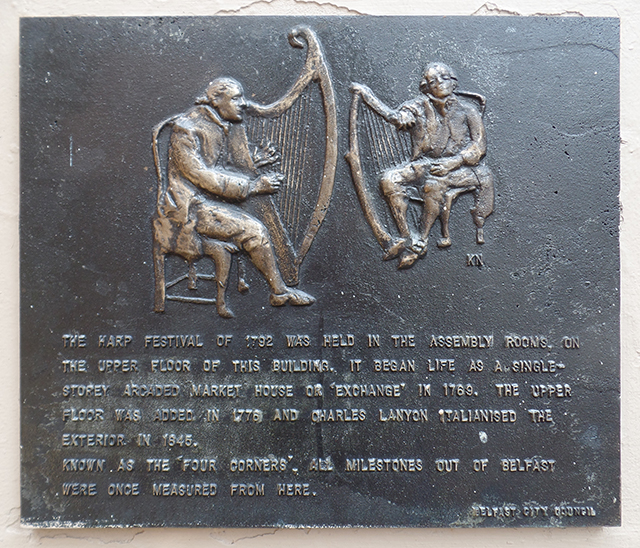
The 1792 Belfast Harp Festival is rightly held in high regard by musicians and scholars alike and is acknowledged as a moment of enormous significance in the recognition and preservation of Irish traditional music. 

Conversely, the Ulster-Scots song tradition, which first started to appear in print in 1793 (and potentially in newspapers earlier than this) is pretty much ignored. Scores of poetry books printed from that date onwards include easily 100 or maybe even up to 200 songs. Many give the names of the tunes they were to be sung to. Why is this not seen as important? Maybe only some music matters. Maybe some people discard their heritage too casually.

(The example below, about the 1798 Rebellion, was printed in 1811 – just 13 years after the Battle of Ballynahinch. It was written Francis Boyle of Granshaw, who lived just 13 miles from the battlefield and well within the community that it affected. He was about 60 years old in 1798.) 

SAM 0520

Commemorative plaque for the Harp Festival in Donegall Street, Belfast. SAM 0187

The Mecklenburg Declaration and the Mecklenburg Resolves

The original documents were lost in a fire in 1800, which has led some scholars to question the authenticity of the Mecklenburg Declaration of 20 May 1775. However in 1838 a similar document called the Mecklenburg Resolves was found, dated 31 May 1775. Other scholars have had no such qualms. Others mounted a campaign in support of the Resolves and proposed a state-wide celebration on 31 May each year. The Mecklenburg Declaration also featured in the Proceedings of the Scotch-Irish Society of the USA in 1895.

As historic as this is (or might be) the wording is not as emotive as that found in the earlier Fincastle Resolutions - a document about which there is no debate, and a document authored by an Ulsterman. Indeed, when you read it, it could ONLY have been written by an Ulsterman :).


01583u LRWheel255

Thursday, September 15, 2016

The Mecklenburg Declaration and Francis Cummings - 'the finest specimen of manly person in the crowd of fine-looking Scotch-Irishmen there'

A few weeks ago I posted here about the Fincastle Resolutions of 20 January 1775, said to be “… the earliest statement of armed resistance to the British Crown in the American Colonies …" which were writted by County Donegal-born Presbyterian Minister Rev Charles Cummings.

A few months after Fincastle, a similar but more famous Declaration was published at Mecklenburg in North Carolina, on 20 May 1775, and again among an overwhelmingly Ulster-Scots community. Present that day was a Rev Francis Cummings, who would later be a tutor to future President and son of Carrickfergus, Andrew Jackson, who, when the Mecklenburg Declaration was read aloud in Charlotte, North Carolina, was just a boy of 8 living 20 miles away at Waxhaw.

Here are two clippings from Sketches of Some of the Settlers of Upper Georgia, by George R Gilmer (1923).

Mecklenburg 2

Rev Francis Demaris Cummings sounds like the classic dashing hero. He was '...born near Shippenburg, Pennsylvania, in the spring of 1752. In his 19th year his parents moved to Mecklenburg County, and young Cummings exchanged his former life for the classic halls of the Queen's Museum in Charlotte, where he was an eye-witness of the Mecklenburg Convention of May, 1775, concerning which he furnished a certificate, and also gave some account in a published sermon. He graduated at Queen's Museum about 1776, and spent several years teaching. Among his pupils in Bethel, York County, South Carolina, was Andrew Jackson, afterwards President...'

His parents are thought to have been Charles and Rebecca (McNickle) Cummings.

Mecklenburg 1

A dramatic account of Cummings' preaching, dated 1802, can be found in Foote's Sketches of North Carolina, on p404. The ministers who preached at Spartanburg that day were called Kennedy, Williamson, Gilleland, Wilson, Simpson, M'Elhinney and of course Cummings. (link here)

Cummings died in Greensborough, Georgia, in 1831.