Personal blog of Mark Thompson. Formerly Managing Director of GCAS Design in Belfast, Northern Ireland (from 1999 - 2006) and Chairman of the Ulster-Scots Agency (from June 2005 - June 2009). Thoughts on Ulster-Scots heritage, identity, evangelical Protestant faith, music and other stuff I stumble upon.
Tent meetings have been a feature of Ulster evangelical life for centuries. Methodist missionary Matthew Lanktree's diary of 1818 records that at the bottom of our lane here at Ballyfrench, men would rig up a tent out of ships' sails and hold large Sunday services and communion meetings there.
Later in the 1800s in the Cullybackey area there were large tent meetings called the Fenaghy Camp Meetings, the first of which were held in mid August 1887. Thousands gathered at these meetings for many years - a reported 12,000 in 1889. Special trains from Belfast were laid on to bring people to the 10-tent site, five of which were for refreshments throughout the days of meetings.
The organisers started well, by aiming to bring the most well-known preachers to rural Antrim. D. L. Moody was due to attend in 1892 but was prevented from doing so due to his son falling seriously ill.
In 1887 it was hoped that Charles Haddon Spurgeon would be the main speaker, but the organisers seem to not have done much forward planning and only wrote to him in July. On the 16th July Spurgeon, a man who seldom minced his words, wrote this amusingly frank reply:
Dear Sir,
I wish I could come to you. But the request almost amuses me. Do you really think that I am waiting about for work, or hanging on a nail to be taken down at a few days notice? Why my dear Sir, I never have a leisure day. When the year begins, it is usual to have every day allotted down to its close, and all arranged to be used if the Lord will.
Engagements for the week you seek have been made so long ago that I cannot tell you when, and the year 1888 is already in great part allotted unless I go to heaven.
It is always impossible for me to leave hom at short notice; and indeed the work of the Lord at home will not often allow for my absence at all.
Yours very heartily,
C. H. Spurgeon
In the end, a Scotsman of County Antrim parentage, Rev John McNeill - known in his day as 'the Scotch Spurgeon', preached that first year instead of Spurgeon, and again in 1892 as a stand-in for Moody.
In 1858 Spurgeon had drawn large crowds to Botanic Gardens in Belfast, with trains bringing people from as far as Dungannon and Monaghan to hear him preach.
(from 100 Years at Portstewart: The Story of a Keswick Convention by Rev Joseph Fell, 2014)
In 1871, Presbyterian Sebastian C Adams produced an astonishing work of art. Entitled A Chronological Chart of Ancient and Modern Biblical History, it was a 20 foot long panorama of world history, exquisitely drawn by Adams himself, and reproduced for sale using the cutting-edge chromolithography printing technology of the time. Further editions would be published during Adams' life, and have been reprinted even recently. The chart starts with the Biblical Adam of Genesis (dated at 4004BC) and ends at 1878, with predictions as to what would happen up to 1900.
Adams was born into a Presbyterian family in Sandusky, Ohio, in 1825, the son of Captain Sebastian Adams (1789–1847) and his wife Eunice. They were from Vermont, and Captain Adams was a ship owner who "sailed on the lakes, meeting with many adventures and engaged in the War of 1812. He was a man of great nerve and courage". Captain Adams' father was Aaron Adams, who served in the 1776 Revolutionary War with the "Green Mountain Boys", a regiment based in Vermont.
Sebastian junior was the youngest son in the family and travelled across the United States in his early years, almost dying at one stage. Reaching Salem, Oregon, on the west coast in 1850, he met up with his brother William who had already been there for two years, and another brother Oliver. Here Sebastian Adams also met his future wife, Martha McBride, the daughter of Tennessee-born Dr James McBride, who had been a missionary in Hawaii. The McBrides said they were cousins of President Andrew Jackson (see here) so therefore were of Ulster extraction.
The chart is one of the most amazing visual artefacts I've ever seen. I am pretty sure a copy of it was once on display at the library of the Ulster-American Folk Park and may still be there.
This article from the Belfast News Letter in 1893 corroborates an old advert I saw many years ago, but which sadly I didn't acquire at the time. The County Down town of Comber, very much an Ulster-Scots town, was renowned for producing "Old Comber" Whiskey. Production began in 1825 and it was colloquially known as "Auld Cummer". This article describes a swish social occasion at the long-demolished Mount Alexander, a grand home built by the Montgomeries in the 1620s.
Found this on a recent hoke, on a bric-a-brac stall at the Annual County Down Traction Engine Club Rally at Rosemount, Greyabbey, for the princely sum of £4. Made by J.A. Campbell & Son, 64 Royal Avenue, Belfast. Not totally sure of date but from graphical style I would guess early 1950s?
After a long long wait we now have our restored gates and rustic pillars installed and a layer of stone over the yard. The gates are about 100 years old and have been repaired, primed and painted in Massey Ferguson red. It has taken us a long while to find the right materials, and men with traditional skills who understood what we were trying to achieve, to make this all happen – and to keep within present-day planning and building control regulations. Field entrances are now wider than the old original gates to let heavy machinery in and out – but they are still an ideal width for a regular family car.
It is possible to do a newbuild in a way that honours tradition. There is an Ulster vernacular and I hope other people will also adopt it, in ways which are relevant for modern life, and not limit it to open-air museums – these are places which I greatly enjoy visiting but which can be in their own way a little bit commodified. Ulster vernacular should live and grow in our landscapes.
With many thanks to my friend the architect Doug Elliott who steered us through the early years and brought to bear his own life-long awareness of an Ulster aesthetic. Click the images to enlarge.
(PS - the norm was 5 bars, but as you'll see from the photographs, additional bars would often be added to stop lambs escaping)
And all heavily influenced by places like this - the Scotch-Irish Farm and Ulster Forge at the Museum of American Frontier Culture, Virginia, which we visited on honeymoon in 1997. (Interestingly it seems to now be just named the 'Irish Farm').
Joseph G McKee Fisk University in Nashville Tennessee was established in 1865 as a result of the earlier influences and pioneering educational work of County Down man Joseph G McKee of Loughaghery (south of Anahilt), among the 'freedmen' - former Black slaves. He emigrated as a teenager and studied at Westminster College in Philadelphia, became an itinerant Presbyterian preacher in Nebraska & Kansas before coming to Nashville in 1863. In Nashville he set up various schools for Black people, which eventually developed into Fisk University. Some years later, Fisk fell upon hard times and needed innovative methods of fundraising to keep its doors open. The Fisk Jubilee Singers were 'born'.
The Fisk Jubilee Singers come to Ulster A group of 11 black students formed the Jubilee choir which toured the US and Europe, including Charles Spurgeon's Metropolitan Tabernacle in London, and later to Belfast (at the Ulster Hall) and Londonderry (at First Derry Presbyterian Church) as a short hop after their Scottish dates. And of course they visited Portrush and the Giants Causeway, to collect specimens for the University collection.
The coverage of the time, and the warmth and enthusiasm with which they were received, was exemplary.
"… the Jubilee Singers were esteemed by the citizens of Derry as another company of young people turning back a tide of ignorace, cruelty and prejudice…" – from The Singing Campaign for Ten Thousand Pounds ; or the Jubilee Singers in Great Britain by Rev Gustavus D Pike (1875)
McKee's return to Ulster, and death aged 36 McKee, in poor health, returned to Anahilt to spend the summer and autumn of 1865 with his parents. As you'll see below in the letter written by his uncle, Joseph G McKee died on 25 September 1868 "burned out" by his efforts, at the home of his father in law, Rev. James Arbuthnot, of Harshville, Adams County, Ohio, five years before his young Jubilee Singer protegés visited Ulster. It is a shame we know so little of him here today.
• The Singing Campaign for Ten Thousand Poundscan be read online here. • A PhD dissertation on the subject, and McKee, by Crystal A. deGregory is online here. • The portrait of McKee above is from Free at Last by Jane Collins (1896), online here.
Postscript - Joseph McKee was interested in his own ancestry, and in his visit home he inspired his relatives at Annahilt to compile a family tree. This was eventually published, in great detail, as A History of the Descendants of David McKee of Anahilt, by Prof James Y McKee in Philadelphia in 1892. It can be read online here, including a dramatic account of how Joseph was almost lost at sea in an Eagle Wing-esque storm.
This well-known engraving shows a single large dwelling on the shore of Belfast Lough. It has been suggested to me that this is the house built by Alexander George Stewart (1737–96) which he named Macedon, close to Whitehouse. He was descended from the Stewarts of Ballydrain, between Belfast and Lisburn, and whose family estate is today the prestigious Malone Golf Club. The Stewarts of Ballydrain have a brilliant story, from when they arrived in Ulster from Scotland in 1608. Alexander had a brother, Thomas, who lived at Whitehouse. If you're familiar with the urban and suburban sprawl of North Belfast and Newtownabbey you'll be amazed by how rural this scene is - it wouldn't be out of place in the Highlands of Scotland.
Here is a map showing Macedon - and nearby Hazelbank (built by the Ulster-Scots McTear family, also in the late 1700s). Both houses are now gone, the area is now Hazelbank Park.
"... The antislavery movement which led to our Civil War began among the Scottish and Ulster-Scottish immigrants; though not in New England. This is a prevalent delusion, which the brilliant writers of that region have not always discouraged. But the real anti-slavery movement began among the Scottish Covenanters (largely in South Carolina and East Tennessee) twenty to thirty years before there was any organized opposition to slavery else where, even in Massachusetts. At the beginning of the century the Rev. Dr. Alexander McLeod hesitated at accepting a call to the Covenanter congregation in Chambers Street, New York, because a small Newburgh congregation was associated in the call, some of whose members held slaves. There upon the Presbytery enacted that "henceforth no slaveholder should be retained in their communion". That was in November, 1800. By 1815 the Covenanters, the Methodists, and the Quakers of East Tennessee had eighteen emancipation societies. A few years later there were five or six in Kentucky. By 1826 there were one hundred and forty-three emancipation societies in the United States, of which one hundred and three were in the South, and as yet, so far as known, not one in Massachusetts. As late as 1833, the gentlest and sweetest of American antislavery poets, John G. Whittier, the Quaker, was mobbed in Massachusetts for attempting to make an abolition speech. John Rankin, the noted Covenanter antislavery leader, said that it was safer in 1820 to make abolition speeches in Kentucky or Tennessee than in the North; and William Lloyd Garrison wrote in 1833 that he was surrounded in Massachusetts by contempt more bitter, prejudice more stubborn, and apathy more frozen than among slaveholders themselves ..."
- from The Scot in America and the Ulster Scot, Whitelaw Reid, US Ambassador to Britain, (1912)
Rev John Rankin's Letters on Slavery (1826). The Knoxville Daily Journal described him as 'the Martin Luther of the slavery movement', and that 'His ancestors were Scotch, and came from Ireland to America
in 1720, and were soldiers in the War of the Revolution.'
As shown on the 1905 edition of this well-known volume which (significantly for the choice of cover image) was printed in Richmond, Virginia, the capital of the Confederacy from 1861–1865. Original Presbyterian Covenanter flags from the 1600s can be seen in many churches and museums in Scotland today, widely varying in design and iconography. Many have saltires, others have thistles and Bibles, one I have seen has Hebrew script. Usually they are tucked away in ante rooms, behind light-proof curtains and protective glass to help preserve them. Recent replicas often hang inside the main church buildings as a visible reminder of their Covenanting history.
'…Headin' down South to the land of the pines Thumbin' my way into North Caroline…' - from Wagon Wheel by Old Crow Medicine Show (and covered by countless others including Darius Rucker, above)
In recent weeks (due to the global reach of the media and the internet) the furore over the Confederate battle flag has reached Northern Ireland, where in at least one incident some moron(s) decided to fly it outside the home of a black family in East Belfast in an act of racist intimidation.
I've been to the Southern States on three occasions (first in 1997 on a 3 week honeymoon road trip) travelling through Virginia, Tennessee, Kentucky (a divided state during the Civil War), Georgia and the Carolinas. I bought various souvenir items, including various Confederate flags and imagery from roadside gift shops. I have a cousin in Alabama. Regular readers of this blog live all over the USA including the Southern States. I am no expert on the region, but I have talked with people in those states who treasure their regional heritage, their state's identity, their Confederate history, who feel very detached from Washington DC – and who are not in any way racist.
Prominent people across the US immediately began to call for the removal of the flag from public buildings, from private property, and even from the graves of Confederate war veterans. In one extreme case, the bones of a Confederate General Nathan Forrest were proposed to be exhumed from his grave in Memphis – an act reminiscent of the 'Killing Times' of 17th Century Scotland.
Here in Northern Ireland we understand the power of symbols and flags, but we (should) also know that the actions of an individual, a tiny minority, or even a terrorist/paramilitary organisation does not represent an entire community, region, country or nation. The mis-use or appropriation of the United Kingdom flag, the Northern Ireland flag or the Irish tricolour flag is a frequent occurrence here.
As in Northern Ireland, it is easy to create the appearance of 'action' by targetting symbols and imagery rather than dealing with the actual issues. A high profile political, media and PR campaign is easier to orchestrate than the hard work of actual change. A good explanation of the complexities of the whole story are well outlined here in an article entitled 'Scapegoating Symbols will not resolve Racial America'.
..............................
The Confederate and Charleston connection reminded me of an Ulsterman who claimed to have been present when the first shots of the American Civil War were fired, and who was present when the end of the War was agreed between the opposing Generals Lee and Sherman.
Colonel John Spencer Fairly (1832–1898) was born in Eglinton, County Londonderry. His father was Robert Fairly, the three-times Mayor of Derry in 1769, 1770 and 1782. Robert was son of David Fairly, Donnybrewer Lodge, whose father had been Rev David Fairly, the Presbyterian minister of Convoy and Raphoe for a reputed 65 years from 1711 – 1776). Colonel Fairly's mother was Sarah Huey (daughter of William Huey of Flowerfield House, near Muff just north of Londonderry).
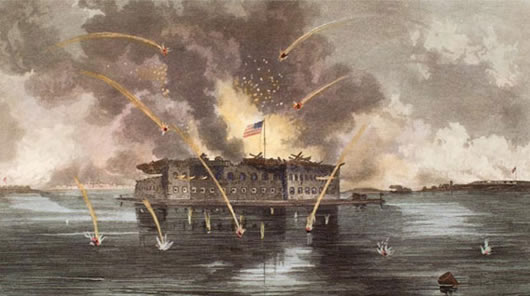
Colonel Fairly said that he had been the commander of gun no. 3 in the remarkable floating "Iron Battery" on the attack on Fort Sumter on 13 April 1861, the first engagement of the Civil War (pictured above). However other sources say he enlisted six weeks later in June 1861 to a Captain Screven's company of horse. Promoted to lieutenant in November 1862, Fairly became aid-de-camp to General WHC Whiting, often acting as his scout. When Whiting was killed at Fort Fisher in March 1865, Fairly was reassigned to the staff of General Wade Hampton until the end of the war, eventually becoming lieutenant colonel. Fairly was present when General Hampton and General Robert E Lee met with General Sherman of the Union Army at Durham, North Carolina, when the three Generals signed the 'Memorandum of Agreement' on 18 April 1865 which effectively ended the war. (See here for a description of an inscribed revolver which was given to Fairly by General J. E. Johnston, on behalf of Hampton, that same day).
Fairly is known to have settled in Charleston after the war. He died at Wilmington, North Carolina, in August 1898, his obituary describing him as a 'gallant Confederate soldier" and "a prominent figure in the commercial life of Charleston, South Carolina", initially in wholesale, then railroads and also the production of cotton seed oil.
Fairly joined the Scotch-Irish Society of the USA in 1892, aged 60, 27 years after the end of the War. The claim of his involvement in the Iron Battery appears in his self-penned biographical notes. If true (and there's little reason to think he made up his story, which would have brought easy scrutiny and widespread ridicule) this places him at both the event which started the War and the event which ended the War. Founded in 1889, the Society's published Proceedings show a determined effort to acknowledge the wartime courage of the people of both North and South.
His brother, Lt. Col. William H Fairly, was a Confederate army courier and was killed at the Battle of Trevilian Station in Virginia. It was the largest all-cavalry battle of the war, taking place in June 1864.
"People groups" are too simple. Not everyone who is a proud Southerner is a racist. It is far too simplistic, and possibly a grotesque smear, to suggest that everyone in any "people group" thinks and behaves the same way. Every nation's flag can be interpreted as either honourable or dishonourable. Men from every tradition in Ireland fought on both sides of the "War Between the States".
When in Kentucky in 1997 we stayed at Boone Tavern in the college town of Berea. The College was the first racially integrated educational establishment in the South, founded in 1855 by an Irishman and his Scotch-Irish wife. To this day, the motto of the College comes from the New Testament –
"And hath made of one blood all nations of men for to dwell on all the face of the earth" – Acts 17:26.
..............................
PS – If any readers know more about Fairly I would be delighted to hear from you. As this 1889 pamphlet shows, he was anti-slavery, but given his other theories therein I doubt very much that he was a paragon of virtue, or that his late 1800s attitudes will be consistent with ours in the present day. Nevertheless he seems like an interesting, but forgotten, figure.
His retail premises in Charleston are shown below.
American Reformed Baptist pastor Voddie Baucham is back in NI during August. Details on his website are sketchy just now – Belfast, Strandtown, Bangor, Enniskillen and also Letterkenny in Donegal. His background and personal story are available here, which includes postgrad study at Oxford. He has been in NI on a number of occasions before. He las lots of videos available online and, in an age when race is a dividing issue, preaches the Gospel for all people and to all people with power and vigour. The Gospel Coalitionpublish some of his articles here, and SermonAudio hosts a lot of his regular preaching here. He is due to relocate from the USA to Africa later this year
My mother became a Christian / was saved / came to faith (whatever the term is these days) in 1963, aged 17, during a mission being held in Donaghadee Orange & Protestant Hall, through the preaching of well-known evangelist Hedley Murphy. Built in 1912, sadly the hall was burned in 2006, in an arson attack. A friend recently showed me this YouTube footage of Hedley's 'Ulster-Scottish' campaign of 1969.
The 200th anniversary of the Battle of Waterloo is today (see website here).
A Samuel Gillespie of Inishargy near Kircubbin fought in it. He had been born on 4th March 1796 so was just 2 years old when the 1798 Rebellion took place - and therefore just 17 when he fought at Waterloo. He survived Waterloo and came home, eventually dying on 17 July 1875. He was buried at Kircubbin Presbyterian Church. I have tried a few times to locate his gravestone, but it seems to not be there any more. The inscription once read:
Erected by Sergt S Gillespie in memory of his beloved wife Margaret Gillespie, born 6th Decr 1798, died 12th Decr 1861 Here also lie the remains of the above named Sergt S Gillespie, born 4th March 1796, died 12th July 187[ ].
The Griffiths Valuation for Inishargy lists Samuel Gillespie and also Thomas Gillespie - Samuel had just over an acre of land. James Heaney of Kircubbin leased Samuel's land and house in 1863.
Here is an amazing story of Peter McMullen, a weaver from Downpatrick, who also fought at Waterloo. His pregnant wife Elizabeth was also on the battlefield - she was shot in the leg - and her husband eventually lost both of his arms
In a bizarre story which broke the other day, Rachel Dolezal, the President of a branch of the NAACP (National Association for the Advancement of Colored People - website here) is actually white. That's not really a big deal, as the organisation was founded by white people. The issue is that she has been pretending to be black, and has got away with it for years. Her family has just recently exposed her chirade.
The scandal reminded me of John Elmer Milholland (1860 – 1925). He was the NAACP's first Treasurer. His father, John Milholland (1819 – 1895) was an Ulsterman (believed to have been born at Tamlaghtduff / Tamladuff near Bellaghy) who arrived in America in the 1840s to become a farmer at Lewis in New York State. The 1831 Census has many Mulhollands in the area. John Sr's father was a Protestant and his mother Catholic, with more of the relatives in the area Catholics. John Sr is known to have gone to Scotland for work during harvest season, a common practice well into the 20th century.
After a fire killed his wife and daughter, John Milholland Sr sailed back across the Atlantic with his son and came to Tamlaghtduff for two years. The family have been described as 'Scotch Irish American ... staunch Presbyterian'. (source here).
Returning to the USA, John E became a newspaperman, Editor of the New York Tribune (owned by Whitelaw Reid, and Milholland is said to have assisted Reid's political campaigns) and later set up a pneumatic underground mail tube system in New York, and did the same in Philadelphia - securing lucrative contracts with the US Mail. He married Scotswoman Jean Torry who was then living in New Jersey. Eventually he was so wealthy that he bought a property in London near Kensington Palace.
He was described as "the last of the Lincoln Republicans" and in 1905 published The Negro and the Nation. He campaigned for racial and social reform, founding the Constitution League. He found himself opposing fellow Scotch-Irish Presbyterian, President Woodrow Wilson, and lost the US Mail contract in the aftermath.
He maintained an interest in Irish politics, and was pro-Home Rule (see page 31 here) but seemingly prone to a newspaper man's hyperbole, claiming that Edward Carson had a personal audience with the Kaiser in order to arm the Ulster Volunteer Force.
His daughter Inez inherited his political passion, and was a leading Suffragette, but she seems to have spent much of the family's fortune. Inez died young, and when John E died he left only his property "Meadowbank" and "a few worthless bonds". Another daughter, Veda, was an opera singer and had an Irish Setter dog called Derry.
• Milholland's NAACP colleague Moorfield Storey had opinions on Ireland too. Here is a 1919 article in the Spectator archive which is interesting, as much for the editor's comments at the end.
... the predominantly Presbyterian "United Irishmen' of the Ards Peninsula attacked the Market House in Newtownards, on the night of 9–10 June, known as 'Pike Sunday'. A similar attack was launched on Portaferry Market House.
A Ballywalter man called William Wallace was in the thick of it. Fellow Ballywalter men William Stuart, James Kain, and brothers Hugh and David Maxwell were killed in the fray, and their gravestones can be seen today at old Whitechurch graveyard - surrounding the old Anglo-Norman church ruins which Sir James Hamilton had restored in the 1620s, and which had been the scene of the public signing of the Solemn League & Covenant in 1644, an event led by Hamilton's nephew and namesake Rev James Hamilton.
As the photos here show, both buildings still stand today and have changed little over the centuries. SR Keightley's 1903 novel The Pikemen, A Romance of the Ards of Down has a chapter entitled "The Prison at Newtownards" - a cell which can still be seen today in the Market House, which is now the Ards Arts Centre. The book has a good smattering of authentic Ulster-Scots speech for some of the characters.
I plan to head south to Enniscorthy in Wexford some time soon to visit the 1798 Rebellion Visitor Centre, in particular to see how the story of the Northern risings in Antrim and Down is told.
Here is an account from the Northern Star on activities in our area here, Ballyhalbert and Portavogie, from just over a year before in April 1797.
Portaferry Market House would make a fine "1798 in Ulster" interpretive centre!
(Harry Allen's 2004 book The Men of the Ards is an outstanding account of the local events of 1798)
"The Ards with its peculiar dialect is rich with anecdotes ... 'by my saul, gin they dinna ca' that a ratrate they may gang tae Hell for ane..." – from Ulster in '98, Episodes and Anecdotes.
My dad bought our farm at Ballyfrench - Ireland's most easterly townland - around 1973. The photo above is of the farm in 1968. All his life he had laboured to the owners, the Johnstons. Prior to the Johnstons a family called Ralston owned it. The Ralstons went to America, and some years ago a bus load of them came back from California to see the old place. In the late 70s my dad had built the family a new bungalow, so the old house was disused then, but still pretty well preserved - the Ralston visitors peeled some of the wallpaper from the walls to take home with them. The old house was renovated a few years ago, and we lived in it for a while during the build of our current house just down the hill.
Christina "Tina" Johnston was the one who hired my dad when he was wee. She had a small table in the corner of the scullery where she'd feed him soda bread and jam after he'd done his morning's work. There's a dignity in working hard to buy something of your own – he inherited nothing, but with sweat and graft he bought the place not long after I was born. It became the second Thompson farm at Ballyfrench; the one he grew up on just two fields away has been lived in by Thompsons since at least the 1750s.
In digging a bit recently I found the Great War memorial of Glastry Presbyterian Church on Barry Niblock's excellent website. It lists a number of Ballyfrench men, including three Johnstons who presumably had emigrated to the USA but signed up to fight. Browne H – Ballyfrench – Rifleman – Royal Irish Rifles Donnan H – Ballyfrench – Rifleman – R.I.R. – Gassed Donnan T – Ballyfrench – Private – U.S. Army Johnston H T – Ballyfrench – Private – U.S. Army Johnston J G – Ballyfrench – Private – U.S. Army Johnston W – Ballyfrench – Private – U.S. Army
The 1901 Census of Ireland includes a large Johnston family at house 18 Ballyfrench, with six sons and three daughters. The sons include a Hugh Johnston (11), a James Johnston (9) and a William Johnston (12). Presumably these are the same men, who would have been aged 24, 22 and 25 when the Great War broke out 13 years later in 1914.
I have no idea what became of them, but they farmed our fields and were born and grew up in our old house. They may even have planted the red fuschia hedge that my dad and I cut on Saturday morning - shown just behind the white garden wall in the photo. They may also have used the scythe sharpening stone I found a broken end of, under the hedge.
...................
From neighbouring Ballyeasboro (I went to Ballyeasborough Primary School) are these men:
Hagan J – Ballyeasboro – Lance Corporal – R.I.R. – Wounded Hanna W – Ballyeasboro – Sergeant – R.I.R. – Killed in Action Palmer R – Ballyeasboro – Sergeant – Canadian Expeditionary Force Tibbs H – Ballyeasboro – Corporal – U.S. Army
...................
It's hard to imagine how the countryside of Ulster was torn apart 100 years ago by the loss of a generation of young men through emigration and war service. And if you survived those, the "white plague" of tuberculosis wasn't too far away.




 The Fisk Jubilee Singers come to Ulster