Monday, May 25, 2015
700 years ago today, Edward Bruce set sail from Ayr with 6000 men in 300 ships. Operation Ireland was underway...


Friday, May 15, 2015
Ulster farm gate restoration
Over the years I have gathered up 4 old original blacksmith gates from various folk in our area. They're now being sandblasted, repaired, primed and painted. Here are two I went to see this morning which have just been sprayed Massey Ferguson red. These are the classic Ulster hooped 5-bar gate although these two have had a extra bar added at the bottom maybe to stop lambs escaping.
Even though the 4 gates came from 3 different folk scattered between Donaghadee and Cunningburn, the man who is fixing them can tell that they were all made by the same blacksmith, and all at least 100 years old.
Will post some photos in a while once the big pillars are in place and these are all hung.

Sunday, May 10, 2015
Channel 5: Secrets of Great British Castles - Carrickfergus.

Would welcome readers' views on this programme. I supplied a portrait of Sir Hugh Montgomery to the production company which appears at 26 minutes. The De Courcy and Bruce segments I found to be very strong, however some of the 1600s segment (starting at 27 min) is... well... see for yourself. Click here to watch.
"the (Bruces') aim was to take Carrickfergus Castle, and to turn Ulster Scottish": 13 min


Thursday, May 07, 2015
Remembering Archibald McIlroy- the 100th anniversary of his death
Arguably the best and most commercially successful Ulster-Scots writer. Drowned 100 years ago on board the doomed SS Lusitania.


Tuesday, April 28, 2015

Monday, April 27, 2015
Nuance in Northern Ireland
We have lost it.
Nuance that is. There is little or no nuance in public discourse any more. Twitter and phone-in shows have brought war to every issue, where the extremes are deployed against each other. And many spokespeople, public figures and activists relish this opportunity for easy coverage and airtime. And the behaviour of some provides perfect material for programme producers. In the ongoing "culture war" which has been squared up between 'traditional' Christianity and 'progressive' same-sex identity, there seems to be no scope for either to listen.
The irony is that the Gospel says that all have sinned. Sin takes a million forms, but is ultimately always about the self. The Gospel also says that humanity cannot behave its way to right relationship with a holy God. If it could, reverently speaking, then Jesus made a terrible mistake and was wasting His time. He didn't actually need to die and rise again, He just needed to give good advice. And so (liberalised) churches minimise sin and reduce the Gospel to mere moral lessons, and others seem to forget the import of the Gospel and embark upon moralistic campaigns to get society to behave 'better'. But people cannot behave better enough. And sin isn't just our actions, words and motives – it's our very nature. To coin a phrase, we are all born this way. "All have sinned and fallen short", backed up with "For God so loved the world", are the great levellers.
Dr Rosaria Butterfield, an academic and erstwhile lesbian activist, has a fascinating story to tell. And she 'gets' the Gospel in a way that many of us would benefit from. Nuance, intelligence and a proper understanding of the Gospel is a powerful combination. Northern Ireland would benefit from a Rosaria Butterfield.
Reaching Ireland
The most recent calculation of the population of the island of Ireland is 6.4 million, with 4.6 million in the Republic and 1.8 million in Northern Ireland (stats here). Scotland's population is a wee bit less, at 5.3 million.
The largest 25 towns and cities across the whole island are (broadly speaking, using 2011 figures) listed below, with 12 of the 25 in Northern Ireland:
1 Dublin 1,045,769 2 Belfast 276,459 3 Cork 190,384 4 Limerick 90,757 5 L'Derry 83,699 6 Galway 72,729 7 Lisburn 71,465 8 N'abbey 62,056 9 Bangor 58,388 10 Craigavon 57,685 11 Castlereagh 54,990 12 Waterford 49,213 13 Drogheda 35,090 14 Dundalk 35,085 15 Swords 33,998 16 Bray 31,091 17 Ballymena 28,717 18 Newtownards 27,281 19 Newry 27,433 20 Carrickfergus 27,201 21 Navan 24,851 22 Ennis 24,253 23 Coleraine 24,089 24 Tralee 22,744 25 Kilkenny 22,179
(The bold ones are in Northern Ireland.)
So the total 'urban' population on the island is 2.6m people, with 40% of these in Dublin alone.
If you set aside the huge 'skew' of Dublin (as you might do with London in a GB context) the population of the rest of the cities and towns on the island of Ireland totals 1,531,837.
Of this, just over half (799463) are in Northern Ireland. And of the top 12 cities and towns, 7 are in Northern Ireland.
Visually speaking, it looks like this (circles representing size of population, not the physical size of the places).

However, island-wide, this means that around 3.8 million people, 60% of the island's total population, do NOT live in the biggest cities and towns. This is still a largely rural island. Over the years I've worked with Northern Ireland-based food companies seeking to expand into the Republic and to sell products there. A map like this is a fairly good indicator as to where the marketing efforts need to be targeted for maximum return.
But it's also a surprise to see how strong Northern Ireland's towns and cities are when compared with the rest of the island. Working harder in your own back yard is often a simpler task for SMEs than the risk and stretch of expanding to a new location farther from home.
In summary:
1) 40% of the island's population is urban.
2) Just over half of the non-Dublin urban population is in Northern Ireland.
3) Greater Belfast and the towns around it total 577,840, equating to roughly 1/3 of the non-Dublin urban population on the whole island.
I'm sure a professional statistician will have more accurate figures and analysis than these.
Tuesday, April 21, 2015
Quinton Nelson, North Channel Pilot

Probably a dozen or so times every summer I go out fishing with Quinton Nelson from Donaghadee, in his boat 'The Brothers'. My first trip was when I was about 14, with Donaghadee man David McCormick (who has since become one of the world's top deep sea anglers) - our fathers work together and David and I laboured to them during the summer holidays when we were both still at school. David's father Bob re-installed the 17th century Patrick Montgomery coat of arms on a dwelling house on the Craigboy Road, where it had languished in a yard for donkeys years having once graced Patrick Montgomery's orchard-surrounded house that was the first building on the site.
Quinton is a man of many talents, and he often accompanies the open sea swimmers who travel to Donaghadee from around the world every summer to try to swim the 18 miles to Portpatrick. The current record is 9 hours 34 minutes, set by US swimmer and Nike Ambassador Michelle Macy in July 2013. In August 2014, Colleen Mallon from Co. Armagh swam across in 9 hours 56 minutes.


Monday, April 20, 2015
Robert the Bruce and the Isle of Man

This photo is the view down our lane, to the shore. The lane - the Ballyfrench Road - is locally called "Nelly's Brae", after a woman called Nelly who lived in the house at the bottom whose chimney is just visible. The Ormo bread cart used to stop at Nelly's house and the folk who lived further along the road used to go down there to collect their weekly orders. Nelly died having been found at the bottom of an open well - a fate similar to the Scottish poet Robert Tannahill.
The land on the horizon isn't Scotland (which is just out of shot, to the left hand side) but is in fact the Isle of Man.700 years ago the Isle of Man was of major strategic significance to the ambitions of the Bruce brothers:
May 1313: The Isle of Man and a ‘preliminary raid’ on Ulster On 17 May 1313 Robert the Bruce landed at Ramsey on the Isle of Man ‘with a multitude of ships’, besieged a castle for five weeks and is reported to have ‘sent galleys to Ulster’ probably in search of provisions to sustain the siege. They landed with the approval of Robert the Bruce’s father-in-law, Richard de Burgh, the Earl of Ulster. Bruce granted the Isle of Man to Randolph, Earl of Moray. One of the conditions was that Moray had to annually provide ‘six ships of twenty six oars’ - perhaps an indication of Bruce’s growing maritime ambitions.
January 1315: the English regain the Isle of Man This event may have accelerated the need to carry the battle into Ireland.
May 1315 - Edward Bruce invades Ulster with his Bannockburn army
30 September 1316: Edward Bruce in Fife, Scotland Edward Bruce is known to have been at Cupar in Fife, with Robert the Bruce and the Earl of Moray. Surviving records of the meeting show that he styled himself as ‘Edward, by the grace of God, King of Ireland.’ It has been suggested that the meeting was to discuss Edward’s ambitions to acquire the Isle of Man from the Earl of Moray.
Here is an article on Murtagh MacKennedy, the 'Keeper of the Isle of Man' and head of the Bruce garrison on the island.
Sunday, April 19, 2015
Clanyard Bay, Mull of Galloway
My grandfather had friends and probably extended family at Clanyard Bay south of Portpatrick, and sailed across many times in his life. He used to stand on the shore at Ballyhalbert and on a clear day point out Clanyard to his sons. I have never visited it, but am thankful to Edward Beck who lives near there for these slideshows. Also below is a reconstruction of the old Castle Clanyard, built by the Gordons in the early 1500s but abandoned by 1684. They also lived at Cardoness Castle, a superb site you can visit today.
Wednesday, April 15, 2015
699 years ago - the Battle of Carrickfergus, Easter 1316
Tim Hodkinson does a good job of telling the dramatic story of the Anglo-Norman counterattack on Edward Bruce's Carrickfergus - click here.
Monday, April 13, 2015
Basia Bulat - Touch The Hem Of His Garment
Oh there was a woman, in the Bible days
She had been sick, sick so very long
She heard Jesus was going to be passing by
So she joined the gathering throng
And while she was pushing her way through
Someone asked her "What are you trying to do?"
She said "If I could just touch the hem of His garment
Then I know I'll be made whole right now".
Basia Bulat is new to me, recommended by a friend. The story of course comes from Matthew 9:20, Mark 5:25, Luke 8:43.
Friday, March 27, 2015
Thursday, March 19, 2015
Cindy Woolf & Mark Bilyeu - Traditional Songs of the Ozarks
I was in touch with Mark Bilyeu a few years ago when he was the lead singer of his family band 'Big Smith' who are sadly now defunct. In 2006 they issued a BRILLIANT DVD film entitled Homemade Hillbilly Jam, parts of which are available to watch free online. This is his new project
Monday, March 16, 2015

Thursday, March 12, 2015

Saturday, March 07, 2015
"The sea wasn't a barrier, it was a highway"
This expression is often used to explain to our car-centric, land-locked culture just how easy and frequent travel between Scotland and Ulster has been over the millennia - small boats can easily cross the North Channel. For example, the Montgomery Manuscripts give this description of Stranraer merchants making a day trip to Newtownards (via Portpatrick and Donaghadee) and were back in Stranraer by bedtime that same day:
As likewise in the fair summer season (twice, sometimes thrice every week) they were supplied from Scotland, as Donaghadee was oftener, because but three hours sail from Portpatrick, where they bespoke provisions and necessaries to lade in, to be brought over by their own or that town's boats whenever wind and weather served them, for there was a constant flux of passengers coming daily over. I have heard honest old men say that in June, July, and August, 1607, people came from Stanraer, four miles, and left their horses at the port, hired horses at Donaghadee, came with their wares and provisions to Newton, and sold them, dined there, staid two or three hours, and returned to their houses the same day by bed-time, their land journey but 20 miles.
Over 400 years later, have a look at the Stena Line website and you'll see it can still take pretty much 3 hours. Albeit you can get an Ulster Fry on the boat and watch a movie - these probably weren't available in the early 1600s.
Let's build a landbridge!The map below, reputedly from 1912, shows that there was an idea to replace the watery North Channel sea with a highway, and to dig a new Northern Channel which would connect the loughs of Foyle, Neagh and Carlingford. No idea of the source of this map, it was posted on Facebook last year and I scooped it. Presumably its purpose was humourous or satirical.

The advert below from a Belfast and Northern Counties Railway brochure of the 1890s shows that even Third Class and Steerage passengers (the bottom rung of the social ladder) could take a day trip from Belfast to Scotland. Depart Belfast at 9:00am, sail to Stranraer, get to Ayr before 2:30pm, leave Ayr just after 6:00pm, back on the boat at 8:15pm and arrive in Belfast before 11:00pm. And you could get your breakfast on the boat.

Wednesday, March 04, 2015
Jesus' Family Tree
Tim Keller of Redeemer Presbyterian Church in New York, in sparkling form, just two weeks ago.
Monday, March 02, 2015
Alexander Alane / Alesius - Translating the Bible
I am reading lots about the Reformation at present. Usually distilled into simplistic Northern-Ireland-tribalisms of Catholic v Protestant, the actual issue was/is theological and not tribal. The Church had, for centuries, presented a false message of "works-salvation" (with umpteen other extra-Biblical add-ons). But when the early manuscripts were read afresh, the message of the Bible actually turned out to be the opposite - "salvation by faith alone in Christ alone". As this blog post from Canada recently put it, Christ Alone is bad for business. The Reformation was a revolution. The Gospel is available to all who will receive it, regardless of tribe, colour, gender, nationality. No "good works" can secure it or improve it. No money can procure it.
The first martyr of the Scottish Reformation was young Patrick Hamilton, burned at the stake at St Andrews in 1528 for daring to present this scandalous and liberating message. A younger monk, Alexander Alane, was sent to persuade Hamilton of his error. Alane ended up being persuaded by Hamilton! Some days later as Hamilton burned (it took 6 hours in total, in a scene reminiscent of the horrific ISIS burning of the Jordanian pilot Muath al-Kasaesbeh recently), Alane was among the watching crowd and later became Hamilton's first biographer. Changing his surname to Alesius, he went to Luther's Germany and settled at Wittenberg. It was here that Alesius (according to the Oxford Dictionary of National Biography) –
'...became involved in a literary feud with the Catholic polemicist Johannes Cochlaeus, which at once made him known throughout Germany and beyond. In March or April 1533 he published an open letter to James V, in which he appealed to his sovereign to annul a recent decree by the Scottish bishops prohibiting the possession and distribution of the New Testament in the vernacular (Alexandri Alesii epistola contra decretum quoddam episcoporum in Scotia). Although it is not certain to which decree he referred, there is evidence to show that William Tyndale's translations of the New Testament were secretly shipped to Scotland and that individuals were prosecuted for its possession. The publication of this elegantly written work may have been Melanchthon's idea, who at this time strove to further reform movements in other countries by appealing to their rulers. In June Cochlaeus reacted likewise with an open letter to the Scottish monarch, claiming that Alesius was translating Luther's New Testament and other works into Scots with the intention of shipping them to Scotland, and warning that free access to the scriptures in the vernacular would not only lead the people into error, but incite political and social unrest...'
Alesius is an overlooked Bible translator. He did so with a theological, evangelistic purpose not just as a linguistic exercise. I have volumes of the Scots New Testament from the 1800s and 1900s and enjoy them very much. Wye-Smith is the most accessible to me. I also have a significant collection of hymns and gospel songs in Scots and Ulster-Scots, most of which are online here. But I have still often been a bit uneasy and unsure of Ulster-Scots Bible translations in the present-day - unsure of their need or their usefulness. As a gospel initiative, no problem. As a merely linguistic or literary project, I am not so sure that scripture should be treated as an intellectual commodity.
However last week in Scotland I took part in an event where a County Antrim man preached a sermon in Ulster-Scots and read from the recent Gospel of Luke in Ulster-Scots, (which was published under the direction of Wycliffe Bible Translators) to a Scottish congregation. It was magnificent, in a natural setting, being used by a man who had grown up with the words and expressions, touching hearts with power and presenting the Gospel to those who would receive it.
Here is one of Cochlaeus' objections to Luther:
Luther’s translation was read (as the source of all wisdom, no less) by tailors and shoemakers, even women and simpletons, many of whom carried it around and learned it by heart, and eventually became bold enough to dispute with priests, monks, even masters and doctors of Holy Scripture about faith and the gospels.
Around the same time Philippe-Robert Olivetan translated the Bible from Hebrew into French. Here is his summary to his sceptical brother-in-law Jean Calvin –
“There are but two religions in the world. The one class of religions are those which men have invented, in all of which man saves himself by ceremonies and good works. The other is that one religion which is revealed in the Bible, and which teaches man to look for salvation solely from the free grace of God.”
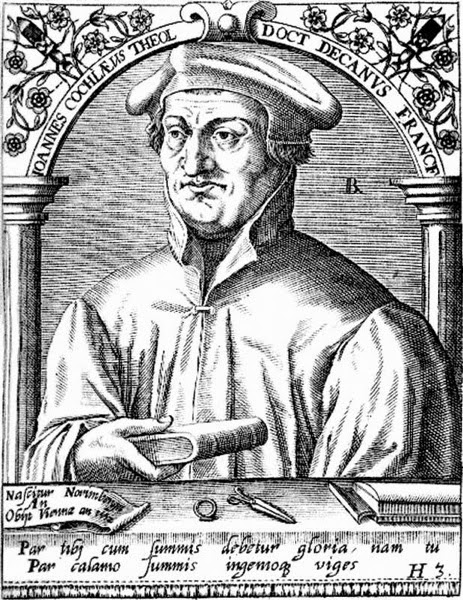
Cochlaeus' portrait from Wikipedia is below.
Friday, February 27, 2015
Imagining Ulster

I make an appearance on this new BBC Northern Ireland series which starts on Sunday night, presented by William Crawley. Can Ulster be re-imagined? Is there more than just the stereotype? I believe so and it is starting to emerge. Late last year I worked on AuthenticUlster.com, a new brand and heritage tourism initiative. And the beautiful new magazine Freckle NI is another example.
Politics has an important place in every society, but it should not define everything we are and everything we do. Culture runs deeper and is less subject to change. A cultural understanding of oneself is far more enduring than a political one.
The 'new' Northern Ireland is deeply connected to the success of Game of Thrones. As a friend showed me just the other day:
“Never forget what you are, for surely the world will not. Make it your strength. Then it can never be your weakness. Armour yourself in it, and it will never be used to hurt you.” ― George R.R. Martin, A Game of Thrones

Subscribe to:
Posts (Atom)