Friday, February 27, 2015

Imagining Ulster

SAM 1902

I make an appearance on this new BBC Northern Ireland series which starts on Sunday night, presented by William Crawley. Can Ulster be re-imagined? Is there more than just the stereotype? I believe so and it is starting to emerge. Late last year I worked on AuthenticUlster.com, a new brand and heritage tourism initiative. And the beautiful new magazine Freckle NI is another example.

Politics has an important place in every society, but it should not define everything we are and everything we do. Culture runs deeper and is less subject to change. A cultural understanding of oneself is far more enduring than a political one.

The 'new' Northern Ireland is deeply connected to the success of Game of Thrones. As a friend showed me just the other day:

“Never forget what you are, for surely the world will not. Make it your strength. Then it can never be your weakness. Armour yourself in it, and it will never be used to hurt you.” ― George R.R. Martin, A Game of Thrones

Imagining Ulster Ep 1

Thursday, February 19, 2015

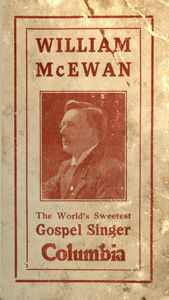
William MacEwan - the voice of "The Old Rugged Cross"

William McEwan Graphic

William MacEwan 13 02 1932 Hartlepool

Back in 2011 (to coincide with the 100th anniversary of his first recordings) I posted here a ten-part biography of the Glasgow-born singer William MacEwan (1871-1943). He came back into my head this week when I found the above advert, from Hartlepool on 13 Feb 1932. He last recording session was in London in March of that same year. I also found this online, confirming my own researches:

'... Good sales could not always be guaranteed, but Columbia scored an equally important success with its 1927 American recording of Scottish-born gospel singer William MacEwan's rendition of the hymn "The Old Rugged Cross" coupled with "Let's talk it over bye-and-bye" (Columbia 4148). By 1933 British sales of this record had exceeded 250,000, at a time when all but a handful of the most successful dance and popular music record enjoyed sales of 100,000 and most record companies considered sales in excess of 10,000 copies a "hit" ...' - source here.

MacEwan's voice made The Old Rugged Cross world famous. By the year he died, 1943, it had sold a reported 20 million copies around the globe, both vinyl and sheet music. If you're interested in reading the full biography, here are all ten parts:

- Part One

- Part Two

- Part Three

- Part Four

- Part Five

- Part Six

- Part Seven

- Part Eight

- Part Nine

- Part Ten

Tuesday, February 17, 2015

"The temperamental gulf which divides the inhabitants of north-east Ulster from those of south-west Cork, is no wider than that which separates the people of Sutherland from those of Selkirk" - William Cook Mackenzie (1862-1952) - 'The Races of Ireland and Scotland'

SAM 1850

One of the first books I bought when I became interested in Ulster-Scottish history was William C Mackenzie's 1916 400 page volume The Races of Ireland and Scotland (now available on Archive.org.here) - found in a long-gone second hand bookshop on Gray's Hill in Bangor. It mostly deals with ancient history and perhaps, like many Victorian-era publications of this kind, has been superceded by later discoveries and scholarship. Mackenzie drew upon numerous Irish sources and painted a picture of a regular two-way criss-cross of communication and migrations across the North Channel throughout time. The Picts and Cruthin get numerous mentions, as do linguistic issues.

At the time, in my early 20s, I was a bit disappointed by it. Its history was too long ago, and its geography too far away, to seem relevant to me. I preferred buildings I could touch and take photographs of, words I could still hear and had grown up with myself in my community, surnames I recognised and history which was around my own home turf.

Now, however, the book interests me more. William Cook Mackenzie (1862-1952) argued the case for a regional appreciation of Scotland, and Ireland, and of the multiplicity of cultural influences which had shaped Scotland - such as the Scandinavian / Viking influence of his native Western Isles.

Born on the Isle of Lewis (an island bizarrely claimed by earlier historians to once have been inhabited by a race of pygmies and where pygmy remains had reportedly been found - a theory which Mackenzie, his brother and his cousin investigated and published a paper on in 1905) he was a Fellow of the Society of Antiquaries of Scotland. He was a scholar and speaker of Scottish Gaelic and also fully appreciative of the Norse connections.

He lived in London for a time when he worked for the British India Steam Navigation Company (he wrote a biography of his ancestor, Colonel Colin Mackenzie, the first Surveyor-General of India and renowned antiquarian). William emigrated to Australia and lived in Brisbane from 1884-1888 where he worked for the Bank of Queensland. He then returned to England, became managing director of a cotton importing company, and settled at Richmond Upon Thames. 

• In 1903 he published his first book, the 600 page History of the Outer Hebrides. It refers to the MacNeills of Barra, (see here on page 65) whom I mentioned here a few posts ago and whom Mackenzie interestingly connected back to a Viking called Njal who is said to have been the 'progenitor' of the Barra MacNeills - thereby confirming that very recent DNA discovery. 

• In 1908 he published his 400 page A Short History of the Scottish Highlands and Islands, which is online here.

• in 1916 he expanded his geography further, in The Races of Ireland and Scotland. MacKenzie acknowledges that his book, for its day, was groundbreaking:

'... the main theories advanced in this book are entirely new, and, if I may use the word without fear of being misunderstood, entirely "revolutionary". I am not so sanguine as to suppose they will meet with complete acceptance, not so confident as to believe that they are impervious to criticism. But I have made no important assertions without supplementing them by reasoned proofs that have satisified me...'

• In 1923 Mackenzie declined an invitation to stand for Westminster election as the Liberal candidate for Lewis. 

• In 1931 he published Scottish Place Names - review here.

• In 1932 he published the 350 page The Western Isles; their history, Traditions, and Place-names (which appears to not yet be available online). 


He retired from business in 1934. In 1937 the Moray Press published Mackenzie's 326 page review of his own books entitled The Highlands and Isles of Scotland' and in 1938 he was made a Freeman of Stornoway. He died, aged 91, at his home at St Margaret's-on-Thames, in 1952. I intend to re-read the book over the coming months and will post anything relevant here. In our globalised age, regionalism is dwindling. Regional distinctives are less pronounced than ever before. The excerpt below shows how obvious they once were.

SAM 1853 2

Tuesday, February 10, 2015

Carmoney (Carnmoney) Witches - a poem by Francis Boyle, c. 1808


CARMONEY WITCHES,
A humorous modern Song, founded on fact,
by F. B. , Cumber, Granfhaw.

Tune "Lovely Molly has an air " 

In Carrick town a wife did dwell,
Who does pretend to conjure witches
Auld Barbara Goats and lucky Bell,
Ye'll no lang to come through her clutches ;
A waefu' trick this wife did play,
On fimple Sawney, our poor tailor,
She's mittimiss'd the other day
To lie in limbo with the Jailor :
This fimple Sawney had a Cow
Was aye as sleekit as an otter
It happen'd for a month or two.
Aye when they churn'd they got nae butter;
Roun-tree tied in the Cow's tail,
And vervain glean'd about the ditches;
These freets and charms did not prevail.
They cou'd not banifh the auld witches:
The neighbour wives a' gather'd in
In number near about a dozen,
Elfpie Dough and Mary Linn,
An' Keat M'Cart the tailor's cousin,
Aye they churn'd an' aye they fwat,
Their aprons loos'd and coost their mutches
But yet nae butter they could get.
They bleft the Cow but curft the witches:
Had Sawney summoned all his wits.
And fent awa for Huie Mertin,
He could have gall't the witches guts
An' cur't the kye to Nannie Barton;
But he may fhow the farmer's wab
An' lang wade through Carmoney gutters,
Alas' it was a fore mis-jab
When he employ'd auld Mary Butters;
The forcereft open'd the fcene.
With magic words of her invention,
To make the foolifh people keen
Who did not know her bafe intention.
She drew a circle round the churn.
An' wafh'd the staff in fouth run water
An' fwore the witches fhe would burn,
But fhe would have the tailor's butter.
When fable night her curtain fpread.
Then fhe got on a flaming fire.
The tailor ftood at the Cow's head
With his turn'd waiftcoat in the byer;
The chimney cover'd with a fcraw,
An' ev'ry crevice where it fmoak'd,
But long before the cock did craw
The people in the houfe were choak'd,
The muckle pot hung on all night
As Mary Butters had been brewing,
In hopes to fetch fome witch or wight
Whas entrails by her art was ftewing
In this her magic a' did fail
Nae witch or wizard was detected;
Now Mary Butters lies in jail,
For the bafe part that fhe has acted.
The tailor loft his fon an' wife,
For Mary Butters did them fmother
But as he hates a fingle life.
In four weeks time he got another;
He is a crufe auld canty chiel,
An' cares nae what the witches mutters
He'll never mair employ the deil,
Nor his auld agent, Mary Butters;
At day the tailor left his poft,
Though he had feen no apparation
Nae wizard grim nae witch nor ghoft,
Though ftill he had a ftrong fuspicion
That fome auld wizard wrinkled wife.
Had caft her cantrips o'er poor brawney
Caufe fhe and he did live in ftrife,
An' whare's the man can blame poor Sawney;
Wae sucks for our young laffes now,
For who can read their mystic matters
Or tell if their fweet hearts be true,
The folk a run to Mary Butters;
To tell what thief a horfe did fteal,
In this fhe was a mere pretender
An' has nae art to raife the deil
Like that auld wife, the witch of Endor
If Mary Butters be a witch,
Why but the people all fhould know it,
An' if fhe can the mufes touch
I'm fure fhe'll foon descry the poet,
Her ain familiar aff fhe'll fen'
Or paughlet wi' a tu' commiffion,
To pour her vengeance on fhe men,
That tantalises her condition.


Thursday, February 05, 2015

The Irish / Scottish Gaelic clan who have just turned out to be Vikings. Every single one of them.

NewImage

(Pic above - Barra)

I had a very interesting conversation last weekend with someone I'd only 'met' online - like me, very into Ulster-Scots history - and researching her MacNeill / McNeill roots. We talked for a long time, including about John McNeill the preacher known as 'The Scotch Spurgeon' whose father was from Lisnagunoge near Bushmills in North Antrim. She's now arranging to take her father to Inverkip on the west coast of Scotland to visit McNeill's grave - I located it a few years ago and took plenty of reference photographs to enable it to be found again one day.

The accepted wisdom is that the McNeills / MacNeills were a Gaelic clan who lived in the Western Isles of Scotland - Barra in particular - and migrated back and forth to the north of Ulster, helping to establish a shared culture on both sides of the water. They are said to have descended from Irish hero Niall of the Nine Hostages:

'...  Niall of the Nine Hostages, whose dynasty dominated Ireland between the 5th and 10th Centuries, got his name from taking hostages as a strategy against his opponent chieftains. The King, who died in 405AD, was the founder of the longest and most powerful Irish royal dynasty and known by some as the greatest king that Ireland ever knew...'

That's a common story, and easy to accept due to the way history is often told.

Until DNA ancestral research came along that is. A study by Professor Alex Buchanan at the University of Tasmania, of hundreds of people around the world all descended from Barra's McNeills, has found that every one of them is actually of Viking descent.

Here is an article on HeraldScotland, the original source for the Niall of the Nine Hostages excerpt above.

Stephen McNeil, the Premier of Nova Scotia in Canada seems a bit unhappy about the revelation and has insisted upon his Irishness. Other McNeils - in true online outrage fashion - are said to be 'devastated' and have resorted to large quantities of whiskey to drown their sorrows. Here is another Canadian article.

What does this mean?

Well, as I have blogged about before, Viking ancestry seems surprisingly common, my own DNA ancestry has revealed exactly the same, and as DNA studies continue I do think that 19th century ideas of (nationalistic) identity will be rethought and rewritten. Genetics and culture are not the same thing though - genetics are as ancient as humanity, whereas culture changes and shifts over the centuries through human influence. There is no 'pure' anything.

But then there is this. You want social equality? Here it is, one of Scripture's great democratic levellers. 

"And hath made of one blood all nations of men for to dwell on all the face of the earth" - Acts 17 v 26

................

PS: the Dublin Penny Journal of 28 September 1833 that the Irish O’Neills had come to Ireland from the Orkneys in the 9th Century, descended from Belus, who was King of the Orkneys before the birth of Christ. Originally their name was O’Nial of Hy Nial, meaning ‘chief’ or ‘prince’. Online here - similar to an article which appeared in the Belfast Monthly Magazine of 1812 which is online here and also in PD Hardy's The Northern Tourist of 1830 online here. Maybe more of Ireland is Viking than we are allowed to know. 

Cleish Castle - maternal home of the Portaferry Monypennys

Dating from the late 1500s, the castle was heightened and extended in the early 1600s. Quite a pad. The Monypenny connection has continued right down in living memory in Hilary's family - her (late) great uncle Colin, a lovely man who gave me some of his theology books, had Monypenny as his middle name.

NewImage

NewImageNewImage

The Monypennys of Pitmilly and Portaferry

I have been married for nearly 18 years. When I first went to visit my in-laws in Buckinghamshire, Hilary's dad produced a family tree which a relative of his had composed from family archives. Even though Hilary's surname is/was Bowker, the family tree was of the Monypennys of Pitmilly near St Andrews in Fife. It was a huge rolled-up document, and one name jumped off the page at me...

SV209032

You don't expect to find a Rear-Admiral from Portaferry named on a family tree in leafy Buckinghamshire!

Rear Admiral

Just before Christmas 2014 when I gave a talk to Upper Ards Historical Society, I showed them this. Amy Anderson was kind enough to then send me some information she had on file from the Savage Estate rent roll of 1644. The Savages were an Anglo-Norman family who had been in the Ards Peninsula since the late 1100s.

ARTHUR MONYPENNY - FROM FIFE TO PORTAFERRY
On the rent roll was an Arthur Monypenny who was renting a considerable amount of land in the area - at:
• Ballycam (£7)
• half Ballynichol (£5)
• half Ballypound (Ballyfounder? £4 5 shillings)
• Parsons Hall (£2)
• two Parks (20 shillings)
• a Park in Ballyphilip (£2 2 shillings), and also
• his house and garden (£1 15 shillings).

An Arthur Monypenny also appears on the Savage Rent Roll for 1641, leasing two unnamed townlands, and also on the Subsidy Roll for 1663, paying £3 12 shillings for Parson's Hall. Presumably this is the father of James Monypenny. Arthur was a high-ranking churchman, the 'Prebend' of St. Andrews Parish in 1620. He succeeded his brother Andrew Monypenny who had been the previous Prebend - according to Reeves' Ecclesiastical Antiquities of Down, Connor and Dromore Andrew Monypenny had been 'collated to the Archdeaconry of Connor on 18th March 1616".

FIFE
St Andrews Parish is here on the Ards Peninsula, dating back to the early Anglo-Norman era (St Andrews Parish Church is at the other end of the road we live on) - and of course there is a St Andrews back in Scotland in Fife, famous worldwide for its university and the Royal and Ancient Golf Club.

The Monypennys had come to Ulster from Fife. Interestingly so did the local Bishop, Robert Echlin (1576-1635), who was from Pittadro, and would have been the superior of the Monypenny brothers. Echlin arrived in 1615 and set up his home at Ardquin Abbacy. When Echlin died he was succeeded by another Fife-born Prebend - Henry Leslie had been installed as Prebend of Connor (by Echlin) in 1619.

What is interesting about this is that it slays the local myth about a Scottish v Irish quasi-apartheid on the Peninsula in the early 1600s. In fact, there were many Scots living as tenants on the southerly Savage estates - just as there were Irish tenants living on the more northerly Scottish-owned Hamilton estate near Conlig. As ever, the truth erodes the propaganda.

JAMES MONYPENNY - FROM PORTAFERRY TO KENT
Back to where we began. James Monypenny joined the Royal Navy and by 1697 was a Captain. He became First Lieutenant of Admiral of the Fleet Sir George Rooke's flagship at the capture of Gibraltar and the Battle of Malaga in 1704. He married well - Mary Gybbon of Hole Park - and he purchased the Maytham Hall in Rolvenden, Kent, in 1714. He died aged just 51 but sadly his impressive memorial at St Mary the Virgin Church in Rolvenden skips over his Portaferry origins though. He features on FindaGrave.com

43887538 137106120372


COLVILLES AND CARDINAL BEATON
Back a few generations and the family tree has a James Monypenny who died in 1638, marrying a Eupham Colville, the daughter of Robert Colville of Cleish Castle. This James and Eupham are said to have had "7 sons of whom 3 settled in Ulster between 1612 and 1620". Two of these sons were the above-named Andrew and Arthur. Another son, John, married Susanna Colville, whose father was the Commendator of Culross - another town in Fife which still today has superbly preserved 17th century architecture.

And a few generations before that a David Monypenny was implicated in the murder of his notorious cousin, a certain Cardinal David Beaton who was famously assassinated on 29 May 1546 - just three months after Beaton had ordered the burning of George Wishart on the streets of St Andrews. As the family tree says:

"Having been declared privy to the slaughter of Cardinal Beaton, his kinsman, in 1546, he and his son received in 1553 a pardon from Mary Queen of Scots".

WHERE DID THEY LIVE?
So now the hunt is on to locate the plausible Monypenny residence in Portaferry. Given that they were churchmen, I wonder if the tiny 40 acre townland of Parson Hall might be the place? There is one farm there today. And are there any Monypenny gravestones in Portaferry? The Griffiths Valuation only has one Moneypenny in County Down - a Joseph Monypenny living in Ballymacarrett.

It seems that this Rear Admiral James Monypenny is Hilary's g-g-g-g-g-g-grandfather. Mathematics mean that she will have 127 others! But it's interesting to make a connection across nearly 4 centuries of living here in the Ards Peninsula, a place which is still as interwoven with Scotland as it was back then.

Cleish Castle is below. NewImage

Christianity and Islam - "there is no good news"

Michael Horton usually has interesting things to say. His latest book blows the lid off trend-obsessed 'radical' Christianity - the first book of his that I came across was the provocatively-titled Christless Christianity - and he was right, such a thing does exist and is actually pretty widespread. These three short videos make for interesting viewing.


With much of Islam the core message is "keep the rules and you'll get in". The Christian message (if properly told) is "the standards required are beyond your reach. Jesus came to meet those standards on your behalf".

Wednesday, February 04, 2015

'Modern Family' - Heaven and Hell

I don't watch this tv show, but I caught this when 'channel-hopping' a few years ago.


It doesn't want to embed, so here's a link.

Friday, January 30, 2015

One I grew up with, and one we still sing


A beautiful new recording of a classic hymn. Written by 26 year old James Cleveland Moore (1888 – 1962), from Georgia, USA circa 1914 and was dedicated to his parents. His father was Charles Robert Moore, an ageing Baptist pastor in Draketown, Georgia.

It was first recorded in 1926 by “Smith’s Sacred Singers”, said to be the first “country gospel” recording – it sold 277,000 copies in an age when sales of 5000 was considered good. It was recorded by the Carter Family in 1932.

As my mother old me one day years ago as she lay in a hospital bed - "Dinnae get oul".

Thursday, January 29, 2015

Ulster Greets

I wonder if, when this book was produced in 1919, did the publisher appreciate that in Scots and Ulster-Scots, 'greets' means 'cries'. Many of the 'brave and faithful sons' and relatives of the 'glorious dead' would have been struck by the probably unintentional double-meaning.

SAM 1726 2

Greet

Tuesday, January 27, 2015

The first flag of Northern Ireland? But was the Red Hand actually Green?

First NI Flag

Possibly. Graphic from this description of the Ulster Pavilion at the British Empire Exhibition of 1924. Perhaps archival photographs exist somewhere. Further details online here.

The one-time shipyard worker William Grant, by this time the MP for North Belfast, was not impressed –

"I would like to ask the hon. Member a further question. Is he aware that a great deal of dissatisfaction exists amongst those who have visited the Exhibition at the Ulster Pavilion, that the only persons who appear to be satisfied with the Exhibition are the Ministry themselves, and that those who ought to be satisfied are a great deal dissatisfied? ... Is it a fact that the decorations of the Ulster Pavilion are green, yellow and red, and that at the opening of the Exhibition the red hand of Ulster was actually painted green? As the answers given are so unsatisfactory, I think we should raise this matter on the adjournment of the House."

So what should have been Northern Ireland's greatest showpiece event turns into a farce. Controversy and not celebration. A self-congratulatory government department making a horlicks of culture?....

Friday, January 23, 2015

"The nicht o' the waddin'"


"The nicht o' the waddin'
The nicht o' the fun
The nicht o' the waddin'
She had a wee son
She christened him Paddy
Wi' a hair on his bum
The nicht o' the waddin'
The nicht o' the fun"

One of my late granda's songs, remembered by my mum tonight, as I was playing tune 'The Irish Washerwoman' to her on the mandolin. This is him with my aunt Ruth Wilson (now Hamilton).

Granda Wilson 4

Tuesday, January 20, 2015

William of Orange's Act of Gracious, General and Free Pardon, 23 May 1690 -- "their Offences may not hereafter be brought in Judgement, Question or Remembrance ... Indulgent Grace"

CPB274

I have blogged about this before. I now have an original copy. The theologically-inclined will see the Gospel exemplified here.

King William III, Prince of Orange, and Mary his Queen, put this Act to Parliament just a few weeks before William sailed for Ireland. All acts of treason and support of the previous regime were wiped clean:

'... The King and Queen's most Excellent Majesties, taking into Their Serious Consideration the long and Great trouble and Discords that have been within thins Kingdom, and that by occasion thereof, and otherwise, many of Their Subjects are fallen into danger of, and lie open to the great Penalties and Forfeitures; and withal Graciously Considering the Faithful Hearts, and Dutiful Affections of Their Loyal Subjects : Out of an Earnest Desire to deliver Their subjects from the Penalties and Forfeitures aforesaid, and to the intent that their Offences may not hereafter be brought in Judgement, Question or Remembrance, to the least Endangerment of them, either in their Lives, Liberties, Estates or Reputations, but that they, having an entire Confidence in Their Majesties, and perfect Union among themselves, may be encouraged in their Duty to their Majesties Government, and more fully and securely enjoy the benefit of it; Their Majesties are of Their Princely and Merciful Disposition and meer Motion, most Graciously inclined to extend unto them Their General and Free Pardon, and that in a more bountiful manner than hath been accustomed : Their Majesties Assuredly Trusting, that all Their Subjects by this Clemency and Indulgent Grace, will be the rather induced henceforth more carfully to observe the Laws, and perform their Loyal and due Obedience to Their Majesties ...'

- An Act for the King and Queen's most Gracious, General and Free Pardon. 23 May 1690

Saturday, January 17, 2015

What's in a name? The saga of East Coast Council

Who Wants Change

Northern Ireland is undergoing a revamp of local government. There will be fewer local councils - not that the country is getting smaller - but local government is paradoxically becoming both smaller (there will be fewer of them) - yet bigger (they will have more staff and more powers and functions).

This is all with the stated aim of saving money. Yet anybody who has been through a 'change management' process in a large organisation will know full well how expensive these processes can be. They take a long time, there's the inevitable drop in confidence among customers/the public, productivity reduces, staff morale is usually damaged, scepticism sets in, there are redundancy packages to negotiate, legal fees escalate - and of course there's the consultants fees to pay for all of the 'fresh thinking' that has to be bought in from outside.

One of the challenges is what to call these newly-merged Councils.

Sometimes they naturally belong together as logical areas - but, as in the case of the area where I live - two councils based in two towns which in themselves are very different from each other and even rivals of one another, are being pushed together.

Ards Borough Council (based in Newtownards) and North Down Borough Council (based in Bangor). The towns have been rivals for centuries, I would suggest going back at least as far as 1606 with Hamilton's Bangor and Montgomery's Ards competing with one another, and their respective Royal Town Charters which were granted by King James VI & I in 1613. And before them, maybe even the monks and friars of Ards Priory and Bangor Abbey might have been trying to out-do each other. In the late 1500s the whole area was marked on maps as The Ardes. By 1906 the whole area was within the Parliamentary constituency of North Down - one of four constituencies in County Down which were (you guessed it) North, South, East and West.

Where this rivalry has got to is no agreement on the name for the newly-merged Council. Some combination of the two previous names has always seemed logical to me. But the word on the street is that the North Down contingent wouldn't support "Ards and North Down Borough Council" and the Ards contingent wouldn't support "North Down and Ards Borough Council". The resultant stalemate has brought about a name which was narrowly approved by the Council members - 'East Coast Council' - but which the public has reacted very badly to and which has attracted a lot of negative press coverage. People power has mobilised itself to vocally object. It's a bad start for the new organisation.

I wasn't involved in the project but I know many of the people who were - councillors, Council officers, and also consultant team. They all asked me for input and I gave it - informally and also formally. Naming something is really tough, but in a climate of enforced merger and perceived loss of identity it's even harder for the consultant team to navigate the storms. But not using a placename in the Council name seems daft - East Coast of where exactly? We holidayed in East Yorkshire last summer, and their coast is magnificent. Google "East Coast Council" and you'll end up in Yorkshire, in Suffolk and even Singapore. My kids tell me in American rap music there is an East Coast v West Coast rivalry. East Coast could be anywhere.

And so the name becomes a vanity exercise. Somebody wanted the merged Council to be creative and new. Which in itself is a positive objective. Where it all went wrong is that the name's not where to do that - choose a simple, trustable, distinct name - and let the creativity show by being creative in the marketing, the events, the way the organisation goes about its business. Be creative in how you operate - don't think a fancy new name will overcome perceived failings in product or service. To quote an old song - It ain't what you do, it's the way that you do it, and that's what gets results.

'East Coast Council" has now backtracked and, rather than scrap the name outright, have now done what they probably should have done in the first place, and have put the name out to public consultation. They have a shortlist of six:

• Ards North Down • East Coast • North County Down • North Down and Ards • Loughlands • Peninsula.

I will always go for a combination of the two - either Ards & North Down or North Down & Ards. Go alphabetical or toss a coin. Just get on with it. Local government shoulcn't be 'exciting' - it should be reliable and trustworthy, and in tune with the public they are meant to serve. Want to be creative? Then do something imaginative - reduce bureaucracy, get better at serving your customers, keep the place spotlessly clean, get sensible and efficient planning policies, support small business - do things that help people!

It's easy to kick the consultancy team. But they didn't write the brief or set the terms of the contract or allocate the budget. Implementing the new name - whatever it is - on everything from leisure centres and bin lorries and car park tickets and signs - will cost far more than their 'naming process' fee will be. Everybody wants change, nobody wants to change or reveal the actual cost of it.

Map

Sunday, January 11, 2015

Appalachia - The Big White Ghetto: "...the last redoubt of the Scots-Irish working class that picked up where African slave labor left off..."

NewImage

Story here.

Thursday, January 08, 2015

So just how popular was Scots language literature in 1800s Ulster?

... popular enough for volumes like this to exist - 200 page pocket edition of three famous Scots language poets, with vocabulary flowing with Scots joy. There were other similar volumes published by John Henderson, such as a double volume of Ramsay and Ferguson. This volume was published in the same year as Moneyrea's Robert Huddleston. It increasingly seems that Ulster was positively awash with Scots and Ulster-Scots literature for centuries, up until the 'progress' of the late 20th century and the horrors of the Troubles. 

Tannahill was a weaver, born to Ayrshire parents, but committed suicide in 1810. His work was first published in 1807. M'Neill was roughly contemporary with Burns, first published in 1789, just before he went to Jamaica for a while. Ramsay was earlier and had already been published in Belfast many times before. Just like today, printers don't print books unless there is a ready market for them.

Centuries before smartphones and iPods, these poets and publications were the pocket-sized entertainment for the masses. 200 pages of poems and songs! Our ancestors were far more literate than we give them credit for.

Tannahill MacNeill Ramsay Belfast 1844 LR

Tuesday, January 06, 2015

2015 - two important Ulster-Scots Centenaries

On my drive home yesterday I heard a piece on Radio 5 Live about English Heritage and seven important centenaries they are marking this year. As far as I can see, the Ulster-Scots world has two in 2015:

Edward Bruce 700 The 700th anniversary of the arrival on 26 May 1315 of Edward Bruce's Bannockburn army at Larne Lough, the start of a 3 1/2 year campaign in alliance with the Ulster O'Neills to oust the Anglo-Normans from Ireland. It's a story that places the Ulster-Scots connection 300 years before the Settlements and Plantations of the 1600s, and yet in a sense it paved the way for them both - when King James VI & I of Scotland succeeded in 1603 to become King of everywhere - an objective which had eluded King Robert the Bruce of Scotland in the early 1300s. A Facebook group has been set up for Friends of Edward Bruce 700.

Archibald McIlroy 100 The centenary of the death of perhaps the finest, and most commercially successful, Ulster-Scots 'kailyard' writer. McIlroy (1857–1915) was onboard the SS Lusitania when it was torpedoed and sank off the west of Ireland on Friday 7 May 1915. A total of 1198 people drowned, 11 miles from Kinsale. Legend has it that McIlroy was carrying the manuscript of his 'magnum opus' to present to publishers in Belfast. On the centenary evening on Thursday 7th May, former Presbyterian Church in Ireland Moderator the Very Rev Dr Donald Patton is giving a lecture on McIlroy at Union Theological College for the annual Robert Allen Lecture for the Presbyterian Historical Society, of which Dr Patton is the current Chairman. Here's a link to the Ulster-Scots Language Society's bio of McIlroy.

There are probably more centenaries than these two, but these are the two big yins.

Wednesday, December 31, 2014

Letter from Robert Burns Jr. – Belfast, 13 September 1845

Today is New Year's Eve and at midnight around the world crowds of well-liquored folk will blunder their way through a few lines of 'Auld Lang Syne', an old Scottish song collected by and usually attributed to Robert Burns.

This letter came into my possession during 2014. Written by Robert Burns Jr. from 2 York Road, Belfast to Miss Isabella Begg at Bridgehouse, Ayr. It's unspectacular in terms of content, but the date does not coincide with his other known visits to Belfast in 1844 - suggesting that he was a more regular visitor than is often thought. His daughter, Eliza (33 years old in 1845) and her daughter Martha (6 years old in 1845) moved to Belfast in the early 1840s having been in India and London. They lived in the city for about 25 years, mostly in the York Road district but later at Wilmont Terrace on the Lisburn Road.

Robert Burns Jr was born in 1787, the same year as the (second) Edinburgh edition and (third) Belfast edition of his father's poems. So the letter seems to be a 58 year old uncle getting his 39 year old niece to do a bit of travel arranging for him.

.......................................................

2 York Road, Belfast, Ireland
Saturday September 13th 1845

My dearest Isabella
If the weather should permit I shall leave Belfast for Ardrossan on the morning of the 23rd. As I am desirous of getting to Ayr the same evening for the purpose of avoiding passing the night at Ardrossan. I wish you to enquire at the Terminus as what hour the last train leaves Ardrossan and Kilwinning for Ayr. Please to let me know this as speedily as possible for should I set to Ayr that evening. I shall expect to have the pleasure of your company at breakfast at Mr. Johnston's on the morning of the 24th. 

Eliza and Patty are well and send you their love. My love to my Aunt, to Agnes and yourself.

Believe me,
My dearest Isabella
Yours ever and truly

Robert Burns 

.......................................................

Isabella Burns Begg Sr (photo here from around the same time as the above letter was written when she would have been 74 years old) was the youngest sister of the poet Robert Burns, and so was therefore Robert Burns Jr's aunt. She moved back to Ayr after her husband John Begg died in 1813, and was kept busy telling stories to visitors about her (late) famous brother. Two of her daughters were Agnes Brown Begg (1800–1883, presumably the Agnes mentioned in the letter) and her namesake Isabella Burns Begg Jr (1806–1886, presumably the Isabella the letter was written to).

So was 'Patty' a nickname for Martha? And who was Mr Johnston? 

Robert Burns Jr Letter 1Robert Burns Jr Letter 3

Robert Burns Jr Letter 2

Saturday, December 27, 2014

Dal-Araidhe and Dalriada / Ferdoman, King of the Ards

Before the Anglo-Normans arrived in the 1170s, Ulster was different. Dalriada connected today's North Antrim with Argyll in Scotland. Today's County Down was the confusingly-similarly-entitled Dal-Araidhe.  

SAM 1412 

SAM 1411

I had a great night just before Christmas in giving an illustrated talk to Upper Ards Historical Society in Portaferry. They have been very helpful and supportive over the years and it's always good to go and share information with like-minded neighbours. I'd like to get to more of their meetings but the busyness of life gets in the way. Their Journal is an exemplary production, and over the many years it has been published some of my late grandfather's poetry has featured in it.

On the afternoon before I went, I flicked through my copy of An Ards Farmer; or, an Account of the Life of James Shanks, Ballyfounder, Portaferry by James C Rutherford, published in 1913, the year after Shanks' death. Shanks was a renowned collector and antiquarian, fascinated by Ards Peninsula history from Stone Age artefacts to the 1798 Rebellion, with a love of Robert Burns and Presbyterian history. (oh to have a time machine...)

Shanks was a friend of G.F.Savage-Armstrong and they shared a love of ancient historical tales, G.F.S-A. providing Shanks with all of the inscriptions from Ardkeen graveyard. Shanks wrote a letter to the Belfast Morning News in 1908 in which he pointed out that an ancient urn, with human ashes, had been found near the pillar stone of Ballyrusley, said to be those of 'some Cuchullin warrior' who had been 'Chief of Tara'. Locals will know that Tara Hill on the Ards Peninsula is near Millin Bay, just south of Kearney village.

Shanks refers to 'Ferdoman, the Bloody-weaponed King of the Ards' who was involved in the Battle of Moira in AD637 and who is said to have escaped uninjured. Shanks believed that Ferdoman was King of Tara:

'... Is now held up by Congal. The standard of Suibhne, a yellow banner, The renowned King of Dal Araidhe, Yellow satin, over that mild man of hosts, The white- fingered stripling himself in the middle of them. The standard of Ferdoman of banquets, The red-weaponed King of the Ards of Ulster, White satin to the sun and wind displayed Over that mighty man without blemish ...'

– from Congal by Sir Samuel Ferguson

Ireland's history is far more divided and splintered than most people today are allowed to know. Just like in Scotland there have been multiple regional kings and clans and tribes and chieftains and kingdoms through the centuries, fighting with one another long before anyone from England got involved. Narrow nationalism, designed to inflame, aggrieve and 'radicalise' recent generations, is nonsense. The full story needs to be told and understood.

• Click here for some brilliant information about Tara Hill / Tara Fort including a 360˚ panorama of the view from the top. (from the Voices of the Dawn - The Folklore of Ireland's Ancient Monuments website)