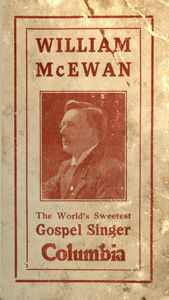

A beautiful new recording of a classic hymn. Written by 26 year old James Cleveland Moore (1888 – 1962), from Georgia, USA circa 1914 and was dedicated to his parents. His father was Charles Robert Moore, an ageing Baptist pastor in Draketown, Georgia.
It was first recorded in 1926 by “Smith’s Sacred Singers”, said to be the first “country gospel” recording – it sold 277,000 copies in an age when sales of 5000 was considered good. It was recorded by the Carter Family in 1932.
As my mother old me one day years ago as she lay in a hospital bed - "Dinnae get oul".
Friday, January 30, 2015
One I grew up with, and one we still sing


Thursday, January 29, 2015
Ulster Greets
I wonder if, when this book was produced in 1919, did the publisher appreciate that in Scots and Ulster-Scots, 'greets' means 'cries'. Many of the 'brave and faithful sons' and relatives of the 'glorious dead' would have been struck by the probably unintentional double-meaning.


Tuesday, January 27, 2015
The first flag of Northern Ireland? But was the Red Hand actually Green?

Possibly. Graphic from this description of the Ulster Pavilion at the British Empire Exhibition of 1924. Perhaps archival photographs exist somewhere. Further details online here.
The one-time shipyard worker William Grant, by this time the MP for North Belfast, was not impressed –
"I would like to ask the hon. Member a further question. Is he aware that a great deal of dissatisfaction exists amongst those who have visited the Exhibition at the Ulster Pavilion, that the only persons who appear to be satisfied with the Exhibition are the Ministry themselves, and that those who ought to be satisfied are a great deal dissatisfied? ... Is it a fact that the decorations of the Ulster Pavilion are green, yellow and red, and that at the opening of the Exhibition the red hand of Ulster was actually painted green? As the answers given are so unsatisfactory, I think we should raise this matter on the adjournment of the House."
So what should have been Northern Ireland's greatest showpiece event turns into a farce. Controversy and not celebration. A self-congratulatory government department making a horlicks of culture?....
Friday, January 23, 2015
"The nicht o' the waddin'"
"The nicht o' the waddin'
The nicht o' the fun
The nicht o' the waddin'
She had a wee son
She christened him Paddy
Wi' a hair on his bum
The nicht o' the waddin'
The nicht o' the fun"
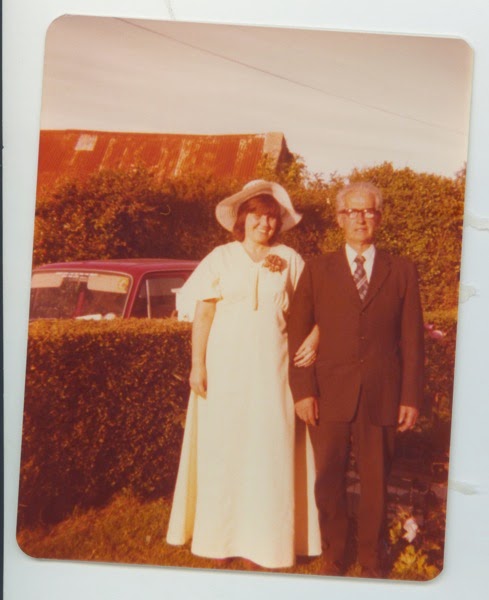
One of my late granda's songs, remembered by my mum tonight, as I was playing tune 'The Irish Washerwoman' to her on the mandolin. This is him with my aunt Ruth Wilson (now Hamilton).
Tuesday, January 20, 2015
William of Orange's Act of Gracious, General and Free Pardon, 23 May 1690 -- "their Offences may not hereafter be brought in Judgement, Question or Remembrance ... Indulgent Grace"

I have blogged about this before. I now have an original copy. The theologically-inclined will see the Gospel exemplified here.
King William III, Prince of Orange, and Mary his Queen, put this Act to Parliament just a few weeks before William sailed for Ireland. All acts of treason and support of the previous regime were wiped clean:
'... The King and Queen's most Excellent Majesties, taking into Their Serious Consideration the long and Great trouble and Discords that have been within thins Kingdom, and that by occasion thereof, and otherwise, many of Their Subjects are fallen into danger of, and lie open to the great Penalties and Forfeitures; and withal Graciously Considering the Faithful Hearts, and Dutiful Affections of Their Loyal Subjects : Out of an Earnest Desire to deliver Their subjects from the Penalties and Forfeitures aforesaid, and to the intent that their Offences may not hereafter be brought in Judgement, Question or Remembrance, to the least Endangerment of them, either in their Lives, Liberties, Estates or Reputations, but that they, having an entire Confidence in Their Majesties, and perfect Union among themselves, may be encouraged in their Duty to their Majesties Government, and more fully and securely enjoy the benefit of it; Their Majesties are of Their Princely and Merciful Disposition and meer Motion, most Graciously inclined to extend unto them Their General and Free Pardon, and that in a more bountiful manner than hath been accustomed : Their Majesties Assuredly Trusting, that all Their Subjects by this Clemency and Indulgent Grace, will be the rather induced henceforth more carfully to observe the Laws, and perform their Loyal and due Obedience to Their Majesties ...'
- An Act for the King and Queen's most Gracious, General and Free Pardon. 23 May 1690
Saturday, January 17, 2015
What's in a name? The saga of East Coast Council

Northern Ireland is undergoing a revamp of local government. There will be fewer local councils - not that the country is getting smaller - but local government is paradoxically becoming both smaller (there will be fewer of them) - yet bigger (they will have more staff and more powers and functions).
This is all with the stated aim of saving money. Yet anybody who has been through a 'change management' process in a large organisation will know full well how expensive these processes can be. They take a long time, there's the inevitable drop in confidence among customers/the public, productivity reduces, staff morale is usually damaged, scepticism sets in, there are redundancy packages to negotiate, legal fees escalate - and of course there's the consultants fees to pay for all of the 'fresh thinking' that has to be bought in from outside.
One of the challenges is what to call these newly-merged Councils.
Sometimes they naturally belong together as logical areas - but, as in the case of the area where I live - two councils based in two towns which in themselves are very different from each other and even rivals of one another, are being pushed together.
Ards Borough Council (based in Newtownards) and North Down Borough Council (based in Bangor). The towns have been rivals for centuries, I would suggest going back at least as far as 1606 with Hamilton's Bangor and Montgomery's Ards competing with one another, and their respective Royal Town Charters which were granted by King James VI & I in 1613. And before them, maybe even the monks and friars of Ards Priory and Bangor Abbey might have been trying to out-do each other. In the late 1500s the whole area was marked on maps as The Ardes. By 1906 the whole area was within the Parliamentary constituency of North Down - one of four constituencies in County Down which were (you guessed it) North, South, East and West.
Where this rivalry has got to is no agreement on the name for the newly-merged Council. Some combination of the two previous names has always seemed logical to me. But the word on the street is that the North Down contingent wouldn't support "Ards and North Down Borough Council" and the Ards contingent wouldn't support "North Down and Ards Borough Council". The resultant stalemate has brought about a name which was narrowly approved by the Council members - 'East Coast Council' - but which the public has reacted very badly to and which has attracted a lot of negative press coverage. People power has mobilised itself to vocally object. It's a bad start for the new organisation.
I wasn't involved in the project but I know many of the people who were - councillors, Council officers, and also consultant team. They all asked me for input and I gave it - informally and also formally. Naming something is really tough, but in a climate of enforced merger and perceived loss of identity it's even harder for the consultant team to navigate the storms. But not using a placename in the Council name seems daft - East Coast of where exactly? We holidayed in East Yorkshire last summer, and their coast is magnificent. Google "East Coast Council" and you'll end up in Yorkshire, in Suffolk and even Singapore. My kids tell me in American rap music there is an East Coast v West Coast rivalry. East Coast could be anywhere.
And so the name becomes a vanity exercise. Somebody wanted the merged Council to be creative and new. Which in itself is a positive objective. Where it all went wrong is that the name's not where to do that - choose a simple, trustable, distinct name - and let the creativity show by being creative in the marketing, the events, the way the organisation goes about its business. Be creative in how you operate - don't think a fancy new name will overcome perceived failings in product or service. To quote an old song - It ain't what you do, it's the way that you do it, and that's what gets results.
'East Coast Council" has now backtracked and, rather than scrap the name outright, have now done what they probably should have done in the first place, and have put the name out to public consultation. They have a shortlist of six:
• Ards North Down • East Coast • North County Down • North Down and Ards • Loughlands • Peninsula.
I will always go for a combination of the two - either Ards & North Down or North Down & Ards. Go alphabetical or toss a coin. Just get on with it. Local government shoulcn't be 'exciting' - it should be reliable and trustworthy, and in tune with the public they are meant to serve. Want to be creative? Then do something imaginative - reduce bureaucracy, get better at serving your customers, keep the place spotlessly clean, get sensible and efficient planning policies, support small business - do things that help people!
It's easy to kick the consultancy team. But they didn't write the brief or set the terms of the contract or allocate the budget. Implementing the new name - whatever it is - on everything from leisure centres and bin lorries and car park tickets and signs - will cost far more than their 'naming process' fee will be. Everybody wants change, nobody wants to change or reveal the actual cost of it.

Sunday, January 11, 2015
Appalachia - The Big White Ghetto: "...the last redoubt of the Scots-Irish working class that picked up where African slave labor left off..."

Thursday, January 08, 2015
So just how popular was Scots language literature in 1800s Ulster?
... popular enough for volumes like this to exist - 200 page pocket edition of three famous Scots language poets, with vocabulary flowing with Scots joy. There were other similar volumes published by John Henderson, such as a double volume of Ramsay and Ferguson. This volume was published in the same year as Moneyrea's Robert Huddleston. It increasingly seems that Ulster was positively awash with Scots and Ulster-Scots literature for centuries, up until the 'progress' of the late 20th century and the horrors of the Troubles.
Tannahill was a weaver, born to Ayrshire parents, but committed suicide in 1810. His work was first published in 1807. M'Neill was roughly contemporary with Burns, first published in 1789, just before he went to Jamaica for a while. Ramsay was earlier and had already been published in Belfast many times before. Just like today, printers don't print books unless there is a ready market for them.
Centuries before smartphones and iPods, these poets and publications were the pocket-sized entertainment for the masses. 200 pages of poems and songs! Our ancestors were far more literate than we give them credit for.

Tuesday, January 06, 2015
2015 - two important Ulster-Scots Centenaries
On my drive home yesterday I heard a piece on Radio 5 Live about English Heritage and seven important centenaries they are marking this year. As far as I can see, the Ulster-Scots world has two in 2015:
Edward Bruce 700 The 700th anniversary of the arrival on 26 May 1315 of Edward Bruce's Bannockburn army at Larne Lough, the start of a 3 1/2 year campaign in alliance with the Ulster O'Neills to oust the Anglo-Normans from Ireland. It's a story that places the Ulster-Scots connection 300 years before the Settlements and Plantations of the 1600s, and yet in a sense it paved the way for them both - when King James VI & I of Scotland succeeded in 1603 to become King of everywhere - an objective which had eluded King Robert the Bruce of Scotland in the early 1300s. A Facebook group has been set up for Friends of Edward Bruce 700.
Archibald McIlroy 100 The centenary of the death of perhaps the finest, and most commercially successful, Ulster-Scots 'kailyard' writer. McIlroy (1857–1915) was onboard the SS Lusitania when it was torpedoed and sank off the west of Ireland on Friday 7 May 1915. A total of 1198 people drowned, 11 miles from Kinsale. Legend has it that McIlroy was carrying the manuscript of his 'magnum opus' to present to publishers in Belfast. On the centenary evening on Thursday 7th May, former Presbyterian Church in Ireland Moderator the Very Rev Dr Donald Patton is giving a lecture on McIlroy at Union Theological College for the annual Robert Allen Lecture for the Presbyterian Historical Society, of which Dr Patton is the current Chairman. Here's a link to the Ulster-Scots Language Society's bio of McIlroy.
There are probably more centenaries than these two, but these are the two big yins.
Wednesday, December 31, 2014
Letter from Robert Burns Jr. – Belfast, 13 September 1845
Today is New Year's Eve and at midnight around the world crowds of well-liquored folk will blunder their way through a few lines of 'Auld Lang Syne', an old Scottish song collected by and usually attributed to Robert Burns.
This letter came into my possession during 2014. Written by Robert Burns Jr. from 2 York Road, Belfast to Miss Isabella Begg at Bridgehouse, Ayr. It's unspectacular in terms of content, but the date does not coincide with his other known visits to Belfast in 1844 - suggesting that he was a more regular visitor than is often thought. His daughter, Eliza (33 years old in 1845) and her daughter Martha (6 years old in 1845) moved to Belfast in the early 1840s having been in India and London. They lived in the city for about 25 years, mostly in the York Road district but later at Wilmont Terrace on the Lisburn Road.
Robert Burns Jr was born in 1787, the same year as the (second) Edinburgh edition and (third) Belfast edition of his father's poems. So the letter seems to be a 58 year old uncle getting his 39 year old niece to do a bit of travel arranging for him.
.......................................................
2 York Road, Belfast, Ireland
Saturday September 13th 1845
My dearest Isabella
If the weather should permit I shall leave Belfast for Ardrossan on the morning of the 23rd. As I am desirous of getting to Ayr the same evening for the purpose of avoiding passing the night at Ardrossan. I wish you to enquire at the Terminus as what hour the last train leaves Ardrossan and Kilwinning for Ayr. Please to let me know this as speedily as possible for should I set to Ayr that evening. I shall expect to have the pleasure of your company at breakfast at Mr. Johnston's on the morning of the 24th.
Eliza and Patty are well and send you their love. My love to my Aunt, to Agnes and yourself.
Believe me,
My dearest Isabella
Yours ever and truly
Robert Burns
.......................................................
Isabella Burns Begg Sr (photo here from around the same time as the above letter was written when she would have been 74 years old) was the youngest sister of the poet Robert Burns, and so was therefore Robert Burns Jr's aunt. She moved back to Ayr after her husband John Begg died in 1813, and was kept busy telling stories to visitors about her (late) famous brother. Two of her daughters were Agnes Brown Begg (1800–1883, presumably the Agnes mentioned in the letter) and her namesake Isabella Burns Begg Jr (1806–1886, presumably the Isabella the letter was written to).
So was 'Patty' a nickname for Martha? And who was Mr Johnston?


Saturday, December 27, 2014
Dal-Araidhe and Dalriada / Ferdoman, King of the Ards
Before the Anglo-Normans arrived in the 1170s, Ulster was different. Dalriada connected today's North Antrim with Argyll in Scotland. Today's County Down was the confusingly-similarly-entitled Dal-Araidhe.


I had a great night just before Christmas in giving an illustrated talk to Upper Ards Historical Society in Portaferry. They have been very helpful and supportive over the years and it's always good to go and share information with like-minded neighbours. I'd like to get to more of their meetings but the busyness of life gets in the way. Their Journal is an exemplary production, and over the many years it has been published some of my late grandfather's poetry has featured in it.
On the afternoon before I went, I flicked through my copy of An Ards Farmer; or, an Account of the Life of James Shanks, Ballyfounder, Portaferry by James C Rutherford, published in 1913, the year after Shanks' death. Shanks was a renowned collector and antiquarian, fascinated by Ards Peninsula history from Stone Age artefacts to the 1798 Rebellion, with a love of Robert Burns and Presbyterian history. (oh to have a time machine...)
Shanks was a friend of G.F.Savage-Armstrong and they shared a love of ancient historical tales, G.F.S-A. providing Shanks with all of the inscriptions from Ardkeen graveyard. Shanks wrote a letter to the Belfast Morning News in 1908 in which he pointed out that an ancient urn, with human ashes, had been found near the pillar stone of Ballyrusley, said to be those of 'some Cuchullin warrior' who had been 'Chief of Tara'. Locals will know that Tara Hill on the Ards Peninsula is near Millin Bay, just south of Kearney village.
Shanks refers to 'Ferdoman, the Bloody-weaponed King of the Ards' who was involved in the Battle of Moira in AD637 and who is said to have escaped uninjured. Shanks believed that Ferdoman was King of Tara:
'... Is now held up by Congal. The standard of Suibhne, a yellow banner, The renowned King of Dal Araidhe, Yellow satin, over that mild man of hosts, The white- fingered stripling himself in the middle of them. The standard of Ferdoman of banquets, The red-weaponed King of the Ards of Ulster, White satin to the sun and wind displayed Over that mighty man without blemish ...'
– from Congal by Sir Samuel Ferguson
Ireland's history is far more divided and splintered than most people today are allowed to know. Just like in Scotland there have been multiple regional kings and clans and tribes and chieftains and kingdoms through the centuries, fighting with one another long before anyone from England got involved. Narrow nationalism, designed to inflame, aggrieve and 'radicalise' recent generations, is nonsense. The full story needs to be told and understood.
• Click here for some brilliant information about Tara Hill / Tara Fort including a 360˚ panorama of the view from the top. (from the Voices of the Dawn - The Folklore of Ireland's Ancient Monuments website)
Thursday, December 25, 2014
"A tyranny of Like-mindedness ... a culture of forgetting, of wilful ingnorance"
From Howard Jacobson in Spiked:
"... I’m not worried about a tyranny of the state like Nineteen Eighty-Four - I don’t think that will happen. But we’ve got the tyranny of like-mindedness. We’re living it.’
The creeping conformism of the present clearly bothers Jacobson. He frequently peppers our conversation with entertaining criticisms of today’s cultural recession, the absence of different voices, be they past or present. ‘Like-mindedness is the killer. Where ever three people agree, what they’re agreeing about will almost certainly be wrong. Agreement is terrifying.’ The reasons for this tyranny of like-mindedness are manifold for Jacobson, drawing as it does on the unifying nature of social media – ‘what happened, if it happened’ was partly facilitated by something he calls ‘Twitternacht’ – and a culture of forgetting, of wilful ignorance, of historical amnesia, of presentism. The past is a foreign country that more and more view with disdain.
‘I’m a visiting professor at AC Grayling’s New College of Humanities, and I was telling the students there about the programme I was making about Robert Hughes, Germaine Greer, Clive James and Barry Humphries, all of whom arrived in England at the time I went to Australia. And some of the girls had heard of Germaine Greer. But that was it. Major cultural figures. Forgotten. No one’s made them forget. There is a culture of forgetting to do with an absorption in now, a throwaway sense of now ..."
Tuesday, December 23, 2014

Monday, December 22, 2014

Friday, December 19, 2014


Glam Psalm - 'Lay Down' by The Strawbs
Back in 6th form (that's the early 1990s) some one of my friends introduced me to 'Lay Down' by The Strawbs, recorded in 1972. It has been in my head all week for some reason, a great tune but I was never able to work out the words. Google has supplied these, which it seems are based on Psalm 23.
By still waters I lay down with the lambs
In pastures green I made peace with my soul
And I cared not for the night
While my guiding star shone bright
By still waters I lay down
I lay down.
Lay down, I lay me down
Lay down, I lay me down
Lay down, I lay me down
For my soul.
At the roadside I took toll of my times
In dirty streets I found peace for my soul
May the merciful be right
Are you ready for the night
At the roadside I lay down
I lay down.
Lay down, I lay me down
Lay down, I lay me down
Lay down, I lay me down
For my soul.
In deep sorrow I took flight with the sun
From mountains high I gained strength for my soul
I proved stronger than the test
When my spirit came to rest
In deep sorrow I lay down
I lay down.
Lay down, I lay me down
Lay down, I lay me down
Lay down, I lay me down
For my soul.
The first single (that's a 45rpm vinyl record) I ever bought was Boney M's Brown Girl in the Ring with Rivers of Babylon on the B-side – bought at a stall in Newtownards Market one Saturday morning when I was about 9. Rivers of Babylon is based on verses 1 - 4 Psalm 137, the great Psalm of exile. Most people forget about the rest of that Psalm.
Steve Earle's acoustic version is great, but it uses the Rastafarian term 'King Alpha' rather than the Biblical term 'LORD'.
Tuesday, December 16, 2014
Many Hands: Rebuilding Appalachia
<iframe src="//player.vimeo.com/video/114107581?byline=0&portrait=0&color=ffffff" width="640" height="360" frameborder="0" webkitallowfullscreen mozallowfullscreen allowfullscreen></iframe> <p><a href="http://vimeo.com/114107581">Many Hands: Rebuilding Appalachia</a> from <a href="http://vimeo.com/citygatefilms">Citygate Films</a> on <a href="https://vimeo.com">Vimeo</a>.</p>
Friday, December 12, 2014
The New Jack the Giant Killer, by Mrs Dorothea Lamont of Belfast

Mrs Lamont kept a 'juvenile school' at Donegall Street at the corner of Commercial Court. She was described by one of her pupils. Thomas McTear. as 'a remarkably fine lady, and a great favourite with children. She wrote amusing books for the young, such as Jack the Giant-killer, etc., and was very entertaining'. Her edition was advertised in the 1842 edition of The Edinburgh Review, and in the 1839 edition of the London Catalogue of Books,
Who was Mrs Lamont? It is likely that she was Dorothea Lamont, the wife of noted United Irishman and Belfast intellectual Aeneas Lamont. Aeneas Lamont had been the typesetter of The Northern Star, and corresponded with George Washington. Aeneas died in 1803 and his widow corresponded with Samuel Thomson, the 'Father of Ulster-Scots Poetry'. A Mrs Lamont of Belfast was a subscriber to Ulster-Scots poet Andrew M'Kenzie's 1810 collection of poems, and in 1818 a volume entitled Poems and Tales in Verse by Mrs Aeneas Lamont was published in London (link here).
With a bit of research and untangling there could be a brilliant story here - linked to one of the most famous children's books ever written.
Wednesday, December 10, 2014
'Thousands have been hacked to pieces'
A report from the Washington Times, 23 November 1894. I cam acros this while looking for something else. Given recent and ongoing atrocities commited by ISIS against Christian communities in the Middle East it is shocking to read of exactly the same things happening 120 years ago.

Subscribe to:
Posts (Atom)