from Spiked.
'General' Henry Munro was in fact an ordinary linen merchant. He had served for a time in the Volunteers, a locally-raised regiment which had been founded in many Ulster towns at the time in the event of a French invasion. He found himself made 'General' of the Co Down United Irishmen, but after they were defeated he was arrested and executed outside his own house at Lisburn Market House. He was hanged and then beheaded, with his head displayed on a spike. It remained there until a Scottish regiment came to Lisburn - tradition says that this was the Scottish Fencibles, led by John Campbell the 1st Marquess of Breadalbane, near Pitlochry. Campbell had the head taken down and buried with the rest of his remains in an unmarked plot in the graveyard of Lisburn Cathedral, saying 'it was a bad way to conciliate the people', and that it was 'taken down to gratify the Scotch soldiers, as Munro was of Scotch descent'.
Some days before the Battle of Ballynahinch, Munro is also reported to have said: "If we are to fight, let us take the field like men, and do battle with all our might, but a national cause must not be stained by the cowardice of midnight assassins."
His words resonate to our generation.
(image from this site)


A few weeks ago I was asked to be interviewed by the novelist and poet Nick Laird for a BBC Radio 4 programme about Orange parades, to be broadcast in June some time. It wasn’t a wide-ranging interview , but very specific to my own personal experiences and also of the differences between rural and urban (for regular readers here, this is one of my ongoing themes). It turns out that one my wife’s close friends is Nick’s cousin, and the programme’s producer was someone I have known from when we were at school together. We got on well, apart from my dire attempt to make them both coffee. I have no idea how the programme will be edited, or how much (if any) will be used. I hope it comes across as reasonable and non-contentious.
I’m not a ‘spokesperson’ for anybody and so I felt able to answer the questions as honestly and openly as I could. I thought it might be of interest to some readers for me to summarise some of the thoughts and discussion here.
..............
(I suspect that most of my thoughts and experiences of things Orange are very commonplace, shared by thousands of folk, and so not in any way new or unique. I expect that others will criticise. But here goes.)
Almost ten years ago in June 2004 my parents and my oldest son were almost killed in a car crash just outside my front door, they had been leaving 5 year old Jacob back home after a children’s meeting at Carrowdore Mission Hall. Some of you will know of the dire state my mother was left in following the accident, and of her current dreadful health condition.
I made a number of major ‘life decisions’ in the following months. One of these was to accept the repeated invitations I had received from a friend to join an Orange lodge, one with a more Christian and educational ethos than most do. Another decision was to accept the invitation to become Chair of the Ulster-Scots Agency (the previous Chair, Lord Laird, had resigned in April of that year). Another was to plan a path towards self-employment which would allow me more time at home with my family rather than continue to waste the 3 – 4 irreplaceable hours I was spending every day commuting to a Belfast office. There were other decisions too.
Due to busyness and other commitments I'm not able to get to many lodge meetings during the year, but I do enjoy the open meetings where a guest speaker will come; for example, in 2013 there was a talk on the 400th anniversary of the King James Bible; earlier this year a panel discussion; on previous years talks have been on aspects of Ulster history, of Reformation history, of the Williamite Revolution of 1688-1690 and of Great War poetry. The chat after the meetings is always good, a bit of friendly intra-Protestant theological banter, a fine cup of tea and few slices of fruit loaf. I have met at least one man who has, as they say these days, 'come to faith', and who tells me each time we meet that listening to the old Gospel music my brother and I play was a key moment in that awakening. It's not everybody's idea of a good time, and might in some cases be akin to a church committee meeting. But other lodges are not like ours I suspect.
Where I grew up, the thing which is labelled nowadays as ‘community relations’ has always been overwhelmingly positive, in common with many rural parts of the province, but in contrast to some parts too. We had no tradition of Orange membership in our family even in previous generations, but the 12th was one of the big days out every year and we always went to watch the bands and lodges – as enthusiastic spectators, not participants – but we knew many of the participants as friends and neighbours. Huge family picnics made the night before, ice cream in the field, the whole shebang.
‘Community relations’ in normal language just means that we got on well with the people who the textbooks and newsrooms imply are meant to be our historical opponents. Our Catholic neighbours were folk like the men my father worked with on the farm and on building jobs, the elderly woman who had been my piano teacher for umpteen years, and so on. But neighbours first, and that they were in some way ‘different’ was way down our priority list. These are folk we would see in the builders yard, or at the cattle market, or at the post office, or the local shop, or wave at in the car as we passed each other on the road. Not next-door neighbours, but from just a few miles away, all well-known to one other. All of us were from families whose roots are intertwined in this locality down through the generations.
My father’s approach to flags was often to put one up when the holiday started, on the morning of the 11th July, and take it down when the holiday ended on the evening of the 13th, so as not to potentially offend men who might be working around our yard (farm holidays are much shorter than the traditional ‘Twelfth Fortnight’ elsewhere in Northern Ireland). I can also remember him consciously deciding to not fly a Union Flag on some years, but only the white Northern Ireland flag, at times when he was angered by UK government policy in this part of the UK. US readers will understand the emotive nature of flags.
Every ‘Protestant’ church has its own particular approach to communion, and its own restrictions as to who is permitted to take communion within their services. It’s not a casual issue. There are valid and major theological differences among Protestant churches, never mind between broadly Protestant and Catholic theologies. Free Presbyterians and Non-Subscribing Presbyterians are a universe apart despite their similarity of name. Baptists and Presbyterians have at least one major and possibly irreconcilable difference, and Church of Ireland and Presbyterian have many differences of approach and conviction. You need a letter to even get in to some Gospel Halls, to prove your membership of a like-minded Gospel Hall, never mind to ‘break bread’ with them in communion. I know of men who think that (Protestant) Unitarianism is a greater heresy than any Catholic doctrine. I have no problem with anyone holding to particular distinctives and convictions – but we live in a strange era where difference is presumed to inevitably lead to conflict, and that the assertion of difference is a bad thing. This is nonsense. Point out your distinctives, protect your convictions, engage in debate about them, be a persuader and defender of them - but live and let live. I would not expect any Church, Protestant or Catholic, to allow open access to communion to people not members of their denomination.
I have been to at least one funeral Mass in a Catholic church, as a spectator not as a participant. I would go again if I felt it right to do so, despite the theological differences. I know many other members of Orange lodges who have also done so out of neighbourly regard. Even in areas where ‘The Troubles’ raged and innocent people were murdered, I am aware that funerals were, and remain, a communal time regardless of ‘difference’. But they are private, painful, occasions and should not become a circus for controversy to be picked over by pundits and the politically-minded as to who attended and whether they should have.
Maybe in the city a spirit of neighbourliness doesn’t exist to the same extent as it does in the country, and it’s easier to ‘demonise’ a group of people when you don’t actually know any of those people, or have a life-long relationship with any of them. Parade days in Belfast seem to act as ‘lightning rods’ for ongoing 365 days a year community tensions in particular areas, a focal point for agitation, antagonism and violence, for individuals and organisations to radicalise young people and recruit them to their ‘cause’. Extreme provocation will always cause problems, and is often cynically designed to do so. And it works.
Sometimes the reporting just stokes these fires. The reckless feral unparented urban kids who might vandalise a nearby Catholic church are just as likely to do so to a Protestant one as well. Drive around and see how many have grilles on their windows to try to prevent wanton vandalism. I can tell you many stories of Belfast churches, and churches in the bigger market towns on the edges of Loyalist housing estates, living under regular threat of vandalism from ‘their own sort’ (but who are working hard to 'reach' those children and their families). But this goes unreported as it’s not ‘sectarian’. The same degree of damage provides acres of media coverage if presented as ‘sectarian’, with eager pundits seizing the opportunity to sustain their own profiles.
This is all in stark contrast to the experiences I have had in the country, where parades are colourful musical spectacles and family occasions, attracting big crowds of people of every age group, passing churches of every kind without incident. Behaving the way neighbours should behave.
I have quietly taken part in a good few local parades over the past ten years, and have the family memories and family photographs to treasure. Wheelchair and blindness have diminished my mother’s appreciation of the pre-12th in Saintfield and of the 12th Day itself, but if she’s spared she’ll be out again this year along with the huge family circle we have, smiling and listening and cheering and enjoying the day out as much as she is able. I suspect that, as usual, my father will have a pocketful of Gospel tracts to hand out to whatever people he gets into conversation with. My brother and I have been involved in simple open-air evangelism meetings in ‘The Field’ in the morning before the parades began. And I have no hang-ups about taking the tune of ‘The Sash’ and shifting it a bit with the words of ‘What a Friend We Have in Jesus’ – for a greater cause than anything that this world can offer, and entirely consistent with ‘… a humble and steadfast faith in Jesus Christ, the Saviour of mankind, believing in Him as the only Mediator between God and man …’. Three brothers called Wedderburn were doing something similar in the 1520s in Dundee at the start of the Scottish Reformation, taking familiar folk tunes and changing the words. Read old books – you’ll learn things.
It is good to see some in the towns and cities now consciously doing the right thing. Here is one recent example from Lisburn, and here is one from Belfast – small steps but positive nonetheless. There is still a long way to go, on 'both sides'.
I don’t claim to have all of the answers, and the country is not an idyllic paradise. Alcohol and 'hangers on' seem to blight the Belfast occasions, both of which in my experience are rare in the country. Since joining an Orange lodge I have learned many things. But there is a lot going on out in the sticks which the city might benefit from. Attitudes are different here because the circumstances and context are different.
Hopefully the listeners of Radio 4 will be able to make some sense of it all, and like my English in-laws, maybe one day experience (and be a bit underwhelmed by) the low-key normality of a country 12th.
...........
For those with an interest in theology, Canadian author and blogger Tim Challies has been grappling with some key issues, and again in this earlier article.
.
Here's a rarity, one of my many finds over the years. The Ulster Sports bicycle by the Rudge Whitworth company of Nottingham needs a bit of restoration, but is another example of the Red Hand being used simply as a regional symbol, even featured within the sprocket casting. I am guessing mine dates from the 1940s or 1950s. Rudge also had an Ulster motorcycle; some years earlier, the Austin car company had an Ulster model as well.
Recent reports from England indicate that Islamist hardliners have been targetting schools, strategically taking over the boards of governors, applying pressure to teachers, influencing the curriiculum all with the objective of 'radicalising' children there. Here is just one such report.
Whilst the aim in England seems to have been to indoctrinate the children in order to make them sympathetic towards extremist causes, it has set me wondering about our own circumstances in Northern Ireland. It didn't happen in classrooms (as far as I know - but this essay by Edna Longley suggests that classrooms did indeed play a destructive, divisive role), but over the past 40 or 50 years the younger generation have been preyed upon here as well, and radicalised in order to become footsoldiers for republican or loyalist 'causes'.
A wider issue though is that, in contrast to being consciously 'programmed', I meet people all the time in my own age group who went through the school system here and who were effectively 'de-culturised' - taught nothing of our own history, of our intertwined cultures, of local Ulster-Scots traditional literature and of the positive impact of Ulster emigrants upon the wider world.
This knowledge vacuum has done two things - firstly, it has in many cases meant that people are receptive to propaganda stereotypes and are not equipped to refute them. Secondly, there is now an almost endless public appetite for well-presented, well-researched, informative and locally-rooted heritage projects - many people find the discovery of forgotten traditions to be a fresh revelation.
Educationalists in Northern Ireland would do well to pay attention.
George-Francis Savage Armstrong is a favourite writer of mine, who I have blogged about here before and will again soon. He died in 1906; PRONI holds two letters which were sent to his widow Elizabeth Savage-Armstrong following the Easter Rising:
............
Letter from Raymond Savage-Armstrong, describing Dublin City after the Easter Rising in 1916.
'From Raymond describing the appearance of Dublin after the Sinn Fein rebellion (received May 7th 1916)' 'Addressed to Mrs Savage-Armstrong, Strangford House, Strangford, Co. Down'
'My dear ?,
I was not able to get on yesterday to Limerick so stayed the night here. The train which should have got in to ? St at 1pm got in at about 3pm and the train from Kingsbridge started at 3 we stopped at every station on the way down and went at Dublin Wicklow and Wexford speed. There were only two trains south from Kingsbridge yesterday but I hear all trains will be running today. I start by the 12.20. I saw ? who was very busy and had 4 nights without ?. ? was here on his way to Mesopotamia. I had not seen him for 10 years he had been at ? and had spent the week with the 3rd ? Rangers hunting rebels in Wexford who finally surrendered. Stephens Green closed to public. One hears odd shots at night still. They had not been able to keep up the 2nd Batt ? Rangers as there were so few recruits. ? Br only very slightly damaged and no visible damage along the line. Troops about ? and pickets lying about streets and patriots ? about constantly. There are a good many cyclist boys in the country I think for hunting down the rebels. Must stop now.
Ever your loving son.
Raymond.
............
This gravestone in Greyabbey old grave yard has intrigued me for a while, of 18 year old Sandy McClelland who was killed in Dublin on 27th April during the 1916 'Easter Rising'. His father James McClelland died the next year aged 61, having also buried two other infant sons.
The 1911 Census of Ireland records a 55 year old James McClelland, of nearby Balligan, who was Church of Ireland by denomination and a stonemason by trade. His wife was Agnes, aged 53, and they had five children - Nellie (21), James (18), Mary (16), Alexander/Sandy (13) and Robert (10). 10 years earlier the 1901 Census also includes three older daughters - Jane (19), Grace (13) and Ellen (11).
116 British soldiers were killed in the Easter Rising, with 368 wounded and 9 unaccounted for. Sandy had been a Rifleman in the 4th Extra Reserve Battalion of the Royal Irish Rifles, and was buried here in Greyabbey on 1st May 1916. The Newtownards Chronicle gave a short report, ending with 'Deeply regretted by the sorrowing Father, Mother, Brothers and Sisters'.
It is said that his mother Agnes took the rest of the family to America in the 1920s to make a fresh start.
..........
I'm sure someone has done the research already, but it seems to me that four other Ulstermen serving with the RIR were killed during the Easter Rising. They were:
- C Duggan (Belfast) - J Hanna (Belfast) - LCN Morton (Belfast) - J McCullough (Belfast)
Also killed while serving with the RIR were:
- J Coyle (Middlesborough) - J Mulhern (Dublin) - J Nolan (Dublin) - D Wilson (Glasgow)
A J A Thompson from Enniskillen was killed (serving with the Royal Dublin Fusiliers) and a J Cullen from Belfast was killed (serving with the Royal Irish Fusiliers). A Constable Christopher Millar from Belfast was killed (he was in the Royal Irish Constabulary). A detailed list is available here and includes some pretty grim details of the killings of members of the Dublin Metropolitan Police Force.
Whilst this was going on in Ireland, 49,000 Irishmen lost their lives in the Great War. The records are now searchable online here.
...........
Presumably the McClellands attended St Andrew's Parish Church at Balligan, one of the prettiest and most historic in the Ards Peninsula, built in 1704 from materials salvaged from three older medieval churches which had been restored in the 1620s by Sir James Hamilton from Scotland.


This project launches later today. All are currently hosted on Vimeo but will be at www.DiscoverUlsterScots.com from Monday - I'm posting them here this morning so that Google can have a few hours to index the page, in case anyone catches today's publicity and searches online for them. Thanks to the many, many people who contributed, I think these will be a huge boost to public awareness of all five writers.

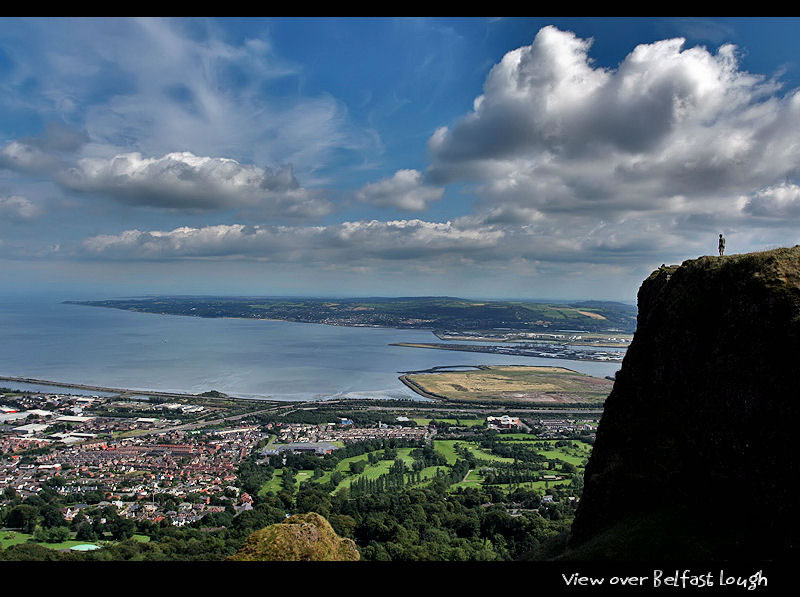
Photo above - Belfast Lough (source)
A deliberately provocative title for this blog post. Strangford Lough in County Down is endlessly admired as a natural habitat, but Belfast Lough is seldom acknowledged for its wildlife and is thought of mostly as a commercial sea route for trade and tourism. Back in 1880, Robert Lloyd Patterson published a book entitled The Birds, Fishes and Cetacea commonly frequenting Belfast Lough. It's a lovely read and is online here. His brother, William Hugh Patterson, has featured on this blog a few times before. Hope you enjoy the read. I am jealous of some of his fishing exploits.
... it must be funding round time again, and you've found this blog. Well done - Google is amazing. Well, don't assume that the many folk like me who know a few things about Ulster-Scots heritage (and others know loads more than I do) are sitting here full of excitement awaiting a phone call or email from a junior researcher so we can have our 'brains picked'. That's got very tiresome.
Most of us know by now you're only looking for us because of the money, it's like the smell of blood in the water and the sharks are circling again. I'm picky about who I waste my time with. If you're serious about doing a good job, about treating the subject with respect, and about presenting it with some empathy then maybe I'm interested. But otherwise, believe me, I'm not interested in being pillaged for knowledge which you won't understand and which you'll then probably butcher and mangle and pump into the public domain.
This knowledge is our cultural crown jewels. You wouldn't hand your car keys to a monkey, would you? So just pause for thought. If you want to pump out the same-old same-old then fire away and get on with it. But if you're genuine, then take some interest outside of the commissioning and funding round deadlines. Invest time to understand what you're seeking to portray, and we might invest some time with you in return.
The three-part series Plandáil was produced in 2011 for BBC Northern Ireland, backed by the Irish Language Broadcast Fund, and was presented by Neil Martin. It is one of the best televisual accounts of the Scots' arrival in Ulster in the early 1600s that I have seen in recent years - and importantly, it explains the differences between what Hamilton & Montgomery did in east Ulster, in contrast to how events unfolded in west Ulster.
I have been invited to give a talk next Wednesday evening at the AGM of the Presbyterian Historical Society of Ireland, on the subject of Rev James Hamilton of Ballywalter (1600-1666), one of the first ministers to come across. One of the events that Hamilton is renowned for was a public debate with the Bishops in Belfast which was dramatised in Plandáil - you can see at around 29 minutes in to the clip below.
Hamilton's story is one which has interested me for many years, given that he was the first minister in the area where I live, and that - unlike his contemporaries Robert Blair, John Livingstone and Robert Cunningham, nothing has been written about him. The talk will be general, not drilling down into the obscure details, but I hope it will be interesting to the audience. I need to get the full version published and out of my system!

"... the true and legitimate claim on the English crown, said the Scots, lay with the house of Wessex whose sole living representative was one Robert 1st of Scotland ..." (at 46.30)
- see GWS Barrow, page 315 here.
 |
| The Bruces' ultimate aim? |
'… It was probably at this time of peaceful occupation of Ulster by the Scots, that Sir Gruffydh Llwyd, who was in rebellion again Edward II., wrote to Edward Bruce to invite him into Wales, that by the union of the Albanian Scots with the Britons, the Saxons might be driven out, the times of Brutus restored, and the whole of Britain divided between the Britons and the Scots. Edward Bruce, notwithstanding his Norman blood, agreed to the proposal on condition that he was to have such command and such lordship over the Welsh, ‘prout alius hactenus princeps vester liberius habere consuevit.’ These were bright visions for the Earl of Carrick's younger son, the proud and overbearing Edward Bruce; he had been crowned King of Ireland, he had a near prospect of the crown of Scotland, and he now dreamed of the crown of Britain …’
- Annales Hiberniae by James Grace of Kilkenny (c. 1537).
‘… The prospects of Edward Bruce were at this time at highwater mark; he was heir-presumptive to the throne of Scotland had in all probability already been crowned king of Ireland, and now received a communication from Gruffydh Llwyd, who was leading a rebellion in Wales, offering to support him as ruler of that country if he would assist in freeing them from the English, and even holding out the prospect that they might together expel the Saxons and establish the ancient kingdom of Britain …’
- The invasion of Ireland by Edward Bruce by Caroline Colvin (1901)

A beautiful rendition. The Scottish influence on Dundalk in County Louth is shown by the cigarette brand 'Sweet Afton' which was manufactured there for many years, and the packaging and advertising for which has images of Robert Burns. Some of this is in display in Dundalk County Museum. Burns' sister Agnes lived there, and her cottage still stands at Stephenstown Pond.


