

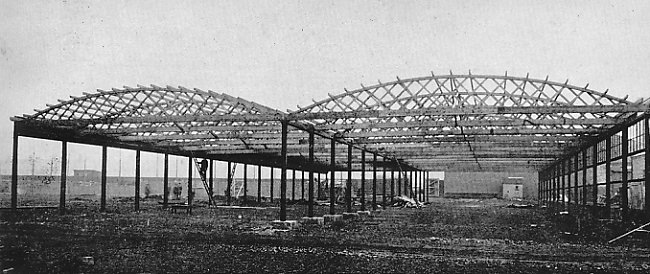
Here is a feat of engineering which isn't talked about much. The Belfast Roof was an ingenious lattice system, developed around 1860. The trusses have a curved top, and could span huge distances with no need for any vertical supports like pillars inside. These meant that large open-plan buildings - like aircraft hangars - were much easier to build and work in. Aside from being structurally clever these were visually beautiful. Some pics below gathered up from various websites. It would be good to see these reintroduced to our local architecture.
Friday, August 30, 2013
The Belfast Roof


Saturday, August 24, 2013
'Handed Down - Country Fiddling and Dancing in East and Central Down' by Nigel Boullier

Earlier this year I had the privilege to work with Nigel Boullier to put together a truly groundbreaking publication of his collection of over 30 years of music, photographs, stories, biographies and dances from the part of County Down where we both live. The outcome is the 544 page Handed Down - Country Fiddling and Dancing in East and Central Down, published by the Ulster Historical Foundation.
It covers over 200 years of living tradition, of community, of a world which predates and defies the 'two tribes' stereotypical approach to Ulster life. Nigel writes with authority, through years of study and research but because he is a fiddle player himself and is writing about his own folk, people who have influenced him throughout his life - and in turn of the people who influenced them, all the way back to the late 1700s.
Handed Down is a colossal achievement on many levels, succeeding in being both intimate and yet scholarly. Whilst my task was mainly to make it all fit within our page quota I hope that the design approach helps to get the story across. It contains 500 fiddle tunes, 30 dances and biographies of 300 fiddle players. It begins with a detailed overview of the origins of music and dance in County Down and, to me, a refreshing summary of the politics which have done such damage to folk tradition - on the one hand through appropriation by Irish Nationalism, and on the other hand just outright neglect and abandonment by Ulster Unionism. Traditional music is seen in our generation as the preserve of 'one community'. Handed Down shows that it is in fact a common inheritance, one which our ancestors truly shared.
As Nigel knows, at times it was a tough design process, but the painstaking effort that we both applied to it over many months has really paid off. We got on like a house on fire and a Waltons Mountain badge lives to tell the tale (that's an in-joke for Nigel!). Further photographs to be posted soon.
Handed Down - Country Fiddling and Dancing in East and Central Down is available here priced at £24.99.
Thursday, August 22, 2013
Wednesday, August 21, 2013
Glenfield & Kennedy Ltd, Kilmarnock (photographed today at the Thompson Pump House, Belfast)
You can find out more about the company's history at FutureMuseum.co.uk (click here)

Thursday, August 15, 2013
Moody and Sankey in Dublin, 1874
The two great American revivalists - DL Moody the preacher, and Ira D Sankey the song leader (who was of Scotch-Irish descent) - visited Britain in 1874. They arrived at Belfast on Sunday 6 September 1874 and preached to thousands of people until the following Sunday when they headed for Londonderry. From 24 October - 29 November they were in Dublin, again preaching to thousands every day. An account of their campaign in Dublin, printed in The Nation - said this:
'... Irish Catholics desire to see Protestants deeply imbued with religious feeling, rather than tinged with rationalism and infidelity; as long as the religious services of our Protestant neighbours are honestly directed to quickening religious thought in their own body, without offering aggressive or intentional insult to us, it is our duty to pay homage of our respect to their conscientious convictions; in a word do as we would be done by ...'
Remarking on this, a later author wrote '... it would surely be a bright and blessed day for our country, if this spirit of mutual respect and toleration were everywhere honestly acted out among us. Mr Moody never makes controversial reference to others. His success in attracting the favourable attention of our brethren of a different faith has been unexampled in the history of our city... men are not addressed as by their particular Church, but as sinners ...'

Wednesday, August 14, 2013
Sunday, August 11, 2013
Singing the Psalms in Prison
"... The dispute about Psalm-singing has broken out in an entirely unexpected quarter - an Irish prison. Some of the "Scotch-Irish" convicts have recently petitioned the chaplain not to use hymns in the prison service, but to use the Psalms, as the latter were inspired and the former were not. Perhaps if the criminals had shown the same degree of reverence for inspired writings before their incarceration, they would have saved themselves from much trouble and the country much expense ...'
- from the New York Times, 29 August 1869
Wednesday, August 07, 2013

Friday, August 02, 2013
Breakfast Ulster-Scots style
I was told this story many years ago. A big dour hefty man from Portavogie, John Thompson, married a thin timid wee woman called Maggie, probably some time in the 1950s. They moved into a cottage at the end of our road, at what was once a 'clachan' called Butterlump. On the day after the wedding, Maggie said to John:
"Whit way wud ye like yer egg this mornin John?"
Unimpressed, John said:
"Hmph. Alang wi anither yin".

Thursday, July 18, 2013
Animal cruelty
As I went up tae a wee hoose farm
A wee bark cam oot an dugged at me
I lifted my shouther over ma stick
An gien the wee dug such a lug on the lick
An made its water ee
(sent to me by Samuel, Carrowdore)
Monday, July 08, 2013
Joseph Braddell & Son, Belfast; manufacturers of breech loading shotguns, rifles & pistols. Established 1811
Saw this beautiful old label recently. Location of the shop? - next door to The Ulster Club - must have been a well-known venue in its day.

Thursday, June 27, 2013
Robert Wallace Murray - Confederate Army veteran, Belfast entrepreneur and philanthropist & resident of Newcastle, County Down.
Robert Wallace Murray was born in Jerusalem, Virginia, on February 9th 1836 (in 1888 the town's name was changed to Courtland). He was educated at home by his father, Dr Robert Murray, who had been born somewhere in Ireland, and who had been a classical scholar. The family lived in a large historic building called Elm Grove which Dr Murray bought in 1832, where he set up a school for local children. One of the pupils was William Walter White (1842-1918) a minister's son who later joined the Confederate Army (see biography here).
On the outbreak of the American Civil War, aged 25, Robert Wallace Murray joined General Robert E. Lee's regiment of the Confederate Army and is said to have 'participated in the brilliant dashes which made the Southern Commander famous in the earlier stages of the war.' (The National Park Service website records a Private Robert W Murray who served in the G Company of the 6th Regiment of the Virginia Infantry which had been raised in Norfolk, Virginia in May 1861. One of the regiment's field officers was Colonel William Mahone who like Murray also came from Jerusalem).
After the War Murray moved to Warrington in Lancashire and then to Ulster. He married Marion Workman at St John's Presbyterian Church, Newtownbreda on 7 June 1866. Marion died of typhoid fever on Boxing Day 1882, aged 37. Murray married again, on 19 March 1884, to Elizabeth Murray at Fisherwick Presbyterian Church.
He prospered in his new homeland and became a J.P. for County Antrim, Chairman of the famous Belfast tobacco firm Murray, Sons & Co, Honorary Secretary of the Royal Victoria Hospital, a Director of the Belfast Ropeworks Co. Ltd. and a member of the Belfast Harbour Board. He stood as a Liberal candidate in the election of 1886 for the constituency of East Belfast.
He penned a number of works - 'Modern Hindrances to Faith', 'General Lee' and 'Eighteen Months in the Confederate Army' a lecture which was published in 1877.
His home was Enniskeen, on the Bryansford Road near Newcastle - the 1901 Census records that he was 65 years old and his wife Elizabeth was 64. They had 4 female servants. The house is now the Enniskeen Country House Hotel (website here, including this overview of the history of the house).
He died on Christmas Eve of December 1904, leaving half of his estate to the London Missionary Society, and large bequests to Forster Green Consumptive Hospital (£75,000), the Belfast Society for Providing Nurses for the Sick Poor, and Belfast Hospital for Sick Children.
The former headquarters of Murray, Sons & Co. on Belfast's Sandy Row, has recently undergone a £5m refurbishment (shown below). I am sure someone out there can do further research into this fascinating man.
................
POSTSCRIPT 1 - The Virginian Pilot newspaper of Norfolk, Virginia reported on 20 May 1900 that Murray's brother was Rev James Murray, a noted Presbyterian minister and then pastor of Hampden-Sydney College. James was planning a trip to Belfast to visit Robert, after which he planned to go to the Paris Exposition. A third brother, Dr William W Murray was a pharmacist based in Suffolk, Virginia.
POSTSCRIPT 2 - This document contains the following details: '...In 1832 Oswin Ricks sold the property to Dr. Robert Murray, an Irish-born physician. Tradition states that Murray operated a school at Elm Grove at mid-century, a belief substantiated by the 1850 census which lists fourteen girls and two boys (in addition to the Murrays's own six children) residing at the house at that time. Murray sold the property to William W. Briggs in 1858. In 1887 Lucius Manry, father of the present owner, bought Elm Grove...'
Elm Grove is on the National Register of Historic Places and is shown below:
POSTSCRIPT 3 - before some looper froths at the mouth about the Confederates, and jumps to all sorts of bonkers conclusions, I am of course aware that there were men of Ulster descent on both sides of the Civil War / War Between the States / etc., including the Union Army's General Ulysses Simpson Grant whose ancestral home is near Ballygawley in County Tyrone. He went on to become US President. Grant visited the Harland & Wolff shipyard in Belfast in January 1879. It's easy to imagine Gustav Wolff greeting the former President, with fellow directors of related companies. I wonder if R.W. Murray J.P. was with the welcoming party, and if he revealed to Grant that just 15 years earlier they had been wartime adversaries? Or if he stood at the back quietly whistling 'Dixie'?


Tuesday, June 04, 2013
'he stabbed her in the heart and her heart's blood did flow...'
A new take on the famous Appalachian murder ballad 'Pretty Polly', by Vandaveer. Beautifully shot.
Thursday, April 11, 2013
Multicultural Ulster - introduction
Left: Detail from the Census of Ireland form, 1911.
What if everything you know is wrong? What if the stereotype of 'two tribes' in a state of constant antagonism in Ulster/Ireland is not true? What if it is in fact a relatively recent invention - and what if the actual story of Ulster / Ireland is of a truly multicultural place with thousands of years of comings and goings of different peoples and influences?
It has been said that there is no such thing as Irish history, just Irish mythology. The Census form here shows that 100 years ago efforts were made to avoid 'vague' terminology. Sadly this wisdom has not applied for the past few generations. People have been told that there are just two groups and that they belong to one or the other and never the twain shall meet or have met. But how would this place change for the better if everyone who has been fed that stereotype throughout their lives - and who as a result is boxed in to one of those 'two tribes' - had grown up understanding a bigger, broader and more accurate story?
Maybe rushing back to a selective interpretation of the 17th century, seeking justification to hate your neighbour, (as so many people ultimately seem to do) is a very unhealthy pastime and a very bad idea.
Over a series of posts to follow I am going to attempt to map out a complex, hopefully interesting, Alternative Ulster. The next post will begin with a family trip we made to Newgrange in the Boyne Valley in 2009 - a 5000 year old structure which is older than Stonehenge or the Pyramids...

Tuesday, April 09, 2013

Sunday, April 07, 2013
The Law v The Gospel (by Ralph Erskine, Dunfermline)

One for Sunday. The Bible shows us that the Law of God demands an impossibly high standard of perfection. No-one can achieve it - but many try to do so, and either end up:
a) filled with pride as they admire what they see as their 'successes' - as the poem above says it takes 'boasting' and 'feeds it to my bane', or
b) filled with despair when they experience repeated failure.
Jesus came and raised the bar. To paraphrase, He shocked his listeners one day by telling them 'here's a list of things that the Law says, if you do them, are sins. Well, even if you think about them that's sin too'. Only Jesus meets the perfect standard required the Law - and not only for Himself, but on behalf of all of the failures who trust in Him. I'm not a follower of Jesus because I am a 'good person' or as people in Northern Ireland often say 'good living'. I follow Him because I am a failure, rotten to the core in word, thought, deed and motive - but His perfection covers my failure completely. Ulsterman William McComb put it like this, inspired by these famous words from the Apostle Paul.
And so the Gospel, as the poem says, - 'yields me full relief'. And that relief, and gratitude, I hope is bringing about a change.
Saturday, April 06, 2013
National Tartan Day in the USA
Greetings to my US readers who are celebrating National Tartan Day today. The date of April 6th was chosen as this is the date of KIng Robert the Bruce's Declaration of Arbroath on 6 April 1320 - a document seen as the predecessor of the Scottish Covenants, the US Declaration of Independence, and therefore by default both the Ulster Covenant and the Women's Declaration of 1912. Of the 46 men who signed the Declaration of Arbroath, many had served under Edward (and Robert) Bruce during their campaign in Ulster/Ireland from 1315-1318. The list of signatories is available here.
See the Declaration of Arbroath online here.


Wednesday, April 03, 2013
Multicultural Ulster?
If you take the time to read the great historical volumes published in the 1800s, ie prior to the political turmoils of the various Home Rule crises which began in 1886, what you'll notice is the orthodox view was that Ulster as a province had been, throughout the centuries and millennia, a truly multicultural place. This is not understood today. Will post more here soon to develop this idea.
Sunday, March 31, 2013
New DNA evidence indicates 10% of Scottish men are descended from the Picts; 3% of Northern Irish men too.
Interesting story here. '...The Picts were assumed to have “disappeared”. But this version of history has since been updated and it is now believed they were overtaken by political events becoming assimilated by incoming Scots invading from Ireland...'
(oops - just fixed genuine typo in title - thanks Mick!)
Subscribe to:
Posts (Atom)