Ards folk are fond of their history, and tomorrow night the Events Programme for the 400th anniversary celebrations of the borough Charter is being launched. As you can see from the photos below of an antique bass drum from the CLB band, with the town seal hand-painted on the shell, local people here have remembered the date fondly over the centuries and I'm sure this year will be one to remember.

Wednesday, February 27, 2013
Newtownards 1613


Friday, February 22, 2013
Wooden iPhone conversion kit
So if technology is taking over your life then now at least you can adjust to it in a rustic, natural way. Eden Made is a wooden iPhone self-conversion kit from Germany, costing €89. Nice touch.




Sunday, February 17, 2013
Wednesday, February 13, 2013
The Mandolas (video clip from Irish tv station Balcony TV)
Never heard of these guys before but their sound is great. They describe themselves as a 'four piece folk-pop harmony group' and are from Cork.Website here. They have a page here with some more background info and music.
Tuesday, February 12, 2013
Fishermen's Friends (Port Isaac, Cornwall)
The manager (Paul McMullen) and one of the members (Trevor Grills) of acapella singing group Fishermen's Friends have tragically died as a result of an accident at a concert venue at the weekend. I've enjoyed their style for a few years, and was just re-reading their biography - Sailing at Eight Bells. For those of you who don't know of them here's an introductory video:
Sunday, February 10, 2013
Saturday, February 09, 2013
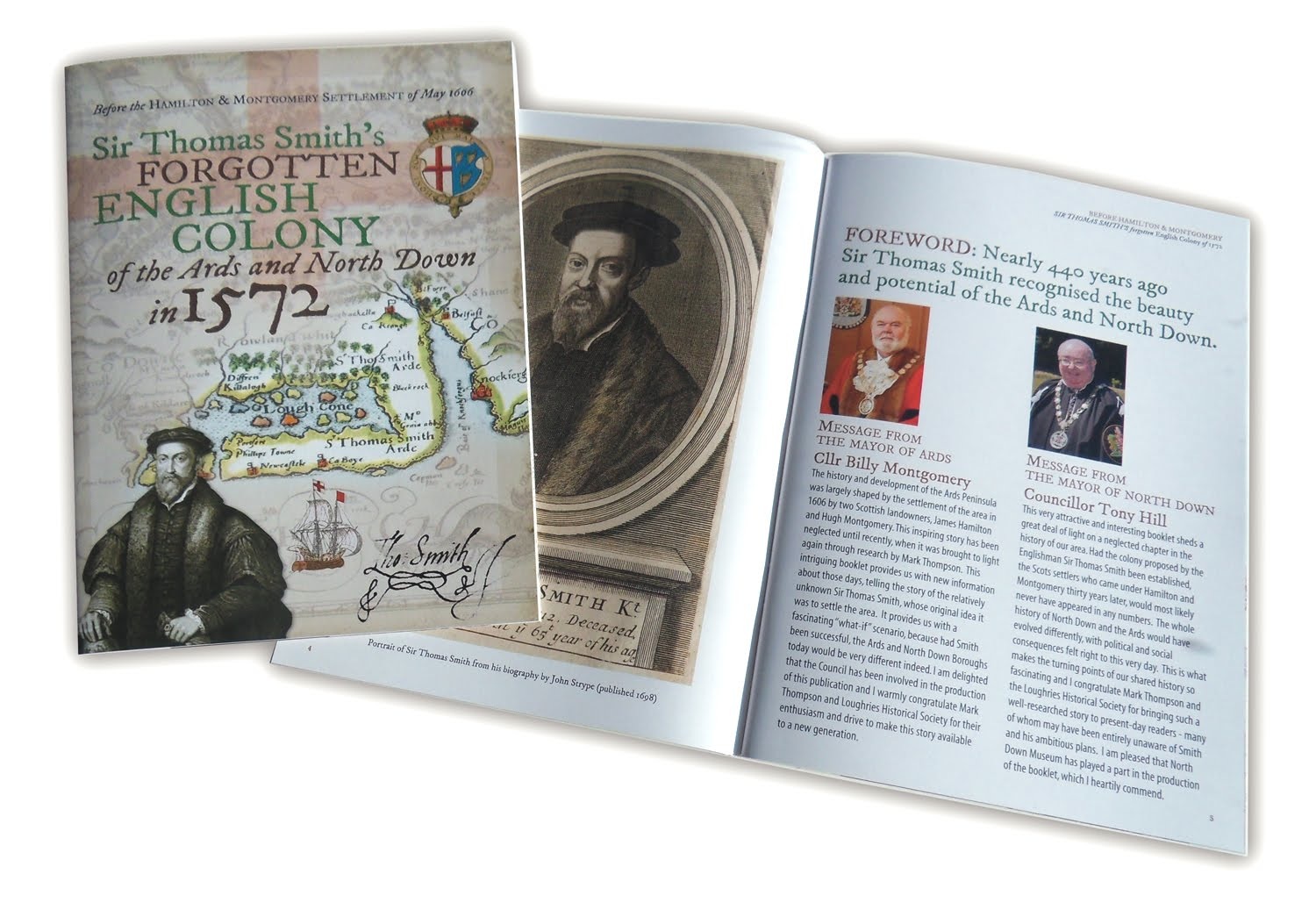
Join me on Valentine's Night!

Dr Jonathan Bardon's talk to the Society in January was about the arrival of James Hamilton in 1606, so I'm doing what is sometimes called the 'backstory' or if you're into Star Wars, the 'prequel'. For those of you who don't know, around 1605 Hamilton got a look at the Smiths' old legal papers from 1572 and discovered a golden opportunity which they had missed out on, but which he wanted for himself.
Bangor Abbey was burned down during the Smith campaign, but Hamilton rebuilt it. Hamilton succeeded where Smith failed. When he died he was buried in the Abbey crypt.
Hope to see you there!

Thursday, February 07, 2013
City versus country (Photo: the Scotch-Irish Farm, Frontier Culture Museum, Staunton, Virginia USA)
An idyllic photo of hard work outside an old Ulster farmstead that was taken across the Atlantic to Virginia. I visited it 15 years ago on honeymoon.
It is one of my favourite images and I am posting it here as over the past few days I have been thinking about the enormous social mis-fit there is here in Northern Ireland. It is not the 'two tribes' stereotype. It is the gulf between city people and country folk. It is vast.
The NI media and the majority of NI institutions are dominated by city-minded people. In cultural terms there is a version of Ulster-Scots heritage in the cities - but the authentic and natural form is to be found in the country areas. In landscapes not streets. City issues do not automatically apply to the country; city 'chips on the shoulder' are sometimes irrelevant in the country. City fights should not be assumed to exist in the country.
I have been spending a bit of time over recent months with some city-dwellers who are getting to grips with Ulster-Scots history for probably the first time ever. I think their self-confessed scepticism is starting to melt a wee bit. And fair play to them for being open-minded. But every now and again their urban mindset seems to struggle with things that country folk find natural.
Yes, Scotland is just over the water and we can see it every clear day. Yes, there are lots of folk out here who still use those words. And yes, we do try to get on with our neighbours even if their politics and religion are different than our own - we'll maybe bump into them next week in the shop, or down at the shore, or at the builders suppliers. And our grandparents probably knew their grandparents. And maybe even after all of that, they are our neighbours first and 'different' second.
As a local man once said to me '... d'ye know who it is that causes all the bother roon here? A'll tell ye - oul Bilfast yins...'. Life in much of rural Ulster is far from perfect, but it is not as polarised as in the city.
I know some lovely folk from Belfast, so the observation certainly doesn't apply to everybody. But, the next time you hear people arguing on our radio and tv channels, ask yourself if they are city-minded people. They probably are.

Tuesday, February 05, 2013
So King Richard III of England (1452 - 1485) has been found buried under a car park?
Here's the story. But what's the big deal? The first King of Scotland lies in an unmarked grave on a hillside in the suburbs of Belfast.....

Saturday, February 02, 2013

Thursday, January 31, 2013
In the County Tyrone in the town of Dungannon...
A photo from about 1pm this afternoon, moments before a hail and sleet storm.

Tuesday, January 29, 2013
Friday, January 25, 2013
Yin for Burns Nicht
A 50 year old recording of Psalm 23 in Scots, read by Rev James L Dow, 1963. Mair fillin than haggis...
Thursday, January 17, 2013
R.J. McClean's Double Headed Goat Wool Line - made from the Gossypium fleece of the Blue Ridge Mountain Scotch irish Goat.
Found this photo in the bowels of the computer the other day.

Monday, January 14, 2013

Saturday, January 12, 2013
Sir James Fullerton (d. 1631) - Hamilton's man
I was in London last week and had hoped to visit Westminster Abbey to see the memorial to Sir James Fullerton, but time didn't permit. Fullerton was James Hamilton's right hand man and fellow Ayrshireman, and is an interesting character in his own right:
According to Paterson's History of the County of Ayr (1852), his parents were John Fullerton of Dreghorn and Janet Mure of Rowallan. John was a firm supporter of the Reformation in Scotland. Dreghorn is only about 12 miles from James Hamilton's home of Dunlop, and given that Hamilton's father was the local minister it's possible that James Hamilton and James Fullerton had known each other from childhood. James Fullerton became a pupil of the firebrand Scottish Reformer Andrew Melville.
In 1587 Hamilton and Fullerton left Scotland together and sailed for Dublin, where they established a school and later became founding Fellows of Trinity College. In 1605 when Hamilton got wind of the impending deal between Con O'Neill and Sir Hugh Montgomery to split the O'Neill's Clandeboye estates in half, Fullerton was at the Royal court and got to the King, persuading him to divide the estate into three, with one third for Hamilton (to whom the King owed a lot of favours). For his trouble, James Fullerton is said to have been granted Olderfleet Castle in Larne and other parcels of land in Westmeath, Tipperary, Waterford, Sligo, Donegal, Dublin, Roscommon, Kerry, Kilkenny, Kildare and Cork, including a licence to hold a weekly Saturday market and two fairs in Sligo.
Fullerton however '...loved ready money and to live in Court more than in waste wildernesses in Ulster...' and doesn't seem to have spent much if any time here at all.
Below is Fullerton's modest memorial at St. Paul's Chapel in Westminster Abbey. Official description here.
- some further details on the Ayrshire Fullartons, and their Covenanter connections, can be found here on ElectricScotland. HEre is an excerpt:
'... John Fullarton of Dreghorn, who was served heir to that estate in 1546, and who was the fifth in direct descent from Rankine Fullarton of Fullarton, mentioned previously, took an active part in the Reformation in Scotland, and involved his estate very much on that account. With a view of suppressing the convent of Carmelite friars at Irvine, which the Fullartons of that ilk for centuries liberally supported, he purchased, on 19th May 1558, from Robert Burne, prior of said convent, the lands of Friars Croft and Dyets Temple, on which it was situated. At the meeting of the first General Assembly of the reformed Church of Scotland at Edinburgh, 20th December 1560, Fullarton of Dreghorn was one of the commissioners “for the kirk of Kyle.” On 4th September 1562, with the earl of Glencairn, Lords Boyd and Ochiltree, and a number of the gentlemen of Ayrshire, he subscribed the famous band at Ayr, to support and defend the reformed religion at all hazards, and against all its enemies; and, on Queen Mary’s marriage with Lord Darnley, he went, on 31st August 1565, to Edinburgh, along with the earls of Moray, Glencairn, and Rothes, and Lords Boyd and Ochiltree, at the head of 1,300 horse, in defence of the reformed faith. He was also one of those who, on 25th July 1567, subscribed the articles agreed to in the fifteenth General Assembly, for the punishment of the murderers of the king (Darnley), the defence of King James, and the rooting out of all monuments of popery. In 1570, with the Reformed noblemen and gentlemen of Ayrshire, he signed the letter addressed to Kirkaldy of Grange, desiring to know the meaning of his threats toward John Knox. In the General Assembly of March 1571, he was one of the commissioners appointed to wait upon the Regent, relative to matters pertaining to the jurisdiction of the church. By his wife, Janet, daughter of Mungo Mure of Rowallan, he had three sons and three daughters. His third son, Sir James Fullarton, was educated at Glasgow, under the tuition of the celebrated Andrew Melville, and afterwards went into the court of Charles the First, who knighted him, and appointed him first gentleman of the bedchamber. In this situation he died, and was interred in Westminster Abbey, where an elegant monument was erected to his memory...'

Saturday, January 05, 2013
Wednesday, January 02, 2013


Sunday, December 30, 2012
Three into two won't go
Above: an old embroidered place setting from my own collection, showing Ulster as a combination of Thistle, Rose and Shamrock. Probably circa 1930.
I still have trouble explaining - often to people who really should know better - that the political 'two tribes' Troubles industry is not the only way to view life and history of Ulster and Northern Ireland. Perhaps the Troubles industry is too lucrative, too much of an easy-sell, for those who have grown wealthy, famous or even lazy by perpetuating it. It fills airtime and column inches, it sells books and theatre tickets, keeps people in certain jobs, and consequently fills people's hearts and heads. Politics has its place, but it should not be everything.
I will continue to argue for the cultural three strands story. On Christmas Day I was loaned a book (now that's miserly, eh?!) entitled The Orange Order, written by a Tony Gray, published in London in 1972. I have not started to read it yet, but the short author's bio on the verso caught my eye. It gives some of Gray's background, mentioning that '... his mother comes from an Ulster family of Scots-Irish settlers called McKee, his father was Anglo-Norman in origin and Church of Ireland by persuasion; and he married an Irish Catholic. So, as he says, he has been exposed to three of the main strains in the Irish situation ...'.
Thistle, Rose & Shamrock. Scottish, English & Irish. Presbyterian, Anglican & Catholic. Three cultural sides to the story, not two.
..........
Thanks to the many thousands of you who bother to visit and read here throughout the year. I plan to be offline for a few days, so enjoy your New Year / Hogmanay celebrations and I'll be back in early 2013 (dv) with the same themes and some new thoughts and discoveries along the way.

Subscribe to:
Posts (Atom)