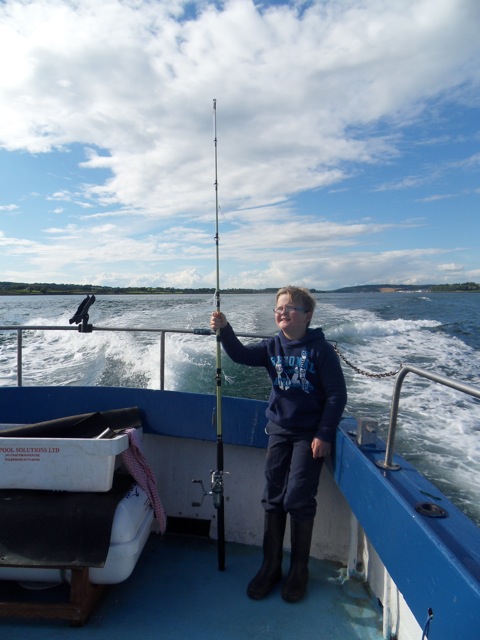
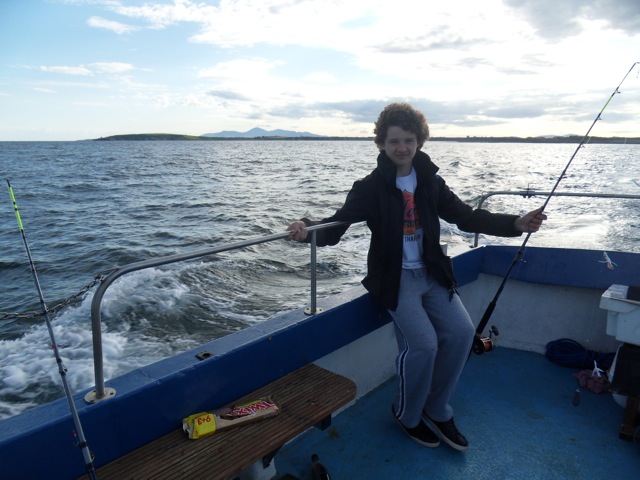
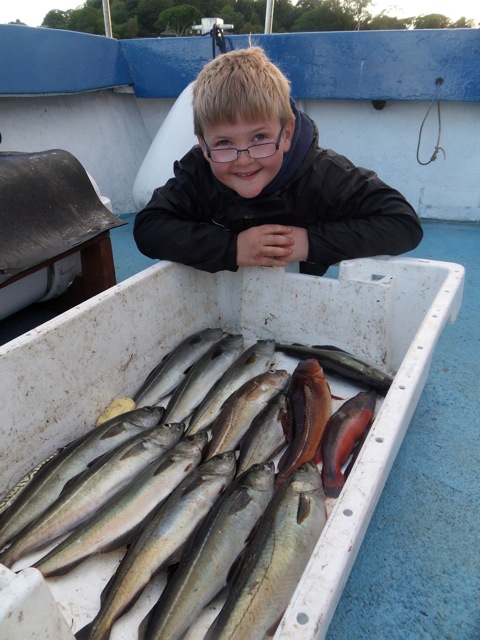
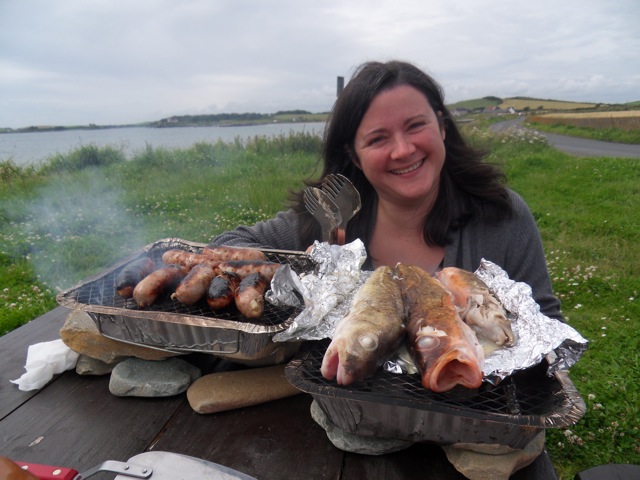
Last night the five of us went out fishing from Portaferry with Peninsula Charters on a 3 hour trip, from 5.30 till 8.30, taking advantage of the tide times. Those of you how know me well will know how much I love getting out onto the water, usually up around Bangor or Donaghadee. So we tried something different last night and boysadear did it pay off! Best night's fishing I can remember, and the family were amazed at the variety and quality of the catch. The freezer is well stocked now with pollock (lythe) and coalfish (blockan), we landed a few good cod which we barbecued earlier today and also some wrasse (but we only kept one of them as a trial - it was tasty, soft, but very bony). The men that run the boat have fished the bottom end of the Peninsula, Strangford Lough and the coast of Lecale all their lives and so when we got going the banter and oul stories were mighty.
Website is here. We are definitely planning a few more trips with them before the summer is out, so anyone who lives in the area who fancies coming with us during August please get in touch with me and I'll make the charter arrangements.
Otherwise feel free to contact them directly and prepare for a trip to remember!
Farewell Portaferry
First coalfish
With the Mourne Mountains behind
Nice coalfish for Charlie
The SeaGen tidal energy turbine
Homeward bound
Gutted, mostly beheaded...
...and battered fillets for supper!
Two cod and a wrasse heading for the barbecue
A happy chef!
You could spend a lot of money travelling to (for example) the west coast of Ireland or Scotland for an experience like this. Now it's available right on our own doorstep. Scenery, banter, stories, the satisfaction of catching your own dinner... and far more enjoyable (and sustainable) than queueing at the fish counter at Tesco! We just need to get a bigger freezer...
Tuesday, July 31, 2012
Deep sea fishing with Peninsula Charters, Portaferry







Friday, July 27, 2012
BBC2 tonight: The Great British Story - Episode Six: The Age of Revolution - 7.30pm
Thanks to William for this tip-off, the publicity information says:
"...This week Michael tells the story of the British Civil Wars, seen from the perspective of the people, right across the British Isles. In search of their experience he travels to Dublin to uncover the horrors of the Irish Rebellion, to County Down with the Ulster Scots, and to Cornwall where an amazing local project is mapping the battlefield finds of Parliament's greatest defeat.
Uncovering little known stories in the arms manufacturing centres of the Black Country and Birmingham, Michael shows how the war split local communities. In Myddle, in Shropshire, a unique village account gives a vivid portrait of the young men who died in the war. In the aftermath, with the monarchy overthrown and the king executed, revolutionary movements rise up, Levellers and Diggers, which Michael argues are the roots of our modern British democracy. The episode ends with the monarchy restored and the British people united under one crown, on the verge of the Age of Industry..."
It will be interesting to see how our story is told and portrayed. I was asked to take part in one of "The Great British Story" local events at Mount Stewart back in May but wasn't available to do so.
Link to BBC website here.

Tuesday, July 24, 2012
Seth Sykes (1892 - 1950) - unique artefacts discovered!
Some of you will know of Seth Sykes, a Glasgow tram conductor and evangelist. He and his wife Bessie travelled the British Isles and spent much time in Ulster during the 1930s and 1940s at places like the Shankill Road Mission and the various Christian Workers Union halls, especially the one in Lisburn which is still going today. I have met many folk here who met the Sykes and remember them fondly. The rare booklet "Seth Sykes - a Great Little Man" tells his life story and gives a number of accounts of Seth and Bessie's time on this side of the water.
One of their methods was to go to public places, like Market Square in Lisburn, where they used 'magic lantern' shows (glass slides beamed from an enormous projector) to project large images onto the exterior walls of public buildings or onto temporary screens - all to attract a crowd and to then present the Gospel message to them through pictures, stories and songs. And we think Powerpoint is innovative? Try getting an outdoor electrical supply in post-war Ulster!
Amazingly, a man contacted me a few weeks ago (thanks to finding previous blogs posts here which mentioned the Sykes') to say that he had just unwittingly obtained what turned out to be the Sykes' projector and glass slides collection at an auction in Yorkshire. I have now acquired them from the man and they should arrive with me later this week. More info to follow...
Monday, July 23, 2012
A Tale of Two Theologies - the Dutch and Scottish Reformed Traditions
Some of you will enjoy this article from TheResurgence.com

Sunday, July 22, 2012

Tuesday, July 17, 2012
My son Jacob with the late great Doc Watson in the background, Norris, Tennessee, October 2002
Doc Watson died a few weeks ago, aged 89. He was one of the greatest country-blues traditional guitar players. We saw him playing when we were in Tennessee in October 2002 at the annual Homecoming at the Museum of Appalachia in Norris. But he had the benefit of being recorded, of being respected, of his ability and authenticity being recognised. That he was blind from childhood made his musical talent all the more remarkable - he once said he could strip and engine and rebuild it despite not being able to see. He was 'discovered' in middle age, having spent his life up till then playing at country socials and dances. How many others have passed away here in Ulster in recent decades, unrespected, unrecognised, unrecorded, and how much tradition has been lost?
Here's an obituary. And here's what Doc Watson thought to be the most important -


Monday, July 16, 2012
The McTear Brothers - from Covenanters to Shipbuilders - the Belfast Glasgow Steamship Company (founded 1826)
As you head out of Belfast towards Greenisland, you'll pass Hazelbank Park on the shore of Belfast Lough. One of Belfast's grand houses stood there until the IRA blew it up in the 1970s; in its later years it had been used as a Council headquarters. The big house at Hazelbank Farm had been bought by David McTear in 1796. His grandfather, Noah McTear, had fought as a Covenanter at the Battle of Bothwell Brig near Hamilton in Scotland in 1679, and like so many fled across the water to Ulster in the aftermath (one account says he was in an open boat with his wife and son). They settled at Ballycarry.
David McTear had two sons - Thomas and George. Inspired by the leading innovation of their day, the steam-powered engine and specifically ships driven by these new-fangled engines, the brothers brought the technology to Ulster when they founded the Belfast Glasgow Steamship Company in 1826. They headhunted a Robert Patterson Ritchie (nephew of William Ritchie of Saltcoats) to oversee the construction of their first vessel (called the Fingal) which was built in Greenock in Scotland. Maybe the engraving above is Fingal? Robert Ritchie became her first captain.
The Glasgow agents for the company were brothers James and George Burns - in a series of mergers and acquisitions the company became the Burns & Laird Line which continued operations across the North Channel up until the 1960s. The architecture of the firm's former headquarters in Belfast is adorned with stone carvings of Scottish thistles and depictions of St Andrew, Scotland's patron saint.
With all the publicity Titanic has received this year due to it being her centenary, other important maritime stories have been overlooked. The Belfast-Glasgow connection is a truly titanic story.

Sunday, July 15, 2012
The Lower Lights - "A Hymn Revival" Volume 2
(Mormon) acoustic old-time hymn-playing ensemble The Lower Lights have just issued Volume 2 in their series 'Hymn Revival'. Some great classics here. Some of these are new to me and without having researched them yet they may well be Mormon standards. So, not sure if this should be regarded as (to use an Old Testament term) "food sacrificed to idols", but musically speaking some of these recordings are terrific. it's ironic that whilst many 'mainstream' evangelical churches even here in relatively conservative Northern Ireland are ditching these centuries-old hymns and spiritual songs, that others are recognising their quality and are taking hold of them for today.

Wednesday, July 11, 2012
Some rough thoughts on Scottish Independence
(thanks to Robin for the photo)
Over the past few months, a few people have asked me to write articles about potential Scottish independence for other websites. I decided to keep my powder dry as I don't really want to set myself up as a 'talking head' political commentator sort (of which Northern Ireland has far too many anyway). But as the opinion polls and coverage of the subject continue to swing back and forth, I thought I might outline my train of thought here and get it oot o the road.
I'm a Unionist
In a nutshell, as regular readers here will know, I believe that here in Northern Ireland there's far too much emphasis on POLITICAL identity and not enough on CULTURAL identity. The media and public institutions are stuck in a politics-only mindset and can't imagine a world any other way. I have political views and I vote regularly. I am a Unionist, both rationally (because to me it makes sense) and emotionally (because of family and ancestry). But politics is just one part of my world.
Culture more important than politics
Culture will always be more important for me than politics. Why? It's very simple - politics can change at the whim of a politician or political party, but culture is shaped by centuries of communal experience. If I only regard myself politically, that means I am trusting my identity to a future First Minister, Prime Minister or election result. And in the meantime I am leaving myself exposed to the rollercoaster of endless political debate and opinion polls. Madness!
What if Scotland goes independent?
So if the people of Scotland were to vote for independence, what impact would that have on Northern Ireland? In this supposed "nightmare scenario" for Unionists of Scotland voting for independence, and the likely break-up of the United Kingdom - where would that leave Northern Ireland's Unionist population? A major part of our POLITICAL identity would have disappeared, perhaps forever, thanks to politicians and the wrong result in an election. If the Union disappeared then Northern Ireland's Unionists would surely also then disappear. No Union, no Unionists?
Post-independence?
However, our deeper and more powerful CULTURAL identity would carry on regardless. Scotland would not drift further away - it will still be 18 miles from Donaghadee to Portpatrick. Our centuries of historic and cultural connections with Scotland would not change one iota. These connections predate the Union; they have at times opposed the Union, have in the main supported the Union - and they may even outlive the Union. Our ties with Scotland could even be strengthened as a new Scottish independent government might well want to forge closer links with Northern Ireland (and the rest of Ireland too), making that 'official' relationship stronger than it has been for generations. But on a more human level, far away from new governments and new policies and new initiatives, I would still have family and friends in Scotland. Independence will not change that either.
So, get cultural!
Culture and heritage matter far more than politics. And yet our CULTURAL identity is the one thing which has been (and is still being) trivialised, ridiculed, attacked and under-resourced. Many opportunities have been lost and resources wasted. I tried to influence the rarified world of "the system" for four years and it was daily struggle to get good quality Ulster-Scots work done. And I know plenty of others who bear similar scars, some far deeper than mine. But between us we've still somehow managed to get some good stuff done. But there's scope for so much more. Where are the promised "East-West" organisations and initiatives? Oh that's right, there aren't any, that was just a deception spun by politicians.
"The system" resists culture because it views everything as political, and moulds everything it touches to become political.
But people need something far deeper. Cultural identity will outlast all politics - whether that's within independent countries or as part of a United Kingdom.

Tuesday, July 10, 2012
"Rangers, Protestantism and Scottish Society" by Harry Reid
The ongoing saga at Rangers Football Club continues to bewilder many. Through the frenzy of company law, tax law, financial charlatans and opportunists, and what sometimes appears to be a vengeful Scottish football 'establishment' seizing its opportunity to slay the giant, there seems to be agreement among the manager, Ally McCoist, and the majority of fans, that Rangers should rebuild from the bottom league of Scottish football regardless of the financial implications.
In all of this, a few pieces of intelligent writing have emerged. This article was sent to me by a few people, having been published on a website I hadn't heard of before. Written by Harry Reid, former editor of The Herald newspaper, it provides an interesting view on the social changes which have left the Church of Scotland on the sidelines with little relevance for today. I think many readers here will find it of interest.

"...Rangers had standards and dignity, a sense of pride and self-belief: they were a decent club representing something resolute - aye ready – in the Scottish character and their supporters were honourable people. They had a strength and self respect that was undoubtedly linked to the better aspects of the Scottish Protestant tradition.
All that has withered away now. It is not just because of the demise of Rangers; there has been a parallel decline in the Church of Scotland. Not so long ago it could legitimately claim to be Scotland’s national church; it could speak to Scotland, and speak for Scotland. Now it can barely raise a whimper on any matter of public significance.."
Click here for article
There are other well-considered articles on the same website.
Someone once told me 'Better to fail with honour, than to succeed by fraud'. All of the problems at Rangers were caused by the company, not the football club. Yet the football club is bearing all of the punishment, and those running the company (so far) have got away with it. But I wonder will the financiers who caused the implosion at Ibrox face appropriate justice, or will they escape in a smokescreen of lawyers and administrators?
To lift the closing comment from this article on the same website, "Salvation is always possible – even for the most lost of causes".
Saturday, July 07, 2012
Thursday, July 05, 2012
Gladstone and an "Ulster Covenant", 1869
In 1869, the Liberal Prime Minister William Gladstone "dis-established" the Church of Ireland (see story here). Below is an excerpt from a speech he gave in Parliament that year, where he uses the term "Ulster Covenant", 43 years before the eventual Covenant was created.
Earlier in the debate Benjamin Disraeli outlined a chronology of Established church history in Ulster from 1568 onwards, and of the arrival of the Presbyterian Scots during the reign of King James I. Mr Henry Chaplin, the MP for Mid Lincolnshire*, in what was his maiden speech in the house reinforced the "historical resume" which Mr Disraeli had given and spoke of "...a bargain which had been made with the settlers of Ulster..." and the Convocation of 1634 (see story of the Convocation here).
Gladstone rose and, referring to early 1600s Ulster, and highlighting the status of both Ulster Presbyterians and Irish Catholics, said this:
"...it would, perhaps, be more convenient to postpone the discussion of that portion of the hon. member's speech relating to what I may call the Ulster Covenant until we come to the amendment in which it is proposed virtually to include the grants of James I, because the amendment upon which we are now engaged would not include them... a covenant may have been made between James I and the Protestant settlers of Ulster in the first place, I know not how those who look down upon the pages of history can think that the bargain has ever been kept as respects the major portion of these Protestant settlers in Ulster - namely, the Presbyterians. And I may also say that from that covenant was absent the men who had a paramount right to be consulted - namely, the men of the Irish nation..."
- Gladstone's speech as reported in The Guardian, 5 May 1869.
The language is a bit tortured, but the use of terminology is interesting. MPs knew Ulster history, understood the difference between the Church of Ireland and Presbyterians, and knew the term 'Covenant'.
.................................
* Henry Chaplin's daughter Edith married Charles Vane-Tempest-Stewart, 7th Marquess of Londonderry (of Mount Stewart). Stewart became Leader of the Senate and Minister for Education in the first Northern Ireland government in 1921.
.................................

Two interesting Ulster Covenant references, from Canadian newspapers of 1912 (one pro and one anti): -
"...The Ulster Scot may be led; he will not be driven. Home Rule will come by consent, not as a yoke of humiliation for any section of the Irish nation..." - The Lethbridge Daily Herald, Friday 11 October 1912
"...anyone must have been as green as Ireland's justly celebrated grass to take all this foolishness seriously. Only an Ulster Scot who can build a holiday around the doctrine of predestination could swallow it. The stage management of this solemn comedy was too raw..." - the Winnipeg Free Press, 17 October 1912
Wednesday, July 04, 2012
The Cove, Ballyhaskin
Found this postcard recently. Ballyhaskin is a rural townland between Ballywalter and Millisle. Not much to see there, but once upon a time it was thought picturesque enough to have a postcard printed. An idyllic image from a simpler time.
"Oul boat-holes gien up thair task in,
Reuch an roakie Ballyhaskin,
Eneuch o pladdies fur tha askin,
An mair on doon,
Roakie heidlans at Tha Whuskin,
Gar boats gang roon"
- an excerpt from this poem by Philip Robinson

Thursday, June 28, 2012
Sweet Afton - by Chris Thile
(Thile is pronounced Thealey). This is a beautiful rendition of the Robert Burns classic, played in the Brig O Doon Hotel in Alloway, Ayrshire, I think in 2008:
Flow gently, sweet Afton, among thy green braes,
Flow gently, I'll sing thee a song in thy praise;
My Mary's asleep by thy murmuring stream,
Flow gently, sweet Afton, disturb not her dream.
(full poem available here on the BBC website)
Tuesday, June 26, 2012
If you have a spare £250,000, and then a few pound more for upkeep...
...then this could be the house for you. Ballyvester House outside Donaghadee is said to have been first established by a William Catherwood, one of Sir Hugh Montgomery's close associates, who was born in Lanark, Scotland around 1570 and settled at Ballyvester in 1606. Catherwood was also granted the nearby townland of Ballyfrenis by Montgomery that same year; in the later 1600s the Catherwoods styled themselves as “Lairds of Ballyvester”.
A more recent cultural connection for Ballyvester House is that this is where the family of Sir James Craig, the first Prime Minister of Northern Ireland, lived for many generations. Craig's father was born here before relocating to Belfast where he became a whiskey millionaire.
The Ordnance Survey Memoirs of 1837 for Donaghadee parish said that “the dialect of the people is almost completely Scotch and they have altogether a great resemblance to their Scotch neighbours”. James Craig's grandfather (who died in 1868 and whose gravestone is in Donaghadee Parish Churchyard) would have been around at the time the Memoir was recorded.
So with family connections here it is no surprise that Sir James Craig is said to have overseen the famous gunning events at Donaghadee of 24/25 April 1914.

Monday, June 25, 2012
'True Blue Presbyterians - firm, plain and durable'
'...the men wore jerkins or coats made from home spun wool prepared for use by a fuller who had a "waulk mill". The colour employed when such cloth was dyed was generally blue. This may have given rise to the designation "true blue Presbyterians" especially among the Irish immigrants from Ulster where decent cloth was meant to be firm in texture, plain in aspect and durable in wear...'
- from Girvan 1668 - 1968
Friday, June 22, 2012
Boughey William Dolling Montgomery gravestone, Magheralin
Regular readers will know who BWD Montgomery is. Located his gravestone today at Magheralin when I was in the area.


Unplugged
Have had quite a few conversations with folk lately who have noticed that switching off the media is good for you. In America they've given this the name 'media fast'.
For most of my life here in Northern Ireland our airwaves and newspapers brought nothing but reports of murder and terrorism, to immeasurable effect. Thankfully that is (largely) over. Now however the coverage is dominated by (to steal a phrase someone used recently) the political, the public sector and the pointless. No matter what the subject matter (eg something truly life-altering like the shocking price of Jaffa Cakes) we are force-fed a stale format where we are given a Unionist view and a Nationalist view of everything*. This is usually followed by the latest public sector report exposé of yet another financial or competence flop (yet which mysteriously no-one seems to be held responsible for). And, then to lighten the mood occasionally, a bit of entertainment stuff like golf, rugby or Snow Patrol etc... before starting all over again with something political again, and so on.
One of the advantages of "social media" is that you can choose to avoid all of the above and just communicate with your friends or read what they're up to, and connect with like-minded folk. Some of it might be trivial, but at least in a sense it's relationship-building and contact-maintaining. I like catching up with people who I've maybe not seen in person for a while, for them to say "I read such-and-such on your blog..." which then kickstarts a conversation.
There's been much discussion lately about the death of newspapers and the upsurge of 'new media'. I think that this misses the point. If anything is dying it's people's appetite for being spoonfed the same old stuff by corporate media, and the upsurge is in being able to stay in touch with real people. 9 out of 10 cats still prefer authentic instead of contrived if they are given the choice.
> Try the 'National Day of Unplugging' here
> Try the 'Undo List' here
(There was a bit of a tangle here on a similar theme a few weeks ago).
*presumably the Unionist spokesperson would approve of Jaffa Cakes because of the orangey bit.

Tuesday, June 19, 2012
New DVD: "The Story of Ulster's Solemn League & Covenant" by Twelve Stones Media: £10.00 + £2.00 p&p
Nowadays people don't read much, usually because they can't be bothered. The printed page is not pored over as it was in previous generations - video is our medium of choice today. Even though they wouldn't read for an hour, people are more than happy to watch a screen for hours on end.
This new 1hr DVD - "The Story of Ulster's Solemn League & Covenant" takes the viewer through the 1800s and 1900s, from the Act of Union of 1801 right up to Ulster Day of 28 September 1912, explaining the events which shaped the hearts and minds of the 471,000 people who signed the Covenant that day.
Historical illustrations and photographs are interspersed with four interviews - Dr Fraser Agnew, Nelson McCausland MLA, Dr David Hume and myself. I must confess that the political complexity of the three Home Rule crises often makes me glaze over, but not this time, the story is told clearly without getting bogged down in obscurities. There are some fascinating insights into parts of the Ulster Covenant story which are often never told including how new Vatican policies of the time and public statements by Catholic church leaders confirmed to Ulster Protestants that their worst fears were not just hypothetical - 'Home Rule' would indeed be 'Rome Rule', as the slogan of the time warned. It also talks about Rev J B Armour, the pro-Home Rule Presbyterian minister, and of how land reform also played a part in the popular opinions of the time. A poignant story is of those Ulster people in counties Donegal, Cavan and Monaghan, who signed the Covenant as a bond of solidarity but who found themselves abandoned when the border was drawn and Ireland was partitioned.
The parts which I contribute are relatively 'soft', (filmed at Donaghadee on a cold grey February morning) explaining something of the earlier Scottish Covenants, the 1644 Solemn League and Covenant in Ulster, the awareness of the Covenanters' in late 1800s and early 1900s Ulster, and of my great grandfather who signed the Ulster Covenant in Troon in Ayrshire.
I can't praise this DVD highly enough, and can thoroughly recommend it to anyone wanting to find out more about these emotive, historic times. I hope other 'professional' broadcast television producers can match the standard of high quality, informative content which has been set here.
> The DVD is available through the Twelve Stones Media eBay store for £10.00 + £2.00 postage and packing. Click here.

Friday, June 15, 2012
Settle bed - found one at long last
"...There was an oak settle standing beside the wall, a little removed from the window. Now a settle (Ah, but it is long since I have seen one!) is a long box-like arrangement with a high back, which opens out to form a bed, but which when closed makes a very comfortable seat or couch, and is, if of black oak as ours was, a handsome piece of furniture...
"Get in there," she said, "an' say yer prayers if iver ye prayed in yer life afore. Pray fur the hoose ye hae brocht intae peril, the lad whose feet are gaun doon tae daith, an' the auld wife whose pittin' her immortal soul in jeopardy fur yer sake. God hae mercy an' protect us a'."
I am sure Savage would sooner have faced the company of soldiers upon the road than that accusing countenance. He did not utter a word in reply, but did her bidding, and in another minute Alison and I had folded up the settle and stood looking at one another silently from either end..."
- from The Pikemen; A Romance of the Ards of Down by S R Keightley (1903)
