Earlier this year, Radio Ulster held a public vote to find the ten most popular songs written by Northern Ireland artists. You can find out more here on the BBC Northern Ireland website. The winner was the 2001 song 'Shining Light' by Downpatrick rock trio Ash - a great piece of guitar pop and I think a worthy winner.
The lyrics of 'Shining Light' have occasional oblique Biblical references - 'a constellation once seen over Royal David's city' and so on (read them here and pick out the references for yourself). I'm not saying that 'Shining Light' is a gospel song, but it made me wonder what the top ten Northern Ireland / Ulster written gospel songs would be. So in a few days time I'm going to post here my own top ten Great Northern (Sacred) Songbook - readers suggestions are very welcome.
To be continued...
Here's a link to the Wikipedia entry; below is the video of 'Shining Light':
Thursday, May 31, 2012
The Great Northern (Sacred) Songbook


Saturday, May 26, 2012
An oul freen fae Ballyfrenis
Great to see that my oul freen fae Ballyfrenis Darren Gibson (we went tae Sunday School, then big school, and then Art College thigether) has gone on tae bigger an better things from his Newtownards Chronicle column and is noo writin a new Ulster-Scots column for the News Letter.
He micht leeve nearhaun the Maiden City noo, but he's still a Low Country Lad at hairt (an tung forbye). Today's column is about the simple joys of a wee danner, with a stick, and with no distractions. I'll say nae mair jist noo until he puts it online. To visit Darren's blog, 'Fae tha Han o a Low Country Lad', click here.


Friday, May 25, 2012
697 years ago today...
(image from this website)
... on 25 May 1315 Edward Bruce, the younger brother of King Robert the Bruce, sailed from Ayr with a huge armada of 300 ships and with 6000 men. They landed on the County Antrim coast at numerous locations stretching from Glenarm to Larne Lough. Their purpose was to fulfil an invitation which had been extended to Edward by 12 Gaelic chieftains and the rogue Anglo-Norman DeLacys - to become King of Ireland and to drive out the Anglo-Norman 'Englishry' establishment.
Thanks to the victory at Bannockburn in 1314, Robert was now the undisputed King of an independent Scotland. So in 1315, Edward would also become a King. Just days after the arrival in Ulster, his 6000 Bannockburn-hardened men famously defeated 20,000 Anglo-Normans in a huge battle near Raloo. A few weeks later Edward was 'crowned' at Carrickfergus Castle*... and so began a 3 year campaign. Robert came across to help on a number of occasions. Ultimately, the Bruces' campaign failed.
With all of the talk about 'centenaries' in Northern Ireland this year and over the next few years (Titanic / Covenant / Easter Rising / Somme etc.) two earlier cultural centenaries have been overlooked:
• 2013 will be the 400th anniversary of the arrival of Edward Brice, the first Presbyterian minister in Ireland, to Ballycarry in County Antrim
• 2015 the 700th anniversary of his ancestral kinsman Edward Bruce, at the same part of County Antrim.
Exhibition display at Edinburgh Castle of the coronation of Robert the Bruce
From the entrance of Edinburgh Castle
* over the years some have claimed Dundalk as the location of Edward's crowning. He was certainly killed near there in 1318 and a gravestone at Faughart bears his name. Scholarly opinion these days is that Carrickfergus was where he was crowned


Friday, May 18, 2012
If you take the view that all human culture is 'fallen'...
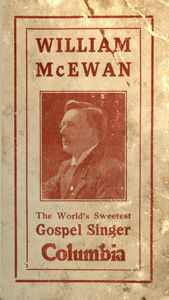
...then who's to say that this tune is any worse (or better) than the original? This is the old hymn 'In Tenderness He Sought Me' written in 1894, reworked by the Seattle indie rock band Citizens, who are part of the Mars Hill network of churches. All four songs from their new EP 'Already / Not Yet' are available here. In 1894 it was written to suit a tune which was typical of the popular musical style of the time; and as the Archibald McIlroy posting below showed (and also the William McEwan series from November 2011) we can often get 'hung up' on our own ideas of what tradition is, not realising that what we regard as traditional was once very contemporary.
But if you're hankering for the original, and for the words, here it is.
(PS - It would definitely sound better with two male harmony vocals, guitar and mandolin!)
Wednesday, May 16, 2012
Ulster-Scots Broadcasting
Some of you will know that around Christmas 2010 I was invited to join Northern Ireland Screen's Ulster-Scots Broadcast Fund (website here); a relevant BBC Northern Ireland web page from November 2011 outlining themes for commissioning is available here.
Many of you will have seen some of the programmes which have been made with financial support from the Fund; some of you may well be a bit more famous today due to having appeared in some of the programmes; or perhaps you've had your showreel/portfolio enhanced by being involved in making some of them.
This blog post is to invite feedback from anyone who has an opinion to share on the subject, so please email me if you have something to say, or better still post a comment below by clicking on the small blue 'Comments' text in the footer of this posting.
You can send me an email by using the first of the 'quicklinks' along the top of this page.
(NB: This is not an 'official' consultation process but is for my own interest only. I can however relay any specific feedback to the USBF Committee if you want me to do so, either anonymously or attributed).
Tuesday, May 15, 2012
"...A conteenual runnin' tae Sabbath-schools an' Gospel-halls an' tent meetin's; ivery whor an onywhor that there's onything excitin' or new... makin' the sanctuary like a play-hoose..."
Below are five pages scanned from Archibald McIlroy's The Humour of Druid's Island (1902), set in Islandmagee in County Antrim. The idea of 'Gospel-halls and tent meetin's' being 'excitin' or new' might come as a shock to some, as today many people (both within and without) would regard these as the pinnacle of tradition. Well not in a rural Presbyterian community in 1902! This is just one example of McIlroy's observational and storytelling genius, and shows the underlying complexity of multi-stranded Ulster Protestantism. And what has become Ulster's iconic 'wee drap o tay in yer haun'' is also scorned as a modern innovation of a 'hurry-scurry age'.
He wrote in the Preface that the vocabulary in his books had been purposely diluted for commercial reasons - '...the dialect as spoken by the inhabitants of the rural districts, especially those of Antrim and Down. The only liberty I have taken with this rich inheritance is to water it down a little, to suit public taste...'. Nevertheless even this publisher-approved Ulster Scots is tremendous stuff.
(What would Mrs Donaldson make of the pace of life in 2012?!)
The Preface adds 'We in Ulster are proud of our unique dialect. We may at times feel a little ashamed to express ourselves in it before the ignorant... we think in it however; and when we are excited it oozes from us like water from the rock. We have a supreme contempt for poor creatures who have nothing to fall back upon but the pure English tongue'.


Bloodless bean-counters rule over us – where are the leaders?
Thanks to Anne for the tip-off on this great story:
'...Managerialists, he says, are “a group who consider themselves separate from the organisations they join”. They are not interested in the content of the work their organisation performs. They are a caste of people who think they know how to manage. They have studied “The 24-hour MBA”. There is a clear benefit from their management, for them: they arrange their own very high salaries and bonuses. Then they can leave quickly with something that looks good on the CV. The benefit to the company is less clear...'
Full story by Charles Moore of the Daily Telegraph (click here)
Friday, May 11, 2012
State persecution of dead preachers - 1686 and 2012
You couldn't make it up. In 1686 the Covenanter minister Alexander Peden - a faithful minister in rural Scotland who like so many of his contemporaries had been branded an 'enemy of the state' by the regimes of Charles II and his brother James II - died peacefully having evaded capture (including spending time in County Antrim) for many years. Enraged by this, his body was dug up by the authorities:
'...Peden was buried in Auchinleck kirkyard but forty days later dragoons heard of his death and his place of burial. They exhumed his body and took it to Cumnock on horseback. They intended to hang his corpse on the gallows as a warning to others, this did not happen though as the plan was upset with the intervention of the Earl of Dumfries, he feared an uprising from the people of Cumnock and Peden was buried at the foot of the gallows as a final mark of disgrace...' (excerpt from Cumnock.net)
Today I have heard that an English-based blogger who operates under the name of the great English Reformer Archbishop Cranmer (biography of the original Cranmer here) is being pursued by the Advertising Standards Authority for daring to place an advert for Coalition for Marriage on his blog. Cranmer's is an articulate and popular blog on themes of faith and current affairs. You can read about it here.
The original Thomas Cranmer was burned at the stake in Oxford, where today you can visit the 'Martyrs Memorial'.
Here is the 'offensive' advert. If you are inclined to support the campaign, click here to do so. And D A Carson's latest book, The Intolerance of Tolerance, might be of interest to you.

Thursday, May 10, 2012
Wally Olins on 'Place Branding'
Wally Olins is a recognised global expert on how to market a place - country, city or region. This is great stuff.
Wednesday, May 09, 2012
The Clydesdale Covenanters: Gavin Hamilton of Mauldslie, James Hamilton of Kittiemuir.... and (St) Patrick
Having got a few bits of research off my desk and out of my system I am now back to hopefully finish researching the life and connections of Rev James Hamilton of Ballywalter (1600 - 1666).
The River Clyde rises in the hills near Moffat in the middle of the south of Scotland, and winds its way along a valley close to a number of towns like Lanark, Dalserf and Hamilton before reaching the city of Glasgow. The area was known as the 'Clyde Valley' (spot the Ulster reference in that name) or 'Clydesdale' - today 'South Lanarkshire'.
I have found that two of the Covenanters so brutally executed after the Battle of Rullion Green / Pentland Rising were from Clydesdale - Gavin Hamilton of Mauldslie and James Hamilton of Kittiemuir near Stonehouse - and they were related to Rev James. He had been raised near Mauldslie and Kittiemuir, at the estate of Hallcraig/Halcraig which was then owned by his uncle Archibald Hamilton (Halcraig is long-gone, but the site is today Carluke Golf Club, on the Mauldslie Road). Archibald also bought an estate in Limerick around 1609 when King James I issued the town with a new, Scottish-inspired, charter.
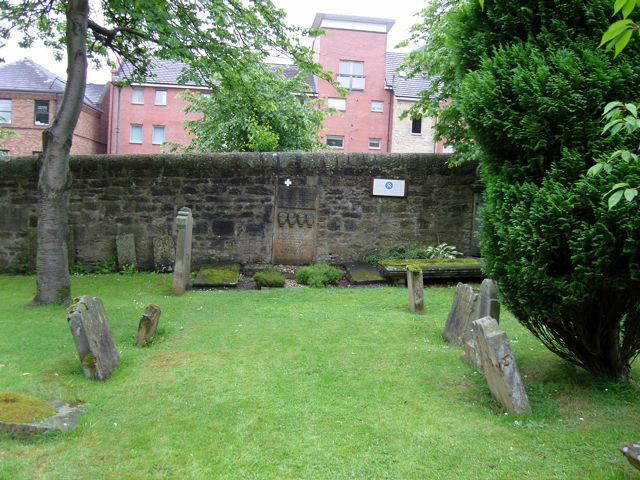
Gavin and James were taken to Edinburgh where history records they were executed on a 10-man gallows. Their hands and heads were cut off - the severed hands were displayed at Lanark (where they had sworn the Covenant just prior to the Battle) and the severed heads sent to the town of Hamilton. The heads were later buried, and the striking headstone shown below was erected in their memory - you can see it at Hamilton Old Parish Kirkyard today, with a plaque beside it installed by the Scottish Covenanter Memorial Association.
In reading about these Hamiltons, and in connecting them to the Ulster Hamiltons, I found an account in a book about the locality entitled 'Stonehouse: Historical and Traditional' (1888). In it, on page 161, is a reference to:
"ST PATRICK'S WELL.– Whether Patrick was a Scotchman or not, it is indisputable that he has left an indelible impression on Scotland, and his name is fragrant in many places to this day... one place in this parish that bears his name is this well, and probably the neighbouring lands of Patrickholm... Patrick's memory still lives in the neighbouring parish of Dalserf, where he is said to have preached; and a grateful people in due time erected a chapel and dedicated it to him at Dalpatrick, endowing it with some land, and where tradition says he at one time resided..."
Over the years of casual reading I have found scores of references to (St) Patrick in Scotland. (Ssssshhh - don't tell the Northern Ireland Tourist Board) Here's an old map of the bend in the river at Dalserf, with Dalpatrick and 'Maldsly' marked on it.


Friday, May 04, 2012
The Adventures of Ulster Oat, 1950s
I do some design work with White's Oats nowadays - here's a great old ad from the bowels of my book mountain - Ulster oats and a piper.

Wednesday, May 02, 2012
John Wesley - 'vivid life story in modern caption form', 1953
I picked this up a few weeks ago for the princely sum of £3. It was published in the Coronation Year of 1953, to mark the 250th anniversary of John Wesley's birth. The publisher made a determined effort to simplify the story 'in modern caption form' to make it easy to get the story across to the general public, and hired a very accomplished illustrator called Greta Jones to create the visuals. The style reminds me of the more serious stories in the Dandy annuals I had as a wee lad growing up here in the 1970s. This booklet is just 24 pages, smaller than A5 in size, printed on cheap newsprint paper and given away free with a publication called the Sunday Companion.
The introduction was written by a 'TV personality' called George Cansdale (he went on to become the 'zoo man' on BBC's children's programme Blue Peter; his obituary here is fascinating). He was the Churchwarden of All Souls, Langham Place, London. The intro says -
'Although the world has seen many changes since the days of John Wesley, the heart of man has certainly not changed for the better, and his deepest needs are just the same. John Wesley spent many years as an intensely sincere religious man, but it was not until he was in his middle thirties than he came to realise for himself the experience of personal salvation. That surely is the trouble with many of us today...'
The quality of the storytelling is superb, hope you enjoy the sample pages below.


Tuesday, May 01, 2012
Barbour's Linen Thread, Lisburn, N. Ireland
Here's a recent find - the red box pictured below. Barbour's were founded in 1784 when John Barbour moved from Paisley in Scotland to Lisburn, County Down. Over the years the business became a world leader in the manufacture of threads. Sadly their factory at Hilden ceased production in February 2006 and now lies derelict (see photos here) on the banks of the River Lagan. I have gathered up some examples of their products and packaging, all of which use the Red Hand of Ulster as the central symbol for the company's branding.


Monday, April 30, 2012
Promoting Portavogie in 1913
People had simpler tastes 100 years ago. I picked up this old postcard on Saturday at the NI Postcard Fair (where I met a couple of other postcard-hokers I know from old!). The caption reads 'One of Portavogie's Beauty Spots'. But it's not what you'd expect from a beauty spot - no beach scene, no dramatic waterfalls, no glens or valleys. Just a field. With some folk standing far away, a wheen o kye and hooses. I have a fair idea where this was taken from (it's about 9 fields away from our front door) but it's now built over with new houses, so not much chance of taking the same photo today for comparison. The thing is, as modest and ordinary as the image is, I am sure every one of the folk in the photo could have kept us riveted for hours with local stories and traditions. Oh for a time machine...

Friday, April 27, 2012
Galloway Gossip Eighty Years Ago (1901)
Thanks to my friend Joe in Ayrshire for showing me his copy of this great book over a cup of tea last Friday night in his lovely home up in the hills. Joe helps me with a lot of stuff, from stories and songs to bricks an visiting oul hooses and Covenanter battle sites! It's a real gem of a book, and I'm going to enjoy reading it over the neext wheen o weeks. The oul folk knew a thing or two:
Speech
'...the writer has a speaking knowledge of every dialect of Scotch, including two of Glasgow-Irish, and two of Ulster Scotch, as well as five dialects of vernacular English...'
Ulster migrants in Galloway
'...the Scotch-Eerish is really no Eerish ava. They're the descendants o' the Scotch Colonists yt James the Sixt got tae gae ower an coloneese Ulster aboot three hunner year sin. They maistly speak verra gude Scotch... they'r joost wur ain folk come back again... they're maist a' Presbyterians and a gey wheen o them's Cameronians. They maistly come ower tae work...'
Monday, April 23, 2012
Grave of John McNeill, 'The Scotch Spurgeon', Inverkip
I have been re-reading McNeill's biography lately; his father was from Lisnagunogue in north Antrim. John spent a fair bit of time preaching in Belfast, there are some great accounts of his visits to our side of the water. So while in Scotland I decided to locate his gravestone, and found it tucked away in the corner of the old graveyard at Inverkip, between Greenock and Largs. The inscription on the stone reads:
In Loving Memory of
John McNeill
Scotland's Beloved
Preacher of the Gospel
Called home 19th April 1933
Aged 78 Years
'Always abounding in the work
of the Lord' 1st Cor 15 v 58
His mother
Catherine McTaggart
His father
John McNeill
and his sister Margaret
McNeill's other sister Kate was a popular poet of her day. A previous post on John McNeill is available here.


Sunday, April 22, 2012
Well Park, Greenock - the home of Elizabeth Shaw, wife of Sir Hugh Montgomery
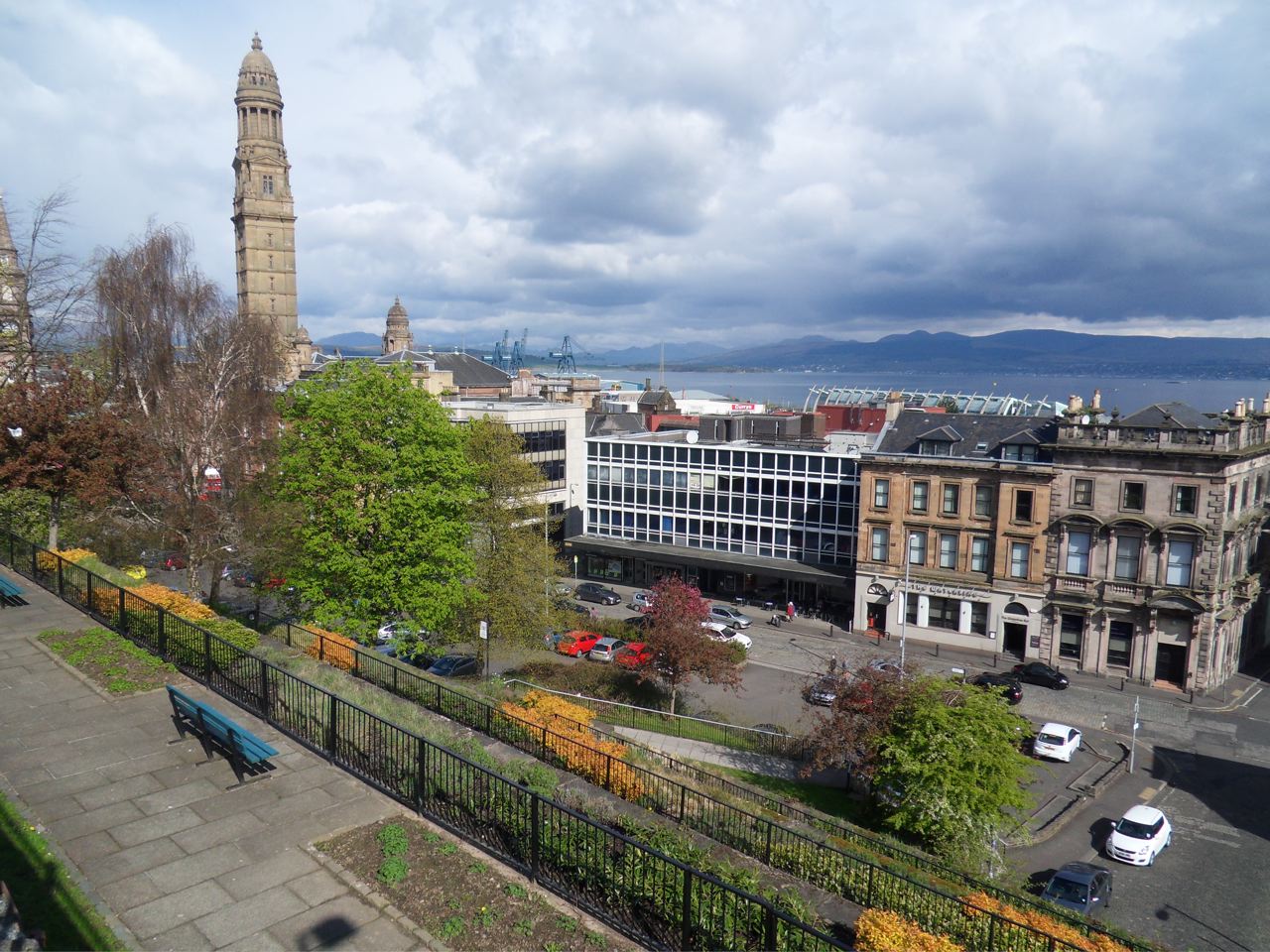
These photos are of Well Park which overlooks the cobbled area of Greenock town centre. The park was given to the people of the town by the Shaw family, an early member of which was Sir Hugh Montgomery's wife Elizabeth - the park is the former site of their castle, 'Wester Greenock'. Elizabeth was the brains of the Montgomery Ulster-Scots empire around Newtownards, but she died around 1623 or so. The old 1629 well shown below was built by the Shaws back home in Greenock; meanwhile Elizabeth's brother James Shaw built Ballygally Castle on the County Antrim coast road in 1625. This excellent account of the history of Greenock says that it was Elizabeth's father John Shaw who built the first church in the town with permission from King James VI. And it's no surprise to read that '...In 1670 a French traveller, M. Jorevein de Rocheford, visited `Krinock' which he says is 'the town where the Scots post and packet boat starts for Ireland...'. The first history of Greenock is available here.
Well Park is lovely spot for a stop-off if you're doing the coastal drive from Glasgow down to the Troon or Cairnryan ferries, with good views across the River Clyde. Visiting these places really brings history to life. Pics should enlarge when clicked.


Ignoring the uniqueness of Antrim and Down (and other places too)
Award-winning but factually lacking. For example, it leaves out Hamilton & Montgomery in 1606, the Lowland Scots settlers brought by the Antrim MacDonnells in 1607, those brought by Bishop Montgomery to Derry and Donegal in 1607, visuals imply that Antrim and Down were part of the Plantation of Ulster (which they weren't, although the text partly remedies that issue, partly...), in the Cromwell section no mention of the proposed deportation of hundreds of Ulster-Scots community leaders from Antrim and Down, no mention of the 1661 ejection of Presbyterians from their pulpits, no mention of the experiences of the 'Killing Times' of Charles II and James II which give vital context to the impact of the 'Comber Letter'.... dear dear dear. Looks like there was no distinct Ulster-Scots or Presbyterian experience during the 1600s at all. Visually beautiful, but as for some of the content...
Here it is.
'Ignoring the uniqueness of Antrim and Down' (and of the many Scottish-settled areas and communities across Ulster) is still, sadly, a common theme in some circles. Years ago I was told by many 'experts' that there was no Ulster-Scots story, so I set about trying to change that. I think that those of us who helped me did a superb job, and continue to do a superb job. But now that the Ulster-Scots story is deeply researched and well told, many 'experts' just choose to ignore it. The stereotypical 'two tribes' Protestant v Catholic approach to history is clearly going to take a while to go away.
Saturday, April 21, 2012
Auchans Castle, Dundonald, Ayrshire
The birthplace of Colonel James Wallace, the one-time Governor of Belfast who was sacked when the authorities found out he was a Presbyterian. Below are an old engraving and two photographs I took this afternoon.
Auchans looks a lot like Monea Castle in County Fermanagh. It's fenced off but you can access it via a lane which runs from the main road between Loans and Dundonald, and you can walk the the whole way round - a very impressive building. It's set within a (now mainly ruined) walled enclosure which surround it, about 100 yards away from the building on all sides.
Colonel Wallace lived at Ballycarry in County Antrim and led the Covenanters at Rullion Green in 1666, where his name is inscribed on the metal plaque.


Friday, April 20, 2012
Scottish Covenanter Memorial Association 2012 AGM
Just finished my 1hr presentation at the SCMA annual dinner meeting. Amazing response, record turnout, lovely to see many old friends again, exciting connections made with new friends, all free tabloid publications snapped up and all copies of the Alexander Peden book sold out. Wonderful wonderful night - "we're all the same folk with a wee bit of water in between" - some of you will be getting emails from me with specific information!
Some of the people who were there tonight are readers here, please feel free to post a comment or send me an email so I can relay your feedback to like-minded folk on our side of the water.