
I really probably shouldn't stoop to this level. I have never followed the "career" of Russell Brand and have done my level best to avoid the past seven days of relentless, wall-to-wall media coverage. However, it seems that he and I have something in common... we're both very ropey mandolin players:
Friday, October 31, 2008
Russell Brand and me


Irishness and Identity
I've spoken to some people over recent weeks who have been out to the USA during this autumn to the big Scottish Games festivals that are held there every year. Tens of thousands of Scottish and Ulster-Scots descendants attend these. Among the Ulster-Scots-American diaspora in the USA, at least on a popular level, there seems to now be a trend away from the historically-used term "Scotch Irish", to "Ulster-Scots". The explanation given to the folk I've spoken with was that these Americans said "we're not Irish in any way - Irish is not who we are". The term "Irish" creates an impression, sends a cultural and historical signal - a signal that these people feel no affinity with.
So, are you Irish? It sounds like a simple question, but in fact is deeply complex. Identity - your sense of who you are, and of your origins - is not cut-and-dried, especially in a contentious and multi-cultural place like Northern Ireland in 2008. Our sense of identity has been pulled apart by violence, politics and a fair degree of purposeful social engineering.
Without getting into a definition of what "Irish" means (faaaaar to big a subject for a blog post, or for my wee brain) I see "Irish" being generally used today as a description in four main contexts:
Geographically Irish - ie belonging to the landmass referred to as the island of Ireland, which comprises the two separate jurisdictions of the Republic of Ireland and Northern Ireland;
Politically Irish - ie a citizen of the Republic of Ireland (because if you're from Northern Ireland, you're politically British, whether you like it or not. But of course the edges on this are blurred - for example people in Northern Ireland can apply for Republic of Ireland passports);
Culturally Irish - ie embracing of Irish traditional culture, from bodhrans to the GAA and a lot of things in between;
Linguistically Irish - ie a user (reader or speaker) of the Irish language
There are probably other contexts too. However, most people I know feel no sense of connection with political, cultural or linguistic Irishness - it's not who they are, or where their family heritage lies, or where their aspirations take them. As a result they are reluctant to describe themselves as being Irish, even in a geographical sense, because doing so would send a completely false political, cultural and linguistic signal about their identity. So some people now use the term "Northern Irish" - a term that has become more commonplace over recent years.
Which are you?
(With apologies to my many overseas readers who are no doubt bewildered by this post!)
Thursday, October 30, 2008
In Search of Ulster-Scots Land
This 2008 book"In Search of Ulster-Scots Land: The Birth and Geotheological Imagings of a Transatlantic People, 1603-1703" looks very interesting, and much better than the author's previous one. The new one is on GoogleBooks, and you can flick through it in the viewer window here.

Wednesday, October 29, 2008
Can a sword really be worth £10,000?
Yes, if it's the sword of the Covenanter hero Captain John Paton!
You can visit the Lochgoin and Fenwick Covenanters Trust Museum here - they have some of Paton's other artefacts on display.
Here's a photograph of Paton's superb memorial at Fenwick Parish Church in Ayrshire: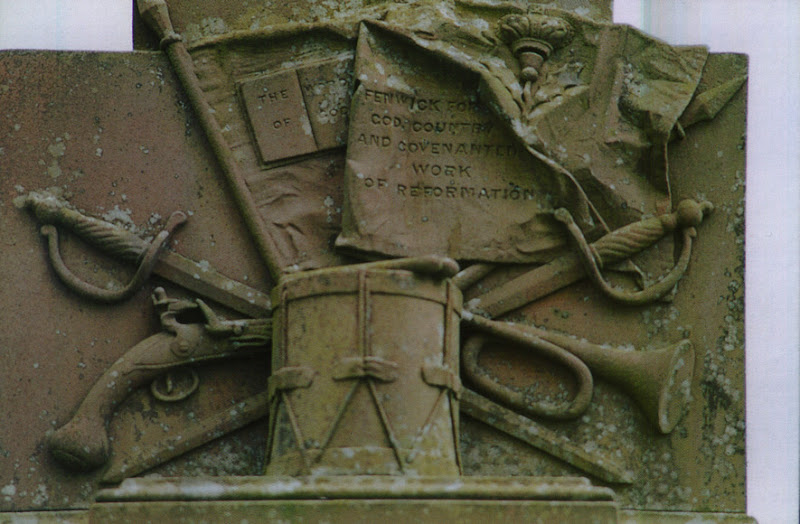
Monday, October 27, 2008
Radio Ulster "The Book Programme" last Saturday
Dr Ivan Herbison, Dr Frank Ferguson and I were recently interviewed for BBC Radio Ulster's "The Book Programme", presented by William Crawley. The bit we were in was produced and presented by Robbie Meredith, an oul freen o' mine. Here it is on the BBC iPlayer - click here.
The relevant part starts at 19.30 in, about the recent Anthology of Ulster-Scots which was edited by Frank. It's an excellent collection, worth putting on your Christmas list if you're into books.
Saturday, October 25, 2008
"Hunger" update
Ever since my unexpected Talkback début earlier in the week, I have had numerous phone calls, emails and text messages from people supporting my comments in my original post about "Hunger" and the wider context. And not just hard-headed unionists. Quite a surprising number of professional people in the media and television industry (both broadcasters and independent production companies) have gone out of their way to phone me. I would like to thank them all for doing so. Meanwhile, courtesy of The Watchmen, I see that Gail Walker expressed similar views in the Belfast Telegraph about a month ago.
Friday, October 24, 2008
I'm a Pepper, He's a Pepper, She's a Pepper....
...if you drink Dr Pepper you're a Pepper too!
That was the slogan of an old 1970s tv ad that I (and maybe you) grew up with, for the strange-tasting soft drink Dr Pepper. Well, in a publicity stunt a few months ago, the company said that if the 17-years-in-the-making-and-subsequent-music-industry-joke new Guns n' Roses album came out this year they would give everyone in America a free bottle of the stuff!
It probably seemed like a good idea at the time. The problem is that the album, entitled "Chinese Democracy" is now complete and will be released at the end of November. Oops! Cue emergency board meetings of the Dr Pepper Snapple Group Inc...
So around 350 million bottles of Dr Pepper are potentially going to be offered free - available via a downloadable voucher on the company's website when the album is released. I say potentially, because the snag is that the offer will only be on the website for 24 hours.
Never mind being free, you couldn't pay me enough to drink a bottle of Dr Pepper - it's mingin', honkin, or in Belfast-speak, ratten. As someone who spent many wasted teenage hours on my guitar trying to learn to play the intro to the Guns N Roses song "Sweet Child O' Mine", I hope the album's a lot better than the soft drink.
Here's a YouTube clip of the old ad:
Here's the video for Sweet Child O' Mine (from 1988 I think):
And here's some headcase playing the same song using only his hands!...
Thursday, October 23, 2008
A special night at Bangor Abbey
.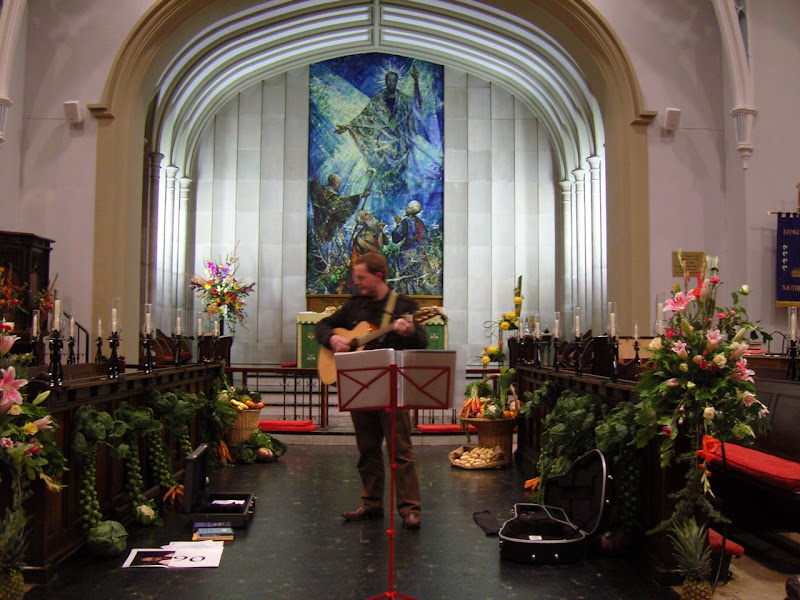
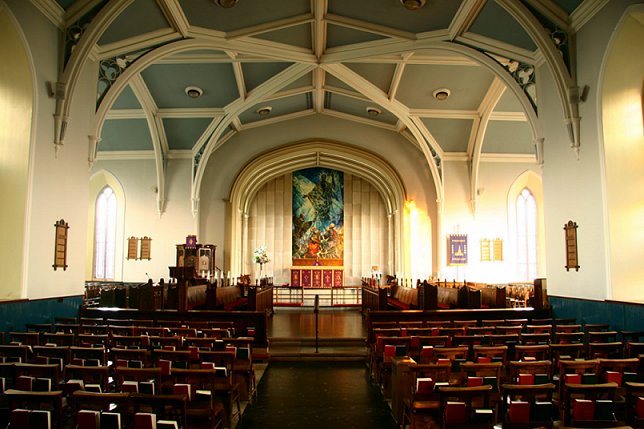
Here's a pic of Graeme getting tuned up. We had a marvellous time here last Saturday night - we played for about an hour and a quarter in the most magnificent setting I've ever had the privilege of playing in.
Sir James Hamilton, Founding Father of the Ulster-Scots buried below us, (and also in real life before our very eyes, greeting the audience as they came in!) in the church where the mighty Robert Blair had his Ulster ministry. There's a memorial to Blair's first wife, Beatrix Hamilton, in the vestibule (see pic below).
For me the experience was literally spine-tingling - to play and sing and to read from Blair's biography in the very place where he preached is hard to explain. And the reaction from the people who were there, the Abbey's congregation, choir members, and the organisers of the event was marvellous. To be enthusiastically complimented on our two part "brother duet" harmonies by experienced, trained, choral singers is quite something for us! Buildings this old were designed to be acoustically perfect, and a single strum of the wee mandolin filled the place.
I was very impressed that everyone going in was given a leaflet about Hamilton & Montgomery. It was a joy to be there, and thankfully they've asked us to go back. Next time we'll film the concert and put it up on YouTube!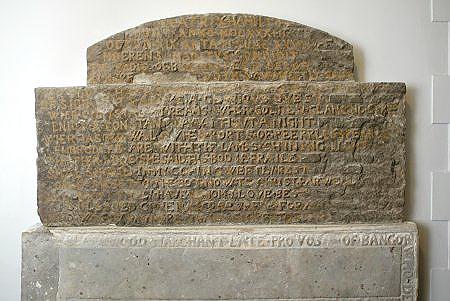
Wednesday, October 22, 2008
So when exactly was Ulster-Scots invented?
This was brought to my attention a few weeks ago. This is a still image from the recent BBC documentary "The Day the Troubles Began" which was broadcast earlier this month. In the middle of the archive footage was this close-up - a placard being carried by the civil rights marchers, using the term "Ulster hyphen Scots", and as might be expected, linking it to politics (unionism) and discrimination (racialism):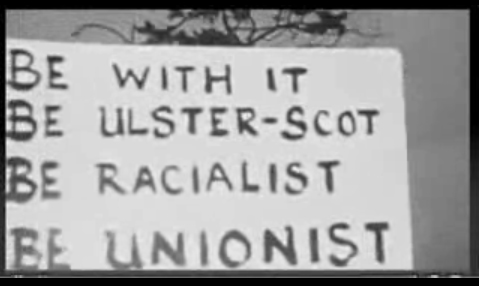
Nowadays the opponents, sceptics and critics of Ulster-Scots regularly allege that it's all false, and was invented in 1997 - and one of the callers to Talkback yesterday repeated this stereotype.
However, the opponents, sceptics and critics of forty years ago were clearly very aware of the term.
So when did this alleged invention take place?
Few of these lemming-like critics will be convinced by the inconvenient truth that the term was first recorded in 1640, around the high point of Scotland's National Covenant and its impact on the Ulster Scots population. Click here for the full reference.
Tuesday, October 21, 2008
Talkback
So I unintentionally hit the big time today - a piece on Radio Ulster's Talkback on the blog post about "Hunger" and the general media trends that are out there at the moment. Just goes to show how widely read this wee personal blog actually is! The playwright Gary Mitchell was on Radio Ulster just last week talking about the same issues - partially covered here by the News Letter.
Sunday, October 19, 2008
The Origins of Vernacular Scots Gospel Music? : The "Psalms of Dundee" or "The Gude and Godlie Ballates", Dundee, 1546

"...a little volume which, after the Bible itself, did more for the spread of reformation doctrines than any other book published in Scotland..."
............................
As the Reformation began to take hold in Scotland in the early 1500s, the area around Fife, St Andrews and Dundee became a hotbed of Reformation activity. Patrick Hamilton was burned at the stake in St Andrews in 1528, aged just 24, and his successor, George Wishart, suffered the same fate in the same town in 1546.
The early Scottish Reformers in the area used what even today would be regarded as creative techniques to spread the gospel – street theatre and contemporary songs.
In the History of Dundee, Robert Small (first published 1792) wrote of satirical plays and dramas being written and performed in Dundee in 1540 – in conjunction with Wishart’s preaching they had a huge impact on the local people.
Much of this material was written by three local brothers named Wedderburn, who had been students at St Andrews University, and two of whom may well have been there when Patrick Hamilton was martyred. Two of their dramas included a satire about the beheading of John the Baptist, and a comedy about Dionysius "...in which also he handled the Papists severely...". The Wedderburns also turned their creative energies to writing and compiling popular songs, often using existing folk tunes but writing sacred and pro-Reformation lyrics for them. In essence, they hijacked the popular culture of their generation to spread the gospel. Reformers in Italy and Holland were already doing the same (see Laing’s preface in the PDF link below)
James Wedderburn was the oldest of the three; the middle brother John had to flee to Germany where he continued the work – there he “…changed many obscene songs and rhymes into hymns…” (Small, p 96). They “…turned the tunes and tenor of many profane ballads into godly songs and hymns, which were called the ‘Psalms of Dundee’, whereby he stirred up the affections of many…” (Small p 97). The youngest of the three, Robert Wedderburn, the Vicar of Dundee, ended up in Paris and joined with the leaders of the French Reformation. Robert had written a scorching document entitled "The Complaynt of Scotlande" (PDF link here), in which he stated that it was "...unpossible that Scottis men and Inglis men can remain in concord under ane monarchy or ane prince, because ther naturis and conditiouns are as indefferent as is the nature of scheip and wolvis....".
Robert had had been fined in 1543 for destroying images in the local monasteries. When the troops of Henry VIII invaded Dundee in 1547, they burned Robert's house to the ground as they retreated, with the English officer, Sir Andrew Dudley, writing to his superior to plead that they must send to Dundee "a good preacher and good books, for they desire it much here, and I think it would do more good than fire and sword". The creativity and dedication of the three Wedderburn brothers was having a revolutionary effect in Scotland.
According to Prothero's The Psalms in Human Life, the night in December 1545 before George Wishart was arrested, he and a group of friends sang Psalm 51 from the Wedderburn brothers' collection (see Prothero p 262 & 263)
The collection was first published sometime between 1542 and 1546, and was entitled A Compendious book of Psalms and Spiritual Songs Commonly Known as "The Gude and Godlie Ballates". The book contained 112 different pieces and was described as “Presbyterian propaganda”, with various editions printed up until 1621. It was reprinted again in the mid 1800s (PDF version available here - printed copies of even this later edition are rare and it took me a fair while to track one down at a reasonable price. The only one on Abebooks will set you back £65.00, but reprint editions are cheaper.)
The Wedderburn strategy wasn't to make the church worldly, rather it was the other way round - they seized hold of elements of the world's secular culture and turned them into powerful tools for Reformation and the gospel.
Their approach has been analysed in an article by Anne Geddes Gilchrist entitled 'Sacred Parodies of Secular Folk Songs: A Study of the Gude and Godlie Ballates of the Wedderburn Brothers' (Journal of the English Folk Dance and Song Society, vol III no 3, 1938, pp 157-182).
Here's a great quote, reinforcing the importance of the Gude and Godlie Ballates, from The Cambridge History of English and American Literature in 18 Volumes (1907–21). Volume III. Renascence and Reformation.
"...It was about the year 1546 that there appeared a little volume which, after the Bible itself, did more for the spread of reformation doctrines than any other book published in Scotland. As no copy of this edition has been preserved, we can only conjecture its contents from the first edition of which we possess a specimen—that of 1567, apparently an enlarged edition of the original. The book generally known in Scotland as The Gude and Godlie Ballatis is, next to Knox’s Historie of the Reformatioun, the most memorable literary monument of the period in vernacular Scots..."
LINKS:
- The Wedderburns and their Work (1867)
- the image of the three Wedderburn brothers above is from this website)
Friday, October 17, 2008
Hunger
There appears to be a carefully co-ordinated revisioning of the Irish Republican movement going on.
• A few weeks ago there was widespread public outrage at the BBC programme about the IRA escape from the Maze prison in 1983.
• then the alleged IRA Northern Bank £26m robbery trial collapsed
• next, last night the film "Hunger" was premiered in Belfast, about the IRA hunger strikes of the early 1908s...
• which coincided with the opening of a photographic exhibition about the decay of the Maze in what is left of the prison itself.
One of the defining characteristics of the overwhelming majority (but of course not all) of Northern Ireland's unionist population has been its' ability to absorb and thole a generation of bloody terrorism - and not lash back, not vote for political parties aligned to terrorist groupings, not retaliate. To sit back and endure plays like "A Night in November" which demonise us, and which diminish our right to exist unless we become like "the other side".
I just wonder when that same unionist population will finally crack, when will it have had more than it can bear, when will it finally stand up. Like the people of Chile eventually did when they finally realised the horrific price that "peace" had cost them when they let General Pinochet away with murder (he struck a sordid deal to allow the Chilean people a form of democracy - as long as they agreed to give him immunity from prosecution for the official figure of 3,197 murders he had presided over. He was later stripped of immunity and put on trial).
Away from all the red carpets, the popping flash bulbs, the clinking glasses and the chic suits - here's a reminder from David Todd of what the hunger strike "heroes" were in prison for in the first place.
So when does crime cease to be crime? When can murder become art? And when is it acceptable for a public body like Northern Ireland Screen to fund and publicise this type of revisionism and soft-focus arthouse propaganda - again and again and again. Dig through their website for yourself.
And meanwhile the youth wing of Sinn Fein are painting Northern Ireland's standard "pillar box red" Royal Mail letterboxes green and get away with publicising their vandalism on the internet and radio, while the party itself is preparing to protest against the Royal Irish Regiment troops returning home from Iraq and Afghanistan. Even the IRA are suffering because of the credit crunch.
You couldn't make it up if you tried. Welcome to the new Northern Ireland. Do I feel the temperature dropping even further in our cold house?....
Friday, October 10, 2008
Stairway to Heaven?
Whilst Western news is dominated by financial meltdowns, foreign news is more interesting. The Japanese government are going to reveal plans in November to build what they're calling a "space elevator", which was first conceived by a Russian scientist in the 1960s. It'll be nearly 36,000 km high and will take a week to get from the surface of Earth to the top of the elevator, where there will be a platform of some type. However, what would it be used for? Seems strange to me, but is pretty close to Charlie's recent explanation of how to get to Heaven!
Thursday, October 09, 2008
Never a truer word spoken...
Protestants are a peculiar people, with minor theological differences becoming great unspannable chasms. This joke was claimed in 2005 to be the best religious joke in the world. It was written by the very strange American comedian Emo Philips. It's a brilliant insight into the complexity of intra-Protestant denominational attitudes:
Once I saw this guy on a bridge about to jump.
I said, "Don't do it!"
He said, "Nobody loves me."
I said, "God loves you. Do you believe in God?"
He said, "Yes."
I said, "Are you a Christian or a Jew?"
He said, "A Christian."
I said, "Me, too! Protestant or Catholic?"
He said, "Protestant."
I said, "Me, too! What denomination?"
He said, "Baptist."
I said, "Me, too! Northern Baptist or Southern Baptist?"
He said, "Northern Baptist."
I said, "Me, too! Northern Conservative Baptist or Northern Liberal Baptist?"
He said, "Northern Conservative Baptist."
I said, "Me, too! Northern Conservative Baptist Great Lakes Region, or Northern Conservative Baptist Eastern Region?"
He said, "Northern Conservative Baptist Great Lakes Region."
I said, "Me, too! Northern Conservative Baptist Great Lakes Region Council of 1879, or Northern Conservative Baptist Great Lakes Region Council of 1912?"
He said, "Northern Conservative Baptist Great Lakes Region Council of 1912."
I said, "Die, heretic!" and I pushed him over.
Saturday, October 04, 2008
The Day my Kids killed my camera?
This bit of footage was rescued from the SD card on my now-deceased Kodak digital camera which sadly passed away in February 2008. I suspect that these were its dying moments - be careful where you leave your gadgets!
Tuesday, September 30, 2008
The Comeback Tour!
Well hardly, that's a bit grand, but Graeme and I will be playing this Saturday evening at the Carrowdore Mission Hall monthly "Gospel Rally" at 7pm - if you're available feel free to drop in. You'll be made very welcome and there'll be plenty o tay and buns afterwards, including Ulster's National Dish! We'll be playing five or six songs and hymns.
The following Saturday night, 11th October we're playing at a special event at Bangor Abbey - a deeply historic location of massive Ulster-Scots significance. You can click here to see what'll be happening on the night. Hilary took the photos, and my good friend Gifford Savage did the write-up! Gifford and I worked together on the reprint of the Abbey's historical book a few years ago. When Gifford asked us to play at this, there was no way I could turn it down!
Musically, it'll be similar to what we did before as the Low Country Boys, but simpler in that it'll be pretty close to the "brother duet" style of the 20s and 30s - two voices, mandolin and guitar. We're still debating over the track listing, but there's plenty to choose from!
Saturday, September 27, 2008
A bit of light relief
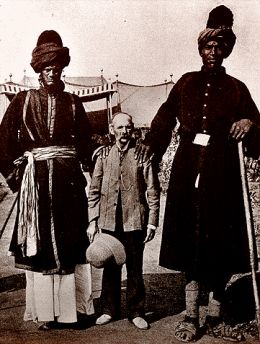
My grandfather was a very tall man (that's not him in the pic!) - they say he was around 6' 8". Whilst he grew vertically, I seem to have grown horizontally. Anyway, here's an article about giant people and their bones which have been found in the USA, Peru and Hawaii. Some great pics from National Geographic too.
So that set me Googling. Here's an incredible list of reported giant remains in the Ohio Valley, USA, from the mid 1800s.
Many years ago I found an intriguing old book in a now-long-gone dark musty (foosty) bookshop in Smithfield called The Giant Cities of Bashan and Syria's Holy Places by the Presbyterian minister Rev Josias Leslie Porter (1823 - 1889), published in 1863. Porter (whose address in the foreword is given as Brandon Towers, Belfast - just off Connsbrook Avenue in Sydenham) seems to have been an explorer / adventurer as well as a clergyman, as well the second President of Queen's University from 1879 until his death in 1889. He spent time in the Holy Land long before the turmoil and wars of the 20th century took hold; he spent 10 years as a missionary to Syria from 1849 - 1859.
The book is dedicated to the Right Honourable Lord Dufferin and Clandeboye, who himself was a renowned international diplomat and antiquarian, who has a large statue to his memory in the grounds of Belfast City Hall. His estate at Clandeboye even to this today contains a breathtaking collection of ancient artefacts that he accumulated during his time spent overseas.
The Holy Land was a largely deserted, abandoned place then, with its antiquities still standing, although by then many were in ruins. Strangely though, Bashan itself was very much intact. Porter wrote in the book that "...the cities built and occupied some forty centuries ago by these old giants exist even yet. I have traversed their streets; I have opened the doors of their houses; I have slept peacefully in their long-deserted halls..." A PDF version is available free on GoogleBooks.
He also wrote: "..."Moses makes special mention of the strong cities of Bashan, and speaks of their high walls and gates. He tells us, too, in the same connection, that Bashan was called the land of the giants (or Rephaim, Deut. iii. 13), leaving us to conclude that the cities were built by giants. Now the houses of Kerioth and other towns in Bashan appear to be just such dwellings as a race of giants would build. The walls, the roofs, but especially the ponderous gates, doors, and bars, are in every way characteristic of a period when architecture was in its infancy, when giants were masons, and when strength and security were the grand requisites. I measured a door in Kerioth: it was nine feet high, four and a half feet wide, and ten inches thick, - one solid slab of stone. I saw the folding gates of another town in the mountains still larger and heavier. Time produces little effect on such buildings as these. The heavy stone slabs of the roofs resting on the massive walls make the structure as firm as if built of solid masonry; and the black basalt used is almost as hard as iron. There can scarcely be a doubt, therefore, that these are the very cities erected and inhabited by the Rephaim, the aboriginal occupants of Bashan..."
So maybe the old Finn McCool / Giant's Causeway legends are right?!
Friday, September 26, 2008
Don't believe everything you read in the newspapers
I am told the News Letter are continuing their shabby campaign in today's paper by continuing to stoke up controversy around A Danner With Drennan. Sickening - particularly when they know the truth. I spoke to one of their journalists by phone last week, later emailed him and copied it to the Editor. But still the campaign continues. Newspaper sales must be down for them to resort to this...
Thursday, September 25, 2008
The power of music
A few weeks ago I spent an afternoon in Ballykeel with the local Presbyterian minister Martin McNeely and two men from the Kirk Session. To sit in a Starbucks coffee shop with three men I'd never met before on a drizzly Monday afternoon, talking about Robert Murray McCheyne (and other things too), was just great. I hope I was of some use to them.
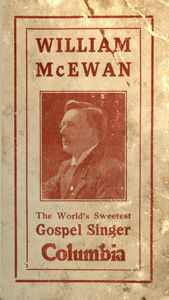
As we left, Martin loaned me two things: his copy of Memoir and Remains of R M McCheyne, and a CD entitled "Preachers and Congregations Volume 5: 1926 - 1931" (Document Records DOCD 5559). It took me a day or two to find a bit of clear time to sit down and listen to it, and it is superb. For me the standout track by far is "He's The One" (written by J B Mackay) sung by Rev H B Jackson and recorded in 1929. It's the best version of this hymn that I've ever heard, an old gem that we often listened to at home either on vinyl records or being sung by my mother. I've listened to it every day since, and have even played it to people who've called into the house. It has an almost William MacEwan vocal style, and just an old pump organ playing simple chords and melody. Hearing it is like time travel, to an era before electrified praise groups, when the old hymns of the faith were sung with pathos and sincerity. Here are the words:
Is there anyone can help us, one who understands our hearts,
When the thorns of life have pierced them till they bleed;
One who sympathizes with us, who in wondrous love imparts
Just the very very blessing that we need?
Refrain:
Yes, there's One, only One,
The blessed, blessed Jesus, He's the One!
When afflictions press the soul, When waves of trouble roll,
And you need a friend to help you, He's the One.
Is there anyone can help us, who can give the sinner peace,
When his heart is burdened down with pain and woe;
Who can speak the word of pardon that affords a sweet release,
And whose blood can wash and make us white as snow?
Is there anyone can help us, when the end is drawing near,
Who will go thro' death's dark waters by our side;
Who will light the way before us, and dispel all doubts and fears,
And will bear our spirits safely o'er the tide?
Great stuff! (PS it's 91 in Redemption Songs)
Subscribe to:
Posts (Atom)