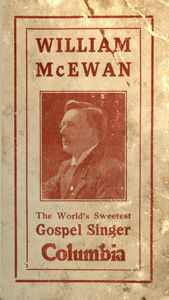

Alexander Anderson (1845 - 1909 / shown right) was a poet from the south west of Scotland, and was widely published during his lifetime. Hope you can understand this - my favourite portion is the bold bit in verse 14.
.................
I am auld an' frail, an' I scarce can gang,
Though whiles when I tak' a turn,
It's only when the sun blinks oot
On the braes by the Vennel Burn.
Then I tak' a look at the Kirkland Heichts,
An' up at Glen Aylmer Hill,
Then a kinder look at the auld kirkyaird
Where the dead sleep soun' an' still.
It's a dear kirkyaird at the fit o' the hills,
For it hauds the dust o' ane
Wha was true as the steel o' his ain gude sword,
An' stood by his kith an' kin.
He tak's his rest, wi' nae stane at his heid,
But I ken that Ane in the skies
Could come this nicht to the auld kirkyaird
An' point oot where he lies.
O, sleep ye soun', bauld Patrick Laing,
As ye ha'e been sleepin' for years;
I am frail and feckless, but still in my heart
Your name is saft wi' my tears.
The sands o' my life are unco few,
An' I ha'ena an hour to tyne,
But I ken fu' weel in the auld kirkyaird
Your dust will welcome mine.
An' there we twa will sleep fu' soun'
Wi' the green grass owre oor head,
Till the years bring roun' the richt to a'
For which Scottish bluid ran red.
Then the Lord will come doon in the licht o' the sun,
When the last sweet day shall dawn;
An' we'll rise frae oor graves, an' He'll meet us there,
An' tak' us baith by the han'.
The Cairn Hills lie on the other side
Wi' the sweet Nith rowin' atween,
An' there sleep twa leal frien's o' mine—
Aul' frien's o' the days that ha'e been.
They are waitin' for me as I for them,
An' it canna langer be,
For I ken that baith ha'e a tryst wi' the Lord,
An' He has a tryst wi' me.
I ken fu' weel that they wait an' wait
Till they hear the trumpet ca',
Then Hair an' Corson will rise an' cry—
"The time has come for us a'."
An' I mysel', a frail, auld man
That unco weel can be spared,
Will meet them baith at the fit o' the hill,
At the tree in the auld kirkyaird.
They dee'd as only men should dee,
For their faither's faith an' hame,
An' they lie wi' their face to the open sky,
Wi' nae touch on their cheek o' shame.
It will a' come richt, when the Lord in his micht,
Comes doon frae heaven to see,
For I ha'e a tryst in the auld kirkyaird,
An' the Lord has a tryst wi' me.
I ha'e heard bauld Cameron preach the Word
On the side o' a Sanquhar brae,
While I sat wi' the sword atween my knees,
As ane wha should watch an' pray;
An' I had my plaid drawn owre my heid,
An' open upon my knee
The Word o' Ane that I brawly kenned
Wad keep min' o' His tryst wi' me.
I ha'e lain in hags when the winter nicht
Was bitter an' lang an' cauld,
I ha'e shared my plaid wi' Renwick, too,
When the winds were snell an' bauld;
An' Peden, worn wi' the fire o' the Word,
An' thinly cled for the storm—
I ha'e lain a' nicht wi' my back to the win'
To keep puir Sandy warm.
I ha'e seen dark Clavers turn his back,
On his lips the snarl o' a dog,
An' strike spurs deep in his deein' steed
As he fled frae wild Drumclog;
But I saw him again at Bothwell Brig,
An' the hilt an' point o' his sword
Were red with the blood o' the saints that day
That fell with their trust in the Lord.
I am stiff wi' the midnicht rains that fell
As I lay in Blagannoch Moss;
But little I care for a rickle o' banes—
I gi'ed them a' for the Cross.
I ha'e focht the fecht, I ha'e set my faith
Where I trust though I canna see—
It wad be a ferly, atweel, if the Lord
Should fail in His tryst wi' me.
A' the leal, true hearts that were ance wi' me
They are free frae their care an' pain,
An' I am the last that is left to tell
O' the things that are sunk an' gane.
There is peace ance mair, an' I sleep in a bed
As soun' as soun' can be;
But this nicht I fin' that I canna lie doon,
For the Lord has a tryst wi' me.
Could my wife but lay her han' in mine,
As she used to do langsyne;
But Marion Dryfe is years in her grave,
An' a lanely hearth is mine.
But her dochter's weans are unco guid,
An' do a' they can for me;
I hear her speak an' I hear her fit
As they hing about my knee.
Hark! voices are comin' doon in the win',
I ha'e heard them mony a day—
Peden, Renwick, Corson, an' Hair,
An' Cameron shout for the fray.
But higher an' sweeter abune them a'
A Voice keeps cryin' to me -
"John Harkness, hast thou min' o' our tryst
That I set langsyne wi' thee?"
Pit the weans to their bed—gang a' to your bed,
I canna langer be spared;
I hear a Voice that nane o' ye hear,
An' it comes frae the auld kirkyaird.
It's growin' dark—pit some peats on the fire,
An' lay the Book on my knee;
For I ha'e a tryst wi' the Lord this nicht,
An' the Lord has a tryst wi' me.
........
(And if you have any weans, you'll enjoy this yin, also written by Anderson. You can read more about him, and his work, here.
Wednesday, April 23, 2008
"The Covenanters Tryst" by Alexander Anderson


Thursday, April 17, 2008
No Surrender!

US Presidential candidate John McCain has revealed his new campaign slogan - the famous battle cry of the Siege of Derry - "No Surrender!" One American commentator thinks this will alienate the Irish American vote, but maybe it will mobilise the Scotch-Irish vote in a similar way to Senator James Webb's 2006 election on the back of his 2004 book "Born Fighting - How the Scots Irish Shaped America". Like Webb, McCain is of Ulster-Scots descent. And then of course there was the famous McCain versus Gerry Adams incident on St Patrick's Day 2005.
I doubt very much that 99.9% of Americans will automatically link "No Surrender" with Ulster, or Ulster-Scots, anyway - the awareness is nowhere near high enough for it to register. So this is probably a storm in a teacup. But if the choice of slogan creates a media-driven furore in the USA, that's great! Anything that positively raises the popular awareness of Ulster-Scots identity and history to the US public is in my view a good thing.
Anyway, to the (more) important stuff - here's the musical notation for an old American hymn of the same name. (click to enlarge). 
Wednesday, April 16, 2008
The Solemn League and Covenant in Holywood, County Down, 7th - 9th April 1644

Thanks to Jack Greenald yet again for pointing me in the right direction on this one!
Just discovered in the collection of the Ulster Museum is a copy of the Solemn League and Covenant:
At Holliwood the 8th Apryll, 1644, and upon
ye nynth herof lykweyes after sermon
delyvered by Mr William Adair upon both
these days the Covenant of religion was
explained and theirafter sworne, subscribed,
and seald w't marks by a number of ye
inhabitants of ye Kingdom of Irland
With 67 signatures, including:
Mr William Adair (the minister who preached)
Master Charles Hall (probably the parish minister at the time)
John Wright
Thomas Reid
Thomas Bailie
Alexander Waddell
John M'Cormick
John Waugh
John Scott
John M'Bride
James Fairlie
Thomas Russel
John Pentland
Alexander Gillespie
John Martin
James Webster
John M'Clelland (probably of Newtownards, the principal of Sir Hugh Montgomery's "great school" and part-time minister, and who was on "Eagle Wing")
I was sent a scan of a newspaper clipping from 1912 (specific date and specific newspaper unknown, but sometime a few weeks before the Ulster Covenant), entitled Solemn League and Covenant - Original Copy in Belfast - The Signing in Ulster - Historical Sketch". It is subtitled A brave day in Ireland on the last Lord's Day (April 7 1644) at the swearing of the Covenant in Belfast by our army and sundry others .
Make no mistake, this is of MASSIVE historical significance and is cultural gold dust!
Tuesday, April 01, 2008
Ballyfrenis Presbyterian Church

Oh boy. It really should be no surprise - it's been in my blood all along... here's my latest Covenanters discovery!
This church (now closed and turned into a house) is where my mother's side of the family (Wilsons) worshipped at the townland of Ballyfrenis in the middle of the "Low Country", halfway between Carrowdore and Millisle, for many generations up until the 1950s. The church published a small booklet entitled "The Story of a Century" by Rev John Forbes in 1946. I have a photocopy of it.
It was established in 1843, as an offshoot of the "Associate Presbytery of Ireland" which had been formed in 1810 by a Rev James Bryce of Killaig, County Antrim. The booklet says of the new Ballyfrenis congregation that "many of the Covenanting faith of that day joined the new church and took a leading part in its life and work...". Perhaps some of you who understand the politics of Presbyterian history in Ulster can fill me in on the background.
The other member churches of the Associate Presbytery were in County Antrim - Cullybackey, Loanends, Killaig - and for three years the people of Ballyfrenis had no church building to worship in. So "the congregation held their religious services in the open air... there were thirteen communicants at the first celebration of the Lord's Supper, which was held in the "Green". This form of worship was commonly practised by the Covenanters during the persecutions in Scotland, and this may be the reason why the Ballyfrenis people were known as 'Covenanters' at this time..."
The booklet even specifies where the outdoor meetings (and in inclement weather, the farms and barns where the indoor meetings) were held, in the townlands of Ballyfrenis, Drumawhey, Ballybuttle and Islandhill (where the Wilson family home, where my mother and her 8 siblings were reared, still stands - a single storey cottage with a corrugated iron roof)
In 1846, Rev John Ewing was ordained by the Associate Presbytery of Ireland as the first Minister of Ballyfrenis. In 1858 the Associate Presbytery of Ireland was admitted into the United Presbyterian Church of Scotland.
The 1859 Revival hit Ballyfrenis too, "a most promising revival of religion in the neighbourhood, and our little church has occupied the most prominent part in it. The attendance has very greatly increased, being in the forenoon more than double that of what it used to be; in the evening three of four times as great as formerly..."
In 1900, the United Presbyterian Church of Scotland and the Free Churches of Scotland merged to form the United Free Church of Scotland. Ballyfrenis remained with the United Free Church up until 1922, when they joined the Presbyterian Church in Ireland. In 1932, the then Minister Rev Hugh F Kirker, retired having been the minister at Ballyfrenis since 1886 - 46 years! The Wilson family has a deep affection for the memory of Mr Kirker. He even co-ordinated the local signings of the Ulster Covenant in 1912, and signed it himself - see the evidence here.
In 1932 the congregation merged with Carrowdore, where my uncle Vincent is to this day a member of the Kirk Session.
So, a potted history of my mother's folk. And surprise surprise, they were 19th century Covenanters!!
Wednesday, March 26, 2008
Dr Martyn Lloyd Jones and the Ulster Scots


Yes, it's hard to believe, but I've just come across an excerpt from the renowned theologian Dr Martyn Lloyd Jones' book Preaching and Preachers where he refers to John Livingstone, the Killinchy minister who had preached with such power at the Kirk O Shotts revival in Scotland in 1630:
"...A revival, by definition, is the mighty act of God and it is a sovereign act of God It is as independent as that. Man can do nothing. God, and God alone, does it … A revival is something which, when it happens, leads people to say, as the townspeople said in Jerusalem on the day of Pentecost, ‘What is this? What is it?’ It is something that comes like a tornado. It is almost like an overflowing tide, it is like a flood. Astounding things happen, and of such a magnitude that men are left amazed, astonished...
Miraculous things happen, things that are beyond the explanation and the wit of men. And indeed, if you consult the men whom God has used on such occasions, they will all tell you the same thing.
They suddenly, like John Livingstone, became conscious of a power coming upon them.
Not themselves. Taken up, taken out of themselves. Given liberty. Given authority. Given fearlessness. Speaking as men of God with the boldness of the original apostles. They knew when the power came, they knew when the power went. You will read it in the journals of Whitefield and of Wesley and all the rest. This is the hand of the Lord. This is the demonstration of the Spirit and of power. It was because he knew so much about this that the Apostle Paul says ‘For the weapons of our warfare are not carnal, but mighty through God to the pulling down of strong holds; casting down imaginations, and every high thing that exalteth itself against the knowledge of God, and bringing into captivity every thought to the obedience of Christ’ (2 Corinthians 10:4–5). That is it ..."
Monday, March 17, 2008
First Derry Presbyterian Church

William Roulston and I visited this church a few weeks ago, it's right on the famous walls of the city. Here's a pic of a huge memorial in the entrance hall. It reads:
"... from 1605AD onward, many Scotsmen settled in Londonderry and the neighbourhood, so many that in 1644, when the Solemn League and Covenant was publicly signed in the Diamond, they formed the bulk of the population..."
Once again, the Covenanters are everywhere!
Michael Bruce
Michael Bruce was minister of Killinchy from 1656 - he was their next minister after John Livingstone. He was a great-grandson of Rev Robert Bruce of Edinburgh, and was a mighty field preacher of his day, both in Ulster and Scotland. I've just downloaded a copy of Howie's "Sermons Delivered in Times of Persecution in Scotland", where it says of Bruce:
"...The fire of persecution for non-conformity in Scotland soon extended to the North of Ireland. The king and his courtiers
well knew that there were many valiant men in Ulster who would never bend before the blast, however furious it might blow.
Bruce was ejected from the church and living of Killinchy, and, orders being given for his apprehension, he was compelled to betake himself for safety to the houses of private friends and other places of refuge. But he did not cease to proclaim the Gospel. In kilns, barns, or woods, and even in the night, he and many of his flock met and held sweet fellowship together in partaking, in doctrine and sacrament, of the bread of life..."
Covenanters in Ulster on GoogleMaps
Spent Saturday with William Roulston and John Turner, visiting some Covenanter sites in County Antrim. Two of them (The Vow and Laymore) were tricky to find, so I've started an online heritage trail on GoogleMaps to make it easier to find them again, and for other folk to find them too. Click the link on the left under "My Other Websites" to see them - let me know what you think.
Blair Necessities
How important was Robert Blair? Am I exaggerating all of this?
"...it is an undoubted fact that the labours of Blair and his brethren had a most blessed effect on the tumultuous colony of Ulster, and served to make that Province what it has ever been since..." (p. 111)
"...the awakening which followed was the chief means of putting on Ulster the stamp which it has ever since retained..." (p. 110)
"...it was this spiritual awakening that laid the foundation of the prosperity of Ulster..." (p119)
from The Preachers of Scotland by William Blaikie, 1888.
Thursday, March 13, 2008
Covenanter Street Names in Belfast


(Thanks to Jack Greenald for the tip-off on this one.) Jack mentioned this to me a while back, so I dug out the Belfast Streetfinder, and lo and behold down in Orangefield, close to Grosvenor Grammar School, there are three streets named after David Houston, and one after Richard Cameron / the Cameronians.
At the side of Sandy Row Orange Hall is Renwick Street, and just off the Shankill is Cargill Street.
Cameron, Cargill and Renwick were all killed for their stand, and all three had their heads displayed at the Netherbow in Edinburgh as a deterrent to others who might follow them. Houston died in Ulster and was buried near Connor in County Antrim. Somebody in the old Belfast Corporation obviously knew his Ulster-Scots history for him to propose these names!
(sorry for the messy layout, but Blogger's not a very refined publishing tool)
Tuesday, March 11, 2008
Robert Blair of Bangor

Robert Blair is probably the most important of all of the early Ulster Presbyterian ministers. He arrived in Ulster, somewhat reluctantly, after a career in both teaching and ministering in Scotland. That's his signature above, taken from his autobiography. There's a ropey digitised version of it available here on Google Books to download free as a PDF.
The Presbyterian Historical Society will be reprinting it later in the year, and next week they're launching a reprint of "Adair's Narrative". It'll be on sale for £20, but they've only printed 250 copies with Tentmaker Publications, so my advice is to get one quick. It's a magnificent source of information about the early Scots settlement in Ulster, and has a lot of details about the early ministers, Eagle Wing, the Sixmilewater Revival and the later persecutions. Absolutely essential reading.
Here's a bit about Blair. He was obviously getting on well in Scotland, and was considering going to France to preach among the Huguenots. However, much like Abraham and Jonah, he felt the call of God. The Lord said to Blair - "as if one standing by had audibly said" -
"Thou fool art taking the disposal of thyself, not submitting to me. Thou must either preach the Gospel in Ireland or nowhere at all" Being thus rebuked, he found himself bound in spirit to set his face towards Ireland; and yet, for all this, was not persuaded to settle there, loathing that country, and hankering still after France. Yet, the Sovereign Lord thrust him over into Ireland wholly against his inclination.
So, coming over, and landing at Glenarm, he goes towards Carrickfergus; and, having come within a mile of the town, upon the top of the hill Bangor in these parts appeared to him; at sight of which the Lord did unexpectedly fill his heart with such a sweet peace and extraordinary joy that he could scarcely contain himself, but was forced to lie down upon the grass to rejoice in the Lord, who was the same in Ireland that he was in Scotland..."
Seeing Bangor doesn't usually have that affect on people! Blair had been invited to Bangor by Sir James Hamilton, who I refer to as one of the Founding Fathers of the Ulster Scots. A great booklet of Blair's life is available from the Presbyterian Historical Society for £2.00
I recently bought a reprint copy of “Scottish Martyrs and Covenanters” by Daniel Defoe and Others. Defoe wrote the classic Robinson Crusoe. It has a short chapter entitled “Blair, Rutherford, Dickson and Douglas”, where Blair is described as having a “mild and amiable temper”, and of being “a sweet, majestick-looking man, and he showed me the majesty of God”.
Tuesday, March 04, 2008
"It's Rangers For Me"

I'll never play at Ibrox, and I've only ever been to the great stadium a handful of times. So to be quoted in a book dedicated to Rangers is quite something for me.
I'm on page 128, right in the top left corner, in Chris Williamson's chapter entitled "Rangers and the Ulster Scots".
I only started following Rangers when I was about 12 - it was 1984 - I couldnt work out why all the boys in my year at school were wearing white Umbro shorts for PE that had a funny monogram on the leg. I'd never seen it before; it was of course the world-famous "RFC" crest.
At that point, Jock Wallace was the manager, the Rangers News was a two colour newssheet, the kit sponsor was CR Smith (a Glasgow double glazing firm) and they weren't winning much. Nevertheless most Saturday nights were spent desperately trying to tune the tv into BBC Scotland so we could watch the Rangers highlights on "Sportscene" rather than the English football on "Match of the Day"!
Monday, March 03, 2008
"Two Shall Be Together" (Notes from a PreMillennial Childhood)

Another wee Sunday School chorus that drifted back into my head tonight:
Say, will you be ready when Jesus comes?
Are you sure you're born again and washed in Jesus' blood?
Are your garments spotless, are they white as snow?
Say will you be ready when Jesus comes?
Two shall be together, grinding at the mill;
Two shall be together, sleeping calm and still;
One shall be taken, the other left behind
Say will you be ready when Jesus comes?"
Graeme and I should record this, and others like it, sometime. Capture them all now while there are still older folks about to sing them to us, and before we forget them ourselves.
(Illustration from There's a New World Coming by Hal Lindsey, 1973)
Saturday, March 01, 2008
Today's edition of "The Scotsman"!
I subscribe to the daily free email from The Scotsman newspaper. In today's one it included "Fact of the Day", which was:
Fact of the Day
On this day in 1546, Protestant reformer George Wishart was burnt at the stake by Cardinal Beaton. Wishart's death precipitated a riot as Protestants stormed St Andrews Castle, the Cardinal's refuge. To read more about Scotland's history go to heritage.scotsman.com
Roll on the day when Northern Ireland's mainstream media commemorates events like this!
[Just a few weeks ago I blogged about Wishart's martyrdom here, where I revealed that one of Hilary's ancestors was involved in the retaliatory murder of Cardinal Beaton!]
Thursday, February 28, 2008
370 Years Ago

"...On this day, Wednesday, February 28, 1638, the Covenant was first read aloud in the Greyfriars Church of Edinburgh. This was the same church where John Knox had once been taken for trial. It was already dear to the Scots, and now would be more so. Leading individuals signed the covenant on the spot.
The next day, it was taken to Tailors Hall, where the burghers of the city added their names. In subsequent days and weeks, the movement gained force as copies made their way not only throughout Scotland, but into Ireland. Everywhere, people signed..."
(from http://chi.gospelcom.net/DAILYF/2003/02/daily-02-28-2003.shtml)
Tuesday, February 26, 2008
1640 - Ulster Covenanters causing bother yet again

This is a description of a scene in Scotland in early August 1640, of a Covenanter army of 20,000 men, 4,000 horse and wagon loads of artillery. The army had left Edinburgh on 31st July and was preparing to invade England - headed by Blair from Bangor and Livingstone from Killinchy!
"...along with the colours displaying the motto 'Covenant for Religion Crowne and Country,' marched resolute military chaplains, namely Alexander Henderson, Robert Blair, John Livingstone and other country pastors..."
Henderson is acknowledged as the author of Scotland's National Covenant, so once again this shows just how integral the Ulster ministers were to the whole "50 Years Struggle" from 1638 - 1688.
(quoted from The Covenanters, p349 by J King Hewison, 1908)
Thanks Graeme!
Check this out - my brother Graeme just sent it to me. This is what gospel music should be all about. Simplicity and sincerity - fantastic!
Saturday, February 23, 2008
Be Prepared

It's the motto of the Scouts; it's worth bearing in mind that if you intend trying to spend time tracking down Covenanter monuments, you need to have the right boots with you. The monuments are often well off the beaten track, in the middle of fields and moors, which are good fun to squelch and skid through in mid February. Here's the evidence!
A was gutters tae the oxters and had tae change baith ma breeks and ma shuin at the side o tha road yin day! But no tae worry, A got the photos A was efter - ye can see maist o them here
Friday, February 22, 2008
Theodore Roosevelt and the Covenanters

100 years ago, the President of the USA was Theodore Roosevelt. He was made President aged just 42, following the assassination of President William McKinley - yet another President of Ulster descent whose ancestors came from Dervock in County Antrim. Roosevelt's term was from 1901 - 1909, and his mother's ancestors had come from Glenoe in County Antrim and emigrated to what were then the "American Colonies" in May 1729.
In his great epic "The Winning of the West" , Roosevelt wrote:
"It is doubtful if we have realised in the leadership of our country, the part played by that stern and virile people, the Scotch-Irish, whose predecessors taught the creed of Knox and Calvin. These Irish representatives of the Covenanters... formed the kernel of the distinctively and intensely American stock who were the pioneers of our people in their march westward, the vanguard of the army of fighting settlers... they became the vanguard of our civilization...these were the men who first declared for American independence... they were the kinsfolk of the Covenanters, they deemed it a religious duty to interpret their own Bible... for generations their whole ecclesiastical and scholastic systems have been found fundamentally democratic."
Tuesday, February 19, 2008
Alexander Peden and the 100 Ulster-Scots

(Illustration - Alexander Peden at the grave of Richard Cameron, Airds Moss, between Cumnock and Muirkirk)
The Covenanters in Ulster story is so unresearched (except by the dedicated few) that it's like stumbling through a diamond mine - kick something over and there's another gem right before your eyes. Here's the latest one:
From a book called Historical Notices by Lord Fountainhall, Vol II p 630, dated 27th March 1685:
"News came to the Privy Counsell that about 100 men well armed and appointed had left Ireland, because of a search there for such malcontents, and landed in the West of Scotland and joyned with the wild fanatiques... They had one Mr Peden a minister with them, and one Isaack who commanded them. They had frighted the most part of all the country ministers, so that they durst not stay at their churches, but retired into Edinburgh or garrison tounes; and it was sad to see whole shires destitute of preaching except in brughs. Whenever they came they plundered armes, and particularly at my Lord Dumfries's house" (quoted in History of Old Cumnock, page 169)
So Peden left Ulster, returned to Scotland (probably in 1685 - when the 23 year old Rev James Renwick was emerging as the new leader of the Covenanters), and brought with him a band of 100 well-armed Ulster-Scots. They joined their Scottish Covenanter kinsfolk, and promptly tore their way through the west of Scotland, seizing guns whereever they went.
.......
Peden had heard much about young Renwick (shown here), but was wary of him. When they eventually met, Peden was reassured by Renwick's commitment. He had little to worry about, for when Renwick was seized and hauled to Edinburgh to be martyred, these were his final words:
"...Spectators, I am come here this day to lay down my life for adhering to the truths of Christ, for which I am neither afraid nor ashamed to suffer. Nay, I bless the Lord that ever He counted me worthy, or enabled me to suffer anything for Him; and I desire to praise His grace that He hath not only kept me from the gross pollutions of the time, but also from the many ordinary pollutions of children; and for such as I have been stained with, He hath washed and cleansed me from them in His own blood.
I am this day to lay down my life for these three things:
1. For disowning the usurpation and tyranny of James, Duke of York.
2. For preaching that it was unlawful to pay the cess expressly exacted for bearing down the gospel
3. For teaching that it was lawful for people to carry arms for defending themselves in their meeting for the persecuted gospel ordinances.
I think a testimony for these is worth many lives; and if I had ten thousand, I would think it little enough to lay them all down for the same.
Dear friends, I die a Presbyterian Protestant; I own the word of God as the rule of faith and manners... I leave my testimony approving the preaching in the fields, and defending the same by arms. I adjoin my testimony to all these truths that have been sealed by bloodshed, either on scaffold, field, or seas, for the cause of Christ.
I leave my testimony against Popery, Prelacy, Erastianism, against all profanity, and everything contrary to sound doctrine and the power of godliness; particularly against all usurpations and encroachments made upon Christ’s right, the Prince of the kings of the earth, who alone must bear the glory of ruling in His own kingdom, the church; and in particular against the absolute power affected by this usurper, that belongs to no mortal, but is the incommunicable prerogative of Jehovah, and against his Toleration flowing from this absolute power.”
Renwick was hanged in Edinburgh on February 17, 1688. The illustration here is of his statue in Stirling.