

Some readers will be aware that a few years ago I helped to publish a collection of my late grandfather's poems. He was well known in the Ards Peninsula area back in his day, and his poems were regularly published in the local papers. I re-found these two poems the other day, which he had written as memorials for the Palmer family of Portavogie, and which were printed as one-offs to be framed and hung on the wall of the bereaved homes. We have collected quite a few of these. What's significant about these two is that they were printed not here in Ulster, but (as the close-up image at the bottom shows) by John Ritchie in Kilmarnock, Scotland. Some copies of the book are still available, with all profits being donated to the RNLI (Royal National Lifeboat Institution). Click here for info.The firm of John Ritchie still exists in Kilmarnock today, opposite the entrance to Dean Castle.
Monday, October 29, 2012
Two of my grandfather's Memorial Poems, printed in Kilmarnock.


'The Scot in Ulster' by John Harrison (1888) - digital edition now available // 125 years old next year
Derek at Library Ireland has over the years digitally published some very important historical books, and (as you might imagine) to a far higher standard than the likes of GoogleBooks and Archive.org. His latest publication is The Scot in Ulster: Sketch of the History of the Scottish Population of Ulster (1888) by Edinburgh author John Harrison.
BACKGROUND
Harrison (1847-1922) made his own journeys across the sea from Scotland, and much of the book is based upon his own observations. The Scot in Ulster was originally published as a series of articles in The Scotsman newspaper in the spring of that year. Harrison also wrote Oure Tounis Colledge; Sketches of the History of the Old College of Edinburgh (click here for Archive.org edition) which had been published in 1884. Towards the end of his life, in 1919, he published The History of the Monastery of the Holy-Rood and of the Palace of Holyrood House (click here). Both of these had also begun as series in The Scotsman. In 1920 he published The Company of Merchants of the city of Edinburgh and its schools, 1694-1920.
Here is an excerpt -
'...It is strange for any man who is accustomed to walk through the southern districts of Scotland, and to meet the country people going about their daily work in their everyday clothes and everyday manner, to cross into Ireland and wander through the country roads of Down or Antrim. He is in a country which is supposed to be passionately anxious to set up a separate nationality, and yet he cannot feel as if he were away from his own kith and kin. The men who are driving the carts are like the men at home; the women at the cottage doors are in build and carriage like the mothers of our southern Highlands; the signs of the little shops in the villages bear well-known names — Paterson, perhaps, or Johnstone, or Sloan; the boy sitting on the "dyke" with nothing to do, is whistling "A man's a man for a' that."
He goes into a village inn, and is served by a six-foot, loosely-hung Scottish Borderer, worthy to have served "drams" to "the Shepherd and Christopher North"; and when he leaves the little inn he sees by the sign that his host bears the name of "James Hay," and his wonder ceases. The want of strangeness in the men and women is what strikes him as so strange.
Then he crosses the Bann, and gets into a different region. He leaves behind him the pleasant green hills which shut in Belfast Lough, the great sweep of rich plain which Lough Neagh may well ask to show cause why it should not be annexed to its inland sea; he gets within sight of the South Derry hills, and the actors in the scene partly change. Some are very familiar; the smart maid at his inn is very like the housemaid at home, and the principal grocer of the little village is the "very image" of the elder who taught him at the Sunday-school; but he meets a donkey-cart, and neither the donkey nor its driver seem somehow or other to be kin to him; and the "Father" passes him, and looks at him as at a stranger who is visiting his town,—then the Scotsman knows that he is out of Scotland and into Ireland.
It is not in Belfast that he feels the likeness to home so much, for everybody is walking fast just as they are in Glasgow, so he cannot notice them particularly, and, of course, the "loafers" at the public-house doors, who are certainly not moving smartly, do not count for anything in either town; but it is in the country districts—at Newtown-Ards, or Antrim, where life is leisurely, that he recognises that he is among his own people. While it is in a town which is in the border-land between Scottish and Irish, say at Coleraine, on a Saturday market-day, that he has the difference of the two types in face and figure brought strongly before him. Some seem foreign to him, others remind him of his "ain countrie," and make him feel that the district he is in, is in reality the land of the Scot. The manner in which the two races have lived side by side for three centuries and are yet separate still, is stated with fine courtesy and good feeling in the account of the parish of Dungiven in Derry, written by the rector, for an old Statistical Account of Ireland.—The book was never completed, like so many noble attempts in Ireland.—"The inhabitants of the parish are divided into two races of men, as totally distinct as if they belonged to different countries and regions. These (in order that we may avoid the invidious names of Protestant and Roman Catholic, which indeed have little to say in the matter) may be distinguished by the usual names of Scotch and Irish; the former including the descendants of all the Scotch and English colonists who have emigrated hither since the time of James I., and the latter comprehending the native and original inhabitants of the country. Than these, no two classes of men can be more distinct: the Scotch are remarkable for their comfortable houses and appearance, regular conduct and perseverance in business, and their being almost entirely manufacturers; the Irish, on the other hand, are more negligent in their habitations, less regular and guarded in their conduct, and have a total indisposition to manufacture. Both are industrious, but the industry of the Scotch is steady and patient, and directed with foresight, while that of the Irish is rash, adventurous, and variable...'
Harrison's book will be 125 years old next year. Over a century later we can look at it and pick holes in some of the dated ideas - but his book is important as it is another example of the awareness of Ulster-Scots culture and heritage in the mid to late 1800s. As a light-touch introduction to the Ulster-Scots story it's hard to better.
BROWSE ONLINE FREE - click here
DOWNLOAD FOR DIGITAL DEVICES, JUST $3.99 - click here
A short biography of Harrison can be found here.

Saturday, October 27, 2012
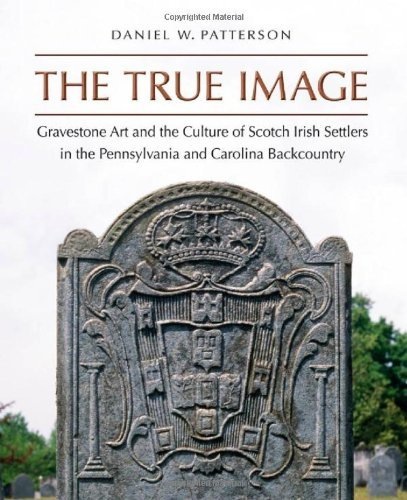
The True Image: Gravestone Art and the Culture of Scotch Irish Settlers in the Pennsylvania and Carolina Backcountry
Intro: Here in Northern Ireland, Ulster-Scots heritage is all too often trivialised, used as a commodity to soak money from public funders, politicised and poisoned - and often by those who claim to be its firmest advocates. Meanwhile from across the Atlantic comes an example of the depth and quality of work which could also be done here, if the 'decision makers' only understood the value of what we have under our very feet.
(article below reproduced from this website)
..........................
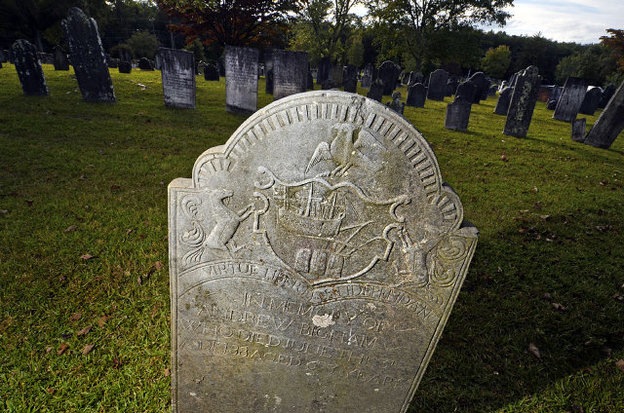
For more than 30 years, UNC Chapel Hill folklorist Daniel Patterson spent spring breaks and vacations roaming old cemeteries in the Piedmont region of the Carolinas.
Dodging poison ivy and black widow spiders, he photographed weathered gravestones when the light was just right, so he could read the carvings; often he sat for hours, watching until that moment arrived.
At first, it was a casual hobby, sparked by curiosity over markers similar to those he’d seen in New England and read about in Northern Ireland.
Then, while tramping through such historic church cemeteries as Thyatira Presbyterian in Rowan County, Steele Creek Presbyterian in Charlotte and Waxhaw Presbyterian in Lancaster County, S.C., Patterson began to notice a certain gravestone style rich in artistic design, poetic inscription and professional detail. The carver didn’t sign the stones, but Patterson sensed they came from a single source.
Through painstaking research, he traced the markers back to a shop near Charlotte run by members of the Bigham family in the 18th century. By the late 1970s, Patterson’s hobby had turned into a passion.
Decades of intensive field work and digging into archives and little-used manuscripts have produced a book that not only examines the unique Bigham headstones made before and after the American Revolution, but a vanished pioneer culture.
Published this month by UNC Press, “The True Image: Gravestone Art and the Culture of Scotch Irish Settlers in the Pennsylvania and Carolina Backcountry” is a story that also encompasses how people lived during the violent times of the Revolution, their political and religious battles along with providing new insights into slavery.
David Perry, editor-in-chief at UNC Press, doubted Patterson would ever finish the book he’d been working on for so long. When the author, who is 84, finally turned in a massive manuscript, Perry took a “big gulp.”
“It was daunting,” he said. “I was expecting a catalogue of old gravestones. Instead, Dan gave us a world.”
Looking through the lens of three generations of Bigham carvers and their circle of apprentices, Patterson has produced a work Perry thinks will appeal not only to specialists, but a wider readership interested in families and history.
“This book will be around a long time,” Perry said. “It will remind us of who we are, how we got here and what we hold dear.”
Tom Hanchett, historian at the Levine Museum of the New South, said Patterson is a highly respected educator who for many years headed the folklore curriculum at UNC Chapel Hill.
“He trained generations of scholars to appreciate the traditions passed down to us today,” Hanchett said. “This book is his life’s work.”
The names and dates on old gravestones are keys to “helping us understand how people fit into a larger culture,” Hanchett said. “It’s a great way to see local culture at work.”
Linda Blackwelder, who helped Patterson research the history of the Steele Creek community, urged him “to hurry up and finish the book.”
“I told him ‘I’m gonna die before you get it finished,’” she said. “I’m excited he has completed it. I’m glad he’s made a record of these stones. They’re eroding. They’re all melting away and it makes me sick.”
Bigham family member Earl Pike connected with Patterson years ago and read early chapters of the book. He’s been looking forward to the finished work.
“I’m thrilled to death Dan has done this,” said Pike, 78, of College Station, Texas. “I’m going to pass it on to my children. They need to know something about their ancestors.”
A Greensboro native, Patterson is the author or editor of nine books, including “The Shaker Spiritual,” “Sounds of the South,” and “A Tree Accurst: Bobby McMillon and Stories of Frankie Silver.”
“The True Image” is particularly fulfilling. The burying grounds of North and South Carolina became windows into the past, allowing him to unlock some of the region’s mysteries.
As Patterson explored old cemeteries, he found the stones were mostly made by unskilled hands helping their families or neighbors.
But the Bigham work was different. These markers came from skilled, creative craftsmen who turned out what Patterson calls “a surprisingly large and impressive body of work.”
Making the Bigham connection wasn’t easy. In his spare time, Patterson left his Chapel Hill home and drove to old cemeteries scattered from Hillsborough to Chester, S.C. He walked the grounds, collecting names of deceased persons and dates from the markers.
Then he took the list to the State Archives where he explored old records. Probates were especially helpful. Families listing their deceased relative’s possessions might include a receipt for a gravestone, naming the person who made it.
Traces of the Bighams weren’t left behind in letters or diaries. Patterson had to dig the story from deeds, marriage bonds, probates, court minutes and Revolutionary pension applications. Of special help was a privately printed family history supplied by the descendant of another stonecutter in Chester County, S.C.
“It was slow going,” Patterson said. “Tedious and time-consuming.”
Ultimately, he identified about 1,000 stones from the Bighams and their apprentices. The markers – the earliest surviving art of British settlers in the region – were scattered across 11 counties in North and South Carolina and in Pennsylvania.
Patterson looked at all aspects of the stones – designs, motifs, inscriptions. He began to see cemeteries as “art galleries and little libraries … used for storytelling.”
At Sugaw Creek Presbyterian Church cemetery in Charlotte, Patterson found a Bigham marker with the names of four children who died within four consecutive days of each other in 1781.
Patterson wrote: “The stone has no explanatory inscription, but only the coat of arms, as if having lost so much of the future in so short a space, the family stayed itself with a tight grip upon the past.”
A church history provided an answer to what had happened. The children’s’ 16-year-old brother came home from the Battle of Kings Mountain on Oct. 7, 1780, suffering not only from a gunshot wound but smallpox. The battered teen soldier survived. But smallpox brought down his younger sisters and brothers, one by one.
Early one morning, as sunlight raked across a flat gravestone at Hopewell Presbyterian Church Cemetery in Mecklenburg County, Patterson saw shadows fall into the cuts carvers had crafted on the surface. And that made something magical happen: Previously invisible words appeared on the stone.
It looked like poetry – put on the 1815 marker of prominent citizen Richard Barry, the son of one of Charlotte’s founders. The words were hard to read, but Patterson managed to get them down and research the inscription on the Internet.
He found the epitaph came from “Poems on Various Subjects, Religious and Moral, by Phillis Wheatley, Negro Servant to Mr. John Wheatley of Boston, in New England,” the earliest book by an African-American poet.
Born in Africa, Phillis Wheatley had been a slave since the age of 7. Her poetry book had been published in London in 1773 – 11 years before her death.
“The member of the Barry family who devised the epitaph knew the volume well, for the lines bind together couplets from three of Wheatley’s elegiac poems,” Patterson wrote.
Why a white Southern family in pre-Civil War Mecklenburg County picked lines from a black poet for their kinsman’s marker is an intriguing question.
To Patterson, it appears they were “making a statement … that they disapproved of slavery.”
He couldn’t answer all the questions that arose while writing “The True Image.” But he tried – mining as much information as possible.
The job that once seemed never-ending is done. And Patterson hopes it will appeal to anyone interested in the region, its early history and people.
“I had no idea I’d ever finish this,” said Patterson. “Now, it feels good to get it over with. It’s been wonderful fun. And also exhilarating.”
..............
• Order the 544 page book on Amazon for £42.50
- click here
Friday, October 26, 2012
Nobody Knows The Trouble I've Seen / Peace in the Valley - Luther Dickinson (& recordings from The 78 Project)
This recording was released back in April of this year by Tompkins Square Records in San Francisco as a limited edition record, a 78rpm to be precise. The guitarist, Luther Dickinson, plays in a range of different bands including The Black Crowes and North Mississippi Allstars. The recording below of two old classics sounds like it was done in the 1920s, just right for something available on a 78rpm.
He's also involved in something called 'The 78 Project" with a range of other musicians and singers, to make new recordings of old old songs in the way they were originally recorded - nothing digital and no autotuners, all live. The video below of 'Glory Glory Hallelujah, Since I Laid My Burdens Down' is great - adding a fife really works and adds a certain 'Ulster-ness' to the performance! As you can see it's all recorded live, cut onto vinyl there and then and played back to the artists just the way the original 78s were. Inspirational!
(all 78 project videos available here)
The 78 Project: The Wandering - "Glory, Glory" from The 78 Project on Vimeo.
The 78 Project: Valerie June - "Happy or Lonesome" from The 78 Project on Vimeo.
The 78 Project: Joe Henry & Lisa Hannigan - "Red River Valley" from The 78 Project on Vimeo.
The 78 Project: Valerie June - "Wildwood Flower" from The 78 Project on Vimeo.
And this one which was written by 'Son of Ulster' the Baptist pastor and hymnwriter Robert Lowry...
The 78 Project: Adam Arcuragi - "How Can I Keep from Singing?" from The 78 Project on Vimeo.
...and a lovely version of the old murder ballad 'Banks of the Ohio'
The 78 Project: Vandaveer - "Banks of the Ohio" from The 78 Project on Vimeo.
Thursday, October 25, 2012
The Blue Sky Boys
If there's an old 'brother duet' that I really love , it's the Blue Sky Boys. There's something primitive and deceptively simple about their music, from the era before past-faced bluegrass and when music was just starting to be recorded. Stuff like this gives a wee glimpse of what music was like before commercialisation. Magnificent.
Tuesday, October 23, 2012
Tourism fixation?

Everything in NI these days seems to be justified by, or focussed upon, potential tourism. This is nothing new - the Ulster Tourist Development Association was the first tourism agency in the British Isles, founded back in the 1920s shortly after the establishment of Northern Ireland.
This is a small place and to prosper financially we need to attract money from beyond our own region. Tourism is important. However, to prosper culturally there are things we need to treasure, promote and recover for our own communal good, regardless of whether tourists care or not. But I'd argue that a culturally interesting and confident place will naturally attract people who want to come and see, and to enjoy being in that place, whether NI or anywhere else.
Marketing Northern Ireland as a cultural destination would have been difficult without 40 years of terrorism, which broadcast 40 years of urban and violent footage around the world and which became the paradoxical image for a place that is overwhelmingly rural and peaceful. But even before that it was hard to get the message out and for visitors to see a reason to get beyond the big iconic 'must-see' places.
I recently picked up a copy of Scotch-Irish, Third Letter by W. W. Watson of Salina, Kansas, published privately as a limited edition almost exactly 100 years ago on 6th November 1912. He begins his travelogue as follows:
"We were long undecided as to where we would spend our summer vacation. Being of Scotch-Irish descent, I was anxious to visit the land of my great grandfathers, Scotland and Ireland. After a great deal of discussion, we got off on the Kron Prinz Wilhelm from New York on July 16th. The Titanic disaster caused Mrs Watson to rather lean toward a summer trip to the Pacific coast, but as we had been to the coast so many times, usually returning over the Canadian Pacific, I held out somewhat unreasonably for spending our vacation this time on and across the Atlantic."
So far so good. He's stood up to his wife and has opted for a cultural quest to the old country.
After six days sailing they arrived at Plymouth, headed for two days in London, and then got a train to Fishguard in Wales. They took a ferry from Wales to Rosslare in the south of Ireland. From here they went to Cork, Blarney Castle, Queenstown, Bantry, Glengariff, Killarney, then to Dublin.
However, just when you think 'okay, the Scotch-Irish tourists have done the south, and now they're heading for a full immersion experience in Ulster, the province of their ancestors', it all gets a bit disappointing. They spent just 2 days here - they went to Belfast 'by far the liveliest city in Ireland, up-to-date and full of business', Portrush, Dunluce Castle, the Giants Causeway. They then took the train from Portrush via Ballymoney 'the home of President McKinley's ancestors' to Larne and sailed to Scotland, arriving at Stranraer. They whisked up the west of Scotland, back down to Edinburgh, then Melrose, and then back to London.
So, even 100 years ago, people from overseas were coming here to feel a connection with their roots and to enjoy some cultural tourism, but spent little or no time in Ulster at all, and when they did it was just for a quick look at Belfast, a spin up to the Causeway and away again. And that's what the majority of overseas visitors still do today.
There is so much more here than the big 'must sees'. But I wonder if these undiscovered gems will ever appeal to anyone apart from local daytrippers and the real hardcore heritage buff.

Sunday, October 21, 2012
“The ideological compass in Northern Ireland is pointing towards Narnia and the media are writing the script”
A highly insightful piece reported by Alan in Belfast over on Slugger O'Toole about Northern Ireland's media (a subject which has been touched on here many times over the years). Click here. It summarises a speech by Brian McDermott at the Workers Party conference in Belfast yesterday. An audio recording of the speech is on that same page.
'...and “audience figures” are what obsesses “media people” here in Northern Ireland, not “informing people, developing arguments or analysing the society we live in...'
A few weeks ago a friend who works in the NI media summarised that, regrettably, most people in that sector have 'a kind of well-heeled disdain' for tradition and ordinary things.
Brian McDermott's speech focuses on radio, and so would be interesting for him to expand the theme onto tv, print and online. And full credit to Alan for his work in regularly reporting events which are seldom, if ever, covered in the mainstream media.
(thanks to Michael for tipping me off about this)
Saturday, October 20, 2012
Broadside ballad entitled 'Sons of Levi, A New Masonic Song'
The late George Holmes gave me a recording of this song, I am pretty sure he played the lambeg drum on it but was too modest to admit that to me. I found it again recently here on The Word on the Street, a website by the National Library of Scotland which is a collection of nearly 1800 'broadsides'. The commentary on the song says that it is Jacobite in origin, became Masonic and then Orange. The lyrics from George's version are a little different than those shown below. The lyrics are full of quite esoteric scriptural references; I'll leave it for my more Biblically-literate readers to assess the claim from the chorus that a group of people can be 'the root and the branch of David, the bright and glorious morning star...'. George's recording of it is great.

Friday, October 19, 2012


Tuesday, October 16, 2012
Boston Harbour Auctions - Royal Ulster Yacht Club - 1899 America's Cup Pennant
An amazing item now up for auction by Boston Harbour Auctions, bids start at $1800 but expected to achieve $3000 - $5000. Description below:
Extremely rare original late 19th/early 20th century Royal Ulster Yacht Club pennant with painted and embroidered detail including the red hand of Ulster and Royal Crown; elements of their burgee. The bunting is marked R.U.Y.C.. Royal Ulster Yacht Club, was the sponsor club of Sir Thomas Lipton during his challenges for the America's Cup. The bunting is also marked "The S McFadden Co, makers, 198 Hudson St. NY". Sir Thomas Lipton, the tea and grocery magnate raced for the America's Cup five times, never winning. A story in the New York Times from 1899 details the events of the Lipton vessels and how they were adorned with national flags, Royal Ulster Yacht Club pennants and Lipton on private burgee. Flown from a topmast as it measures 15'5" x 9'. The flag does have some minor holes but is in great condition considering it's age.
Thomas Lipton's parents are often said to have been Ulster-Scots - from Clones in County Monaghan.

Monday, October 15, 2012
Scotland viewed from Ballywalter at 8am this morning
The hills of Galloway in the distance, the Mull of Galloway in front of them, the waters of the North Channel, and with Ballywalter beach in the foreground.

Saturday, October 13, 2012
Mission Hall Chic? The Tin Tabernacle Tearoom
Baileys Home and Garden of Ross-on-Wye (the place with the annual book festival) is a fairly unique retailer who have carved out a reputation for themselves as treasuring the simpler things of life. We have been there a few times.
Visiting their website earlier, I see they now have a 'Tin Tabernacle Tearoom'. Now, I'm not sure about converting wee former places of worship into eateries, but Baileys Home and Garden clearly understand the aesthetic and innocent beauty of these buildings. This may well be a brilliant repro rather than an original (apart from the giant pieces of cutlery it looks original to me). But can you imagine this in present-day Northern Ireland? I can't - not without some smart-alec 'twist' to spoil it.
Bailey's Home and Garden were awarded 'Best Homewares Retalier 2012' by The Daily Telegraph. Their book Simple Home is an absolute joy.


Friday, October 12, 2012

Thursday, October 11, 2012
What would John Knox do?
A sad story unravelling in Glasgow. Be thankful that Presbyterians on our side of the water have more sense than this. (full article here)
'... Whilst in the great scheme of things what I am about to write about is not of the same scale as some of the much deeper and wider injustices in our society and world today, nonetheless what is going on is indicative of a deep malaise within the church in Scotland in general and the Church of Scotland in particular...
For many years St Georges Tron has been a flagship church of the evangelical renewal within the Church of Scotland – something that has been going on since the 1950s ... the congregation have recently completed a £3 million refurbishment of their City centre building. As anyone who goes into the centre of Glasgow can see it is truly a church building at the heart of the city, reaching out to thousands every day. And yet it looks as though this is now going to end – not because of persecution from outside, nor decline within, but simply because the Church of Scotland has decided to destroy this work...'
It's nearly 500 years since a German Catholic monk, Martin Luther, took his lonely stand at Wittenburg, and sparked the Reformation and a return to a clear understanding of what Scripture teaches. 'Reformation' is often presented as solely a Protestant v Catholic thing, and as such is 'sectarianised'. However one of the phrases linked to the Reformation of the 1500s and 1600s and Reformed thought generally is 'Semper Reformanda' - always reforming.
Sadly it increasingly seems that many nominally Protestant denominations today need a new Reformation.
Wednesday, October 10, 2012
Statistical Survey of the County of Antrim, by Rev John Dubourdieu of Annahilt, 1812
"... the descendants of the Lowland Scots still retain the accent of their original country, though it is not as strong as it formerly was; and the English colonists have in many instances acquired it..."
Monday, October 08, 2012
A message from Georgia
It's always an encouragement to get this sort of feedback (reproduced with permission).
.................
Mark,
Stumbled on your blog site. My wife and I made two trips and spent four weeks in Northern Ireland and Southern Scotland in 2011. Being from southern USA I just wanted to put my feet on the land of my heritage. Great trips, highlighted by great people who made me feel at home. We may be miles apart in distance but we still share many common values passed by previous generations. Thanks for keeping our history alive and well in this digital age.
I'm from Georgia. My ancestor John Agnew sailed from Larne to South Carolina in 1772 with Rev. Martin's group.
Clinton Agnew
'Ireland for Christ' - Rev John Pollock of St Enoch's Presbyterian Church, Belfast (part 2)
Rev John Pollock (subject of this previous post here back in August) turns out to have been a fascinating character. Thanks to Robert and Margaret who got in touch with me I now have the words and musical notation of 'Ireland for Christ' which he wrote in 1899. A scan is reproduced below, with permission -
The references in the lyrics to 'ancient land of saints and sages', 'from the slavery of ages, rise to liberty', 'Erin's sons and daughters' etc. read today as quite (N)ationalistic. However by way of contrast I've also been sent handwritten tonic sol-fa notation for a piece that Pollock wrote to be the 'Christian Endeavour Convention Song, Derry 1903' entitled 'No Surrender' !. Presumably the words of it had Gospel content and he was just making use of the well-known slogan to catch the attention of the audience at the Convention, in a way that was appropriate for the city.
If these two pieces suggest that Pollock's politics wavered a bit, then he confirmed that in a later speech. I recently came across a very interesting article in the North Down Herald from early 1914 which gives a report of a visit Pollock made to Hamilton, Ontario, Canada where he spoke at an Orange Hall in North James Street.
'...His opposition to Home Rule was made all the more remarkable by the admitted fact that he was a Scotch Liberal. He confessed that he had already changed his mind on the question twice... at the outset he proclaimed he was "a Home Ruler on principle, but thought Irish self-government impossible under present conditions"..."I have no objection to a free Parliament on College Green in Dublin, but I do object to Italian rule"...'
The article goes on to explain that his only reservation was of 'Rome Rule', ie Catholic church interference in a future 'Home Rule' parliament in Dublin, and suggests that if it weren't for this suspected interference Pollock would have supported Home Rule.
Bear in mind that Pollock was minister of the single largest Presbyterian church in the British Isles at the time. So, whilst not very 'PC' for today, his speech reveals intriguing nuances within the mind of one of the most prominent Ulster Presbyterians 100 years ago, whose speeches in Canada were given newspaper coverage back at home. Whichever side of the political debate Pollock found himself on, his focus remained on the Gospel.

Sunday, October 07, 2012
Mumford & Sons - Come Thou Fount of Every Blessing
A gem for a Sunday morning, written in 1757. (see Wikipedia entry here)
Come Thou Fount of every blessing
Tune my heart to sing Thy grace;
Streams of mercy, never ceasing,
Call for songs of loudest praise
Teach me some melodious sonnet,
Sung by flaming tongues above.
Praise the mount! I'm fixed upon it,
Mount of God's unchanging love.
Here I raise my Ebenezer;
Hither by Thy help I'm come;
And I hope, by Thy good pleasure,
Safely to arrive at home.
Jesus sought me when a stranger,
Wandering from the fold of God;
He, to rescue me from danger,
Interposed His precious blood.
O to grace how great a debtor
Daily I'm constrained to be!
Let that grace now like a fetter,
Bind my wandering heart to Thee.
Prone to wander, Lord, I feel it,
Prone to leave the God I love;
Here's my heart, O take and seal it,
Seal it for Thy courts above.
Tuesday, October 02, 2012
Mumford & Sons with Emmylou Harris - help!
If any US-based readers can somehow help with this I'd be very grateful. Mumford & Sons and Emmylou Harris performed a one hour concert last week on CMT Crossroads. This channel isn't available in the UK and the CMT website won't allow UK residents to view the online clips. Here's the link.
Saturday, September 29, 2012
Andrew Bonar-Law in Comber and Newtownards, Easter 1912; speech references to Scotland
Born in Canada, Bonar-Law was briefly British Prime Minister in the 1920s. During the anti-Home Rule campaign, as leader of the Conservative Party, he toured parts of Co Antrim and Co Down around Easter 1912. He and others, including Sir Edward Carson, arrived at Comber Square around 1pm on Easter Monday. During his speech to the gathered crowd, Bonar-Law pressed an Ulster-Scots button:
'...this is the first time I have visited Ireland on a political mission, and I can assure you that firmly I believe you are determined under no circumstances to allow yourselves to be driven out of the kingdom which your fathers have done so much to build and to sustain... I know Scotland well, and I believe that rather than submit to such a fate the Scottish people would face a second Bannockburn or a second Flodden Field. (Cheers.) And how can they expect that you will submit? All that is needed is to enable the people of England and Scotland to realise with what horror you regard the change which for a party purpose they are willing to force upon you. (Cheers.) Once they have realised that they will have realised also that the Unionists here are determined that the Union shall remain long after we who are now fighting your cause have been buried in the soil beneath (Loud Cheers.)...'
He then travelled to crowded Newtownards Square. Rev William Wright later reflected on how he welcomed Law to the platform:
'...The great bulk of the people who stood around him that day were descendants of Scotsmen, holding the creed of their ancestors, of which the late William Ewart Gladstone - no mean authority in such matters - stated, when addressing their kindred in their own land: "which, whatever else may be said of it, made your forefathers a strong and determined race." That strength might have been held in reserve in the peaceful times they had had under the British Crown, or might have been allowed to manifest itself in the pursuits of peace, but it abode in the blood of the people of Ulster, and if necessity arose it was there as it was in that province and in Scotland in many a field of fight in the brave days of old...'
Bonar Law responded:
'...As has been pointed out, my father was born and is buried in your province. Even when I was a boy in Canada I remember well how proud he was, and how constantly he showed his pride in his Ulster blood - a pride which could not have been greater if he had been descended from a line of kings, instead of being, as he was, the son of the small farmer in Ulster...'
.............
Many other speeches made in the Ards at the time, all designed to motivate and mobilise the listener, referred to Scottish history and ancestry. I am sure that these references were carefully chosen for maximum effect. The Ards is an Ulster-Scots heartland and the newspaper accounts of the events of 1912 show that very clearly.
NB - It may seem strange to us that Bannockburn and Flodden were employed in 1912 in a pro-Unionist argument, as both were great battles between the armies of Scotland and England. Bonar-Law's point was not purely political, but rather to show that in years gone by people had refused to be oppressed and were willing to fight for their freedom. And by the report above of the crowd cheering, his Comber audience knew full well what he was talking about.

Sir Edward Carson on the Ulster-Scots
(Speaking in Portadown, Wednesday 25th September 1912)
'...Was bragging a characteristic of the Ulster Scot? Was it by bragging that they won Derry, Aughrim and the Boyne? I remember Mr Gladstone once wrote a famous letter, he said, “read history.” I wonder do the Radicals ever read history? If they do I wish they would look over the history of the American War.
I should like just to quote to you as evidence of the Ulster Scot what two or three great men who have studied him, not merely in this country, but in America and elsewhere, have said, and I would first quote what the present American Ambassador in England Mr Whitelaw Reid, has said – “they (the Ulster Scots) were the first to proclaim for freedom in these United States, even before Lexington, Scots Irish blood had been shed on behalf of American freedom, and the spirit of Patrick Henry animated the Scotch Irish to a man when the clash came. In the forefront of every battle was seen their burnished mail and in the gloomy rear of retreat was heard their voices of constancy and courage.”
And the late President M’Kinley, who, I believe, came himself from Antrim descent, said this – “the Scotch Irish man comes of mighty stock, descending from those who would fight, and who would die rather than surrender.”
Lord Rosebery who was Prime Minister of England, said this – “the Ulster Scots without exception are the most dominant, the most irresistible race that exists in the universe.”...'

Friday, September 28, 2012
The gravestone of Rev George Brydone at Kircubbin Presbyterian Church (from Flodden > Covenanters > 1798 Rebellion > 1912 Ulster Covenant)
The flat stone in the foreground is the gravestone of Rev George Brydone, who (then aged 51) was the minister of Kircubbin on the shores of Strangford Lough in 1798. He was from Scotland and had arrived at Kircubbin aged 31. Brydone's understudy Archibald Warwick of Loughriscouse was arrested and executed nearby (aged just 29) for his involvement in the 1798 Rebellion and was later buried at Movilla. The inscription on George Brydone's stone reads:
UNDERNEATH
lies the body
OF REV. GEORGE BRYDONE
late minister of the presbyterian
Congregation of Kircubbin
He was ordained to the pastoral charge
of this congregation
by the Presbytery of Lauder, Synod of Kelso, Scotland
March 3rd commenced his ministerial labours
April 26th 1778
And departed this life September the 3rd A.D. 1817
Aged 70 years.

Situated halfway between Kelso and Edinburgh, Lauder had been a Royal Burgh since 1500 and was where John Knox and James Guthrie (the second martyr of the Covenanter 'Killing Times') had ministered in previous centuries. The town grew in the shadow of Thirlestane Castle, the architect of which, Sir William Bruce, also designed the unique Old Parish Church in 1673.
The famous collection Wilson's Tales of the Borders and of Scotland (first published in 1834) includes a story about a John Brydone, set in 1645 in the area near Lauder, called 'The Adopted Son - a Tale of the Times of the Covenanters' (read it online here). It shows that the Brydones were very familiar with being persecuted by the King's troops - back in 1600s Scotland, never mind in late 1700s Kircubbin.
Earlier still, a William Brydone of Selkirk had been knighted by King James IV of Scotland on the battlefield of Flodden in 1513. In 1790 a John Brydone also of Selkirk was reported as still having William's sword.
The Edinburgh Magazine and Literary Miscellany of 1817 reported Rev George Brydone's death, 'At Dunevely, Ireland'. Next to his stone is another flat one, to 'John Brydone of Donavelly' (Dunevely) who died on 16 October 1825 aged 74. Presumably they were brothers.
.........
It is easy to imagine the Brydone brothers standing alongside their congregation and neighbours at Kircubbin in October 1798, watching young Warwick being hanged by Redcoats - remembering full well their own illustrious ancestors who had fought similar struggles in centuries gone by, and no doubt sympathising with the cause Warwick had died for.
It is no wonder that a Newtownards Chronicle report of an Ulster Covenant meeting at Kircubbin Orange Hall in 1912 records that when William Mitchell-Thomson (the Scottish-born MP for North Down) referred in his speech to the Scottish Covenanters of old, someone in the room cried aloud "their descendants are here tonight!".
Over the next few days the Ulster Covenant will be marked. This simple story above shows that the Ulster Covenant, when cut off from its Scottish cultural roots and the power of handed-down family traditions, becomes a hollower story of simply 'big picture' politics - rather than deep rooted centuries-old heritage which coursed through the veins of the people of 1912.
Political history is interesting - but it's not the whole story.
Wednesday, September 26, 2012

Tuesday, September 25, 2012
Emigration, Orangemen and a St Patrick's Day violin (fiddle) in Portavogie, March 1911
From the Newtownards Chronicle, 25 March 1911
PORTAVOGIE TRUE BLUES LOL No 552
The members of this lodge met last week to do honour to two of their members, Brs. W M'Master and Alex M'Vea, who left for Chicago, USA on St Patrick's Day. Br. Wm Clint was moved to the chair, and in the course of his remarks thanked the members for placing him in that position, and expressed regret at the departure of their brethren, but wished them every prosperity in the land of their adoption. The chairman also presented each with beautiful certificates. The secretary of the lodge, Br. David Kelly, also spoke. He said he could not let the occasion pass without saying a few words, and he knew he was only expressing the heartfelt wish of all the members of that lodge, when he wished their much respected brethren (Brs. A M'Vea and W M'Master) health, happiness and prosperity in the land they were going to, and hoped that before many years they would have made enough to enable them to settle down at home in Portavogie once more. He concluded by wishing them a safe passage over, and to say he hoped they would not forget the happy times spent in No 552 (applause). Brs. M'Vea and M'Master amicably replied. During the evening gramophone selections were given by Br. Alex O'Prey. A dance was subsequently indulged in, the music being rendered by Br. Hugh O'Prey (violin). Br John Kelly, W.M. kindly acted as M.C. and rendered valuable assistance. The dancing continued until a late hour, after which the singing of 'Auld Lang Syne' brought an enjoyable evening to a close.
• Alex and Hugh O'Prey were clearly musical; both lived at Ratallagh between Portavogie and Cloughey, and signed the Ulster Covenant at Ballyeasborough Orange Hall. According to the 1911 Census Alex was 19; he had a 16 year old brother called Hugh. Their father was also called Hugh, aged 45. I suspect the father was the fiddle player. The family was Church of Ireland (presumably Ballyeasborough again) and all of the men were blacksmiths.
• William Clint of Cloughey also signed at Ballyeasborough
• David Kelly of Kirkistown signed at Kirkistown Orange Hall

Monday, September 24, 2012
Ards & The Ulster Covenant - the story of a community
The 'big picture' political story of the Ulster Covenant is everywhere at the moment - radio, tv, newspaper and events. Tonight I spoke at the launch of 'Ards & The Ulster Covenant' exhibition which is now on display at Ards Town Hall until 6th October before then starting a 'tour' of other towns and villages across the Borough. I worked on the exhibition with a number of other folk who are readers here (go and see the exhibition - they are all named on the acknowledgements).
It takes a different angle, telling the grassroots story of the Ulster Covenant in the Ards area - of people, events and stories that the standard accounts gloss over. The panels are entitled:
• The Ards in 1912
• Connections with Scotland
• Home Rule and the Idea of the Ulster Covenant
• Public Rallies in the Ards
• Famous Ards Signatories
• The Women's Declaration
• Ards Folk who signed Beyond Ulster
• Differing Views, Mutual Respect
• From Ulster Covenant to Northern Ireland
There is also a large map showing the locations where the Covenant was signed in the area, with small bar charts of the numbers of men and women who signed. It's intended for a local audience, so therefore the approach is to tell local stories - this meant that fresh research was critical, to unearth themes and accounts that haven't been seen in 100 years. Various artefacts have also been uncovered and included - such as the handwritten Covenant from Ballywalter, and the Ballyfrenis banner.
If you live in the area or have some connection here, make a point of going along to see it and drop me a line to give some feedback.
Detail from map panel:
Some quick snaps


Sunday, September 23, 2012

Friday, September 21, 2012

"O Lord grant me Thy grace that no word or act of mine may be spoken or done rashly, hastily, or with anger towards those who differ from me"
From the Ulster Volunteer Force prayer, 1913.

Thursday, September 20, 2012

Sunday, September 16, 2012
Ballyeasborough LOL 1310, September 1912
The Ulster Covenant wasn't signed in Portavogie. Surprising as that might seem today, back then it was a tiny place. Maps of the early 1800s show only a handful of small houses scattered along the coastline, but no village as such. Descriptions of County Down of the late 1800s don't even mention Portavogie; the 1911 census shows that all of the other Peninsula villages had larger populations. There wasn't even a Presbyterian church in Portavogie until 1926, the same year that the People's Hall was founded, however the Orange Lodge in the village can trace its roots back to 1797 (see website here). The local parish church was (and still is) out in the countryside - St Andrew's Church at Ballyeasborough had been built in 1850 - it is literally at the end of our road. I went to Ballyeasborough Primary School (which was turned into a house years ago and is now for sale). Just up the brae a bit was Ballyeasborough Orange Hall, which was also turned into a house many years back. Below is a report of the pre-Ulster Day discussions at the Orange Lodge. In the end, 257 men and 240 women signed the Covenant and the Declaration at Ballyeasborough.

Saturday, September 15, 2012
The Niver Budge - a poem from Greba / Greyabbey
I was given these a while ago and thought I should post them here to see if anyone out there can shed some light on the story. These are two related poems about a boat which was built at the 'Breek Hole' or 'Brick Hole' on the shore near Greyabbey around 1879. The construction was overseen by Mr H S Brookes, the land agent of Major General W E Montgomery (1847 - 1927) of Rosemount. While she was being built one of the locals declared 'boys she'll niver budge', and the name stuck.
The 'Niver Budge' was 20 -30 tonnes and was used to transport lime from Castle Espie, coal from England and seaweed from Strangford Lough. The poem below is said to have been written by Robert McKay, who was one of the crew:
The Niver Budge
Come all you seamen, and launch men, too
And a dismal story I'll tell you
Of terrible hardships; these were so,
On board the 'Niver Budge' not long ago.
To the 'Niver Budge' boys we do belong,
A well built vessel, both stout and strong,
Mr Brooks being her captain's name
A better seaman ne'er crossed the main.
Robert Wright - he is a man of fame
And bold Ned Kane - you may know the same,
For Sheely's Island we now set sail
For gravel bound; with a pleasant gale.
Bold McKay he loud did bawl,
"Lower your mainsail, here comes a squall"
He was a sailor, both stout and true
As ever sailed in the Budge's crew.
Out spoke bold Hagan, and this did say
"I think my brave boys, we'll have some tay,
We got no meat since we left the shore
And I'm afraid we'll return no more."
Mr Brookes he was an honest man
He took his seamen all by the hand
"Rabbie Reid", said he, "ye need no fear
For soon you'll see your Louisa dear".
As the Nut Bank it came into view,
Our gallant seamen their anchor threw.
And every man they held up their hand
And thanked God they were near the land.
Twas then that the small boat was launched,
Through wind and wave, for to take her chance,
She filled with water up to the brim
And we got a cart for to draw her in.
After this near disaster, the hull lay near Mid Isle at Greyabbey for years (pictured above), but eventually Major General Montgomery allowed the Scouts who camped on the island to break her up for firewood.
As you might expect from the locality, an Ulster-Scots version was also written - in fact, the person who gave both to me said that the Ulster-Scots one was written first. However I only have some fragments of it, which are below, and spelled as provided to me:
The Niver Budge
Ou'l Ned Kane at the helm did stand
By the help of God, boys weel reach the land
At Ned's word the sails did fill
And they steered her for Greba Mill
Keptain Brooks being a dacent man
Tuck his sailors by the han
Rabby Reid ye needny fear
For soon you will see your Louisa dear.
Up spoke boul Hagans
And thus did say
A'll put the tay pot on for a drap o tay
I've been looking at some old maps of the coastline between Greyabbey (Greba) and Kircubbin, and have found some interesting old Scottish-influenced place names such as Bloody Burn Bay (which of course the Bloody Burn flows into) and Bank O Bonnie.

Friday, September 14, 2012
So I was talking yesterday with a recognised authority on the Ulster Covenant...
... and asked him a few questions which had been puzzling me. He confirmed that:
1) The 'turnout' to sign the Ulster Covenant in 1912 across Co Antrim and Co Down, when compared with the 1911 census figures, was low. Perhaps only around 50% of those who could sign up to it (ie the Ulster Protestants / Unionists) actually did. And the numbers who signed in Belfast were relatively low as well.
2) The clergy of the Church of Ireland were more pro-Ulster Covenant than the Presbyterians, with about 85% and 65% signing respectively.
These are two major revelations. When you talk to people who really know their subject you can get a very different, and fresh, perspective. Discuss...
Monday, September 10, 2012
'The Work and Progress of the Gael' - 100 years ago last night...
... on 9 September 1912 the renowned / infamous historian, antiquarian and Irish nationalist Francis Joseph Bigger (1863-1926, see biography here) held a public meeting at St Patrick's Parochial Hall in Portaferry. Bigger had recently completed his conversion of Jordan Castle in Ardglass into an O'Neill castle (which he renamed Castle Shane) and so was fairly active in the Lecale area. There is a fascinating account in the Newtownards Chronicle of how Bigger and William Gibson sailed from Strangford at 7pm, across the 'limpid waters of the lough in a dignified manner in well-lighted boats', landed at Portaferry, paraded the town led by torch bearers, and held the event where the theme was 'The Work and Progress of the Gael'. Earlier in the day there had been 'childish' rumours circulating that some from Portavogie intended to disrupt the meeting, but nothing of the sort happened - '...the eternal vigilance of the R.I.C. under the command of Sergeant Reynolds and Constable Breen was largely in evidence; but this was as unnecessary as it was ridiculous...the Portaferry police were too sharp to be bamboozled'.
I plan to type up the full newspaper account and post it here soon. It stresses yet again that despite valid differences of opinion, people got on well with each other.
Bigger was a remarkable character and collector, who did a great deal to preserve old stories and traditions. Some say he maybe even invented a few along the way! His story was recently published as "FJ Bigger - Ireland's Cultural Visionary" (see here for info).
• St Patrick's Parochial Hall is now available for hire as holiday accommodation (click here). A replica is at the Ulster Folk & Transport Museum (click here).

Saturday, September 08, 2012
Oul country remedies: Witness the amazing fat-melting herbal rub! (weemen never change...)
This was in a few 1914 editions of the North Down Herald. Feel free to share this with your female friends just to see how they react. I suspect some will be online in seconds trying to locate a supplier of 'cirola bark' and 'quassia chips'.

Friday, September 07, 2012
Ulster Covenant Centenary events in the Ards
I'm pleased to update readers here that a wide range of activities are being planned for the Ards area to mark the 100th anniversary of the Ulster Covenant. The forthcoming exhibition will have its first public showing will be on Saturday 22nd September at the free Commemorative Family Day in Londonderry Park which runs from 11am - 4pm. Keep an eye out for the doordrop leaflet which will be delivered to approx 20,000 homes over the next week or so to promote all of the activities. ( Most if not all of the contributors to the exhibition are regular readers here, so thanks to every one of you - I won't name you just yet!).
One of the themes in the exhibition is to tell some of the stories of those in the area who opposed the Covenant, who supported Home Rule for Ireland - and importantly of the positive neighbourly relations which remained throughout the period. People had differing political opinions and religious traditions, but were determined to remain good neighbours.
The rural Ards is not a perfect place, and there are of course some hotheads in various localities and communities, but these positive relations can be seen back in 1606 when Scottish families arrived here with Hamilton & Montgomery, through the 1798 period, through the 1912 Covenant period, and they remain the norm here today. This is an important message, especially with recent events in Belfast. Long may those positive community relations continue.
As the Newtownards Chronicle report of September 1912 observed, the Ards had "...none of that bigotry and sectarianism, alas, too common in other areas..."

Punch Brothers - playing in Belfast on 5th November
Great band, frightening technical ability. Playing at the Empire Music Hall on Botanic Avenue on Monday 5th November. Not exactly trad old-time/bluegrass but it's their modern avant-garde twist that makes them what they are.
Wednesday, September 05, 2012
From Belfast City Hall "Decade of Centenaries" exhibition"

...and there are still plenty today blighted by these same ambitions.
Monday, September 03, 2012
Ulster Covenant Centenary events in the Ards area
(Please forward this post to anyone you think might be interested)
I'm working on a few projects with Ards Borough Council to commemorate the signing of the Ulster Covenant in the borough back in September 1912. I've been asked to publicise these two related events:
Talk: 'The Covenant and its Legacy' by Dr David Hume
Monday 17 September at 7pm in the Town Hall, Newtownards
Admission is free, but please register by emailing Ursula Mezza, Public Relations Officer - click here
Community Church Service
Friday 28 September at 10am in St Mark's Church, Newtownards
Members of the public are welcome to attend.
The projects I am helping with are nearing completion, with lots of local 'buy-in' from across the borough. The research team have found some brilliant stories which have been forgotten over the intervening years, and some of which are very important for today's generation.
More info to follow here over the coming weeks.

Saturday, September 01, 2012
160 Acres Free! Emigration to Canada - advert from the North Down Herald, 1914.
This advert caught my eye on a recent trip to the Newspaper Library in Belfast. Because it uses the same form of words that my great-uncle John used in his first letter home after emigrating to Canada in the 1920s. (see previous blog post here). I wonder if he was deliberately referring to a similar advert which had caught his eye back then?

Wednesday, August 29, 2012
Spirit Family Reunion at The Goat's Toe this Friday night.
This band are playing at The Goat's Toe in Bangor on Friday night and Belfast on Saturday night. Brilliant sound. Thanks to the Open House Festival email newsletter for letting me know.
Tuesday, August 28, 2012

'Amity and Enmity' by Anthony D Buckley
I came across this 2010 article a few days ago, on the website of University College Dublin. I don't know the author - Anthony D Buckley - but I think that many of you will be interested in what he has to say. Even though he seems not to 'get' the fullness of Ulster-Scots heritage, and seems to not be aware of the upsurge in Reformed thinking within the younger generation, the general approach of the article - that the stereotyped "them against us" narrative of Northern Ireland is not the whole story - is very welcome. Here are a few excerpts:
'...Protestants and Catholics prided themselves on being good neighbours. This good neighbourliness manifested itself in all kinds of ways. For example, there was practical help between farmers, with the larger tasks being shared... there was also evidence of general good-neighbourly behaviour between people irrespective of sectarian division... in many other places, community relations have remained quietly strong, much as they were in the 1970s and earlier. It is merely that writers have stopped writing monographs of this kind. Subsequent studies have been inclined to concentrate on less peaceful places and to neglect the cooperation and amity that still exists and can readily be rediscovered...'
I also like his warning to government to not turn authentic local festivals into 'tourist attractions'. Local people inherit local tradition from previous generations - whereas visitors just consume it. You can read the whole article here.
Sunday, August 26, 2012
Mair fishin' fae Peninsula Charters
We were fortunate enough to get back out again yesterday, and what a haul! We brought home 40 fish - cod, pollack (lythe) and mostly coalfish (blockan) - of around 2lbs weight each. Also got a wrasse and a wheen o mackerel forbye. As you can see from the pics below we had nearly 3 full buckets, which when we got home again became a well-filled sink where all were gutted, beheaded, de-scaled, cleaned and readied for either the cooker or the freezer.
Even a generation or two ago, people around our area caught big numbers of fish during the summer months for survival - layered them in saut (salt) in big earthen crocks which were then stored in a cool outhouse - all to keep the family alive until springtime. We are fortunate to go fishing without that pressure, simply for leisure and enjoyment... and in good weather.
Visit the Peninsula Charters website here. And when you book them tell them I sent you!


Saturday, August 25, 2012
Old Crow Medicine Show clip of "Jim Jones at Botany Bay" (go to 2.36 - 3.28)
This is an old English / Australian folk song. In this clip Old Crow Medicine Show play it to the tune that Bob Dylan used to record the song in the 60s. It was originally published in 1907 in Charles MacAlister's book "Old Pioneering Days in the Sunny South" on page 72 where he says the tune is "Irish Molly-O" (online edition here). Here are the words of "Irish Molly-O", a tale of a Glasgow man called MacDonald who emigrates to Tyrone, falls in love with Molly, is set for America but Molly's father is having none of it. It is said to be from from around 1810:
IRISH MOLLY-O
Tell me who is that poor stranger that lately came to town
And like a pilgrim all alone, he wanders up and down
He's a poor forlorn Glasgow lad and if you'd like to know
His heart is breaking all in vain for Irish Molly-o
Chorus:
She is young and she is beautiful and her likes I've never known
The lily of old Ireland and the primrose of Tyrone
She's the lily of old Ireland and no matter where I go
My heart will always hunger for my Irish Molly-o
Oh but when her father heard of this a solemn vow he swore
That if she wed a foreigner, he would never see her more
He called for young MacDonald and he plainly told him so
I'll never give to such as you my Irish Molly-o
MacDonald heard the heavy news and sadly he did say
Farewell my lovely Molly, I am banished far away
Till death shall come to comfort me and to the grave I go
My heart will always hunger for my Irish Molly-0
Some of you will recognise the general format of the chorus. "Irish Molly - O" was adapted and became "The Hat My Father Wore"... but is best known as the Orange folk song "The Sash My Father Wore", which is another tale of travel between Glasgow and Ulster.
THE SASH
Here am I, a loyal Orangeman, from Ulster's shores I came
To see my Glasgow brethren of honour and of fame
And to tell them of my forefathers who fought in days of yore
All on the twelfth day of July in the Sash my father wore!
Chorus:
Sure it's old, and it is beautiful and its colours they are fine
It was worn at Derry, Aughrim, Enniskillen, and the Boyne.
Sure my father wore it when a youth in the bygone days of yore,
And it's on the Twelfth I love to wear The sash my father wore.
Amazing how something as simple as a tune can link Scotland, Ulster, America and Australia across the centuries, and can be both "Irish" and "Orange".
Thursday, August 23, 2012
Snobs' Law: Criminalising Football Fans in an Age of Intolerance
Many of my readers here (of whatever background) will recognise Dr Stuart Walton's conclusion in this article which is based upon his new book Snobs' Law: Criminalising Football Fans in an Age of Intolerance.This is his conclusion on the sectarian issue in Scotland today:
"...the rise of anti-sectarianism did not emerge because of a rise in sectarian behaviour, or of sectarian violence; yet anti-sectarianism became a significant political, media, policing and legal matter in Scotland. As we have seen, the rise of interest in sectarianism has absolutely nothing to do with the behaviour of people on the terraces or on the streets. It has, on the contrary, everything to do with the activities and rhetoric of the Scottish elites and their establishment of a virtual industry of anti-sectarianism..."
This really clicked with me today, based upon an experience yesterday where, at an event based upon local history, the media outlet that was present attempted to 'spin' the project into a quasi-sectarian issue. It was bizarre and bewildering.
Northern Ireland has its historic problems, but it also has a poisonous anti-sectarian industry (which paradoxically, by constantly raising the issue, has become pro-sectarian) which seeks to insert a narrative of social division into spheres of life where none exists. It is very sad to read that Scotland now has a sectarian industry too.
Hopefully (both in Scotland and here in NI) most people will continue to get along with each other despite this divilment.
Tuesday, August 21, 2012
The Assassination of Jesse James by the Coward Robert Ford
Thanks to Will Ghormley of Iowa for getting in touch and inadvertently reminding me of this 2007 movie. It's seriously underrated (probably because the leading man is Brad Pitt). The cinematography is wonderful.
Saturday, August 18, 2012

Friday, August 17, 2012
What's the connection between the Ulster Covenant and the 1949 Le Mans 24hr winning Ferrari team?...

Wednesday, August 15, 2012

Tuesday, August 07, 2012
Rev John Pollock (1852 - 1935): From Glasgow to Belfast, "Scotland for Christ", "Ireland for Christ" and the CE Covenant
The Rev John Pollock was born in Scotland in 1852 (reportedly Govan in Glasgow) and ministered in Fife, Edinburgh and Glasgow. He came to Belfast in 1901 to become minister of St Enoch's Presbyterian Church from 1901 until retirement in 1930, a successor to the renowned "Roaring" Hugh Hanna who had retired in 1891. Built in 1872, St Enoch's was said to be the biggest Presbyterian church in the British Isles, but today it is closed.
John Pollock was highly active within the "Christian Endeavour" youth movement and became the President of CE in Ireland, Britain and then Europe.
CE had been founded in the USA in 1881 by Francis E Clark. In 1889 a branch of CE was established at Agnes St Presbyterian Church in Belfast by a working class woman called Margaret Magill. The movement grew rapidly and by 1896 there were 100 CE societies in Protestant churches across Ireland (bringing together Presbyterian, Methodist, Moravian, Baptist, Congregational, Church of Ireland and Quaker) and by 1889 over 10,000 young people were members. It can be claimed that CE brought a unity of purpose and spirit of co-operation across the Protestant denominations in Ireland which had seldom, if ever, been seen before. Significantly, a Covenant was at the heart of its functions. As the 1977 book A History of the Christian Endeavour Movement in Ireland states -


"... The primary emphasis of Christian Endeavour has been on the response of the individual to the redeeming work of Jesus Christ, a response expressed in faith, commitment and service. This has been expressed through the covenant or pledge taken by each active member, and renewed each month at a special meeting of the society to which he or she belongs..."
The book gives three separate covenants as an appendix: the Active Members Covenant, the Junior Active Members Covenant and the Trial Members Covenant. So in late 1800s and early 1900s Ulster, Christian Endeavour - probably the first pan-denominational youth movement across all of the evangelical Protestant churches - was using a Covenant as its basis for membership.
In CE founder Francis Clark's 1906 book Christian Endeavor in All Lands, (click here for online edition), a 25-years-on retrospective, these two excerpts speak volumes:
'...think of the "Solemn League and Covenant" of the Scottish martyrs! There is no more holy spot than the flat tombstone in Greyfriars' churchyard in Edinburgh where with the blood drawn from their own veins they signed and sealed the covenant which ensured Scotland's liberties and made Scotland great...'
'...stimulated and sustained by the obligation of a covenant with God and men as binding and exalting as the "Solemn League and Covenant" of Scotland's noblest days...'
Back in 1896, when still a minister of a church in Scotland, John Pollock had written a hymn entitled "Scotland for Christ" for the Scottish National Christian Endeavour Union; I found it in an old hymn book last week. Typical of the era it is full of references to the old Scottish Covenanters of the 1600s: -
SCOTLAND FOR CHRIST
"Scotland for Christ" Hark the challenge resounding
High over mountain and valley and plain
All the dark forces of treason confounding
Christ is advancing to conquer and reign!
Chorus:
Rally Endeavourers! Swell out the chorus!
Trusting in God and renewing your tryst
Bright gleams the banner that's marching before us
Claiming the victory - "Scotland for Christ!"
Men of the Covenant! In glad attestation
Setting your seal to the bond of the Lord
Follow your fathers in high consecration
Filled with His Spirit, believing His word
Sons of the martyrs! be this your ambition
Moved by the purpose their memory inspires
Calmly confronting this world's opposition
Bravely to follow your patriot sires
Brothers and sisters in Christian endeavour
Loving and earnest, leal-hearted and true
Bound in a union that nothing can sever
Rally around the old Banner of Blue
"Scotland for Christ!" from the cot to the palace
"Scotland for Christ!" pass the watchword along
Till from her mountains, her glens and her valleys
Scotland united shall join in our song!
(words from Manly Praise - a Collection of Solos, Quartettes and Choruses edited by Rev Wm Nelson, 1897)
IRELAND FOR CHRIST
Pollock was asked to write a similar hymn, "Ireland for Christ", for the 1899 British Christian Endeavour Convention which was held in Belfast, attracting 1900 delegates, but I haven't located it as yet. Both pieces were said to "...have remarkable power, and are characteristic of the music of the two countries...". Here are some artefacts from early Belfast CE Conventions:

Pollock's son, Paul Gilchrist Pollock, was in the 14th Royal Irish Rifles and was killed on the 1st July at the Somme. There was a memorial plaque to him at St Enoch's Church (see image here / portrait available on this website). Another son was a Royal Navy officer, and Rev Pollock's daughter Elsie was a sister in the Ulster Volunteer Force hospital - after the Great War she became a missionary in Formosa (today Taiwan).

CE AND THE ULSTER COVENANT?
By 1907 CE membership in Ireland was still around 10,000 young people. It experienced a decline and by 1911 there were 6,000 members, but numbers surged again with missions held in Portadown and Belfast in 1911 - 1913. CE membership peaked in 1936 with nearly 15,000 members in Ireland and 452 local societies.
Rev John Pollock was an influential Glasgow-born Presbyterian, ministering in north Belfast to the biggest Presbyterian congregation in Britain, and a leading member of the global Christian Endeavour youth movement whose ethos is still today based upon a 'Covenant'. This is an intriguing example of how the idea of a "Covenant" was very much a familiar element within Ulster Protestant church culture in the decades before the eventual Ulster Covenant of September 1912, signed by 471,414 people exactly 100 years ago.
Christian Endeavour still exists and provides an excellent range of youth-oriented materials, resources and services to churches around the world including here at home.
• To find out more about the work of Christian Endeavour today, visit their website here.
• Their 98th Irish Convention takes place in September, click here for details.
