

Philip and Maynard reminded me of this poem over recent weeks. I wrote it in 1995, following my grandmother's funeral - she died on 12th February, and I had to break the news to my father. He had turned 50 just 3 days before. The funeral "service" was held in her home, with friends and neighbours jammed into the wee room with the stove. We buried her at Ballyhalbert alongside her husband William, who'd died 48 years before.
The whole experience was deeply intense for me, I'd never experienced the death of a close family member before, and I'm not the type to go to every funeral in the locality. Maybe that's a generational thing - I know folk, like my da, who feels the need to be present at as many as possible, to show his respect and sympathy. I've not been at the funerals of a few elderly relatives over recent years, maybe that's bad.
My granny lived just over the fields from us, and was a big influence on me when I was growing up. Her husband, William Thompson, was the poet and he died in 1957, leaving her to rear five weans. The photo below is of her and me at the door of her wee house at Ballyfrench, around 1975, with her holding my brother Graeme.
The poem was written as a bit of catharsis, but to my surprise when I showed it to some other folk they liked it, and it was published in Ullans Nummer 7, 1999 and then in the 2003 book A Blad o Ulstèr-Scotch. For Maynard and Philip to be talking about it lately must mean it's had some kind of lasting impact on both of them, so here it is:
We cairryt her
Doon tha brae
By tha fiel whaur we kepp tha beess
Dizens o fowk ahin us forbye,
An tears wallin up in ma een.
Past tha enn o Skelly’s road
An by Sam Beggs’s loanen
Tha wun wus coul on Bellyfrench
Thon bricht February mournin
A wheen o fiels an a dizen o hens
She spent her days leukin efter
It gien her hauns somethin tae dae
Amang tha tears an tha lauchter
A hae mynn o tha day she wus bakin
Her shoartbreid wus burnt
A filled ma pokits
Wi black shoartbreid
Feart
Ma granny micht greet
We taen her tae Bellyhailbert
An laid her alangside her man
Whaur he wus waitin foarty-echt year
Leukin ower tha Sheugh tae Scotlann
A miss her
Whiles
A quair wee woman she wus
Bot A’ll see her yin day
An ma granda forbye
A’ll tell her o aa tha fuss
She gien us whun she left,
As intil tha grun she wus lowerin
An we happed her ower wi flooers an tears
Yin bricht February
Mournin.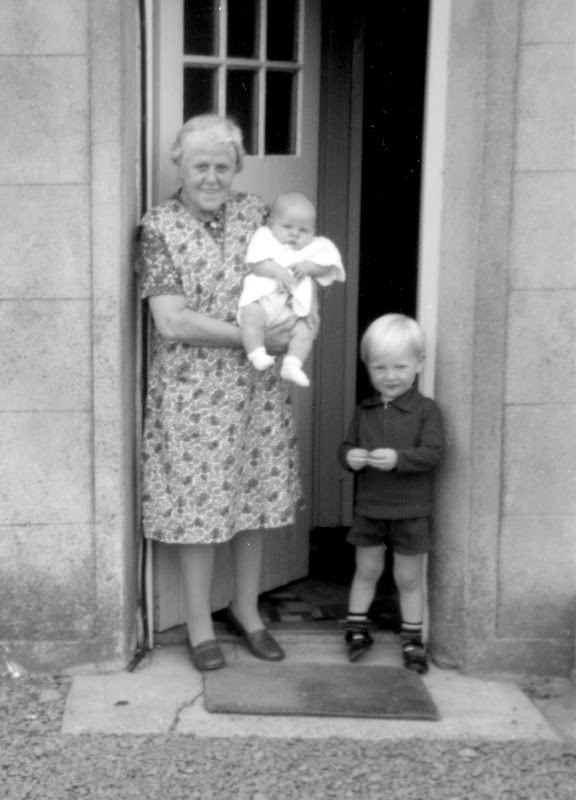
Monday, September 15, 2008
A Bricht February Mournin


Saturday, September 13, 2008
Red Hand Rednecks™?
This is an interesting story from the BBC website on the McCain/Palin republican Presidential election candidates, who the author claims have : "...white Southern Scots-Irish values - redneck values..." He goes on to say "...The essentials of redneck culture were brought to America by what we call the Scots Irish, after first being shipped to the Ulster Plantation, where our, uh, remarkable cultural legacy can still be seen every 12 July in Ireland. Ultimately, the Scots Irish have had more of an effect on the American ethos than any other immigrant group..." And after all, McCain's election compaign has included the "No Surrender Tour", and he has an ancestor (Captain John Young from Armagh) who apparently fought with William of Orange at the Boyne. There's a recent thread on Slugger all about it (with all the usual tit-for-tat chitterin' reader postings too).
So as usual, everything that matters has an Ulster connection. To wrap up, here's another McCain who was in Ulster a few months ago, talking about his family heritage and politics.
...............
™ (I made that name up, so it's mine. The trademarked Ulster-Scots-American giftware range is currently in production)
Thursday, September 11, 2008
Address to a Nintendo DS
Here's another effort to inflict on you! A Nintendo DS is a wee hand-held computer game that has infested the younger generation, increasing the poverty of parents, and the disobedience and selective hearing of weans, the world over. This is about our Charlie (5 1/2) and his DS fixation:
Charlie an' thon oul' Nintendo
He near haes his ma roon the bend-o
Killin' things fae ooter space
Gubbin' them richt in the face
Ye cannae fin' him roon the place
He's awa' playin' thon oul Nintendo
Ye cannae get near the Nintendo
Charlie'll no gie ye a lend-o
Ye dinnae hae a chance ava
He's jumpin' left an richt an aa'
Spongebob Squarebreeks taks a fa'
Fae Charlie wi' thon oul Nintendo
Ye'd think it was glued tae his hands-o
Lego Star Wars an' then Super Mario
Cloddin' fireballs at fowk
Fechtin' Darth Vader's nae joke
His ma says he's goin' tae get choked -
If he disnae quat playin' Nintendo!
He cannae pit the thing doon-o
Even whun he's in the bathroom-o
He couped - it went fleein' across the room
It hut the toilet an' went doon
It gien a splash, an then it droon't
He kill't his beloved Nintendo
(but a wheen o' months later, efter weerin' doon his ma' an' da wi' gurnin' an' gan on, he got anither yin...)
When it's time tae go tae his bed-o
Charlie hides it richt unner his pillow
The blanket's pu'd up ower his heid
Ye cannae see him, jist his feet
Whit's that lit up alo the sheets?
It's Charlie wi' thon oul Nintendo
Nae doot Charlie's hooked on Nintendo
He's nae need tae even pretend-o!
Ye'd think he'd naethin else tae dae
But sit on his rear-enn an' play
"A'll redd ma room some ither day...
A'm on Level Five on Nintendo!"
Wednesday, September 10, 2008
Address to an iPod
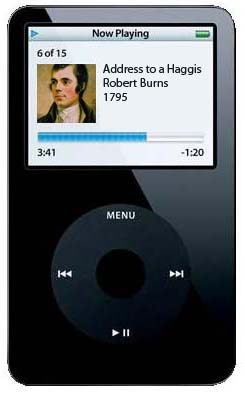
Here are two quick poems I wrote tonight (when I should have been doing real work) and when panged with guilt looking at the iPod I hardly ever use any more. These are in my best pigeon Ulster-Scots, and inspired by Gary Blair, who was rightly complaining that Ulster-Scots has more to it than prootas and kye. (potatoes and cows)
Address to an iPod, version 1
Fair fa' yer fancy, shiny face
Chief gadget o the modern race
Aboon them a' yer thumpin' bass
Through white ear plugs
The status symbol o' the tasteful
An the smug
(that was with apologies to Robert Burns)
..............................
Address to an iPod, version 2
A langed tae buy an iPod
For aa ma favourite sangs
A wud pit aboot ten thoosant on't
Tae listen a' year lang
A seen ither fowk wi iPods
So A wanted yin masel
Wi wee white wires hanging fae mae lugs
Amang the sproots o' hair
Oh hoo A yearned for an iPod
A thocht A wus missin' oot
Wi' adverts on the television
iPod fowk aa jumpin' aboot
So A bocht masel an iPod
It wasnae very big
A cud pit it in ma pokit
Wi room for 80 gigs
Boys A loved ma new wee iPod
It haed a colour screen
It wus wee an black an shiny
An powerfu' on the een
Admirin' ma new iPod
A thocht A wus some boy
A footer't at it, och, for oors!
It wus my pride an joy
But, the coast o' ma new iPod
Weel it was far fae chape
Three hunner poun' A pairted wi'
Tae be redd o' CDs an' tapes
So for weeks A fill't ma iPod
Wi' aa' o my CDs
A burnt an burnt and fill't it
Tae the gills wi MP3s
But efter weeks an' weeks o' wantin'
It wusnae lang afore
A loast the notion o' ma iPod
Noo it sits here, getherin' stour
Noo A niver luk near ma iPod
A jist dinnae hae the time
Weel thon wus yin dear Aipple!
Three hunner poun'? A wusnae wise!
Burns he wrote o' the haggis
An Orr o' prootas an hills
But siccan a waste o' money!
O' gadgets A hae had ma fill
Yinst we jist haed grapes and prootas
Noo Ulster-Scots hae iPods forbye
But we irnae ony mair content
For we hinnae ony time.
Tuesday, September 09, 2008
There I was, stuck in traffic on the way home one evening last week, when an Ulsterbus pulled out...
Thankfully the only thing that hit me was the relevance of the message in the advert...
Wednesday, September 03, 2008
Away for a few days
Aye, will be away from the computer till Saturday night, so no blogging for a wee while. Meanwhile here's a link to a blog post which was a real encouragement, from Magherafelt Reformed Baptist Church.
Saturday, August 30, 2008
Hilary's Family Tree - Part 4
Yet another fascinating discovery. Hilary's family tree includes a Henry Francis Bowker (18XX - 1907). He was was the founding Chairman of the Keswick Convention! This just came up in casual conversation the other night, I could hardly believe it, and so I set off digging for information.
After a few nights of hoking aboot I found the pic below on the cover of a book called "These Sixty Years - a History of the Keswick Convention", published in 1935. This is probably the only surviving picture of him - the great-great-great-great grandfather of my three weans!
He was the father of Henry Charles Bowker, who I blogged about as Part 2 of her family tree.
The first Convention was held in 1875, at which he was one of the preachers. In 1878 a set of twelve Keswick-related pamphlets were published. HF Bowker wrote the first one, entitled "Sanctification: a Statement and a Defence". He was one of the pillars of the Keswick Convention until his death in 1907.
In the introduction to the 1878 booklet "A Personal Christ" by Rev W Haslam, Henry Francis Bowker wrote:
It is from the neglect, not so much of the doctrines of the Gospel, but of Christ Himself, that the walk of so many believers is fitful, uncertain, and consequently unhappy, instead of being established, peaceful, and a true witness for Christ.
This website has some information about HFB:
Mr. H.F. BOWKER, after a time of prayer, rose as one who could attest the truth that “He is able.” “We come,” said he, “with testimonies of victories - victories which refer us all to Christ; and even as Abraham could not receive the gifts of the king of Sodom anxious to do him honour because he had lifted up his hand unto Melchizedek, for the gifts had been blessed by that mysterious king - so we who are now to receive the blessing of the great Melchizedek should make Him the central figure in our hearts henceforth and for evermore.”
(Hardly the sort of lightweight fluffy language you hear in most churches today*!) and:
...next Mr. BOWKER rose to show the all sufficiency for us in Christ. “In Christ we have as perfect sanctification as redemption. If this be true, let us settle it in our minds that in Him we have now as perfect sanctification as we shall ever have. Let us take of these gifts laid up in Him for us, and write them upon ourselves.”
and:
“What of the world’s pleasures and amusements? Shall I be the friend of the world and the friend of God? It is impossible to be both; and if I settle that I will be a friend of God then I must drive a ploughshare right through that borderland trodden hard by the feet of Christians going back and forth over it.”
[PS - The world is a small place. For the past 3 years I've designed the advertising materials for the Keswick at Portstewart summer convention.]
* Melchizedek as a forerunner or type of Christ was a well-known theme with the preachers of my youth. Who was Melchizedek? Here's a podcast, but be warned the speaker has a strange voice.
Wednesday, August 27, 2008
Bagpipes in Ulster
I got thinking about the importing of Highland culture into the Lowlands and Ulster, which then got me thinking about bagpipes. Pipe bands are generally believed to have emerged from British Army regiments in the late 1800s and early 1900s. However maybe the origins of bagpipes in Ulster are in fact more authentic, as the following excerpt from The Montgomery Manuscripts might suggest.
This is a description of Hugh Montgomery III, the first Earl of Mount Alexander (c.1625 - c.1663) near Comber, and grandson of Sir Hugh Montgomery, Viscount Ards:
"...Montgomery came accomplished in the French tongue, dancing, fencing, touching the lute, riding the great horse, and other academy improvements; yet he laid aside all courtly recreations, and betook himself to fortification and other martial arts, which (with other parts of the mathematicks) he had learned abroad; he now using no musick (except in the church and in house devotions) but only the drum and trumpet and bagpipe among the soldiers, in which he delighted, for he was conformist to the adage, Dulce bellum inexpertis (transl: war is sweet to the inexperienced)..."
So there we have it. Documentary evidence of bagpipes in Ulster around 1641/1642.
As reading Adair's Narrative will show, this third Montgomery was no friend of the Ulster-Scots Presbyterians who were his tenants, and from whom his father and grandfather had made their fortunes. And his son, Hugh Montgomery IV, the 2nd Earl of Mount Alexander (1651 - 1717), was a friend of the Duke of York (who later became the despised King James II). Montgomery IV had even sent troops to Donaghadee in the days following the Covenanters' disastrous defeat at the Battle of Bothwell Bridge on 22 June 1679, to capture "Scotch rebels" that might be fleeing for refuge in Ulster. However nearly ten years later when Montgomery IV received a letter - the famous "Comber Letter" - dated 3rd December 1688, he went into a blind panic. It revealed an alleged plot to massacre the Protestants of Ireland:
GOOD MY LORD, — I have written to let you know that all our Irishmen through Ireland are sworn that on the 9th day of this month, being Sunday next, they are to fall on, to kill and murder man, wife, and child, and to spare none; and I desire your lordship to take care of your self, and all others that are adjudged by our men to be heads; for whoever of them can kill any of you, is to have a captain's place. So my desire to your Honour is to look to yourself, and to give other Noblemen warning, and go not out night or day, without a good guard with you; and let no Irishman come near you, whatever he be. This is all from him who is your friend and Father's friend, and will be, though I dare not be known as yet, for fear of my life. Direct this with care and Haste to my Lord Montgomery.
Hugh Montgomery IV sent the letter to Dublin, where it caused such public pandemonium that 3000 people took to the ships at the harbour and sailed for England:
"...there got away about three thousand souls. There happened to be abundance of ships in the harbour at that time, which were so crammed that many were in danger of being stifled. The run of these people happened to be so suddain, and in the middle of the night, that it resembled the flight of the Jews out of Egypt... This fatal news which had so terrified the Protestants of Dublin, as if the dissolution of all things had been at hand, arrived not to several parts of the kingdom, till the very day 'twas to be put in execution, which being Sunday, was brought to the people in the time of Divine Service in some places, which struck them with such suddain apprehensions of immediate destruction, that the doors not allowing quick passage enough, by reason of the crowd, abundance of persons made their escapes out of the windows, and in the greatest fright and disorder that can be represented, the men leaving their hats and perriwigs behind them, some of them had their cloaths torn to pieces, others were trampled under foot, and the women in a worse condition than the men. And this disturbance did not only continue for this day, but for several Sundays after, the Protestants were in such a consternation and terror, that all, or most of them carried fire-arms, and other weapons to Church with them, and the very ministers went armed into the pulpit, and centinels stood at the Church doors all the while that they were in the Church. But whether this were a real thing designed, or whether by that discovery prevented, I leave it to others to judge and determine; but certain it is, that never anything happened in the kingdom... made so great a fright among the Protestants as this..."
The Comber Letter had been read to the population of Londonderry, terrifying the Protestants of the surrounding area who then fled in huge numbers from their homes and farms to the safety of the walled city. With the King's armies now bearing down upon the city, and senior civic leaders inside the walls dithering about what they should do, it fell to 13 young men - known as "Apprentice Boys" - to take action into their own hands, and they shut the gates of the city. One of them, William Crookshanks, is said to have been a relative of the Covenanter minister John Crookshanks who had been killed at the Pentland Rising in 1666. (source: Mackenzie's Memorials of the Siege of Derry p10)
With a tidal wave of public hysteria across Ulster, and in fear of losing his estates (and perhaps his life) in the expected Irish uprising, Hugh Montgomery IV conveniently forgot about his actions of June 1679 and turned to the Covenanters of the Ards area for protection. Sometime in 1689 Montgomery entered into an agreement known as a "bond of compliance" with the Covenanter minister David Houston. The bond said:
"...I do promise that I will use my best endeavour to cause all such persons over whom I have influence to be aiding and assisting to settle the present interest in this country, and will by all means persuade such to join with, and pursue such measures as the Earl of Mount-Alexander shall, from time to time, propose, and give out for safety thereof—providing such persons, with whom I have influence, have liberty to choose their own Captains and inferior officers. And I do promise, if such persons will not be advised by me as aforesaid, and my being here may be accounted obnoxious to the country, I will, upon my Lord Mount-Alexander his command, leave the country upon his order to do so. — As witness my hand, Dd. HOUSTON..."
[all indented quotes above are from The Montgomery Manuscripts]
Monday, August 25, 2008
If John Knox came back...
Here's an interesting blog post about the Covenanters, by an Australian couple who now live in Oxford. Very similar reaction to mine having visited St Giles' Cathedral in Edinburgh earlier this year:
We wandered down to St Giles Cathedral, because we had read somewhere that Knox had pastored a church there for a while. We found a statue of him in a corner. He looked out of place, among all the fancy stained glass windows and such. It seemed poignant somehow, having him stand, holding his Bible, poised as a preacher. He looks unimpressive amongst the trappings of the cathedral and no attention is drawn to him.
Yet so many people know God because of him. So many people are safe from God's anger forever because he preached the message of Jesus faithfully.
On the opposite side of the cathedral, they engage in activities that would have made him very cross indeed. Lighting candles instead of praying to God. Ostentatious organ playing (and I like organ music, but this was way over the top). Large, audacious stained glass windows. I suspect he would smash his own statue, and then set to work getting rid of all these other distractions to hearing God's word and taking it seriously.
Sunday, August 24, 2008
Scotland and identity continued
There are a few interesting posts on this over at the excellent 3000 Versts - here and here. Below I've cut-and-pasted an anonymous razor-sharp reply to one of them:
The misrepresentation to the Scots of their own identity has been fostered for some time. In education, media and culture, it's all Jacobite in theme.
The Scottish are responding logically to the stimuli they are fed. change the substance, change the mindset. we can go from a despondent "we lose", drugged up, fat, violent and miserable faux-Jacobean Scottishness to their actual heritage, a vibrant, work orientated, bible literate, self respecting, Union understanding: 'Covenanterism'. This is a big point phrased briefly.
Go on an official tour of Edinburgh, you will be taken to the grave of a very faithful dog and your state tour guide will not mention that the bars in the windows in the old building not 30 yards away in the ground once held those great men the Covenanters who changed history, for the better, with their blood.
You will also notice the total absence of education on Knox, the actual Union or its glorious history or the finest of Scotch Achievement, instead you will get the 'Mel Gibson' treatment from people who have inferred an elementary and base proposition (nationalist belligerence) and accepted it.
And the glorious legacy, if upheld before a comprehensive educated labour movement manipulated Scotland, will shine out and eclipse it all, making these Bonnie princes and make pretend William Wallaces be revealed as the shameful, discouraging blight on identity and self motivation they really are.
What a difference 400 years makes
Back to Fermanagh. As you know we visited both Monea and Tully Castles, which were built by energetic and wealthy Scots, determined to make a success of their new business ventures in west Ulster. They had been granted lands in Fermanagh in the years following the Plantation, which had begun in 1610.
Having left Monea Castle, we drove the hilly backroads between Garrison and Belleek. On the way, we passed a huge windfarm at Callagheen.
Who built it and runs it? Scottish Power.
Thursday, August 21, 2008
The Invention of Tradition; the Highland Tradition of Scotland - by Hugh Trevor Roper

Scotland played Northern Ireland last night, and the match finished 0-0. Scotland fans are as usual clad in tartan, kilts, with bagpipes, ginger wigs and all the usual stuff that is accepted today as Scottish iconography. Some of my pipe band friends wear kilts every Saturday at their competitions. But where did it all come from in the first place? Is it all as ancient as some people claim? Maybe not:
"...The creation of an independent Highland tradition, and the imposition of that new tradition, with its outward badges, on the whole Scottish nation, was the work of the late eighteenth and early nineteenth centuries..."
Here's a link to Hugh Trevor Roper's famous summary. Just 30 pages long, and a very worthwhile read.
Here's also a review of one of Roper's other writings: The Invention of Scotland.
(but maybe if I still had the lean muscley legs of my early 20s I'd be wearing a kilt too!)
Wednesday, August 20, 2008
Celtic?
I'm not talking about football, but identity. This is another great book I have sitting in the pile, waiting to be read sometime soon. I've had a flick through the pages and it looks like another exocet of a myth-buster.
"Celticness" is everywhere, from faux craft shop kitsch with swirls and stuff, to a descriptive term which is sometimes used innocently enough, but now and again it is code for "non-English", or sometimes even "anti-English". With an English wife and subsequently an English extended family, I don't appreciate anti-English sentiment. Everyone deserves criticism when it's due, regional rivalry has its place, and I will admit to a few tears of joy when Northern Ireland beat England at Windsor Park in 2005!.
However, anti-Englishness seems, in some quarters, to be acceptable. Northern Ireland-style sectarianism has often been described as "Scotland's Secret Shame" - but others now see anti-Englishness as a much bigger problem there. (Have a look at this page, and some of the posts - especially no. 109). The label "Celtic" can be one way that English people are alienated and branded as outsiders. Politics, nationalism and romantic nonsense are a heady combination - one which has even crept across the Atlantic into Appalachia.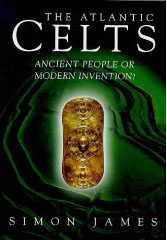
The assertion of this book "The Atlantic Celts: Ancient People or Modern Invention?" (published 1999) is that the modern label 'Celtic" (ie how the term has been applied since around the 1700s) is nonsense, all made up, with no archaeological evidence to support it.
The author is not some crackpot obsessed with ancient history and constructing identity myths - quite the opposite. Published by the British Museum Press, Dr Simon James is an accomplished Iron Age and Roman archaeologist, currently at Leicester University. Here's an old website he had. And here's an old article from the Scotsman newspaper:
...........................................................
Did the Ancient Celts exist?
MILLIONS of people around the world think of themselves as Celtic and believe that their remote ancestors in the British Isles were Celts too. But many British prehistorians now argue that the idea that the pre-Roman peoples of the isles were Celts is misleading and probably just wrong. Why?
One fundamental, startling reason, is that no-one in Britain or Ireland called themselves "Celts" before 1700. Our earliest evidence for the identities of these peoples - the 2,000-year-old writings of their Greco-Roman neighbours - records Celts only on the continent, most notably the Gauls of modern France. The inhabitants of the isles were already called "British" and "Irish", and these were distinguished from the continental "Celts".
So where did the idea of insular Celts, ancient and modern, come from? It appears in the 18th century. "Celtic" came into use in the context of the isles as the result of the work of a pioneering linguist, the Welshman Edward Lhwyd, who demonstrated that Scots and Irish Gaelic, Welsh, Breton and related languages were also related to the extinct tongue of the ancient Gauls. He chose to call this family of dead and living languages "Celtic". Soon it was being used as an ethnic label for living peoples, and was applied to ancient monuments too. It became fixed in popular consciousness with remarkable speed. A century later, in "Rob Roy" Sir Walter Scott could refer to an 18th-century Highlander as a Celt without elaborating; his readers knew what he meant. By then, modern Celticness, and an ancient Celtic past, were part of agreed popular history. It has come to be believed that the Celtic ancestors were invaders from the continent.
I believe that the rapid uptake of belief in Celtic identity, and Ancient Celtic roots, was driven by the perception among Welsh, Scots and Irish that their several identities were in danger of being swamped by the new English-dominated superstate. Celticism provided an alternative, shared, non-English identity. Celtic identity, then, and British identity, are twins, both initially political creations of the 18th century. This in itself is nothing very surprising: every such identity is created at some time, for good contemporary reasons. Scottish and English identities also have such histories, but can be traced back much further. It is also almost universal for ethnic or national identities to claim roots in the distant past, which may be authentic or may be exaggerated, or spurious; it is an important way of legitimating our sense of self, and our claims to our place in the world.
Archaeology was a late addition to all this, only really developing in the later 19th century. As early discoveries were made, they were interpreted according to the already established Celtic model. Many seemed to fit it well: Britain, Ireland and Gaul all have hill-forts, and some magnificent ancient metalwork decorated in similar, exquisite patterns. But more recent research has probed much deeper into the Iron Age past and has found not evidence for Iron Age Celtic invasion, but basic continuity from earlier prehistory; these peoples were, mostly, already here.
Also, the evidence for types of houses, settlements, farming and economy, the way people lived, the things they made and used, and the ways in which they disposed of their dead, are not uniform and often not even very similar. There seem to have been many different peoples living in Britain, probably with a multiplicity of identities. It is implausible that they all thought of themselves as sharing common Britishness, let alone a wider Celticity.
The idea of overarching identities linking vast areas appeared briefly with the Romans, and more recently with the quite new ideas of Britishness, pan-Celticness and now, European integration. It is up to the peoples of the present to decide whether they wish to establish a Celtic Union, or a United States of Europe. But projecting Celtic identity on to the ancient peoples of the Britain may, ironically, be to rob them of their many, diverse, real self-identities.
...........................................................
James' work has got him into some hot water and controversy over the years - defying the establishment usually has that result. (as someone pointed out to me in the Independent newspaper earlier this month, ask Radovan Karadzic!)
Identity in Northern Ireland is a loaded issue. Maybe "Celticness" should be consigned to the dustbin?
PS: Here's a link to something I posted online over 5 years ago.
Sunday, August 17, 2008
Hilary's Family Tree - Part 3
• Part One: David Moneypenny here
• Part Two: Henry Charles Bowker here
Hilary's surname is very distinctive - Bowker. There aren't that many Bowkers in the world, so the chances are that the Bowker family tree is small and well-integrated. There are only 2590 Bowkers on the current UK electoral roll. Here's a link to the origins of the name, which seem to be French/Norman.
So when I recently found a George Bowker in Rev George Hill's classic text "The Plantation in Ulster" (1877), I was intrigued. There is probably a connection.
On page 463 it says that on 10 April 1616, George Bowker was leased the "poll" at Derhowe, and another at Dromany, both in County Cavan. Both were leased for 21 years to him by the local "undertaker" or landlord, an Englishman called Sir John Fish, who was originally from Bedfordshire and who had been granted 2,000 acres in the Loughtee barony (in the north west of the county, around Swanlinbar, Glangelvin and Dowra - just south of Fermanagh's Lough Erne and not far from the Marble Arch caves which we visited last week.)
By the way, a "poll" was a quantity of land, of around 25 acres. So George Bowker's lease of two polls for 21 years wasn't an early example of exploitation of migrant workers from eastern Europe!
The Courage to be Protestant
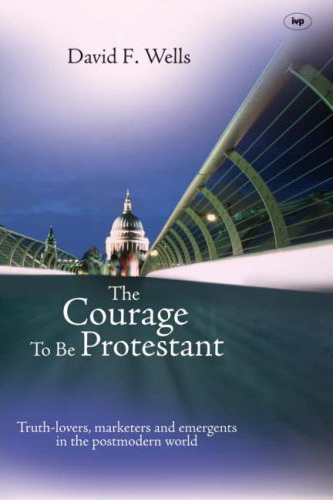
"The P Word" is frowned upon in many quarters, especially among progressive types in the shiny new Northern Ireland. "The Courage to be Protestant" is the title of a book I was given just about a week ago, and I've been working my way through its brilliantly-reasoned chapters during the past few days.
It is perhaps a wee bit too American in its examples for a UK, or even Northern Ireland, readership, but you'll easily recognise the overall themes and trends. Its core argument is that the historical anchors of the Protestant faith - the Reformation solas of grace alone, faith alone and scripture alone, and a reverence for doctrine - have been jettisoned, and that they need to be restored. This is the back cover blurb:
'It takes no courage to sign up as a Protestant.' With these words, David Wells opens his bold challenge to the modern church. In this volume, Wells offers the summa of his critique of the evangelical landscape, as well as a call to return to the historic faith, one defined by the Reformation solas (grace, faith, and Scripture alone), and to a reverence for doctrine.
Wells argues that the historic, classical evangelicalism is one marked by doctrinal seriousness, as opposed to the new movements of the marketing church and the emergent church. He energetically confronts the marketing communities and what he terms their sermons-from-a-barstool and parking lots and après-worship Starbucks stands'. He also takes issue with the most popular evangelical movement in recent years - the emergent church. For Wells, many emergents are postmodern, postconservative and postfoundational, embracing a less absolute understanding of the authority of Scripture than he maintains is required.
'The Courage to be Protestant' is a dynamic argument for the courage to be faithful to what biblical Christianity has always stood for, thereby securing hope for the church's future.
The author, David Wells, defines the broad evangelical world into three groups: classical evangelicals, church marketers, and emergents. From this basis he then goes on in a series of illuminating chapters to chart and explain how evangelicals have shifted dramatically away from a Scriptural foundation to one which has adjusted its message to secular culture, and has lost its way.
There are two interviews with David Wells here and here.
Here's a review, and another. To summarise by using a quote from this second review, "...a powerful internal critique of the state of many churches within Evangelicalism, particularly the marketers and the emergents. It is also a reminder that many within Evangelicalism are trying to hold fast to the essential truths of the Protestant Reformation and calling others within Evangelicalism to do the same..."
Saturday, August 16, 2008
Five Days in Fermanagh
Just back from a short break in Fermanagh with the family. In between trips to a) the Marble Arch caves, b) the swimming pool, c) the shops and d) the football pitch beside Enniskillen Castle Museum - where Jacob and I had a "Hit the Crossbar" competition and we impressively drew 3-3 with just 20 shots each! - we also diverted to some of the local historical sites/sights.
Fermanagh was one of the six western counties of Ulster that were "planted" with landlords and then tenants from England and Scotland from the year 1610 onwards. Historically speaking, I find that the organised, low-to-medium-impact Plantation of Ulster is all too often over-emphasised, and that this is largely to the detriment of the more natural, high-impact, migrations between east Ulster and western Scotland that had been going on for many centuries, and which have continued right up to the present day. And of course there are also the migrations of ordinary people within Ulster itself - the story is more complex, and more interesting, than simply the 120 or so aristocratic landowners who arrived from England and Scotland during the Plantation. (Having said that, George Montgomery - Hugh Montgomery's younger brother - was bringing Scots from Glasgow, Ayr and Irvine into Derry, Killybegs and Donegal in Spring 1607 even before the infamous "Flight of the Earls" of September 1607, so Plantation isn't even the whole story for the west of Ulster.)
However, Fermanagh has many Plantation-era castles dotted around Lough Erne, each of which tells a story. Here are just three:
Monea Castle (two pics below) is impressive, built between 1616 - 1618. It was built for local landlord Malcolm Hamilton from Dalserf in Lanarkshire, and it was described as "a strong castle of lime and stone".

...................................................................................................
Tully Castle (below) has a lovely Ulster cottage style visitor centre (thankfully unmanned and without a gift shop or cash register) and was built by Sir John Hume of Plowarth in Berwickshire in 1613. The interpretive panels in the cottage tell its' story. On Christmas Eve of 1641 the local Irish Gaelic chieftain Rory Maguire had his men storm the Castle, taking all of the occupants - 15 men and 60 women and children - prisoner. Despite Maguire providing written assurances that no harm would come to them, the next day they were all stripped naked and killed, and the Castle was then set on fire. Surely there should be a memorial of some kind here. The gardens were planted as part of the castle's refurbishments of the 1980s, and are in saltire and diamond style formations, said to be as close as possible to the original.
...................................................................................................
Castle Balfour (below) is in the grounds of Lisnaskea Holy Trinity COI Church, and was built by Michael and James Balfour of Kinross in Fife, Scotland. They arrived in Ulster in 1610 and the castle was built by 1619. I also visited the ancient Aghalurcher Graveyard just a few miles away, looking for the grave of James Johnston, the Lisnaskea minister who was ejected from his pulpit in 1661. I thought I'd found it, took loads of photographs, but when I got home and cross-checked my photos with one that William Roulston has sent me (and which was printed on the cover of the Covenanters in Ulster heritage trail), I'd photographed the wrong one! It did look very similar though. However I don't think I'll be making the 6 hour round trip to go back there to re-photograph it anytime soon.
...................................................................................................
And finally, perhaps of just as much cultural significance for this generation as castles were for the early 1600s, this chip shop in Belleek is one for the trademark infringement police, but 10 out of 10 for creativity:
Thursday, August 07, 2008
Ulster-Scots Proverbs - No. 1
"Better tae hae nane than a bad yin"
(English translation: better to have none than a bad one. Can apply to all kinds of possessions - cars, dogs, chinese takeaways, and dare I suggest women - even though Hilary will kill me if she ever reads this post, and she would probably retaliate and say men...)
Monday, August 04, 2008
Two recent photographs (click to enlarge)
How close is Scotland anyway? Here's the evidence, photographed this evening at Ballywalter. You can make out the different colours of fields in Scotland.
And a sign of sad decline (or perhaps impending revival?) just outside Ballymena. The sign over the doorway is significant:
"Blasphemous Hymns and 'Too Loud' Organs"
Found this article online today.
There is a phenomenon known as "the Worship Wars", where modern day churches have been ripped apart by debate over musical styles. (by the way, defining worship as music alone is a massive mistake. It's a huge topic that I have neither the understanding nor time to explore in this post). To give you a flavour of how impassioned these disagreements can be, here's a portion of letter that was written by a critic of the new style that had infiltrated a church:
"I am no music scholar, but I feel I know appropriate church music when I hear it. Last Sunday's new hymn - if you can call it that - sounded like a sentimental love ballad one would expect to hear crooned in a saloon. If you insist on exposing us to rubbish like this - in God's house! - don't be surprised if many of the faithful look for a new place to worship. The hymns we grew up with are all we need."
And another:
"What is wrong with the inspiring hymns with which we grew up? When I go to church, it is to worship God, not to be distracted with learning a new hymn. Last Sunday's was particularly unnerving. The tune was un-singable and the new harmonies were quite distorting."
The hymns they were talking about were cutting-edge for their time, a departure from tradition, and perhaps a foolhardy distraction from what church services should be about. But wait... Letter 1 was written in 1863 about the hymn "Just as I am without one Plea". Letter 2 was written in 1890 about the classic "What a Friend We have In Jesus", which was written by Banbridge man Joseph Scriven.
Growing up in an Ulster gospel hall and mission hall setting, I can't imagine these two hymns being regarded in that light (there would be nothing left in Redemption Songs if the 19th century classics were removed!).But I must admit, most of today's modern christian "praise and worship" music makes my toes curl. I used to think that the hymns I love were traditional, but clearly at one point they were invented too, modern innovations. I wonder what I would have thought in 1890?
It all brings into very sharp perspective the Ulster and Scottish Covenanters' singing of Psalms 71 and 78 as the government troops charged down on them on the snowy slopes of Rullion Green in November 1666.
So, to give you an idea of the variety, here's a series of YouTube finds - firstly, a modernised version of one of my favourite hymns, Jesus Paid It All (written in 1865) - performed by ex-pat Ulsterman Alastair Vance who now lives in North Carolina.
To be contrasted with this - communal unaccompanied singing of Psalm 102 at the RPCNA International event last month:
And this, from my favourite gospel singer that I've ever found on YouTube. He seems to be on a one-man mission to flood YouTube with old hymns - his style reminds me a lot of the singers that came to Carrowdore Mission Hall when I was a wee boy. Here he is singing "Years I Spent in Vanity and Pride":
Finally, this is a hymn that's very dear to me. Five years ago, when my mother was in intensive care, in a coma and clinging to life following a car crash at my own front door, I played a version of this to her through the earphones of my iPod - the Robert Lowry hymn Christ Arose (1874). I couldn't find any footage of a traditional Ulster gospel hall on Youtube (as if!), but this clip is as close as it gets - men in suits trying to sing harmony. Just close your eyes... and ignore the flowers, stained glass and large pipe organ in the background.
Covenanters Grave on Flickr

I found this great photo on Flickr earlier on, of the grave of an anonymous Covenanter who died high in the Pentland Hills from the wounds he sustained at the Battle of Rullion Green in November 1666. Badly wounded and dying, he was found the next day by a local man, Adam Sanderson of Blackhill. His dying wish was said to be "Bury me in sight of the Ayrshire Hills", and so Sanderson carried his body to the top of a hill known as the Black Law, and built a small cairn as a marker. The gravestone was put there some years later.
The grave location is part of an 11 mile walk, visited by Scottish walking clubs like the Monkland Ramblers, and is recalled on this website's account of the Battle of Rullion Green.
Here's a map of the precise location, 13 miles from the battle site.
Sunday, August 03, 2008
Last weekend
Last weekend was jam-packed. Jacob and I started Saturday by watching Linfield Legends v Man Utd Legends, and Glentoran Legends v Liverpool Legends, at the Oval. Must admit I was delighted to see the still skilful Jan Molby controlling the midfield, and with a belly even bigger than mine. He was my hero as a 14 year old, and still has superb touch, control and passing ability. Then we headed to the European Pipe Band Championships in Lisburn for the afternoon.
.............
Then we went up to the Cairncastle Ulster Scots Folk Festival for the highlight of the day, their evening soiree. I reckon there were close to 500 people jammed into the big marquee; Willie Drennan had talked me into bringing my mandolin and I joined in with the mass ensemble of folk musicians (about 30 people!) for a version of "I Saw the Light". Great stuff!
My oldest son Jacob (10) then led the band on the tin whistle for a pretty raucous version of the old Belfast street song "I'll Tell Me Ma". It was funny playing in public again (I had wanted to take this whole year off, but when Willie asks and it's Cairncastle, well... it's kinda hard to say no), but I was really proud of Jacob. 10 years old, a big performance, thanks to the quality tuition he's had for lambeg drum and tin whistle from Joseph Long at the Greyabbey Junior Drumming Club over the past two winters.
The next afternoon the whole family drove back up (a 3 hour round trip!) for the Praise Service. Again I got roped in, and it was great. Unrehearsed and rough, but really enjoyable to be among such great folk. Nothin fancy, just simple and authentic. You can't invent what they've got at Cairncastle. Here's the communal singing of Amazing Grace (apologies for the shaky camerawork, I was trying to show the size of the audience)
.............
Then that evening Graeme was preaching at Brooklands Gospel Centre in Ballybeen (it was his own church while he lived in Newtownards), and he twisted my arm into playing there too. We did a brother duet version of three old hymns, which were so well received that we were asked to do two or three more at the end of the meeting. Mandolin, guitar and two voices.
Drew Craig (for those of you who don't know him, Drew has been a missionary to Romania for most of his life, and he must be in his 70s by now) got up after we'd finished and told a story of his childhood near Cullybackey. In their house they had an old organ his father played, an old piano his mother played, and a mandolin that his brother played. Every weekend they had communal family hymn singing. One evening, an American GI who was stationed nearby was walking along the road outside their house, heard them singing, and came up to the house and asked if he could join them. He was a Christian, he was welcomed into their home, and for the next few years during his time based in Northern Ireland he went to their church each Sunday.
So three musical performances inside two days. Hopefully nae mair for the rest of the year, but word has spread like wildfire and the enquiries are flooding in again!
Some photos below of me and Jacob, and of me playing mandolin with the Whitlees Community Church band from Ardrossan - both pics from Cairncastle. Thanks to Cathy and Davy Angus of Angus Fifes in Donaghadee for sending these to me.

Saturday, August 02, 2008
Hilary's Family Tree - Part 2
Hilary's family tree (part one - David Moneypenny - is here) includes another interesting man - her great-great grandfather Henry Charles Bowker (1839-1920) was a 19th century theologian and a close associate of the famous dispensationalist E W Bullinger.
[Bullinger is renowned for writing a series of influential books, including The Companion Bible. My uncle Harvey Shaw, Baptist postor at Killicomaine Baptist Meeting House in Portadown, bought me a copy for my 21st birthday. I had first met Hilary just a few weeks previously, completely oblivious to the historical connections between her and my new Bible!]
HC Bowker was a member of the Trinitarian Bible Society,(their slogan is Founded in 1831 for the circulation of Protestant or uncorrupted versions of the Word of God) and he's mentioned quite a few times in Juanita S Carey's biography of Bullinger (Kregel Publications, 2000). She reveals that Bullinger was also an Orangeman, a member of LOL 481 in Walthamstow, and had become its Worshipful Master in 1881 - he was the vicar of Walthamstow and St Stephen's from 1870 - 1888.
It seems that they met when HC had retired to Northwood in Middlesex, by then aged 70. He joined the TBS a year later in 1910, became a member of both its committee and finance committee. He began to help Bullinger on his monthly prophecy magazine Things to Come (reprinted edition available here as a 7 volume set) and also helped write the notes to The Companion Bible. Things to Come included articles by famous theologians and writers such as Sir Robert Anderson, Horatius Bonar, Philip Mauro, Ivan Panin and CH Spurgeon.
From 1881 - 1891 HC was the minister at Culmington in Shropshire. When he left, the parishioners presented him with a beautiful engraved silver teapot, which we inherited a few years ago. Here's a detail:
The biography says of HC that "...he gave up much of his early days for truths which he held strongly; but was patient with all men, and slow to strive, for, he frequently said, 'all of us err somewhere, and I may be erring here'. He was a ripe scholar, and a Christian gentleman..."
In 1911, HC contributed a series of articles to Things to Come entitled "The Gospel of the Glory of Christ". When Bullinger died on 6 June 1913, HC Bowker took on the task of completing the notes for The Companion Bible and took over the editor's job on Things to Come, with both publications now being funded by Sir Robert Anderson. The completed Companion Bible was finally published as a complete 6 volume set in 1922. Its' appendices are marvellous!. Most of the New Testamnent notes were written by HC Bowker.
With the onset of the Great War, life in wartime Britain became difficult, and Things to Come came to an end in November 1915.
About this time, his grandson - Colin Moneypenny Bowker - was born (1912 to be precise). I had the privilege of meeting Colin a few times, and even though by this time Colin's health was declining, he was a lovely Christian gentleman. HC had died on 29 April 1920, aged 81, when Colin was just 8 years old, so Colin remembered very little about him. HC's obituary was printed in TBS's The Quarterly Record of October 1920.
In conversation with Colin at Hilary's parental home in Christmas of 2004 we got talking about HC Bowker, and on 2 January 2005 I sent Colin a copy of Carey's biography, with all of the references to HC marked in ink, with post-it notes for good measure.
Sadly Colin was hospitalised soon after this, and passed away (to be with Christ!).
------------------------------------------------------
On my birthday, 17 January, I received a letter from Colin's granddaughter Clare Bland. Just before he died, Colin had spoken with Clare about our visit to High Wycombe, and he told her that he was enjoying reading the Bullinger biography I had sent over; he also had his Bullinger concordance close by! Clare wrote "...I hope it will give you pleasure to know that he was so gratified, both by the renewal of his acquaintance with you, and by your gift of the book..."
As time passes by, and the times we live in change our contexts, our theology changes too. Mine certainly has changed, and no doubt will continue to. Nevertheless I have immense regard and respect for my forefathers and for the work they did, demonstrating their commitment to the Gospel right up to the point where they were called home.
------------------------------------------------------
(Footnote: HC Bowker's father was HF Bowker, who was associated with the founding of the Keswick Convention. He will be the subject of a forthcoming post)
Friday, August 01, 2008
1859 Revival
Thanks to Jack Greenald for this:
'Among the most eminent of those ministers of the Church of Scotland who followed their countrymen to Ulster, the names of Brice, Bruce, Livingston, Blair, and Cunningham are household words in the north of Ireland to this day'.
from Heaven Came Down - the 1859 Revival by John Weir (1860). I got my copy in 1987 as a Sunday School prize from Carrowdore Mission Hall. It still has the classic "Presented to" sticker on the title page.
Here's a video called "Heal the Land" presented by the late Dr Ken Connolly about the various revivals that took place that year - the Ulster section starts at exactly 1 hour in. the sound isn't great, but the story is told well. (My guess is that this was filmed in Sept 1992 as one of the scenes is the old Forensic Science Lab which was blown up by the IRA that month.)
Most of the video is about County Antrim, but there's a great story at about 1hr 16 about the Reformed Presbyterian Church in Newtownards being the location of the first major prayer meeting in the area in May 1869, with 200 people attending.
The voiceover says:
"it happens that once the Revival hit Newtownards it started sweeping down that (Ards) Peninsula, and one after the other like a domino effect these little fishing villages fell under the spell of that great Revival. And that's how the Revival came to the north east of Ulster..."
There's also a dedicated website, but hard to tell if it's about the Ulster revival as the photograph looks like the USA to me; and Crawford recommended this book about the 1858-62 Revival in Scotland.
Tuesday, July 29, 2008
How I spend my days
I mentioned a few posts ago that I've been creating a new "blogfolio" (a combination of a blog and a portfolio). It's not quite finished yet, but here it is. It gives an overview of about 45 design projects that I've done over the past 4 or 5 years. The blogfolio needs a bit of re-ordering, but comments are welcome!
David Hackston slideshow
This post is an experiment. If you click here, you should be taken to a Flickr slideshow of some images of David Hackston's grave at Cupar in Fife. This is the cover image on the Covenanters in Ulster heritage trail.
Monday, July 28, 2008
Final comments on the 12th (for a while)
Just read this by Ed Curran in today's Belfast Telegraph, which builds on an article from Alex Kane which was in the News Letter a few weeks ago (the News Letter site is down today, but his article is discussed here), which in turns picks up on some thoughts I had written as part of this November 2007 post on this blog).
I'm sure that the 12th is a debate/discussion that has a long way to travel. If (in a secular sense) the future of Northern Ireland society depends on a new articulation of our history, and identities, then the next number of years will be very interesting.
And, to whet your appetites, the next two articles about The Covenanters in Ulster which will be published in The Ulster-Scot have the potential to be absolutely central in our community beginning to rethink its past.
PS: I don't necessarily agree with what these two are saying, but the discussions themselves are interesting.
[ UPDATE: Alex Kane's article is back online, here ]
Thursday, July 24, 2008
The Final Frog!

There's always one - a slow one that's miles behind all the rest. This wee frog was released tonight, the last of our batch. All the others (49) went about 2 weeks ago, at which stage this one was still just a big blob of a tadpole with back legs, a big tail, but no sign of any frog characteristics and not even any wee stubs for front legs.
We thought that he must be a mutant, one that would have died already if he'd been in the wild, and we didn't hold out much hope for him. So for the past two weeks he's been swimming about all by himself, nibbling on wee bits of raw fish.
Then all of a sudden he started to change, front legs and eyes emerging, tail shrinking, a late developer making up for lost time. A week ago he was still a tadpole with legs, but here he is earlier tonight sitting on my hand, on his way to the corner of the field where all of the rest were let loose.
So there are (hopefully) 50 wee froglets leaping about at Ballyfrench, the first generation of a new breed.
Recommended brother duets
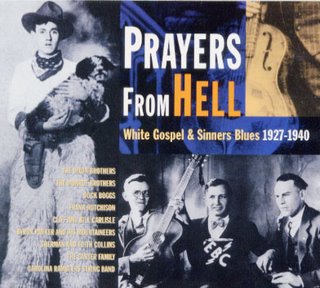
Had quite a few emails from people asking for recommended brother duets style CDs. As a starter, I'd suggest the brilliant Prayers from Hell - White Gospel & Sinners Blues 1927-1940, which is available in some specialist record shops and also here from Amazon.com. Here's a review. It includes the wonderful track What Would The Profit Be? by the Monroe Brothers, who were Bill and Charlie Monroe. They recorded as a brother duet in the 1920s and 1930s, before Bill created the high-speed picking style that became known as bluegrass.
The Louvin Brothers and brother duets
(A hinnae pit ocht on ma blog aboot music in a brave while, so here's a wee yin that'll hiddae dae)
I've been re-listening to lots of the old 1920s - 1950s "brother duet" style of hillbilly and old-time gospel music. The simplicity is just marvellous, two brothers with instinctive untaught harmony singing, often learned in the simple rural churches where they grew up, and traditionally just a guitar/mandolin combination as the only instrumentation.
It's not just that I like this style, in the sense of subjective taste. I have an affinity for it in all its rustic roughness, a sense of connection that goes far beyond just enjoyment. I'm sure it's cultural, an example of the Ulster-Scots-American fusion of styles and faith that emerged from the revivals of the 1850s both here and in America. But that's a whole other blog post!
Meanwhile here are a few YouTube clips about brother duets and the Louvin Brothers in particular. As the voiceover of the first clip says, "Baptists of the hellfire and brimstone variety!"
Tuesday, July 22, 2008
Covenanters in Ulster website
I've spent the last few days revitalising the Covenanters in Ulster site. Still need to do some work on the GoogleMaps version of the forthcoming heritage trail. Click here to visit the site.
Thursday, July 17, 2008
Murdoch Nisbet, the Lollards of Kyle, the Covenanters and the New Testament in Scots
Some time in the late 1400s there was a man in the district of Kyle in Ayrshire (to be precise, in Hardhill in the parish of Loudon) called Murdoch Nisbet (1470? - 1558). Not much is known about him, but he had a mighty impact in his day. He is believed to have been a "notary", a high-ranking civil servant. But he had another, some might say subversive, side. Because Murdoch Nisbet's faith and personal conviction led him to defy the norms of his time. Murdoch was a Protestant, to be precise, a Lollard.
Background:
Protestant ideas were not new to Scotland - there had been some Protestants in Scotland before Murdoch's time. For example, an English ex-Franciscan monk, James Resby had been burned at the stake in Perth in 1407, and around 1433, a Bohemian/Czech Protestant called Paul Craw had been burned at the stake in St Andrews.
Nisbet was a Lollard (a follower of the teachings of John Wycliffe) - specifically he was one of the Lollards of Kyle. In 1494 a group of 30 Lollards of Kyle were summoned by the Archibishop of Glasgow to stand before King James IV of Scotland on a charge of heresy. The charges were dismissed, but it was a sign of the times. Murdoch Nisbet is known to have "fled over seas". Now if you were living in Ayrshire, about 12 miles from the coast at Troon, where would "over seas" be? Hmmm....
Murdoch's Manuscript:
Anyway, wherever Murdoch Nisbet ended up, whether it was England, Germany or Ulster, he took with him a manuscript that he'd been secretly working on - a translation of the New Testament into vernacular Scots. He translated from Purvey's 1395 revision of Wycliffe's Bible. It's not known how long Murdoch was away from Scotland, but when he came back with some other Lollards who had also fled, the persecution was still underway.
Nisbet probably returned to Ayrshire in the 1520s, to a Scotland where Patrick Hamilton would be burned at the stake in 1528, and where two other Lollards - Jerome Russell and 18 year old Alexander Kennedy - would be burned in Glasgow in 1538, and the renowned George Wishart also burned in St Andrews in 1546. In between these famous Scottish martyrs were many more, but lesser-known: Henry Forrest (1533), David Stratton and Norman Gourlay (1534) and the five Edinburgh martyrs Thomas Forrest, Keillor, Beverage, Duncan Simpson and Robert Forrester (1539). So:
"... Murdoch, being in the same danger, digged and built a vault in the bottom of his own house, to which he retired himself, serving God and reading his new book. Thus he continued, instructing some few that had access to him, until the death of King James the V (note: James V of Scotland died in 1542, aged just 30, probably from cholera) ... Murdoch, tho' then an old man, crept out of his vault and joining himself with others of the Lord's people, lent his helping hand to this work through many places of the land, demolishing idolatry where ever they came..."
Nisbet's house had been sited on land that later became Loudoun manse glebe, at the curve of a burn. Apparently there are old foundations still there, marking the location of the building.
John Nisbet the Covenanter
Murdoch died in 1558 (the year before John Knox's tumultuous return to Scotland from Geneva) and left his New Testament manuscript to his son Alexander Nisbet, who left it to his son James, who left it to his son John. This John Nisbet was a soldier of renown, and was at Scone when the duplicitous King Charles II swore the Covenants in 1650 as part of his scheme to exploit the Covenanters and to use the Scottish throne as a stepping stone to what become his Restoration in 1660. John became a famous Covenanter hero, he was at Lanark in 1666 as the Covenanters marched toward Edinburgh and ultimately the Battle of Rullion Green.
At Rullion Green, John Nisbet
"received 17 wounds, was stript naked and left for dead, yet as much strength and life reserved, as enabled him to make his escape in the night, tho' it was a twelve month before he recovered. At Drumclog he did good service, behaved to a wonder, yet was preserved; at Bothwell he fought openly and boldly..."
Time went on and John Nisbet listened to great Covenanter preachers like Donald Cargill, Richard Cameron and James Renwick, and through the persecutions of the early 1680s "...he contended against the sinful compliance of these times..." He was martyred aged 58 at the Grassmarket of Edinburgh on 4 December 1685, leaving three sons, Hugh, James and Alexander.
1905: Manuscript published
Anyway, Murdoch's old manuscript was passed down to James, who was a Sergeant at Edinburgh Castle, who gave it to Sir Alexander Boswell to keep in his library at Auchinleck in Ayrshire (only 10 miles away from where Murdoch had written it nearly 200 years before). It stayed here until 1900 when Lord Amherst of Hackney allowed it to be published by the Scottish Text Society. The manuscript is today in the collection of the British Museum.
These 1905 editions are rarer than hen's teeth, but here's the cover of my copy:

Murdoch Nisbet is remembered today in his home town of NewMilns in a number of ways - a small award-winning housing development is named after him, there's a plaque inside the local church, which is also the same church that has a number of Covenanter memorials, including one to Murdoch's descendant John Nisbet mentioned above.
(italic quotes above are from A True Relation of the Life and Sufferings of John Nisbet in Hardhill, first published 1718, which had been written by the James Nisbet mentioned above)
Links:
Wikipedia on Murdoch Nisbet
1949 Newmilns Reenactment of Murdoch Nisbet
1949 Newmilns Reenactment of John Nisbet and Covenanter martyrs
Good to see there were what we now call "living history" projects on Covenanter themes over 60 years ago! Here's a photo of John Nisbet's memorial at Loudoun Parish Kirk in Newmilns, photographed back in February.

Glasgow Evangelical Gospel Mission


Last August I went to the World Pipe Band Championships in Glasgow. Just round the corner from my hotel I found the Glasgow Evangelical Gospel Mission (269 High Street). Here are a few photos of their marvellous building and shopfront display. May they never change it!
Hilary and the Guitar
Mark Anderson wins the "Quip of the 12th" competition - he stepped out of the parade in Portavogie to have a brief chat, and when I introduced him to Hilary he said something like "you're coming on well on the guitar!".
Which, for the non-regular visitors, is a reference to this recent post!
Shows you how dangerous this blogging lark can be!
Wednesday, July 16, 2008
Covenanters in Ulster Heritage Trail
It'll be out in two weeks time; get your advance orders in to the Ulster-Scots Agency. Here's the front cover: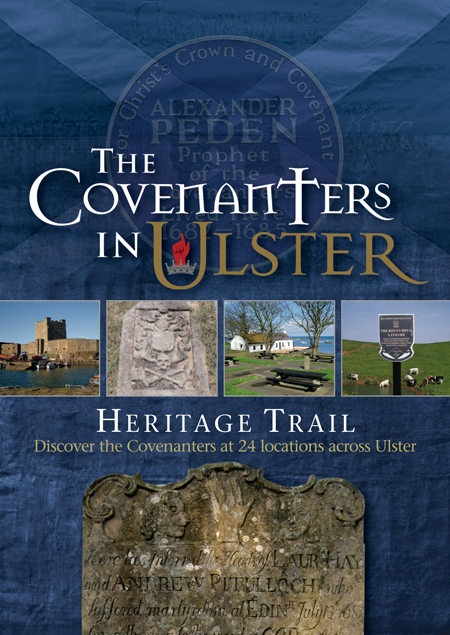
And here's the ad that is appearing in the next edition of the Presbyterian Church's "ReachOut" magazine:
The Twelfth Part Five: Rogues Gallery
Portavogie 12th pictures:
As if Jacob's home-made hairdo wasn't bad enough, look at his two mates!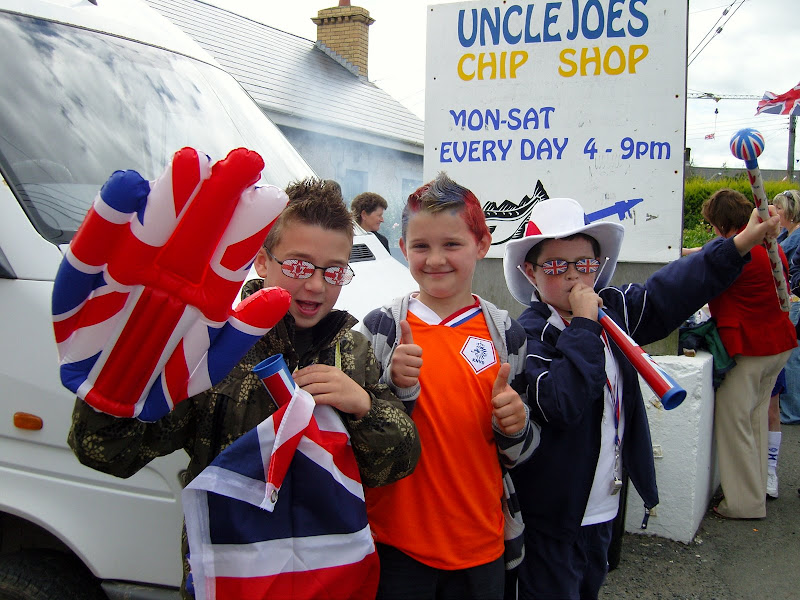
Stephen J and Jacob: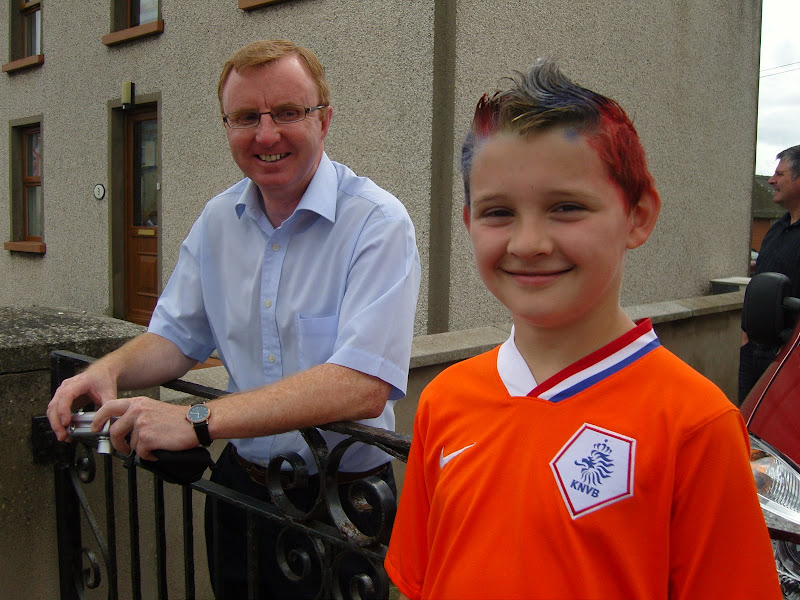
Maggie-Jane must have inherited Hilary's English "I don't like the bands" gene: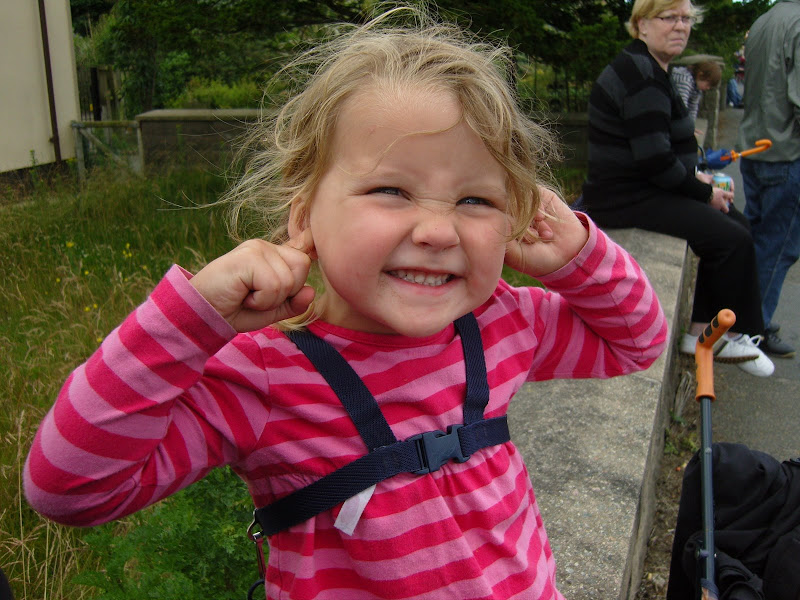
John W: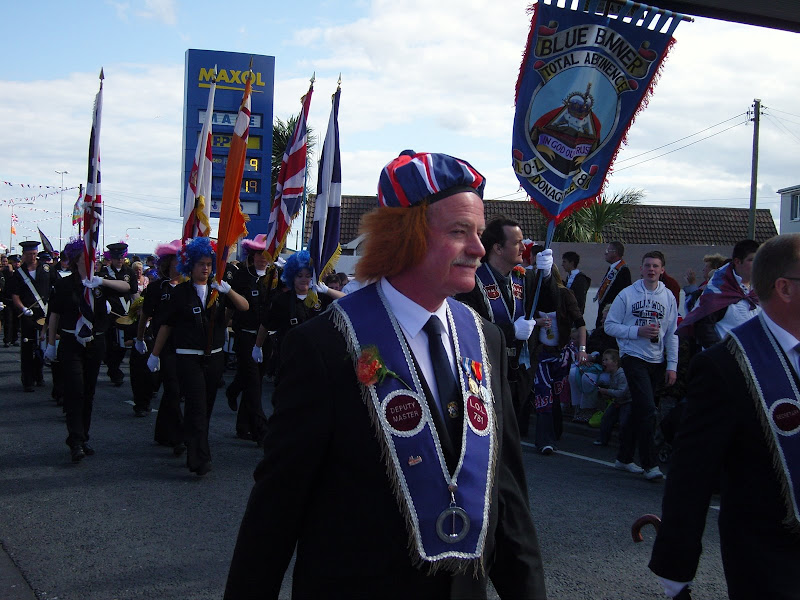
Mark A: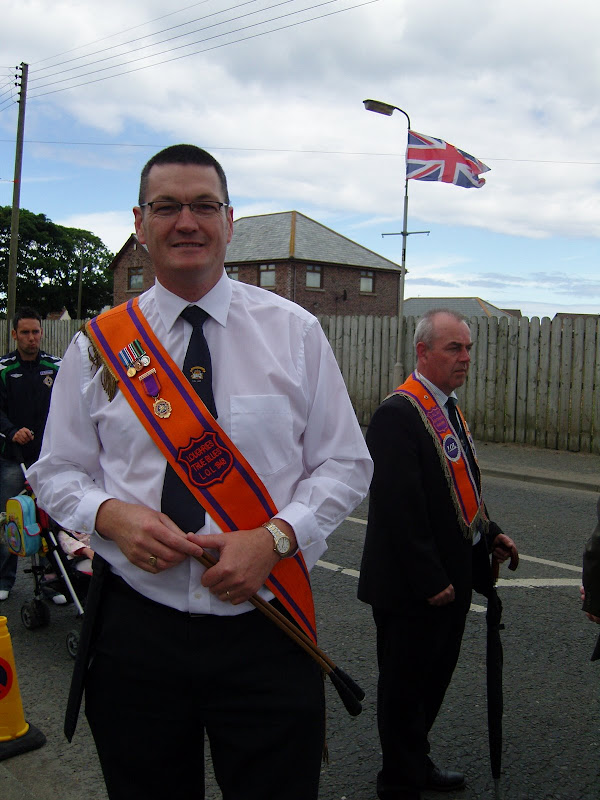
Jack G: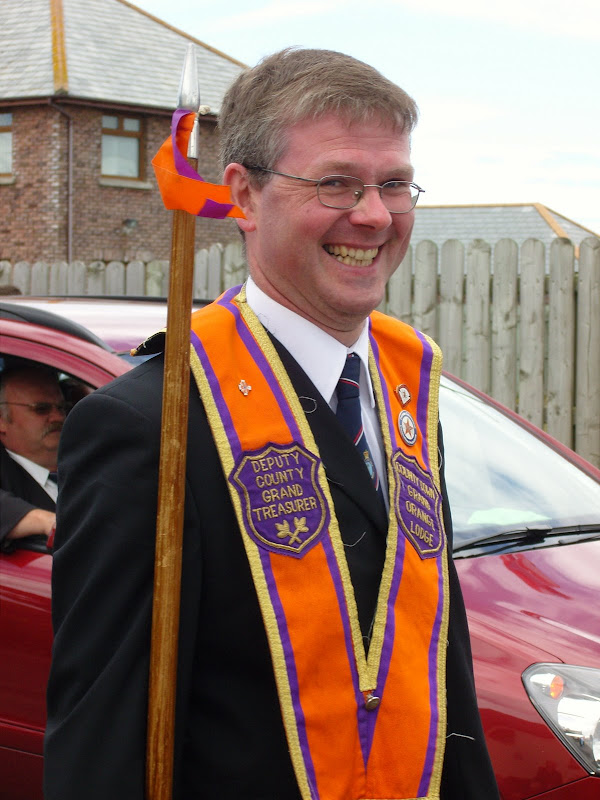
Joseph L: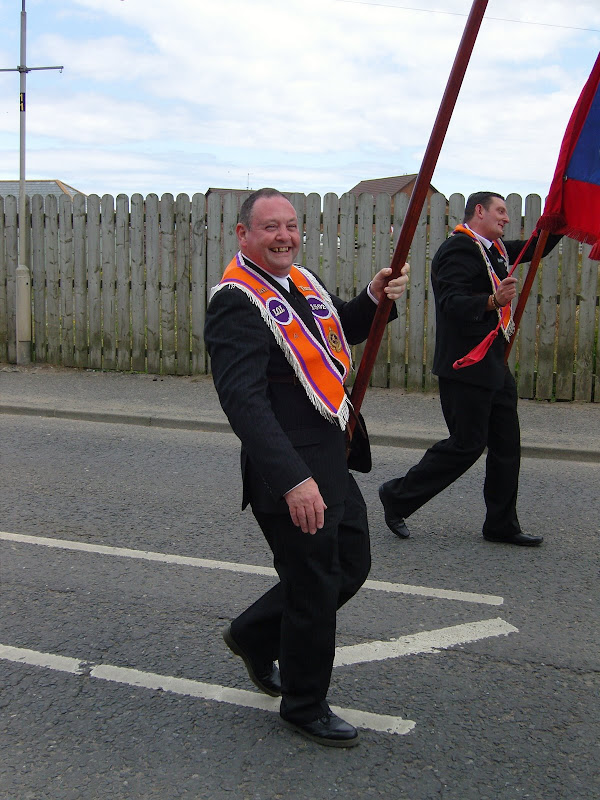
Eddie Grimason greets his fans: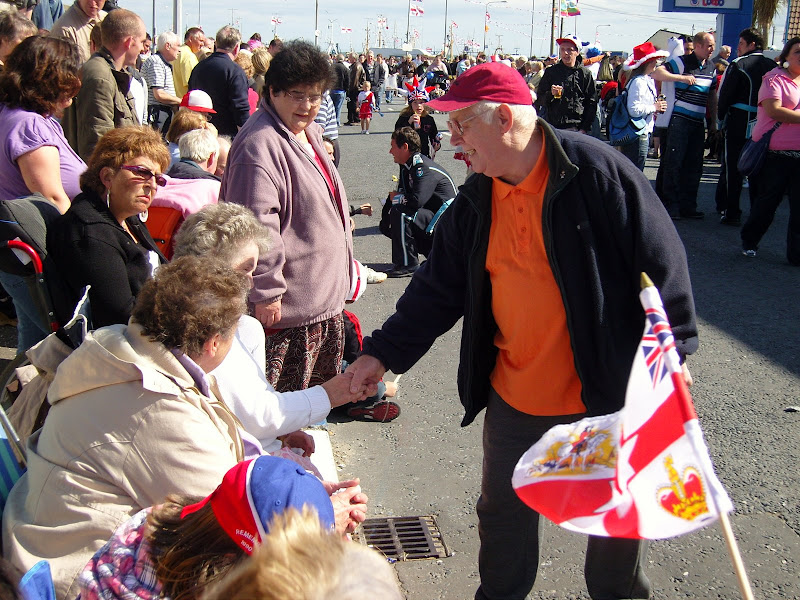
The family wait with excitement!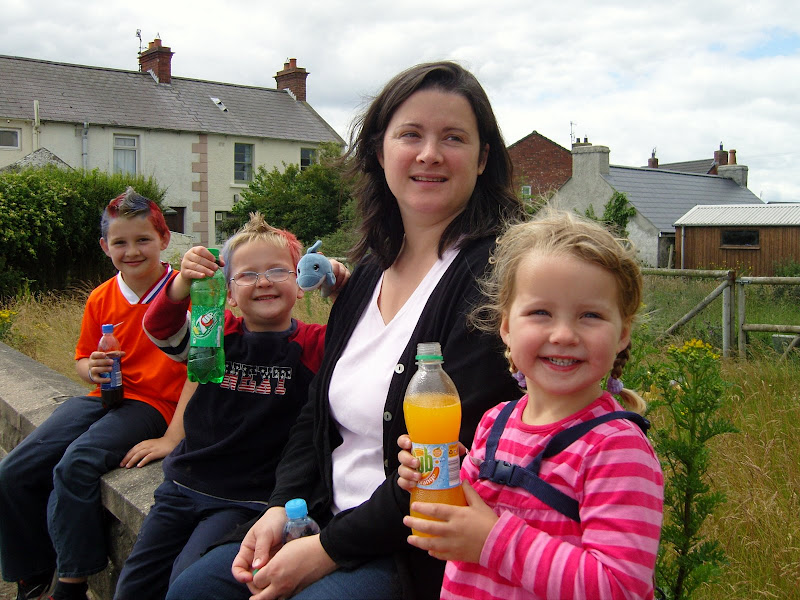
Me and Jacob: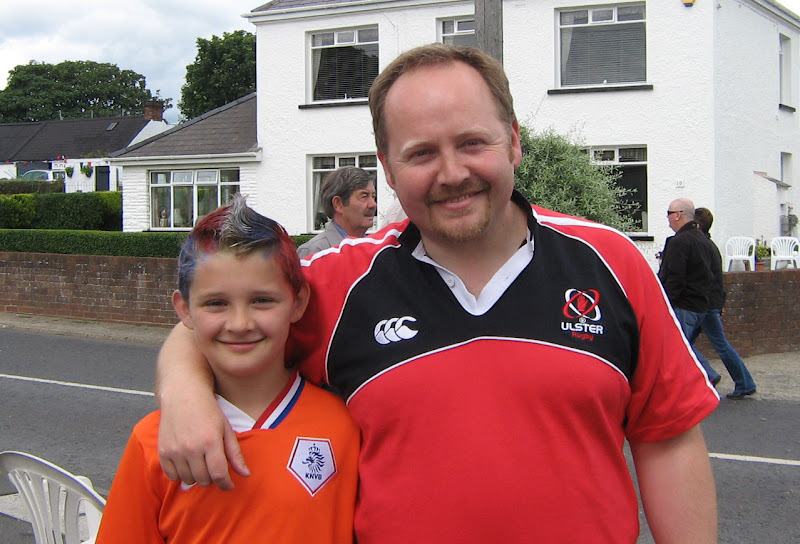
Plenty more great photos over on Stephen's blog (which is where I stole the last one from!)
Tuesday, July 15, 2008


The Twelfth Part Three: It may be a typo, but that's how it's pronounced
In an era of slick branding (which is my day job and once I get my new blogfolio finished I'll post a link here for you all to see and judge), hand painted typos have a certain charm.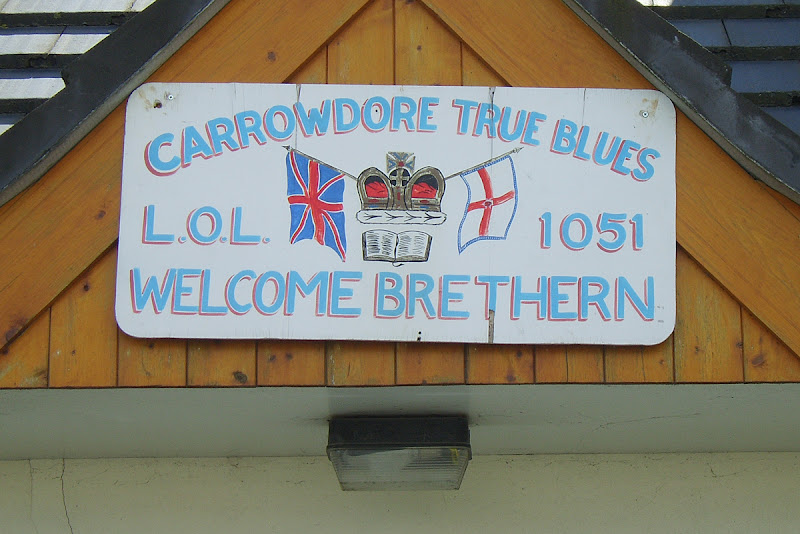
Compare and contrast: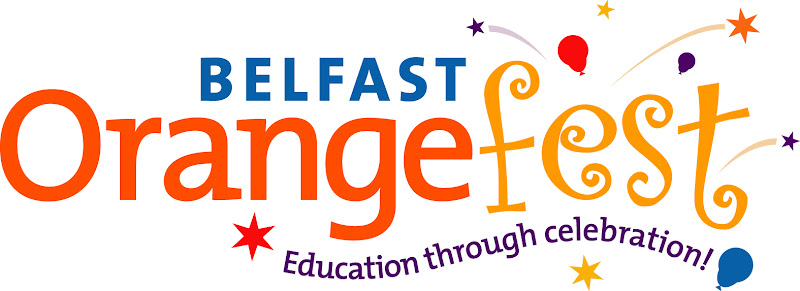
Red Hand Guinness
Carrying on from the oyster post, I bought three of these old Guinness bottles a few years ago on eBay - I'd been trying to track one down for years. Bet they don't produce this brand any more!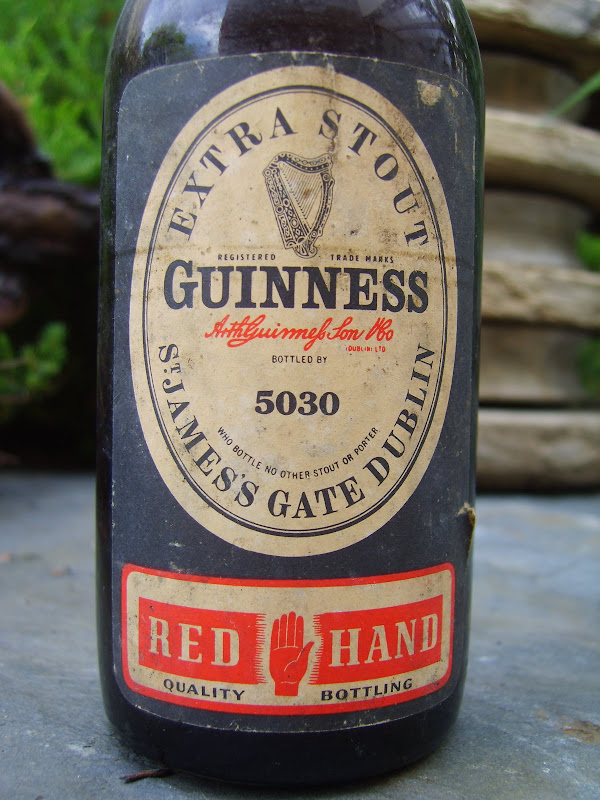
I also found this old pub sign in Belfast, but sadly long since gone. If anyone knows anything about this brand, get in touch.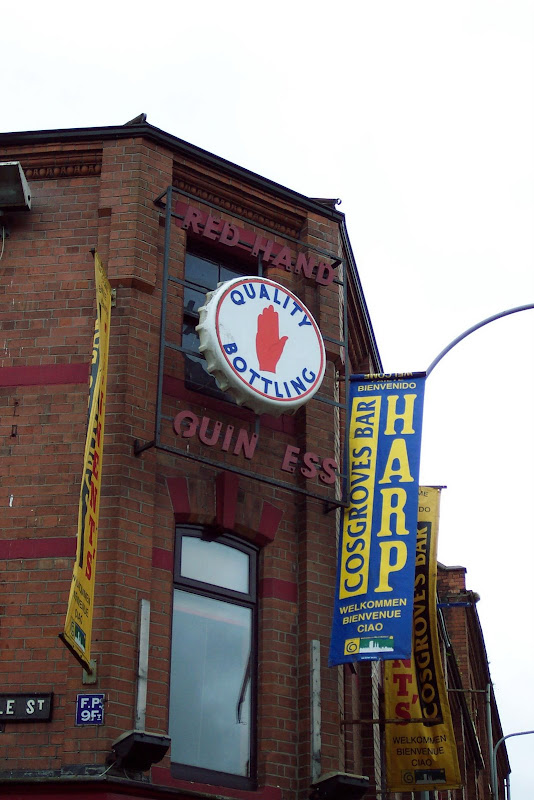
Hillsborough Oyster Festival
Is the Hillsborough Oyster Festival the stupidest-ever idea and location for an event? It has been going now for years, a corporate platform created by Guinness to give the rich and aspirational something to do for a weekend, bringing to life one of their corporate photo library images that appears in every Oirish tourist publication produced these days.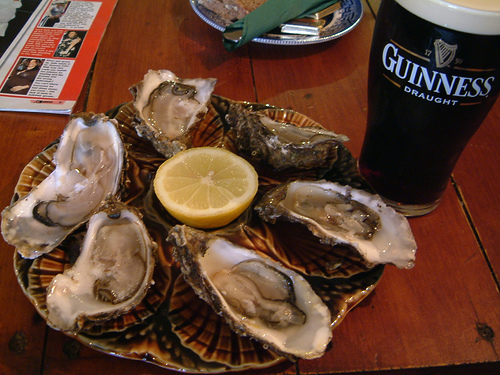
The irony is that you can't actually get oysters in Hillsborough. Or fish. Or crab. Or lobster, or any other kind of seafood. Because Hillsborough, as most people know, (according to GoogleMaps) is far inland - about 15 miles from Belfast and about 20 miles from the nearest sea inlet (Strangford Lough). And as for the nearest oyster farm where the things are actually available, it could be as far away as Donegal!
They must have a really tough time landing all those baskets of fresh oysters at the quayside in Hillsborough.
The Twelfth Part Two: Ulster's National Dish
Some will claim that the Ulster Fry is our national dish. Partial as I am to a good fry from time to time (a real one has fried pancakes and vegetable roll*, none of this hash browns and black pudding nonsense - be wary of people who seek to deviously subvert and internationalise the Fry), I have long believed that there is one other food, an unsung hero, to whom the title of Ulster's National Dish truly belongs.
It's not yellow man. It's not Tayto crisps. It's not even Bushmills whiskey. No ladies and gentlemen, I give you (drum roll.....) the egg and onion sandwich!
No church tay meetin, Sunday School social, family picnic or Twelfth day can be considered truly complete without some egg and onion. It has been the staple of Ulster Protestants for many generations. I was delighted to see one of the food vans in the field at Portavogie had restored egg and onion to its rightful position - jostling for orangey-yellow attention with the modern day bacon & cheese burger, and placed above the chilli chicken burgers! This particular van owner was obviously a man of considerable insight, as he was also selling tea and buns. You'll never get that at a McDonalds franchise.
So impressed was I, that I was even prepared to tolerate the (frankly unnecessary) innovation of the egg and onion bap, as a substitute for the standard egg and onion sandwich, on the basis that he had described it using the traditional term "bap", not a roll, and that he hadn't overstepped the boundary by going for something as poncey or elitist as a baguette, panini or (sharp intake of breath) a wrap!
So I paid my £1.50 and took a bite - boysadear, the perfect egg and onion! Hard boiled egg (not scrambled) raw white chunky onion (not the scallion substitute, and not finely chopped), and real butter (not mayonnaise or salad cream). All's well in the world when traditional egg and onion still exists as a menu option for Ulstermen.
(* for those of you who don't know, the humble vegetable roll is about 99% sausage "meat". Ah, the Northern Ireland sense of irony and humour!)
The Twelfth Part One: It's not what it used to be...
Had some conversations recently about the changing face of Orangeism and the 12th celebrations. Lots of articles have been published in the last few days, mostly in two camps: a) things are changing and it's great, or b) so much for the supposed change, the Lisburn Road was still swimming in alcopops.
The third position is Rev Stephen Dickinson's, which has been explained here, here and here. At great risk of sounding like a fence sitter, I have sympathy with all three views - yes some good moves are being made, but sadly there is still an alcohol culture at some stretches of some parades (as is the case generally in society), and be very wary about dumbing down, losing authenticity, and losing the core values. (I didn't see none of that fancy Orangefest branding in Portavogie!).
Maybe I should have a caption competition for the pic below, photographed a while back outside the Orange Hall in Newtownabbey up near Mossley Mill...
...I wonder if Heather got much trade from the Lodge members?