I had an enjoyable and interesting meeting today with a Queens University academic about Ulster-Scots related issues, with particular relevance to community relations in Northern Ireland. We talked for the best part of 2 hours - I hope he got something out of it.
What became ever more clear to me during the conversation is that the "two tribes" stereotype of Northern Ireland - Protestant/Catholic British/Irish Unionist/Nationalist - is not the whole story, but its' perpetuation is doing huge damage to our cultural life. To me, this outmoded bipolar model harks back to the 1500s, when the issues on this island were English/Irish. To be stuck in this mindset 500 years later is a tragedy and disgrace.
Why? Because it leaves out Scotland. In the 1600s Ulster was changed forever when a tidal wave of Lowland Scots began to arrive here. We might have a "two tribes" political identity, but we have three-sided cultural identity - with Scotland the missing piece. The distinctive regional flavour of Ulster compared to the rest of the island is overwhelmingly due to the influence of lowland Scotland. But the Scottish chapter of Ulster's story is, for most people who live here, completely unknown. And its potential is unrealised.
As long as society, politics, academia and the media remains stuck in the false, 1500s, two tribes mentality, and as long as political identity continues to be imposed upon cultural identity, a"shared and better future" will remain just a buzzphrase for government policy.
It's time to change the story.
Wednesday, October 21, 2009
Two Tribes


Monday, October 19, 2009
If you enjoyed Neil Oliver's "History of Scotland" and can't wait for the new series, this might just keep you going for a few weeks...
Saturday, October 17, 2009
In a Land Where We'll Never Grow Old (1914) - the first ever "country gospel" recording
If this doesn't tug your heart strings I don't know what will.
It had been written by James Moore (1888 - 1962), a young Baptist pastor, in 1914, when he was just 26. He had gone home to the church his ageing father was the pastor of, and when his father - Charles Robert Moore - tried to sing, his voice was frail and weak. James wrote this hymn shortly after, and dedicated it to his parents. It was recorded by Smith's Sacred Singers from northern Georgia, said to be the first ever "country gospel" record. To understand what that category meant back then, empty your mind of any ridiculous Garth Brooks and Shania Twain nonsense, and picture yourself sitting in a primitive wee wooden mission hall in the Ulster-Scots-influenced rural South of America, among country folk who lived off the land and had a heart for the gospel. The Smith's Sacred Singers record was a phenomenon - it sold a staggering 277,000 copies in an age when sales of 5000 were considered good.
(In a Land Where We'll) Never Grow Old
I have heard of a land on the far away strand,
’Tis a beautiful home of the soul;
Built by Jesus on high, where we never shall die,
’Tis a land where we never grow old.
Refrain
Never grow old, never grow old,
In a land where we’ll never grow old;
Never grow old, never grow old,
In a land where we’ll never grow old.
In that beautiful home where we’ll never more roam,
We shall be in the sweet by and by;
Happy praise to the King through eternity sing,
’Tis a land where we never shall die.
Refrain
When our work here is done and the life crown is won,
And our troubles and trials are o’er;
All our sorrow will end, and our voices will blend,
With the loved ones who’ve gone on before.
Friday, October 16, 2009
William Wilson 1906 - 1982 / Mary-Ann Hamill 1918 - 1982

This is a photo of my granda as a young man, hokin' prootas or gathering potatoes. He lived at Ballyrawer outside Carrowdore on the Ards Peninsula and when he married (on 10 January 1938) they later moved to Islandhill (a place Wilbert Magill calls Blacktoon) and bought a wee house there in April 1940. He died when I was just 10 and I have only very faint memories of him, and his garden that he spent so much of his time in. I can remember one day he showed me how to pull out nettles by the roots without getting stung. I love this photograph.
The wee house was (literally) a pighoose when he bought it. It had just two rooms, and in later life he bought a block-making machine. The weans then helped him to make concrete blocks, and with these he built "the far room", an extra room on the end of the house. The floor was earthen, where the weans played "pugs" with marbles and wee holes they hoked in the floor. To add a bit of grandeur, he worked for weeks to make a mosaic doorstep with a star in it. (And no, he was neither Orangeman nor Mason). Even to this day, the water tank is on the roof outside - and the roof itself is corrugated iron.
The second photograph is of his wife, my granny, Mary-Ann (Molly) Hamill. This is her as I remember her, feeding the hens at the back of their wee house. She died about 6 weeks after my granda. She'd married him when she was just 19 (he was 32) and I imagine just couldn't bear to live without him. They raised 9 weans in that wee house - a far simpler, harder life than any of our pampered, spoilt generation will ever know.
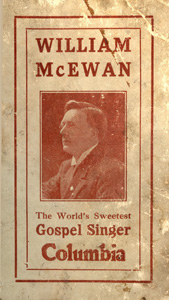
When my granda died, among his stuff was found the words of "My Ain Countrie", the old Scots language hymn (written by Mary Ann Demarest in 1861, and was one of the six recordings made by the Glasgow singing evangelist William MacEwan in 1911 - the first-ever gospel recordings in the world):
A am far frae ma hame an A’m weary aftenwhiles
For the lang’d-fer hamebringin’ and ma Faither’s welcome smiles
An A’ll ne’er be fu’ content, aye until ma een dae see
The gowden gates o’ Heaven, an’ ma ain countrie.
The earth is fleck’d w’ floo-ers, mony tinted, bricht an’ gay
The birdies warbles blithely, fer ma Faither made thaim sae
But these sichts an’ these souns wull as naethin be tae me
Whun A hear the angels singin’ in my ain countrie
A hae His guid word o promise that some glaidsome day the King
Tae His ain royal palace His banished hame will bring
Aye wi’ een an wi hairt rinnin owre we shall see
The King in aa His beautie in wor ain countrie
Ma sins they hae been mony, an’ ma sorrows hae been sair
But there they’ll niver vex me, nor be remember’d mair
Fer His bluid has made me white an His haun shall dry ma een
When He brings me hame at last tae my ain countrie
Sae little noo A ken o yon blessed bonnie place
A only ken it’s hame, whaur A shall see His face
It wad surely be eneuch, aye, fer iver mair tae be
In the glorie o’ His presence in wor ain countrie
Like a wean tae its mither, a wee birdie tae its nest
I was fain be gangin’ noo untae ma Saviours breast
Fer He gaithers in his bosom witless worthless lambs like me
An carries thaim hissel tae His ain countrie
He is faithfu’ that has promised an He’ll surely come again
He’ll keep His tryst wi’ me, at whit hoor A dinnae ken
But He bids me still tae wait, aye an ready ay tae be
Tae gang at ony moment tae wor ain countrie
Sae A’m watchin’ aye an’ singin’ o ma hamelann as A wait
Fer the sounin’ o’ His fitfa’, this side the gowden gate
God gie His grace tae aa wha listens noo tae me
That we a’ micht gang wi’ glaidness tae wor ain countrie.
.
Scotland this morning

About 7.30am, looking from our front door towards the Mull of Galloway. (click to enlarge)
Thursday, October 15, 2009
Scottish Bishops and Ulster-Scots apples
Over the years there's been a fair bit of comment about Ulster-Scots being "too Orange", or indeed of Orangeism being affected by the emergence of Ulster-Scots (funding). There are both overlaps and distinctions between these two cultural traditions, and major discussions could be had about these issues, but not on this post. But never mind oranges, what about apples?!
BACKGROUND:
When King James VI of Scotland became King James I of England and Ireland in 1603, he began to appoint Scottish bishops in Ireland:
• Denis Campbell was appointed as Bishop of Derry, Raphoe and Clogher in 1604, but he died in London in July 1604 before he took up his post.
• Shortly after, the same bishoprick was given to George Montgomery, Sir Hugh Montgomery's younger brother. Montgomery arrived in west Ulster around Spring 1607 and began to bring lowland Scots from Ayr, Glasgow and Irvine into Derry, Donegal and Killybegs. His portrait is in Clogher Cathedral.
• In 1610 Montgomery's bishoprick was changed, with Raphoe being replaced by Meath. His job at Raphoe was filled later that year by yet another Scot - Andrew Knox. He was related to the famous John Knox (possibly a nephew?) and therefore also related to Josias Welsh.
• When Montgomery died in 1620 his position at Clogher was taken up by another Scot, James Spottiswood, brother of John Spottiswood, the archbishop of St Andrews.
On 4 March 1613 Robert Echlin from Pittadro in Fife was appointed by King James I as the new Bishop of Down and Connor. He was the same age as I am now - 37. He graduated from St Andrews University in 1596 (during the time that the mighty Andrew Melville was one of the Professors there). The previous Bishop was also a Scot - James Dundas - he had been appointed in 1612 but died just a year into his appointment. Echlin (initially at least) tolerated the arrival of the Presbyterians and compromised with them in order to ordain them into service in Ulster. However, he later turned against them...
...anyway, Echlin set up home at Ardquin (between Portaferry and Kircubbin - it is said he chose the location because it reminded him of the landscape of Fife) and built an Abbacy there beside the old church. The church has recently been refurbished and the Abbacy ruins have a house built inside them - quite a remarkable thing to see! Echlin died in 1635 and was buried at Ballyphilip in Portaferry, an old graveyard that's now very badly overgrown and locked up most of the time. When Echlin died, he was succeeded as Bishop of Down and Connor by yet another Scot, Henry Leslie.
THE APPLES
Some of Echlin's descendants who remained on the Ards Peninsula invented the Echlinville / Ecklinville cooking apple. The description of the variety is:
"...the tree is vigourous and has decorative blossom. It is a cooker or sauce apple. It was popular with the victorians and widely grown in gardens also recommended for an 'artistic' orchard. It was popular in Worcestershire. No longer planted by 1930s, as fruit bruised easily..."
Saplings are available from the National Fruit Collection in England, costing about £45 per tree. This is what the fruit looks like:

Wednesday, October 14, 2009
Blogs worth watching - the Minister and the Moderator
Following on from the recent post about the importance of online media, it's now clear that blogging is becoming the platform of choice. Check these out:
The Minister
The Moderator
Very brave of Nelson to admit to being a Cliftonville fan. Thank goodness he didn't say Man United :-P !
A Memorial in Grey Abbey

Greyabbey (on the Ards Peninsula) is full of tombs and memorials. It is right beside Rosemount, which is the present day home of the Montgomery family, and which was established as such around 1607 by James Montgomery (the brother of Sir Hugh Montgomery). One of these memorials (pictured lying flat on the ground in the photo) is of William Montgomery, the author of the Montgomery Manuscripts and other important histories of the Ards and of Ulster-Scots traditions. This same stone also mentions Sir Hugh Montgomery, and as far as I know is the only memorial in Ulster to Sir Hugh. The inscription is hard to read, but as far as I can see it says:
"...The honourable Elizabeth Montgomery died ye 15th of November anno domini Christi 1677 aged 42 years. William Montgomery of Rosemount Esq her only husband continued a widower and so died on ye 7th day of January anno domini 1706 being 74 years old. Hugh first Lord Viscount Montgomery of Ye Great Ardes by his two eldest sons was grandfather of them whose earthly remains are layd in ye vaulted tomb before his Manx marble both of which were made for their peculiar repository by ye care pains and cost of ye said wina due defence ten years Elizabeth his good and only wife their only issue James in August 1687 married Elizabeth eldest daughter of Archibald Edmonstone Laird of Duntreath..."
Sunday, October 11, 2009
Yet another great night at Bangor Abbey!
A clip from Bangor Abbey last night. No amplification or effects - the raw performance.
Before the Throne of God Above (original 1863 melody):
Full post over at our Thompson Brothers blog. More clips to be uploaded over the next few days.
Saturday, October 10, 2009
Some sartorial advice from Sir Thomas Smith in 1572
...that Countrie of Ireland requireth rather lasting and warm clothes than gorgeous and deere garmentes..."
Pass that on to your wives, gentlemen!
(from A Letter Sent By T. B. Gentleman, a 63 page pamphlet published by Smith in early 1572)
The Covenanters in Ulster - coming soon to BBC Radio Ulster

Last Saturday, Dr William Roulston and I spent most of the day with Laura Spence of BBC Northern Ireland, and Elizabeth Rice and David Walker of Blackthorn Productions. We recorded a special edition of Radio Ulster's "A Kist o Wurds" about the Covenanters in Ulster - it will be broadcast in three weeks' time at 4pm on Sunday 1st November and repeated at 7.30pm on Wednesday 4th November.
It comes hot on the heels of an edition of Kist where Laura, Elizabeth and I did a lengthy but fairly informal piece about Newtownards Priory, and a shorter piece about very rare edition of the Montgomery Manuscripts, which had been discovered by my old friend Jim Tollerton of Stacks Bookshop in Dundonald. That programme was broadcast on 20 September, and I had lots of positive comments about from folk who heard it.
• BBC Radio Scotland have also recently made a programme about the Covenanter "prophet" Alexander Peden which will be broadcast over the coming weeks too. I understand it will be presented by Richard Holloway, Chair of the Scottish Arts Council. He presented the tv series "The Sword and the Cross" a few years ago which also touched on the Covenanters.
• I'm told that BBC Scotland television have also completed an hour-long episode of their mega series A History of Scotland about the Covenanters. The first five episodes in the series dealt with ancient and medieval Scotland and were originally broadcast this time last year (they've recently been repeated on BBC Four). The second five episodes begin in the late 1500s and will be broadcast starting on 8th November, with the last of the original five programmes, "Project Britain" currently viewable online on BBC iPlayer. The series is presented by Neil Oliver.
The Covenanters' story deserves a wider Ulster stage than just 30 minutes on radio - and sadly I expect that the BBC Scotland programmes will reduce Ulster to a footnote - but hopefully the programme will be a first step to something bigger. With thanks to everyone for the enormous graft that's gone into making the programme happen.
(The photo above is of the Alexander Peden memorial at Glenwherry, County Antrim - just up the Douglas Road at Mistyburn. Click to enlarge)
Thursday, October 08, 2009
Ravara Pipe Band @ Portrush, August 2009
Over at Aiblins, Mr Ulster-Scot has been showing off his new blog design (which is great) and his fancy new digital video camera (which is also great). The clip below is from his impressive 57 video YouTube channel. Great quality images and audio.
It's a good example of why the future of independent publishing is definitely online, not in budget-limited, circulation-limited and editorially-controlled print - or indeed the even more controlled world of broadcasting. Ulster-Scots might make a small dent on traditional media (and congratulations to those who are working to that end, and who have given me a number of opportunities to dabble there too), but in a world that's going online, where in 2006 online advertising in the UK eclipsed newspaper advertising and just last month overtook television advertising, the internet is the medium that matters. And blogging is FREE.
I was talking to someone from Channel 4 a few weeks ago, who said that a massive 25% of the audience for the teen-docu-drama Skins only watch it online. And here's another example of how concerned European television news companies are about the internet.
(Interestingly, President Obama has been talking about a bailout of the declining mainstream media, much like the car industry, insurance giants and the banks. Perhaps the establishment needs an establishment media?).
Here at Bloggin fae the 'Burn I'm now up to an average of almost 2000 unique users every month (last month it was 1960 to be precise). Surprisingly, the post about Veda is one of the top ten most visited pages!.
Mandolin therapy
Therapy for the mandolin, and therapy for me too. I've been footering with it now and again in between other things - here are the before and after pics. (I first blogged about it back in May).


Wednesday, October 07, 2009
Bothwell Bridge, 20 June 1903

(click to enlarge)
This photo is from the "Bothwell Bridge National Memorial" book, which was produced following the installation of the monument to the many Covenanters who fought and died on this spot in 1679. 224 years after the battle, 25,000 - 30,000 spectators gathered for the installation event.
Of the many dignatories on the Committee which organised the monument and event was Lord Rosebery. He had been Prime Minister from 1894 - 1895, and in a speech in Edinburgh in November 1911 (where he shared the platform with Whitelaw Reid, the US Ambassador to Britain who was of Co Tyrone Covenanter descent) Rosebery famously said:
"I love Highlanders and I love Lowlanders, but when I come to that branch of our race that has been grafted on to the Ulster stem, I take off my hat in veneration and in awe. They are, I believe, without exception the toughest, the most dominant, the most irresistible race that exists in the universe at this moment."
Tuesday, October 06, 2009
Monday, October 05, 2009
Tonight on RTE - "Cork's Bloody Secret"
For those of you who're staying in the house tonight, this programme looks like essential viewing.
In April 1922, in Dunmanway, County Cork, the IRA pulled ten Protestants from their beds and murdered them. For the first time ever, the victims' families in the tiny Protestant remnant in Cork have agreed to talk about those events on camera.
Read the review by Eoghan Harris about it here:
Exorcising the dark, bloody secrets of IRA in West Cork
An earlier, similar story is The Story of Lucy Gault by William Trevor, which was nominated in 2002 for the Booker Prize. You can read Feargal Keane's review here: A timely reminder of the Irish Republic's brush with a kind of ethnic cleansing
The "victims issue" of the recent Troubles has been under scrutiny again in Northern Ireland over the last few weeks. And there are more, so many more, long-forgotten atrocities. May society, and the world, never allow these tragedies to be swept under the carpet.
Ulster-Scots lecture week in Markethill
I'm off to Markethill in County Armagh this evening to give a 40 min Powerpoint / illustrated talk on the Hamilton & Montgomery Settlement of 1606. It's the first in a series of talks being given every night this week in the Old Courthouse. The full list is:
Monday 5th October - Mark Thompson
1590s - 1625 (Hamilton & Montgomery Settlement)
Tuesday 6th October - William Roulston
1625 - 1660 (Covenants)
Wednesday 7th October - Knox Hyndman
1660 - 1689 (Persecution)
Thursday 8th October - Harry Coulter
1690 - 1811 (Covenanters to Reformed Presbyterians)
Friday 9th October - Robert McCollum
1811 - Present (19th & 20th Centuries)
The events have been organised by the local (Ballenon and Ballylane) Reformed Presbyterian churches. Each talk begins at 7.30
Saturday, October 03, 2009
Barnamaghery Yin Yin
No, it's not the Ulster dialect of Chinese!. Barnamaghery is a small townland out near Darragh Cross and Kilmore in the middle of County Down. This is a photo of the Orange hall, and the lodge that meets there is Barnamaghery LOL 11 - or, as the locals say, Barnamaghery Yin Yin. It might be a surprise to find evidence of Scots speech in that part of Country Down - but Montgomery's estates in 1606 included the area around Kilmore, so maybe some of the folk there date back to that first major settlement.


Friday, October 02, 2009
New Music!
Have just uploaded three of our "Scullery Table Demos" for people to listen to. Hope you enjoy them, rough as they are!
Thursday, October 01, 2009
The Quireboys in Belfast - Friday 4 December
We all have regrets in life - things we didn't do that we should have, things we did do that we shouldn't. One of mine is not going to see the great Newcastle-upon-Tyne band the Quireboys when I was 18. It was 20 years ago, the year of my A levels, and what I recall is that the date of the concert clashed with our school 6th Form formal. For a variety of reasons I (reluctantly) opted for the formal, whilst my mate Darren went to see the Quireboys. For a variety of reasons my night didn't go the way I'd hoped it might (in hindsight, there was probably one colossal missed opportunity in the midst of it all...) and of course Darren claimed it was the best concert he'd ever been to. The Quireboys' sound is like classic 70s British rock music, with a Rod Stewarty vocal sound. They have an acoustic album on the way for November, and the track "Mona Lisa Smiled" on their website has some lovely wee splashes of mandolin all over it. So I reckon I might well go and see them, and fill in the gap that's been missing for the past 20 years! Mona Lisa Smiled: Misled: