
Tonight at bedtime I said to Charlie (who's 8) - "nae use haein' a dug an barkin' yersel" - the eyebrows went down and he repeated back "nae use hen dung.... what?!!".
Tuesday, December 14, 2010
Friday, December 10, 2010
When worlds collide
I took my parents to Belfast this morning. When we'd finished what we'd gone there to do, on the road home we called in at Tesco in Newtownbreda. My da doesn't really do shops and he was impressed both by the scale of the place and that you could get a decent fry for £4 in the café. They bought some stuff and I bought some too, and as we queued at the till my da went first. The checkout girl rang in the total amount and then asked him "Do you have a Clubcard?". Clearly this was an alien world he had entered, with strange customs. So he just looked at her and then silently handed her some money.
I wish he'd said "Naw, but dae you hae a Nuffield or a Fordson Dexta?"


Thursday, October 28, 2010
The mathematics of genealogy
I'm working a bit on the family tree again, with help from some expert friends. Thus far I can get Thompsons at Ballyfrench back into the 1760s, which is pretty good. It coincides with the family tradition of Thompsons arriving near Ratallagh in the mid 1700s, having come from between Kilmarnock and Troon in Scotland. But I'm doing what most people do, which is focus mainly on the strand of ancestors who passed down my surname.*
However, when you see the diagram expanding, the range of surnames increasing, and then do the maths, the number of ancestors that each of us has is mind-boggling.
I have two parents (obviously), and therefore four grandparents, and therefore eight great-grandparents, and therefore 16 g-g-grandparents. Most of them were born in the late 1880s, so that's 4 generations every 100-ish years.
But every time you go back a generation, the number doubles. 16 g-g-grandparents becomes 32 g-g-g-grandparents, which becomes 64 g-g-g-g-grandparents, which becomes 128 g-g-g-g-g-grandparents, which becomes 256 g-g-g-g-g-g-grandparents. So that's us now back another 120-ish years, to around the 1760 date mentioned above.
To leapfrog back another 120 years, to 1640, the numbers get scary: that 256 becomes 512, which becomes 1024, which becomes 2048, which becomes 4096.
So I had 4096 ancestors alive in 1640. Go back one more generation to around 1615 and it becomes 8192 ancestors. And then go back just one more, to before the magic date of 1606, and I had (theoretically, and give or take a generation or two for early mortality, or even possible longevity) 16384 ancestors on the planet.**
And, theoretically, so did you.
So, the odds of just ONE of my ancestors being on the first boats sent across from Scotland to Ulster by Hamilton & Montgomery in 1606 has got to be pretty good, eh?
* so the surname of just one line of descent is really a ridiculously limited picture.
** however, the tree does not expand endlessly, because the numbers don't tell the whole human story. Particularly in small communities, second cousins would have been marrying - in fact, some statisticians think that 80% of the marriages in world history were between second cousins. Google that for yourself!
Tuesday, October 19, 2010
"She roars wi' her elbows tae save her een".
This was a figure of speech used to describe my father's aunt Lucy (1893-1962) - she was renowned as somebody who pretended to cry when she didn't get her own way. Today she might be called a drama queen or an attention seeker. Picture somebody rubbing their fists in their eyes (to hide the lack of tears) and flapping their arms up and down at the same time, almost like wings, and you'll get the idea.
Sunday, October 17, 2010
Anither wee yin fae Ballyfrenis
Another wee rhyme from my aunt Betty:
"Lift the tither fit, lift the tither fit, lift the tither fit my dear
Lift the tither fit, lift the tither fit, let the watter rin clear"
There were other lines that she can't remember just now - can you help?
Misquoting Macbeth
"Daddy, I know a line from Macbeth", said Charlie (7) to me on Saturday afternoon. "Bubble, bubble, toilet trouble..." - at which point I fell about laughing!
Sunday, October 03, 2010
My great-grandmother, Martha Wallace.
This is a photo of my great-grandmother (on my mother's side), Martha Wallace. This is her in her garden at Ballyfrenis, "flowering" for an Ayrshire embroidery company. Like many women in the Ards, she worked for an agent in Donaghadee who in turn sold her work to companies in Scotland. She was born in 1889 and married on 19 March 1909 In Ballyfrenis Church, died on 20 April 1954 and was buried at Ballycopeland graveyard on the north side of Millisle. She and her husband, Vincent Hamill, had nine children - she taught all four of her daughters how to "flower" too. The last surviving daughter, Agnes, died at Ballyfrenis just a few weeks ago, aged 91 - this photo was found among her personal effects which older folk in the family are now working through.
(A famous account from 1843 calculated that in Ards, Castlereagh and Belfast, up to 16,000 women were employed by Glasgow companies - "...nearly the whole of the work sent from Glasgow to London and other parts of England is produced in this district. It is bleached in Scotland, and sold as “Scotch work"...).

Friday, October 01, 2010
When your church pastor gives you advice on how to get a Mistress, should that be cause for concern?
I was shocked too, but the more he talked the more I was persuaded. Actually seems like quite a good idea, with a lot of benefits. Great for keeping extra warm in the winter. So I thought about it and decided that if I got one, I'd prefer a black one, just for variety. He 'd had one for years when he was a lot younger, but got fed up with her and dumped her. He could remember helping his dad throw her out the door into the yard... but there was a hint of regret in his voice, she had left him many fond memories. So I looked in the paper and found one in Killyleagh but sadly by the time I phoned she was already taken. So if you know anyone that's getting rid of theirs, let me know. Ideally I'd like one that's about 100 years old but in perfect working order.
Here's a photo of the type I'd like - the Modern Mistress solid fuel stove, made by Smith and Wellstood in Bonnybridge, Scotland (and alternatively by the Columbian Stove Works, Falkirk). Here's another beautiful photo. My granny had one of these when I was wee, as did my parents in the "oul hoose" - I remember sticking my finger in the bright orangey bit when I was about 3. I only did that once.
I really am looking for one, so let me know!
Thursday, August 12, 2010
Simple things
I've spent a few late nights recently with my two boys doing a bit of pier fishing. We usually get there about 9pm (dusk at this time of year), and so far we've caught a load of lythe (English name - pollack) and blockan (English name - coalfish), with other local sea anglers telling us that they've managed to get rare varieties like cuckoo wrasse this summer too. Last night the clouds rolled away and the stars came out, so we stood fishing in the dark looking up at the Plough and other constellations. All good male bonding stuff, and the things that (hopefully) the boys will remember for the rest of their days.
Saturday, May 22, 2010
The Great Sausage Roll Swindle
(NB: If you're reading this on Facebook, you can read this post in full on my blog)
Don't judge a book by its cover, or a sausage roll from the photo on the packet! I really should be avoiding sausage rolls, but I persuaded Hilary to buy some the other day.
THE PACK
.
THE REALITY
Usually, food packaging that doesn't have a clear window is packaging with something to hide. Hmmm.....
.


Tuesday, April 20, 2010
Sir Thomas Smith’s forgotten English Colony of the Ards and north Down in 1572

(NB: If you're reading this on Facebook, you can read this post in full on my blog). This booklet (pic left - click to enlarge) is my latest historical project, and will be launched on Friday 14th May at Ards Arts Centre (the old Town Hall). It's taken the best part of a year to complete, and conscious of my own limitations I'm happy with the end result. Published through Loughries Historical Society (and without the help of Mr Balmoral the booklet would never have happened!), with the printing funded by Ards Borough Council, North Down Museum and the Ulster-Scots Community Network, it lifts the lid on what was going on in the Ards and north Down before the Lowland Scots arrived with Hamilton and Montgomery to settle exactly the same region in May 1606. The booklet has 40 pages in total, and is lavishly illustrated throughout with some very rare maps and portraits which took ages to track down. Here's the introduction:
...........
IN MAY 1572 around 800 young men gathered at the small town of Liverpool in the north west of England, bound for a new life in the Ards Peninsula and north Down.
Their venture had been planned with meticulous detail. The English authorities had been considering a scheme like this since at least the year 1515, so there was no shortage of either colonial theory or political will. It was 5 October 1571 when Queen Elizabeth I granted her Secretary of State, Sir Thomas Smith, 360,000 acres of land in this most easterly part of Ulster, “the nearest part of all Ireland to Lancashire.”
Smith and his 24 year old son, who was also called Thomas, had until March 1579 to successfully colonise the lands or else lose their grant. So, almost immediately, they began advertising their newly acquired estate to potential tenants across England, through the unique and imaginative step of publishing a range of promotional literature – a single page broadsheet, followed by a map of east Ulster accompanied by a 63 page promotional booklet. However, even though the land had been claimed by the English Crown since the late 1100s, it was disputed territory, having also been claimed by the Clandeboye O’Neills from around 1345.
The Smiths' objective was to establish a new English colony centred around a new fortress town called Elizabetha that was to be located at the upper end of the Peninsula where “it is joyned unto the rest of the Island”, and which would be defended by three major forts that the colonists would build. However, Sir Thomas was sent to France on Royal business, leaving the project in the hands of his son. But, due to delays, by the time the colonists set sail on 30 August 1572 the number of emigrants had plummeted to around just 100.
They arrived the next day and set up base camp at the small townland of Newcastle, between Cloughey and Kearney. However, a few months earlier Sir Brian O’Neill, the chief of the Clandeboye O’Neills, had acquired copies of the Smiths’ booklet. The discovery of their plan turned Sir Brian, who was described by the English authorities in 1571 as “a loyal and true subject” , into a man who “suddenly assumed a hostile attitude.” Knowing that Smith’s English colonists would make use of the vacant abbeys and any major stone buildings, O’Neill set fire to them all and left the English outpost town of Carrickfergus in ashes.
The Smith scheme struggled on, but it was doomed from the start, being dogged by both local Irish opposition and internal strife among the colonists themselves. On 20 October 1573, just over a year after arriving in Ulster, Thomas Smith jnr was killed by two Irishmen he had employed. The high profile murder sent shockwaves through the English authorities in London. The original Smith colony was then scattered, with most of the colonists returning home to England. After a few failed attempts to start afresh, by late 1575 the scheme was abandoned; Sir Thomas’ health deteriorated and he died in August 1577.
Sir Thomas Smith’s nephew and heir, Sir William Smith, had built a new church at Theydon Mount in Essex, and Sir Thomas was buried there. Sir William tried to revive the Ards project in June 1579, but it was too late. The deadline of the original grant had passed and the great adventure was over.
Nevertheless, Sir William Smith (and, later, his second son who was also called Thomas Smith) clung vainly to the hope that they might one day reclaim the family’s grant. However, after the Queen died in 1603, Sir William Smith was sent by the new Scottish King James I to Spain. Smith left his Ulster affairs in the hands of one of the King’s men - James Hamilton - giving Hamilton inside knowledge of lands in east Ulster which, once he had acquired them for himself, would make him famous. The failure of the Smiths’ English colony, and the destruction which it brought about, cleared the way for the success of the Hamilton & Montgomery lowland Scottish settlement of the same lands that would begin 34 years later in May 1606.
“Hamilton & Montgomery succeeded where Sir Thomas Smith failed. They created the bridgehead through which the Scots were to come to Ulster for the rest of the century.”
from The Narrow Ground by ATQ Stewart.
............
Copies will soon be available from Loughries Historical Society. Get in touch if you want to come to the launch evening.
The O'Neill burnings are referred to on the present-day interpretive signage at Newtownards Priory, Holywood Priory and at the new visitor centre at Grey Abbey (pic below - click to enlarge)
Monday, January 04, 2010
Kennlin an' Shunners
(NB: If you're reading this on Facebook, the original post is from my blog) Over Christmas we burned about 10 big plastic fishboxes worth of scrap timber and logs that I had chopped up with the electric circular saw and the axe. (Folk that live along the coast will know how useful washed-up fishboxes can be. I used to jump over piles of them on my Grifter thanks to a plywood ramp and a lot of pedal power - very dangerous!). Clearing out the fireplace naturally brings back a lot of oul vocabulary, like shunners and kennlin (cinders and kindling in standard English). Of course the weans look at me like I'm from the moon, but when I explain the words they get into it and start using them forbye.

Monday, December 28, 2009
"I’m 94 this mornin'"
Here's a poem my granda used to recite (that's him in the tank top in the pic above, probably aged about 15, with his three brothers and four sisters):
Ninety Four
I’m 94 this mornin', aye I’m 94 theday
I’m no' as young as I used tae be for I’m gettin' oul an' grey
But my heart is young and I’m fu' o' fun and I’m very pleased tae say
I’m getting mairried on Thursday tho' I’m 94 theday
Tae some folk doon in the village it will be a big surprise
The people think it’s a' a joke an' the minister’s tellin' lies
But we will hae a lauch at them as sure as you’re alive
For I’ll mebbe see a christenin' yit afore I’m 95!
Here's a recording of it from a Scottish folklife website; another by Will Fyffe, and a traditional English version from the British Library archives, recorded in Firle in Sussex (where Hilary's brother and family live).
.

Friday, October 30, 2009
Gressgaw, floormot, thaveless, haverel and attercap
Talking to my mother a while ago, I grabbed a pen and a bit of paper - because in the course of about 15 minutes she used these five words. She doesn't use dense Ulster-Scots, but English that's heavily peppered with a flow of words that aren't in the English dictionary. Why? Because they're not English words! Her definitions were:
Gressgaw: cut on or between the fingers
Floormot: garden
Thaveless: useless
Haverel: a thran big woman or man
Attercap: cheeky / smart alec
The foundation of any language is of course individual words. Nearly everyone in Northern Ireland (apart from the self-conscious-and-upwardly-mobile) says "aye" instead of "yes" and "wee" instead of "little". That's evidence of just how big the impact of Scots has been here over the centuries.
Hardly anybody in Northern Ireland nowadays knows who James Orr, the Bard of Ballycarry, is - never mind go to the linguistic depths of memorising his poetry. Outside of east Londonderry, Antrim and Down, maybe not many folk even use the obscure words that my mother uses. But it would be great if more people, young and old, came to recognise just how many Scots / Ulster-Scots words they naturally use every day.
(NB: This blog now feeds over to my Facebook page, where Robin has quite rightly posted about Ulster-Scots words being used in Donegal. East Donegal is of course another important language location given the early lowland Scots migrations there too. The post above was about NI, so apologies for leaving Donegal out!)
Friday, October 16, 2009
William Wilson 1906 - 1982 / Mary-Ann Hamill 1918 - 1982

This is a photo of my granda as a young man, hokin' prootas or gathering potatoes. He lived at Ballyrawer outside Carrowdore on the Ards Peninsula and when he married (on 10 January 1938) they later moved to Islandhill (a place Wilbert Magill calls Blacktoon) and bought a wee house there in April 1940. He died when I was just 10 and I have only very faint memories of him, and his garden that he spent so much of his time in. I can remember one day he showed me how to pull out nettles by the roots without getting stung. I love this photograph.
The wee house was (literally) a pighoose when he bought it. It had just two rooms, and in later life he bought a block-making machine. The weans then helped him to make concrete blocks, and with these he built "the far room", an extra room on the end of the house. The floor was earthen, where the weans played "pugs" with marbles and wee holes they hoked in the floor. To add a bit of grandeur, he worked for weeks to make a mosaic doorstep with a star in it. (And no, he was neither Orangeman nor Mason). Even to this day, the water tank is on the roof outside - and the roof itself is corrugated iron.
The second photograph is of his wife, my granny, Mary-Ann (Molly) Hamill. This is her as I remember her, feeding the hens at the back of their wee house. She died about 6 weeks after my granda. She'd married him when she was just 19 (he was 32) and I imagine just couldn't bear to live without him. They raised 9 weans in that wee house - a far simpler, harder life than any of our pampered, spoilt generation will ever know.
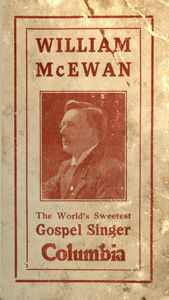
When my granda died, among his stuff was found the words of "My Ain Countrie", the old Scots language hymn (written by Mary Ann Demarest in 1861, and was one of the six recordings made by the Glasgow singing evangelist William MacEwan in 1911 - the first-ever gospel recordings in the world):
A am far frae ma hame an A’m weary aftenwhiles
For the lang’d-fer hamebringin’ and ma Faither’s welcome smiles
An A’ll ne’er be fu’ content, aye until ma een dae see
The gowden gates o’ Heaven, an’ ma ain countrie.
The earth is fleck’d w’ floo-ers, mony tinted, bricht an’ gay
The birdies warbles blithely, fer ma Faither made thaim sae
But these sichts an’ these souns wull as naethin be tae me
Whun A hear the angels singin’ in my ain countrie
A hae His guid word o promise that some glaidsome day the King
Tae His ain royal palace His banished hame will bring
Aye wi’ een an wi hairt rinnin owre we shall see
The King in aa His beautie in wor ain countrie
Ma sins they hae been mony, an’ ma sorrows hae been sair
But there they’ll niver vex me, nor be remember’d mair
Fer His bluid has made me white an His haun shall dry ma een
When He brings me hame at last tae my ain countrie
Sae little noo A ken o yon blessed bonnie place
A only ken it’s hame, whaur A shall see His face
It wad surely be eneuch, aye, fer iver mair tae be
In the glorie o’ His presence in wor ain countrie
Like a wean tae its mither, a wee birdie tae its nest
I was fain be gangin’ noo untae ma Saviours breast
Fer He gaithers in his bosom witless worthless lambs like me
An carries thaim hissel tae His ain countrie
He is faithfu’ that has promised an He’ll surely come again
He’ll keep His tryst wi’ me, at whit hoor A dinnae ken
But He bids me still tae wait, aye an ready ay tae be
Tae gang at ony moment tae wor ain countrie
Sae A’m watchin’ aye an’ singin’ o ma hamelann as A wait
Fer the sounin’ o’ His fitfa’, this side the gowden gate
God gie His grace tae aa wha listens noo tae me
That we a’ micht gang wi’ glaidness tae wor ain countrie.
.
Sunday, October 11, 2009
Yet another great night at Bangor Abbey!
A clip from Bangor Abbey last night. No amplification or effects - the raw performance.
Before the Throne of God Above (original 1863 melody):
Full post over at our Thompson Brothers blog. More clips to be uploaded over the next few days.
Thursday, October 08, 2009
Mandolin therapy
Therapy for the mandolin, and therapy for me too. I've been footering with it now and again in between other things - here are the before and after pics. (I first blogged about it back in May).


Tuesday, October 06, 2009
Saturday, September 19, 2009
Stuggy and Wee
As I've posted here before, I was fortunate enough to grow up in a family, in a community, in an area, where Ulster Scots words and phrases were part of everyday life, and even though it was more diluted than the Ulster-Scots of my parents, who in turn used a form more diluted than their parents, Ulster-Scots still leavened and coloured our daily speech. Not in the classroom, or even in the closest town (Newtownards), but certainly at hame wi oor ain yins.
Well, fast forward 30 odd years - Hilary took our two boys to get their hair cut yesterday. When they came back, Charlie's looked very uneven, so I brushed my hand through it and said "Charlie, your hair's all stuggy". It was a word often used in our house when I was wee, as my ma used to cut our hair for us - and despite her best efforts, with us as moving targets, stuggy was a regular aftermath!
The definition of stuggy from Chambers Concise Scots Dictionary is "a jagged or uneven cut, anything left coarse by uneven cutting". (Interestingly, stuggy isn't in The Hamely Tongue )
There was a discussion on Radio Ulster's Good Morning Ulster a few weeks back about the use of the word "wee", as in "put in your wee PIN number", or "what about a wee biscuit" etc. "Wee" is part of everybody's speech in Northern Ireland, and whilst I'll admit it's over-used to a ridiculous degree, it's another example of cultural markers of Scottish origin which permeate everybody's life here. The presenters seemed to be doing all sorts of contortions to NOT describe "wee" as Ulster-Scots though. The closest they got was when one of them said "isn't that a Northern Irish and Scottish word". But maybe even that small acknowledgement of a cultural continuity that stretches across the water is another wee step forward...
Monday, August 31, 2009
Tidying up - 4 1/2 year old style
On Saturday past we had a bit of a tidy up around the house - it had been neglected over the summer months. Lots of days away means not enough time at home, and so we rolled our sleeves up and got things ship-shape again.
Our youngest, Maggie-Jane, is four and a half. I went into her room (it was a week or two since I'd been in there) and was shocked by the state of the place! So I called her upstairs to help me sort it out, and to get things underway I handed her a cardigan that was on the floor.
She took it from me, trotted over to the other side of the room, and dropped it in the corner.
She looked at me. I looked at her, gobsmacked, with my chin on the floor.
She said "But Daddy, that's my special corner where I put everything"...
Subscribe to:
Posts (Atom)