
Just a few days ago a new exhibition (which William R and I worked on) began at Ards Tourist Information Centre, and a smaller version at North Down Museum. Both will be touring local public venues over the summer months. A few pics of the exhibition being assembled at Ards TIC are below. The design style follows a pre-existing style which had been developed by another designer for the accompanying printed literature. Keep an eye on local press to see the exhibition when it's touring. It's great that both Councils are getting to grips with local heritage and telling our unique story. There are some events lined up for later in the year, and two bus tours being led by yours truly!


Wednesday, April 20, 2011
Ulster-Scots in the Ards and North Down - exhibition


Tuesday, April 12, 2011
Ayrshire connections, 2011
Last Saturday I had the great privilege of spending about 2 hours with a retired man from Ayrshire, who was en route to County Leitrim (with his wife and two grandchildren) to spend a week with his son who lives there now. We met up near Lisburn, having emailed each other off and on for the last year and a half - it was a bit like meeting a pen pal! He found me online shortly after getting his first computer, whilst searching for the words of 'My Ain Countrie'. He lives between Dunlop and Beith - Hamilton & Montgomery country.
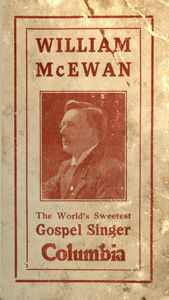
We got on like a house on fire, he brought me about 16 'Scotch brick' with the names of Ayrshire brickworks moulded into them. He also brought about 30 old 78s, of William MacEwan, Duncan McNeill, Jimmy Shand and fiddle player Mackenzie Murdoch. He told me of how his father used to cycle into Glasgow on a Sunday afternoon to listen to William MacEwan's open-air singing! He sang me four songs (which he let me record) one of which had been given to him in 1963 by a Robert Thompson from Sorn in Ayrshire who had learned it from his mother as a child in the 1890s. It has never appeared in print or in any university library in Scotland.
I could have talked to him all day, and I'm sure his wife and grandchildren feared that I would do just that! I am planning to meet up with him in June when I head over to Scotland for a few days on a research and photography mission for a project I'm tinkering at, and to give him his records back once I've digitised them all.
It was a brilliant afternoon, a wealth of common culture, and an example of how blogging has a value far beyond pixels and keyboards.
Thursday, November 04, 2010
Migration, Salvation and Refuge: News from Irvine, Final Episode... for now
In this final instalment in my mini-series about Ulster's links with the Ayrshire port of Irvine, I thought it would be important to provide a reminder of the faith connections.
In Spring of 1607, before the Flight of the Earls from west Ulster, Sir Hugh Montgomery's brother Bishop George Montgomery brought tenant families from Glasgow, Ayr and Irvine into the western ports of Donegal, Killybegs and Derry - copying what big brother was doing at Donaghadee.
Robert Blair was born in Irvine in 1593 and was the revolutionary minister at Bangor from 1623-1636, and according to John Lockington's biographical booklet of the man he was the de facto leader of the Ulster-Scots (published by the Presbyterian Historical Society of Ireland - click here to order a copy). Two of Blair's brothers - the eldest, John and the second, James, both became Provost of Irvine (one was probably the James Blair who Sir William Brereton met in 1635 - see the first post in this series).
Just up the road from Blair's stomping ground of Bangor is Holywood, where fellow Scot Robert Cunningham had been minister since 1615. Cunningham fled Ulster during the persecutions of the 1630s for Ayrshire - he died at Irvine in 1637 and was buried there, where his memorial can be seen today in the kirkyard. (There are other Irvine / Ulster connections listed on that earlier post)
But those gospel connections are not just relics of the past, because last Saturday Billy Kerr emailed me with the message which inspired this series of posts:
"...Today I experienced an extraordinary Ulster-Scots connection. This afternoon I took my wee Labrador bitch Jasmine down Irvine shore for a walk. Normally, on arriving on the beach I look for a plastic bottle to throw into the sea for her to fetch. On picking up the first bottle I saw, I noticed what appeared to be a scrolled piece of paper inside. I extricated the note and to my amazement it was a message from Bangor,County Down, heralding the same 'Good News' to the people of Ayrshire, that Irvine born Robert Blair proclaimed in County Down nearly four hundred years previously..."
There are probably hundreds, even thousands, of stories about Irvine and Ulster; and probably the same could be said for every port along the west cost of Scotland, from Portpatrick right along the 100 miles to Greenock - never mind the 150 miles of coastline along the eastern route from Portpatrick to Gretna, never mind the Kintyre peninsula and further north.
With a programme of locally-based research a deep river of Ulster-Scottish history could be released, and published in a suitable medium for both present-day and future generations.
(with thanks to Billy for the inspiration and help; his 'message in a bottle' is below. Billy writes the local history column each week for the 'Irvine Times'.)
PS - I phoned the man whose contact details are on the cover of the tract, there was a code on the back, it had been put into the sea in January 2002!

Wednesday, November 03, 2010
Wee Stamper Murdoch: News from Irvine, Episode 4
Billy Kerr from Irvine has sent me another example of the Ulster-Scottish interactions, this time from the Kirk Session minutes of Irvine (Old) Parish Church from 7 December 1760:
"...Helen Murdoch compeired and acknowledged she had brought forth a child in fornication. Being interrogate who was the Father, said, that George Downie Stamper was the Father of it, who commonly resides at Belfast but has taken a house in this Town, being asked if she had told him of her being with child, said she had, and that he had acknowledged it to John Young and James Alexander sailors..."
When historical stories obsess upon the "great and good", the story of the ordinary people is missed - people who struggled with the same issues and events as folk still do today. I wonder how wee Stamper Murdoch turned out in later life?
Tuesday, November 02, 2010
Smuggling and Contraband: News from Irvine, Episode 3
Following on from my two previous posts, Billy Kerr from Irvine has sent me a chapter entitled The Contrabandists from the book "Royal Burgh of Irvine" by Arnold McJannett (1933). The amount of stories about the links that the town had with Ulster are just staggering. Here are a few highlights:
• in 1667 the Scottish government banned the importation of cheap beef, meal and corn from Ireland. Fines and confiscations were the penalty for anyone caught. "Commissioners" were appointed to guard the west coast of Scotland - a coastline which had just two custom-houses, at Ayr and Irvine.
• in April 1672 the curate of Kilbirnie, Archibald Beith, was sentenced to be beheaded in Edinburgh following an attack he led on a ship which had sailed from Ulster, during which Beith shot dead two of the crew. However, the Episcopal authorities intervened and Beith was spared - but was banished to Rothesay.
• John Reid, an Irvine merchant, traded across the North Channel with three ships - the Ann of Lairne, the John of Portrush and the Swift of Rodwatter. He managed to dodge the fine print of the taxation laws by landing goods the day before heavy taxes were introduced.
• In October 1687 a large importation of goods from Carrickfergus was offered on first refusal the people of Irvine, before being sold to commercial traders.
• Rock salt was imported from Larne to Irvine to preserve supplies of meat and fish.
• In July 1681 a theatrical company from Ireland travelled to Scotland to perform a play before the Duke and Duchess of York (the later King James II), but had their costumes impounded as the law prohibited the importation of laced clothes. The restrictions were heightened later that year to also prohibit "silver and gold threed, silver and gold lace, fringes or tracing, all buttons of gold and silver threed all manner of stuffs and ribbans"
The extent of smuggling between the two coastlines was enormous - "Almost the whole community betook to smuggling... many a farm house in Ayrshire possessed underground accommodation, almost as extensive as the buildings visible above ground, which was used as depots for the run goods."
Monday, November 01, 2010
Burgesses from Ulster: News from Irvine, Episode 2: 1665 & 1667
(Photo: Glasgow Vennel, Irvine. Source here)
Following on from the previous post, in the book Muniments of the Royal Burgh of Irvine, Volume II (published 1891), there are more details of Irvine's connections to Ulster.
The accounts include both the illegal smuggling of "Irish Cloaths", and the legal trading of Ayrshire-mined coals into Ireland. On 26 May 1665 James Porter was appointed as a Burgess of Irvine - his father, Hew Porter, was a Burgess in Lochlerne (Larne?). Two years later on 13 May 1667 James Cleland, former Provost of Bangor, was also appointed as a Burgess of Irvine. The Burgh accounts for 1601-1602 include a reference to a "William Wilsoun, travellour in Ireland" (the same period when Hugh Montgomery was famously trading between Ayrshire and Carrickfergus). On 18th April 1681 the Irvine town Treasurer, Robert Brysone, was ordered to pay David Buchanan "nynteinth pounds Scotts" for his work on repairing the town clock - Buchanan had to do the work because William Weir (presumably the man who should have done the work) had "went to Ireland".
All fairly unspectacular stuff - which is the whole point. The links across the sea, between the two coastlines, and among what was/is one cultural community were/are ordinary. The Ulster-Scots connection is natural, ordinary - and, paradoxically, that's what makes it special.

Sunday, October 31, 2010
"10,000 persons have left the country": News from Irvine, Episode 1: 1635
In the 1630s, there was a major crop failure in Scotland. Sir William Brereton was in the district of Irvine in 1635 and wrote of two consecutive years when the land had been so "sterill of corne" that the people were "constrained to forsake itt." Guess where the people fled to?
He continued: "We came to Mr James Blare's in Erwin, a well affected man, who informed me of that which is much to be admired: above 10,000 persons have within two years past left the country wherein they lived, which was between Aberdeen and Enverness, and are gone for Ireland: they have come by 100 in Companys through this Town, and 200 have gone hence for Ireland together, shipped for Ireland at one tyde..."
However, their arrival in Ulster was not to the liking of the authorities: "...their swarming in Ireland is so much taken notice of and disliked, as the Deputie hath sent out a Warrant, to stay the Landing of any of these Scotch that come without a certificate. Three-score of them were numbered returning toward the place whence they came, as they passed this Town." Brereton wrote of sailing from Portpatrick to Islandmagee in a 10 tonne ship along with 17 horses - the ship was "soe much overthronged with passengers as wee had nott every man his owne length allowed to lye at ease".
• from Travels in Holland, the United Provinces, England, Scotland and Ireland, 1634-35, by Sir William Brereton, Knight. Click here for GoogleBooks edition.

Tuesday, September 07, 2010
From Ballyhalbert to Galloway - a morning view from last week
The only sound was the put-put-put of the wee inboard engine, around 7.30am. I've lived all my life on the coast here, and the view to Scotland has been a regular feature of every one of my 38 years. Some of my first steps were taken on this very beach (when my parents lived along the front of Ballyhalbert, before they bought the farm from the Johnstons, a farm my father had laboured on since he was a wee boy. His father and uncles had laboured those fields as well, as did their parents, as far back as family tradition goes.). All three of my own children have learned to walk on the same stretch of sand. I think most folk have places which are special to them - for me, the coastline from McCammon Rocks to Mooney's Brae is almost part of my DNA. Click the photo to enlarge.
Saturday, May 01, 2010
The blue-eyed, sandy coloured, Ulster-Scots of the Ards, 1840
(NB: If you're reading this on Facebook, you can read this post in full on my blog). Samuel Carter Hall and Anna Maria Hall were great travel writers of the 1800s. Here's a description of their observations of the people of the Ards Peninsula:
"...Mr and Mrs Hall, who toured Ireland in 1840, described the people of the coastal areas of County Down as being quite different because of the close approximation of the Scottish coast. The faces they met had a "square, stolid and "look forward" sort of expression, the cheek bones were high and broad, the eyes somewhat sunk and blue rather than black and grey, the complexions were still what they call "sandy" in Ireland. A Scotch-Irish dialect was, and still is today, particularly strong in the Middle Ards in and above the saltwater marsh..."
The three volumes they wrote were Ireland, its Scenery, Character & C, Mr & Mrs C Hall, 1843. PDF downloads here
(ps - how long do you think it will be before some moron sends me a "Seig heil" type comment?....)
Friday, April 30, 2010
Oh the Gallowa' hills are covered wi' broom, Wi' heather bells in bonnie bloom, Wi' heather bells an' rivers a'...
(NB: If you're reading this on Facebook, you can read this post in full on my blog). ...An' I'll gang oot o'er the hills tae Gallowa'. I haven't posted any photos of the view to Scotland in a while, so here's one from this evening, with wee white houses in clear view - Ballyhalbert (Clydesburn) sand in the foreground, Galloway hills on the horizon. A pilot friend told me last night that industrial pollution has a major effect on visibility, and that hundreds of years ago clear views like this would have been much more commonplace than they are today. Click to enlarge:
Saturday, February 20, 2010
Burial Isle and the Mull of Galloway
(NB: If you're reading this on Facebook, the original post is from my blog) Took this photo yesterday - Burial Isle is just off Ballyhalbert, the most easterly point in Northern Ireland. There's a legend that it has a secret Danish burial chamber full of Viking treasure - if you could find it under the guano! The land in the foreground is mainland Ulster, then Burial Isle, with a snowy Mull of Galloway in Scotland on the horizon. Click to enlarge.
Monday, February 15, 2010
1636 - 1638: From "beggary" to "prosperity" - another wave of lowland Scots migration to Ulster
(NB: If you're reading this on Facebook, the original post is from my blog) Billy Kerr, who writes the weekly history column in the Irvine Times newspaper in Ayrshire sends me great information. In a recent email, he sent me a scanned page from a book entitled "The Royal Burgh of Irvine" by Arnold McJannet (Glasgow 1938). In it, on p 166, McJannet outlines a massive wave of migration to Ulster:
"...about 1636 the coming and going of Scots and Irish* between their respective countries was on a scale that made it a remarkable feature of the time... so numerous were the bodies of Scots passing through Irvine for Ireland at this period that the Earl of Strafford... was compelled to insist on every Scot who arrived in Ireland bringing with him a certificate of his respectability and honest intentions... no fewer than 10,000 Scots from the country between Aberdeen and Inverness had crossed to Ireland within two years... they came in parties of one hundred in number at a time through Irvine... three hundred had shipped for Ireland at one tide. The reason was that the country had suffered a series of bad harvests which reduced a large proportion of the people to beggary and drove many to emigrate to the north of Ireland to contribute by their thrift and energy to the prosperity of modern Ulster..."
This late 1630s migration is a new one to me, and warrants further research. Significantly, this part of Scotland, whilst northerly, is still mostly Lowlands and in the 1630s was very Presbyterian - the book "The Covenanters in Moray and Ross" by M MacDonald (Inverness 1892) provides some brilliant detail and insight into the area at exactly the time of this migration. From 1605 - 1613, and then 1622 - 1624, the renowned Robert Bruce of Kinnaird had been banished to Inverness by King James (his published Life and Sermons are here). Bruce was a preaching tornado and massive spiritual conversions took place across the whole region. By the time that Scotland's National Covenant arrived there in 1638 "...the people of Sutherland, Easter Ross, Nairn and Moray entered into the Covenant with alacrity...".
To bring the connections up to the present day, Billy also tells me that he was born in a part of Irvine which was then known as "Wee Ulster", such were the huge numbers of Ulster families living there and working in the shipyards of Ayrshire.
* NB - I suggest that the term "Irish" here is geographical, rather than linguistic or cultural, and refers to people who were Ulster-Scots.
Saturday, January 30, 2010
Provosts of Newtownards, Movilla Abbey and the link with Ayrshire

(NB: If you're reading this on Facebook, the original post is from my blog) I visited Movilla Abbey today (shown here, click to enlarge) on my way through Newtownards. It was a lovely clear crisp morning, with a wee bit of snow on the ground, so with camera in hand I snapped a few photos. One discovery was of the gravestone of "John Saunders, late Provest of Newtown who departed this life the 20 day of 1704"- the gravestone a reddish colour and is built into the east wall of the abbey ruins. "Provost" is of course an old Scottish term for Mayor.
John Corry from Dumfriesshire (1638 - 1708) was also a Provost of Newtownards. And Sir Hugh Montgomery was of course the first Provost of Newtown. Walking back to car I came upon a gravestone with the inscription "Erected to the Memory of Robert McCredie of Ayrshire, Scotland, who departed this life March 31st 1848 aged 47 years"..
As these gravestones, and the recent information I posted here from Billy Kerr in Irvine demonstrates, the Ulster-Ayrshire connection is very strong. I was pleased to find this online recently, from 2003:
Friendship Charter between Irvine Valley Regeneration Partnership, Ayrshire and Newtownards:
We, the communities within the Irvine Valley Regeneration Partnership Area (Darvel, Newmilns & Greenholm, Galston, Moscow, Hurlford and Crookedholm), Ayrshire, Scotland, extend a hand of friendship to the towns and communities within Ards Borough Council, Northern Ireland. Our aim is to foster and develop mutual understanding and respect between the people of the Irvine Valley and Newtownards and to improve the economic development of the towns and villages by the promotion of tourism. We will communicate and exchange visits with each other, thereby developing human and cultural relations and establishing a firm foundation for future understanding respect and friendship between the people of The Irvine Valley and Newtownards.
It would be great to see the Councils on both sides of the water develop these links for the present day. John Saunders and John Corry, the old Provosts of Newtown, would definitely approve!
Thursday, January 21, 2010
The blog as a bridge to Scotland
(NB: If you're reading this on Facebook, the original post is from my blog) In August 2007, the Centre for Cross Border Studies proposed that a bridge should be built linking Ulster to Galloway (BBC report on the story here). While we wait for that to happen, I'm finding that this blog is making connections across the water too. Just over the past few months quite a few folk from west and central Scotland have been in touch with me directly - local Scottish historians who are interested in the Ulster-Scots links from the other side of the narrow sea.
Recently, William Kerr from Irvine on the Ayrshire coast (whose great grandmother was a McGowan from Armagh) sent me a clatter of brilliant information:
- a photo of the memorial to Rev Robert Cunningham (first Presbyterian minister in Holywood) which I never even knew existed! The inscription reads:
"Erected Anno Dom 1824
to
the memory of
The Rev Robert Cunningham
Sometime Minister of the Gospel
at Holywood in Ireland, who for
his faithfulness to the cause of
CHRIST, was expelled from his
charge by the Bishops and died
in exile at Irvine on the 27th of
March 1637
He was eminently distinguished
for meekness and patience and
zeal in his ministry"
It also has a few lines of Latin that I'm going to get translated, or find a translation for. Here's William's photo:
He also sent me:
- information about Rev Robert Blair (first Presbyterian minister at Bangor, and leader of the early Ulster-Scots)
- an Agnes Ferguson buried in Irvine (who as a child was at the Siege of Derry)
- a Lisburn man, William McKnight, who became minister at Irvine in 1709
- the school in Irvine that Edgar Allan Poe attended (he was of Ulster-Scots descent as well)
So I'll let you all know when the Northern Ireland museums sector get in touch to discuss how they might be able to incorporate these kinds of simple, culturally authentic "east-west" stories into their interpretations, replacing the politically-based Anglo-Irish (Scotophobic?) stuff that's presently filling up far too many of their galleries, and subsequently the minds of their visitors. However I suspect we'll be waiting a looooooong time for that particular phone call - in fact, the North Channel road bridge may well be up and running first.
Ultimately, leaving aside the "great and the good" and public institutions for a minute, it's far more important that ordinary folk on baith sides o the Sheugh continue to recover our cultural heritage, learn from each other and share our histories with one another - it's all one story anyway, of kindred people with a wee bit of water in the middle.

Wednesday, January 13, 2010
Kindred homes of kindred people
Found this brief, old, poem tonight - about the view from Donaghadee:
Yonder stretches Scotia's outline
Here the coast of Down is seen
Kindred homes of kindred people
With the Copeland Isles between
From A History of County Down by Alexander Knox (Belfast, 1875), p 486. Here's a pic of the view from Donaghadee, taken at the Moat between Christmas and New Year, looking towards Galloway. Click to enlarge
Thursday, January 07, 2010
A wheen mair photos
(NB: If you're reading this on Facebook, the original post is from my blog) Three pics from early this morning. Click to enlarge.
Towards Galloway:
Towards the harbour (with the Isle of Man faint in the background):
The bay (described on a 1500s map I have as "Talbot's Cove"):
Sunday, January 03, 2010
Snow in Galloway
(NB: If you're reading this on Facebook, the original post is from my blog) It's been snowing everywhere except on the Ards Peninsula! Not fair. Imagine the envy of our three weans (children) when they looked across the water this morning and saw this: (click to enlarge)
Tuesday, December 15, 2009
From the Ards to Galloway - 9.30am this morning
How close is Scotland? This close (click on the pic to enlarge):
Friday, October 16, 2009
Scotland this morning

About 7.30am, looking from our front door towards the Mull of Galloway. (click to enlarge)
Friday, September 04, 2009
What can you see from Scrabo Tower?
Two recent photos below - one of Scrabo Tower, which overlooks Newtownards. And another of the interpretive sign at the car park there, with a map of the places you can see when you're up there. Click both to enlarge

Subscribe to:
Posts (Atom)