(NB: If you're reading this on Facebook, this is a post from my blog)
Some people eulogise about 1798 as some kind of eutopian cross-community moment. They wish for a time machine so that they, being from community A, could have stood valiantly alongside those of community B, through bonds of brotherhood and common cause that still resonate deep within them. Yawn. It's a nicely airbrushed tale.
I've just finished re-reading David Hume's booklet on the 1798 Rebellion, or "Turn Oot", entitled To Right Some Things We Thought Wrong (Ulster Society, 1998). David rightly points out that, after years of agitation and planning, the eventual Rising in Antrim and Down of June 1798 was suddenly undermined by what had occurred in southern Ireland just days earlier, actions carried out by those who claimed to be fighting for the same cause. Rather than a rising against the state, the headline news from Wexford was of brutal massacres of fellow citizens.
There are two lists online of those who were killed - here and here, giving their names, where they lived and in some cases how they died. Be warned - some make for very grisly reading. (ref: National Library of Ireland, Dublin NLI JLB 94107)
So, when the order was given for Antrim to rise on 7th June, many just stayed at home, hiding in byres, developing instant illnesses, or just staying at work in the fields. Just a week later, at Ballynahinch, hundreds of men deserted the night before the famous Battle at which Betsy Gray and so many others were killed. The Rising was roundly defeated by the government forces; the aftermath was many months of executions and deportations. Shortly afterwards, the Parliament of Ireland was abolished and in 1801 the United Kingdom of Great Britain and Ireland was born.
As Antrim poet James Campbell (1756-1818) later wrote:
In Ninety Eight we armed again, to right some things that we thought wrong
We got sae little for our pains, it's no worth mindin' in a song.
Sunday, June 20, 2010
1798 and the massacres in Wexford


Thursday, June 17, 2010
Ulster-Scots and "The State"
(NB: If you're reading this on Facebook, this is a post from my blog)
This week Northern Ireland has been responding to the Saville Report. Some of the reactions are as you would expect. It's got me thinking about the relationship between "The State" and Ulster-Scots throughout history.
At this point in time, Ulster-Scots people are mostly Protestant and mostly Unionist. That cannot be denied and is nothing to be ashamed of. But far too often the modern, unthinking, presentation of Ulster-Scots has - tragically - been a trivial, trashy variety of Ulster Protestantism or Unionism, with a thin veil of newly-applied Scottishness. It might tick the boxes of the many funders out there, but it lacks depth, authenticity and knowledge.
As a result there are widespread false perceptions in the mind of the general public, providing fodder for the critics who demolish it with ease. Of even more concern, it has also dug a deep well of frustration amongst those quiet folk who loved and cherished their Ulster-Scots identity for decades and generations, before the money taps were turned on, and who now are turned off by much of what takes place under the Ulster-Scots label. The problems are not just presentational, but go right to the heart of how heritage is understood, protected and supported by "The State" - if it is at all. But if the apparatus of the state in Northern Ireland only understands the "two tribes" British v Irish political model, then who cares about the "three legged stool" English+Scottish+Irish cultural model?
Over the next few weeks I'm going to mull this over with the view of posting a series like last year's "Objections" series, which will highlight some important historic examples which show how the relationship between Ulster-Scots and the state has shifted over the years.
I'll not be able to examine every strand, but am posting this taster as an invitation for ideas or suggestions. Sharper minds than mine could do a far better job, but I hope to draw attention to some of the issues.
Tuesday, June 15, 2010
An important oul stane at Café Manor, Donaghadee
(NB: If you're reading this on Facebook, you can read this post in full on my blog)
Hilary and I were in Donaghadee at lunchtime, and went to the Café Manor beside the library (I'd just borrowed a few oul copies of WG Lyttle's Robin's Readings and Sons of the Sod to see if they were any different to my own copies). The sun was shining so we went through to tables in the walled garden. There, on two polished concrete plinths, was a big slab of cut stone about 4 feet long and a foot thick. I had seen it years ago - Donaghadee historian Harry Allen (author of this excellent history of the town) had told me about it, and had helped me track it down. It had been rescued from likely destruction from a back alley in Donaghadee, and bears the following inscription:
"The Manor Pound, Donaghadee, alias MONTGOMERY" - This commemorates Sir Hugh Montgomery's attempt in 1626 to rename Donaghadee as "Montgomery" and Portpatrick (on the opposite, Scottish, coastline) as "Port Montgomery"*.
So I lost all composure and in a loud voice I called out to Hilary - "LOOK - IT'S HERE, THIS IS THE STONE!! IT'S HUGH MONTGOMERY'S STONE!!".
That's not really the done thing on a sedate lunchtime in Donaghadee, and I startled the folk who were already eating their lunches in the garden. So a woman called over to me "So are you going to give us all a history lesson then?". Now I couldn't let an opportunity like that go, so in about 2 minutes I told all of the folk there the story of Hamilton and Montgomery and the attempt to rename the towns. The folk were delighted, and were going to head off to the Parish Church to see the stone above the church doorway which also commemorates Montgomery having built it too. One of the staff came to ask more, and so now she has a great story to tell their customers.
So, next time you're in the 'Dee, go to Café Manor and get a look at a great piece of Ulster-Scots history. However, thrifty Ulster-Scots beware, access to the walled garden costs an extra £1.50 a head!
(* the Glasgow General Assembly of 1638 included a Rev James Blair, minister of Port Montgomery - so the new name hung on for a while at least.)
Saturday, June 12, 2010
A petition from the inhabitants of Ballywalter and Ballyhalbert in response to the threat of danger from "our most treacherous enemies the French".
(NB: If you're reading this on Facebook, you can read this post in full on my blog)
If you surveyed the World Cup-watching public of Ballyhalbert and Ballywalter today, I think a fair proportion would see the French as their red-white-and-blue allies thanks to this incident!. Back on 13 April 1756 it was very different. On the eve of the Seven Years War, the men of middle of the Ards Peninsula weren't forging pike heads in the blacksmiths shops just yet, but they were concerned about the potential of a French invasion. So much so that they organised a petition and sent it to the Belfast News Letter (which then had been in print for only 19 years), who published all of the names. It's a good genealogical source for the period:
Bailie,William / Bailie,William / Bick,Hugh / Bigham,Archd. / Bodin,James / Boyd,James / Boyd,John / Boyd,Robert / Boyd,Samuel / Brown,Henry / Brown,Hugh / Brown,William / Brown,William / Causey,Andrew / Cauvert,Ed/Jr / Cauvert,Ed/Sr / Corran,Samuel / Corran,William / Coulter,John / Craig,Hugh / Craig,James / Craig,William / Doryan,Jas/Jr. / Doryan,Jas/Sr. / Drysdall,Henry / Dunbar,Francis / Gilmer,William / Glen,James / Glen,Michael / Glen,Robert / Gowan,David / Gowan,Jas/Jr. / Gowan,Jas/Sr. / Grey,William / Kennedy,Andrew / Kennedy,James / Kennedy,T/Jr. / Kennedy,T/Sr. / Kilpatrick,Hugh / Kilpatrick,John / Kilpatrick,John / Kilpatrick,Thos / Leeman,John / Leeman,William / Loughlin,Hugh / McCauvery,Jas. / McClements,Jas. / McClements,Jas. / McClements,Jn. / McCormick,Rob / McCormick,Thos. / McCormick,Wm / McDowell,Wm. / McKee,David / McKee,John / McKelvey,John / McMaster,Wm. / McWhur,Samuel / Miller,Henry / Miller,James / Miller,John / Miller,Rob/Jr. / Miller,Rob/Sr. / Moor,Henry / Murdagh,Robert / Palmer,Robert / Pue,Richard / Read,William / Reed,John / Ross,Robert / Small,Bernard / Stoop,James / Wilson,Hugh / Wilson,James / Wilson,James / Wilson,John / Wilson,John / Wilson,William
Why did they do it? What were they hoping to achieve? We may never know. Other Ballyhalbert men like Matthew Scott were emigrating to America around this time, and probably joined up with George Washington's army. The links between the 1798 Rising of Presbyterian Ulster-Scots in Antrim and Down, and the Presbyterian Ulster-Scots in the American Revolution of 1776, are crystal clear. But maybe this sets some context for the much-written-about sympathies with Revolutionary France.
A 1764 census for the Barony of Ards recorded a total of 16037 people, 15137 (95%) of whom were Presbyterian, 695 (4%) were Church of Ireland and just 85 (0.5%) were "Papists". In 1847, Henry Montgomery wrote that "...the rebellion, at the close of the last century was, in its origin and almost to its end... a Presbyterian rebellion…”.
The best book on the local 1798 events is Harry Allen's "Men of the Ards". I might blog a bit more about 1798 over the next while, but I'll wrap this post up with a story from Rev William Steele Dickson, Minister of Ballyhalbert (and later Portaferry). He was arrested the day before the planned attacks on Newtownards and Portaferry and was imprisoned in Scotland, where there were equivalent groups like the United Scotsmen. Dickson had been under surveillance for some time as he was suspected of forging links with these groups across the water. In prison, he was challenged by a Scottish inmate who had swallowed government misinformation that the rising in Antrim and Down was a "popish rebellion" (by spreading stories like this, the government was probably trying to undermine Ulster/Scottish Presbyterian co-operation). Dickson turned aside and wrote down the names and denominations of 20 of the leading United Irishmen in County Down. The list had 10 Church of Ireland, 6 Presbyterians and 4 Catholics. Dickson handed the list to him and said "look at that, and then tell me what becomes of your popish rebellion?".
In other words, stick that up your jumper!
(thanks are due to my good friend Dr William Roulston for drawing this petition to my attention. William's book - Researching Scots-Irish Ancestors, cites this petition among a huge collection of sources for the genealogy enthusiast who's trying to pin down their Ulster-Scots forebears)
Friday, June 11, 2010
"for twenty-four years I've been living next door to Alice"
(NB: If you're reading this on Facebook, you can read this post in full on my blog)
That's the name of an old 70s song. Sir James Hamilton's grandson, Henry Hamilton, was another man who was head-over-heels in love with a woman called Alice. Sadly for Henry, she destroyed his life.
Henry Hamilton was the 2nd Earl of Clanbrassil and had one of the biggest estates and fortunes in east Ulster. He met Alice Moore, a "very handsome, witty and well-bred lady" and was besotted. His mother (as mothers do) sized Alice up and was in "great grief" when Henry and Alice got married in May 1667. Alice was high maintenance and Henry racked up massive debts in trying to meet the costs her lavish, flirtatious, lifestyle. He sold off large parcels of the Hamilton estate to his tenants - and both Henry and Alice were at this stage just 28 years old. The Hamilton Manuscripts describe her as "beautiful and vicious".
In 1669, Alice ordered the Presbyterian meeting house in Bangor (at Fisher’s Hill now Victoria Road), whose minister was Gilbert Ramsay, be torn down. It broke Ramsay's heart. The following Christmas, Alice was among the audience at a new theatre in Smock Alley in Dublin which had three tiers of balconies - it was the Waterfront Hall of its day. The glitterati were there to see a satirical, mocking anti-Presbyterian play called “The Non-Conformist”. During the performance, the upper balcony collapsed into the middle balcony which then crashed down onto the lower balcony. Many people were killed, and Alice was badly injured.
However, that brush with death didn't hamper her selfish ambitions. The Hamilton will had been carefully laid out by Henry's father to ensure that, if Henry died, it would remain in the Hamilton family. Alice persuaded Henry to change his will, making her his sole heir. His mother saw the disastrous potential and warned him - "Son, expect that within three months after you perfect such deeds, you shall lodge with your grandfather and father, in the tomb of Bangor". On 27 March 1674, Henry's will was rewritten - "it is my will and pleasure to leave unto my dear wife, the Countess of Clanbrassil, her heirs and assigns, for ever, all my estate in the kingdom of Ireland..."
Henry had effectively signed his own death warrant. On 12 January 1675 he died suddenly in Dublin - and Alice ordered his body to be disembowelled within 5 hours of his death, and for a rush burial to take place at Christ Church in the city. Some time later, his body was reburied at Bangor, fulfilling his mother's prediction.
The suspicion is that Henry had been poisoned. However, the Hamilton family fought back, and Alice didn't get her hands on the estates. She remarried but died - miserable, alone and childless - on 13 Jan 1678.
Tuesday, June 08, 2010
Publications and Projects
(Intro: tragically, a lot of what has been done in the name of Ulster-Scots over the past 15 years or so has been ill-informed, trivial, politicised, invented, speculative, money-chasing, egocentric nonsense - which has done untold damage to our deep authentic heritage. I quickly realised I couldn't change the world, but could at least devote what little time I had to help some quality projects to emerge. This is still my aim).
2006: Hamilton & Montgomery 1606 - "The Dawn of the Ulster-Scots".
My first full year as Chairman of the Ulster-Scots Agency (June 05 - June 09) was the 400th anniversary of what I still regard as the seminal moment in Ulster-Scots history – when James Hamilton and Hugh Montgomery, both from Ayrshire, struck a deal with Con O’Neill for two thirds of his estates in Co Down. It wasn’t the first contact between Scotland and Ulster – the links had been going on for centuries, way before the Scottish Reformation of 1560 and the Plantation of Ulster of 1610 – but it was the first permanent lowland Scottish settlement of Ulster, a natural migration of lowland Scottish families. The year included a 50 minute documentary broadcast on BBC Northern Ireland, entitled “Dawn of the Ulster Scots”, presented by Flora Montgomery. A special edition tabloid is available which tells the whole story, as well as a foldout heritage trail. I took care of all of the research, writing, photography and design. With thanks to Dr John McCavitt for his guidance throughout the project, and to the Montgomery and Rowan-Hamilton families for their support.
+ Visit the project website.
+ Order copies of the publications
 2007: The Bruces in Ulster
As proof of the pre-Plantation, pre-Reformation links mentioned above, this project went back 700 years to 1306/1307 when King Robert the Bruce spent a winter on Rathlin Island, after which he returned to Scotland to fight a seven year campaign which ended with Scottish independence. His brother Edward then came to Ulster and was declared High King of Ireland for a few years, before being killed in a battle at Dundalk. A special edition tabloid is available which tells the whole story, as well as a foldout heritage trail. I took care of all of the research, writing, photography and design. With thanks to Doug Archibald of The Robert the Bruce Commemoration Trust for his help and quality proofing, and to the Ulster History Circle who installed a commemorative plaque on Rathlin in Summer 2007. The plaque was unveiled by a group of VIPs, including the Earl of Elgin, a lineal descendant of Robert the Bruce.
+ Visit the project website.
+ Order copies of the publications
2007: UlsterVirginia.com
This website project was produced in the run-up to Northern Ireland's participation at the Smithsonian Folklife Festival in Washington DC in July 2007. A host of expert contributors provided fresh research and articles; the Virginia Tourism Corporation also assisted. The project was launched, using a series of billboard posters in greater Belfast, by the US Consul Dean Pittman. I took care of all of the photography and design and co-ordinated the research and writing.
+ Visit the project website
2008: The Covenanters in Ulster
This 1600s in Ulster are a deeply misunderstood period, usually reduced to the Plantation and the Battle of the Boyne. The story of the Covenanters is one whch goes deep into the psyche of Scots and Ulster-Scots, of Presbyterians who were brutally persecuted for standing up for their faith and for opposing the tyrant Kings. A special edition tabloid is available which tells the whole story, as well as a foldout heritage trail. I took care of all of the photography and design and co-ordinated the research and writing. We also ran a week-long series in the News Letter. With thanks to all of those who helped and supported, in particular Dr William Roulston.
+ Visit the project blog.
+ Order copies of the publications
2008: "Sacred Scotch Solos"
This personal online project is an historical archive of over 80 sacred songs which have been given to me over the years by folk both in Ulster and Scotland. Most are from Scottish printed sources about 100 years old, providing evidence that in previous generations people were comfortable using Scots creatively in worship and outreach. All of the pieces use varying densities of Scots, from a light sprinkling of vocabulary through to much deeper usages. Since the site went live, the Church of Scotland's "Scots Language in Worship Group" have used some of the pieces in their own repertoire. Scots and Ulster Scots are both used by contemporary songwriters as well. The site includes text of the lyrics, and downloadable scans of the original musical notation.
+ Visit the project website
2009: Alexander Peden, Prophet and Covenanter in Scotland and Ulster
Having completed my term at the Ulster-Scots Agency, this book was a natural extension of the “Covenanters in Ulster” project, telling the story of the most enigmatic and famous of the Ulster Covenanters. Peden was born in Ayrshire, but during the “Killing Times” sought refuge at Glenwherry in County Antrim. This 112 page book is centred around a reprint of a 1755 Belfast pamphlet about Peden and includes a collection of essays and historical poems. BBC Radio Scotland produced a half hour programme about Peden, presented by Richard Holloway, around the same time as the book's completion. I took care of all of the photography and design and co-ordinated the research and writing. I also contributed one of the articles, entitled "Publishing Peden - A Chronology of Chapbooks 1712 - 1872". With thanks to all of those who helped and supported, in particular, Dr William Roulston, Jack Greenald and Dane Love of the Scottish Covenanter Memorials Association. Thanks also to The Ullans Press for issuing the book under their imprint.
+ Order a copy of the book
2009: Frances Browne Multilingual Poetry Prize
A lighter moment amongst the solid history. I tend to leave the linguistic side of Ulster-Scots to the experts who understand its nuances far better than I do. I enjoy the colour of the words and expressions and have dabbled with a wee bit of poetry. A light hearted poem I wrote for fun, Address to a Nintendo DS, finished as runner-up in this annual competition run by the Finn Valley Voice newspaper in Donegal.
2010: The Forgotten English Colony of Sir Thomas Smith
What happened before the arrival of the Ulster-Scots? In north Down and the Ards, the story of what came before is the failed colony of Sir Thomas Smith. After almost a year of research the first outcome of this project is a 40 page full colour booklet, the printing of which was funded by Ards Borough Council, North Down Museum and the Ulster-Scots Community Network. I took care of all of the research, writing, photography and design. With thanks to a broad range of universities, galleries, museums and libraries across the UK and RoI, all of whom are acknowledged and referenced inside. The booklet has been covered in the News Letter and the Newtownards Chronicle, and there’s a possibility of some television coverage in the near future.
+ Order a copy of the booklet
2010: North Down and Ards Tourism project
I've just finished a major piece of work with the Ulster Historical Foundation to show the tourism potential of the Ulster-Scots heritage of North Down and Ards. Supported by the two local Councils and the Northern Ireland Tourist Board's Tourism Innovation Fund the end result was over 300 pages of information, history, genealogy, potential tourism products and a bank of fresh photography.
Digitisation Projects
It's essential that history is made accessible for today's reader and researcher. When still at the Ulster-Scots Agency, I also took the lead on producing digitised versions of:
• The Hamilton Manuscripts (compiled by TK Lowry, 283 pages, first published 1867)
• The Montgomery Manuscripts (compiled by Rev George Hill, 504 pages, first published 1869)
• The MacDonnells of Antrim (complied by Rev George Hill, 515 pages, first published 1873)
• The Plantation in Ulster (compiled by Rev George Hill, 636 pages, first published 1877). This has an accompanying CD of the Thomas Raven maps of the Plantation counties, courtesy of PRONI, with narrative by Professor Raymond Gillespie.
All of these were produced as facsimile text-searchable PDF files, available on CDRom.
A gospel moment in "Prince of Persia"
(NB: If you're reading this on Facebook, you can read this post in full on my blog) There's a moment in the new Disney movie "Prince of Persia" that some of you will enjoy (I took Jacob to see it last week). I must admit I wasn't expecting a movie based on a computer game to be much good, but it was a swashbuckling cracker with lots of very scary curved swords, warriors and grisly (implied) deaths.
The hero, Dastan, reveals to his rival Princess Tamina (who of course he ends up falling in love with) that he is not of Royal blood. In the heat of an argument he shouts at her "I wasn't born in a palace like you - I was born in the slums of Nasaf, where I lived and I fought and I clawed". Shocked, she asks, "And how did you become a prince?". Dastan pauses and replies, "The King marched into the market one day and he, I don't know, he found me, he took me in..."

Sunday, June 06, 2010
Thoughts on Devolution
(NB: If you're reading this on Facebook, you can read this post in full on my blog) At the Scottish Parliament in Edinburgh there are various literary quotations on the wall, some of which have a relevance to Devolved Government here in the UK. One is:
"...When we had a king, and a chancellor, and parliament-men o' our ain, we could aye peeble them wi' stanes when they werena gude bairns - But naebody's nails can reach the length o' Lunnon..."
- Sir Walter Scott (1771-1832) Mrs Howden in Heart of Midlothian
Which got me thinking, if you could choose a text for the wall at Stormont, to make a pithy comment about Devolution in Northern Ireland, what would it be? I know for a few readers of this blog it might be a verse or two from "A Cannae Thole Ye" by GF Savage Armstrong! Here's another contender:
"...A saw naebody that A kenned till A got tae Bilfast. Waens, dear, it's a big toon that!... Whun A got oot at the station-hoose , an' saw the crowds o' fowk rinnin' this road an' the tither road, A got that scaured for feer o' loasin' mysel' that A had a noshin' o' lyin' doon ahint the station-hoose till the train wud be reddy tae birl back hame again..."
- WG Lyttle (1844-1896), Robin's Readings
Suggestions by placing a comment below, or by emailing me, would be very welcome!
...
UPDATE: an emailer who wants to remain anonymous sent me this from Robert Burns, and has asked for it to be added here as his suggestion for Stormont -
"We're bought and sold for English gold - Such a parcel of rogues in a nation!"
Friday, June 04, 2010
"Well Mother I am started to till the soil in Canada" - John Thompson from Ballyfrench, May 1925
(NB: If you're reading this on Facebook, you can read this post in full on my blog)
My grandfather's brother, John Thompson, emigrated from Ballyfrench, County Down to Canada in 1925 (he's wearing the hat in the pic above). A few weeks ago one of his letters surfaced among some family papers:
1/5/1925
c/o Robert Barker, Almonte, Ontario, RR No 1, Canada
Dear Mother,
Just a few lines to let you know that I arrived allright in Canada and in the best of health at present hoping this will find you all enjoying good health. Well Mother I am started to till the soil in Canada I got a start made on Tuesday so I did not get any holidays on this side. The emigration Officers were at Quebec when we landed there and sent every one their own way so I never saw Davies since we left Quebec so I think he has gone another route so I am about 250 miles from Toronto and about 30 miles from Ottowa of course this place I am in is miles from nowhere. I suppose there will be word from the rest of the boys that went out before - you might get me Wm Bell's address I suppose he is in a fine place too. We landed that night Saturday in Quebec about ten o'clock and had to stop aboard all night and got off the next morning at eight oclock. Well Mother I think this is all the news for this time only. Hope to hear from you soon again with love to all. From your Son John Thompson.
From an Ulster Peninsula to a Canadian Island
A 1904 Business Directory for Almonte is available here - Almonte is in Lanark County and even today still has a Highland Games event each year. About a 2 1/2 hr drive from Almonte is Amherst Island, Lake Ontario. Between 1820 and 1880, 105 families emigrated from the Parish of St Andrews (in the middle of the Ards Peninsula) to Amherst Island. The island was owned by the 3rd Lord Mount Cashell, who also owned estates in Cork, Tipperary, but his largest estate was nearly 50,000 acres in mid Antrim – at Kells, Cullybackey and the countryside around Ballymena. In the 1830s and 1840s he bought over 20,000 acres in “Upper Canada”, following in the footsteps of a number of Scottish gentlemen who had done the same (for example, a William Dickson from Scotland had bought 94,000 acres there in 1816).
The majority of the emigrants were Presbyterians, and until 1851 their minister - an Ulster missionary called Rev McLeiche – preached in the open air. A church was built that year. Cashell sold the island in 1857 to his second cousin, Major Robert Perceval-Maxwell, whose parents owned the Finnebrogue estate near Killyleagh and another at Groomsport. They built churches, schools (where the textbooks from the Ards were used), formed an Orange lodge and also a pub called the "County Down Inn".
There are many detailed stories about specific families, from Adairs to Watsons, in A New Lease on Life, by Catherine Anne Wilson (McGill-Queens University Press, 1994). Some of the Cashell and Perceval-Maxwell papers of the Amherst Island tenants are held at PRONI.
NB - Mary Becker and Lena McVea run both the Ards Peninsula DNA project and also the Amherst Island DNA project.
Here's a Googlemap to show where Amherst Island is:
View Larger Map

Monday, May 31, 2010
Reviews of GF Savage-Armstrong's "Ballads of Down", 1901
(NB: If you're reading this on Facebook, you can read this post in full on my blog)
I posted about Ballads of Down recently; since then I've been sent a copy of a promotional leaflet which was produced at the time, containing what it calls "Press Opinions" of the book. Here are a few examples:
"the Ulster character and the Ulster dialect have never before found such expression in literature as these delightful 'Ballads of Down.'" - Leisure Hour
"the spirit which breathes in the national poet of Scotland breathes to a very considerable extent in 'the Poet of Wicklow.'" - Brighton Gazette
"he is distinctly at his best in the dialect poems, some of which have a homely pathos which is not a little touching." - Liverpool Post
"there is a genuine charm... and something of Lowland Scotch pith and grit" - Manchester Guardian
"Mr Savage-Armstrong... is the truest voice that Ulster life has yet found" - Review of Reviews
"To the Scottish reader these poems will prove especially attractive... that the spirit that pervades these songs is akin to the genius of Scottish poetry will be apparent to every reader... his latest volume shows how deftly he can touch themes of peasant-life in Ulster, and how cleverly he can manipulate the quaint dialect of County Down." - Dundee Advertiser
"the general excellence of his work will not be questions... his metre is never at fault... to Scotch readers there will be an added interest to his volume from the fact that a number of the poems are in dialect - an Ulster form of Lowland Scotch" - Aberdeen Free Press
"He shares with Burns a certain swift, unaffected draughtsmanship, and creates for his reader a vivid sense of the natural characteristics of the scene depicted. In his management of the dialect he is wholly admirable" - Irish Times
"the dialect-verse... has its tender love-strains, its sly humour, and its pathos, which to those who are 'sons of the soil' must make a special appeal" - Northern Whig
The leaflet has dozens more reviews; what is interesting from the above selection is (aside from the obvious Burns comparisons) how warm and open the press in Belfast and Dublin were towards the book, never mind in Dundee and Aberdeen.
Wednesday, May 26, 2010
The kirks and braes o' Killyleagh (and the media and museums of course)
(NB: If you're reading this on Facebook, you can read this post in full on my blog)
Whilst Northern Ireland's suburban media élite have once again spent their day ridiculing Ulster-Scots, I was in Killinchy and Killyleagh, visiting some local, historically-important, churches. I'll not mention the people by name (just in case the thought police go and hunt them down) but I had a marvellous afternoon talking with local folk, born and bred on the other side of Strangford Lough, about local history and fast-disappearing vocabulary. One of them gave me her personal collection of old yellowed newspaper cuttings of Ulster vocabulary, dating back to the late 1800s - a real treasure trove of information.
They also told me of old Ulster-Scots street names in Killyleagh which have been replaced by bland alternatives within their lifetimes - Braeside which led to Breakey's Brae, Barracks Brae (which was changed to Shrigley Road), Sabbath Brae (changed to Castle Lane) - and up near Raffrey, Bratchey's Brae (probably Bradshaw's Brae, just like in Newtownards - but still spelled as "Bratchey's" on a nearby house), which joins the Temple Burn Road.
Not that any of these things would interest the opponents of Ulster-Scots. The dominant attitude of the establishment in NI towards Ulster-Scots has always been hostility of one kind or another. That antagonism can be traced back in various forms for centuries. In more recent decades that has included the trivialisation of tradition, the wiping out of old place names and the exclusion of our story from the classroom, or - dare I say it - most museums. I've blogged about that before.
The smug, constructed world that today's media and cultural élite lives in is one where they can talk down their noses about 'reinforcing elderly rural protestant stereotypes', and get away with it. Their airbrushed world bears little resemblance to the lives and interests of ordinary Ulster folk. As I've said manys a time, the closest many of these "experts" get to rural life is the car park at Marks and Spencer.
(See the recent post on GF Savage-Armstrong's clashes with the literary élite of a century ago - click here)
Monday, May 24, 2010
The missing Montgomery portraits and memoir - an open message to art collectors, libraries and museums in New Zealand and Australia
(NB: If you're reading this on Facebook, you can read this post in full on my blog)
I'm posting this in the hope that, one day, these items might surface and perhaps copies of them could be sent back to Ulster in the interests of history and cultural heritage.
1. THE MISSING PORTRAITS
The Montgomery Manuscripts were written by William Montgomery in the late 1600s and early 1700s. They were first printed in Belfast in 1830, and then again in 1869 with the addition of magnificent footnotes by Rev George Hill. Hill's portrait hangs in the Great Hall of Queens University in Belfast, in which he is holding a copy of the manuscripts. Because of the limitations of printing at the time, there are very few illustrations in the book. Tantalisingly, Hill does refer to two then-extant original portraits - of Sir Hugh Montgomery, the First Viscount of the Great Ardes (1560 - 1636) which is said to have been a life-size portrait - and also one of his second son Sir James Montgomery of Rosemount (1600 - 1651). Here is Hill's description: -
"...An oil painting of the first viscount is in the possession of Mrs. Sinclair, formerly of the Falls, near Belfast, who is seventh in lineal descent from him. The same lady also possesses a portrait in slate of sir James Montgomery of Rosemount, and miniature likenesses of col. Wm. Montgomery of Killough, and his wife, Isabella Campbell of Mamore. Col. William Montgomery was grandson of the author, and great-grandfather of Mrs. Sinclair..." (The Montgomery Manuscripts, footnote, page 117)
No-one alive in Ulster today has ever seen these portraits - they are thought to have been taken to Australia or New Zealand by emigrants.
2. THE MISSING MEMOIR
In the Preface, Rev George Hill refers to a biography of Hugh Montgomery II (1597 - 1642) - "...The memoir of the second viscount is unfortunately lost, at least for the present, having been probably carried away to Australia by the author's lineal descendant, captain Frederick Campbell Montgomery, who settled in that colony about the year 1835..."
Sir James Hamilton and Sir Hugh Montgomery have been called "The Founding Fathers of the Ulster-Scots". Hamilton's original portrait hangs at Castle Ward, the National Trust property near Strangford. It is a tragedy that 150 years ago, an equivalent original portrait of Sir Hugh Montgomery was in a private collection in Belfast but has since been lost, probably taken to the other side of the world.
If you know where these two Montgomery portraits might be - PLEASE GET IN TOUCH!! There may even be a reward for the person who uncovers them, and who helps to return copies of them to the people of Northern Ireland.
(NB - The portrait of Sir Hugh Montgomery shown here is the one which has been used in recent years. It is from a copy indenture from Fraser's "Memorials of the Montgomeries", which is a poor facsimile of an original 1630 indenture. I was recently given a digital copy of the original indenture, and the portrait looks much better than the one shown above - but as I don't own the copyright for it I won't post it here)
........
Who was Mrs Sinclair? A few months ago a local historian was good enough to send me this background info:
"...There were several wealthy families with the name Sinclair resident in mid 19th century Belfast. The most prominent were the owners of J&T Sinclair, Merchants and Ship owners, they owned two of the largest mansions in the North of the city, the Grove and Hopefield. Another family were the owners of S Sinclair and Company Linen Merchants who lived in College Gardens and other houses in the South of the city. The only connection of a Sinclair family to the Falls would be in the late 18th and early 19th Century. William Sinclair, a very successful Linen manufacturer, is described as the Falls Bleacher. The family house and business premises were in Mill Street, where Castle Street and Divis street now are. Their very substantial house faced the entrance to King Street. He built Fortwilliam House at the end of the 18th Century but the bleaching business was still carried on at the Mill Street site and they presumably retained their house there. William Sinclair died in 1807 and left three daughters but no sons. Fortwilliam was sold soon after his death but his wife survived him until 1854. She lived mainly in Donegal Place but she would always have been associated with the Falls. To my mind she is the only possible candidate among the Belfast merchant classes of that time. As is not unusual at that time the name appears as both Sinclaire and Sinclair. I hope this is helpful, incidentally William Sinclaire was quite a character with wide interests which included being Chairman of the Society of United Irishmen..."

Saturday, May 22, 2010
The Great Sausage Roll Swindle
(NB: If you're reading this on Facebook, you can read this post in full on my blog)
Don't judge a book by its cover, or a sausage roll from the photo on the packet! I really should be avoiding sausage rolls, but I persuaded Hilary to buy some the other day.
THE PACK
.
THE REALITY
Usually, food packaging that doesn't have a clear window is packaging with something to hide. Hmmm.....
.


Monday, May 17, 2010
George Francis Savage-Armstrong's "Ballads of Down", 1901
(NB: If you're reading this on Facebook, you can read this post in full on my blog).
A while ago, Fiona McDonald posted on her blog about this writer, who also features in Dr Frank Ferguson's excellent Ulster-Scots Writing: An Anthology. George Francis Savage-Armstrong (1845 - 1906) was born in Dublin (his father was from Wicklow and his mother was from Co Down) and his wife, Marie Elizabeth, was from Belfast. Her father was Rev John Wrixon, rector of St John the Evangelist Church on the Malone Road.
"GFSA" was a prolific writer and poet (full bibliography here). He was Professor of English and History at Queen's College Cork and at one stage was a contender for the position of Poet Laureate. His later writings included much County Down history, as well as "Ballads of Down", a collection of 92 songs and poems published in 1901.
Many of these are in Ulster-Scots, which he describes in the glossary as follows - "...the Downshire dialect, with its variants, is an Ulster development of Lowland-Scottish - principally Ayrshire - brought over by Scottish settlers in the reign of James I... the dialect is more or less marked according to the locality and to the degree of the speaker's education. Some of the peasantry have it so strongly as to be hardly intelligible to a stranger...". Even with his own academic pedigree, his English poetry is described in the Dictionary of National Biography as "competent but pedestrian" - nevertheless, "GFSA" retained a sound handling of Ards Peninsula Ulster-Scots.
Here's an example of his work, a poem called A Cannae Thole Ye!
Ye may be clivver, may hae won
A wheen o' honour 'nayth the sun
But, whatsaee'er ye've earn'd or done,
A cannae thole ye!
Ye may be genial noo and then
Wi' helpless waens an' humble men;
But, though ye'd gilt auld Poortith's den,
A cannae thole ye!
Ye may be guid; ye may be great;
Ye may be born tae rule the State;
But, though ye rowl'd the wheels o' Fate,
A cannae thole ye!
Ye may hae drawn yer watery bluid
Frae Noe's sel' that sail'd the Flood;
But, though in Noe's breeks ye stud,
A cannae thole ye!
Ye may be lord o' mony a rood;
Yer smile may mak' a monarch prood;
But, though the De'il afore ye boo'd,
A cannae thole ye!
It's nae that ye hae din me wrang;
It's nae A feel a jealous pang;
It's jist that, be ye short or lang,
A cannae thole ye!
A CONTROVERSIAL CAREER:
GFSA attracted some opposition during his career - here's an excerpt from his DNB entry:
"...He was antagonistic to the Irish literary revival and was severely criticized by W. B. Yeats. In ‘“Noetry” and poetry’, his second review of Savage-Armstrong's Poetical Works (9 vols., 1891–2), Yeats judged Savage-Armstrong's work to be either rhetorical or crude, but conceded that the ‘Irish’ verses were memorable. In 1898 Savage-Armstrong addressed the Irish Literary Society, London, on ‘The Two Irelands in Literature’, arguing against Matthew Arnold that Gaelic literature had ‘not much style, very little melancholy, and very little natural magic’. He praised the foundation of Trinity College, Dublin as having initiated ‘Irish literary production in the English tongue’ (The Times, 28 May 1898). Yeats responded ferociously, attacking the barrenness and negativity of Savage-Armstrong's Ireland, arguing that he knew little of Gaelic literature, that he represented an obsolete tradition and that he resented being sidelined by the writers of the revival; Yeats's attack was an expansion of his first review of Savage-Armstrong's Poetical Works, in which he had asserted that ‘Mr. Armstrong has cut himself off from the life of the nation in which his days are passed, and has suffered the inevitable penalty’...."
Threatening, almost sinister, stuff - showing that even 100 years ago swimming against the intellectual mainstream was a dangerous activity. GFSA spent the last years of his life at Strangford House where he died on 24 July 1906. Some of his collected material is held at the William Andrews Clark Memorial Library (UCLA).
CHILDREN and WWI:
The Savage-Armstrongs had three children, all of whom were caught up in the events of World War One:
Francis Savage Nesbitt Savage-Armstrong (5 July 1880 - 23 April 1917) became a Lieutenant Colonel in the South Staffordshire Regiment. He joined the Army on 19 Sept 1900 and served during the Boer War. He served in France & Flanders from 3 Nov 1914, was twice Mentioned in Despatches, and was awarded the D.S.O. (see London Gazette 23 Jun 1915). He was killed in action on 23 Apr 1917 and is interred in the Poit-du-Jour Military Cemetery, France.
John Raymond Savage-Armstrong (13 May 1882 - 1918?) became a Captain in the 4th Leinster Regiment. He was wounded at the "Battle of Hill 60" at Ypres in April 1915, and was released on sick leave. He seems to have returned to Strangford House - Northern Ireland's Digital Film Archive contains two of his letters which were written around the time of the 1916 Easter Rising - one written to him by a Miss Julia Taylor of Dublin, and one written to him by his son (also called Raymond).
Arabella Guendolen Savage-Armstrong served as a nurse at the Richmond Military Hospital during World War I, and after this, was active in social settlement programs like the Hackney Girls' Club, the Pell Street Club and the Sandes Soldiers' Home at Magilligan, Co Londonderry.
IMHO, the Ulster-Scots material in "Ballads of Down" is worth reprinting for today's generation.
Sunday, May 16, 2010
If you like movies, you'll love this!
A break from the normal content here at the 'Burn - a great send-up that sinks the boot into the repetitive formula of every Hollywood mega-movie of the past 20 years! (sorry about the freezeframe image that the clip starts with - blame YouTube!)
Friday, May 14, 2010
Sir Thomas Smith booklet launch

(NB: If you're reading this on Facebook, you can read this post in full on my blog). Tonight saw the launch of the Thomas Smith booklet. The Londonderry Room in the Old Town Hall in Newtownards was packed with a cross-section of local folk, local historical societies, individual historians, councillors, Jim Shannon MP, Nelson McCausland MLA (Minister for DCAL), the Mayor of Ards Cllr Billy Montgomery, and many more. After the introductory remarks from Hammy Gregory (Loughries Historical Society), the Mayor and Jim Shannon, I spoke for about 30 minutes using a Powerpoint presentation as a visual aid to summarise the Thomas Smith story. The reaction from the audience was superb, the booklets flew out the door, and I think we've really managed to put Smith back on the local map.
The next step is for someone to buy Craigantlet quarry (I am pretty sure this is close to where Smith planned to build his biggest defensive fort) from its current owners Tarmac and turn it into a hilltop heritage centre with a spectacular 360 degree panoramic view of Belfast Lough, Strangford Lough, Scotland and the Isle of Man!
Thanks to everyone who was so enthusiastic this evening; all being well this is just another step along the road of recovering the unique heritage and stories of north Down and the Ards. Somebody, some day, will do a PhD on Sir Thomas Smith's forgotten colony - I just hope my booklet helps to bring his story to today's generation.
Copies of the 40 page booklet are available from Loughries Historical Society - click here to email them for a copy.
Above all - enormous credit goes to Mr Balmoral himself, Mark Anderson of Loughries Historical Society, who is doing a magnificent job in the local community, and schools, in bringing the Ulster-Scots story to the people of the Ards and North Down. Our area would be much poorer without the work he does, and in how he conducts himself - in his own quiet, modest, steady way he has won the respect and confidence of councillors, council officers, teachers, parents and weans. Like Hamilton and Montgomery in May 1606, Mark inherited something of a cultural wasteland, but through hard work he is steadily rebuilding the walls and bringing people in - and like Hamilton and Montgomery's tenants, the seeds he has sown are now reaping a bumper harvest!
Tuesday, May 11, 2010
What is Ulster-Scots? A People and their Heritage
It sounds like a simple question, but it’s actually very complex. Identity is a complicated issue, and even more so with a long-neglected, marginalised and misunderstood identity like Ulster-Scots. There are many important subtleties that this small article can never adequately cover, so this will only serve as a simple introduction, not a comprehensive study. Hopefully others, better qualified than I, can explore the themes outlined here in more detail.
A People and their Heritage
The term Ulster-Scots has, for nearly 400 years, referred to people, not place - the people who migrated from the Lowlands of Scotland to Ulster, and to the Ulster-Scots communities that they established right across the nine counties. It is important to recognise that migrations between the two coastlines have been ongoing for thousands of years, but it is generally accepted that it was the Hamilton & Montgomery Settlement of May 1606 that saw the floodgates open. Tens of thousands of Lowland Scots poured into Ulster:
“…Hamilton & Montgomery... did not wrest a fertile, cultivated and prosperous region from Gaelic proprietors. They came instead to a country devastated by war and famine... they created the bridgehead through which the Scots were to come into Ulster for the rest of the century...”
from ATQ Stewart The Narrow Ground, page 38 – 39
This first large wave of permanent migrants were not soldiers or mercenaries (as was the case in the other major Scottish migrations of the era, for example to Poland or Sweden). They were ordinary Scottish families, seeking a new life. They were mainly Presbyterian in faith and outlook, and overwhelmingly Scots-speaking in language. As John Hewitt summarised so well, it was:
“…a transplantation of Scots from not very far away to a climate and an economy very like home, and to which the language, folk culture and lore had been carried without dilution…”
from Ancestral Voices; the selected prose of John Hewitt, p66
This was just the beginning - these first Ulster-Scots settlements were built upon over the following centuries, through constant fresh migrations which both increased the size of the Ulster-Scots community and enriched our heritage and traditions. The permanent Lowland Scots imprint on Ulster is crystal clear.
Ulster-Scots heritage and traditions
So Ulster-Scots not only refers to these people, and their descendants, but also to their heritage and cultural traditions. The Lowland Scots brought industry, language, music, sport, religion and a myriad of traditions to Ulster. And many of these have become mainstream, not narrow cultural markers, but broad themes in our society. None of these things were fossilised, frozen in a 1600s timewarp - the traditions have developed, changed and grown over time. In Scotland, what were once only markers of regional Highland identity have over time become markers of national Scottish identity. In the same way, some aspects of Ulster-Scots identity have adopted Highland influences too.
Is “Ulster-Scots” not just about the two places – Ulster and Scotland?
Some people assume that anything that links the two places of Ulster and Scotland should be described as Ulster-Scots. However, this confuses the term and clouds how it has been used over the centuries. Links between the two places might be more clearly described using a different term, such as Ulster/Scottish.
How old is the term “Ulster-Scots”?
Some people think the term Ulster-Scots is a recent invention. This is nonsense – and reveals much about the poor knowledge of our history. The first known written usage of the term Ulster-Scots was in 1640. In the aftermath of Scotland’s National Covenant of 1638, the Presbyterian community in Ulster was seen by the government of the day as a very real threat, and Sir George Radcliffe wrote “…none is so dim-sighted but sees the general inclination of the Ulster Scots to the Covenant…”
The term “Ulster-Scots” in literature
In literature, the term crops up time and again. Here are just five famous examples from the late 1800s – early 1900s:
• Rev Henry Henderson (1820 – 1879) of Holywood wrote a column entitled “Ulster Scot’s Letters to his Friends at Home and Abroad” in the Belfast Weekly News under the pseudonym “Ulster Scot”, from 1869 – 1879. When he died, his son William carried on the column as “Ulster Scot junr”!
• The book Three Wee Ulster Lassies, published in London in 1883 includes three characters – Nelly Nolan the Ulster-Kelt, Bessie Stronge the Ulster-Saxon and Jennie Scott the Ulster-Scot.
• Edinburgh author John Harrison published a series of articles, and later a book, in 1888 entitled “The Scot in Ulster” where he uses the term Ulster Scot throughout the text.
• In 1912 the US Ambassador to Britain, Whitelaw Reid (himself of Co Tyrone descent) delivered a lecture in both Belfast and Edinburgh entitled The Scot in America and the Ulster-Scot, which was later published as a book.
• In 1914 James Barkley Woodburn published his epic 400 page volume The Ulster-Scot - His History and Religion.
The pedigree of the term “Ulster-Scot” is undeniable.
Shouldn’t it just be “Scots in Ulster”?
At what point did the early settlers cease to be simply Scots in a different land, and become something else? Some would say that by the 1650s when the first generation of Ulster-born Scots were becoming adults there were clear signs of them being different than the mainland Scots their parents had left behind. For example, when some of the Ulster-based Presbyterian ministers went back to Scotland in the late 1630s, the Scottish ministers were not impressed by some of the religious practices they had developed in Ulster; in 1640 the General Assembly criticised many of these practices as "Irish innovations". So even by 1640, the cultural practices of the Ulster-Scots were becoming slightly different from those of their Scottish kinsfolk. And this process of change and adaptation would continue, right up to the present day.
Conclusion
When you glance across some of the key chapters through history - from King Robert the Bruce’s links with Ulster in the 1300s, to the organic settlements and organized plantations of the early 1600s, the period of Covenants and “Killing Times”, the great popularity of Robert Burns in Ulster, the Scottish Enlightenment of the 1700s and the role played by the Ulster-Scot Frances Hutcheson, and the great industrial partnerships that linked the shipyards of Belfast and Glasgow throughout the 1800s and 1900s – it’s clear that the Ulster-Scots story is of massive significance to both countries, and to people on both sides of the slim stretch of water. At the narrowest point, only 13 miles of sea separate Ulster and Scotland. In 1606 the sea crossing took just three hours, and today it’s not much faster! Scots and Ulster-Scots folk alike have much to gain by strengthening our deep historic ties, and to understanding the Ulster-Scots story.
© Mark Thompson, June 2009. (this article appears on the website of the Ulster-Scots Agency).
Shanties and Sea Songs
(NB: If you're reading this on Facebook, you can read this post in full on my blog). I saw a superb programme on BBC4 last night: Shanties and Sea Songs presented by Gareth Malone. You can watch it on BBC iPlayer here. It'll be downloadable for the next few days, so I strongly recommend that if you're into rural folk culture and traditional music that you get it while you can. Here's a summary from the BBC website:
The story of Britain's maritime past has a hidden history of shanties and sea songs, and choirmaster Gareth Malone has been travelling Britain's coast to explore this unique heritage. From dedicated traditionalists to groundbreaking recording artists, Gareth meets a variety of sea-singers from across the country.
His journey begins in Portsmouth where he meets a devoted shanty singer, before continuing on to Tyneside and the Yorkshire coast, where the Filey Fisherman's Choir, with an average age of 70, are determined to keep the tradition alive.
Gareth gets a fascinating insight into the songs of the Herring Girls when he visits Gardenstown in Scotland. In Whitby, he meets Kimber's Men, a local group who have dedicated themselves to writing and singing songs celebrating heroes of the sea, such as a rescue of 1881 when the sea was so rough the people of Whitby had to carry their 2-tonne lifeboat some six miles overland on a wooden trailer and in heavy snow to the bay where a ship had hit the rocks. Despite the exhaustion, they still managed to rescue the shipwrecked crew and passengers.
Gareth's journey ends in Port Isaac in Cornwall, where a group of local fishermen sing shanties and sea songs alongside their day job. Calling themselves the Fishermen's Friends, they have been so successful that they have landed a lucrative record deal.
Go to about 25 minutes in to hear a wee flash by Filey Fisherman's Choir of Londonderry man Henry Gilmour's mighty hymn "I've Anchored My Soul in the Haven of Rest". Great television, great music - a perfect example of how traditional cultures can be treated with respect and insight to produce compelling programmes.
Monday, May 10, 2010
If you're going to emigrate, why not take your all of your friends, family and neighbours with you?
(NB: If you're reading this on Facebook, you can read this post in full on my blog). That's exactly what happened around Millisle in the mid-1800s, when an entire community just upped and left, and settled at Rock Island in Illinois, USA:
“…Mr M’Auley was beloved as few ministers have been beloved… when he came as minister to the congregation and district, he found the sad state of poverty and need that followed the potato famine of the years 1846 and 1847… during these years of hardship and distress many members of the congregation from Millisle emigrated to America. Most of these settled in and around Rock Island, a city of western Illinois, USA, on the Mississippi River. A strong colony of settlers from Ballymacruise, Drumfad, Ballyhaskin, Ballywhiskin and adjoining townlands was established here, and that colony still exists. The descendants of those early emigrants differ in speech from the surrounding farmers and tradespeople, and they still like to have news about Millisle and the old folks whose names are so familiar to them…”
from Millisle and Ballycopeland Presbyterian Church – a Short History by Rev T Kilpatrick MA (Newtownards 1934)
Monday, May 03, 2010
New CD launch - this Friday night!

(NB: If you're reading this on Facebook, you can read this post in full on my blog). You might know that my brother Graeme and I are continuing our amateur-acoustic-old-fashioned-Ulster-Scots-gospel-music efforts by launching our new CD - Soda Farls and Redemption Songs - this Friday night, up at McKee's Country Store and Restaurant in the Craigantlet Hills - it's an open invitation evening, starting at 7.30.
The music will last for about 45min to an hour and will be divided equally into two parts - us playing songs from the CD for half of the evening, and good communal singing from "Redemption Songs" for the other half. McKee's are going to leave the restaurant tables in position, and wlll be serving tea and shortbread to your table throughout the evening. During the singing their bakers will be making the soda bread, which will be served fresh and warm to your table at the end of the music! You can listen to some samples from the CD here.
The cd (shown here - click to enlarge) will be on sale for £10.00. We've worked hard on the packaging and booklet - the CD even has a soda farl printed on it! It should be available in the usual shops over the next few weeks, but we're also selling direct - you can place an order by clicking on "Buy The CD" here. Hope to see you on Friday evening - music starts at 7.30!
Saturday, May 01, 2010
The blue-eyed, sandy coloured, Ulster-Scots of the Ards, 1840
(NB: If you're reading this on Facebook, you can read this post in full on my blog). Samuel Carter Hall and Anna Maria Hall were great travel writers of the 1800s. Here's a description of their observations of the people of the Ards Peninsula:
"...Mr and Mrs Hall, who toured Ireland in 1840, described the people of the coastal areas of County Down as being quite different because of the close approximation of the Scottish coast. The faces they met had a "square, stolid and "look forward" sort of expression, the cheek bones were high and broad, the eyes somewhat sunk and blue rather than black and grey, the complexions were still what they call "sandy" in Ireland. A Scotch-Irish dialect was, and still is today, particularly strong in the Middle Ards in and above the saltwater marsh..."
The three volumes they wrote were Ireland, its Scenery, Character & C, Mr & Mrs C Hall, 1843. PDF downloads here
(ps - how long do you think it will be before some moron sends me a "Seig heil" type comment?....)
Friday, April 30, 2010
Oh the Gallowa' hills are covered wi' broom, Wi' heather bells in bonnie bloom, Wi' heather bells an' rivers a'...
(NB: If you're reading this on Facebook, you can read this post in full on my blog). ...An' I'll gang oot o'er the hills tae Gallowa'. I haven't posted any photos of the view to Scotland in a while, so here's one from this evening, with wee white houses in clear view - Ballyhalbert (Clydesburn) sand in the foreground, Galloway hills on the horizon. A pilot friend told me last night that industrial pollution has a major effect on visibility, and that hundreds of years ago clear views like this would have been much more commonplace than they are today. Click to enlarge:
Sunday, April 25, 2010
"Scunnered" with elections?
(NB: If you're reading this on Facebook, you can read this post in full on my blog). The media here in the UK has been ablaze for the past few weeks analysing the live TV debates with the leaders of the three major GB political parties - Brown, Clegg and Cameron. And last week we had our own Norn Iron version on UTV, with another one coming next week. The Times has a story on the leaders debate in Scotland, with use of the word "scunnered" the main attraction. Click here.
Tuesday, April 20, 2010
Sir Thomas Smith’s forgotten English Colony of the Ards and north Down in 1572
(NB: If you're reading this on Facebook, you can read this post in full on my blog). This booklet (pic left - click to enlarge) is my latest historical project, and will be launched on Friday 14th May at Ards Arts Centre (the old Town Hall). It's taken the best part of a year to complete, and conscious of my own limitations I'm happy with the end result. Published through Loughries Historical Society (and without the help of Mr Balmoral the booklet would never have happened!), with the printing funded by Ards Borough Council, North Down Museum and the Ulster-Scots Community Network, it lifts the lid on what was going on in the Ards and north Down before the Lowland Scots arrived with Hamilton and Montgomery to settle exactly the same region in May 1606. The booklet has 40 pages in total, and is lavishly illustrated throughout with some very rare maps and portraits which took ages to track down. Here's the introduction:
...........
IN MAY 1572 around 800 young men gathered at the small town of Liverpool in the north west of England, bound for a new life in the Ards Peninsula and north Down.
Their venture had been planned with meticulous detail. The English authorities had been considering a scheme like this since at least the year 1515, so there was no shortage of either colonial theory or political will. It was 5 October 1571 when Queen Elizabeth I granted her Secretary of State, Sir Thomas Smith, 360,000 acres of land in this most easterly part of Ulster, “the nearest part of all Ireland to Lancashire.”
Smith and his 24 year old son, who was also called Thomas, had until March 1579 to successfully colonise the lands or else lose their grant. So, almost immediately, they began advertising their newly acquired estate to potential tenants across England, through the unique and imaginative step of publishing a range of promotional literature – a single page broadsheet, followed by a map of east Ulster accompanied by a 63 page promotional booklet. However, even though the land had been claimed by the English Crown since the late 1100s, it was disputed territory, having also been claimed by the Clandeboye O’Neills from around 1345.
The Smiths' objective was to establish a new English colony centred around a new fortress town called Elizabetha that was to be located at the upper end of the Peninsula where “it is joyned unto the rest of the Island”, and which would be defended by three major forts that the colonists would build. However, Sir Thomas was sent to France on Royal business, leaving the project in the hands of his son. But, due to delays, by the time the colonists set sail on 30 August 1572 the number of emigrants had plummeted to around just 100.
They arrived the next day and set up base camp at the small townland of Newcastle, between Cloughey and Kearney. However, a few months earlier Sir Brian O’Neill, the chief of the Clandeboye O’Neills, had acquired copies of the Smiths’ booklet. The discovery of their plan turned Sir Brian, who was described by the English authorities in 1571 as “a loyal and true subject” , into a man who “suddenly assumed a hostile attitude.” Knowing that Smith’s English colonists would make use of the vacant abbeys and any major stone buildings, O’Neill set fire to them all and left the English outpost town of Carrickfergus in ashes.
The Smith scheme struggled on, but it was doomed from the start, being dogged by both local Irish opposition and internal strife among the colonists themselves. On 20 October 1573, just over a year after arriving in Ulster, Thomas Smith jnr was killed by two Irishmen he had employed. The high profile murder sent shockwaves through the English authorities in London. The original Smith colony was then scattered, with most of the colonists returning home to England. After a few failed attempts to start afresh, by late 1575 the scheme was abandoned; Sir Thomas’ health deteriorated and he died in August 1577.
Sir Thomas Smith’s nephew and heir, Sir William Smith, had built a new church at Theydon Mount in Essex, and Sir Thomas was buried there. Sir William tried to revive the Ards project in June 1579, but it was too late. The deadline of the original grant had passed and the great adventure was over.
Nevertheless, Sir William Smith (and, later, his second son who was also called Thomas Smith) clung vainly to the hope that they might one day reclaim the family’s grant. However, after the Queen died in 1603, Sir William Smith was sent by the new Scottish King James I to Spain. Smith left his Ulster affairs in the hands of one of the King’s men - James Hamilton - giving Hamilton inside knowledge of lands in east Ulster which, once he had acquired them for himself, would make him famous. The failure of the Smiths’ English colony, and the destruction which it brought about, cleared the way for the success of the Hamilton & Montgomery lowland Scottish settlement of the same lands that would begin 34 years later in May 1606.
“Hamilton & Montgomery succeeded where Sir Thomas Smith failed. They created the bridgehead through which the Scots were to come to Ulster for the rest of the century.”
from The Narrow Ground by ATQ Stewart.
............
Copies will soon be available from Loughries Historical Society. Get in touch if you want to come to the launch evening.
The O'Neill burnings are referred to on the present-day interpretive signage at Newtownards Priory, Holywood Priory and at the new visitor centre at Grey Abbey (pic below - click to enlarge)
Tuesday, April 13, 2010
WG Lyttle's book covers - and Harry Creevy of Greyabbey
(NB: If you're reading this on Facebook, you can read this post in full on my blog). Wesley Greenhill Lyttle was a famous writer, performer and newspaper man in the late 1800s. There's a very good short biography of him here. He's probably best known for his books "Betsy Gray and the Hearts of Down" and "Daft Eddie and the Smugglers of Strangford Lough". Below are four covers from the paperbacks of some of his lesser-known (but in my own view, much better) writings - all have a good heavy dose of local Ulster-Scots dialogue. The illustrations and type on these are brilliant -
He also wrote a local tourism booklet called "The Bangor Season - what's to be seen and how to see it" in 1885. It contains short descriptions of the main towns and villages of the area, and includes the following about Greyabbey:
"A remarkable personage, known as Harry Creevy, resides in Greyabbey. He is pretty much a hermit, no-one being allowed to enter the humble house in which he lives. Harry is quite a favourite with the population, who liberally supply him with food. He possesses a remarkable memory and seems to never weary of reciting - in loud and gutteral tones - headstone inscriptions and local legends. His appearance as he saunters through the graveyard is calculated to alarm a timid visitor, but Harry is exceedingly gentle in manner, and the visitor who can engage him in conversation is indeed fortunate..."
Nowadays, Harry Creevy would probably get an ASBO.

Thursday, April 08, 2010
Johnny Cash - descendant of Scottish Covenanters?
(NB: If you're reading this on Facebook, you can read this post in full on my blog). There's a 30 minute radio programme on BBC iPlayer which I listened to today called "Johnny Cash Of Easter Cash". (click here to listen)
It traces Cash's roots to Easter Cash, near Falkland in Fife, to an ancestor called William Cash (1653 - 1708) who emigrated to Virginia in the 1670s and settled in Westmoreland County, where many Ulster emigrants later settled. Falkland was the birthplace of the famous Covenanter minister Richard Cameron (1648 - 1680). Maybe they were even boyhood friends; lots of Covenanters ended up being sent as slaves to Virginia during the 1670s and 1680s. Johnny Cash visited Falkland a few times, and some of the people he met are interviewed in the programme. Well worth a listen.
RELATED ARTICLES:
> Article "From Nashville to Govan" (with a Covenanter reference)
> Article "Johnny Cash's Scottish Roots Explored in New Documentary"
> Article "Scottish Roots of Johnny Cash - the man in black tartan"
(Pic above of Easter Cash from this article)

Saturday, April 03, 2010
Some music for tomorrow - Blind Lemon Jefferson - "He Arose from the Dead"
(NB: If you're reading this on Facebook, you can read this post in full on my blog). I went to a unique musical event last night to mark Easter, a Good Friday "Tenebrae" service at Portaferry Presbyterian Church - which included a certain Lambeg drummer creating an awesome sense of the thunder and earthquake that ripped through the earth and sky when Jesus died. The room was plunged into darkness and then the rumble of the Lambeg got louder and more intense to an almost ear-splitting crescendo. An amazing experience - and a great credit to Mark, to Neil McClure and the New Quay Singers who had the vision to make it all happen.
Just as impressive, but in a very different way, are the simple hymns and folk songs about Easter. Robert Lowry, son of Killyleagh emigrants, wrote the marvellous hymn "Christ Arose". For a simpler, acoustic sound, here's a bit of Blind Lemon Jefferson (1893 - 1929) playing a great old song for Easter Sunday - and another for every day of the year.
Thursday, April 01, 2010
Mars Hill Church does Easter
(NB: If you're reading this on Facebook, you can read this post in full on my blog). Some of you have been getting into the Mark Driscoll / Mars Hill Church material lately, which is great. Tomorrow they're launching their Easter activities at whokilledgod.com. They're premiering a film about the death and resurrection tomorrow night at 8pm.
Saturday, March 27, 2010
“Scotch-Irish Foodways in America”
(NB: If you're reading this on Facebook, the original post is from my blog). Ulster-Scots food? The usual knee-jerk response to this is some sneering comment about battered Mars Bars, the obvious haggis - or perhaps the glorious egg & onion sandwich! As ever with Ulster-Scots subject matter, in between the scorn - and the trivialisation - there's a deep and important story to be told.
Mary Drymon is an American writer, historian, museum educator and curator who has recently published an important book called “Scotch-Irish Foodways in America”. (I am glad she stuck with the historic term "Scotch-Irish" and didn't adopt the recent "Scots-Irish") She has based the book on the recipes known to have been used by Ulster-Scots emigrants who arrived in Maine in the early 1700s. Mary's research indicates that it was Ulster emigrants who brought rhubarb to America - as was the case with potatoes.
> Here's a brief article about the book
> Here's Mary Drymon's blog
> Buy the book on Amazon
There's a great quote on Mary's blog:
"Don't eat anything your great-grandmother wouldn't recognize as food"

Friday, March 26, 2010
"A tongue as broad as any Scot", Ballyhalbert, 1983
(NB: If you're reading this on Facebook, the original post is from my blog). This is a scan from the Ards Borough Council 1983 tourist's guide booklet. For the language enthusiasts, the last line is interesting:

Sunday, March 21, 2010
"When They Ring The Golden Bells for You and Me"
(NB: If you're reading this on Facebook, the original post is from my blog). John Gray sang this at Carrowdore Mission Hall last Sunday night - a lovely rendition of an old hymn from the late 1800s. I found this version by Natalie Merchant (who sang with Wilco and Billy Bragg on the great "Mermaid Avenue" album of old Woody Guthrie songs).
And here's a very impressive guitar / instrumental version:
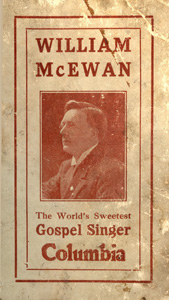
Glasgow man William McEwan, "the world's first great gospel singer", recorded a version in New York in May 1926; the brilliant Virginian singing Baptist pastor Alfred Karnes recorded it in 1927 (download his version free here) and the McCravy Brothers recorded it in 1930.
Saturday, March 20, 2010
A message from North Carolina
(NB: If you're reading this on Facebook, the original post is from my blog). A few days ago I was astounded to receive the following note on Facebook. The irony is that for a good few months now I've been thinking about deleting my Facebook page because people keep inviting me to play games or join causes that I don't really have the time or interest to get involved in, and so rather than risk offence I figured that shutting it down would be a good move.
Then, out of the blue, a complete stranger called Sharon Stewart Wilkerson emailed me from Asheville in North Carolina. For those of you familiar with the content of this blog and the kinds of projects I invest my spare time in, you'll have some idea of how blown away I was by this (reproduced below, unedited, with Sharon's permission):
.........
Mark,
I ran across your personal blog yesterday while searching for more information about the Ulster Scots language, and found a treasure trove. I ended up looking at your other sites and got such a blessing!
My Granny was born and reared on a farm outside Bushmills, County Antrim, and was converted at the age of fifteen in an evangelistic meeting. Her parents were saved through an evangelist at an earlier period. My grandfather, John Stewart, was born in Lurgan and was an orphan by the age of seven. My grandparents emigrated separately to Scotland. My grandfather was saved there and met my Granny. They married in 1904. My dad, James Alexander Stewart, was born in Glasgow and was "fitball daft". The Lord saved him when he was a teen and he became a boy preacher. He preached all over the British Isles as a boy. He met my American mom in Budapest, Hungary where she was ministering under the Southern Baptist. My parents travelled so I did not get to spend a lot of time with them. Dad also founded mission organizations and wrote many books.
I say all that to explain that I when I was with them, Dad read me stories about the Covenanters, and told me all about Revival. (He saw Revival under his ministry as a young preacher in Europe.) He taught me Scottish history and all about the great Scottish preachers etc etc. I also got to spend time with my parents during their meetings. Dad especially loved open air meetings.
I saw that you had "Fu an skailin" listed on your Sacred Scots Songs page. My husband and I still teach it to children along with "Come Awa the Noo". My family knew Seth and Bessie Sykes, as well as "Uncle Charlie' Main. Uncle Charlie was a mentor to Dad and I remember him even participating with Dad in the open air on the beach at Bangor as part of the Bangor Missionary Convention in 1965. Willie Mullan, Ian Paisley, WP Nicholson, Stanley Mawhinney, Herbert Mateer, and many more were part of the dear ones in Ireland.
Well, you see I got carried away! Thanks for posting all the articles, songs, poems etc. I enjoyed them so much! My husband and I live and minister in the mountains outside Asheville, NC, where the people have a lot of Scots Irish in their heritage. (The music!)
Well, "I'll Fly Away" now!
In Christ,
Sharon
.........
A lot of stuff has been written over the past 15 years or so about Ulster and America, much of it about centuries-old Presidents (whose Ulster links, in some cases, are pretty thin), much of it repetitive and very far removed from the common cultures of ordinary people. Sharon's email shows that there is still, alive and well today, a common evangelical faith and culture which spans Scotland, Ulster and America, and that some of the wee songs that I grew up with here in the Ards Peninsula, which had been taught to my parents and grandparents by the "oul Scotch preachers" like Seth Sykes, Charlie Main and Jock Troup, are still being sung today in the mountains of North Carolina.
Friday, March 19, 2010
Enough to start a riot in a Cathedral
(NB: If you're reading this on Facebook, the original post is from my blog). 1637 Book of Common Prayer, Scottish edition. As (not) recommended by Jenny Geddes. On eBay now for $900!
Thursday, March 18, 2010
Patrick at Immanuel Presbyterian Church
(NB: If you're reading this on Facebook, the original post is from my blog). On Monday evening past, I was a stand-in speaker for Immanuel Presbyterian Church PWA (now called Presbyterian Women) on Agnes Street in the Shankill area of Belfast. The speaker who was booked had to go gallavanting off to America last week, so the ladies at Immanuel put up with me instead!
I took a powerpoint along with lots of images but very little text, just as visual aids for the talk. I started (as you might expect) by pointing out a few of the myths and nonsense, then the Scottish stories and legends of Patrick, the Patrick-related placenames in Scotland, the early Ulster-Scots records of Templepatrick near Donaghadee, then onto the similarity of portions of his Confessio and Psalm 40, the Cross of St Patrick flag and its modern applications in logos (like the PSNI badge), Patrick Hamilton the first martyr of the Scottish Reformation and the origins of Scottish Presbyterianism, and finished with the work of Ulster-born hymn tune writer William James Kirkpatrick - "My faith has found a resting place not in device or creed...". A light and enjoyable evening for me, and apparently for the audience too!
Wednesday, March 17, 2010
From Patrick's "Confessio", circa 450AD
(NB: If you're reading this on Facebook, the original post is from my blog). "...For there is no other God, nor ever was before, nor shall be hereafter, but God the Father, unbegotten and without beginning, in whom all things began, whose are all things, as we have been taught; and his son Jesus Christ, who manifestly always existed with the Father, before the beginning of time in the spirit with the Father, indescribably begotten before all things, and all things visible and invisible were made by him.
He was made man, conquered death and was received into Heaven, to the Father who gave him all power over every name in Heaven and on Earth and in Hell, so that every tongue should confess that Jesus Christ is Lord and God, in whom we believe..."
Full text available here.