
Benjamin Franklin wasn't overly fussed about the Ulster-Scots who were filling Pennsylvania. Some have said that he feared the strength of their numbers, and the decline of Quaker control (much of which had been built up by Ulster-born James Logan). A group of them, known locally as the Paxton Boys, had killed 20 Conestoga Indians around 1763. Outraged, Franklin put pen to paper and wrote a famous response entitled A Narrative of the Late Massacres, in Lancaster County, of a Number of Indians, Friends of this Province, by Persons Unknown With Some Observations on the Same (link here). Persons unknown? Hardly, he probably knew them by name. He described the Scotch-Irish as 'the Christian white savages of Peckstang and Donegall'.
Incensed by what he regarded as Franklin's one-sided account of the context and events, a Carrickmacross (County Monaghan) born Anglican itinerant missionary, Thomas Barton (1730-1780), responded with his own publication The Conduct of the Paxton-men, Impartially Represented (link here). He quoted a Quaker member of the assembly for Chester County, Nathaniel Grubb, who in 1755 in an 'unChristian and ungenerous speech' had described the Ulster settlers as 'a pack of insignificant Scotch-Irish, who, if they were all killed, could well enough be spared' (source here). Grubb later denied he had ever said such thing. Barton believed the Pennsylvania authorities had left the Scotch-Irish communities unprotected for many years, and therefore they had a right to self-defence.
Here's the main point for today. He signed it off as follows:
Dated from my Farm-House, March 17th, 1764
A Day dedicated to Liberty and St Patrick.
So in Scotch-Irish frontier Pennsylvania of 1764, St Patrick's Day was being observed.
Friday, March 16, 2012
Liberty and St Patrick, 17 March 1764 - "the Christian white savages of Peckstang and Donegall"


Saturday, January 21, 2012
Update on the US Ambassador's visit to Belfast in March
The recent blog posts on the US Ambassador coming to Belfast seem to have worked - they have attracted attention and a few people have asked if this blog is becoming the Ulster-Scots version of Wikileaks!
The truth of course is that those postings were set exactly 100 years ago in 1912, although I tried to avoid making that too obvious. The launch of the Titanic and the signing of the Ulster Covenant were just two of the big events that year - the newspapers of early 1912 show that the Ambassador's visit to Belfast was another high-profile occasion, and one which further demonstrated the historic and cultural links with Scotland, and also with America.
It seems that he originally planned to be here on 2nd April, the day that Titanic would set sail from the shipyard. Here is the first press release for the event:

It was announced yesterday at a meeting of the Presbyterian Historical Society that the Hon Whitelaw Reid, United States ambassador in London, will deliver a lecture on ‘The Ulster Scot’ under the auspices of the Society in the Assembly Hall, Fisherwick Place, on 2nd or 3rd April next. The Hon Whitelaw Reid has been Ambassador to the Court of St James since 1905, and was Special Ambassador to Great Britain for the Queen’s Jubilee and the Coronation of Edward VII. Being of Scotch Covenanter descent, his remarks on the Ulster-Scot, and the Scotch-Irish pioneers in America, will appeal with special force to an Ulster audience. He is the author of several works on historical and economic subjects. He will be the guest of Sir William Crawford during his stay in Belfast.
- from the Northern Whig, 15 February 1912
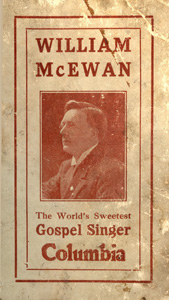
Reid had first given the address in Edinburgh in November 1911 (at the Synod Hall) for the Edinburgh Philosophical Institution. (this was the same month that Glasgow singer-evangelist William MacEwan was in London making what are said to be the first-ever gospel recordings for Columbia Records). Reid's family roots were in County Tyrone - his grandfather was from near Cookstown and his grandmother from near Omagh. So it was natural that Whitelaw Reid should deliver the same lecture in Ulster.
(PS - I hear that there are now thoughts in some quarters to mark the centenary of Reid's visit).

Below is a graphic from Reid's unsuccessful Presidential campaign of 1893, when he ran for Vice-President alongside Benjamin Harrison, who was also of Ulster-Scots descent:

Monday, October 24, 2011
The Latimers: A Tale of the Western Insurrection of 1794 by Rev. Dr. Henry McCook (Philadelphia, 1898)
This post is for Jenny in Alaska. Here are more examples of that Scotch-Irish symbol from the late 1800s. Here's a biography of Henry McCook, and here's a free online edition of the book.


Thursday, June 09, 2011
Lowland Scots, Ulster Scots, Scotch-Irish
'...The Lowland Scots, the Ulster Scots, and the Scotch-Irish of America are, as has been noted, one and the same race, but the two latter branches of the race have had experiences in Ulster and America which have strengthened their character and toughened their native fibre by the very difficulties they have been compelled to overcome... the Ulster Scot in his new environment ceased to be a Lowlander, though the seedbed of his race was the Lowlands of Scotland... he will make one more migration - this time to the New World, where freedom abounds and opportunity beckons. Here, amid new surroundings, he will undergo a further change, and here he will go his farthest lengths and attain his greatest heights. No longer a Lowland Scot or and Ulster Scot, he becomes the Scotch-Irishman of America - still of the same race as the Lowlander and the Ulster Scot, to be sure, but different from either by reason of his adjustment to a changed environment...'
from The Scotch-Irish of Colonial Pennsylvania by Wayland F Dunaway (University of North Carolina Press, 1944) p 26-27
Visit Ulster, Pennsylvania here.
Friday, April 15, 2011
"the invisible ink on the pages of American history"
Good article here on James Webb's recent documentary 'Born Fighting' which I blogged about following the UK broadcasts back in February.
Wednesday, March 09, 2011
Flax Seed and Emigrants
Richard MacMaster's latest book 'Scotch-Irish Merchants in Colonial America' is a great read, and details how flax seed was imported from America (a trade which seems to have begun around 1705 when import laws were passed by government), and how people emigrated on the same ships. This was also something that Senator James Webb's recent two part tv series 'Born Fighting' touched on. My good friend Mark Anderson sent me the image below from one of his recent forays in a local library. It comes from the Newtownards Chronicle in 1916. A beautiful image! Interesting that even as World War 1 raged through continental Europe, Holland was still capable of growing and exporting goods.
• A previous post about the Ulster linen industry's impact upon the Argentinian sugar industry, through the hard work and vision of two Ballymena brothers, can be read here. One of the real paradoxes of Ulster-Scots heritage is how it can be both hyperlocal yet international.


Monday, February 21, 2011
Ole Smoky Tennessee Moonshine
The best packaging design I've seen in years; with thanks to Glen.
"...Our Scots-Irish ancestors brought their knowledge and skills of whiskey-making with them as they came to Appalachia. Conditions in the area were good for growing corn, but it didn’t take long to realize a lot more money could be made off of a gallon of corn liquor than a bushel. Once the law began cracking down on the industry, the nature of our people and the rugged mountain terrain made way for the hay day of bootlegging..."
Visit the magnificently-designed website.

Thursday, April 08, 2010
Johnny Cash - descendant of Scottish Covenanters?
(NB: If you're reading this on Facebook, you can read this post in full on my blog). There's a 30 minute radio programme on BBC iPlayer which I listened to today called "Johnny Cash Of Easter Cash". (click here to listen)
It traces Cash's roots to Easter Cash, near Falkland in Fife, to an ancestor called William Cash (1653 - 1708) who emigrated to Virginia in the 1670s and settled in Westmoreland County, where many Ulster emigrants later settled. Falkland was the birthplace of the famous Covenanter minister Richard Cameron (1648 - 1680). Maybe they were even boyhood friends; lots of Covenanters ended up being sent as slaves to Virginia during the 1670s and 1680s. Johnny Cash visited Falkland a few times, and some of the people he met are interviewed in the programme. Well worth a listen.
RELATED ARTICLES:
> Article "From Nashville to Govan" (with a Covenanter reference)
> Article "Johnny Cash's Scottish Roots Explored in New Documentary"
> Article "Scottish Roots of Johnny Cash - the man in black tartan"
(Pic above of Easter Cash from this article)

Saturday, March 27, 2010
“Scotch-Irish Foodways in America”
(NB: If you're reading this on Facebook, the original post is from my blog). Ulster-Scots food? The usual knee-jerk response to this is some sneering comment about battered Mars Bars, the obvious haggis - or perhaps the glorious egg & onion sandwich! As ever with Ulster-Scots subject matter, in between the scorn - and the trivialisation - there's a deep and important story to be told.
Mary Drymon is an American writer, historian, museum educator and curator who has recently published an important book called “Scotch-Irish Foodways in America”. (I am glad she stuck with the historic term "Scotch-Irish" and didn't adopt the recent "Scots-Irish") She has based the book on the recipes known to have been used by Ulster-Scots emigrants who arrived in Maine in the early 1700s. Mary's research indicates that it was Ulster emigrants who brought rhubarb to America - as was the case with potatoes.
> Here's a brief article about the book
> Here's Mary Drymon's blog
> Buy the book on Amazon
There's a great quote on Mary's blog:
"Don't eat anything your great-grandmother wouldn't recognize as food"

Friday, January 15, 2010
The term "Scotch-Irish", and the Scotch-Irish Society of America
(NB: If you're reading this on Facebook, the original post is from my blog)
"...I have sometimes noticed a little confusion of mind in relation to the phrase "Scotch-Irish," as if it meant that Scotch people had come over and intermarried with the native Irish, and that thus a combination of two races, two places, two nationalities had taken place. That is by no means the state of the case. On the contrary, with kindly good feeling in various directions, the Scotch people kept to the Scotch people, and they are called Scotch-Irish from purely local, geographical reasons, and not from any union of the kind that I have alluded to. I haven't the least doubt that their being in Ireland and in close contact with the native people of that land, and their circumstances there, had some influence in the developing of the character, in the broadening of the sympathies, in the extending of the range of thought and action of the Scotch-Irish people; but they are Scotch through and through, they are Scottish out and out, and they are Irish because, in the providence of God, they were sent for some generations to the land that I am permitted to speak of as the land of my birth..."
- from this address by Rev Dr John Hall (shown here) of New York, 1892.
Hall (1829 - 1898) was originally from Armagh, had been appointed minister of Fifth Avenue Presbyterian Church, New York, in 1867. He graduated from Princeton in 1875, and returned to Ulster in 1890. The following year, he addressed the Scotch-Irish Society of the USA and said "...I never saw the province present such a look of prosperity as it did last year... there was never so much money in circulation in legitimate ways among the people... I was born there and brought up there, and I labored for years in Ulster as a minister...I brought from that country two things that would have a great influence on my life. The first of these is a pronounced conviction of the unspeakable value of a definite religious belief, and the second of these is a wife of whom I am bound to say here that for all these years she has exercised over me that kind of Home Rule of which—[Here the speaker's voice was drowned with applause and laughter]..." So even in 1890s America, there was a high awareness of political events in Ulster! An excellent biography of Hall, written by his son Thomas C Hall DD, is available here:
"...One of the keen pleasures of his life was the recurring conventions of the Scotch-Irish in America. He looked forward with what was for him eager pleasure to these gatherings...it was my father's lot to preach before the convention, and nowhere did he ever feel more completely in touch with his audience than when taking part in the 'old-time meeting' which formed a part of the convention's exercises..." (p 296)
The Proceedings of the Scotch-Irish Society are great bound volumes from the late 1800s and early 1900s. I have two full sets of them I've gathered up over the years, but of course these days they can be found on the Net. Here are the links to readable, text-searchable versions:
First Congress (Columbia, Tennessee, 1889)
Second Congress (Pittsburgh, Pennsylvania, 1890)
Third Congress (Louisville, Kentucky 1891)
Fourth Congress (Atlanta, Georgia, 1892)
Fifth Congress (Springfield, Ohio, 1893)
Sixth Congress (Des Monies, Iowa, 1894)
Seventh Congress (Lexington, Virginia, 1895)
Eighth Congress (Harrisburg, Pennsylvania, 1896)
Ninth Congress (Knoxville, Tennessee, 1900)
Tenth Congress (Chambersburg, Pennsylvania, 1901)
Some of the content has definitely dated and was a product of its time, however there's mountains of very valuable stuff in them too.
(PS - Hall's biography says he was a close friend, when a student for the ministry, of Matthew Kerr, the author of "The Ulster revival of the seventeenth century", published in 1859. Hall himself had reservations about some of the events of the 1859 Revival).
(PPS: The Scotch-Irish Society of the United States of America welcomes membership applications and can be found online here.)

Wednesday, September 02, 2009
It was the Scotch-Irish who introduced the Potato to America
Do you know that it was Ulster emigrants who introduced the potato to North America? In that world famous periodical, the American Potato Journal (June 1967) there's a reference which will astonish many of you:
Scotch Irish bring potatoes to Londonderry (Derry) New Hampshire
The most authentic report indicates that the first Irish (white) potatoes grown in North America were planted in Derry (previously Londonderry), New Hampshire during the spring of 1719 by a group of Scotch-Irish immigrants. That the seed was brought from Ireland may be the reason that the potato was called the "Irish potato".
Read it for yourself here!
And there's even a sign to mark the location:
Further details about one of the sixteen Scotch-Irish familes involved was published in 1890, in the Proceedings and Addresses of the Second Congress of the Scotch-Irish Society of America at Pittsburgh, Pennsylvania, May 29 to June 1, 1890 in an article entitled Scotch-Irish in New England by Rev. A. L. Perry, Professor of History and Politics, Williams College, Williamstown, Mass.

"...the most interesting of the purely Irish families, who came with the Scotch to Worcester, with whom they had contracted relationship during their long residence in Ulster... was the Young family, four generations together. They brought the potato to Worcester, and it was first planted there in several fields in the spring of 1719. The tradition is still lively in Scotch-Irish families (I listened to it eagerly in my boyhood) that some of their English neighbors, after enjoying the hospitality of one of the Irish families, were presented each on their departure with a few tubers for planting, and the recipients, unwilling to give offense by refusing, accepted the gift; but suspecting the poisonous quality, carried them only to the next swamp and chucked them into the water.
The same spring a few potatoes were given for seed to a Mr. Walker, of Andover, Mass., by an Irish family who had wintered with him, previous to their departure for Londonderry to the northward. The potatoes were accordingly planted; came up and flourished well; blossomed and produced balls, which the family supposed were the fruit to be eaten. They cooked the balls in various ways, but could not make them palatable, and pronounced them unfit for food. The next spring, while plowing the garden, the plow passed through where the potatoes had grown, and turned out some of great size, by which means they discovered their mistake. This is the reason why this now indespensable esculent is still called in New England certainly, and perhaps elsewhere, the "Irish potato."
John Young was perhaps the oldest immigrant who ever came to this country to live and die. If the inscription on his tombstone is to trusted, which the American Antiquarian Society, of Worcester, copied and published many years ago, he was ninety-five years old when he landed at Boston. He lived in Worcester twelve years, died in 1730; was buried in the old yard on the common. His son, David Young, an old man when he came, died at ninety-four years, and was buried in the same place. His son, William Young, a stone cutter by trade, erected over their graves a common double headstone, with the following inscriptions in parallel columns, united at the bottom by the rude yet precious rhyming lines:
"Here lies interred the remains of John Young, who was born in the isle of Bert, near Londonderry, in the Kingdom of Ireland. He departed this life, June 30, 1730, aged 107 years.
Here lies interred the remains of David Young, who was born in the parish of Tahbeyn, county of Donegal, and kingdom of Ireland. He departed this life, December 26, aged 94 years.
The aged son, and the more aged father
Beneath (these) stones their mould'ring bones
Here rest together."
Any help in finding out more about the other families would be much appreciated. This webpage says that "...Some names found in the early community are: James McKeen, John Barnett, Archibald Clendennin, John Mitchell, James Sterrett, James Anderson, Randall Alexander, James Gregg, James Clark, James Nesmith, Allen Anderson, Robert Weir, John Morrison, Samuel Allison, Thomas Steele, John Stuart. They paid no money for their land as it was a free gift from King William..."
Wednesday, August 12, 2009
Eck Robertson playing "Sally Gooden" - June/July 1922

"...Recorded on June 30, 1922 or July 1, 1922 in New York City. Although it is indeed possible, if not likely, that country or hillbilly performers had been recorded earlier, these sessions with Texas fiddler Eck Robertson are the earliest documented recording sessions of a country performer. The recordings were not released until about a year later. "Sally Gooden" is another ubiquitous old-time fiddle tune that is rivalled only by "Soldier's Joy" in popularity..."
Here's a post from earlier this year about Ulster-Scots music and the fiddle playing tradition.