Personal blog of Mark Thompson. Formerly Managing Director of GCAS Design in Belfast, Northern Ireland (from 1999 - 2006) and Chairman of the Ulster-Scots Agency (from June 2005 - June 2009). Thoughts on Ulster-Scots heritage, identity, evangelical Protestant faith, music and other stuff I stumble upon.
"... the Ballymascanlan Volunteers who six months ago were all United Irishmen are now complete Orangemen..."
When researching the Henry Thomson booklet I posted about recently, I came across this reference in a book about his relatives, the Thomsons of Ravensdale in County Louth. It will come as a shock to some, but it is a perfect example of how the 'prism' of nationality can't comprehend the priority of community.
There are similar examples I know of in the area around Saintfield and Ballynahinch where former 'Volunteers' became 'United Irishmen' - but after the battle defeats of 1798 they then (unthinkably for some) became members of new Orange lodges in the locality, uniting again with their neighbours. Why? Because community matters. The people you live with, work with, and rely upon, matter more than an ideology.
When specific moments from the past are homed in on, usually through a desire to make those moments relevant to the present, very often everything that happened in between has to be ignored, especially the things that are complex and inconvenient. But in doing so in the pursuit of simplicity, what happens is that the fuller, complex, community story is not explained or understood.
Back on 21 June was the 300th anniversary of the town of Londonderry, New Hampshire, being awarded its charter, having first been established by Ulster-Scots emigrants in 1719. An image of the surviving 1731 duplicate version is on this website.
This is from Adam Lynn's collection Random Rhymes. Despite 'the system' in Northern Ireland doing almost everything it can to equate Ulster-Scots with modern-day Unionism, when you bother to actually read authentic Ulster-Scots literature you will struggle to find much of any overtly Unionist content.
The writers are almost entirely about community rather than nationality, and any indications of the concept of nationality is defined by their lived experiences of community first. This poem isn't high art, it's an account of a typical community 12th July.
Attempts to skew Ulster-Scots into the binary political framework of Ulster Unionism or Irish Nationalism will fail. You might actually perceive glimmers of both, even within the same piece of writing, because it's far more organic than our restrictive present-day categories (see 2019 post about Adam Lynn here and a July 2020 post, again about Adam Lynn, here). It's good for everybody. If only the policy-makers bothered to understand.
You can extend this beyond our own narrow context – to emigrant America and the Revolution of 1776, you'll read writing that is pro, and writing that is unsure, and writing that is against.
There's always a broader, fuller, picture.
Challenge your own categories. Read the literature. Community first.
The best stories are the most surprising ones! Last week this 52 page booklet was launched, telling the long-lost story of "Henry Thomson & Co.'s Old Irish Whisky, Newry, Ireland".The pic shown above where this quest all began – the 1920s / 1930s bottle that's part of the street window display at Grace Neill's in Donaghadee. It first caught my eye many years ago when walking past. The surname was part of the attraction, and so about 5 years ago I started to dig into the story. And dig. And what a story it has turned out to be.
.............
Henry inherited his father's business in 1859, a lucrative wine and spirits merchants in Newry. Their 1860s building is in Trevor Hill still today, designed by architect WJ Barre. It looks a like a miniature version of another more famous building Barre designed at the same time – the Ulster Hall in Belfast.
Henry served a 5 year term as a Unionist MP from 1880–85, was a prominent Orangeman (becoming Deputy Grand Master in 1911) and was well-respected right across the community in his day. There are multiple newspaper reports of his generosity and kindness - "taking men as he found them, and judging them by their deeds and not their creeds".
A few miles south of Newry, at Ravensdale in Co Louth, a branch of the Newry Thomsons had set up a major linen business in the 1700s. In their family collection was a buffalo leather coat worn by King William III at the Boyne, given to them by one of William's senior soldiers. It is now on public display in the collection of County Museum, Dundalk.
For 30 years Henry Thomson & Co.'s Old Irish Whisky was marketed as 'The Finest Whisky in the World'. It must have been good as it was awarded a Royal Warrant in 1892, the first Irish whisky ever to be granted one.
In 1904 it was Henry's whisky fortune that saved the 'Sham Fight' at Scarva when he bought Scarvagh Demesne, and also funded the building of Scarva Orange Hall.
His whisky was sold around the world well into the 1930s – in that decade in New York the Rockefellers opened a swish new restaurant 'La Maison Française' in Manhattan, fronted by Parisian celebrity chef Henri Charpentier, which served Henry Thomson Old Irish Whisky. And 40 years after Henry's death, the Newry newspapers were still saying positive things about his legacy. The brand name continued in various forms in the Newry area right up to the present day.
Henry was buried in the family plot at St Patrick's in Newry, alongside his Presbyterian brewery owner in-laws the Henry's. At the base of the triple gravestone is the classic Ephesians 2 text "By grace are ye saved through faith, and that not of yourselves, it is the gift of God".
Sincere thanks to everyone who contributed personal and private content and trusted me enough to allow me to include those. The final booklet is 52 pages packed with the best content I could fit in. Lots had to be left out, and more content is still coming forward - so maybe there might be a second, expanded, edition in future.
.............
I'll be sending everyone who has helped me assemble the story a copy by post pretty soon. For everyone else, *free* copies should be available (while stocks last) from:
• Bagenal's Castle in Newry • Museum of Orange Heritage,Belfast • County Museum, Dundalk
In August, A.D. 1595, the Lord Deputy encloses a letter to Lord Burghley, which exhibits the disturbed state of the Ards neighbourhood in that year:—
Rowland Savage to Captain Izod:
Worshipful good captain, whereas your worship desired me to send you all the news of the Scots. All the news I can learn your worship shall know it. The whole army is as yet at Copland Islands, and the Queen's ships keep them in there.
There was six gallies that was coming after them; the Queen's ship met the five gallies and sunk two of the gallies, and took two of them, and the other ran ashore and saved their men.
The Earl of Tirone came not to Clanaboie as yet. The soldiers of Knockfergus came to help the ships with all the barks and boats of the town, and what news we get I will certify your worship from time to time. No more unto your worship at this time, but God have you in his keeping.
From Strangford this present Tuesday, Strangford, August I.
……….
From p114 & 115 of The Savage Family in Ulster by George Francis Savage-Armstrong (1906)
Eudox: I wonder, Irenius, whether you runne so farre astraye; for whilst wee talke of Ireland me thinkes you rippe up the originall of Scotland; but what is that to this?
Iren: Surelie very much, for Scotland and Ireland are one and the same.
Eudox: That seemeth more strange; for wee all knowe right well that they are distinguished, with a greate sea runninge betweene them; or else there are twoe Scotlands.
Iren: Never the more are there twoe Scotlands, but twoe kindes of Scotts there were indeede, as you may gather out of Buchanan, the one Irine or Irishe Scotts, the other Albyne Scotts; for those Scotts or Scythians arrived, as I supposed, in the North parts of the Island, where some of them afterwards passed into the next coaste of Albyne, nowe called Scotland, which, after much trouble, they possessed, and of themselves named yt Scotland; but in process of tyme, as is commonly seene, the denominac[o]n of the part prevailed in the whole, for the Irishe Scotts puttinge away the name of Scotts, were called only Irishe, and Albyne Scotts, leavinge the name of Albyne, were called only Scotts. Therefore yt cometh of some wryters, that Ireland is called Scotia-major, and that which nowe is named Scotland, is called Scotia-minor.
Eudox: I doe nowe well understande your distinguishing of the twoe sortes of Scotts, and twoe Scottlands, howe that this which is nowe called Irelande was auncyently called Erine, and afterwardes of some wrytten Scotland, and that which is nowe called Scotland was formerlie called Albyn, before the cominge of the Scotts thither: But what other Nations inhabited thother partes of Irelande?
In 1315 Sir Robert Savage of Ardkeen was one of the many Anglo-Norman lords who fought the invading Bruce armies which had landed at Larne that year. A generation later, after the Bruce failure, Sir Robert embarked upon a major building programme in 1342, but was chastised by his son Henry who astutely told him that people are far more important than buildings:
“better a castle of bones than of stones; where strength and courage of valiant men are present to help us, never will I, by the grace of God, cumber myself with dead walls…”.
I recently needed to seek out a source from 1616, which was mentioned in a secondary reference of 1867. The primary source was the Chancery Rolls for 1616. Disastrously, they were all destroyed in Dublin in 1922. Find out more here.
"When Dublin’s Four Courts went up in flames on June 30th, 1922, seven centuries of Ireland’s historical and genealogical records, stored in a magnificent six-story Victorian archive building known as the Record Treasury, were lost. In one afternoon, hundreds of thousands of English Government records concerning Ireland, dating back to the 13th century, were destroyed - seemingly forever." – from IrishCentral.com
'...In the country districts around Belfast, and probably in other parts of Ireland, there is an old and popular method of treating a complaint occurring on edge of eyelids popularly called "a sty" or "stihan" i.e., by puncturing, or pointing at the little abscess with a thorn yet firmly believed in by the peasantry. I have never been able to discover the origin of this method of treatment. Why the thorn should always be that of a gooseberry bush is peculiar. Sometimes one from an ordinary white thorn is used, but the former is preferred, and said to be more efficacious, especially so if the "sty" be pricked through a gold ring. In County Down, a gooseberry thorn is pointed nine times at the "sty" quite close, but not touching, and then the thorn thrown over the left shoulder...'
Why even bother with a blog? Maybe for these reasons. I really like a lot of Ryan Holiday's outputon his various Daily Stoic channels, even though I have never journalled. Maybe blogging is as close as I'll get to that.
I usually avoid the news but occasionally I get drawn back into it. Perhaps it's a symptom of being 50, but it is strange to me to have lived through what is now 'history', to remember it as having been 'real time' life, and to wonder why those whose job it is to commentate upon it appear have such a limited grasp of it, or at least to daily observe that they recite an edited, redacted, version of it. Wikipedia gets criticism but, to understand why Northern Ireland politics is in the news yet again, a quick scan over the period 1998–2007 here would be of benefit. Then go digging and ask why those various suspensions and issues arose. You'll need to dig pretty deep because it seems that hardly anybody explains anymore. Figuring out where you're at is much easier when you retrace how you got there. To co-opt a famous slogan from 1798 and apply it to events two centuries later … Who dares to speak of '98 – 2007?
Three friends have told me about this, and it is excellent. See how ideas of ancient history were selectively mined and appropriated to construct notions of identity in 1930s Ireland. I am delighted that the renowned Estyn Evans' work comes across in it so well. It can't have been easy for him to swim against the well-funded tide. An essential watch, see it here on iPlayer. Much to think about.
When you read all the best accounts of the 'colonial' era in America, you soon see a common thread that the people's loyalty was first and foremost to their community. A coalescing and coming together of the common interests of those communities – Charles Augustus Hanna reckoned there were 500 Scotch-Irish communities in the original 13 colonies – then becomes a nation. And a nation which then, after 1776, became a new state. Communities carry values, traditions, continuity - regardless of their geography or who their governing administrators are. We would do well to remember that momentum, when looking at Ireland's past, present and future. A bottom-up community-first perspective is the most effective way to understand. Imposing a top-down, nation-first mould makes little sense.
... So says Darryl Cooper at 1hr 04minutes in this fascinating podcast about the origins and context of what he calls "the conflict between Israel and Palestine".
The world of Americana music has been very excited by the apparent reformation of the Oklahoma cult band the Turnpike Troubadours. They've been on hiatus for all sorts of rumoured reasons. The unrivalled quality of their music, which has been featured on the TV series Yellowstone, is why there's such excitement –
The Ulster-Scots Agency published a booklet back on St Patrick's Day which I authored, the culmination of many years of assembling scraps and references to the once-familiar orthodox story of Patrick's Scottish origins. Here is another reference that I found over the weekend. So much of the past generation of Ulster-Scots growth has been about recovering almost-lost knowledge and traditions. For two generations the community had neglected its own heritage, abandoned much of it, saw little value in it – but also, Northern Ireland's 'officialdom' had decided to marginalise and deride it. Hopefully the forthcoming generation will put it all to good use.
When visiting our oldest son in Glasgow last weekend, I took off on a walking tour while he was doing some work, and made my way along Sauchiehall Street and up to Glasgow School of Art to see how the refurb and rebuild is going, following its two devastating fires of 2014 and 2018. My recent post from back in February tells some of the story of how I was offered a place there back in 1991, and even though I didn't take up the offer, those magical weeks when it nearly happened will always have a special place in my heart and memories. Some pics below.
As with Belfast, Glasgow is frequently pigeonholed as a place of heavy industry and working class blue collar attitudes. These are true, but the ease of that stereotype disguises the diversity, creativity, artistic and craft traditions of both cities.
These short videos are a great way to explore the history of our landscapes. The clear evenings are back, so why not get out there? Graham has done a great job here, and it's always brilliant to see and hear Charlie Gillen.
This map was posted on Facebook this week, on the We The Irish - Podcast page (click here). No source is given for the atlas this is from, but the key bottom left says that stats are from the 1881 census, and also the 1897 work of EG Ravenstein in On the Celtic languages in the British Isles: a statistical survey, Journal of the Royal Statistical Society (1879). As has been mentioned here over the years a few times, the language answer as self-completed by respondents on the 1901 and 1911 census, which has been quite recently visualised and mapped by Barry Griffin, is way out of kilter in east Ulster.
None of these historical administrative ventures or mapping projects allowed for Scots being distinct from English, so its linguistic existence gets lost, divided, or even misinterpreted. We have a trilingual society, but for centuries we've only had a bilingual bureaucracy.
"Thus, by easy steps, we go from St. Patrick to lona and the Culdees and Knox in Scotland, and to Switzerland, with its Zwingli and Geneva, and to Germany and Luther. Germany, which now leads the world in scholarship, was content to receive its first schools from humble Scotch-Irish itinerants."
– Prof George Macloskie D.SC, LL. D. (1834-1919) was Professor of Biology in Princeton College. This quote is from his address 'What the Scotch-Irish Have Done For Education', which was given at the first Congress of the Scotch-Irish Society of America in Columbia, Tennessee in 1889. He was born at Castledawson, and was ordained as a Presbyterian minister in 1860. He was minister of Ballygoney near Magherafelt from 1861–1873. Pic below of Macloskie is from this website
Presbyterians get almost all of the Ulster-Scots attention. But the story and sources are much wider than that. A biography of Rev Hans Morrison (1836–1898) was published in 1899, written by Rev John Coulter of Glastry Methodist Church between Ballyhalbert and Kircubbin. Morrison's ancestry was at Killinchy on his father's side, and Cloughey on his mother's. Hans was born at Echlinville townland near Rubane in 1836. The colourful introduction is a brilliant social study of the area at the time, which includes another description of the language spoken, from Donaghadee to Portaferry which was where Morrison toiled –
"... the Ards is a thickly-populated district of country. Scottish characteristics in dialect, &c, prevail amongst the inhabitants, chiefly around the eastern coast ..."
If I recall correctly, there's a reference in John Wesley's diaries to him trying to preach in east Down in the mid 1700s, but struggling to do so effectively because the people spoke 'Scotch'.
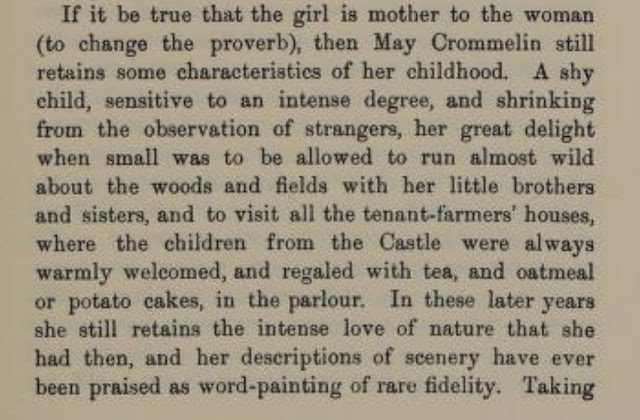
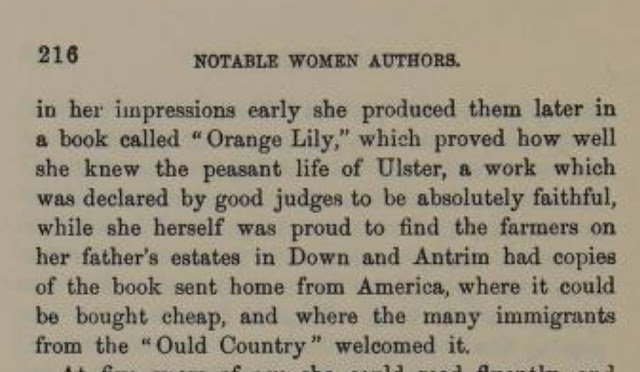
Anyone with a genuine interest in the local heritage of my part of the world will inevitable, naturally, encounter Ulster-Scots. I've mentioned May Crommelin (1848–1930) here before. I picked up a rare original edition of her 1887 novel Dead Men's Dollars last year, a story of a famous Copeland Islands shipwreck and the recovery of its gory booty.
Her recently-reprinted 1880 novel, Orange Lily, is largely autobiographical (online here) with characters who she says 'spoke as broad Scotch as their ancestors did'. This is almost identical to Alice Milligan's 1898 description of Donaghadee, just a few miles up the coast, where the locals spoke 'broadest County Down Scotch'. These two extracts are from an 1893 interview with May Crommelin, in a book entitled Notable Women Authors of the Day –
Below is a circa 1930 photo of my grandfather William Wilson's childhood home at Ballyraer / Ballyrawer (today the Woburn Road), viewed from within the Crommelin's 'plantin'. His brother Henry and sister Rhoda are the weans.
Here's another excellent, mainstream, source for the degree of Scots language usage in County Down just about 100 years ago. There are so many similar sources, someone really should collate them all. In 1924 my grandfather William Thompson was 23, my grandmother Madge Coffey was 13 (they married in 1937); my grandfather William Wilson was 18 and my grandmother Molly Hamill was 6 (they married in 1938). The linguistic world they all grew up in was 'purely lowland Scotch'.
There are umpteen different theologies within Christianity. Being open to learning new perspectives from other traditions is very important, what some of my Presbyterian friends have called "light from any quarter". Over the past while I've been listening/watching Theocast, a podcast style discussion between two Reformed Baptist pastors in greater Appalachia – Jon Moffit and Justin Perdue – which has an orthodox Lutheran twist and natural connections with the fine work being done at 1517. Even though these guys are American, their social-cultural context is very relevant to a Northern Ireland evangelical audience who might be looking for something deeper and truer. Their content is excellent – highly recommended if you want to find a theological framework which has assurance, peace and rest at its core. Their website is here, and here's one recent example –
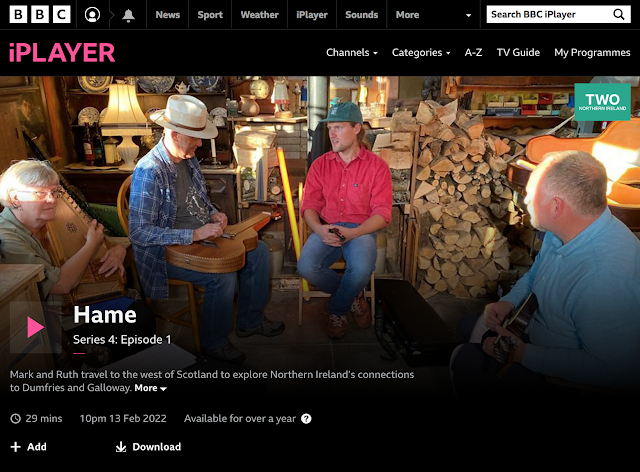
The first episode of the new three-part series of Hame was broadcast last night, on BBC2 NI. You can catch it on iPlayer here. The genesis of the idea for taking the fourth series of Hame across the water to Scotland was very much in the BC era, ie 'Before Covid', but the specific content and approach was all developed during those various 2020 lockdowns and restrictions, and filmed in September and October 2021.
At the very early stages of that process, I reminisced about my own visits to Scotland from childhood onwards, and in particular I revisited my old Art College era diaries and scrapbooks from a moment in 1991 when I very nearly moved to Scotland to study – this post is me capturing some of the memories and notes from then. Looking back, April and May 1991 were when my life crystallised.
• Belfast, September 1990 Art was my only significant A-level achievement, in an era when nobody took it seriously, and long before the term 'creative industry' appeared in our culture. I actually got the joint highest A level Art result in Northern Ireland in my year – thanks to the colossal support of my art teacher, Judy Parker, for her four years of nurturing whatever latent talent I had. I have a fancy certificate somewhere, and was invited to a fancy reception at Stormont one night, and also some other Saturday morning reception that I can only vaguely recall now. These high-falutin things have never really interested me, and I'm only saying them here for completeness of this story. And, at age 50, it's as relevant now as my Cycling Proficiency Certificate or my 25m swimming badge.
If the art thing didn't work out I was going to be a building site labourer on jobs with my dad for a while, which is what I did every summer anyway. I had an interview for a Foundation Year at the University of Ulster's Faculty of Art and Design at York Street in Belfast, in which one tutor was very positive about my portfolio of work and gave me his office phone number if I had any queries – but at the end of the interview the other one glowered at me and said "you'd better shine boy". So I got a place and did that course between September 1990 and June 1991. I did really well in that year, towards the end of which I applied for my subsequent three year degree in various colleges. I always knew I wanted to eventually get a job in a design practice or advertising agency in Belfast, but going away and being independent for a while was appealing. London was an option and I had a pre-interview lined up with Central St Martin's (I had to courier my portfolio there for them to review and shortlist from) but my accommodation option there fell through at the last minute, so I dropped it from the list of contenders and had my portfolio returned to me. My other options were colleges in Scotland, or to remain in Belfast.
• Glasgow, March 1991 The Glasgow School of Art interviews were held in early March 1991, and I headed across with another student from my year group, Eamonn. We spent a few days there and really enjoyed the historic School and the general Glasgow experience. The tutors there 'got us', they understood Belfastness, and in my interview they bantered with me that I looked a bit more normal in real life than in my passport photo (which was attached to my interview application form) which they said made me look like I'd just been released from Crumlin Road jail. Eamonn had friends in the city so we visited some well-known hostelries and eateries, such as the Horseshoe Bar and Sannino's, and were given flyer invites to an intriguingly titled "ceilidh/rave" and also to a 'Dance Classics Night' at a place called Tin Pan Alley. The American alternative rock band Jane's Addiction were playing at Barrowlands when we were in Glasgow (8th March), but we didn't go to see them. I had time to kill one afternoon, so I visited the famous stadiums of Ibrox and Parkhead (where I was given a private tour by a security guard). Glasgow was very plausible as a destination as my mum had cousins who were living in Rutherglen and, if I got offered a place, they were going to put me up in a spare room for a while until I got settled in the huge city.
• Dundee & Edinburgh, April 1991 The interviews for Dundee Duncan of Jordanstone College of Art & Design, and Edinburgh School of Art, were about 6 weeks later in late April. Around the time that I boarded the ferry to travel to those, the offer letter from Glasgow arrived. I couldn't believe it, as Glasgow was, and still is, one of the most renowned art colleges in Europe. I have joked a few times that, aged just 19, it was like being asked to sign for Real Madrid. Here it is – dated 18 April 1991 – but with only one week to accept the post "otherwise it will be offered to another applicant". So time was ticking, but during that very same week I was travelling across Scotland to two other art college interviews, in an era with just letters and landlines – no mobile phones, no email, no ability to communicate quickly.
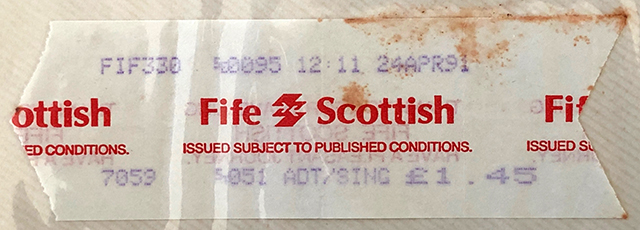
From Stranraer I headed across Scotland by train towards Dundee. I met up with schoolfriends who were at St Andrews University, enjoyed a day & evening there with them (a tour of the town and the Cathedral grounds, a meal in the campus canteen, a Christian Union 'small group' meeting which I think took place in a flat overlooking the famous golf course, and then what I think was this Ken Russell horror movie at the town's famous small cinema). I slept on somebody's floor that night, and had an early start the next morning to get a bus across the Tay to Dundee. The interview in Dundee went really well, the college was great, and whilst I can't find the letter just now I remember that they did offer me a place. It's the city of my childhood cartoon strip heroes Desperate Dan and The Broons, and to be an aspiring illustrator/designer there was a pretty exciting prospect. A couple of days later and the same happened in Edinburgh - a positive interview and a place offered. Not sure which journey this bus ticket is from, but it's dated 24 April 1991.
So Scotland was looking really good, three very appealing options on the table, lots of positive reasons to go.
But what I didn't reckon on was a friend who was already at a university over there, telling me very directly, in person, during those few days of travelling, as we were saying goodbye before I headed off on the next leg of my journey, to absolutely not come to Scotland to study – "don't come here...".
It was quite the bombshell. Perhaps there was a good reason, a well-intended reason – or maybe not. Whatever it was, there was no time to get to the bottom of the issue – again, with just letters and landlines there was no way to communicate quickly. I was in a race against time.
• Staying in Belfast So, more than a little baffled by that, I left Edinburgh on the 15:26 from Waverley Station, via Glasgow Central and Ayr, to board the last ferry out of Stranraer at 21:45 on 25 April 1991. I landed back in Belfast just after midnight on Friday 26 April, which was the day that I needed to confirm with Glasgow, in writing, which required the near-impossible task of finding a fax machine somewhere near home. A week later on Friday 3 May 1991 I had a written offer from Belfast. So with all of this swirling around I decided to stay in Belfast, there just wasn't time to do anything else or to figure out what those "don't come here" remarks had all been about. They had seemingly derailed my hopes, but Scotland just wasn't meant to be. There were bigger plans than mine.
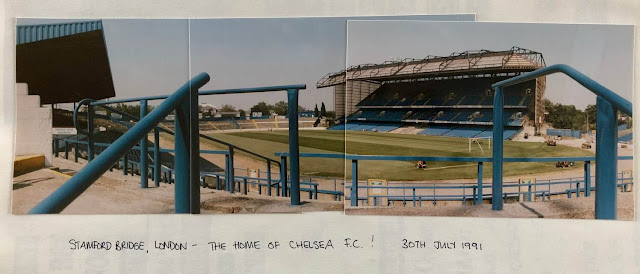
So I got stuck back in and completed the Foundation course in Belfast, got the grades I needed to start the degree course, and then headed off to France in July for a three week church team thing in Marseille – still in a bit of a daze from all the art college stuff, but now knowing that my next 3 years were committed to being in Belfast. On our way back home from Marseille we stopped in London and Windsor for a couple of days, and visited here:
Yes that's me at a very primitive Stamford Bridge. I spent most of that August helping to re-slate the roof of a huge old local farmhouse, and then started the degree course back in familiar Belfast in September 1991.
• Things do work out What I didn't know was that, hundreds of miles away in the south of England, pretty close to the Windsor we had stopped off at on our way home from France, a super-smart girl of Scottish and Ulster-Scots ancestry had decided to scrap the plan to follow her parents' footsteps to study at Oxford or Cambridge – but to take a year out to do charitable voluntary work in Africa and India, after which to pursue her craft skills via a Fine Craft Design degree at an art college. Lo and behold the best courses for that back in those days were at Glasgow School of Art and University of Ulster Belfast. She applied to them both and had an offer from both. She chose Belfast, and arrived in late September 1992.
I first spotted her at the annual beginning of term fire drill, on the morning of 30 September 1992, thanks to her red cardigan. Eventually we got to know each other, and we started spending time together in February & March 1993 (two years exactly after my ill-fated jaunt around Scotland).
Almost exactly five years later, on 26 September 1997, we were married – meaning that this year we'll be 25 years married, our 'silver' anniversary. Her mum spent her childhood at Comiston Drive in Edinburgh; her dad's ancestry is from Pitmilly just outside St Andrews, via Portaferry. Over the years we have spent a fair amount of time in Scotland, with our three now adult children. We have the red cardigan in a box frame on the wall at home.
I am certain we were destined to meet at an art college, whether in Glasgow or Belfast. Back in 1991 I would have really liked to spend three years in Scotland. But things work out as they are meant to.
I used to think that ideology governed behaviour, eg "everyone in that group, all think X, and all behave the same way". Later I came to understand that it's far more the case that individual personality governs behaviour. All 'groups' have a variety of individual personality types within. Not everyone complies with the 'head office' policy of the 'group' they are imagined to belong to. Each individual doesn't belong just to one group, but to dozens, scores, maybe hundreds.
It tends to be the loud and controversial ones within a group who shape the wider perceptions of that group. Their loudness and controversy attracts further attention, which can become media coverage, and suddenly that entire group is framed by the behaviour of the adversarial few.
Social media is still a very new phenomenon as a human experience. Again, I have come to see that, even though groups and tribes appear to form online along ideological lines, it's the personality that governs the behaviour of the individual.
I have met people who are fairly adversarial online – but paradoxically very quiet, conflict-averse, almost introverted, offline. This reminds me of some preachers I knew when I was a boy, who were comfortable when ranting at their listeners from the distance of the pulpit – or, in the open air setting, occasionally haranguing strangers who were passing by – but who were terrible at a normal, relational, one-to-one conversation. Unable to explain, unwilling to listen. Inclined towards pronouncements and denouncements.
I've been lit on a few times online over the years (for pretty innocuous posts, which to my surprise riled others) by people from right across the spectrum – theologically from the traditional to the liberal, politically from the conservative to the progressive. Sitting back to reflect on those mild attacks, even though their ideologies were poles apart, their behaviour and personalities were all very similar. A bit superior, fairly authoritarian, certain of their rightness and happy to disrupt relationships.
My late mother always said 'tak folk as you fin them', ie treat everyone as an individual and respond to how they behave. Personality, and how you behave, is more important than ideology.
.....................
In the early 2000s I did some collaborative work with a huge design consultancy group in London. Over dinner one evening their MD told me that when they were recruiting into any senior executive staff position (which London was full of applicants for), the firm's main interest wasn't experience or talent – when they shortlisted down to the last few candidates what clinched the deal was psychometric testing. They needed to find out what sort of person they were potentially about to bring into the organisation.
• Galatians 5 v 22-23: "But the fruit of the Spirit is love, joy, peace, longsuffering, gentleness, goodness, faith, meekness, temperance: against such there is no law."
A while ago I took part in a one-hour community event not far from where I live, giving a presentation about two centuries of published Ulster-Scots flavoured poetry and songs from our own locality – some quite 'dense' and some quite 'light' – aimed at a very general audience and all just intended to be a good evening's crack and to show how rich local tradition actually is.
At the end of the night a man in his late 60s came over, confused-looking, and asked "But isn't this all just political?". I have no idea who he is. Evidently his body was in the room for the duration, but his head was seemingly in a different room entirely – or else it was functionally unable to process the presentation, which showed a non-political local cultural richness. The shock of the bright daylight realisation that politics isn't the only way to perceive our local world had forced him to retreat back as fast as he could into that familiar, yet dark, shell.
The constant diet of two-dimensional adversarial politics reinforced and institutionalised across all of Northern Ireland society has, for the last 50 years, irreparably forged a mindset beyond which many people are unable to think. I have been shocked to see seasoned academics online in the past few days peddling two-tribes adversarial nonsense. Dismissing the cultural prism. 2D political thinking, not 3D cultural thinking. But maybe for some people their careers have been forged on the 2D and their salary relies upon it.
What is exciting though is that that narrative is not the full picture. There are at least three cultural traditions here. And there is a new generation growing up who are unshackled by local parochialisms, not immersing themselves in the type of current affairs journalism which perpetuates that binary. The younger people aren't so obsessed with the old divisions, they live in more interesting and truer Ulster, and with a far bigger, connected, diverse and open world within their reach.
I was involved in these two programmes, and I make a brief appearance in each, as do some of my friends in our Ulster-Scots cultural world. Our connections with Scotland are endless, and are expressed in so many walks of life. These are two of my favourites – food and music! Both programmes are currently on BBC iPlayer.
This is a big year for us. I will be 50 very soon, and in September we will be marking our 25th wedding anniversary. Our 1997 honeymoon was a roadtrip through Appalachia, from Washington DC to Nashville Tennessee. Part of that included the Museum of Appalachia Homecoming Festival at Norris, Tennessee. It was there, in one of the huge barns full of local artefacts, that I first spotted a cross-stitch sampler bearing the message 'Gang East, Gang West, Hame's Best'.
Some months later I wrote to the Museum's director, John Rice Irwin, who I had met and spoke with on our visit, to ask him a few questions (update – John Rice Irwin died just two days after I posted this, on 16 January 2022). I re-found his reply to me recently –
At first I thought the sampler was a local one-off, but over the years since I have located more of these samplers, and two of them hang on the walls in our home, so it must have been a mass-produced 'kit'. To spot Scots or Ulster-Scots in Appalachia wasn't a huge surprise, but it was a huge affirmation of the stories I had been reading back then in the books by Billy Kennedy, and others. During the Festival Billy and others from NI were present, and he arranged for my wife and I to be invited onstage by John Rice Irwin, in between musical performences, to be introduced to the cheering thousands of people there as "the honeymoon couple from Northern Ireland".
That was 1997. So in 2002 we went back, with my parents and our young son Jacob. It was my parents' first and only time outside the British Isles. It was another superb trip. So much of Appalachia, and its people, felt very much like being at hame.
PS: Here is a photo of John Rice Irwin, from the Museum of Appalachia's Facebook page, which they posted along with a lovely obituary:
This story got more coverage again over Christmas. Lots of us are still scratching our heads at some of the claims, or some of the conclusions. Here's a link to a subsequent, fresh, Facebook discussion by Barry Griffin who was the first to map the scale of the mysterious phenomenon in 2019, and whose maps I have posted here previously. As with all avenues of life, 'Irish' as an adjective does not only ever mean 'Gaelic' or 'Gaeilge'. We visit my in-laws in England many times each year – where on a recent visit my children were recently told "oh you all speak so Irish". Barry's maps are the key to unlocking the East Ulster, predominantly Antrim and Down, linguistic enigma, and he made a lot of sense in the Facebook conversation. There are plausible explanations for the widespread 'scoring out' on the forms, and Barry's maps show the vast extent of that. The people of early 1900s pre-'Partition' Ulster would have had a far more holistic notion of what it was to be 'Irish' than many do a century later. Ireland is an island of cultural and linguistic variety. Our story is complex.
This is a repost having been re-immersing myself in the Ernest MilliganUp Bye Ballads recently, and at the same time noticing the constant 'dialling up' of the rhetoric on this island, with a lot happening politically this year. All the voices I hear (when I occasionally catch the current affairs media) want to win power through an election or referendum – none of them seem want to build a society first. This is a review from the Dublin newspaper Freeman's Journal and National Press on Burns Day, 25 January 1908, expressing its shock that it transpires there are three traditions in Ireland –
...In these days, when the chief city of Ulster and many towns and country districts all over it are become working centres of the Gaelic revival, a book of verse like this will almost come as a shock to the Irish-Ireland reader.
He has been busily working for the de-Anglicisation of the Irish nation, looking forward to an era when the West British shoneen will be extinct, end behold here is reminder that there exists within the borders of our island a country population which is not West British nor shoneen, which has not got to be de-Anglicised, for the simple reason that its speech is not English, as we know it, but Lowland Scotch.
The people speaking this tongue are to found mainly Antrim, Co. Down, but also on extensive tracts of land in the North-West, coming right against the Gaelic frontier of Tir-Conal, in the Laggan district, it is called, in Donegal.
But let not the Irish-Irelander brand those survivors of the Ulster Plantation as aliens and foreigners. This Scotch-Irish dialect, so ragged and almost distasteful to our hearing, was the speech of men who stood side by side with the Northern Catholic Gaels on the battlefields Antrim, who camped on the wooded height of Ednavady, and lined the ditch behind “Saintfield Hedge in the County Down.” was the mother tongue James Hope, and the congregations of those United Irish Presbyterian worthies, Porter, and Steele, Dickson, Kelburn, and Warwick..."