Wednesday, March 15, 2017

Masonic Theatre, Louisville, Kentucky - the 3rd Scotch-Irish Congress, May 1891

Card00531 fr

One of the first things to do when planning an event is to make sure nothing clashes with it. This is where the Scotch-Irish Society of the USA went badly wrong for their third Congress. They chose Louisville, Kentucky (declining offers from San Francisco, Charlotte in North Carolina, and Atlanta) but seemingly might not have checked the city’s calendar.

In terms of population size, it was within the 20 biggest cities in the USA, with around 200,000 residents. That very same mid-May weekend there were, the Society later said, ‘several other public gatherings, whose dates had not been decided when ours was fixed’ - but one of these was the annual Kentucky Derby horse racing festival, a world-famous event which had happened for the past 16 consecutive years. The May Musical Festival was also on at the same time, as was the Democratic State Convention, and the annual reunion of the Elks fraternal society. The city had hosted World Fairs for the previous five consecutive years; Oscar Wilde had lectured there, its first skyscraper had just been built. It was a happening place.

Louisville was jam-packed with people, and the Society had difficulty in getting a suitable venue. In the end they used two - the Masonic Temple Theatre in the morning, and the Polytechnic Hall for the evenings. Both were plush venues, centrally located, and despite the shortage of hotel accommodation for visitors, all went pretty well.

Pre-event publicity invited the general public to attend - ‘the local population, without regard to race, will be cordially welcomed’. The Society had managed to secure 100 private rooms for its most important guests, but with just two weeks to go the Louisville newspapers printed ‘A Call For Hospitality’ on behalf of the Society, seeking AirBNB-style accommodation for visitors in spare rooms of private homes. In the published retrospective  Proceedings the Society thanked the citizens of Louisville for their assistance.

A swish reception was held at Galt House Hotel on the riverfront. There is a hotel there today of the same name, but it is a completely new building dating from 1972. Official headquarters was the Louisville Hotel. As had been the case at Pittsburgh, the Sunday evening event was a vast religious service, with Psalms sung and a sermon delivered, with ‘assembled thousands’ - also described as ‘an immense throng’ - present.

One of those present was Captain J.W. Crawford, a man recently honoured through an Ulster History Circle blue plaque.

What is apparent when you read the reports is that there was a more pronounced sense of ‘Ulsterness’ year-on-year, a specificity that was not so clear-cut in 1889. The organisation was now headed by Ulster-born men like Robert Bonner and Rev John Hall. The now-famous Society logo seems to have made its début in Louisville. A newspaper report said:

...The coat of arms of the society is the red hand of Ulster upon a shield of the Stars and Stripes of the United States. Most of the members have their coat of arms made into a gold badge, which they proudly wear on the lapel of their vests. There is an interesting legend attached to the emblem, which most of the Scotch-Irishmen tell without the least provocation… - The Courier-Journal, Louisville, 13 May 1891

Aaron Baxter, the Glasgow-born mayor of Londonderry had hoped to attend but was unable. Francis Ward of Belfast Chamber of Commerce had planned to be there but fell ill in New York and didn’t make it. Wallace Bruce, who had delivered a poem at Columbia two years before, was now US Consul in Edinburgh and sent his good wishes by telegram.

Inside just two years the Society now had eight State-level chapters. The growth was impressive, building a network of well-connected businessmen and civic leaders in common ancestral cause.

Clipping 9556950Clipping 9548392

Sunday, March 12, 2017

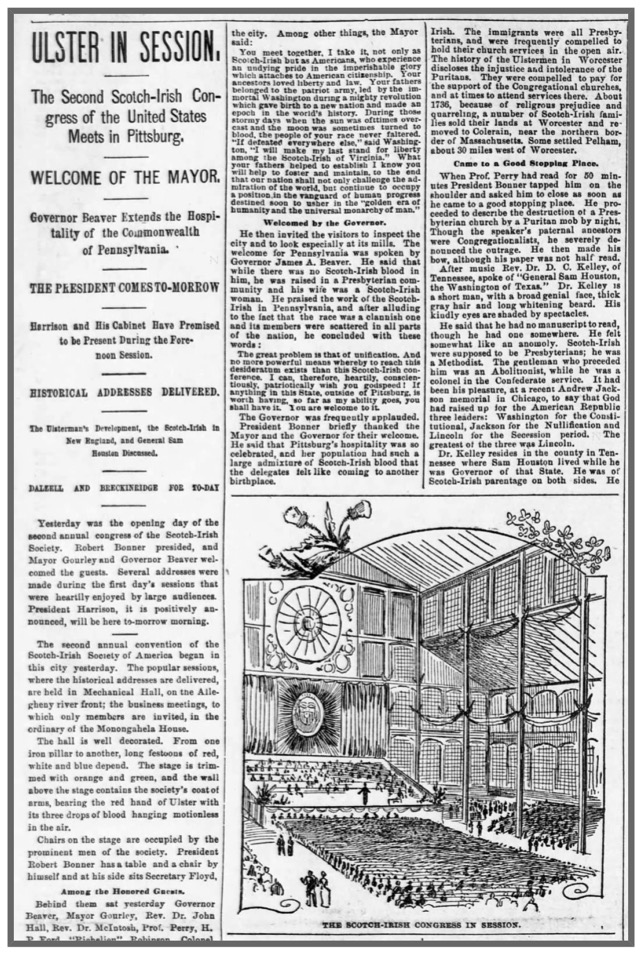
Mechanical Hall, Pittsburgh - venue for the 2nd Scotch-Irish Congress, May 1890

ExpmechThe Mechanical Hall (sometimes called the Machinery Hall) was built in 1889 by the Pittsburgh Exposition Society. The contract to build it was awarded in May 1889 on the condition that it would be finished by September, for a cost of $130,000. In 1890 it was the venue for the second Scotch-Irish Congress, building on the popularity of the first one which had been held the year before in Columbia, Tennessee.

If Columbia had typified small-town gentrified Southern charm, all historical white columns and large leafy gardens, the city of Pittsburgh was the opposite in every imaginable way - the biggest steel production region in the world, and North of the Mason-Dixon Line, and the vast building little over six months old right beside the railway line. Pittsburgh was in the top ten biggest cities in America at the time, with a population of around 300,000.

The capacity of the Mechanical Hall was 6000, and 12,000 people showed up, as did President Benjamin Harrison. Professor McCloskie of Princeton declared that "Pittsburg was essentially a big Scotch-Irish city".

Another success, and momentum now gathering around the Society. You can’t help but look back and imagine that this was an America on the edge of a new century, on the brink of becoming a world power, with huge new waves of immigration lapping its shores. Perhaps, faced with the inevitable changes ahead, the fresh interest in Scotch-Irishness was about looking back, to re-root the attendees in a sense of who they were and where they had come from, of heroic deeds and time-honoured traditions and values which in their view had made their America great.

Clipping 10688885 2 copyClipping 10688827

Clipping 9482677 Clipping 9483164

Clipping 10688885

Wednesday, March 08, 2017

Columbia Athenaeum, Tennessee - Birthplace of the Scotch-Irish Society of the USA, 1889

Cropped athenaeumwithflags1

On Wednesday 8 May 1889, the inaugural Congress of the newly-founded Scotch-Irish Society of the United States of America commenced here – today, less than one hour south of Nashville, and half an hour north west of Belfast – in a huge marquee in the gardens which it was said could hold 5000 people. A newspaper report of the time wrote that the marquee might have been formerly used by the evangelist Sam Jones, the preacher who was at that point underway with the founding of the Ryman Auditorium in Nashville, also known as the Union Gospel Tabernacle but best known as the Grand Ole Opry. The Scotch-Irish Congress lasted until the evening of Saturday 11 May.

Columbia Athenaeum had been built in 1837, intended to be the home of Samuel Polk Walker, a relative of President James Polk who was of East Donegal ancestry. By the 1850s it was a ground-breaking girls’ school, run by the Episcopal Church, teaching art, music, history, science and business. It had capacity for 125 boarders, plus day students from the local area. The school complex is gone but the Rectory residence is still there today.

A thousand newspapers advertised the event. When the day arrived the town was jam-packed, the railways bringing people from far and wide - ‘a crowded mass of humanity’. The stage in the tent could seat 50 people, including a portrait of Polk and a ‘Harp of Erin’ which belonged to a Mrs Emma McKinney, the ‘instructress of music’ at the girls’ school which operated from the Athenaeum, and who would play it later that day, accompanied by a Hal P Seavy, Chairman of the Reception Committee, on the violin. Not the fiddle. The violin.

Later on, the personal harp of Thomas Moore put in an appearance, inside a glass case, described as ‘Tom Moore’s Harp’ - which is akin to the awful abbreviation of ‘Bobby Burns’ that you come across now and again. Moore’s harp was loaned by a George W Childs of Philadelphia, who had bought it from Moore’s family. It is now in the collection of the Royal Irish Academy in Dublin - photo here. A poem in honour of the harp, but which tried to tell the story of the Scotch-Irish people, was delivered by the wonderfully-named Wallace Bruce, a writer from New York of some repute.

This occasion wasn’t for the hoi polloi, the people who would later be called “Our Southern Highlanders” (Kephart, 1913) or the “Plain Folk of the Old South” (Owsley, 1949). The event was characterised as being ‘free from all the rougher elements’, it had both ‘great dignity’ and ‘intellectuality’. By the time the band parade made its way through the town to the Athenaeum the crowd was estimated at 6000 – 10,000 people. During the afternoon breaks, the visitors ‘repaired to the fair grounds' where they were entertained by horse racing; others took driving tours of the area - presumably by horse and carriage as the motor car hadn’t yet been invented. Old soldiers of both the Union and Confederate armies compared reminiscences; Princeton College agreed to help collate information for future reference.

The newly inaugurated President Benjamin Harrison sent his apologies, too busy to attend, but appreciative of the invitation he had received. Previous President Grover Cleveland did likewise. Author Henry C McCook was in the same boat, but his reply was lengthy and gushed with ancestral pride - “the very backbone of these commonwealths has been drawn from the heathered hills of Scotland and the green hills of Ulster”. 

Emma McKinney later sang this Scots language song –

The puir auld folk at hame, ye mind,
Are frail and failing sair,
And weel I ken they'd miss me, lad,
Gin I cam' hame nae mair
The grist is out, the times are hard,
The kine are only three,
I canna leave the auld folk now,
We'd better bide a wee,
I canna leave the auld folk now,
We'd better bide a wee.

When first we told our story, lad,
Their blessing fell sae free,

They gave no thought to self at all,
They did but think of me;

But, laddie, that's a time awa',
And mither's like to dee,

I canna leave the auld folk now,
We'd better bide a wee,

I canna leave the auld folk now,
We'd better bide a wee.

I fear me sair, they're failing baith,
For when I sit apart,

They talk o' heaven sae earnestly,
It weel nigh breaks my heart!

So laddie dinna ask me mair,
It surely winna be,

I canna leave the auld folk now,
We'd better bide a wee.

I canna leave the auld folk now,
We'd better bide a wee.

• Visit the Columbia Athenaeum website here. It's easy to imagine the Southern belles in their grandeur, and the wealthy businessmen, passing an afternoon here.

NewImage NewImageNewImage