To be named as the first ever UK City of Culture is a remarkable achievement. I hope that the Scottish / Ulster-Scots contribution to the city's history and culture will be included in the activities and events in 2013.
Whilst the Ards and north Down holds the cherished position of "Birthplace of the Ulster-Scots" (note - awaits backlash from Co Antrim readers :-) ), Derry wasn't far behind. It's important to remember that while Hugh Montgomery was bringing lowland Scottish families into east Ulster (via Donaghadee) from May 1606 onwards, by Spring 1607 his younger brother George Montgomery was doing the same in west Ulster. Specifically, he brought people from Glasgow, Ayr, Largs, Greenock and Irvine into the ports of Donegal, Killybegs and Derry - all a good six months prior to the Flight of the (Gaelic Irish) Earls from nearby Rathmullan.
George had been made Bishop of Derry, Raphoe and Clogher and he took a great interest in the church lands which went with the job and in making them a commercial opportunity; his portrait still hangs in Clogher Cathedral today. George Montgomery is said to have kept records of the seamen and passengers who arrived - I don't know if these papers have survived, but what a discovery it would be to find them! However just a few years later Derry became a centre of English enterprise and the small Scots community was overwhelmed. Here's a glimpse of the early Scots in the city -
"...When Derry was granted to the City of London in 1610, the former residents had to be compensated. Among those were five or six men, about one tenth of the total, who were almost certainly Scots. Their names were preponderantly those of the south west of Scotland, such as Boyd, Patterson and Wray..." (from Perceval Maxwell).
Towards the end of the century, the English authorities' regard for the Ulster-Scots of the area hadn't improved. During the Siege of 1689, when thousands of Ulster-Scots from the surrounding hinterland sought refuge within the walls of the city (an exodus caused by the infamous Comber Letter which was addressed to Hugh Montgomery III, the Earl of Mount Alexander) a comment was made that "No matter how many of them die, they are but a pack of Scotch Presbyterians". Mount Alexander turned to the Covenanters of the Ards, led by their minister David Houston, for protection. So the ever-resolute Houston gathered a force of Covenanters and... headed for Derry, the city that his old friend and colleague Alexander Peden had foretold on 4 February 1685 (while at the mid-Antrim home of a Mr Vernor) as follows - "Oh hunger, hunger in Derry, many a black, pale face shall be in thee and fire, fire..."
So, the Ulster-Scots story of the city is (in my view) the mortar that holds the bricks of its many other stories together. Let's hope somebody does a brilliant job of bringing that story to life for 2013 and beyond.
(PS: it is of course tragic that Ballyhalbert's brave bid for the title was unsuccessful. Perhaps we will stand a better chance next time, now that the water treatment plant is finished. The untreated sewage in the bay meant that the first bid was just going through the motions...)
Thursday, July 15, 2010
Congratulations Londonderry


W Axl Rose and the first Bailies and Roses in Ulster
I was a teenage "metaller". My hair never got too long (my mother threatened to cut it in the middle of the night; my black Status Quo t-shirt mysteriously vanished in the laundry...), but I bought my copy of Kerrang! every Thursday morning at Page One Newsagents in Newtownards, had a tab at a dingy record shop in North Street in Newtownards called Music World, and bought my first guitar aged about 14 - a Yamaha acoustic that Graeme still has.
I was 15 when Guns N Roses hit the airwaves, and I was the first one in school (as far as I can remember) to buy Appetite for Destruction - on black audio cassette. Up until then, I'd never really got into the Iron Maiden and Metallica that my friends were into. But this was different - brilliant songs with melody and power, with anger and a fire that you'd never get from permed Bon Jovi or Def Leppard in a billion years. Appetite was like a musical petrol bomb (or, for those of you who know it, it was "a molotov cocktail with a match to go"). The video for Welcome to the Jungle had newsreel footage of Belfast riots - and the music media and UK tabloids went into overdrive. That summer I remember being chastened at a Christian youth event by a total stranger of around the same age as me because I was wearing a Guns N Roses t-shirt, who he loudly declared to be "the most immoral band in the world". (I think he was annoyed because he only had a Marillion t-shirt on...) Right enough, the amount of swearing on the album was unprecedented at the time (I'm not condoning it, but it added to the atmosphere around the band and just increased their notoriety), but it was the force and magnetism of the music that gripped me - Izzy Stradlin's rhythm guitar, Slash's lead guitar breaks, the quality of the songwriting... and of course the unique voice of their singer, W. Axl Rose, who could sing in about three different registers. His real name was William Bruce Rose, with the surname later changed to Bailey, and then back to Rose again. In a summer when the UK charts were topped by the likes of Rick Astley and the Pet Shop Boys, Appetite for Destruction was my soundtrack for 1987/1988. It signposted me towards Lynyrd Skynyrd, "Exile"-era Rolling Stones, and other great classics - real bands with guitars, bass and drums. No synthesisers, sampling or overdubbed nonsense. Appetite went on to become the best selling debut album of all time, selling 28 million copies. When they released their next album, a 4 track acoustic EP called "GN'R Lies", I tuned my Yamaha down a semi tone and mastered the EP's hit single "Patience".
Guns N Roses' epic double album - a far more polished release entitled Use Your Illusion I & II - was released on the same day in 1991 as Nirvana's Nevermind. Their singer Kurt Cobain soon replaced Axl Rose at the top of the rock music tree, with Nevermind selling 26 million copies to date. Earlier this year Cobain's roots were traced to County Tyrone.
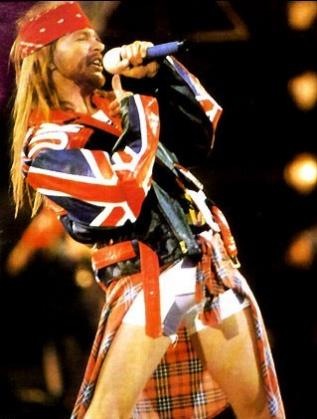
Fast forward 23 years and next month Guns N Roses (well, Axl Rose and a completely different band) will play in Belfast for the first time. At 38 I'm too old to be bothered going, and too skint to spend £55 on a ticket anyway. But when I heard they were coming, I remembered an old article which said that Rose had grown up as a member of a Pentecostal church in rural Indiana, and was of Scotch-Irish descent. He's in the Wikipedia list of Scotch-Irish Americans, and in the band's heyday was often pictured on stage wearing a long kilt. (Incidentally, another band I was really into at the time was superb Atlanta five piece The Black Crowes. I bumped into the two founder members and brothers, Chris and Rich[ard] Robinson, in the Virgin megastore in Belfast on the afternoon of their first concert here. In a magazine interview at the time they also said they were Scotch-Irish).
So what about Axl Rose's family tree? I don't know if he's ever traced his roots (Axl, if you're reading this, I can recommend the Ulster Historical Foundation as your best starting point!). In general terms, the first Bailies to come to Ulster from Scotland were tenants of Sir James Hamilton. In 1613 a William Bailie was one of the twelve burgesses of Bangor, later some Bailies settled at Inishargy (north of Kircubbin) and some sailed across Strangford Lough to Ringdufferin. Some later travelled to Hamilton's lands in County Cavan where they founded Bailieborough. There was also a Scottish settler called George Rose who had moved to Ulster sometime before 1641 and became a tenant on Sir Foulke Conway's estate at Lisburn. Around the same time back in Scotland a John Rose is recorded as writing Latin poetry for the King.
Nowadays in our house it's my oldest son Jacob who cranks up the Guns n' Roses (he's one of the Guitar Hero generation, who is now playing the real thing. His mates have guitars too and it's a billbate*), but the other day we played Sweet Child O' Mine together - me on the acoustic rhythm guitar and him doing the Slash impersonation. He has clips of himself on YouTube. I've posted one below of him playing along to the original.
So when Axl Rose arrives in Belfast in August, maybe he'll be yet another American descendant of that first generation of Ulster-Scots, walking in the footsteps of his forefathers.
And, with over 34.5 million views on YouTube, the original:
* I can't find the word billbate in any Scots dictionary, or The Hamely Tongue. Maybe it's unique to Ards Peninsula Ulster-Scots.
Saturday, July 10, 2010
Ulster-Scots and the Union

This is another example that demonstrates how cultural identity and political identity are not the same thing.
Thursday, July 08, 2010
"Soda Farls and Redemption Songs" - review by Diane Amov on Suite101.com
I'm absolutely blown away by a review of our new CD, by American writer and music blogger Diane Amov. Diane found us on YouTube a few weeks ago, bought the CD from iTunes and has written this amazing review on the website Suite101.com. I can't tell you how honoured I feel that someone who is clearly highly knowledgeable about early 20th century gospel musical styles, and who lives on the other side of the Atlantic, really gets what we're trying to do. Sometimes we've wondered if the songs we learned sitting at the stove at Ballyfrench, or at the wee simple mission halls around the country, are just special to our family or our locality. This review is another example of that cultural highway that links lowland Scotland, Ulster and America.
Diane has been kind enough to include further references to our music on her own (very impressive) blog, Jerusalem Tomorrow, where she has seen fit to place us among people we regard as the best in the genre and musical heroes - artists whose music we soaked up growing up, passed down to us from the older generation.
Sunday, July 04, 2010
Happy 4th of July
Today is of course Independence Day in the US; this short post is for all American readers.
"...Through the American War of Independence, the American Civil War and right up to the present day, the Ulster-Scots/Scotch-Irish influence upon the state of Virginia has been a constant factor. A popular quotation often attributed to General George Washington during the War of Independence is "...if defeated everywhere else, I will make my final stand for liberty among the Scotch-Irish of my native Virginia...", although it is more likely that he didn’t use those specific words, but something very similar. A book published in 1788 quoted Washington as saying, in November 1776, that if defeated everywhere else, he would make a stand in Augusta County, Virginia. Augusta County was a Scotch-Irish heartland...". With this landscape, you can clearly see the appeal of Augusta County for Ulster emigrants.
(Excerpt above is taken from a website I worked on in 2007, UlsterVirginia.com)

Thursday, July 01, 2010
Private James Thompson of Kirkistown, killed at the Somme, aged 20
With the Battle of the Somme commemorations today, I thought this would be a relevant poem to post here. As far as I know he was my grandfather's cousin. My grandfather, William Thompson (1901 - 1957) was just 15 when he wrote this memorial poem. It was typeset and printed by the Newtownards Chronicle for the family, who kept a framed copy on the wall for many years.
In Loving Memory of our Dear Son Private James Thompson, R.I.R of Kirkistown
Who was killed in action at the Battle of the Somme at Thiepval on 1st July 1916, aged 20 years
“What I do thou knowest not now; but thou shalt know hereafter” - John 13 v 7
A loved one has been called away, he’s in our midst no more
In a land afar his body lies far from his native shore
He bade us all a last farewell, a happy brave “Good-bye”
And with the gallant few went forth to suffer and to die
Upon the first day of July amidst the shot and shell
‘Twas in the battle of the Somme he in the conflict fell
What anguish fills each fainting heart and many cheeks grow pale
And in that sorrow-stricken home how many mourn and wail
None in that home shall e’er forget the one so bright and fair
Who young in years was called away, now sits a vacant chair
No one was near when in that hour he breathed his latest breath
But Jesus led him gently on thro’ the dark vale of death
He answered not the roll call here but in that world so fair
When Jesus calls the roll above he’ll not be missing there
We know ‘twas in that solemn hour his spirit took its flight
To dwell with God above the skies in realms of love and light
Oh, sorrow not, but cast your care on Christ, the Unfailing One,
Who ever doeth all things well and say “Thy will be done”
Let this a warning be to all to cease their sinful strife
Thy soul may be required of thee escape thou for thy Life
Oh, be prepared to meet thy God this warning he doth give
Consider now your latter end, believe and thou shall live
And then, where parting is unknown, all sorrow shall be o’er
For strife and conflict never come on yonder happy shore.
Note: according to the Commonwealth War Graves Commission, the memorial of rifleman James Thompson of the Royal Irish Rifles (A Company, 13th Battalion) is at Thiepval, Pier and Face 15A and 15B. His parents are recorded as William and Margaret Thompson, Kirkistown.
"I am not an Ulsterman but yesterday, the 1st. July, as I followed their amazing attack, I felt that I would rather be an Ulsterman than anything else in the world." - Captain Wilfred Spender.

Wednesday, June 30, 2010
Blurring the edges
There's an odd notion that the three main cultural communities in Ulster (English / Scottish / Irish) have hard defined edges which separate them. Whether language, cultural traditions, music, or landscape, this is nonsense. The edges are soft and blurred. One that I hear all the time, because of where I live, is that there's a hard cultural line that cuts across the bottom of the Ards Peninsula below Kir(k)cubbin and across to Cloughey/Kirkistown. Crudely put, the myth goes that around 1606, in an Ulsterised version of the "Operation Passage to Freedom" the incoming Scots struck an arrangement whereby the few resident Irish (that's polite code for Catholics) were moved south of this line to live on the Savage estates, and that all the incoming Scots (that's polite code for Protestants) settled north of this line. It's not true but it gets perpetuated all the time. There are concentrations of Ulster Scots above and Ulster Irish below, but there's not, and never has been, a hard division.
The Savages had arrived in Ireland as one of the new Anglo-Norman families in the late 1100s. Initially they had massive estates within the old Earldom of Ulster which more or less covered County Antrim and County Down, but as the centuries passed their lands were reduced to just the southern tip of the Peninsula and a bit of Lecale. Ongoing attacks from the Clandeboye O'Neills didn't help.
The truth is that there was a significant degree of co-operation between Hamilton and the Savages, and Montgomery and the Savages. In the 1640s a list of tenants on the Savage estates shows that between a half and a third had Scottish surnames. There are loads of examples of well-recorded overlaps and co-operation. The land boundaries of the Savage/Hamilton/Montgomery estates weren't even clearly defined (which is why Hamilton paid big money to get the Royal cartographer, Thomas Raven, onto the job in 1625. The original maps can be seen at North Down Museum in Bangor). And even where the boundaries were well understood, the three families exchanged and leased townlands with one another, with some Irish tenants on Scottish-owned estates, and as shown above, vice-versa. Henry Savage of Ardkeen gradually embraced the Protestant faith of his new neighbours - he was described as"...moderate in his Romish religion, and read the Holy Scriptures; and, on his death-bed, (whereon he lay long) assured me, that he trusted for his salvation only to the merits and mediation of Jesus Christ. He kept no images in his house, and if he had any picture (or such like) he said he would meditate on it, but not worship it. He used to say, that invocation of Saints was needless, although it were supposed they did hear us, or know our wants; because he was sure his Saviour was God all-sufficient..." (Montgomery MSS p 328). As the century drew to a close, in 1690 one branch of the Savages fought for King William III at the Boyne, while another branch fought on the other side for King James II - but some of this branch later changed their minds. Over the following centuries, many became famous high-ranking British military officers.
A while ago, over at Balmoral Perspective, Mark Anderson posted a clip of the slow Irish tune "Raglan Road". I posted a comment that there's a far faster, Ulster, version of the same tune which is used for the Belfast song "The Ballad of William Bloat". Renowned Scottish singer-songwriter Dick Gaughan points out here that the same tune might be Scottish in origin.
But it's easier to claim division and distinction, rather than to take time to explain the blurred edges. The result doesn't turn Northern Ireland into some bland whitewashed cross-community soup, but a place of interesting and myth-challenging contours. Some commentators need to stop pumping out dumbed-down lazy nonsense and take the time to read the early records for themselves. There's a far more interesting, and accurate, story just below the surface.
Sunday, June 27, 2010
Dave Rawlings Machine sing "He Will Set Your Fields On Fire"
Here's a 100mph bluegrass version of an old gospel song Graeme and I recently recorded on our new CD "Soda Farls and Redemption Songs". Dave Rawlings Machine are playing at the Open House Festival in Belfast in September.
Dave came to prominence as the guitar picker and harmony singer for Gillian Welch. Here they are together performing another gem (which we played at our wedding ceremony back in Sept 1997.) Gillian's album Revival is one of my all-time favourites.
Saturday, June 26, 2010
Carrowdore Lambegs
Here are some pics from a Lambeg drum demonstration last night in Carrowdore main street, County Down. Any readers from overseas might be astounded by the scale of the drums - they really are that size. Click to enlarge.


Tuesday, June 22, 2010
Dalway's Bawn and Cowboy Trail: The Irish Dimension
(NB: If you're reading this on Facebook, this is a post from my blog) It's great to see Philip Robinson bloggin' away like billyo; he has a great post here which will interest those of you who enjoyed the Sir Thomas Smith booklet, which tells some of the story of the Earldom of Ulster and of the Claneboy O'Neills' activities around Carrickfergus and south and east Antrim. Well worth a read!
Sunday, June 20, 2010
1798 and the massacres in Wexford
(NB: If you're reading this on Facebook, this is a post from my blog)
Some people eulogise about 1798 as some kind of eutopian cross-community moment. They wish for a time machine so that they, being from community A, could have stood valiantly alongside those of community B, through bonds of brotherhood and common cause that still resonate deep within them. Yawn. It's a nicely airbrushed tale.
I've just finished re-reading David Hume's booklet on the 1798 Rebellion, or "Turn Oot", entitled To Right Some Things We Thought Wrong (Ulster Society, 1998). David rightly points out that, after years of agitation and planning, the eventual Rising in Antrim and Down of June 1798 was suddenly undermined by what had occurred in southern Ireland just days earlier, actions carried out by those who claimed to be fighting for the same cause. Rather than a rising against the state, the headline news from Wexford was of brutal massacres of fellow citizens.
There are two lists online of those who were killed - here and here, giving their names, where they lived and in some cases how they died. Be warned - some make for very grisly reading. (ref: National Library of Ireland, Dublin NLI JLB 94107)
So, when the order was given for Antrim to rise on 7th June, many just stayed at home, hiding in byres, developing instant illnesses, or just staying at work in the fields. Just a week later, at Ballynahinch, hundreds of men deserted the night before the famous Battle at which Betsy Gray and so many others were killed. The Rising was roundly defeated by the government forces; the aftermath was many months of executions and deportations. Shortly afterwards, the Parliament of Ireland was abolished and in 1801 the United Kingdom of Great Britain and Ireland was born.
As Antrim poet James Campbell (1756-1818) later wrote:
In Ninety Eight we armed again, to right some things that we thought wrong
We got sae little for our pains, it's no worth mindin' in a song.
Thursday, June 17, 2010
Ulster-Scots and "The State"
(NB: If you're reading this on Facebook, this is a post from my blog)
This week Northern Ireland has been responding to the Saville Report. Some of the reactions are as you would expect. It's got me thinking about the relationship between "The State" and Ulster-Scots throughout history.
At this point in time, Ulster-Scots people are mostly Protestant and mostly Unionist. That cannot be denied and is nothing to be ashamed of. But far too often the modern, unthinking, presentation of Ulster-Scots has - tragically - been a trivial, trashy variety of Ulster Protestantism or Unionism, with a thin veil of newly-applied Scottishness. It might tick the boxes of the many funders out there, but it lacks depth, authenticity and knowledge.
As a result there are widespread false perceptions in the mind of the general public, providing fodder for the critics who demolish it with ease. Of even more concern, it has also dug a deep well of frustration amongst those quiet folk who loved and cherished their Ulster-Scots identity for decades and generations, before the money taps were turned on, and who now are turned off by much of what takes place under the Ulster-Scots label. The problems are not just presentational, but go right to the heart of how heritage is understood, protected and supported by "The State" - if it is at all. But if the apparatus of the state in Northern Ireland only understands the "two tribes" British v Irish political model, then who cares about the "three legged stool" English+Scottish+Irish cultural model?
Over the next few weeks I'm going to mull this over with the view of posting a series like last year's "Objections" series, which will highlight some important historic examples which show how the relationship between Ulster-Scots and the state has shifted over the years.
I'll not be able to examine every strand, but am posting this taster as an invitation for ideas or suggestions. Sharper minds than mine could do a far better job, but I hope to draw attention to some of the issues.
Tuesday, June 15, 2010
An important oul stane at Café Manor, Donaghadee
(NB: If you're reading this on Facebook, you can read this post in full on my blog)
Hilary and I were in Donaghadee at lunchtime, and went to the Café Manor beside the library (I'd just borrowed a few oul copies of WG Lyttle's Robin's Readings and Sons of the Sod to see if they were any different to my own copies). The sun was shining so we went through to tables in the walled garden. There, on two polished concrete plinths, was a big slab of cut stone about 4 feet long and a foot thick. I had seen it years ago - Donaghadee historian Harry Allen (author of this excellent history of the town) had told me about it, and had helped me track it down. It had been rescued from likely destruction from a back alley in Donaghadee, and bears the following inscription:
"The Manor Pound, Donaghadee, alias MONTGOMERY" - This commemorates Sir Hugh Montgomery's attempt in 1626 to rename Donaghadee as "Montgomery" and Portpatrick (on the opposite, Scottish, coastline) as "Port Montgomery"*.
So I lost all composure and in a loud voice I called out to Hilary - "LOOK - IT'S HERE, THIS IS THE STONE!! IT'S HUGH MONTGOMERY'S STONE!!".
That's not really the done thing on a sedate lunchtime in Donaghadee, and I startled the folk who were already eating their lunches in the garden. So a woman called over to me "So are you going to give us all a history lesson then?". Now I couldn't let an opportunity like that go, so in about 2 minutes I told all of the folk there the story of Hamilton and Montgomery and the attempt to rename the towns. The folk were delighted, and were going to head off to the Parish Church to see the stone above the church doorway which also commemorates Montgomery having built it too. One of the staff came to ask more, and so now she has a great story to tell their customers.
So, next time you're in the 'Dee, go to Café Manor and get a look at a great piece of Ulster-Scots history. However, thrifty Ulster-Scots beware, access to the walled garden costs an extra £1.50 a head!
(* the Glasgow General Assembly of 1638 included a Rev James Blair, minister of Port Montgomery - so the new name hung on for a while at least.)
Saturday, June 12, 2010
A petition from the inhabitants of Ballywalter and Ballyhalbert in response to the threat of danger from "our most treacherous enemies the French".
(NB: If you're reading this on Facebook, you can read this post in full on my blog)
If you surveyed the World Cup-watching public of Ballyhalbert and Ballywalter today, I think a fair proportion would see the French as their red-white-and-blue allies thanks to this incident!. Back on 13 April 1756 it was very different. On the eve of the Seven Years War, the men of middle of the Ards Peninsula weren't forging pike heads in the blacksmiths shops just yet, but they were concerned about the potential of a French invasion. So much so that they organised a petition and sent it to the Belfast News Letter (which then had been in print for only 19 years), who published all of the names. It's a good genealogical source for the period:
Bailie,William / Bailie,William / Bick,Hugh / Bigham,Archd. / Bodin,James / Boyd,James / Boyd,John / Boyd,Robert / Boyd,Samuel / Brown,Henry / Brown,Hugh / Brown,William / Brown,William / Causey,Andrew / Cauvert,Ed/Jr / Cauvert,Ed/Sr / Corran,Samuel / Corran,William / Coulter,John / Craig,Hugh / Craig,James / Craig,William / Doryan,Jas/Jr. / Doryan,Jas/Sr. / Drysdall,Henry / Dunbar,Francis / Gilmer,William / Glen,James / Glen,Michael / Glen,Robert / Gowan,David / Gowan,Jas/Jr. / Gowan,Jas/Sr. / Grey,William / Kennedy,Andrew / Kennedy,James / Kennedy,T/Jr. / Kennedy,T/Sr. / Kilpatrick,Hugh / Kilpatrick,John / Kilpatrick,John / Kilpatrick,Thos / Leeman,John / Leeman,William / Loughlin,Hugh / McCauvery,Jas. / McClements,Jas. / McClements,Jas. / McClements,Jn. / McCormick,Rob / McCormick,Thos. / McCormick,Wm / McDowell,Wm. / McKee,David / McKee,John / McKelvey,John / McMaster,Wm. / McWhur,Samuel / Miller,Henry / Miller,James / Miller,John / Miller,Rob/Jr. / Miller,Rob/Sr. / Moor,Henry / Murdagh,Robert / Palmer,Robert / Pue,Richard / Read,William / Reed,John / Ross,Robert / Small,Bernard / Stoop,James / Wilson,Hugh / Wilson,James / Wilson,James / Wilson,John / Wilson,John / Wilson,William
Why did they do it? What were they hoping to achieve? We may never know. Other Ballyhalbert men like Matthew Scott were emigrating to America around this time, and probably joined up with George Washington's army. The links between the 1798 Rising of Presbyterian Ulster-Scots in Antrim and Down, and the Presbyterian Ulster-Scots in the American Revolution of 1776, are crystal clear. But maybe this sets some context for the much-written-about sympathies with Revolutionary France.
A 1764 census for the Barony of Ards recorded a total of 16037 people, 15137 (95%) of whom were Presbyterian, 695 (4%) were Church of Ireland and just 85 (0.5%) were "Papists". In 1847, Henry Montgomery wrote that "...the rebellion, at the close of the last century was, in its origin and almost to its end... a Presbyterian rebellion…”.
The best book on the local 1798 events is Harry Allen's "Men of the Ards". I might blog a bit more about 1798 over the next while, but I'll wrap this post up with a story from Rev William Steele Dickson, Minister of Ballyhalbert (and later Portaferry). He was arrested the day before the planned attacks on Newtownards and Portaferry and was imprisoned in Scotland, where there were equivalent groups like the United Scotsmen. Dickson had been under surveillance for some time as he was suspected of forging links with these groups across the water. In prison, he was challenged by a Scottish inmate who had swallowed government misinformation that the rising in Antrim and Down was a "popish rebellion" (by spreading stories like this, the government was probably trying to undermine Ulster/Scottish Presbyterian co-operation). Dickson turned aside and wrote down the names and denominations of 20 of the leading United Irishmen in County Down. The list had 10 Church of Ireland, 6 Presbyterians and 4 Catholics. Dickson handed the list to him and said "look at that, and then tell me what becomes of your popish rebellion?".
In other words, stick that up your jumper!
(thanks are due to my good friend Dr William Roulston for drawing this petition to my attention. William's book - Researching Scots-Irish Ancestors, cites this petition among a huge collection of sources for the genealogy enthusiast who's trying to pin down their Ulster-Scots forebears)
Friday, June 11, 2010
"for twenty-four years I've been living next door to Alice"
(NB: If you're reading this on Facebook, you can read this post in full on my blog)
That's the name of an old 70s song. Sir James Hamilton's grandson, Henry Hamilton, was another man who was head-over-heels in love with a woman called Alice. Sadly for Henry, she destroyed his life.
Henry Hamilton was the 2nd Earl of Clanbrassil and had one of the biggest estates and fortunes in east Ulster. He met Alice Moore, a "very handsome, witty and well-bred lady" and was besotted. His mother (as mothers do) sized Alice up and was in "great grief" when Henry and Alice got married in May 1667. Alice was high maintenance and Henry racked up massive debts in trying to meet the costs her lavish, flirtatious, lifestyle. He sold off large parcels of the Hamilton estate to his tenants - and both Henry and Alice were at this stage just 28 years old. The Hamilton Manuscripts describe her as "beautiful and vicious".
In 1669, Alice ordered the Presbyterian meeting house in Bangor (at Fisher’s Hill now Victoria Road), whose minister was Gilbert Ramsay, be torn down. It broke Ramsay's heart. The following Christmas, Alice was among the audience at a new theatre in Smock Alley in Dublin which had three tiers of balconies - it was the Waterfront Hall of its day. The glitterati were there to see a satirical, mocking anti-Presbyterian play called “The Non-Conformist”. During the performance, the upper balcony collapsed into the middle balcony which then crashed down onto the lower balcony. Many people were killed, and Alice was badly injured.
However, that brush with death didn't hamper her selfish ambitions. The Hamilton will had been carefully laid out by Henry's father to ensure that, if Henry died, it would remain in the Hamilton family. Alice persuaded Henry to change his will, making her his sole heir. His mother saw the disastrous potential and warned him - "Son, expect that within three months after you perfect such deeds, you shall lodge with your grandfather and father, in the tomb of Bangor". On 27 March 1674, Henry's will was rewritten - "it is my will and pleasure to leave unto my dear wife, the Countess of Clanbrassil, her heirs and assigns, for ever, all my estate in the kingdom of Ireland..."
Henry had effectively signed his own death warrant. On 12 January 1675 he died suddenly in Dublin - and Alice ordered his body to be disembowelled within 5 hours of his death, and for a rush burial to take place at Christ Church in the city. Some time later, his body was reburied at Bangor, fulfilling his mother's prediction.
The suspicion is that Henry had been poisoned. However, the Hamilton family fought back, and Alice didn't get her hands on the estates. She remarried but died - miserable, alone and childless - on 13 Jan 1678.
Tuesday, June 08, 2010
Publications and Projects
(Intro: tragically, a lot of what has been done in the name of Ulster-Scots over the past 15 years or so has been ill-informed, trivial, politicised, invented, speculative, money-chasing, egocentric nonsense - which has done untold damage to our deep authentic heritage. I quickly realised I couldn't change the world, but could at least devote what little time I had to help some quality projects to emerge. This is still my aim).
2006: Hamilton & Montgomery 1606 - "The Dawn of the Ulster-Scots".
My first full year as Chairman of the Ulster-Scots Agency (June 05 - June 09) was the 400th anniversary of what I still regard as the seminal moment in Ulster-Scots history – when James Hamilton and Hugh Montgomery, both from Ayrshire, struck a deal with Con O’Neill for two thirds of his estates in Co Down. It wasn’t the first contact between Scotland and Ulster – the links had been going on for centuries, way before the Scottish Reformation of 1560 and the Plantation of Ulster of 1610 – but it was the first permanent lowland Scottish settlement of Ulster, a natural migration of lowland Scottish families. The year included a 50 minute documentary broadcast on BBC Northern Ireland, entitled “Dawn of the Ulster Scots”, presented by Flora Montgomery. A special edition tabloid is available which tells the whole story, as well as a foldout heritage trail. I took care of all of the research, writing, photography and design. With thanks to Dr John McCavitt for his guidance throughout the project, and to the Montgomery and Rowan-Hamilton families for their support.
+ Visit the project website.
+ Order copies of the publications
 2007: The Bruces in Ulster
As proof of the pre-Plantation, pre-Reformation links mentioned above, this project went back 700 years to 1306/1307 when King Robert the Bruce spent a winter on Rathlin Island, after which he returned to Scotland to fight a seven year campaign which ended with Scottish independence. His brother Edward then came to Ulster and was declared High King of Ireland for a few years, before being killed in a battle at Dundalk. A special edition tabloid is available which tells the whole story, as well as a foldout heritage trail. I took care of all of the research, writing, photography and design. With thanks to Doug Archibald of The Robert the Bruce Commemoration Trust for his help and quality proofing, and to the Ulster History Circle who installed a commemorative plaque on Rathlin in Summer 2007. The plaque was unveiled by a group of VIPs, including the Earl of Elgin, a lineal descendant of Robert the Bruce.
+ Visit the project website.
+ Order copies of the publications
2007: UlsterVirginia.com
This website project was produced in the run-up to Northern Ireland's participation at the Smithsonian Folklife Festival in Washington DC in July 2007. A host of expert contributors provided fresh research and articles; the Virginia Tourism Corporation also assisted. The project was launched, using a series of billboard posters in greater Belfast, by the US Consul Dean Pittman. I took care of all of the photography and design and co-ordinated the research and writing.
+ Visit the project website
2008: The Covenanters in Ulster
This 1600s in Ulster are a deeply misunderstood period, usually reduced to the Plantation and the Battle of the Boyne. The story of the Covenanters is one whch goes deep into the psyche of Scots and Ulster-Scots, of Presbyterians who were brutally persecuted for standing up for their faith and for opposing the tyrant Kings. A special edition tabloid is available which tells the whole story, as well as a foldout heritage trail. I took care of all of the photography and design and co-ordinated the research and writing. We also ran a week-long series in the News Letter. With thanks to all of those who helped and supported, in particular Dr William Roulston.
+ Visit the project blog.
+ Order copies of the publications
2008: "Sacred Scotch Solos"
This personal online project is an historical archive of over 80 sacred songs which have been given to me over the years by folk both in Ulster and Scotland. Most are from Scottish printed sources about 100 years old, providing evidence that in previous generations people were comfortable using Scots creatively in worship and outreach. All of the pieces use varying densities of Scots, from a light sprinkling of vocabulary through to much deeper usages. Since the site went live, the Church of Scotland's "Scots Language in Worship Group" have used some of the pieces in their own repertoire. Scots and Ulster Scots are both used by contemporary songwriters as well. The site includes text of the lyrics, and downloadable scans of the original musical notation.
+ Visit the project website
2009: Alexander Peden, Prophet and Covenanter in Scotland and Ulster
Having completed my term at the Ulster-Scots Agency, this book was a natural extension of the “Covenanters in Ulster” project, telling the story of the most enigmatic and famous of the Ulster Covenanters. Peden was born in Ayrshire, but during the “Killing Times” sought refuge at Glenwherry in County Antrim. This 112 page book is centred around a reprint of a 1755 Belfast pamphlet about Peden and includes a collection of essays and historical poems. BBC Radio Scotland produced a half hour programme about Peden, presented by Richard Holloway, around the same time as the book's completion. I took care of all of the photography and design and co-ordinated the research and writing. I also contributed one of the articles, entitled "Publishing Peden - A Chronology of Chapbooks 1712 - 1872". With thanks to all of those who helped and supported, in particular, Dr William Roulston, Jack Greenald and Dane Love of the Scottish Covenanter Memorials Association. Thanks also to The Ullans Press for issuing the book under their imprint.
+ Order a copy of the book
2009: Frances Browne Multilingual Poetry Prize
A lighter moment amongst the solid history. I tend to leave the linguistic side of Ulster-Scots to the experts who understand its nuances far better than I do. I enjoy the colour of the words and expressions and have dabbled with a wee bit of poetry. A light hearted poem I wrote for fun, Address to a Nintendo DS, finished as runner-up in this annual competition run by the Finn Valley Voice newspaper in Donegal.
2010: The Forgotten English Colony of Sir Thomas Smith
What happened before the arrival of the Ulster-Scots? In north Down and the Ards, the story of what came before is the failed colony of Sir Thomas Smith. After almost a year of research the first outcome of this project is a 40 page full colour booklet, the printing of which was funded by Ards Borough Council, North Down Museum and the Ulster-Scots Community Network. I took care of all of the research, writing, photography and design. With thanks to a broad range of universities, galleries, museums and libraries across the UK and RoI, all of whom are acknowledged and referenced inside. The booklet has been covered in the News Letter and the Newtownards Chronicle, and there’s a possibility of some television coverage in the near future.
+ Order a copy of the booklet
2010: North Down and Ards Tourism project
I've just finished a major piece of work with the Ulster Historical Foundation to show the tourism potential of the Ulster-Scots heritage of North Down and Ards. Supported by the two local Councils and the Northern Ireland Tourist Board's Tourism Innovation Fund the end result was over 300 pages of information, history, genealogy, potential tourism products and a bank of fresh photography.
Digitisation Projects
It's essential that history is made accessible for today's reader and researcher. When still at the Ulster-Scots Agency, I also took the lead on producing digitised versions of:
• The Hamilton Manuscripts (compiled by TK Lowry, 283 pages, first published 1867)
• The Montgomery Manuscripts (compiled by Rev George Hill, 504 pages, first published 1869)
• The MacDonnells of Antrim (complied by Rev George Hill, 515 pages, first published 1873)
• The Plantation in Ulster (compiled by Rev George Hill, 636 pages, first published 1877). This has an accompanying CD of the Thomas Raven maps of the Plantation counties, courtesy of PRONI, with narrative by Professor Raymond Gillespie.
All of these were produced as facsimile text-searchable PDF files, available on CDRom.
A gospel moment in "Prince of Persia"
(NB: If you're reading this on Facebook, you can read this post in full on my blog) There's a moment in the new Disney movie "Prince of Persia" that some of you will enjoy (I took Jacob to see it last week). I must admit I wasn't expecting a movie based on a computer game to be much good, but it was a swashbuckling cracker with lots of very scary curved swords, warriors and grisly (implied) deaths.
The hero, Dastan, reveals to his rival Princess Tamina (who of course he ends up falling in love with) that he is not of Royal blood. In the heat of an argument he shouts at her "I wasn't born in a palace like you - I was born in the slums of Nasaf, where I lived and I fought and I clawed". Shocked, she asks, "And how did you become a prince?". Dastan pauses and replies, "The King marched into the market one day and he, I don't know, he found me, he took me in..."

Sunday, June 06, 2010
Thoughts on Devolution
(NB: If you're reading this on Facebook, you can read this post in full on my blog) At the Scottish Parliament in Edinburgh there are various literary quotations on the wall, some of which have a relevance to Devolved Government here in the UK. One is:
"...When we had a king, and a chancellor, and parliament-men o' our ain, we could aye peeble them wi' stanes when they werena gude bairns - But naebody's nails can reach the length o' Lunnon..."
- Sir Walter Scott (1771-1832) Mrs Howden in Heart of Midlothian
Which got me thinking, if you could choose a text for the wall at Stormont, to make a pithy comment about Devolution in Northern Ireland, what would it be? I know for a few readers of this blog it might be a verse or two from "A Cannae Thole Ye" by GF Savage Armstrong! Here's another contender:
"...A saw naebody that A kenned till A got tae Bilfast. Waens, dear, it's a big toon that!... Whun A got oot at the station-hoose , an' saw the crowds o' fowk rinnin' this road an' the tither road, A got that scaured for feer o' loasin' mysel' that A had a noshin' o' lyin' doon ahint the station-hoose till the train wud be reddy tae birl back hame again..."
- WG Lyttle (1844-1896), Robin's Readings
Suggestions by placing a comment below, or by emailing me, would be very welcome!
...
UPDATE: an emailer who wants to remain anonymous sent me this from Robert Burns, and has asked for it to be added here as his suggestion for Stormont -
"We're bought and sold for English gold - Such a parcel of rogues in a nation!"
Friday, June 04, 2010
"Well Mother I am started to till the soil in Canada" - John Thompson from Ballyfrench, May 1925
(NB: If you're reading this on Facebook, you can read this post in full on my blog)
My grandfather's brother, John Thompson, emigrated from Ballyfrench, County Down to Canada in 1925 (he's wearing the hat in the pic above). A few weeks ago one of his letters surfaced among some family papers:
1/5/1925
c/o Robert Barker, Almonte, Ontario, RR No 1, Canada
Dear Mother,
Just a few lines to let you know that I arrived allright in Canada and in the best of health at present hoping this will find you all enjoying good health. Well Mother I am started to till the soil in Canada I got a start made on Tuesday so I did not get any holidays on this side. The emigration Officers were at Quebec when we landed there and sent every one their own way so I never saw Davies since we left Quebec so I think he has gone another route so I am about 250 miles from Toronto and about 30 miles from Ottowa of course this place I am in is miles from nowhere. I suppose there will be word from the rest of the boys that went out before - you might get me Wm Bell's address I suppose he is in a fine place too. We landed that night Saturday in Quebec about ten o'clock and had to stop aboard all night and got off the next morning at eight oclock. Well Mother I think this is all the news for this time only. Hope to hear from you soon again with love to all. From your Son John Thompson.
From an Ulster Peninsula to a Canadian Island
A 1904 Business Directory for Almonte is available here - Almonte is in Lanark County and even today still has a Highland Games event each year. About a 2 1/2 hr drive from Almonte is Amherst Island, Lake Ontario. Between 1820 and 1880, 105 families emigrated from the Parish of St Andrews (in the middle of the Ards Peninsula) to Amherst Island. The island was owned by the 3rd Lord Mount Cashell, who also owned estates in Cork, Tipperary, but his largest estate was nearly 50,000 acres in mid Antrim – at Kells, Cullybackey and the countryside around Ballymena. In the 1830s and 1840s he bought over 20,000 acres in “Upper Canada”, following in the footsteps of a number of Scottish gentlemen who had done the same (for example, a William Dickson from Scotland had bought 94,000 acres there in 1816).
The majority of the emigrants were Presbyterians, and until 1851 their minister - an Ulster missionary called Rev McLeiche – preached in the open air. A church was built that year. Cashell sold the island in 1857 to his second cousin, Major Robert Perceval-Maxwell, whose parents owned the Finnebrogue estate near Killyleagh and another at Groomsport. They built churches, schools (where the textbooks from the Ards were used), formed an Orange lodge and also a pub called the "County Down Inn".
There are many detailed stories about specific families, from Adairs to Watsons, in A New Lease on Life, by Catherine Anne Wilson (McGill-Queens University Press, 1994). Some of the Cashell and Perceval-Maxwell papers of the Amherst Island tenants are held at PRONI.
NB - Mary Becker and Lena McVea run both the Ards Peninsula DNA project and also the Amherst Island DNA project.
Here's a Googlemap to show where Amherst Island is:
View Larger Map

Monday, May 31, 2010
Reviews of GF Savage-Armstrong's "Ballads of Down", 1901
(NB: If you're reading this on Facebook, you can read this post in full on my blog)
I posted about Ballads of Down recently; since then I've been sent a copy of a promotional leaflet which was produced at the time, containing what it calls "Press Opinions" of the book. Here are a few examples:
"the Ulster character and the Ulster dialect have never before found such expression in literature as these delightful 'Ballads of Down.'" - Leisure Hour
"the spirit which breathes in the national poet of Scotland breathes to a very considerable extent in 'the Poet of Wicklow.'" - Brighton Gazette
"he is distinctly at his best in the dialect poems, some of which have a homely pathos which is not a little touching." - Liverpool Post
"there is a genuine charm... and something of Lowland Scotch pith and grit" - Manchester Guardian
"Mr Savage-Armstrong... is the truest voice that Ulster life has yet found" - Review of Reviews
"To the Scottish reader these poems will prove especially attractive... that the spirit that pervades these songs is akin to the genius of Scottish poetry will be apparent to every reader... his latest volume shows how deftly he can touch themes of peasant-life in Ulster, and how cleverly he can manipulate the quaint dialect of County Down." - Dundee Advertiser
"the general excellence of his work will not be questions... his metre is never at fault... to Scotch readers there will be an added interest to his volume from the fact that a number of the poems are in dialect - an Ulster form of Lowland Scotch" - Aberdeen Free Press
"He shares with Burns a certain swift, unaffected draughtsmanship, and creates for his reader a vivid sense of the natural characteristics of the scene depicted. In his management of the dialect he is wholly admirable" - Irish Times
"the dialect-verse... has its tender love-strains, its sly humour, and its pathos, which to those who are 'sons of the soil' must make a special appeal" - Northern Whig
The leaflet has dozens more reviews; what is interesting from the above selection is (aside from the obvious Burns comparisons) how warm and open the press in Belfast and Dublin were towards the book, never mind in Dundee and Aberdeen.
Wednesday, May 26, 2010
The kirks and braes o' Killyleagh (and the media and museums of course)
(NB: If you're reading this on Facebook, you can read this post in full on my blog)
Whilst Northern Ireland's suburban media élite have once again spent their day ridiculing Ulster-Scots, I was in Killinchy and Killyleagh, visiting some local, historically-important, churches. I'll not mention the people by name (just in case the thought police go and hunt them down) but I had a marvellous afternoon talking with local folk, born and bred on the other side of Strangford Lough, about local history and fast-disappearing vocabulary. One of them gave me her personal collection of old yellowed newspaper cuttings of Ulster vocabulary, dating back to the late 1800s - a real treasure trove of information.
They also told me of old Ulster-Scots street names in Killyleagh which have been replaced by bland alternatives within their lifetimes - Braeside which led to Breakey's Brae, Barracks Brae (which was changed to Shrigley Road), Sabbath Brae (changed to Castle Lane) - and up near Raffrey, Bratchey's Brae (probably Bradshaw's Brae, just like in Newtownards - but still spelled as "Bratchey's" on a nearby house), which joins the Temple Burn Road.
Not that any of these things would interest the opponents of Ulster-Scots. The dominant attitude of the establishment in NI towards Ulster-Scots has always been hostility of one kind or another. That antagonism can be traced back in various forms for centuries. In more recent decades that has included the trivialisation of tradition, the wiping out of old place names and the exclusion of our story from the classroom, or - dare I say it - most museums. I've blogged about that before.
The smug, constructed world that today's media and cultural élite lives in is one where they can talk down their noses about 'reinforcing elderly rural protestant stereotypes', and get away with it. Their airbrushed world bears little resemblance to the lives and interests of ordinary Ulster folk. As I've said manys a time, the closest many of these "experts" get to rural life is the car park at Marks and Spencer.
(See the recent post on GF Savage-Armstrong's clashes with the literary élite of a century ago - click here)
Monday, May 24, 2010
The missing Montgomery portraits and memoir - an open message to art collectors, libraries and museums in New Zealand and Australia
(NB: If you're reading this on Facebook, you can read this post in full on my blog)
I'm posting this in the hope that, one day, these items might surface and perhaps copies of them could be sent back to Ulster in the interests of history and cultural heritage.
1. THE MISSING PORTRAITS
The Montgomery Manuscripts were written by William Montgomery in the late 1600s and early 1700s. They were first printed in Belfast in 1830, and then again in 1869 with the addition of magnificent footnotes by Rev George Hill. Hill's portrait hangs in the Great Hall of Queens University in Belfast, in which he is holding a copy of the manuscripts. Because of the limitations of printing at the time, there are very few illustrations in the book. Tantalisingly, Hill does refer to two then-extant original portraits - of Sir Hugh Montgomery, the First Viscount of the Great Ardes (1560 - 1636) which is said to have been a life-size portrait - and also one of his second son Sir James Montgomery of Rosemount (1600 - 1651). Here is Hill's description: -
"...An oil painting of the first viscount is in the possession of Mrs. Sinclair, formerly of the Falls, near Belfast, who is seventh in lineal descent from him. The same lady also possesses a portrait in slate of sir James Montgomery of Rosemount, and miniature likenesses of col. Wm. Montgomery of Killough, and his wife, Isabella Campbell of Mamore. Col. William Montgomery was grandson of the author, and great-grandfather of Mrs. Sinclair..." (The Montgomery Manuscripts, footnote, page 117)
No-one alive in Ulster today has ever seen these portraits - they are thought to have been taken to Australia or New Zealand by emigrants.
2. THE MISSING MEMOIR
In the Preface, Rev George Hill refers to a biography of Hugh Montgomery II (1597 - 1642) - "...The memoir of the second viscount is unfortunately lost, at least for the present, having been probably carried away to Australia by the author's lineal descendant, captain Frederick Campbell Montgomery, who settled in that colony about the year 1835..."
Sir James Hamilton and Sir Hugh Montgomery have been called "The Founding Fathers of the Ulster-Scots". Hamilton's original portrait hangs at Castle Ward, the National Trust property near Strangford. It is a tragedy that 150 years ago, an equivalent original portrait of Sir Hugh Montgomery was in a private collection in Belfast but has since been lost, probably taken to the other side of the world.
If you know where these two Montgomery portraits might be - PLEASE GET IN TOUCH!! There may even be a reward for the person who uncovers them, and who helps to return copies of them to the people of Northern Ireland.
(NB - The portrait of Sir Hugh Montgomery shown here is the one which has been used in recent years. It is from a copy indenture from Fraser's "Memorials of the Montgomeries", which is a poor facsimile of an original 1630 indenture. I was recently given a digital copy of the original indenture, and the portrait looks much better than the one shown above - but as I don't own the copyright for it I won't post it here)
........
Who was Mrs Sinclair? A few months ago a local historian was good enough to send me this background info:
"...There were several wealthy families with the name Sinclair resident in mid 19th century Belfast. The most prominent were the owners of J&T Sinclair, Merchants and Ship owners, they owned two of the largest mansions in the North of the city, the Grove and Hopefield. Another family were the owners of S Sinclair and Company Linen Merchants who lived in College Gardens and other houses in the South of the city. The only connection of a Sinclair family to the Falls would be in the late 18th and early 19th Century. William Sinclair, a very successful Linen manufacturer, is described as the Falls Bleacher. The family house and business premises were in Mill Street, where Castle Street and Divis street now are. Their very substantial house faced the entrance to King Street. He built Fortwilliam House at the end of the 18th Century but the bleaching business was still carried on at the Mill Street site and they presumably retained their house there. William Sinclair died in 1807 and left three daughters but no sons. Fortwilliam was sold soon after his death but his wife survived him until 1854. She lived mainly in Donegal Place but she would always have been associated with the Falls. To my mind she is the only possible candidate among the Belfast merchant classes of that time. As is not unusual at that time the name appears as both Sinclaire and Sinclair. I hope this is helpful, incidentally William Sinclaire was quite a character with wide interests which included being Chairman of the Society of United Irishmen..."

Saturday, May 22, 2010
The Great Sausage Roll Swindle
(NB: If you're reading this on Facebook, you can read this post in full on my blog)
Don't judge a book by its cover, or a sausage roll from the photo on the packet! I really should be avoiding sausage rolls, but I persuaded Hilary to buy some the other day.
THE PACK
.
THE REALITY
Usually, food packaging that doesn't have a clear window is packaging with something to hide. Hmmm.....
.


Monday, May 17, 2010
George Francis Savage-Armstrong's "Ballads of Down", 1901
(NB: If you're reading this on Facebook, you can read this post in full on my blog).
A while ago, Fiona McDonald posted on her blog about this writer, who also features in Dr Frank Ferguson's excellent Ulster-Scots Writing: An Anthology. George Francis Savage-Armstrong (1845 - 1906) was born in Dublin (his father was from Wicklow and his mother was from Co Down) and his wife, Marie Elizabeth, was from Belfast. Her father was Rev John Wrixon, rector of St John the Evangelist Church on the Malone Road.
"GFSA" was a prolific writer and poet (full bibliography here). He was Professor of English and History at Queen's College Cork and at one stage was a contender for the position of Poet Laureate. His later writings included much County Down history, as well as "Ballads of Down", a collection of 92 songs and poems published in 1901.
Many of these are in Ulster-Scots, which he describes in the glossary as follows - "...the Downshire dialect, with its variants, is an Ulster development of Lowland-Scottish - principally Ayrshire - brought over by Scottish settlers in the reign of James I... the dialect is more or less marked according to the locality and to the degree of the speaker's education. Some of the peasantry have it so strongly as to be hardly intelligible to a stranger...". Even with his own academic pedigree, his English poetry is described in the Dictionary of National Biography as "competent but pedestrian" - nevertheless, "GFSA" retained a sound handling of Ards Peninsula Ulster-Scots.
Here's an example of his work, a poem called A Cannae Thole Ye!
Ye may be clivver, may hae won
A wheen o' honour 'nayth the sun
But, whatsaee'er ye've earn'd or done,
A cannae thole ye!
Ye may be genial noo and then
Wi' helpless waens an' humble men;
But, though ye'd gilt auld Poortith's den,
A cannae thole ye!
Ye may be guid; ye may be great;
Ye may be born tae rule the State;
But, though ye rowl'd the wheels o' Fate,
A cannae thole ye!
Ye may hae drawn yer watery bluid
Frae Noe's sel' that sail'd the Flood;
But, though in Noe's breeks ye stud,
A cannae thole ye!
Ye may be lord o' mony a rood;
Yer smile may mak' a monarch prood;
But, though the De'il afore ye boo'd,
A cannae thole ye!
It's nae that ye hae din me wrang;
It's nae A feel a jealous pang;
It's jist that, be ye short or lang,
A cannae thole ye!
A CONTROVERSIAL CAREER:
GFSA attracted some opposition during his career - here's an excerpt from his DNB entry:
"...He was antagonistic to the Irish literary revival and was severely criticized by W. B. Yeats. In ‘“Noetry” and poetry’, his second review of Savage-Armstrong's Poetical Works (9 vols., 1891–2), Yeats judged Savage-Armstrong's work to be either rhetorical or crude, but conceded that the ‘Irish’ verses were memorable. In 1898 Savage-Armstrong addressed the Irish Literary Society, London, on ‘The Two Irelands in Literature’, arguing against Matthew Arnold that Gaelic literature had ‘not much style, very little melancholy, and very little natural magic’. He praised the foundation of Trinity College, Dublin as having initiated ‘Irish literary production in the English tongue’ (The Times, 28 May 1898). Yeats responded ferociously, attacking the barrenness and negativity of Savage-Armstrong's Ireland, arguing that he knew little of Gaelic literature, that he represented an obsolete tradition and that he resented being sidelined by the writers of the revival; Yeats's attack was an expansion of his first review of Savage-Armstrong's Poetical Works, in which he had asserted that ‘Mr. Armstrong has cut himself off from the life of the nation in which his days are passed, and has suffered the inevitable penalty’...."
Threatening, almost sinister, stuff - showing that even 100 years ago swimming against the intellectual mainstream was a dangerous activity. GFSA spent the last years of his life at Strangford House where he died on 24 July 1906. Some of his collected material is held at the William Andrews Clark Memorial Library (UCLA).
CHILDREN and WWI:
The Savage-Armstrongs had three children, all of whom were caught up in the events of World War One:
Francis Savage Nesbitt Savage-Armstrong (5 July 1880 - 23 April 1917) became a Lieutenant Colonel in the South Staffordshire Regiment. He joined the Army on 19 Sept 1900 and served during the Boer War. He served in France & Flanders from 3 Nov 1914, was twice Mentioned in Despatches, and was awarded the D.S.O. (see London Gazette 23 Jun 1915). He was killed in action on 23 Apr 1917 and is interred in the Poit-du-Jour Military Cemetery, France.
John Raymond Savage-Armstrong (13 May 1882 - 1918?) became a Captain in the 4th Leinster Regiment. He was wounded at the "Battle of Hill 60" at Ypres in April 1915, and was released on sick leave. He seems to have returned to Strangford House - Northern Ireland's Digital Film Archive contains two of his letters which were written around the time of the 1916 Easter Rising - one written to him by a Miss Julia Taylor of Dublin, and one written to him by his son (also called Raymond).
Arabella Guendolen Savage-Armstrong served as a nurse at the Richmond Military Hospital during World War I, and after this, was active in social settlement programs like the Hackney Girls' Club, the Pell Street Club and the Sandes Soldiers' Home at Magilligan, Co Londonderry.
IMHO, the Ulster-Scots material in "Ballads of Down" is worth reprinting for today's generation.
Sunday, May 16, 2010
If you like movies, you'll love this!
A break from the normal content here at the 'Burn - a great send-up that sinks the boot into the repetitive formula of every Hollywood mega-movie of the past 20 years! (sorry about the freezeframe image that the clip starts with - blame YouTube!)
Friday, May 14, 2010
Sir Thomas Smith booklet launch

(NB: If you're reading this on Facebook, you can read this post in full on my blog). Tonight saw the launch of the Thomas Smith booklet. The Londonderry Room in the Old Town Hall in Newtownards was packed with a cross-section of local folk, local historical societies, individual historians, councillors, Jim Shannon MP, Nelson McCausland MLA (Minister for DCAL), the Mayor of Ards Cllr Billy Montgomery, and many more. After the introductory remarks from Hammy Gregory (Loughries Historical Society), the Mayor and Jim Shannon, I spoke for about 30 minutes using a Powerpoint presentation as a visual aid to summarise the Thomas Smith story. The reaction from the audience was superb, the booklets flew out the door, and I think we've really managed to put Smith back on the local map.
The next step is for someone to buy Craigantlet quarry (I am pretty sure this is close to where Smith planned to build his biggest defensive fort) from its current owners Tarmac and turn it into a hilltop heritage centre with a spectacular 360 degree panoramic view of Belfast Lough, Strangford Lough, Scotland and the Isle of Man!
Thanks to everyone who was so enthusiastic this evening; all being well this is just another step along the road of recovering the unique heritage and stories of north Down and the Ards. Somebody, some day, will do a PhD on Sir Thomas Smith's forgotten colony - I just hope my booklet helps to bring his story to today's generation.
Copies of the 40 page booklet are available from Loughries Historical Society - click here to email them for a copy.
Above all - enormous credit goes to Mr Balmoral himself, Mark Anderson of Loughries Historical Society, who is doing a magnificent job in the local community, and schools, in bringing the Ulster-Scots story to the people of the Ards and North Down. Our area would be much poorer without the work he does, and in how he conducts himself - in his own quiet, modest, steady way he has won the respect and confidence of councillors, council officers, teachers, parents and weans. Like Hamilton and Montgomery in May 1606, Mark inherited something of a cultural wasteland, but through hard work he is steadily rebuilding the walls and bringing people in - and like Hamilton and Montgomery's tenants, the seeds he has sown are now reaping a bumper harvest!
Tuesday, May 11, 2010
What is Ulster-Scots? A People and their Heritage
It sounds like a simple question, but it’s actually very complex. Identity is a complicated issue, and even more so with a long-neglected, marginalised and misunderstood identity like Ulster-Scots. There are many important subtleties that this small article can never adequately cover, so this will only serve as a simple introduction, not a comprehensive study. Hopefully others, better qualified than I, can explore the themes outlined here in more detail.
A People and their Heritage
The term Ulster-Scots has, for nearly 400 years, referred to people, not place - the people who migrated from the Lowlands of Scotland to Ulster, and to the Ulster-Scots communities that they established right across the nine counties. It is important to recognise that migrations between the two coastlines have been ongoing for thousands of years, but it is generally accepted that it was the Hamilton & Montgomery Settlement of May 1606 that saw the floodgates open. Tens of thousands of Lowland Scots poured into Ulster:
“…Hamilton & Montgomery... did not wrest a fertile, cultivated and prosperous region from Gaelic proprietors. They came instead to a country devastated by war and famine... they created the bridgehead through which the Scots were to come into Ulster for the rest of the century...”
from ATQ Stewart The Narrow Ground, page 38 – 39
This first large wave of permanent migrants were not soldiers or mercenaries (as was the case in the other major Scottish migrations of the era, for example to Poland or Sweden). They were ordinary Scottish families, seeking a new life. They were mainly Presbyterian in faith and outlook, and overwhelmingly Scots-speaking in language. As John Hewitt summarised so well, it was:
“…a transplantation of Scots from not very far away to a climate and an economy very like home, and to which the language, folk culture and lore had been carried without dilution…”
from Ancestral Voices; the selected prose of John Hewitt, p66
This was just the beginning - these first Ulster-Scots settlements were built upon over the following centuries, through constant fresh migrations which both increased the size of the Ulster-Scots community and enriched our heritage and traditions. The permanent Lowland Scots imprint on Ulster is crystal clear.
Ulster-Scots heritage and traditions
So Ulster-Scots not only refers to these people, and their descendants, but also to their heritage and cultural traditions. The Lowland Scots brought industry, language, music, sport, religion and a myriad of traditions to Ulster. And many of these have become mainstream, not narrow cultural markers, but broad themes in our society. None of these things were fossilised, frozen in a 1600s timewarp - the traditions have developed, changed and grown over time. In Scotland, what were once only markers of regional Highland identity have over time become markers of national Scottish identity. In the same way, some aspects of Ulster-Scots identity have adopted Highland influences too.
Is “Ulster-Scots” not just about the two places – Ulster and Scotland?
Some people assume that anything that links the two places of Ulster and Scotland should be described as Ulster-Scots. However, this confuses the term and clouds how it has been used over the centuries. Links between the two places might be more clearly described using a different term, such as Ulster/Scottish.
How old is the term “Ulster-Scots”?
Some people think the term Ulster-Scots is a recent invention. This is nonsense – and reveals much about the poor knowledge of our history. The first known written usage of the term Ulster-Scots was in 1640. In the aftermath of Scotland’s National Covenant of 1638, the Presbyterian community in Ulster was seen by the government of the day as a very real threat, and Sir George Radcliffe wrote “…none is so dim-sighted but sees the general inclination of the Ulster Scots to the Covenant…”
The term “Ulster-Scots” in literature
In literature, the term crops up time and again. Here are just five famous examples from the late 1800s – early 1900s:
• Rev Henry Henderson (1820 – 1879) of Holywood wrote a column entitled “Ulster Scot’s Letters to his Friends at Home and Abroad” in the Belfast Weekly News under the pseudonym “Ulster Scot”, from 1869 – 1879. When he died, his son William carried on the column as “Ulster Scot junr”!
• The book Three Wee Ulster Lassies, published in London in 1883 includes three characters – Nelly Nolan the Ulster-Kelt, Bessie Stronge the Ulster-Saxon and Jennie Scott the Ulster-Scot.
• Edinburgh author John Harrison published a series of articles, and later a book, in 1888 entitled “The Scot in Ulster” where he uses the term Ulster Scot throughout the text.
• In 1912 the US Ambassador to Britain, Whitelaw Reid (himself of Co Tyrone descent) delivered a lecture in both Belfast and Edinburgh entitled The Scot in America and the Ulster-Scot, which was later published as a book.
• In 1914 James Barkley Woodburn published his epic 400 page volume The Ulster-Scot - His History and Religion.
The pedigree of the term “Ulster-Scot” is undeniable.
Shouldn’t it just be “Scots in Ulster”?
At what point did the early settlers cease to be simply Scots in a different land, and become something else? Some would say that by the 1650s when the first generation of Ulster-born Scots were becoming adults there were clear signs of them being different than the mainland Scots their parents had left behind. For example, when some of the Ulster-based Presbyterian ministers went back to Scotland in the late 1630s, the Scottish ministers were not impressed by some of the religious practices they had developed in Ulster; in 1640 the General Assembly criticised many of these practices as "Irish innovations". So even by 1640, the cultural practices of the Ulster-Scots were becoming slightly different from those of their Scottish kinsfolk. And this process of change and adaptation would continue, right up to the present day.
Conclusion
When you glance across some of the key chapters through history - from King Robert the Bruce’s links with Ulster in the 1300s, to the organic settlements and organized plantations of the early 1600s, the period of Covenants and “Killing Times”, the great popularity of Robert Burns in Ulster, the Scottish Enlightenment of the 1700s and the role played by the Ulster-Scot Frances Hutcheson, and the great industrial partnerships that linked the shipyards of Belfast and Glasgow throughout the 1800s and 1900s – it’s clear that the Ulster-Scots story is of massive significance to both countries, and to people on both sides of the slim stretch of water. At the narrowest point, only 13 miles of sea separate Ulster and Scotland. In 1606 the sea crossing took just three hours, and today it’s not much faster! Scots and Ulster-Scots folk alike have much to gain by strengthening our deep historic ties, and to understanding the Ulster-Scots story.
© Mark Thompson, June 2009. (this article appears on the website of the Ulster-Scots Agency).
Shanties and Sea Songs
(NB: If you're reading this on Facebook, you can read this post in full on my blog). I saw a superb programme on BBC4 last night: Shanties and Sea Songs presented by Gareth Malone. You can watch it on BBC iPlayer here. It'll be downloadable for the next few days, so I strongly recommend that if you're into rural folk culture and traditional music that you get it while you can. Here's a summary from the BBC website:
The story of Britain's maritime past has a hidden history of shanties and sea songs, and choirmaster Gareth Malone has been travelling Britain's coast to explore this unique heritage. From dedicated traditionalists to groundbreaking recording artists, Gareth meets a variety of sea-singers from across the country.
His journey begins in Portsmouth where he meets a devoted shanty singer, before continuing on to Tyneside and the Yorkshire coast, where the Filey Fisherman's Choir, with an average age of 70, are determined to keep the tradition alive.
Gareth gets a fascinating insight into the songs of the Herring Girls when he visits Gardenstown in Scotland. In Whitby, he meets Kimber's Men, a local group who have dedicated themselves to writing and singing songs celebrating heroes of the sea, such as a rescue of 1881 when the sea was so rough the people of Whitby had to carry their 2-tonne lifeboat some six miles overland on a wooden trailer and in heavy snow to the bay where a ship had hit the rocks. Despite the exhaustion, they still managed to rescue the shipwrecked crew and passengers.
Gareth's journey ends in Port Isaac in Cornwall, where a group of local fishermen sing shanties and sea songs alongside their day job. Calling themselves the Fishermen's Friends, they have been so successful that they have landed a lucrative record deal.
Go to about 25 minutes in to hear a wee flash by Filey Fisherman's Choir of Londonderry man Henry Gilmour's mighty hymn "I've Anchored My Soul in the Haven of Rest". Great television, great music - a perfect example of how traditional cultures can be treated with respect and insight to produce compelling programmes.
Monday, May 10, 2010
If you're going to emigrate, why not take your all of your friends, family and neighbours with you?
(NB: If you're reading this on Facebook, you can read this post in full on my blog). That's exactly what happened around Millisle in the mid-1800s, when an entire community just upped and left, and settled at Rock Island in Illinois, USA:
“…Mr M’Auley was beloved as few ministers have been beloved… when he came as minister to the congregation and district, he found the sad state of poverty and need that followed the potato famine of the years 1846 and 1847… during these years of hardship and distress many members of the congregation from Millisle emigrated to America. Most of these settled in and around Rock Island, a city of western Illinois, USA, on the Mississippi River. A strong colony of settlers from Ballymacruise, Drumfad, Ballyhaskin, Ballywhiskin and adjoining townlands was established here, and that colony still exists. The descendants of those early emigrants differ in speech from the surrounding farmers and tradespeople, and they still like to have news about Millisle and the old folks whose names are so familiar to them…”
from Millisle and Ballycopeland Presbyterian Church – a Short History by Rev T Kilpatrick MA (Newtownards 1934)
Monday, May 03, 2010
New CD launch - this Friday night!

(NB: If you're reading this on Facebook, you can read this post in full on my blog). You might know that my brother Graeme and I are continuing our amateur-acoustic-old-fashioned-Ulster-Scots-gospel-music efforts by launching our new CD - Soda Farls and Redemption Songs - this Friday night, up at McKee's Country Store and Restaurant in the Craigantlet Hills - it's an open invitation evening, starting at 7.30.
The music will last for about 45min to an hour and will be divided equally into two parts - us playing songs from the CD for half of the evening, and good communal singing from "Redemption Songs" for the other half. McKee's are going to leave the restaurant tables in position, and wlll be serving tea and shortbread to your table throughout the evening. During the singing their bakers will be making the soda bread, which will be served fresh and warm to your table at the end of the music! You can listen to some samples from the CD here.
The cd (shown here - click to enlarge) will be on sale for £10.00. We've worked hard on the packaging and booklet - the CD even has a soda farl printed on it! It should be available in the usual shops over the next few weeks, but we're also selling direct - you can place an order by clicking on "Buy The CD" here. Hope to see you on Friday evening - music starts at 7.30!
Saturday, May 01, 2010
The blue-eyed, sandy coloured, Ulster-Scots of the Ards, 1840
(NB: If you're reading this on Facebook, you can read this post in full on my blog). Samuel Carter Hall and Anna Maria Hall were great travel writers of the 1800s. Here's a description of their observations of the people of the Ards Peninsula:
"...Mr and Mrs Hall, who toured Ireland in 1840, described the people of the coastal areas of County Down as being quite different because of the close approximation of the Scottish coast. The faces they met had a "square, stolid and "look forward" sort of expression, the cheek bones were high and broad, the eyes somewhat sunk and blue rather than black and grey, the complexions were still what they call "sandy" in Ireland. A Scotch-Irish dialect was, and still is today, particularly strong in the Middle Ards in and above the saltwater marsh..."
The three volumes they wrote were Ireland, its Scenery, Character & C, Mr & Mrs C Hall, 1843. PDF downloads here
(ps - how long do you think it will be before some moron sends me a "Seig heil" type comment?....)
Friday, April 30, 2010
Oh the Gallowa' hills are covered wi' broom, Wi' heather bells in bonnie bloom, Wi' heather bells an' rivers a'...
(NB: If you're reading this on Facebook, you can read this post in full on my blog). ...An' I'll gang oot o'er the hills tae Gallowa'. I haven't posted any photos of the view to Scotland in a while, so here's one from this evening, with wee white houses in clear view - Ballyhalbert (Clydesburn) sand in the foreground, Galloway hills on the horizon. A pilot friend told me last night that industrial pollution has a major effect on visibility, and that hundreds of years ago clear views like this would have been much more commonplace than they are today. Click to enlarge:
Sunday, April 25, 2010
"Scunnered" with elections?
(NB: If you're reading this on Facebook, you can read this post in full on my blog). The media here in the UK has been ablaze for the past few weeks analysing the live TV debates with the leaders of the three major GB political parties - Brown, Clegg and Cameron. And last week we had our own Norn Iron version on UTV, with another one coming next week. The Times has a story on the leaders debate in Scotland, with use of the word "scunnered" the main attraction. Click here.