Monday, September 19, 2016

Greater Appalachia comes to Ulster

(Update: ‘ultra runner’ Karl Meltzer has just set a new record for completing the Appalachian Trail, in under 46 days, fuelled by sweets and beer and bacon. Story here)


Generally speaking, Appalachia is thought of as being much smaller than its actual area - the purple, yellow and red areas on the map below, from the Appalachian Regional Commission. Yet it pushes both further south and west, and also up into the north east.

Greater Appalachia map ARC Map

In the town of Indiana, Pennsylvania, they have an annual Northern Appalachian Folk Festival each year, which was just last weekend. Yet the Appalachian Trail, the famous hiking route (I’ve only done a few of its 2200 miles) carries on even further, right up through New York State into New Hampshire, Vermont and Maine. 

The highest peaks in the Appalachian mountains are in the northern area (Mount Washington in NH ia 6,288 feet; Mount Katahdin in Maine is 5268 feet) and in the south central area (Great Smoky Mountains are over 6000 feet). Mount Mitchell, again in the south central area, is the highest of all, at  6,684 feet.

25 million people live here, about 40% of which are classified as rural dwellers.

Over the past few years the Appalachian Trail has been extended, up into eastern coastal Canada, into Ulster and Scotland, passing through Greenland and Iceland on the way, and from Scotland into Scandinavia. The International Appalachian Trail website is here. What they’ve done is to include the existing Ulster Way, and a walking route through Donegal. 

Surely this now needs to be properly branded and signposted and advertised. North Carolinian Joe Norman walked the Ulster section in 2013.

NB: The AGM of the International Appalachian Trail will be held at the Ulster-American Folk Park on 22nd September (Thursday of this week) - see here.

Appalachian Trail map Static1 squarespace
International Appalachian Trail - Ulster section mapIAT map

Sunday, September 18, 2016

"A Call from the Trenches to the Shirkers" – Ballywalter, 20-11-1915

This poem appeared in the Newtownards Chronicle. With thanks to Mark Anderson for permission to post it here. It featured in the book The Great War and Its Legacy; A History of Loughries True Blues LOL 1948 which I had the privilege of designing with Mark, an which was launched at the Somme Heritage Centre in the spring of this year. Loughries is a rural area on the peninsula side of Newtownards. 10 men from the lodge served in the Great War, the two men on the cove, Samuel Hutchinson and William Lowry, both survived. Some copies might still be available

A Call from the Trenches to the Shirkers  Poem  Anonymous Ballywalter  NC 20 11 1915

Loughries Cover HR

Friday, September 16, 2016

Music matters?

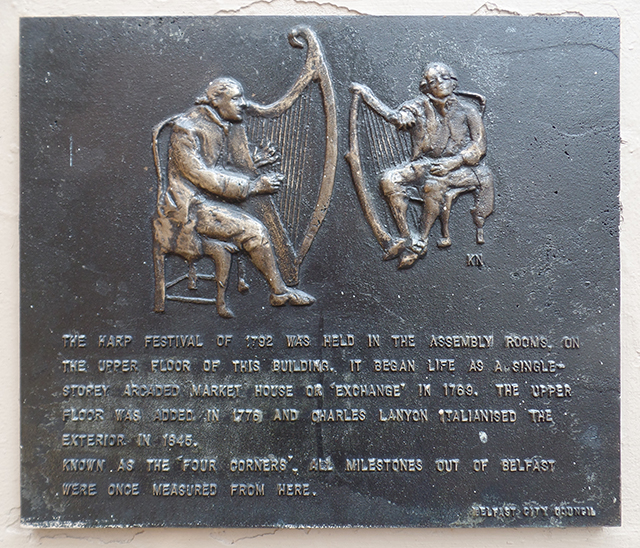
The 1792 Belfast Harp Festival is rightly held in high regard by musicians and scholars alike and is acknowledged as a moment of enormous significance in the recognition and preservation of Irish traditional music. 

Conversely, the Ulster-Scots song tradition, which first started to appear in print in 1793 (and potentially in newspapers earlier than this) is pretty much ignored. Scores of poetry books printed from that date onwards include easily 100 or maybe even up to 200 songs. Many give the names of the tunes they were to be sung to. Why is this not seen as important? Maybe only some music matters. Maybe some people discard their heritage too casually.

(The example below, about the 1798 Rebellion, was printed in 1811 – just 13 years after the Battle of Ballynahinch. It was written Francis Boyle of Granshaw, who lived just 13 miles from the battlefield and well within the community that it affected. He was about 60 years old in 1798.) 

SAM 0520

Commemorative plaque for the Harp Festival in Donegall Street, Belfast. SAM 0187

The Mecklenburg Declaration and the Mecklenburg Resolves

The original documents were lost in a fire in 1800, which has led some scholars to question the authenticity of the Mecklenburg Declaration of 20 May 1775. However in 1838 a similar document called the Mecklenburg Resolves was found, dated 31 May 1775. Other scholars have had no such qualms. Others mounted a campaign in support of the Resolves and proposed a state-wide celebration on 31 May each year. The Mecklenburg Declaration also featured in the Proceedings of the Scotch-Irish Society of the USA in 1895.

As historic as this is (or might be) the wording is not as emotive as that found in the earlier Fincastle Resolutions - a document about which there is no debate, and a document authored by an Ulsterman. Indeed, when you read it, it could ONLY have been written by an Ulsterman :).


01583u LRWheel255

Thursday, September 15, 2016

The Mecklenburg Declaration and Francis Cummings - 'the finest specimen of manly person in the crowd of fine-looking Scotch-Irishmen there'

A few weeks ago I posted here about the Fincastle Resolutions of 20 January 1775, said to be “… the earliest statement of armed resistance to the British Crown in the American Colonies …" which were writted by County Donegal-born Presbyterian Minister Rev Charles Cummings.

A few months after Fincastle, a similar but more famous Declaration was published at Mecklenburg in North Carolina, on 20 May 1775, and again among an overwhelmingly Ulster-Scots community. Present that day was a Rev Francis Cummings, who would later be a tutor to future President and son of Carrickfergus, Andrew Jackson, who, when the Mecklenburg Declaration was read aloud in Charlotte, North Carolina, was just a boy of 8 living 20 miles away at Waxhaw.

Here are two clippings from Sketches of Some of the Settlers of Upper Georgia, by George R Gilmer (1923).

Mecklenburg 2

Rev Francis Demaris Cummings sounds like the classic dashing hero. He was '...born near Shippenburg, Pennsylvania, in the spring of 1752. In his 19th year his parents moved to Mecklenburg County, and young Cummings exchanged his former life for the classic halls of the Queen's Museum in Charlotte, where he was an eye-witness of the Mecklenburg Convention of May, 1775, concerning which he furnished a certificate, and also gave some account in a published sermon. He graduated at Queen's Museum about 1776, and spent several years teaching. Among his pupils in Bethel, York County, South Carolina, was Andrew Jackson, afterwards President...'

His parents are thought to have been Charles and Rebecca (McNickle) Cummings.

Mecklenburg 1

A dramatic account of Cummings' preaching, dated 1802, can be found in Foote's Sketches of North Carolina, on p404. The ministers who preached at Spartanburg that day were called Kennedy, Williamson, Gilleland, Wilson, Simpson, M'Elhinney and of course Cummings. (link here)

Cummings died in Greensborough, Georgia, in 1831.

Sunday, September 11, 2016

Winchester, Virginia, 1755: "The inhabitants are a spurious race of mortals known by the appellation of Scotch-Irish."

Spooktacular Halloween Fest 2007

A few days ago Hillary Clinton said that half of Donald Trump’s supporters are ‘a basket of deplorables’. I suspect this will come back to haunt her. It plays very firmly into the ‘Hillbilly Elegy’ view of the world. And not dissimilar to being called, 261 years ago, ‘a spurious race of mortals’. 

That quote has two different sources:

• one is in a 1755 letter by Col. John Banister of Petersburg to Robert Bolling of Chellowe, Buckingham County, Virginia. You can read it all here. (the letter also says that the Scotch-Irish referred to the Blue Ridge Mountains as ‘Blue Ledge’. According to Chambers Scots Dictionary, ‘ledge’ in Scots means ‘parapet’ or ‘top’).

• The second source is from Scotsman Lord Adam Gordon in 1760, using exactly the same form of words about the inhabitants of Winchester. It is quoted in Essays in Scotch-Irish History, published by the Ulster Historical Foundation (first edition 1969, back in print again - click here to buy), in the essay 'Education in the American Colonies' by Esmond Wright M.P., then the Professor of Modern History at Glasgow University. Previously he had studied at the University of Virginia, where he became an authority on Colonial and Revolutionary America. Wright provides a stout defence of the historical veracity of the term ‘Scotch-Irish’ - he also says that none less than Thomas Jefferson even used the term of himself. (the quote also appears in The Story of Winchester, published in 1925, attributed to Gordon.)

………...

Winchester is a pretty, historic, town. We drove past it in July, having picked up some literature about it in the Virginia Welcome Center, on Interstate 66. We turned south at Front Royal, down into Shenandoah National Park and the Skyline Drive. Had we turned north, about half an hour along the road we would have arrived in Winchester.

Winchester was the birthplace, and final resting place, of country singing legend Patsy Cline (1932–1963), full name Virginia Patterson Hensley - her mother’s Patterson line likely to be Scotch-Irish. My late mother was a big Patsy Cline fan. In her last few months when she was housebound on Sunday mornings I would skip the mission hall service and take my old 1920s L-4 Gibson guitar up with me to see her,  and play familiar hymns and songs that she loved and would sing along to. Times that are too precious to have filmed or photographed, her voice weakened by old age and injury, yet still holding fast to simple profound Gospel truths. Old songs like this one:


Patsy Cline died in a plane crash and was buried at Shenandoah Memorial Park, less than three miles from Winchester’s Opequon Presbyterian Church which dates back to 1736, a congregation which first gathered in a log cabin under the oversight of Donegal (Pennsylvania) Presbytery. The building there today was built in 1897, but there’s a gravestone from 1742 in the adjacent cemetery. The name on the stone is John Wilson, who buried his wife and ’two childer' with ‘IRLAND’ chiselled into it - and is thought to be the earliest settler gravestone in the Valley of Virginia.

The stone crumbled under the unskilled hands of the husband, who brought it from the hill side on the west and inscribed the letters himself as a memorial to his young wife. Tradition says he was the school master. (source here)

My mother’s folk are all Wilsons. It’s a small transatlantic world.

In the same cemetery stands this stone:

To the memory of
Samuel Glass
and his wife
Mary Gamble
Emigrants from Banbridge
County Down, Ireland
A.D. 1735
and
Their Children
John
Eliza
Sarah
David
Robert
Joseph
Were all born in Ireland
And came with them.

………...

There is another, intriguing, connection with Winchester. It concerns an Ulster-Scot whose roots were at Killinchy in County Down, who fled to America as a boy after the 1798 Rebellion. He eventually settled at Winchester and became, in his day, an author of some importance. More about him soon...

What a ‘spurious race of mortals’. What a ‘basket of deplorables’ they were … and still are.

Saturday, September 10, 2016

David Ramsay, the 'Father of American History' (1749–1817) and 'another eminent Scotch-Irishman of this era'

1 2 6D9 25 Ramsay David copy

So it turns out that the Father of American History is, as some might say, ‘one of ours’.

David Ramsey (1749–1817; Wikipedia entry here) was the son of James Ramsay and Jane Montgomery  - as the Oxford DNB describes them, ‘Protestant Irish immigrant farmers’. Some genealogy websites suggest they were from Donegal. It has also been suggested that Jane was a cousin of General Richard Montgomery.

The Archives of Maryland says that James Ramsay served as a member of the Pennsylvania Assembly for York County. David had two older brothers: William became a Presbyterian minister and Nathaniel a high-ranking politician. The family lived in ‘East Drumore’ township - apparently in a ‘whitewashed stone hut’.

Here is an old 1800s bio:

"David Ramsay was born in Lancaster county Pennsylvania on the 2d day of April 1749. He was the youngest child of James Ramsay a respectable farmer who had emigrated from Ireland at an early age and by the cultivation of his farm with his own hands provided the means of subsistence and education for a numerous family. He was a man of intelligence and piety and early sowed the seeds of knowledge and religion in the minds of his children. He lived to reap the fruit of his labours and to see his offspring grow up around him ornaments of society and props of his declining years. The early impressions which the care of this excellent parent made on the mind of Dr Ramsay were never erased either by the progress of time the bustle of business or the cares of the world. He constantly entertained and expressed the highest veneration for the sacred volume and in his last will written by his own hand five months before his death when committing his soul to his maker he takes occasion to call the bible the best of books. It was connected with all his tenderest recollections it had been the companion of his childhood and through his whole life his guide and friend and comforter … Dr Ramsay had the misfortune to lose an amiable and excellent mother very early in life but that loss was in some measure repairedby his father who took uncommon pains to give him the best education that could be then obtained in this country...

In Rupp’s History of Lancaster County (1844), which gives a similar account of the Ramsays, there is a reference to a 1717 community of Ulster emigrants ‘on the banks of the Octorara Creek, by a party of what are now known as the Scotch-Irish. They had many difficulties to encounter...'

He had served in the South Carolina legislature during the War of Independence, and later as a surgeon on the battlefields; his second wife was Frances Witherspoon (the daughter of Declaration of Independence signer John Witherspoon); he was held prisoner for a year.

Astoundingly, in the absence of John Hancock, Ramsay served as Chairman of the Continental Congress and eventually became President of the South Carolina State Senate. It was Hancock who in 1775 had signed off on Congress’ famous address To The People of Ireland (full text online here), which was printed in Strabane-born John Dunlap’s Pennsylvania Packet newspaper on 28 July that same year. Here is the concluding section –

Accept our most grateful acknowledgments for the friendly disposition you have always strewn towards us. We know that you are not without your grievances. We sympathize with you in your distress, and are pleased to find that the design of subjugating us, has persuaded administration to dispense to Ireland, some vagrant rays of ministerial sunshine. Even the tender mercies of government have long been cruel towards you. In the rich pastures of Ireland, many hungry parricides have fed, and grown strong to labour in its destruction … we should be unworthy that ancestry from which we derive our descent, should we submit, with folded arms, to military butchery and depredation, to gratify the lordly ambition, or sate the avarice of a British Ministry. In defence of our persons and properties, under actual violation, we have taken up arms; When that violence shall be removed, and hostilities cease on the part of the aggressors, they shall cease on our part also. For the atchievement of this happy event, we confide in the good offices of our fellow-subjects beyond the Atlantic. ()f their friendly disposition, we do not yet despond; aware, as they must be, that they have nothing more to expect from the same common enemy, than the humble favour of being last devoured.

In 1785 Ramsay wrote the two volume set History of the Revolution of South Carolina (online here) – the first book in the USA to be granted copyright. Writing his own family experience into the context, on page 4 he says

...the assembly of the colony appropriated a large fund for bounties to foreign protestants who should settle in the interior parts. In consequence of this encouragement many arrived from Europe, particularly from Ireland. Great numbers also migrated from Virginia, Pennsylvania and other northern provinces...

In 1789 Ramsay published his History of the American Revolution. On page 23 he writes

This deterred great numbers, especially of the Presbyterian denomination who had emigrated from Ireland from settling within the limits of the governments, and fomented spirit of discord...


NB: It is in Wayland F Dunaway’s 1944 book The Scotch-irish in Colonial Pennsylvania where Ramsay is described as 'another eminent Scotch-Irishman of this era’.

1 2 701 25 ExplorePAHistory a0h1w6 a 349

Friday, September 09, 2016

Ole Smoky Tennessee Moonshine

When the Wall Street Journal writes this about a brand, it’s time to pay attention

“Everybody likes to tout that they’re original and authentic,” said Joe Baker, Ole Smoky’s co-founder. “The reality is that we are.” ... The Smokies have been a haven for illicit moonshine production since at least the 18th century, when a wave of Scots-Irish immigrants brought over traditions of making whiskey by fermenting corn and other grains...


It looks as old as the hills, but it’s only been around for 6 years – and that’s probably because of its founder. Joe Baker was a criminal lawyer living in east Tennessee where his ancestors had been among the earliest white settlers. When the state of Tennessee opened up its distilling laws in 2010, Baker established Ole Smoky Tennessee Moonshine. Here’s the story on Forbes.com

Moonshine is in Baker’s blood. His roots date back to the earliest settlers of Eastern Tennessee. The forested Smoky Mountains were a canopy for Baker’s ancestors and other moonshine distillers, many of them immigrants from Scotland and Ireland who settled there for its familiar terrain...


I had seen some of their advertising before we went to the USA in July, so, knowing we were going to be near Gatlinburg, we visited their new distillery and retail outlet at Pigeon Forge. Pics of our visit are below. The quality of the branding is so strong that you just know that it's more than a facade, more than just an image. It's the best retail 'brand experience' I've ever encountered. Absolutely spectacular.

It’s now the most-visited distillery in America with sales approaching $50m per year. Joe Baker has gone on to set up the Yee Haw Brewing Company, and a new line of Ole Smoky Whiskeys, the result of a merger with Davy Crockett Tennessee Whiskey. 

As it says on their jars, Shine Responsibly. And I had to buy a t-shirt.

I sent an email to Ole Smoky a few days after we got home. I had an idea for them. I hope it got forwarded to Joe Baker. Joe, feel free to get in touch!

IMG 5001IMG 5003IMG 5004IMG 5010IMG 5009IMG 5012IMG 5008IMG 5007IMG 5014IMG 5006IMG 5011IMG 5358

Thursday, September 08, 2016

The original Hillbilly Elegy? 'The Mountain Whites of The South - by a Scotch-Irishman' 1893

The Mountain Whites of The South - by a Scotch-Irishman is a booklet I picked up a good few years ago. Published anonymously in 1893, as you'll see from the images below (if the resolution is okay) it is an appeal to the churches and also the Scotch-Irish Society of the USA to launch a $400,000 educational and relief aid programme into Appalachia - that must surely equate to many tens of millions in todays money. The booklet is just 40 pages long but is packed with information.

The chapters are:
1. Evidences of Scotch-Irish Descent
2. How They Came to the Mountains
3. Their Claims for Aid
4. What is Being Done for their Evangelization
5. How to Benefit Them
6. An Appeal to the Scotch-Irish Society

It is a compilation of a series of articles which had appeared in the Presbyterian Banner newspaper. You can read an online version here

As Dr John Hall said in his introduction: "I write as one of the Scotch-Irish, and under the impulse of deep pity for those whose condition your correspondent describes".

It is interesting that the writer says that:

"I believe these whites of the mountains are largely of Scotch-Irish descent ... I sought for some histories that would treat of the subject in the libraries of Pittsburgh and Allegheny. I could find none. I applied, through a friend, to the Congressional Library in Washington DC. I was informed there was no work in which their origin was treated of in that library, and the learned librarian expressed the opinion that there was no book which contained any account of their origin".

I was a bit cheeky a few posts ago in referring to retired ex-pat Ulster Presbyterian ministers reminiscing in their twilight years. Well here they are, seeking to draw attention to the plight of the poor. That's what 'social justice' used to mean.

P.S.: All of this raises an interesting question - when was the first American-published history of the Scotch-Irish?  Here is one from 1858.

14046004 10154460443982878 6453207002431115305 n 14102133 10154460444092878 59453643644456385 n 14054011 10154460444992878 1185743185773803649 n

Monday, September 05, 2016

Hillbilly Elegy by JD Vance

Jd vance hillbilly elegy life in holler

You’d have to have been living on the moon all summer (or at least, completely detached from the growing resurgence of Scotch-Irish awareness in the USA as the election looms) to have missed the excitement that has followed the release of this new book - already a New York Times bestseller, topping the sales charts. (conversely, I noticed that when visiting July, Ulster-Scots / Scotch-Irishness seemed to be less visible - in bookstores, museums and heritage centres - than on previous trips in 1997 and 2002)

The timing has been impeccable, picking up on the Trump question, and all of the political head-scratching as to how Trump could have happened as a phenomenon. This book predates Trump, and his name doesnt appear once in its pages. Yet the smart commentators see a deeper cultural underbelly, one which has been brewing for decades.

In a later post I am going to suggest that this has in fact been growing for at least a century as can be seen through publications pleading with the Scotch-Irish Society of the USA and the Presbyterian church to launch a massive aid and education programme into Appalachia. There is no evidence that they ever did so. More to follow. Meanwhile here are author JD Vance’s own words :

"Two generations ago my grandparents were dirt-poor and in love. They got married and moved north to Ohio from the Appalachian hills of eastern Kentucky in the hope of escaping the dreadful poverty around them. Their grandchild (me) graduated from one of the finest educational institutions in the world, Yale Law School. But to understand me, you must understand thatI am a Scots-Irish hillbilly at heart.

“I may be white, but I do not identify with the WASPs of the Northeast. Instead, I identify with the millions of working-class white Americans of Scots-Irish descent who have no college degree. To these folks, poverty is the family tradition — their ancestors were day laborers in the Southern slave economy, sharecroppers after that, coal miners after that, and machinists and mill workers during more recent times. Americans call them hillbillies, rednecks, or white trash. I call them neighbors, friends and family.

The Scots-Irish are one of the most distinctive subgroups in America. As one observer noted, “In traveling across America, the Scots-Irish have consistently blown my mind as far and away the most persistent and unchanging regional subculture in the country. Their family structures, religion and politics, and social lives all remain unchanged compared to the wholesale abandonment of tradition that’s occurred nearly everywhere else.”1 This distinctive embrace of cultural tradition comes along with many good traits—an intense sense of loyalty, a fierce dedication to family and country—but also many bad ones. We do not like outsiders or people who are different from us, whether the difference lies in how they look, how they act, or, most important, how they talk. To understand me, you must understand that I am a Scots-Irish hillbilly at heart.

If ethnicity is one side of the coin, then geography is the other. When the first wave of Scots-Irish immigrants landed in the New World in the eighteenth century, they were deeply attracted to the Appalachian Mountains. This region is admittedly huge—stretching from Alabama to Georgia in the South to Ohio to parts of New York in the North—but the culture of Greater Appalachia is remarkably cohesive. My family, from the hills of eastern Kentucky, describe themselves as hillbillies, but Hank Williams, Jr.—born in Louisiana and an Alabama resident—also identified himself as one in his rural white anthem “A Country Boy Can Survive.” It was Greater Appalachia’s political reorientation from Democrat to Republican that redefined American politics after Nixon. And it is in Greater Appalachia where the fortunes of working-class whites seem dimmest. From low social mobility to poverty to divorce and drug addiction, my home is a hub of misery.”

I am fortunate to have travelled through Appalachia three times. When the kids are grown up and moved out I might even relocate there for a time. These people are not just JD Vance's people, they are our people too.

……….

I don’t buy into the Trump = Scotch-Irish theory. No ‘people group’ behaves in a single way. There are plenty of Scotch-Irish who oppose him, indeed the whole point of President Barack Obama’s recent speech was that Trump does not exhibit classic Scotch-Irish values. So, American commentators need to learn some nuance. But the rise of Scotch-Irishness as a concept, representing a set of values, is what is so interesting here.

Sunday, September 04, 2016

"heritage doesn't matter"

Crcxz8VWIAEh1EJ

Friday, September 02, 2016

Grave of Dr Robert Murray, born in County Down, died in Virginia

Typical. We drove past this area when in Virginia back in July. This doctor, buried at Cedar Hill Cemetery, Suffolk, Virginia, was the father of the tobacco millionaire Robert Wallace Murray who came to Belfast to set up his firm. Information from FindAGrave.com

80706197 132174744479


Tuesday, August 30, 2016

College of William and Mary, Colonial Williamsburg, Virginia: "The Valley Ulsterman: A Chapter of Virginia History"

Tucker Hall

On Richmond Road in Williamsburg, a famous college town, is Tucker Hall. On the entrance pillars to Tucker Hall are two statues, of King William III and his wife Queen Mary. These were gifted to the college in the 1920s by Mary Cooke Branch Munford, the first female member of the Boards of Visitors. Back in July I drove up and down this road quite a few times trying to spot the statues, but with no success. The image here is from Google StreetView.

Over 20 years earlier, on 18 February 1896, Armistead C Gordon, a lawyer from Staunton, Virginia, gave an address to the Phi Beta Kappa Society of the college, entitled The Valley Ulsterman: A Chapter of Virginia History. Gordon was also a member of the Boards of Visitors of the college; I have an old pamphlet edition of the talk. The text of the address is available online here.

Armistead Churchill Gordon Portrait Magazine of Poetry 1892

"... invoke from the shadows of the historic and glory-haunted past the Scotch-Irish Ulsterman of the Virginia Valley,--the stalwart and sombre sentinel of liberty upon the outposts of American colonial civilization.

... a distinguished Scotch Irish divine, who came from the North of Ireland after our civil war to minister to a great church in New York City, stated recently that a gathering of Valley people, which he addressed in the county of Rockbridge, reminded him more than any he had ever seen, of his own congregation in the little town of Newry, in County Tyrone, Ulster.

They were men of large courage and of simple faith, these early Ulstermen,--so afraid of God, says the historian of them, that this fear left in their hearts no room for fear of mortal man. Their fixity of purpose, once determined, is aptly if fancifully illustrated in the mythic story which is told of the device of the Ulster Coat of Arms, a device known to all Scotch-Irishmen as "The Bloody Hand of Ulster" ... the Scotch-Irish riflemen of the Valley of Virginia justified in the eyes of history their right to claim as theirs the device of the Bloody Hand ..." --

The College of William and Mary had been founded during their reign in 1693 by Rev James Blair (1656–1743) a Scottish-born minister, originally a Presbyterian but became Episcopalian in 1681 during ‘The Killing Times’. There’s no indication that he had any connection with Ulster. Here's a photo of Charlie holding up a colonial flag outside Williamsburg's Presbyterian meeting house.

NewImage2016 07 04 11 52 38  1SAM 0459  1

Monday, August 29, 2016

Rev Matthew Clark of Londonderry, New Hampshire - Ulster-Scots preacher.

Matthew ClarkRev Matthew Clark (1660–1735) from Kilrea was a veteran of the Siege of Derry. In April 1729 aged around 70 he headed across the Atlantic to succeed Rev James McGregor as minister of Londonderry, New Hampshire. It is said that Clark ‘possessed a strong mind, marked by a considerable degree of eccentricity’. When he died on 25 January 1735, his coffin was carried to his grave by fellow Siege veterans.

A few insights into Clark’s sermons have survived, in the pages of The Autobiography of Horace Greeley, or Recollections of a Busy Life (New York, 1872). Greeley was a famous newspaperman, and that same year ran for President as a ‘Liberal Republican’. His Wikipedia entry is fascinating. His mother was Mary Woodburn, she was descended from a John Woodburn who had emigrated from Ulster in 1725 with his brother David. In a chapter entitled 'A Sample of the Scotch-Irish', Greeley wrote this of Matthew Clark:

"...Mr. McGregor died in 1729, and was succeeded by Rev. Matthew Clark, a patriarch who now came out from Ireland on purpose, and whose memory deserves a paragraph. He never ate flesh, but said nothing on the subject ; and his abstinence was regarded as an idle whim, until one day when my great-grandmother (his niece, as I remember), then a young girl and an inmate of his house, saw the pot wherein the family dinner was cooking boil over into the smaller vessel wherein was boiling his frugal mess of greens. Supposing this of no consequence, she said nothing until — the family being seated at the table, and its head having said grace and taken his first mouthful — he was observed to fall back insensible and apparently dying. Recovering his consciousness after a few moments, he calmed the general excitement by saying, " It is nothing — a trifle — I shall be well directly — only a little of the water from your meat has boiled over into my greens." He had been a lieutenant in the famous Siege, wherein he was wounded in the temple by a ball, which injured a bone so that it never healed ; and, though a devoted evangelist, could never forget that he had been a soldier. Once, while acting as Moderator of an assembled Presbytery, the music of a marching company was heard, when his attention was wholly absorbed by it. Being repeatedly called to give heed to the grave business in hand, his steady reply was,

"Nae business while I hear the roll of the drum."

When death came to him at seventy-six years of age, and after forty years of blameless ministry, he said to sympathizing friends, "I have a last request which must not be denied." " What is it, Father Clark ? " "Let me be borne to my rest by my brother soldiers in the Siege, and let them fire a parting volley over my grave ! " The military parade was conceded ; but, according to my mother's tradition, the volley, though promised, was withheld ; it being deemed indecorous and unsuitable that so holy a man should be indulged in a dying freak so unbecoming his cloth..."

Even in sermons Clark was known to use his native Ulster-Scots:

"...The settlers knew that their homespun garments (often of tow) contrasted strongly with the trim, dapper apparel of the polished denizens of more refined communities ; but they were not thereby disconcerted. Though Burns had not yet strung his immortal lyre, his spirit so flooded their log-cabins that he would have been welcomed and understood in any of them, but would have excited surprise in none. Thus it is related of the Rev. Matthew Clark, already mentioned, that, among the audience in attendance on his ministrations was once a young British military officer, whose scarlet uniform far outshone any rival habiliments, and so fixed the gaze of the young damsels present, that the wearer, enjoying the impression he was making, not only stood through the prayer with the rest, but remained standing after all others had sat down, until the pastor had proceeded for some time with his sermon. At length, noticing a divided attention and its cause, the minister stopped, laid aside his sermon, and, addressing his new hearer, said :

" Ye 're a braw (brave) lad ; ye ha'e a braw suit of claithes, and we ha'e a' seen them ; ye may sit doun."

The lieutenant dropped as if shot, and the sermon was resumed and concluded as though it had not been interrupted.

Here is a longer example:

"...Rev. E. L. Parker's “ History of Londonderry, unto which I am indebted for many facts, gives the following specimen of Mr. Clark's pulpit efforts. His theme was Peter's assurance that, though all others should forsake his Divine Master, lie never would ; and this was a part of his commentary : —"Just like Peter — aye mair forrit (forward) than wise; ganging swaggering aboot wi' a sword at his side ; an' a puir han' he mad' o' it when he cam' to the trial ; for he only cut off a chiel's lug (ear) ; an' he ought to ha' split doun his head."


Clark was not unique in his use of Ulster-Scots, the other Ulster families were just the same:

"...it is related of the Morrisons, who were among the first settlers, -that the good dame remonstrated against the contemplated homestead until assured that there was no help for it, when she acquiescingly entreated :

"A-weel, a-weel, dear John, if it maun (must) be a log-house, make it a log heegher nor the lave "

(a log higher that the rest).


In the late 1800s when Leonard A Morrison (1843–1902), historian of New Hampshire, returned to visit the 'old country', this is what he found:

"...Rev. Matthew Clark, of Kilrea, three miles distant, was the second minister of Londonderry, N. H.. The people in the settlements of Kilrea, Garvagh, Aghadowey, and others are distinctly Scotch, after a residence of 200 years ... I have met and heard talk in some of the settlements persons with the Scotch dialect, with the rich brogue which was occasionally heard in my childhood ..."

This was of course the very same Ulster-American emigrant community which would produce the poems of Robert Dinsmoor in 1828. DInsmoor described the 1718 migration in verse:

In Ulster Province, Erin's northern strand
Five shiploads joined to leave that far off land.
They had their ministers to pray and preach
These twenty families embarked in each.
Here I would note and have it understood,
Those emigrants were not Hibernian blood,
But sturdy Scotsmen true, whose fathers fled
From Argyllshire, where protestants had bled
In days of Stuart Charles and James second
Where persecution was a virtue reckoned,
They found shelter on the Irish shore
In Ulster, not a century before
Four of these ships at Boston harbor landed;
The fifth, by chance at Casco Bay was stranded…

Saturday, August 27, 2016

Oxford Pennant - 'Liberty or Death'

Saw this in a very cool shop called Devolve Moto in Raleigh, North Carolina. Should have bought it! Available online from the manufacturer, Oxford Pennant.


MG 9605


Wednesday, August 24, 2016

Carter G Woodson, Berea College (Kentucky) and the term 'Scotch-Irish' yet again

1000509261001 2152051039001 History Black History Month Origins of Black History Month SF HD 768x432 16x9
When on honeymoon nearly 20 years ago, we stayed at Boone Tavern which is part of Berea College in the town of Berea, Kentucky. This was the first integrated college in the South, established in 1855 by a Presbyterian minister of Scotch-Irish descent called Rev John Fee and his wife Matilda Hamilton Fee. A publication about their respective ancestry is online here. Here is a photo of Hilary and I once again at the Tavern door, back in July of this year, struggling to take a 'selfie'. It is a wonderful place, one of the ‘Historic Hotels of America’.
13606720 10154332174342878 2424966236883499859 n 13690906 10154332450067878 7391066391815553951 o
Berea is named after the town referred to in the Bible in Acts chapter 17, the chapter from which the College took its motto: "And hath made of one blood all nations of men for to dwell on all the face of the earth".
One famous black graduate of the College, in 1903, was Carter G. Woodson (1875–1950), regarded as the ‘Father of Black History’. His remarkable intelligence resulted in a PhD in history from Harvard University in 1912. In 1916 Woodson founded the quarterly Journal of Negro History, in which he frequently spoke of his lifelong rural neighbours as 'Scotch-Irish', and demonstrated a sound grasp of our history. His essay 'Freedom and Slavery in Appalachia' (link here) is still today regarded as a landmark, in which he says that:

"… the strongest stock among these immigrants, however, were the Scotch-Irish, "a God-fearing, Sabbath-keeping, covenant-adhering, liberty-loving and tyrant-hating race" which had formed its ideals under the influence of philosophy of John Calvin, John Knox, Andrew Melville, and George Buchanan.
By these thinkers they had been taught to emphasise equality, freedom of conscience, and political liberty ... when they demanded liberty for the colonists they spoke also for the slaves ... the ideals of the westerners were principally those of the Scotch-Irish, working for "civil liberty in fee simple, and an open road to civil honors, secured to the poorest and feeblest members of society" ...
they therefore hated the institution [of slavery] ... on the early southern frontier there was more prejudice against the slave holder than against the Negro ..."
In later publications he wrote these words:
“… In the States of Kentucky and Tennessee friends of the race were often left free to instruct them as they wished. Many of the people who settled those States came from the Scotch-Irish stock of the Appalachian Mountains, where early in the nineteenth century the blacks were in some cases treated as equals of the whites …"
“… Statistics of this period show that the proportionately largest number of Negroes who learned in spite of opposition were found among the Scotch-Irish of Kentucky and Tennessee. Possessing few slaves, and having no permanent attachment to the institution, those mountaineers did not yield to the reactionaries who were determined to keep the Negroes in heathendom. Kentucky and Tennessee did not expressly forbid the education of the colored people …"
“…  A considerable portion of the abolition literature which influenced  public opinion appeared in the Genius of Universal Emancipation, published by Benjamin Lundy. Through this organ the sentiments of a large number of antislavery people living in the Appalachian highland found expression. They were descendants of the Germans and Scotch-Irish immigrants who came to this country to realize their ideals of religion and government, differing widely from those of the aristocratic planters who maintained a slavocracy near the coast …"
“…  In the very heart of the South, however, the Presbyterians did not fail to aid the instruction of Negroes wherever public opinion permitted it, although they had to confine themselves largely to verbal instruction. In the mountains of Virginia, North Carolina, and Kentucky, where the Scotch-Irish element dominated, there was no diminution of ardor in the religious instruction of the Negroes…"

Bear in mind that these are the words of America's foremost Black historian, a PhD born in New Canton, Virginia, on the fringes of the Appalachian mountains, and educated in West Virginia and Kentucky, a son of former slaves and who lived among the Scotch-Irish people. These are not the imaginings of some ancient expatriate Ulster Presbyterian relic, reminiscing about 'the bygone days of yore' from his retirement manse, waiting for the next annual Congress of the Society to come round. That’s a bit cheeky of me, but you get my point.
Some editions of the Journal are online. Here's the very first edition. If you text-search it, you'll see the term Scotch-Irish appears 14 times. It wouldn't be that frequent in a full year of today's Belfast Telegraph.
“A God-fearing, Sabbath-keeping, covenant-adhering, liberty-loving and tyrant-hating race”. That, in the words of none other than Carter G Woodson, is the Scotch-Irish.

Tuesday, August 23, 2016

The Fincastle Resolutions monument, Austinville, Virginia

In case you were in any doubt about the importance of the Fincastle story - there is a huge stone memorial with this plaque, at the site of the old Courthouse. Article here.

28234238 134469343093

Ole Smoky Tennessee Moonshine

I took this shot, one of many, when we visited their store in Gatlinburg, Tennessee in July. To paraphrase Bill Clinton ‘I inhaled but I didn’t ingest’ - the aroma was something else, but I was driving that day! Post coming soon...

IMG 5008

Monday, August 22, 2016

"Give me Liberty or give me Death" – Patrick Henry

One of the most famous speeches of the American Revolution, given in Richmond, Virginia on 23 March 1775, depicted here in Luther-like pose. Patrick Henry's father was from Aberdeen, and his sister Elizabeth was married to William Campbell, one of the signatories to the Fincastle Resolutions outlined in the post below. Campbell is known to have been of Ulster-Scots descent. Campbell went on to become a hero of the American Revolution, achieving the rank of General. Here is a 1910 ‘Monument’ document to him, published by the United States Senate. What an extract –

‘… In the confronting ranks was a very different class of men. Those from the Holston, under Campbell, were a peculiar people … they were, almost to a man, Presbyterians. In their homes, in the Holston Valley, they were settled in pretty compact congregations; quite tenacious of their religious and civil liberties, as handed down from father to son from their Scotch-Irish ancestors. Their preacher. Rev. Charles Cummins, was well fitted for the times; a man of piety and sterling patriotism, who constantly exerted himself to encourage his people to make every needed sacrifice and put forth every possible exertion in defense of the liberties of their country.

They were a remarkable body of men, both physically and mentally … ever ready at the tap of the drum  to turn out on military service; if in the busiest crop season, their wives, sisters, and daughters could, in their absence, plant and sow and harvest. They were better educated than most of the frontier settlers, and had a more thorough understanding of the questions at issue between the colonies and their mother country. These men went forth to strike their country's foes, as did the patriarchs of old, feeling assured that the God of battles was with them, and that He would surely crown their efforts  with success. They had no doubts nor fears. They trusted in God and kept their powder dry. Such a thing as a coward was not known among them …’


DT9295

Sunday, August 21, 2016

Rev Charles Cummings and an early Declaration of Independence (Abingdon, Virginia, 20 January 1775 ) – "we declare, that we are deliberately and resolutely determined never to surrender"

2902263626 afe0b60a10 z

“… the first adopted statement by the Colonies which promised resistance to the death …”
“… the earliest statement of armed resistance to the British Crown in the American Colonies …" 

The fuse of the 1776 American Revolution was lit by Scotch-Irish Presbyterians. Four years earlier in a remote mountain place called Lead Mines (now Austinville) in south west Virginia, a Rev Charles Cummings (1732-1812) was a leading Presbyterian minister. He had been born in Ireland (possibly Donegal) and emigrated when he was 18 on board a vessel captained by his brother James. Charles went to college in Pennsylvania and graduated in theology, during which he was tutored by Newry-born Rev James Waddell (1739–1805).

Lead Mines was the frontier seat of the vast Fincastle County, then a huge jurisdiction covering what is now south-western Virginia and all of Kentucky. Aged around 40, Cummings accepted a call to the southwest frontier and found himself among Ulster folk, or folk of Ulster descent. His old cabin home still stands today in Sinking Springs Cemetery, Abingdon (just off Cummings Street).

He is said to have drafted the Fincastle Resolutions of 20 January 1775 which are regarded as a precursor to the eventual Declaration of Independence of 1776. There had been earlier statements from other counties, but this was the first to promise resistance to the death. When you read the words of the Resolutions below, you’ll hear echoes of the Siege of Derry ringing in your ears! (One writer thinks that the meeting which adopted the Resolutions was held at James McGavock’s tavern in Fort Chiswell. McGavock was born near Glenarm in County Antrim).

The 13 signers of the Resolutions were:

William Campbell
Arthur Campbell
William Christian
Walter Crockett
Charles Cummings
William Edmondson
William Ingles
Thomas Madison
James McGavock
John Montgomery
William Preston
Evan Shelby
Stephen Trigg

Here is the old Cummings cabin, recently restored: Sinking spring cemetery

In his 10 volume History of the United States from the Discovery of the American Continent, renowned American historian George Bancroft described the events as follows:

It is not probable that even one of the peers [in the House of Lords] had heard of the settlements beyond the Alleghenies, where the Watauga and the forks of the Holston flow to the Tennessee. Yet on the same day, the lords of that region, most of them Presbyterians of Scottish-Irish descent, met in council near Abingdon. Their united congregations, having suffered from Sabbaths too much profaned, or wasted in melancholy silence at home, had called Charles Cummings to the pastoral charge of their precious and immortal souls. The men never went to public worship without being armed, or without their families. Their minister, on Sabbath morning, would ride to the service with shot and pouch and rifle.... The news from Congress reached them slowly; but, on receiving an account of what had been done, they assembled in convention, and the spirit of freedom swept through their minds as naturally as the forest winds sways the firs on the sides of Black Mountain. They adhered unanimously to the association of Congress, and named as their committee Charles Cummings [and others]. Adopting the delegates of Virginia as their representatives, they addressed them as men whose conduct would immortalize them in its annals.

– George Bancroft, History of the United States from the Discovery of the American Continent, Vol. 7, 4th edition..

 ……………………...

The Fincastle Resolutions should therefore be regarded as one of the great Ulster-Scots declaratory documents. If you are familiar with the various Scottish (Presbyterian) Covenants, you will see the template of conditional loyalty writ large in these words –

"To the Honorable Peyton Randolph, Esq; Richard Henry Lee, George Washington, Patrick Henry, junior, Richard Bland, Benjamin Harrison, and Edmund Pendleton, Esquires, the Delegates from this colony who attended the Continental Congress held at Philadelphia: 

Gentlemen,
Had it not been for our remote situation, and the Indian war which we were lately engaged in, to chastise those cruel and savage people for the many murders and depredations they have committed amongst us (now happily terminated, under the auspices of our present worthy Governour, his Excellency the Right Honourable the Earl of Dunmore) we should before this time have made known to you our thankfulness for the very important services you have rendered to this country, in conjunction with the worthy Delegates from the other provinces. Your noble efforts for reconciling the Mother Country and the Colonies, on rational and constitutional principles, and your pacifick,steady, and uniform conduct in that arduous work, entitle you to the esteem of all British America, and will immortalize you in the annals of your country. We heartily concur in your resolutions, and shall, in every instance, strictly and invariably adhere thereto.

We assure you, Gentlemen, and all our countrymen, that we are a people whose hearts overflow with love and duty to our lawful sovereign George III. whose illustrious house, for several successive reigns, have been the guardians of civil and religious rights and liberties of his subjects, as settled at the glorious Revolution; that we are willing to risk our lives in the service of his Majesty, for the support of the Protestant religion, and the rights and liberties of his subjects, as they have been established by compact, law, and ancient charters.

We are heartily grieved at the differences which now subsist between the parent state and the colonies, and most ardently wish to see harmony restored, on an equitable basis, and by the most lenient measures that can be devised by the heart of men.

Many of us, and our forefathers, left our native land, considering it as a kingdom subjected to inordinate power, and greatly abridged of its liberties. We crossed the Atlantick, and explored this then uncultivated wilderness, bordering on many nations of savages, and surrounded by mountains almost inaccessible to any but those very savages, who have incessantly been committing barbarities and depredations on us since our first seating the country. These fatigues and dangers we patiently encountered, supported by the pleasing hope of enjoying those rights and liberties which have been granted to Virginians and were denied us in our native country, and of transmitting them inviolate to our posterity. But even to these remote regions the land of unlimited and unconstitutional power hath pursued us, to strip us of that liberty and property with which God, nature, and the rights of humanity, have vested us. We are ready and willing to contribute all in our power for the support of his Majesty's government, if applied to constitutionally, and when the grants are made by our own representatives; but cannot think of submitting our liberty or property to the power of a venal British parliament, or to the will of a corrupt ministry.

We by no means desire to shake off our duty or allegiance to our lawful sovereign, but on the contrary shall ever glory in being the loyal subjects of a Protestant prince, descended from such illustrious progenitors, so long as we can enjoy the free exercise of our religion, as Protestants, and our liberties and properties, as British subjects.

But if no pacifick measures shall be proposed or adopted by Great Britain, and our enemies will attempt to dragoon us out of those inestimable privileges which we are entitled to as subjects, and to reduce us to a state of slavery, we declare, that we are deliberately and resolutely determined never to surrender them to any power upon earth, but at the expense of our lives.

These are our real, though unpolished sentiments, of liberty and loyalty, and in them we are resolved to live and die.

We are, Gentlemen, with the utmost esteem and regard, your most obedient servant."

……………………...

• Rev Charles Cummings’ parents were John Cummings and Sara (Polk) Cummings. His wife was Mildred Millicent (Carter) Cummings.

• You can read more here.

• Recent article on Cummings here


PS: Exactly 4 months after, on 20 May 1775, the more well-known Mecklenburg Declaration was proclaimed in North Carolina. One of the men present was a Rev Francis Cummings, whose parents were from Ireland, but he was born in Pennsylvania in 1752. When he was 19 his parents moved to Mecklenburg County where one of his pupils was the young Andrew Jackson. Read more on p 139 here.