Camel City Goods from Airtype on Vimeo.


Camel City Goods from Airtype on Vimeo.


And it goes on… the term has a far deeper pedigree than some are willing to acknowledge.
This clipping refers to Hugh Glass, the main character in the Oscar-winning movie The Revenant.
The Board of Health for Philadelphia didn’t want them in 1841. And many today will still deny that these people were called ‘Scotch-Irish’ at all. However, as more and more old printed material gets digitised and put online, more evidence continues to emerge for the veracity of our own history.
‘...commonly called Scotch Irish...’ clearly indicates that the term was in widespread use in 1841 - and so not therefore only a later sectarian invention which served to distinguish themselves from Catholic 'Famine Irish’, as is often alleged.
More about this brand to come in future posts. Genuine heritage which pours from every image and every sentence just as easy as 'shine from a mason jar...

This Guardian article by Kyle Chayka is very important. It is an update of an earlier article in The Verge. Maybe he reads my blog (joking), as his theme reflects a few recent posts here. His insight into what I will call a faux-authentic aesthetic is superb. Reclaimed industrial retro minimalism carefully-curated for the interiors of hipster joints right across the westernised world to all look exactly the same.
There is a massive difference between reflecting and honouring an actual lived heritage, and merely acquiring the appearance of heritage as a momentary fashion statement. I have a scythe on my kitchen wall because, from at least as long ago as 1750, my ancestors mowed the field I built our house on.
Frankly, the thought of skinny-jeaned hipsters Instagramming while eating avocado toast on a roughly-sawn bit of original shipyard sleeper makes my blood boil. Belfast is now coming down with this kind of high-class nonsense. As is Edinburgh, and Bristol, and probably all of our honourable cities. The people of Belfast used to actually sweat and make stuff, now their middle-class grandchildren get anxious about sourdough bread, feta cheese and rocket. Rocket? We used to BUILD AEROPLANES.
Learn how to turn a spade, fill a wheelbarrow, know the difference between a longtail and square shovel. Admire the workmanship of a real stone wall. A grape isn't to be cut in half for your poncy lunchtime salad served on a slate by the weedy beardy guy in the baseball hat - it's for hoakin prootas by folk who understand the seasons, the earth, as did every single generation that has gone before. Until now.
Heritage is not a style accessory. I am glad the hipster aesthetic is being exposed for what it is - the Emperor's (salvaged and tastefully upcycled) nearly-new clothes.
(pic above is some place in London).
Aaron Lewis' music is more like a Hank Williams and Johnny Cash approach than much of the pasteurised & nutra-sweet stuff that's marketed under the 'country' these days. (Forgive the f-word expletive at the very start of the trailer interview below). In the title track the legendary Willie Nelson sings a few lines –
"I hope the Lord can come save my soul Cause I'm a sinner to my core I ask forgiveness and nothing more"
He grew up in rural Massachussetts, not far from the Merrimack River communities favoured by Ulster emigrants in the 1600s and 1700s.
But even though geographically northern, there is a southern cultural ethic at work across much of rural America - spot the Ole Smoky Tennessee Moonshine branding at 3:00. And this song makes the point superbly well:
Sinner by Aaron Lewis (former frontman of rock band Staind) is out on 16 September. His 2010 track Country Boy is also below.
More thoughts from America. My wife is really into crafts - we met at art college when she came to Belfast to do a degree in Fine Craft Design. We have spent a lot of time in craft stores over the past 25 years or so.
The state of Kentucky, when we were there on honeymoon in 1997, was starting to brand itself as a state for artisans and craftspeople, a tradition which had been evident in the state for at least 100 years. ‘Kentucky Crafted’ was and still is the brand name. Nearly 20 years on, there is now a huge stylish retail outlet - The Kentucky Artisan Center - where hundreds of Kentucky artists sell their wares.
On this visit, it seemed to us that the work being made and sold was, in all honesty, not all that different from the work available at craft fairs and outlets here in Northern Ireland, the Republic of Ireland, in Scotland or in England. There is a similar aesthetic. The only tangible difference might be a locally-sourced material, or some local quirk. But the overriding aesthetic - from the artist’s influences, imagination, and production method - is becoming homogenised. The items are exquisitely made. But they seem less local and less unique. It might be made locally, but does it reflect locality?
Perhaps the internet has done this. Certainly in graphic design, it is easy to now absorb influences from around the world, which results in (for example) designers buying the same fonts from the same websites, the same images from the same photo libraries, the same paper stocks from the same big international paper merchants, etc. Photography is the same.
It also happened 100 years ago when recorded music, initlally via 78s and then the radio, could be sent anywhere in the western world and so previously local musical styles were instantly influenced - the players could now hear a fiddle style from across the Atlantic, whereas for generations, centuries even, the only influence was other players within walking distance. Local started to die pretty quickly.
On a previous trip to the USA, I was in Waynesville in North Carolina when the annual fair was taking place. I got talking to a man at a craft stall, who was selling handmade wooden toys and utensils. I asked him if these were traditional items.
His answer - “No. These are just the things that the tourists want to buy”.
‘State Street’ in Bristol is famous for three things - the state line runs right up the middle of the road (as immortalised in the Steve Earle murder ballad ‘Carrie Brown’), and also that just nearby is the burger bar where Hank Williams was last seen alive on New Year’s Eve 1952. The people in Bristol genuinely look like Ulster folk. It was uncanny.
The third thing is that Bristol was where, in 1927, the first country music recordings were made. The now-infamous ‘Bristol Sessions’ brought the Carter Family and Jimmie Rodgers from obscurity to national, and later international, fame. And so it was only right that the Birthplace of Country Music Museum, an affiliate of the Smithsonian Institution, would be founded here in August 2014.
We arrived late, delayed by heavy traffic on a 272 mile journey from Winston-Salem in North Carolina as we drove toward Knoxville in east Tennessee, with Bristol a planned stop (ironically, Hank Williams was doing the same journey, but the other way round). The staff were wonderful, interested in Northern Ireland, knowledgable about Scotch-Irish roots, and kind-hearted enough to stay after closing time to let me see around and to talk - and to tip me off as to other things to make sure to see.
I plan to go back one day, and to spend more time there. What struck me above all was how open and accepting the Museum is about the importance of old-time Gospel music, of hymns and faith, as a critical component in the origins of the genre, and also in the present day. Part of the gallery is a recreation of a church interior, with a large LCD screen playing a looped film of present-day Gospel singers from the area telling their stories and explaining the simple life-transforming message of faith alone in Christ alone.
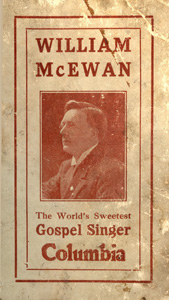
I tried to imagine a museum here which would host this kind of content. But I couldn’t. I suspect the content would be strangled at birth. And yet there is a story, of how the music made the return journey, back to Ulster and Scotland again, with the singing of Ira D Sankey, with recordings by William MacEwan, with recordings by the Carter Family and 'brother duets' of the early 1900s. The music wasn't exported, it just flowed back to the further reaches of the same community rom which it originated, a British Isles distant cousin both connected to and separated from our American kinfolk by the ocean.
I remember once telling a visibly-shocked broadcast presenter that Gospel music isn't primarily a style, or a genre, but a message set to song, across multiple styles and genres. That bit got edited out. Old-time country music - the simplicity of a Blue Sky Boys or Bailes Brothers or McCravy Brothers record - just makes the message even more plaintive and powerful.
We were in rural Virginia. We arrived at the venue which was to be our base for the next 3 days. As we checked in, a poster with the title above caught my attention.
So that evening I went to see the one-man show, expecting a cultural epiphany.
In a sense it was. But rather than ‘Soldier’s Joy’, ‘Boyne Water’, ‘Knoxville Girl’ and many other songs and tunes which have proven Ulster-Appalachian credentials, we got something a lot less interesting:
'My Bonnie Lies Over the Ocean', 'Whiskey in the Jar', even 'What Shall We Do with the Drunken Sailor', a Stephen Foster song or two. ‘Mull of Kintyre' might also have been in there too. I can’t really remember. I went panning for musical and cultural gold - but found nothing.
It was entertaining, it was well played and sung, the artist had the room eating out of his hand. But there was a bigger, better and more compelling opportunity here which was completely missed. Meaning was sacrificed for entertainment. Or perhaps meaning wasn’t really understood in the first place - not transmitted and not sought for.
(PS - pic above is Bill Monroe. He would have done a much better job).
(go to 36:15 in)
" ... And it's got me thinking about the story I told you twelve years ago tonight, about my Kansas grandparents and the things they taught me when I was growing up. See my grandparents, they came from the heartland; their ancestors began settling there about 200 years ago. I don't know if they had their birth certificates, but they were there. And they were Scotch-Irish mostly, farmers, teachers, ranch hands, pharmacists, oil-rig workers. Hardy, small-town folk. Some were Democrats, but a lot of them, maybe even most of them, were Republicans. Party of Lincoln. And my grandparents explained that folks in these parts, they didn't like show-offs. They didn't admire braggarts or bullies. They didn't respect mean-spiritedness, or folks who were always looking for shortcuts in life. Instead, what they valued were traits like honesty and hard work. Kindness. Courtesy. Humility. Responsibility. Helping each other out.
That's what they believed in. True things. Things that last. The things we try to teach our kids.
And what my grandparents understood was that these values weren't limited to Kansas. They weren't limited to small towns. These values could travel to Hawaii; they could travel even to the other side of the world ..."
"It is astonishing,” he says, "how little idea Presbyterians have of pastoral beauty; the Catholic has ten times more fancy — but a Presbyterian minds only the main chance. If he builds a cottage, it is a prison in miniature; if he has a lawn, it is only grass ; the fence of his grounds is a stone wall, seldom a hedge. ... A Presbyterian has a sluggish imagination : it may be awakened by the gloomy or terrific, but seldom revels in the beautiful."
– Gamble's Sketches of History, Politics and Manners in Dublin and the North of Ireland in 1810
Above: Boston, 1730
"But what shall be done for the great number of people that are transporting themselves thither from ye North of Ireland?” - Cotton Mather
Mather's family were familiar with Dublin life, his father was at Trinity College and his two uncles were rectors in the city. He wrote letters to 'diverse persons of honour' with the aim of attracting them to the New World. He had a fair idea of the type of people who would come, not urban Dubliners, but northern Presbyterians with the Siege of Derry still in their veins. He hoped they would in some way be similar to Francis Makemie, who had made a huge impact since his arrival in 1683, and whose work he greatly admired. But not everyone was so keen when the Ulster-Scots turned up:
"... The early ties of religious sympathy and common purpose of the two countries were such that it was natural for Ulster emigration to set strongly toward New England. But when the Scotch-Irish began to arrive in Boston in large numbers, they were not entirely welcome. Their ministers were received with marked courtesy by such leading citizens as Cotton Mather and Samuel Sewall, but in general the large arrivals of 1718 appear to have been viewed with anxiety. In July and August Scotch-Irish arrivals in Boston numbered between five and seven hundred. On August 13 the selectmen chose an agent to appear in court, "to move what he shall think proper in order to secure this town from charges which may happen to accrue or be imposed on them by reason of the passengers lately arrived here from Ireland or elsewhere." In the course of the winter a number were warned to leave or find sureties for their support ..."
– Henry Jones Ford, The Scotch-Irish in America (1915)
As I sat in Boston airport last week waiting for our flight back to Dublin, I remembered that less than one hour north was the proposed location of the settlement for the Eagle Wing and her passengers in Autumn 1636.
1636: Eagle Wing’s Ulster-Scots Presbyterians sail for the Merrimack River
Led by 3 or maybe 4 Presbyterian ministers, they planned to become part of the Massachussetts Bay Colony (official seal shown below). Here is the exact site, marked in green on a map of the late 1700s, and a Google Map from today showing the area more accurately. The small city of Newburyport (population 18,000) now dominates the location.
"The territory lying between Ipswich and the Merrimack River was well situated, and covered an area of more than thirty thousand acres of upland and marshland. In the summer of 1634 it had been carefully examined by an agent sent over by " divers gentlemen of Scotland," who "wrote to know whether they might be freely suffered to exercise their presbyterial government amongst us ; and it was answered affirmatively that they might."We received letters from a godly preacher, Mr. Levinston [Livingstone], a Scotchman in the north of Ireland, whereby he signified that there were many good Christians in those parts resolved to come hither, if they might receive satisfaction concerning some questions and propositions which they sent over.
September 25, 1634, the General Court ordered "that the Scottishe & Irishe gentlemen which intends to come hither shall haue liberty to sitt downe in any place up Merrimacke River, not ppossessed by any." The company embarked for New England, "but, meeting with manifold crosses," abandoned the enterprise and returned home. Before the failure of the expedition was known, however, the town of Ipswich, in the exercise of its authority over the unoccupied territory still under its control, made the following conditional grant with the Irish plantation in mind : —
“December 29th 1634 – It is consented unto that John Pirkins, Junior, shall build a ware [fish trap] upon the river of Quasycung [now river Parker] and enjoy the profitts of itt, but in case a plantation shall there settle then he is to submitt himself unto such conditions, as shall by them be imposed.”
- The History of Newbury, Massachusetts, 1635-1902, John J. Currier (Boston, 1902)
The Parker River mentioned in that quote is just south of the Merrimack and flows into Plum Sound. Today it is a National Wildlife Refuge which each February hosts the Merrimack River Eagle Festival (and here is the website for the Refuge, the map of which shows the Eagle Hill River. Cropped section below).
Eagle Wing of course failed in her voyage, driven back by hurricanes. I wonder how often her story was told at Ulster firesides in the generations which followed.
1718: Four ships of Ulster-Scots Presbyterians reach the Merrimack River
Nearly a century later it was Presbyterian ministers leading a fresh migration. In summer 1718 four ships arrived in Boston, carrying Ulster-Scots Presbyterian passenger families. They were the first shiploads of the vast exodus of that century, of which you can read more here. These first families grew America’s first white potato, the seed crop of which they had brought with them from Ulster on the voyage. They settled in a few different places in the general area. The settlement of Nutfield became the town of Londonderry, just a few miles from the banks of the Merrimack, which was officially chartered 4 years later in 1722. Presbyterian churches were founded in New England.
1800s: Robert Dinsmoor, Ulster-Scots poet, on the Merrimack River
The eagle-eyed among you will spot that this is the same Merrimack River community where Ulster-Scots poet Robert Dinsmoor the ‘Rustic Bard’ emerged in the early 1800s, at Windham, New Hampshire, (just south of the towns of Derry and Londonderry) with his poems published in Haverhill on the north shore of the river in 1828.
Late 1800s: Opposition from the Merrimack River
NB: The post below – “The Scotch-Irish Shibboleth analyzed and rejected” – mentions Lowell, Massachussetts. Lowell is also on the Merrimack River. It’s pretty remarkable that Joseph Smith airbrushed away the Ulster-Scots history of his adopted home, probably a consequence of the vast demographic change which took place in Boston and other port towns following the arrival of ‘Famine Irish” in the mid & later 1800s.
• Willey’s Book of Nutfield (1895) is online here.
• New England Historical Society article ‘How the Scots-Irish Came to America' is online here.
(with thanks to Mary Drymon for providing some of these details a while back)
There has long been opposition to the notion of Ulster-Scots and Scotch-Irish/Scots-Irish identity. This publication by the American-Irish Historical Society is just 30 pages long but has much content that’s worth reading, especially the two poems at the back. To be fair, some of the pro-Scotch-Irish publications of the late 1800s and early 1900s are a bit, as we would say today, “O.T.T.” in places but they also contain much of interest and value. This counter-perspective is also worth reading.
The author, Joseph Smith (1853-1929), was born in Dublin, and emigrated as a young man. He saw military service in the US Cavalry in Mexico from 1873–1878 and spent some years travelling in South America. He later became a journalist. At the time of writing the Scotch-Irish book he was secretary of the police commission in Lowell, Massachussetts.
I am just back from a 3 week break in Washington DC, Virginia, North Carolina, Tennessee and Kentucky. Scotch-Irish heritage is often better understood and appreciated on the other side of the Atlantic than it is here at home. For all of the talk that there’s been over the years, formal links are still to be made to both countries’ mutual benefit.
The 'Brexit' vote has taken the world by surprise. A shocked and outraged establishment is, at time of writing, reeling from the vote. The people, the demos, have done the unthinkable. When the polls closed at 10pm news channels were confidently predicting a ‘Remain’ outcome. Within about 30 minutes the tremors were being felt as results started to come through from post-industrial cities like Sunderland. Half way through the night it was clear that ‘Leave’ had won, largely through the votes of the English and Welsh working classes. The people who ‘power’ generally overlooks.
In the 1640s the King (Charles I) was the ultimate authority. And not in a good way. It has sometimes been said that the best form of government would be a benign King. Charles I was anything but. One of the King’s bishops, Kirkcudbrightshire-born John Maxwell (c. 1590–1647), published a booklet in 1643 entitled The Sacred and Royal Prerogative of Christian Kings, asserting the King’s right to do pretty much whatever he wanted to, sometimes referred to as the ‘Divine Right of Kings’.
Another Kirkcudbrightshire man, but with a very different perspective, was Presbyterian minister Samuel Rutherford (who has featured on this blog many times before), who had been minister at the little country hamlet of Anwoth since 1627. The year after Maxwell’s book, Rutherford published his own response – Lex, Rex, or The Law and the Prince; a Dispute for the Just Prerogative of King and People – which argued the very opposite - that the King was subject to God, to the law, and also to the people; that “power is a birthright of the people borrowed [by a ruler] from them … the people may recover this power”. It has been summarised like this:
1) God gives no moral power to the King to commit immoral acts. 2) Kings can and must be justly held to their constitutional oaths, no less so than the people. 3) God stamps no person with the imprint of king, leaving such a designation to the people. 4) All kings owe their offices and powers to Christ. 5) Obedience to kings in unlawful acts is rebellion against Christ.
The British monarchy was overthrown a few years later, but when it was restored again in the 1660s, Lex Rex was burned in public in Edinburgh, St Andrews (where Rutherford had been principal of the University) and London. Anyone found in possession was declared to be an enemy of the state. In England’s last official book-burning, at Oxford University in 1683, Lex Rex was among the flames, a ‘damnable and pernicious book’. Imagine a university campus being a 'safe space'...
It was of course a theological age and the concepts of power and state were being argued within a theological context. But the principles echo down the centuries to today. Should the people be allowed to upset the applecart, bring change, and thereby determine where the civic power is to reside? ReformationScotland.org has a recent article on this theme, available here. It presents the case that power flows from the people to the rulers, not from the rulers down to the people.
The actor/comedian David Mitchell's article in The Guardian argued that Brexit was far too big an issue to be left in the hands of the people, citing Richard Dawkins' comment "we live in a representative democracy not a plebiscite democracy". Frank Furedi's insightful article here is the opposite viewpoint, and in many ways closer to Rutherford - which is fascinating for a founder of the now-defunct Revolutionary Communist Party. His article resonates very strongly with me.
I have good friends on both sides - both Leave and Remain voters. The fallout from the result is throwing up some very interesting dynamics within our society. I have a feeling that the Brexit issue is far from over. I expect it to be challenged politically, socially and legally from within the UK, and to come under major international pressure, before it is ever implemented. As we in Northern Ireland know well, British governments and civil servants excel in fudge, dilution, ‘constructive ambiguity' and – here’s a big word – obfuscation.
• Various editions of Lex Rex are available online. Here is an 1843 edition, over 300 pages long, on Archive.org. The Preface summarises key themes which show its relevance for today.


