Saturday, July 19, 2014

The 1641 Rising in Ireland

1641 Foxes Engraving LR

Illustration of Portadown in 1641

I did a radio interview recently about this, for a BBC Radio Ulster series called The Long and the Short of It, which is presented by Tim McGarry and Dr David Hume. It will be broadcast tomorrow at 4pm. I opted to skirt around the edges a bit and restrict my comments to the relative safety and tranquility of the events in North Down, as the detail needs to be dealt with by serious historians. However a few of these seek to downplay the event and even mitigate - bluntly, to imply that the Protestants had it coming and shouldn't have been there in the first place. If you want to read the full gruesome details there is no better source in my view than the account by Rev James Seaton Reid (1798-1851) in Chapters 7 and 8 of his seminal History of the Presbyterian Church in Ireland which was first published in 1834. Click here to read it free online.

From 23 October 1641 when the massacres began, firstly targetting English settlers but soon Scots as well, estimates as to the death toll vary widely. Reid analyses all of these estimates in his footnotes beginning on page 336. It is clear that he also did his own primary research to verify the claims. Boastful perpetrators claimed 154,000 Protestants killed, a Protestant writer claimed 200,000 in the first month alone. Reid concludes that those who estimated 37,000 - 40,000 deaths are more reliable sources, and that the 'lowest probable computation' would be 12,000 deaths, 'an awful sacrifice of human life'. The statistics tell a very clear story - the victims were tenant farmer families, civilians, not trained or armed soldiers. It is hardly a surprise that the Scottish Parliament despatched an army in spring 1642.

It is a largely untold and unknown story. A very senior civil servant from Dublin collared me back in 2006 at a corporate event, objecting to my having referred to the 1641 massacres in an article I had written.

It is part of our history and it should be known. Today's threatened slaughter of all of the remaining Christians in Mosul, Iraq, makes this story particularly timely.

Monday, July 14, 2014

20 May 1690 - King William III's 'Act of Grace and Free Pardon'

SAM 5876


(Illustration - Landing of William Prince of Orange at Torbay, a Sentinel Premium Picture, 1899)

In May 1690, when William of Orange was preparing to set sail for Ireland, he introduced to England a new law called the 'Act of Grace', which absolved his opponents and those who had been supporters of his deposed predecessor, King James II, from any retribution for their previous treasons. The standard practice was to round up your enemies, imprison, execute or banish them. Not William. In a speech to Parliament he said:

"My Lords and Gentlemen,

I am resolved to leave nothing unattempted on my part, which may contribute to the peace and prosperity of this nation... it's sufficient to know how earnestly I have endeavoured to extinguish, or at least compose all differences amongst my subjects, and to that end, how often I have recommended an Act of Indemnity to the last Parliament... I intend to send you an Act of Grace, with exceptions of some few persons only but as such as may be sufficient to shew my great dislike of their crimes, and at the same time my readiness to extend protection to all my other subjects, who will thereby see, that they can recommend themselves to me by no other methods than what the Laws prescribe, which shall always be the only Rules of my Government..." In the same speech William said "I must recommend also to your consideration an Union with Scotland ..."

It was of course politically astute to stabilise England before setting off for Ireland. But it was also a shocking act of generosity. William's Act of Grace excluded some 30 English nobles (some are listed on page 30 here) to make public examples of them, but they were never prosecuted apart from a few who were later involved in plots against William. It was written 'no process has been issued against any of them; not a penny of their estates, nor one hair of their heads hath been touched, and several of them have even sat in the House of Lords as our legislators'.

The Act was viewed even by William's supporters as an 'extraordinary and indeed too indiscriminate lenity'.  Lord Delamere described it as 'a general bill of grace and free pardon and without regard to exemplary justice for those treasons and murders and other high crimes committed before his coming hither". The Earl of Shrewsbury was so outraged by the leniency of the Act that he resigned as a Secretary of State in protest.

Two weeks later William set sail, on 4th June 1690, for Ireland. 

The theologians among you will see parallels here. The only solution to broken Law is an Act of Grace from the King himself.

Religions still insist that God's favour can be earned by human merit - by observing rituals and sacraments and traditions and financial donations. The message of the Gospel, recovered at the Reformation when people read the Bible for themselves, is that we are all lawbreakers. An Act of Grace from the Lawmaker Himself is what was required, a personal intervention - which was given at Calvary in the person of Jesus Christ. Faith Alone by Grace Alone in Christ Alone.

Thursday, July 10, 2014

'managerial culture hates expertise'

This was sent to me today by a friend, who'd read it in Private Eye:

'In so many areas of modern life, the managerial culture hates expertise. People who know something, who are really interested in something, make managers feel inadequate and pointless'.


Saturday, July 05, 2014

'Walking Round in Circles' : BBC Radio 4, Nick Laird, and Orange parades in Northern Ireland

SAM 5561

(Photo above taken at Saintfield last evening.) I'm reposting this from back in mid-April as the radio programme, entitled Walking Round in Circles is being broadcast on Monday at 8pm on Radio 4. Parading - in Belfast anyway -  is once again a big issue. 

..............

A few weeks ago I was asked to be interviewed by the novelist and poet Nick Laird for a BBC Radio 4 programme about Orange parades, to be broadcast in June some time. It wasn’t a wide-ranging interview , but very specific to my own personal experiences and also of the differences between rural and urban (for regular readers here, this is one of my ongoing themes). It turns out that one my wife’s close friends is Nick’s cousin, and the programme’s producer was someone I have known from when we were at school together. We got on well, apart from my dire attempt to make them both coffee. I have no idea how the programme will be edited, or how much (if any) will be used. I hope it comes across as reasonable and non-contentious.

I’m not a ‘spokesperson’ for anybody and so I felt able to answer the questions as honestly and openly as I could. I thought it might be of interest to some readers for me to summarise some of the thoughts and discussion here.

..............

(I suspect that most of my thoughts and experiences of things Orange are very commonplace, shared by thousands of folk, and so not in any way new or unique. I expect that others will criticise. But here goes.)

Almost ten years ago in June 2004 my parents and my oldest son were almost killed in a car crash just outside my front door, they had been leaving 5 year old Jacob back home after a children’s meeting at Carrowdore Mission Hall. Some of you will know of the dire state my mother was left in following the accident, and of her current dreadful health condition.

I made a number of major ‘life decisions’ in the following months. One of these was to accept the repeated invitations I had received from a friend to join an Orange lodge, one with a more Christian and educational ethos than most do. Another decision was to accept the invitation to become Chair of the Ulster-Scots Agency (the previous Chair, Lord Laird, had resigned in April of that year). Another was to plan a path towards self-employment which would allow me more time at home with my family rather than continue to waste the 3 – 4 irreplaceable hours I was spending every day commuting to a Belfast office. There were other decisions too.

Due to busyness and other commitments I'm not able to get to many lodge meetings during the year, but I do enjoy the open meetings where a guest speaker will come; for example, in 2013 there was a talk on the 400th anniversary of the King James Bible; earlier this year a panel discussion; on previous years talks have been on aspects of Ulster history, of Reformation history, of the Williamite Revolution of 1688-1690 and of Great War poetry. The chat after the meetings is always good, a bit of friendly intra-Protestant theological banter, a fine cup of tea and few slices of fruit loaf. I have met at least one man who has, as they say these days, 'come to faith', and who tells me each time we meet that listening to the old Gospel music my brother and I play was a key moment in that awakening. It's not everybody's idea of a good time, and might in some cases be akin to a church committee meeting. But other lodges are not like ours I suspect.

Where I grew up, the thing which is labelled nowadays as ‘community relations’ has always been overwhelmingly positive, in common with many rural parts of the province, but in contrast to some parts too. We had no tradition of Orange membership in our family even in previous generations, but the 12th was one of the big days out every year and we always went to watch the bands and lodges – as enthusiastic spectators, not participants – but we knew many of the participants as friends and neighbours. Huge family picnics made the night before, ice cream in the field, the whole shebang.

‘Community relations’ in normal language just means that we got on well with the people who the textbooks and newsrooms imply are meant to be our historical opponents. Our Catholic neighbours were folk like the men my father worked with on the farm and on building jobs, the elderly woman who had been my piano teacher for umpteen years, and so on. But neighbours first, and that they were in some way ‘different’ was way down our priority list. These are folk we would see in the builders yard, or at the cattle market, or at the post office, or the local shop, or wave at in the car as we passed each other on the road. Not next-door neighbours, but from just a few miles away, all well-known to one other. All of us were from families whose roots are intertwined in this locality down through the generations.

My father’s approach to flags was often to put one up when the holiday started, on the morning of the 11th July, and take it down when the holiday ended on the evening of the 13th, so as not to potentially offend men who might be working around our yard (farm holidays are much shorter than the traditional ‘Twelfth Fortnight’ elsewhere in Northern Ireland). I can also remember him consciously deciding to not fly a Union Flag on some years, but only the white Northern Ireland flag, at times when he was angered by UK government policy in this part of the UK. US readers will understand the emotive nature of flags.

Every ‘Protestant’ church has its own particular approach to communion, and its own restrictions as to who is permitted to take communion within their services. It’s not a casual issue. There are valid and major theological differences among Protestant churches, never mind between broadly Protestant and Catholic theologies. Free Presbyterians and Non-Subscribing Presbyterians are a universe apart despite their similarity of name. Baptists and Presbyterians have at least one major and possibly irreconcilable difference, and Church of Ireland and Presbyterian have many differences of approach and conviction. You need a letter to even get in to some Gospel Halls, to prove your membership of a like-minded Gospel Hall, never mind to ‘break bread’ with them in communion. I know of men who think that (Protestant) Unitarianism is a greater heresy than any Catholic doctrine. I have no problem with anyone holding to particular distinctives and convictions – but we live in a strange era where difference is presumed to inevitably lead to conflict, and that the assertion of difference is a bad thing. This is nonsense. Point out your distinctives, protect your convictions, engage in debate about them, be a persuader and defender of them - but live and let live. I would not expect any Church, Protestant or Catholic, to allow open access to communion to people not members of their denomination.

I have been to at least one funeral Mass in a Catholic church, as a spectator not as a participant. I would go again if I felt it right to do so, despite the theological differences. I know many other members of Orange lodges who have also done so out of neighbourly regard. Even in areas where ‘The Troubles’ raged and innocent people were murdered, I am aware that funerals were, and remain, a communal time regardless of ‘difference’. But they are private, painful, occasions and should not become a circus for controversy to be picked over by pundits and the politically-minded as to who attended and whether they should have.

Maybe in the city a spirit of neighbourliness doesn’t exist to the same extent as it does in the country, and it’s easier to ‘demonise’ a group of people when you don’t actually know any of those people, or have a life-long relationship with any of them. Parade days in Belfast seem to act as ‘lightning rods’ for ongoing 365 days a year community tensions in particular areas, a focal point for agitation, antagonism and violence, for individuals and organisations to radicalise young people and recruit them to their ‘cause’. Extreme provocation will always cause problems, and is often cynically designed to do so. And it works.

Sometimes the reporting just stokes these fires. The reckless feral unparented urban kids who might vandalise a nearby Catholic church are just as likely to do so to a Protestant one as well. Drive around and see how many have grilles on their windows to try to prevent wanton vandalism. I can tell you many stories of Belfast churches, and churches in the bigger market towns on the edges of Loyalist housing estates, living under regular threat of vandalism from ‘their own sort’ (but who are working hard to 'reach' those children and their families). But this goes unreported as it’s not ‘sectarian’. The same degree of damage provides acres of media coverage if presented as ‘sectarian’, with eager pundits seizing the opportunity to sustain their own profiles.

This is all in stark contrast to the experiences I have had in the country, where parades are colourful musical spectacles and family occasions, attracting big crowds of people of every age group, passing churches of every kind without incident. Behaving the way neighbours should behave.

I have quietly taken part in a good few local parades over the past ten years, and have the family memories and family photographs to treasure. Wheelchair and blindness have diminished my mother’s appreciation of the pre-12th in Saintfield and of the 12th Day itself, but if she’s spared she’ll be out again this year along with the huge family circle we have, smiling and listening and cheering and enjoying the day out as much as she is able. I suspect that, as usual, my father will have a pocketful of Gospel tracts to hand out to whatever people he gets into conversation with. My brother and I have been involved in simple open-air evangelism meetings in ‘The Field’ in the morning before the parades began. And I have no hang-ups about taking the tune of ‘The Sash’ and shifting it a bit with the words of ‘What a Friend We Have in Jesus’ – for a greater cause than anything that this world can offer, and entirely consistent with ‘… a humble and steadfast faith in Jesus Christ, the Saviour of mankind, believing in Him as the only Mediator between God and man …’. Three brothers called Wedderburn were doing something similar in the 1520s in Dundee at the start of the Scottish Reformation, taking familiar folk tunes and changing the words. Read old books – you’ll learn things.

It is good to see some in the towns and cities now consciously doing the right thing. Here is one recent example from Lisburn, and here is one from Belfast – small steps but positive nonetheless. There is still a long way to go, on 'both sides'.

I don’t claim to have all of the answers, and the country is not an idyllic paradise. Alcohol and 'hangers on' seem to blight the Belfast occasions, both of which in my experience are rare in the country. Since joining an Orange lodge I have learned many things. But there is a lot going on out in the sticks which the city might benefit from. Attitudes are different here because the circumstances and context are different.

Hopefully the listeners of Radio 4 will be able to make some sense of it all, and like my English in-laws, maybe one day experience (and be a bit underwhelmed by) the low-key normality of a country 12th.

...........

 For those with an interest in theology, Canadian author and blogger Tim Challies has been grappling with some key issues, and again in this earlier article.

.
Friday, July 04, 2014

Happy 4th of July to all my American readers

NewImage

'... Call this war by whatever name you may, only call it not an American rebellion; it is nothing more or less than a Scotch-Irish Presbyterian rebellion...".

The theologically inclined among you will enjoy this article on www.Ligonier.org , written by Dr Donald Fortson. He is Associate Professor of church history at Reformed Theological Seminary in Charlotte, North Carolina, and is author of The Presbyterian Story: Origins and Progress of a Reformed Tradition.

Thursday, July 03, 2014

Marketing Castles: The Anglo-Normans in Ulster (and all of Ireland in fact)

Following on from the previous post, as the layers and centuries of history are peeled back, they often reveal the story of the Normans - in Great Britain, in Ireland and in Ulster. Many of the families celebrated as Ulster-Scots in fact have French origins - the De Montgomeries and the De Hambledens (Hamiltons) were both from Normandy. The Montgomery Manuscripts refer to customs of Lowland Scottish gentry being 'in imitation of ye French ... there is plenty of French names and French words alsoe'. The De Brus family, of whom descended King Robert the Bruce, is another example of 'Scoto-Norman'. The same applies to many Irish families.

The Normans were of Viking descent thanks to their leader, Rollo, being given Normandy by the King of France in a famous treaty in AD911 - he had grown tired of defending against relentless Viking attacks. 150 years later, in AD1066, the Normans had grown powerful enough to invade and take control of England. The Bayeux Tapestry is the 230 foot long HD widescreen Blu-Ray account of the Battle of Hastings which was the clincher - the Bannockburn of its day which installed a new King and changed a nation.The first step was England, then north into Scotland and then west into Ireland and northwards into Ulster.

This Viking Ulster-Scots connection might explain my white eyebrows, a physical quirk which has got me occasional bouts of stick and banter over the years! The very kind Mary Becker from California who administers the Ards Peninsula Families Project on FamilyTreeDNA.com got me involved in this a few years ago and my result was Haplogroup I-M253. This is described as 'lineage which likely has its roots in northern France. Today it is found most frequently within Viking / Scandinavian populations in northwest Europe'. Here is a map from Wikipedia:

NewImage

The Anglo-Norman and Scoto-Norman story is not well known - despite the survival of an array of very impressive castles, abbeys and priories which they established and can still be visited and wondered at today. The VisitStrangfordLough.com website has some of them, but they are scattered in among a selection of other historic buildings and houses (see here). The Co Down Anglo-Norman castles are nowhere nearly as well marketed as, for example, the Fermanagh Plantation castles of the early 1600s.

One of the ways of dissolving our 'two tribes' stereotype is simply to tell the full historical story, not a selective one which equips and fuels the present-day political disputes.

Who were these Anglo-Normans? What were their names? How did they live? How many of them were there? What region did they 'occupy', and whose territory was it before they arrived? What type of religion did they practice, and did they impose their own religion on the locals? And who gave them permission to come to Ireland in the first place - was it Pope Adrian IV who gave approval to King Henry II of England in his Laudabiliter of 1155 (a document which itself has been reappraised)? And was it an 'invasion' or were there prior alliances, such as  the King of Leinster (Dairmiud MacMorrough) who enlisted Richard de Clare ('Strongbow') from Wales in his fight against his 'fellow Irishmen' the High King of Ireland and the King of Briefne. What mottes survive, what townland names survive? And were they of one mind or did they have their own internal rivalries and feuds? What are all the things we can see and touch and photograph today which these Normans built? Can we hold medieval events in them? Can we re-enact battles and invasions as major spectacles, like at Bannockburn last weekend? 

Renowned historian Simon Schama has written about the Anglo-Normans in Ireland. The National Archives website also has some interesting content.

But, thus far, the Anglo-Norman story has not been 'packaged' for tourism and the many interesting castles and abbeys do not have this story as a connecting narrative. These places could become a string of pearls, with the added benefit of helping people understand how multicultural the history of Ulster, Ireland, Scotland and the British Isles as a whole really is.

More on the Anglo-Normans of Strangford Lough to follow.

........

This YouTube video about Haplogroup I-M253 includes the image below. People with white eyebrows can be seen at 9min 05seconds!

Haplogroup m253

Sunday, June 29, 2014

A very different Glastonbury

Four summers ago when travelling through Devon and Somerset on a family holiday, we stopped off at Glastonbury. With all the coverage that this year's music festival has had over the weekend, it reminded me of a very different Glastonbury story which you can uncover if you ever visit, but which tends to be overwhelmed by all sorts of very strange 'new age' and quasi-occultic shops and imagery throughout the town.

At Glastonbury Abbey a story is told of an historic local tradition that Joseph of Arimathea visited the area and perhaps brought a teenage Jesus with him. The Abbey interpretative panels, and books and booklets on sale in the gift shop, tell this story time and again. This tradition is not limited to Glastonbury but extends into Cornwall, especially to areas with tin mining history.

SDC15446

SDC15489

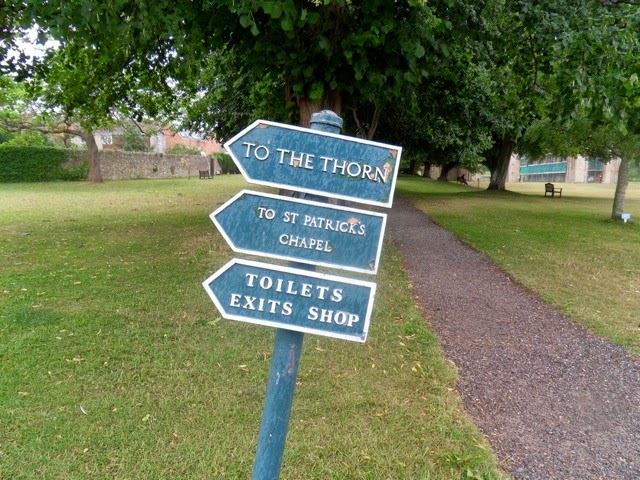
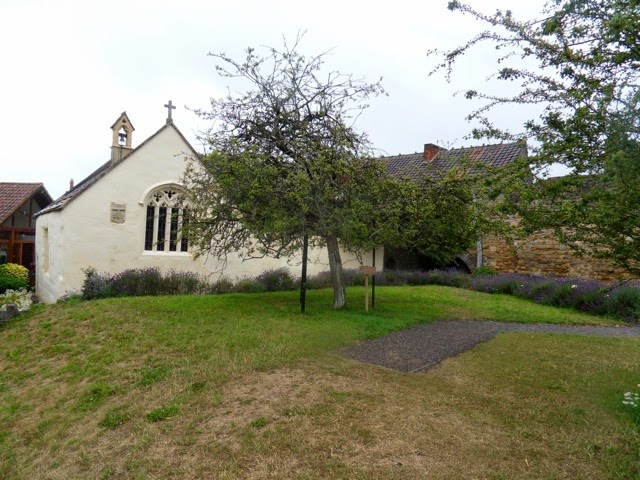
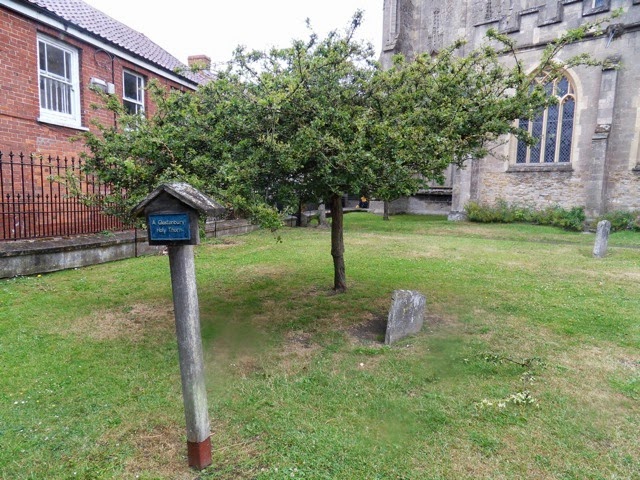
Joseph is said to have planted a tree on nearby Wyrral or Wearyall Hill, which is clearly visible from the Abbey, and from which many other trees have been grafted and which are dotted in various places throughout the town. Most of these have a small plaque beside them. Below are some pics of the one within the Abbey grounds, just outside St Patrick's Chapel. These are said to bloom twice a year, at Christmas and Easter. Our tour guide told us that the Queen has a small branch from the Glastonbury Thorn as a centrepiece each year on the Royal Family's Christmas dinner table. SDC15461SDC15463SDC15464

The Church of St John the Baptist is a fine building in the centre of the town, and it has a thorn tree at its entrance.

SDC15495SDC15496SDC15497

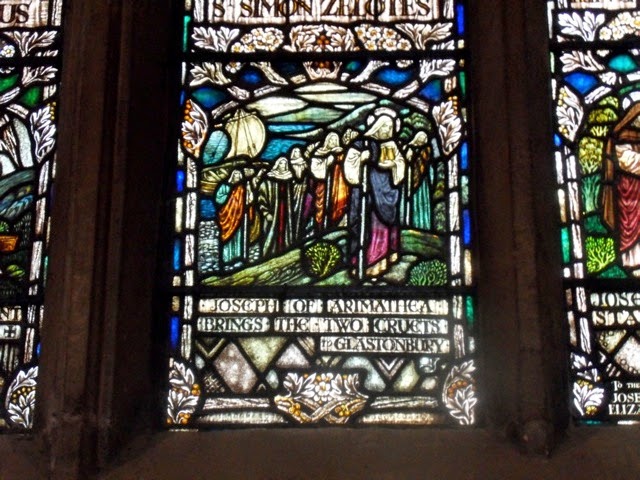
Inside the church there are some stained glass windows which tell the Joseph of Arimathea story - that he brought two 'cruets' with him, and that the original thorn tree grew when he planted his staff on the hillside.

SDC15513SDC15514SDC15510

Also in the north transept of the church is a medieval stone coffin, once-reputed to contain relics or even the remains of Joseph of Arimathea. The church's website says '... In the centre of the transept is what may have been part of a shrine to Joseph of Arimathea, erected in the abbey in the early 15th Century. Displayed in a case on this tomb or shrine is a funeral pall made in 1774 from a cope. This cope was traditionally worn by Abbott Whiting, put to death on the Tor in 1539, although it was probably made during the Abbacy of his predecessor. The 1936 stained glass in the north window is by A J Davies and depicts some of the Glastonbury legends...'

SDC15524

A tree still stood on Wearyall Hill when we visited, but a few months later it was cut down by vandals with a chainsaw. SDC15541SDC15538

Glastonbury is a weird and wonderful place. That Glastonbury Abbey and the Church of St John the Baptist sustain and give some credence to the traditions is interesting. However, most of these seem to have been 'packaged' in the early 1900s following the purchase of the Abbey site by the Church of England, and later by a group of writers and mystics who organised in the town.

These traditions are based on Anglo-Norman stories which are first recorded in the 1200s.

The reputed discovery of the tomb of King Arthur and Queen Guinevere was at Glastonbury in 1191 - very convenient if you are a poor monk and you want to boost visitor figures in an age of medieval pilgrimages - sounds a lot like Sir John De Courcy's reputed discovery of the tomb of St Patrick, St Brigid and St Columcille at Downpatrick just five years earlier in 1186.

Both of these discoveries were during the reign of the French-born King Henry II. The chronicler Gerald of Wales wrote of both events. Maybe someone out there can shed more light on the possible connections. Perhaps they are nothing more than the result of an ambitious Anglo-Norman King ingratiating himself with the conquered locals in both countries.

Wednesday, June 25, 2014

DJ Wilkinson and the Good Shepherd Church video

(I have no intention of this blog becoming another NI amateur politico soapbox, so sorry for this digression. Normal service will be resumed, sharing history and culture with like-minded folk around the globe)

I've been saddened by, and musing over, the sacrilege which has taken place inside, and on the altar of, the Good Shepherd Catholic Church on the Ormeau Road in Belfast, captured in a music promo video by somebody called DJ Wilkinson which was published on YouTube* ... and the fairly muted local media comment there has been about it.

In our age of the PERPETUALLY OUTRAGED, the media reaction to this has been little more than a whimper. Compare this with the fallout from the incident two summers ago which took place on the street outside St Patrick's Catholic Church on Donegall Street. Or the recent Muslim controversy which began with some of the verbal content of a different YouTube clip, published by the Whitewell Metropolitan Tabernacle. Both of these issues jammed the radio phone-in shows and late-night tv panel discussions for weeks, Twitter was ablaze and all the usual commentariat got plenty of coverage opportunities to air their views and opinions. Both incidents will be referred to for years to come when opportunity arises. These are just two examples which spring to mind, I am sure there are many more.

But it seems to me that, unless there is some stereotypical political/sectarian controversy to be inflamed around a particular incident, the majority of our commentators don't really give a fiddlers. If DJ Wilkinson had been a member of a flute band, the whole world would know by now and President Obama would have been on the phone to David Cameron about it. The disrespect and sacrilege would be no different, but the context would be 'juicier', sorry I mean 'newsworthy', and the analysis would be wall-to-wall. You can imagine the headlines and tweets - "Loyalist DJ desecrates Catholic Church" - or indeed, the converse, "Republican DJ desecrates Protestant Church". It's all so predictable.

As I mentioned in this post back in April, it's only the sectarian attacks on churches that attract coverage. As a personal example, about 6 years ago I had my car broken into outside a small church in inner city east Belfast  - the window smashed in, glovebox ransacked, mobile phone stolen. But this was just low-level "Prod-on-Prod" vandalism. Nobody wrote an article about it. Had the very same incident happened, carried out by the very same perpetrators, just a few hundred yards away to a car outside the local Catholic church it would have been deemed 'newsworthy' and a handful of politicians would have been wheeled out to issue statements and fill airtime. photographers and camera crews would have been sent out - on a quiet news day it may have made the front page. All because it would have been presented as 'sectarian'. 

Just as I was formulating some thoughts, Gail Walker, in the Belfast Telegraph, nailed it. Just as Fionnuala Meredith nailed the issue of socially acceptable prejudice in the same paper a few days ago.

It is refreshing to see and read some free thinking in our era of stifling (secular) orthodoxy and highly selective (fashionable) outrage. There are things it is now en vogue or maybe even socially obligatory to express anger about. But don't expect weeks of media outrage about DJ Wilkinson - it's not going to happen.

(* PS: by the way, the music is terrible)

Monday, June 23, 2014

The Battle of Bannockburn, 700 years ago today

Led by Ayrshire-born Robert the Brus, the Scottish army triumphed at the two day battle, fought at Bannockburn near Stirling on 23 & 24 June 1314. The following April, Bruce held a Parliament at St John's Church in Ayr (the surviving tower - much like Helen's Tower at Crawfordsburn and therefore also of course the Thiepval Tower in France - is pictured below). One of the function of the Parliament was to approve the Bannockburn army to set sail, under the command of Robert's only surviving brother, Edward Bruce. This Scottish armada sailed from Ayr seafront to Larne Lough on 25 May 1315, with 6,000 men, to join forces with the Bruce's relatives, the O'Neills.

18 months later Robert came across, bringing a further 7,000 men. It was the descendants of these Bruce-supporting clans who would permanently settle in Ulster in the early 1600s and beyond, as demonstrated again recently by this DNA study by Strathclyde University.

The Bruce story is important to Ulster-Scots, and to the history of Ireland generally. The epic poem by John Barbour, a rare copy of which has recently been restored, tells of many of Edward Bruce's escapades in Ireland. This coming weekend sees the first of a series of major historical commemorations in Scotland. Will we do likewise here in 2015?...


SAM 5125

Monday, June 16, 2014

The term Ulster Scot, Macosquin, 1844


(With thanks to the friend who sent me this gem)

In the spring of 1844 a deputation from the Irish Presbyterian Church attended the Synod of the English Presbyterian Church which was being held in Berwick. In addressing this gathering, Rev. Huston of Macosquin said, 'This meeting is invested with additional interest to an Ulster Scot from the place in which it is held - so near the border line between "Auld Caledonia and the sunny south".' Report in Belfast Newsletter, 3 May 1844.
 
Rev Dr Clarke Huston (1793-1886) was minister at Macosquin near Coleraine for 43 years.

Saturday, June 14, 2014

Commentariat and Christians

Meriam Yahia Ibrahim Ishag 300x192

Northern Ireland's 'commentariat' has been very busy lately following the Islam / Muslim controversy. Aside from the remarks which were made, the subsequent fallout and media storm from those remarks, and finally the apologies, what was revealing to me throughout it all is how detached that commentariat now is from grasping the simplest terminology and beliefs of orthodox Biblical Christian faith. The BBC's own Ed Stourton described this as an 'allergy' in this article earlier in the week.

When a radio host is seemingly oblivious to the difference between 'adultery' and 'apostasy' and repeatedly says the former when the issue is actually the latter; when a Pentecostal is described as a 1646 Calvinist; when run-of-the-mill ordinary Christian folk are casually painted as 'progressive' society's biggest obstacle, who are all either closet or outright racists, it just shows how far away our present-day 'opinion-formers' are from understanding the evangelical Christian community, across multiple denominations, and what we all believe.

From the moment when the early Christian church was 'born', it has been international and multicultural. Acts chapter 2 speaks of '...Parthians, Medes and Elamites; residents of Mesopotamia, Judea and Cappadocia, Pontus and Asia, Phrygia and Pamphylia, Egypt and the parts of Libya near Cyrene; visitors from Rome (both Jews and converts to Judaism); Cretans and Arabs...' being present. There's a map below which shows where these places are. As Jesus carried the cross through Jerusalem a man from Cyrene assisted him. As Jesus' disciple Philip travelled he met a government official from Ethiopia who became a Christian as they talked and read the Bible together - Isaiah 53 was an 800-year old text which foretold Jesus' life. Europeans, Middle Easterns, Asians, Africans. People of every colour and ethnicity.

{All of these people, and millions or billions ever since then, were compelled to respond to the message that Jesus came to make us right with God, something that our own efforts can never achieve. The living fulfilment of all of the Laws which the Jews could never keep. His own summary of the Sermon on the Mount - 'Be perfect, as your heavenly Father is perfect' - is an utterly unattainable goal. But one which Christ himself meets on our behalf, for all who realise their condition and who then trust in Him alone, and emphatically not in any church or in their own self-imagined merits }

The Apostle Paul famously took this Gospel 'Good News' message of Christ into the Gentile countries and the Roman empire of the European continent. The classic Foxes Book of Martyrs of 1563 records traditions that some of Jesus' disciples travelled east as far as India, up into Ukraine, south into Africa. Fast forward to the last book of the Bible and a scene is painted in the future of 'a great multitude that no one could count, from every nation, tribe, people and language' all gathered together to worship Christ.

There are uninformed Christians. There are stupid Christians. There are Christians who say the wrong thing in the wrong way. I am not the sharpest pencil in the box so I am one of them too. But the 'inquisitors' are also uninformed - in an age of alleged 'diversity' (but which is ironically quite narrow in its scope) 'orthodoxy' has become the default target. However, Biblical orthodoxy is far more diverse than its opponents acknowledge.

At the time of writing, Meriam Yehya Ibrahim is still sentenced to death in Sudan. Here is the Amnesty International webpage in support of her. She is just one example. The work of Open Doors continues across the globe - many of the nations represented in the Acts 2 map below have large Christian communities today, many of whom are under threat of persecution and death.

In Brazil, location of the 2014 World Cup, 600,000 evangelical Christians held a huge event in Rio, and a reported 2 million did likewise in Sao Paolo before the tournament began.

For generations all Sunday School children learned this simple text from John 3v16 -  'For God so loved the world, that He gave His only begotten Son, that whosoever believeth in Him should not perish, but have everlasting life."

Christians can sing an old hymn like 'Jesus Shall Lead Me' among the trees of Rwanda just as well as anyone in Ulster.


Pentecost map

"... And hath made of one blood all nations ..." Acts 17 v 26


Monday, June 09, 2014

The more you read, the more you find. (the term 'Ulster Scot' in Pennsylvania again, this time 1905)

Following from the previous post, I remembered my copy of Wayland F Dunaway's The Scotch-Irish of Colonial Pennsylvania, first published in 1944. It's an excellent book and in many ways it bridges the gap between the upsurge of Scotch-Irish publishing in the late 1800s and early 1900s, and the later wave in the 1980s and 1990s up to the present day. It has a huge bibliography, a treasure trove of sources.

One of the sources is The History of Bucks County, Pennsylvania, by William W H Davis (1905). It is now available online here. The third volume in the set has numerous usages of the term 'Ulster Scot'. For example:


• GENERAL WILLIAM WATTS HART DAVIS, a veteran of two wars, author, journalist and historian, was born at Davisville, Southampton township, Bucks county, Pennsylvania, July 27, 1820 ... he was either a native of the north of Ireland, or a son of an Ulster Scot, who had made his way to Pennsylvania with the great army of Scotch Covenanters from the province of Ulster in the first quarter of the eighteenth century.

• PROFESSOR A. J. MORRISON, one of the best known educators in Philadelphia, was born in Northampton township, Bucks county, Pennsylvania February 14, 1844 ... John Morrison, the great-grandfather of Professor Morrison, was a native of the north of Ireland, and was one of the great army of Ulster Scots who, having fled from religious persecution and internecine strife in their native Scotia, took temporary refuge in the province of Ulster, Ireland, from whence many emigrated to Pennsylvania in the first half of the eighteenth century.

• CYRUS T. VANARTSDALEN. of Newtown township. Bucks county, was born in Northampton township. April 5. 1823. He is a son of Isaac and Ann (Torbert) Vanartsdalen, the former a descendant through seven generations in an unbroken line from as many Dutch ancestors who emigrated from Holland ... the latter's ancestry traces back to at least four Ulster Scots who found homes in Bucks county a century later.

• JOHN HART, president of the Doylestown Trust Company, and his brother Frank Hart, of Doylestown, retired banker, are the sons of Josiah and Sarah (Brock) Hart. The former was born in Doylestown township, February 3, 1846... On the paternal side they are of Scotch-Irish descent. Among the thousands of Ulster Scots who migrated to Pennsylvania in the first half of the eighteenth century were those who formed two distinct settlements within the present limits of Bucks county...

Yet again, the term 'Ulster Scot'is proven to have a far greater pedigree than many think.


Sunday, June 08, 2014

Wallace McCamant (1867-1944) and the Ulster Scot

NewImage


Wallace McCamant was from Pennsylvania, a judge, and the man who nominated Calvin Coolidge to become 30th President of the United States. McCamant moved to Oregon and eventually became President of the Oregon Society of the Sons of the American Revolution (website here). At their annual meeting in 1913 he recited this poem:

Heaven speed the Ulster Scot;
The land is lean that knows him not,
His banner bright unfurled.

But hark, the Bruce and Wallace cry,
"For liberty we dare or die!",
He echoes through the world.

Heaven speed the Ulster Scot;
He bears free speech, he bears free thought;
He manumits the soul.

Beneath his feet let error die;
Above his head God's guidons fly,
The while the seasons roll.

McCamant was also a member of the Scotch-Irish Society of the USA; he traced his ancestry back to an Alexander McCamant who had emigrated from County Down about 1775 and settled in Pequa Valley in Pennsylvania.

Wednesday, May 28, 2014

Two men from Seapatrick: Joseph Scriven and James O'Neill

Seapatrick Blog Graphic

Seapatrick is the area where Banbridge is situated in County Down. Joseph Scriven was born at Ballymoney Lodge (just off today's A1 carriageway, where it meets the A26 or Dromore Street roundabout) on 10 September 1819. His life story is remarkable. In 1845 he emigrated to Canada. His musical contribution to the world was the hymn What A Friend We Have in Jesus which he wrote the words of in 1855. He was accidentally drowned in a millpond and was buried at Bailieboro, Cavan County, on the shores of Rice Lake (source here). Interestingly, there is also a Bailieborough in County Cavan in Ulster, so-named after the Bailie family from Scotland who had moved there from County Down. What A Friend We Have in Jesus is one of the world's most famous hymns, and has been translated into many different languages. 

John O'Neill was born in the same area around 1837. He collected a huge repertoire of fiddle tunes, as detailed in Nigel Boullier's book Handed Down which was published last year. John taught his children to play the fiddle and left his collection of tunes to his son James. James O'Neill appears in the Catholic baptismal records in Seapatrick RC parish in 1862, but he emigrated to Chicago in 1881. He assisted Francis O'Neill to publish O'Neill's Music of Ireland in 1903, contributing about 21% of the tunes for that landmark publication.

Both men had a huge musical impact on the world - James O'Neill helped define the Irish traditional genre, and Joseph Scriven wrote one of the most famous hymns of all time. Not bad for a wee townland in County Down.

Ella Fitzgerald's version is at 22:20 in the video below.


Friday, May 23, 2014

Ulster-Scots, the Law and the Gospel


As mentioned in my previous post, one of the things which was revealed (or recovered) at the time of the Reformation was that the Bible's central message is of the Law and the Gospel. This idea seems to have been widely understood for centuries. I have found a reference to it in Robin's Readings (1880) by WG Lyttle. On page 36 of Life in Ballycuddy, County Down, he writes of a Presbyterian minister from Newtownbreda called 'Mister Wurkman' who was being brought before the General Assembly by manipulative troublemaker within his own congregation. A conversation between two onlookers includes this reference: 

'... "A dinnae ken, " sez he, "but he maun be sumthin' mair nor ordnor', whun he'll mak his meinister an' fowk dae jist what he wants; an' no' that alane, but he'll shew ye efter a bit that he can lay doon the law an' the Gospel till Presbytery, Synod an' General Assembly" ...'

The idea of the Law and the Gospel was once commonly understood. Not today.

• Here is the Scottish martyr Patrick Hamilton's work on the subject, called Patrick's Places, from around 1520.

Tuesday, May 20, 2014

Give this a whirl


Tullian Tchividjian is a Presbyterian minister in Florida and is the grandson of Billy Graham. His explanations of "Law v Grace" are I think some of the clearest around these days. 'Law v Grace" was one of the huge discoveries of the Reformation times, it was writing of this concept which got a young Patrick Hamilton burned at the stake in St Andrews in the 1500s. Since then, a religious fog has crept over the landscape and that message has become shrouded in tradition and routine. Refreshing stuff - the stuff of a Second Reformation.

Romans: Part 15 | Tullian Tchividjian from Coral Ridge | LIBERATE on Vimeo.

Saturday, May 17, 2014

Glasgow, Clydebank, Dunfermline and Belfast - the United Co-Operative Baking Society Ltd.

SAM 4653SAM 4657SAM 4658SAM 4654

Tuesday, May 13, 2014

Flag design of the future, from the past

This is from around 1906!


Home Rule All Round

Saturday, May 10, 2014

"The Gun into Irish Politics"

SAM 4539

A few weeks ago there were some commemorations of the 100th anniversary of Sir Edward Carson's Ulster Volunteer Force landing thousands of guns at Larne, Bangor and Donaghadee, carried out by Fred Crawford and overseen at Donaghadee by James Craig, the future Prime Minister of Northern Ireland. Carson tried to quash rumours of his intention for the UVF - saying that 'Our quarrel is with the Government alone, and we desire that the RELIGIOUS and POLITICAL views of our opponents should be everywhere respected. We fight for equal justice for all under the Government of the United Kingdom." (see previous post here).The Irish Volunteers brought guns into Howth a few months after.

It is often said that Carson either introduced, or re-introduced, 'the gun into Irish politics'. I doubt very much that this is true, but it got me thinking. The local militia Volunteer movement of the late 1700s were certainly armed with guns. The furore over the Boston College recordings of the recent 'Troubles', reminded me of earlier recordings of a similar nature  - the 1641 Depositions which are held in Trinity College in Dublin (searchable website here). These are first-hand accounts of the massacres of English and Scottish settlers which took place in Ireland, and which led to the arrival of the Scottish army in 1642, the chaplains of which formalised Presbyterianism in Ireland. If you do a text search on the website for the word 'shot', it gives 431 results. So guns were very much around in the Ireland of the 1640s.

In the 'Killing Times' in Scotland in the 1661-1688 period, armed government troops faced down Presbyterian Covenanter civilians - including shooting people found in possession of Bibles (George Wood of Sorn in Ayrshire was just 16; John Brown of Priesthill was shot in the head in front of his family outside their cottage home).

The Montgomery Manuscripts refer to guns in the post-1642 period, but also they give an account of the Montgomery v Cunningham feud back in Scotland during which in 1586 Hugh Montgomery the 4th Earl of Eglinton was shot dead by John Cunningham of Colbeith, described as a 'foul deed', and that in the aftermath '... all the country ran to arms... there was a scene of murder and bloodshed in the West (of Scotland) that had never been known before...'. Around 1603 a similar feud in Galloway saw the murder of a Maxwell who was killed by a supporter of their rivals the Johnstons, the killer then fled across the sea to Ulster - but the Maxwells tracked him down and shot him dead on his way to church at Caledon near Armagh.

In 1605 you'll recall that the new Scottish King James I was the target of an audacious assassination bid in London known as 'The Gunpowder Plot'. And just a few years earlier in 1597 there was the Dublin Gunpowder Disaster in which 126 people were killed - the gunpowder was being shipped to the English army for the Nine Years War in Ireland - during which I have heard there is one very rare document which suggests that the Scottish Montgomeries were supplying guns and weapons to the Irish O'Neills. (this might explain why Con O'Neill's wife was keen to cut a deal with Hugh Montgomery in later years which led to the settlement of County Down with Scottish families).

The earlier English colony of the Ards Peninsula led by Thomas Smith junior in 1572 resulted in him being shot dead - "... the revolting of certain Irishmen of his own household to whom he overmuch trusted, whereof one ... killed him with a shot ...". The horses belonging to two other Englishmen, Norreys and Malbie, were also shot.

Some say that we have exported these attitudes to. In the 1996 book Culture of honor: The psychology of violence in the South, responsibility for a quickness to take up the gun is blamed upon the Ulster-Scots/Scotch-Irish emigrants who settled in the New World.

So when did the gun first arrive here? An article in the 2007 edition of the excellent periodical The Irish Sword, the Journal of the Military History Society of Ireland, claimed that the first gun in Ireland was recorded in 1332 - so not long after Robert the Bruce had retreated from Ireland after the failed invasion which his brother Edward led in 1315-1318.

As usual, there's a more interesting story underneath the lazy soundbites.

Monday, May 05, 2014

Fed up with Giro D'Italia mania?

... then here's what you need - an Ulster-Scots perspective on cycling from 1902 - "... for weemen it's maist unbecomin...". Cycling was a fairly new thing back then, and not everybody approved!  (scanned page below is from The Humour of Druid's Island by Ballyclare-born Drumbo author Archibald McIlroy, 1902).

In The Auld Meetin-Hoose Green (1898), McIlroy described Ballyclare people as wearing "... magenta-coloured mufflers..."So pink-clad cyclists are nothing new to County Antrim, or to the Ulster-Scots!


SAM 4530

NewImage