Personal blog of Mark Thompson. Formerly Managing Director of GCAS Design in Belfast, Northern Ireland (from 1999 - 2006) and Chairman of the Ulster-Scots Agency (from June 2005 - June 2009). Thoughts on Ulster-Scots heritage, identity, evangelical Protestant faith, music and other stuff I stumble upon.
I spotted this on an auction website recently. The motto is interesting, an articulation of 'conditional loyalty'. Intriguing flag designs and arrangement - paradoxically showing three flags whereas the motto says just one. Below, the framed print of similar design can be seen in The Dark Horse in Cathedral Quarter in Belfast. (the motto features on the statue of John Hampden in Aylesbury, Buckinghamshire).
Above: the famous Brown, Corbett & Co's 'The Ulster' Old Irish Whisky. (Image from an auction website).
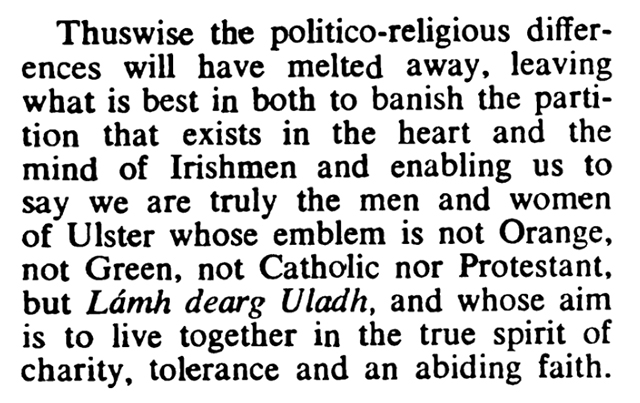
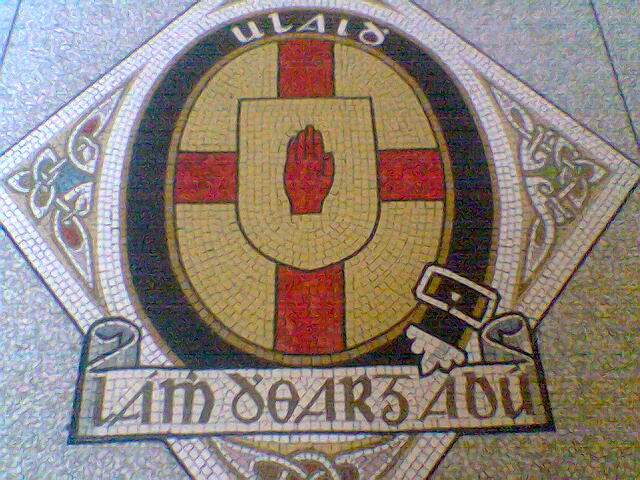
I came across the quote below when looking for something else. I've not had a hoke yet for more information about Dr J. P. Donaghy (Wikipedia here) but his entire address about the Ulster Museum is really interesting and worth a read – it is online on HathiTrust here, from page 720 onwards. Here is his conclusion, with the Red Hand as his ultimate emblematic representation of the possibility of 'together' -
For some time I thought that the term 'The Turn Oot", said to be the Ulster-Scots for the 1798 Rebellion, was a neologism. Not at all. It can be found by searching the British Newspaper Archive, and in this important source too –
"... We talked much of the Rebellion or 'turn-oot', taking pride in the part which some of our
forefathers had played in it. Nothing could have
made us so angry as hearing our ancestors jeered
at and called “pike men”, or to be reminded that
the gallant patriots had gone to battle provided
with grindstones for the occasional sharpening of
their spears. It was a base calumny and unworthy
of credence – almost as insulting as to be told that
the brave men had fired on the soldiers from the
insides of houses and shops..."
- Archibald McIlroy, When Lint Was In the Bell, page 9 (1897).
This book is set in Ballyclare, it uses a line from Robert Burns as its title, and it's about as socially conservative and theologically orthodox as it's possible to be.
The 1798 Rebellion has its 225th anniversary this June. The best way to understand it, and its complexity and contradictions, is through the lens of bottom-up community, not top-down nationality.
Some years ago Cavan County Museum published a book of their collection of banners, entitled Banner, Emblem, Flag or Symbol: The Marching Banners of Cavan County Museum. It includes this one, of Killmore Royal Black Preceptory RBP No 362, Bedell's Mourners.
Bishop William Bedell (1571-1642; Wikipedia here) is best remembered for translating the Old Testament into Irish during his time as Bishop of Kilmore and Armagh (William O'Donnell had already produced a translation of the New Testament, commissioned by Queen Elizabeth I, and completed in 1602, with 500 copies printed - further information here from the 400th anniversary in 2002).
For all of the praise the Bedell translation receives, few ever mention what he experienced at the hands of Irish 'rebels' in 1641, and his death from the pestilence which swept Ulster (see previous post here) due to the piles of unburied corpses.
His life story was written by the Scotsman Bishop Gilbert Burnet in 1685, who became one of the closest allies of Prince William of Orange, and was with him when he landed at Brixham in 1688.
PS: around the same time as Bedell's 1634-40 translation into Irish Gaeilge, just across the water in Scotland translations into Scottish Ghàidhlig emerged. These were by Alexander Munro (1605-53) of Durness, who had been converted to the reformed faith under the preaching of exiled Edinburgh minister Rev Robert Bruce, and have been colloquially called Sandy Monroe's Verses. In 1685 around 80 copies of Bedell's translation were sent to the Scottish Highlands for use in parishes there (see here for more info), but they had limited relevance due to the linguistic differences.
• James Seaton Reid's account of Bedell's life and death is here from page 320 onwards. On the preceding pages, Reid includes a mind-boggling list of ministers and clergy who were all killed by 'rebels' and the barbaric methods used – as well as a list of 20 other ministers who all died of the same 'pestilential fever' that took Bedell.
This is an article I assembled during the various lockdowns and slowdowns, and was published in the most recent edition of the Portavogie Culture and Heritage Society booklet, entitled Rocks of Ages.
.............................
Below: a postcard from my collection showing Portavogie (postmark on the reverse is dated 1902) with some small boats visible at McCammon Rocks in the background.
“During the past week there was a large number of Scotch and other craft engaged on this part of the coast … those engaged in the fishing trade on this part of the Ards coast feel keenly the want of a harbour at Portavogie, both for the accommodation of fishermen and others”.
– Newtownards Chronicle 18 June 1881
1. INTRODUCTION Portavogie developed in the late 1800s and early 1900s, from a scattered collection of cottage homes to a thriving fishing port. Originally, the natural shelter of McCammon Rocks was ideal for small boats and was a major reason for a community to settle on our coast. But as time passed, the number of boats increased and the usefulness of McCammon was limited. There was a need for a proper harbour.
However, the government of the day, perhaps caught up in the ‘big politics’ of Home Rule for Ireland, charged ahead with a construction project without consulting any experienced local fishermen about what they actually needed, or what type of harbour was suitable.
The result was a “practically useless” harbour that local boats refused to use, which wasn’t fit for purpose, and which was severely damaged in its first storm. This is some of the story.
Below: Portavogie near 'Stable Hole', circa 1900
2. BACKGROUND In September 1884, a delegation of Her Majesty’s Irish Fisheries Piers and Harbours Commissioners, comprised of Colonel John Philip Nolan (MP for Galway North), Sir Samuel Hercules Hayes (High Sheriff of Donegal), Sir Thomas Francis Brady and William Johnston (both of Her Majesty’s Inspector of Fisheries) – toured the coastal towns of Ireland to assess the needs of the industry.
They visited the Ards Peninsula to investigate the potential for “a pier and harbour on this dangerous part of the coast, where so many wrecks are annually reported”. They held public meetings at Ballyhalbert and Cloughey where they met with local community leaders and fishermen.
Newspapers of the time paint a helpful picture of our village back then. On 25 July 1885 The Belfast Weekly News published an anonymous letter by ‘An Experienced Fisherman’ stating that there were “forty boats with seven men and a boy in each” at Portavogie, but that there was no harbour “save the lee of a rock”. He also said that 20 years before, both Ballywalter and Portavogie had tried to have the government build suitable harbours, but these efforts were unsuccessful.
A few months later, on 26 October 1885, a special correspondent for the Belfast News-Letter visited Portavogie. He interviewed a local fisherman called Jemmy Hughes who said “there were twenty first class boats and from thirty to forty luggers … giving employment during the summer season to upwards of 400 men, all belonging to the village or its neighbourhood”, fishing as far north as the Shetland Islands and as far south as Kinsale. Their only shelter was at “M’Cammon’s Rock”. The village “contains a population of considerably over one thousand” but “the great want, likely soon to be remedied, is harbour accommodation. Had fishermen shelter for their boats they could fish and even trade during the winter”.
The need for a harbour was a constant factor in community life. In 1896, the Twelfth demonstration was held in Portavogie, on Monday 13th July, in a field provided by James Palmer, in which 14 local lodges participated. Rev A W Whitley, the minister of Cloughey Presbyterian Church, used his platform address “to call upon the Government to push forward the work of constructing fishery piers where needed along our coasts”. Having been minister to the fishermen of the area for 19 years, he said he “would also like to see a harbour at Portavogie”.
3. THE FIRST HARBOUR IS BUILT After years of lobbying, work eventually began on a pier at Portavogie in spring 1901, paid for by the government’s Board of Works in Dublin. However there were problems from the outset – the budget and tender of £7500 did not allow for the removal of some large rocks, and proposed to build the pier around them instead. To make things worse, the Board and their contractors didn’t consult with any local fishermen.
Soon, cracks between central government in Dublin and local government in County Down started to appear.
Concern over this led to the setting up in August 1901 of a new Portavogie Harbour Committee of Down County Council, chaired by General William Montgomery of Greyabbey, with members Henry McGrath of Portaferry, Robert B. Caughey of Portaferry and George Dickson of Newtownards. They wrote to the Board of Works in Dublin to insist on the problem rocks being taken away. The Board refused. In November 1901 and February 1902 General Montgomery tried again, but still with no success. The Board of Works carried on with construction regardless, and in early 1904 they handed the new harbour, and responsibility for it, over to Down County Council.
No locals had been consulted and so in June 1904 when the work was complete, a report by Down County Council "condemned the structure, the best proof of its inutility being the fact that it was not being used by the fishermen of Portavogie".
The ‘blame game’ then began. On 29 July 1904 the Northern Whig published a lengthy, devastating, report by General Montgomery’s Committee, saying that when the Board of Works transferred responsibility to the Council, the Board had failed to follow “bylaws, rules or regulations respecting this work”. The rocks which had not been removed meant that the fleet was not using the new harbour. There were:
“some 50 or 60 sail at anchor at some distance to the north of the pier … the fishing fleet did not use the new pier … as it would be dangerous for them … grave objections have been made by the owners of fishing boats in consequence of the absence of a projecting arm to prevent swell in the harbour, as the strength of the incoming tide renders its use by small boats very dangerous to both boats and fishermen … the fishermen will not avail themselves of the use of the harbour until these defects are remedied, and they cannot advise the Council to undertake responsibility for its use as it at present exists”
The report got worse. The harbour was too small, a boat had already been damaged on the rocks, the top surface was too low and already disintegrating, and no access road or footpaths had been provided:
“the Committee found two trading vessels discharging cargoes at the harbour … the space at present available for berths was barely sufficient for the two vessels lying there, and, as above stated, there were about 60 boats outside in the roadstead”
“injury appears to have already occurred to a boat by grounding on a projecting spur of rock, opposite the pier face”
“the Committee found the state of the roadway on the pier to be very unsatisfactory, the concrete breaking up even under such traffic as has occurred during the short time the pier has been in use”.
“the roadway on the upper surface of the pier had not been carried to a sufficient height, and that the high water spring tides flow over it … the difficulty of using the pier is also accentuated by the absence of approaches from the pier entrance to the public roads”
The issue attracted more and more attention. Glasgow-born Thomas Lorimer Corbett had been the MP for North Down since 1900, and retained the seat in the elections of 1906 and 1910. He became involved in the stand-off between the Council and the Board of Works. In August 1904 he reported that:
"the new harbour works at Portavogie are practically useless for the fishermen for whom they are intended ... during the construction of the harbour the attention of the Commissioners of Works was repeatedly called to the defects in their plans".
4. A NATURAL STORM - AND A POLITICAL STORM The very next spring, nature put an end to the speculation about the unsuitability of the harbour. On 15th March 1905, a “terrible south-east gale” hit Portavogie and "the new pier was absolutely covered with the sea, nothing but the wooden bridge was visible".
The storm smashed up nine boats of the local fleet which had been lying at anchor inside McCammon Rocks. A newspaper report said that
"had these boats been inside the pier, nothing would have been left of them but the moorings. This is another example (if one were needed) of how public money is wasted, owing to the refusal to consult local opinion on matters of this kind”.
In a debate in Parliament two weeks later, Scotland-born Thomas Wallace Russell MP for Tyrone South spoke on behalf of his party colleague James Wood MP for East Down. Russell raised the Portavogie harbour issue with Victor Cavendish, the Chief Secretary to the Lord Lieutenant of Ireland:
“is he aware that the new pier at Portavogie, County Down, erected by the Board of Works in Ireland, has been destroyed by the recent storm; what steps he proposes to take to rectify the injury done, and will he consult and be guided by the advice of local opinion as to what should be done”.
Cavendish shrewdly dodged the issue, and replied that “The Board of Works have no advice of any damage to Portavogie Pier, which is not in their charge, but in that of the county authority”.
5. DELEGATION AT MOUNT STEWART It was now time for the government to hear directly from the fishing community. On 25 April 1905 a delegation of two local fishermen, Mr Cully and Mr Mahood, and two members of Newtownards Rural District Council, Mr William Gowan (Ballyhalbert) and Robert B. Caughey J.P. (Portaferry), met with the Chief Secretary for Ireland, Walter Long.
Long was in Ulster on a trip to Mount Stewart, to stay with the 6th Marquess of Londonderry, and the delegation met him there to tell him in person about what had happened. Mr Gowan said that “the new pier had been found of little value to the local fishermen. It was frequently submerged and afforded very little shelter to fishing boats. It had been computed that it would require upwards of £800 to repair the damaged boats”.
Mr Caughey advised that the Council proposed to meet with the County Surveyor and the engineer for the Board of Works, which the Chief Secretary agreed with. In return, the Chief Secretary also said he would make contact with the Department of Agriculture and Fishing.
After the meeting the Chief Secretary for Ireland wrote to Thomas Lorimer Corbett MP and said that he was
“greatly impressed with the businesslike, moderate, dignified way in which they presented their case. Nothing could possibly have been better done. I am very hopeful I shall be able to do something for them, they have done their best to help themselves”.
6. FINAL FUNDING SECURED The public embarrassment, and the grassroots community pressure, paid off. By July 1905, the government had allocated a further £6216 for the improvement of Portavogie harbour.
However, the procurement and paperwork was slow, but thanks to the intervention of prominent Comber businessman Thomas Andrews, who was then the Chairman of Down County Council, it was approved in November 1907.
In the Northern Whig of 10 June 1908, the Council congratulated itself that it had secured a total of almost £15,000 for Portavogie harbour (which was the original inadequate cost, and the subsequent improvement cost added on top).
By May 1909 the work was well advanced, to the satisfaction of the locals and the Council, with the expectation that it would be finished by the end of the summer. In the end, it was summer 1910 before it was complete.
7. CONCLUSION Portavogie’s first harbour took 3 years to build, and then 6 years to fix. The harbour has had many upgrades over the years, especially for the major three year project from 1952–55, and again in 1978.
More improvements are planned for the coming years. The big lesson from the story of the village’s very first harbour is that it is essential for government agencies to always consult with the community and residents.
..........
Here's a YouTube video of someone's cine film of the 1955 reopening of the harbour. Bowler-hatted gents, 'dunchered' men and Sunday best women – celebrating and signalling the end of the previous age, and the start of something new. For them it was a bright new era, but which itself is now long gone.
The government of the Republic of Ireland looks set to implement some of the most far-reaching and 'shockingly draconian' 'hate speech' laws in the western world. But who gets to define 'hate'? The current government? A future one? A recently unsuccessful candidate for the leadership of the SNP, Kate Forbes, wrote this tremendous article today in defence of free speech in Scotland. Some years ago, conservative evangelicals I know took great delight when a play they objected to was 'cancelled' by a local council here in Northern Ireland. I did what I could to explain to them why free speech for everyone, including those they disagreed with, was far more important than 'winning' through the temporary numerical strength of representation on a sub-committee.
John Stuart Mill's On Liberty (1859; Wikipedia here) is regarded as 'one of the most celebrated defences of free speech ever written'. In 1868, he wrote England and Ireland. Over 50 years before 'partition'. A century before the Troubles. Long before the EU. Long before Brexit. Have a look at this extract: –
"... In all this I am supposing that Ireland would succeed in establishing a regular and orderly government: but suppose that she failed? Suppose that she had to pass through an interval of partial anarchy first?
What if there were a civil war between the Protestant and Catholic Irish, or between Ulster and the other provinces? Is it in human nature that the sympathies of England should not be principally with the English Protestant colony, and would not she either help that side, or be constantly believed to be on the point of helping it?
For generations it is to be feared that the two nations would be either at war, or in a chronic state of precarious and armed peace, each constantly watching a probable enemy so near at hand that in an instant they might be at each other's throat. By this state of their relations it is almost superfluous to say that the poorer of the two countries would suffer most. To England it would be an inconvenience; to Ireland a public calamity, not only in the way of direct burthen, but by the paralysing effect of a general feeling of insecurity upon industrial energy and enterprise...
... Ireland might be invaded and conquered by a great military power. She might become a province of France. This is not the least likely thing to befall her, if her independence of England should be followed by protracted disorders, such as to make peaceably disposed persons welcome an armed pacificator capable of imposing on the conflicting parties a common servitude. How bitter such a result of all their struggles ought to be to patriotic Irishmen..."
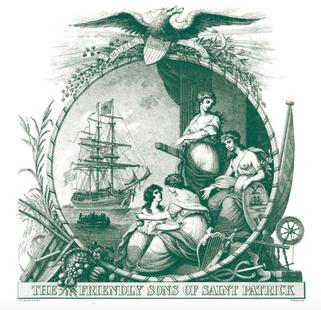
One of the curiosities of the history of Ireland is how concepts of Irishness became monocultural. One example is The Friendly Sons of St Patrick, founded on St Patrick's Day in 1771 in Philadelphia by various men who were close allies of George Washington.
Among the early members were men like General William Irvine (born Enniskillen) General William Thompson (claimed by Co Meath but I have my doubts; would appreciate more evidence*) and Colonel Ephraim Blaine (born in Donegal or Londonderry). Presbyterians all.
On 12 July 1774, Irvine and Blaine were among those who gathered 100 miles west of Philadelphia, at First Presbyterian Church in Carlisle, Pennsylvania, to agree the Carlisle Resolves in support of political reforms which would eventually become Independence. A William Thompson - perhaps the same one - was also there. Carlisle was a renowned centre of Scotch-Irish settlement. Do a search on this blog for some examples. And take a spin through this 1857 publication by the church's minister, Rev George Duffield.
The Scotch-Irish Presbyterians had imbibed the spirit, and understood the power, of that famous instrument which contributed so much, in Scotland, for the Protestant Reformation and Religious Liberty, viz : "The Solemn League and Covenant." It was their attachment, as Protestants, to the cause of civil and religious liberty, that brought them to this Western world. At an early period in the history of British oppression, as practiced in these Colonies, the same patriotic and religious spirit was kindled in them. Nowhere was it more vigorous, active and efficient than in Carlisle and Cumberland County.
However....
In the 1892 History of the Friendly Sons by John C Campbell, who is presented on the title page as "Historian of the Hibernian Society"(on GoogleBooks here), Campbell spends the entire first chapter denying the validity of Scotch-Irishness. Have a read through for yourself.
This 'narrowing' of concepts of Irishness between the society's founding 1771 until this 1892 publication is probably just a reflection of what had also been happening on this side of the Atlantic. A far cry from Wolfe Tone's famous acknowledgement in 1798 of Ireland having three faith denominations, three cultural traditions.
Ireland is an island of cultural variety.
* William Thompson was the first Colonel in the US Army, leading the first battalion authorised by Congress in June 1775. Wikipedia says he was born in Scotland. In 1896, the Ulster Journal of Archaeology published an article by M.I. Murphy of Bay City, Michigan, which said William Thompson was born in Maghera, and was the brother of Charles Thomson. A fanciful story, but untrue.
The Ancient Order of Hibernians had held an annual tribute event at his grave site at Old Carlisle graveyard for some decades. In 1988 the Donegal Society of Wilkes-Barre, and the Gobin Guards of Carlisle, had an eight feet stone Celtic cross memorial made in Ireland which was helicoptered onto his grave. The inscription claims him for County Meath.
The memorial was consecrated in May 1988 and a special service was held in the First Presbyterian Church – the building where he probably was present on 12 July 1774, preparing for independence.
These illustrations are famous depictions of two seminal events.
Firstly, and engraving entitled 'The swearing and subscribing of the National Covenant in Greyfriars Churchyard, Edinburgh', published in The History of Protestantism by James Aitken Wylie (1878). Greyfriars Kirk is in central Edinburgh, just off the historic Grassmarket and the George IV bridge.
Secondly, "Give Me Liberty or Give Me Death! Patrick Henry delivering his great speech on the Rights of the Colonies, before the Virginia Assembly, convened at Richmond, March 23rd, 1775. Concluding with the above sentiment, which became the war cry of the Revolution', published by Currier & Ives (1876). This event – the Second Virginia Convention – took place at St John's Episcopal Church in Richmond, Virginia. Patrick Henry's father was from Aberdeen; his sister Elizabeth was married to Ulster descended William Campbell.
I have been buried in a pile of books for the past month or so, for a very large and important project. In doing so, I have come across some really interesting stories which are new to me.
"John Rosbrugh was not a native born American but belonged to that sturdy class known as the Scotch-Irish, who have furnished so large a proportion of the brains, backbone and muscle which have been indispensable in shaping and maintaining our nationality. He was of the number of those who, for conscience sake, left Scotland and went to the North of Ireland, and who have made that part of Erin's Isle present socially, religiously and politically so marked a contrast with its more southerly portion. He was born in the year 1714, shortly before the family left Scotland, or shortly after they arrived in the North of Ireland, the exact date of the migration not being now attainable. Of the family to which he belonged we have no definite information further than that lie had an older brother, William. It seems that the same impulse which constrained the family to migrate from Scotland to the North of Ireland, impelled this William Rosbrugh, together with his brother John — though the latter was young in years — to take their departure for a land more inviting, beyond the sea, in America"... (1880 source here)
John Rosbrugh's Wikipedia page (link here) says he was born in Enniskillen, of Ayrshire parents. He graduated from the College of New Jersey at Princeton in 1761, along with David Caldwell, later of North Carolina, who would famously cite the ancestral memories of "Londonderry and Enniskillen" in a sermon in support of American independence. Back to Rosbrugh:
"... a call was presented to him to take charge of the Allen Township Presbyterian Church, in connection with Greenwich. Thus he was to be provided with a home in the Irish Settlement, Northampton county, Pennsylvania, among the Scotch-Irish, the stock from which he himself had sprung, as well as his wife. He was now called to the congregation in which his father-in-law, James Ralston, was an elder, and his wife's family were members".
Evidently this was also a Scots-speaking community:
"Mr. Rosbrugh, in making his pastoral visits, once came to a widow living alone. He found her at her devotions and did not disturb her until she was through. She read the Scripture, then lined a Psalm as she sang it, before prayer. He asked her why she lined the Psalm, as there were none to hear her when she was alone. "Ah!" said she, "it is sa quiet I fain would 'dight my gab twice wi'it."
A more accurate spelling might be "it's sae quate I fain wud dicht ma gab twice wi' it". In 1776, Rosbrugh's brother-in-law, John Ralston (link here), was appointed as a member of the Constitutional Convention for Pennsylvania. That same year, John Rosbrugh became Moderator of the Presbytery of Pennsylvania. Revolution was coming.
"These were Revolutionary times, and Mr. Rosbrugh was filled with the spirit of freedom. It was the heavy yoke, politically and religiously, which the Mother Country had imposed upon her people, that drove him and many of his class from the heather, hill and dale of Scotland, to their new homes in America. That the same yoke should be imposed upon them in their new home, seemed to him like the pursuit and oppression of the innocent..."
Rosbrugh became a military chaplain in the American revolutionary army. Aware of the risk, he wrote his last will on 18 December 1776. Less than two weeks later, on 2 January 1777, aged 63, during the Battle of Assunpink Creek, near Trenton, New Jersey, Rev. John Rosbrugh was stabbed to death. A total of 17 bayonet wounds ended his life – inflicted upon him after he had surrendered to a small company of British 'Hessians' who he encountered in a grove of trees. They gave him five minutes to pray. Apparently, he prayed for them (additional source here).
His body was buried near where he died by Captain John Hays, who according to one source had been born in west Donegal. He was later re-buried, some say in the Old First Presbyterian Church graveyard in Trenton.
Jane Rosbrugh raised their five children, with some financial support from the state of Pennsylvania. She died in 1809.
• Gravestone photo above from the excellent All Things Liberty website: "Once it was discovered that he was a Presbyterian minister, he was stabbed repeatedly and left to die".
This came up at auction over the Easter Weekend, I didn't bid on it but maybe should have. This is the Scottish regiment that was in Lisburn during the 1798 Rebellion, and which took the executed United Irishmen leader, the linen merchant, 'General' Henry Munro's decapitated head down from Lisburn Market House - one source says "taken down to gratify the Scotch soldiers, as Munro was of Scotch descent”. The regiment also had Grand Orange Lodge of Ireland warrant number 340.
Munro's 'Scotch descent' has been explored by TGF Patterson, the noted Curator of Armagh County Museum, and also Colin Johnston Robb who was a respected authority on the 1798 Rebellion era.
On the cusp of the new millennium, Steve Earle joined forces with the Del McCoury Band to release "The Mountain" on 23 February 1999. Hilary and I went to see them play at the Ulster Hall on 17 May - it was one of the best concerts I've ever been to - we were up in the balcony, overlooking the stage, marvelling at the 3 piece suits and the single microphone, and the acoustic volume being operated through skilful choreography. From an era when cameras and recording devices were not allowed in venues, and could get you ejected if caught, I've not been able to find any pics or videos online. So, this grainy tv performance will have to do.
"The Scotch Irish of America, through the commendable habit of that race, so it be not carried too far, to put their strength into deeds rather than into words, have missed their meed of credit for the important work they did in our struggle for liberty.
Now, our honored fellow-countrymen and co-patriots, the Puritans, have not made this mistake; they took their part in action nobly, and also they have taken care to record in history, song, and story the might and glory of their deeds.
The "Boston Tea Party" and the "Boston Massacre" will go down emblazoned on the page of history, but the fight at Alamance, and the vehement petitions urging resistance to tyranny sent up to state conventions, and the first Congress, by the Scotch Irish counties of Virginia, North Carolina, and Pennsylvania have scarcely been heard of.
It is my hope not only to show what the Scotch Irish have done for the cause of liberty, but also to give a just idea of the character of this people, a true picture of their home life, and a correct estimate of that religion which is so dear to them, and which has had so much to do with making them the freedom-loving, and withal broad-minded patriots they are.
Few men, I flatter myself, are better equipped to tell a Scotch Irish story than I, Donald McElroy, who in blood am pure blue Scotch Irish, who have been instructed by Scotch Irish divines in things temporal and spiritual, have fought under Scotch Irish leaders, and lived all my life among them"
YouTube offered me this recently thanks to its clever algorithms. I like dipping back into the music of my late teens and early 20s - when this first came out in January 1989 I had just turned 17, in Lower Sixth, trying to figure out the future. It's one of those that nearly wore out my Walkman on various bus journeys, and one I learned to play on my first guitar. It was originally by New Jersey rock band Skid Row; it's one of the songs that Norah Jones said made her want to be a musician. This is a really impressive live cover, virtually note-perfect on both the guitar and the soaring, searing, soothing vocal.
Following on from a previous post, I've been reflecting on a few of Archibald Hamilton Rowan's descriptions. AHR had been tried and found guilty of 'seditious libel' in a court in Dublin. In his closing remarks the judge, Mr Justice Boyd, claimed that AHR's objectives were to bring to Ireland something akin to the carnage of post-Revolution France – "All are summoned to arms, to introduce a wild system of anarchy, such as now involves France in the horrors of civil war, and deluges the country with blood".
• 1794 Prison sentence, and escape to France
AHR was sentenced to a fine of £500 and two years imprisonment on 29 January 1794; various letters and correspondences from his cell are in his autobiography.
But he escaped from Ireland in May and sailed from the small port of Rush just north of Dublin, landed in France at Roscoff, and headed south to Brest where he was held in a military hospital "which had all the appearance of a prison", on suspicion of being a spy from England.
• Psalm 23
In Brest, an English sailor called Rodwell gave him a copy of a commentary on the Psalms, entitled An Exposition of the Twenty Third Psalm, Full of Comfortable and Wholesome Doctrine, by the Anglican Bishop John Hooper, printed in 1562 (on Google Books here). Hooper had been a Protestant martyr, burned at the stake in Gloucester in 1555. Hamilton Rowan later wrote that the volume had "afforded me more pleasure than I ever had before received from a single book".
Soon AHR personally witnessed many examples of those alleged "horrors of civil war". Hisaccount of what he witnessed from his hospital block window is pretty gruesome –
"one side of the building in which I was confined was occupied by the revolutionary tribunals, and we daily saw from our windows, on the opposite side, waggon-loads of prisoners brought for trial. Those who were condemned returned immediately in the same vehicle to the guillotine, with their arms pinioned and their necks bare, while the crowds were shouting "Vive la Republique."
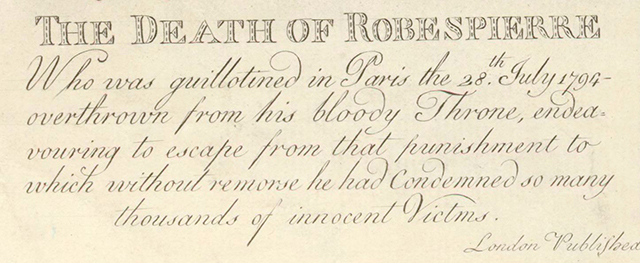
• Summer in Paris AHR was soon released from Brest and was sent with a Mr Sullivan to Paris, via Orleans, where the French leader Robespierre was being celebrated in a public display of cannons, musketry and music "while the multitude responded Vive Robespierre!"
The next day, AHR briefly met with Robespierre in Paris. However, soon after, Robespierre himself was seized and executed, on 27 July 1794. AHR's autobiography tells of the aftermath:
'... On my first arrival in Paris, there was an immense number of houses on which was painted in large letters, "Propriete Nationale a vendre" and on almost all others, the words "Liberté Egalité Fraternité, ou la mort.”
After the death of Robespierre, the three last words were decided to be terrorist, and were expunged every where…'
'... In two days after the execution of Robespierre, the whole commune of Paris, consisting of about sixty persons, were guillotined in less than one hour and a half, in the Place de la Revolution ; and though I was standing above a hundred paces from the place of execution, the blood of the victims streamed under my feet. What surprised me was, as each head fell into the basket, the cry of the people was no other than a repetition of "A bas le Maximum!" which was caused by the privations imposed on the populace ...'
'... I did not see Robespierre going to the guillotine ; but have been informed that the crowd which attended the waggon in which he passed on that occasion, went so far as to thrust their umbrellas into the waggon against his body.
From this period every thing bore a new face. Marat's bust and the bonnet de liberté were torn down and trampled upon in the theatres and other public places...
Being much discontented with the distracted state of Paris, where they were too busy with their own intestine divisions to think of assisting Ireland, or of any thing beneficial to others ... I solicited ... to embark for the United States of America...'
• 1795 Escape to America
"They were too busy with their own intestine divisions to think of assisting Ireland". After less than a year in France, on 17 April 1795 AHR left for America, under the false name 'James Thomson', and arrived in Philadelphia on 18th July.
• 1806 Return to Ireland
He stayed in America until 1800, then travelled to Germany, and eventually came back to Ireland in 1806 upon the death of his father. AHR "chose as his chief place of residence the ancient castle of Killileagh, on his own patrimonial estate in the county of Down".
His autobiography is important reading on the complexity of the period.
......................
On a similar note, Bill Maher touched on the "purifying elixir" of revolutions in this recent, characteristically irreverent, monologue. Human nature and the pursuit of power – If only *I* was in charge, things would be soooooo much better...
Cloughey Bay is a great beach, as the video above shows. My grandfather, William Thompson (06.04.1901–07.04.1957), wrote homespun poems and sold them door-to-door to raise funds for a new lifeboat at Cloughey (here's a blog I created years ago about him). The Constance Calverley was launched in August 1952. The lifeboat station closed in 1965 and was eventually converted into a dwelling house. William's son – my dad – has done some building work on the house over the years for the various people who have owned it since then.
• A shipwreck from 1797: L'Amitié cargo of arms for Rebellion So, many years ago when I first heard the old 1798 Rebellion era poem The Man From God Knows Where being recited, with its reference to Cloughey Bay, it caught my interest. It was written in 1918 by Bangor woman Florence Mary Addy, later Wilson, who was one of a cadré of Bangor-based creative writers of that era, like the Milligans and Lyttles, who I think it is fair to say had Irish nationalist inclinations (see previous post here). Intellectuals and creatives are drawn to being different. Here is her collection in which it was published.
Historically, the French ship L'Amitié was expected to land somewhere along the east coast of County Down, carrying a supply of arms – but she ran aground and sank, north of Ardglass, on 7 April 1797, near to what has ever since been known as Guns Island. The wreck was still in evidence there in the 1970s, with some salvage recovered by divers.
However, the sandy beaches of the drone video aren't the full picture. Even the name Cloughey comes from the Gaeilge 'an Cloch' meaning 'a stone'.
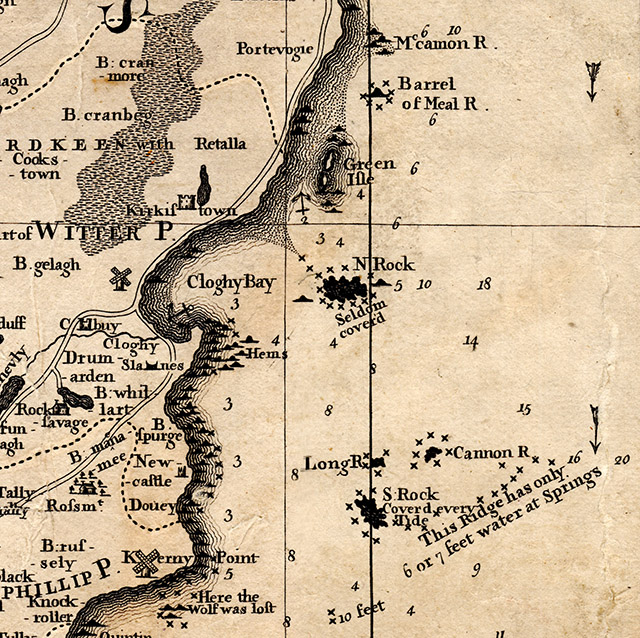
I'm not 100% sure that L'Amitié was actually bound for Cloughey Bay given just how treacherous the rocks along the shore there are. There are newspaper reports of 'wreckers' at Kearney Point luring ships onto the rocks in order to loot their washed-up cargoes. You wouldn't want to land along there without lots of local intelligence, or maybe to rendezvous offshore with smaller local boats. That's why there was a need for offshore lighthouses, on the North Rock and the South Rock, and a lifeboat.
So maybe the poem reference to Cloughey Bay is a bit of storytellers creative licence, but I am open to further information on this if any readers can affirm. Here is a detail from the famous Dr Kennedy's 1755 A Map of the County of Down with a Chart of ye Sea Coast done from Actual Surveys and Accurate Observations:
But the rocks on the coastline weren't the only things that were treacherous...
• A list from 1756: "our most treacherous enemies the French" This apparent pro-French alliance on the Ards Peninsula was a volte-face from 40 years earlier - on 13 April 1756 the Belfast News-Letter published A petition from the inhabitants of Ballywalter and Ballyhalbert in response to the threat of danger from "our most treacherous enemies the French", with a list of 78 men who had put their names to it. The next month the French would invade Minorca, beginning the Seven Years War – so Millisle was probably on their list too (Wikipedia here).
No Thompsons are named on the petition, but they weren't living at Ballyhalbert or Ballywalter anyway. It was around the 1750s when my Ayrshire Thompson ancestors came across the narrow sea and settled at Ratallagh (marked on the map as Retalla) at the north end of Cloughey Bay.
Of course, France had undergone its revolution within those decades between 1756 and 1797. The world had changed. But, as ever, it's important to not presume top-down concepts of nationality. Bottom-up community is where the authentic and interesting is to be found, and where apparent paradoxes can be better explained.
The Fitzgeralds had been in Ireland since 1169, Anglo-Norman in origin, who prior to that had come to England with William the Conqueror in 1066. In Ireland, they had been Earls of Kildare from 1316 onwards, the era of the Edward and Robert The Bruce campaign, with the Fitzgeralds fighting against the Scots.
450 years later, James Fitzgerald, 20th Earl of Kildare, became the 1st Duke of Leinster in 1766.
James and his wife Emily Lennox (who was English, of Scottish and also Royal ancestry) were among Ireland's uppermost social establishment élite. Emily features in the writing of Stella Tillyard, whose Aristocrats: Caroline, Emily, Louisa and Sarah Lennox 1740-1832 included Emily and became a BBC television series (Wikipedia here). Here's a portrait of Emily by Scottish artist Allan Ramsay:
James and Emily had 18 children – including two very contrasting boys.
• Their oldest surviving son, William Robert Fitzgerald (1749-1804), seems to have been the ultimate establishment man. William's entry in the Dictionary of Irish Biography describes him as 'somewhat pompous'. He was chosen as Grand Master of the freemasonic Grand Lodge of Ireland in 1770, and on 5 Feb 1783 he was one of the knights of the new Most Illustrious Order of St Patrick - which took upon itself his family crest, the red saltire 'Arms of Fitzgerald' as its insignia. Here he is:
• William had 'procured' the election to Parliament of his 14 years younger brother, James and Emily's fifth son, Edward Fitzgerald (1763–1798), in 1790. Two years later Edward became sympathetic to the French Revolution and also supported the new Society of United Irishmen, which sought to reform, but later to overthrow, Ireland's establishment of which his own family was such a key part. Edward eventually became a member of the United Irishmen in 1796. He was arrested in the early stages of their 1798 Rebellion, but died in Newgate Prison as a result of wounds sustained during that arrest.
(Stella Tillyard's biography of Edward Fitzgerald, entitled Citizen Lord, was published in 1998 on the 200th anniversary of his death. Edward's life story was written by Thomas Moore, and also by Patrick Byrne in his 1955 book Lord Edward Fitzgerald). Here's Edward:
• In the aftermath of the failure of the 1798 Rebellion, on 31 December 1800 the Parliament of Ireland was abolished, and Ireland was governed from a new, combined, Parliament in London from 1st January 1801. The 'Arms of Fitzgerald' were incorporated into a new flag for the new administration, to represent the inclusion of Ireland within the previous design which had visually merged the pre-existing historic flags of both England and Scotland since 1606 (designed for the 'Union of the Crowns' when King James VI of Scotland also became King James I of England).
• A red flag with a white shield and red saltire might have been used by the Dublin Volunteers in the 1700s. There is a glimpse of this in a detail of the famous Francis Wheatley painting The Dublin Volunteers on College Green, 4th November 1779, said to be a commemoration of the birthday of King William III, and gathered around the statue of William which was there at that time.
Contemporary prints of the painting include a caption 'To His Grace William Robert Fitzgerald, Duke of Leinster & of the Kingdom of Ireland...' and the Fitzgerald coat of arms. He was a Colonel in the regiment.
• Coincidentally, the family crest of the boys' mother Emily Lennox Fitzgerald (whose roots trace back to the Lennox of Woodhead clan of Dumbartonshire in Scotland) was the very same design - a red saltire, sometimes with 'engrailed' lines, and also often depicted with four roses in the white quadrants. The badge of local football team Clydebank FC is based on it, but with four different locally-relevant emblems where the roses usually appear.
... apart from set-piece window-dressing things that make some politicians and some civil servants look and feel important, but which actually deliver nothing, with no organisational infrastructure or resourcing to make things happen within communities and for normal folk. "Strand Three" has no substance. In a previous life I used to get invited to 'important' meetings at which the press releases were approved before the meeting had even begun.
Out of the blue I was contacted recently by one of those. Avoid. It is people and community that matter.
With the current affairs media anticipating a 'deal' ahead of the 25th anniversary, maybe, after a generation of (this is a weird trendy internet politics word) nothingburger, it's time to actually deliver something on an east west basis? I'll not hold my breath.
Thankful to Anne for posting this on her Facebook this week. Everyone loves stories. And therefore the mirror to this is, if you let your stories degrade or fade away, so will your community and your humanity.
This is a fascinating source (online here) of first-hand accounts of the events prior to, during, and after, the 1798 Rebellion in Ireland. Archibald Hamilton Rowan (1757–1834) was the son of Gawen Hamilton of Killyleagh Castle in County Down, and Jane Rowan, but AHR was born and raised among the "privileged elite" of London society.
AHR had never set foot in Ireland until 1784, aged 27, after some years of living with his mother in Paris. AHR bought an estate at Rathcoffy in County Kildare just west of Dublin - only about 7 miles away from palatial Carton House, (which today is a luxury 5 star hotel and resort, where Real Madrid have stayed - website here).
Carton House was the family seat of AHR's contemporary and fellow United Irishman, Lord Edward Fitzgerald (1763-1798), who was one of the sons of the 1st Duke of Leinster, and whom AHR described in his autobiography as a 'high-spirited young nobleman'.
The French Revolution began in May 1789 and AHR was back in France in early 1794. His accounts of what he witnessed and experienced there are illuminating. The high-minded revolutionary ideals had become La Terreur, bloodletting and anarchy, as power shifted from side to side. Here's one example.
"It now became a measure of personal safety, to be able to declare that one had been imprisoned during Robespierre's tyranny. It was dangerous even to appear like a Jacobin, as several persons were murdered in the streets, by La Jeunesse Parisienne, merely because they wore long coats and short hair."
AHR left France for America in June 1795, under the pseudonym of James Thomson, and eventually came back to Europe in 1800, and then to Killyleagh in 1806 on the death of his father.
I've been meaning to read this for a very long time, and it's proving a rich source. More thoughts to follow.
• BBC History Extra: The Story of the French Revolution through 7 severed heads (click here)
I penned these lines on the sofa on Burns Night, just for fun. With apologies to Rabbie...
Fair fa' your honest, stripey paper! Great chieftain o the caramel wafer! Aboon them a! There is nane greater, Tae hae wi tay, The minimum advised for every cratur's Aroon five a day
Och an whun ye peel awa the wrapper The rid an gold looks brave an dapper If the chocolate’s saft it’ll mak a clabber All ower yer fingèrs Sure yer mooth’s near trippin’ ye wi slabbers Nae chance tae lingèr
But tak yer time noo, crisp an sweet A blissful peace sae near complete A near-addiction this Tunnocks treat Ye cannae share Ye’ll hiddae jouk tae the shap doon the street For twa packets mair
It's the worldwide slogan of disastrously bad parenting, when an adult is unable or unwilling to explain to their child why things are a certain way. The demand for obedience, with no explanation, and therefore stimulating no understanding within the child's mind. And, for the parent, the exercise of explaining why you think something, or why you do something, is a great way to self-examine, to re-assess, and to adapt.
Outside of parenting, it's also an attitude that has come up in some reflective conversations with friends in recent months, who have moved away from the religious, political and cultural contexts of their upbringing, which was often due to the failure of the previous generation to explain why.
When an inquiring mind asks an older practitioner 'why do we do this?' and the only reply is akin to 'just because, that's why', then that inquiring mind soon asks 'why do I do this?'. And soon will stop doing it.
And so, in my own narrow personal context here in Northern Ireland, I know many people from a generation of Christians whose youthful years were caught up in the busy activities of evangelical sub-culture but who can't today explain the Gospel, and perhaps have never actually believed it. Their hands were busy as that was the price of continued participation within that sub-culture. But their heads, and hearts, had never received or believed it for themselves. And so they have stopped.
The 2021 census results caused some excitement in the Northern Ireland media, and evangelical circles, with the concentration of 'no religion' in what would be regarded as traditionally culturally majority Protestant population areas, and all of the denominations have dropped in numbers. Personally I'm not overly concerned about this apparent reduction of the illusion of 'social influence' – because faith should be supernatural, individual and voluntary. A verse of a hymn by Joseph Hart (1711-1768) helps explain:
What comfort can a Saviour bring to those who never felt their woe? A sinner is a sacred thing; the Holy Ghost hath made him so. New life from Him we must receive, before for sin we rightly grieve.
It was once socially advantageous to participate in church culture. That is no longer the case, and in fact it might be counterproductive. The old nominalism is disappearing fast. 'My kingdom is not of this world', etc.
To take two topical NI subjects which have come up in these conversations, I know unionists who can't explain why the United Kingdom is Northern Ireland's best option. I know people who enjoy marking the events of 1688-90 but who can't explain why those are relevant today beyond the pageantry and commemorations.
"Just because, that's why" is a verbalisation of thoughtlessness. It is no wonder that, when presented with such shallowness, those who want to think decide that there is no depth and drift away, or look elsewhere for meaning and purpose.
As Simon Sinek says in the video above, whatever you're trying to communicate to others, you need to start with why? And if you can't do that, then go away and figure it out. Now.




.jpg)






_640.jpg)


