Thursday, September 08, 2016

The original Hillbilly Elegy? 'The Mountain Whites of The South - by a Scotch-Irishman' 1893

The Mountain Whites of The South - by a Scotch-Irishman is a booklet I picked up a good few years ago. Published anonymously in 1893, as you'll see from the images below (if the resolution is okay) it is an appeal to the churches and also the Scotch-Irish Society of the USA to launch a $400,000 educational and relief aid programme into Appalachia - that must surely equate to many tens of millions in todays money. The booklet is just 40 pages long but is packed with information.

The chapters are:
1. Evidences of Scotch-Irish Descent
2. How They Came to the Mountains
3. Their Claims for Aid
4. What is Being Done for their Evangelization
5. How to Benefit Them
6. An Appeal to the Scotch-Irish Society

It is a compilation of a series of articles which had appeared in the Presbyterian Banner newspaper. You can read an online version here

As Dr John Hall said in his introduction: "I write as one of the Scotch-Irish, and under the impulse of deep pity for those whose condition your correspondent describes".

It is interesting that the writer says that:

"I believe these whites of the mountains are largely of Scotch-Irish descent ... I sought for some histories that would treat of the subject in the libraries of Pittsburgh and Allegheny. I could find none. I applied, through a friend, to the Congressional Library in Washington DC. I was informed there was no work in which their origin was treated of in that library, and the learned librarian expressed the opinion that there was no book which contained any account of their origin".

I was a bit cheeky a few posts ago in referring to retired ex-pat Ulster Presbyterian ministers reminiscing in their twilight years. Well here they are, seeking to draw attention to the plight of the poor. That's what 'social justice' used to mean.

P.S.: All of this raises an interesting question - when was the first American-published history of the Scotch-Irish?  Here is one from 1858.

14046004 10154460443982878 6453207002431115305 n 14102133 10154460444092878 59453643644456385 n 14054011 10154460444992878 1185743185773803649 n

Monday, September 05, 2016

Hillbilly Elegy by JD Vance

Jd vance hillbilly elegy life in holler

You’d have to have been living on the moon all summer (or at least, completely detached from the growing resurgence of Scotch-Irish awareness in the USA as the election looms) to have missed the excitement that has followed the release of this new book - already a New York Times bestseller, topping the sales charts. (conversely, I noticed that when visiting July, Ulster-Scots / Scotch-Irishness seemed to be less visible - in bookstores, museums and heritage centres - than on previous trips in 1997 and 2002)

The timing has been impeccable, picking up on the Trump question, and all of the political head-scratching as to how Trump could have happened as a phenomenon. This book predates Trump, and his name doesnt appear once in its pages. Yet the smart commentators see a deeper cultural underbelly, one which has been brewing for decades.

In a later post I am going to suggest that this has in fact been growing for at least a century as can be seen through publications pleading with the Scotch-Irish Society of the USA and the Presbyterian church to launch a massive aid and education programme into Appalachia. There is no evidence that they ever did so. More to follow. Meanwhile here are author JD Vance’s own words :

"Two generations ago my grandparents were dirt-poor and in love. They got married and moved north to Ohio from the Appalachian hills of eastern Kentucky in the hope of escaping the dreadful poverty around them. Their grandchild (me) graduated from one of the finest educational institutions in the world, Yale Law School. But to understand me, you must understand thatI am a Scots-Irish hillbilly at heart.

“I may be white, but I do not identify with the WASPs of the Northeast. Instead, I identify with the millions of working-class white Americans of Scots-Irish descent who have no college degree. To these folks, poverty is the family tradition — their ancestors were day laborers in the Southern slave economy, sharecroppers after that, coal miners after that, and machinists and mill workers during more recent times. Americans call them hillbillies, rednecks, or white trash. I call them neighbors, friends and family.

The Scots-Irish are one of the most distinctive subgroups in America. As one observer noted, “In traveling across America, the Scots-Irish have consistently blown my mind as far and away the most persistent and unchanging regional subculture in the country. Their family structures, religion and politics, and social lives all remain unchanged compared to the wholesale abandonment of tradition that’s occurred nearly everywhere else.”1 This distinctive embrace of cultural tradition comes along with many good traits—an intense sense of loyalty, a fierce dedication to family and country—but also many bad ones. We do not like outsiders or people who are different from us, whether the difference lies in how they look, how they act, or, most important, how they talk. To understand me, you must understand that I am a Scots-Irish hillbilly at heart.

If ethnicity is one side of the coin, then geography is the other. When the first wave of Scots-Irish immigrants landed in the New World in the eighteenth century, they were deeply attracted to the Appalachian Mountains. This region is admittedly huge—stretching from Alabama to Georgia in the South to Ohio to parts of New York in the North—but the culture of Greater Appalachia is remarkably cohesive. My family, from the hills of eastern Kentucky, describe themselves as hillbillies, but Hank Williams, Jr.—born in Louisiana and an Alabama resident—also identified himself as one in his rural white anthem “A Country Boy Can Survive.” It was Greater Appalachia’s political reorientation from Democrat to Republican that redefined American politics after Nixon. And it is in Greater Appalachia where the fortunes of working-class whites seem dimmest. From low social mobility to poverty to divorce and drug addiction, my home is a hub of misery.”

I am fortunate to have travelled through Appalachia three times. When the kids are grown up and moved out I might even relocate there for a time. These people are not just JD Vance's people, they are our people too.

……….

I don’t buy into the Trump = Scotch-Irish theory. No ‘people group’ behaves in a single way. There are plenty of Scotch-Irish who oppose him, indeed the whole point of President Barack Obama’s recent speech was that Trump does not exhibit classic Scotch-Irish values. So, American commentators need to learn some nuance. But the rise of Scotch-Irishness as a concept, representing a set of values, is what is so interesting here.

Sunday, September 04, 2016

"heritage doesn't matter"

Crcxz8VWIAEh1EJ

Friday, September 02, 2016

Grave of Dr Robert Murray, born in County Down, died in Virginia

Typical. We drove past this area when in Virginia back in July. This doctor, buried at Cedar Hill Cemetery, Suffolk, Virginia, was the father of the tobacco millionaire Robert Wallace Murray who came to Belfast to set up his firm. Information from FindAGrave.com

80706197 132174744479


Tuesday, August 30, 2016

College of William and Mary, Colonial Williamsburg, Virginia: "The Valley Ulsterman: A Chapter of Virginia History"

Tucker Hall

On Richmond Road in Williamsburg, a famous college town, is Tucker Hall. On the entrance pillars to Tucker Hall are two statues, of King William III and his wife Queen Mary. These were gifted to the college in the 1920s by Mary Cooke Branch Munford, the first female member of the Boards of Visitors. Back in July I drove up and down this road quite a few times trying to spot the statues, but with no success. The image here is from Google StreetView.

Over 20 years earlier, on 18 February 1896, Armistead C Gordon, a lawyer from Staunton, Virginia, gave an address to the Phi Beta Kappa Society of the college, entitled The Valley Ulsterman: A Chapter of Virginia History. Gordon was also a member of the Boards of Visitors of the college; I have an old pamphlet edition of the talk. The text of the address is available online here.

Armistead Churchill Gordon Portrait Magazine of Poetry 1892

"... invoke from the shadows of the historic and glory-haunted past the Scotch-Irish Ulsterman of the Virginia Valley,--the stalwart and sombre sentinel of liberty upon the outposts of American colonial civilization.

... a distinguished Scotch Irish divine, who came from the North of Ireland after our civil war to minister to a great church in New York City, stated recently that a gathering of Valley people, which he addressed in the county of Rockbridge, reminded him more than any he had ever seen, of his own congregation in the little town of Newry, in County Tyrone, Ulster.

They were men of large courage and of simple faith, these early Ulstermen,--so afraid of God, says the historian of them, that this fear left in their hearts no room for fear of mortal man. Their fixity of purpose, once determined, is aptly if fancifully illustrated in the mythic story which is told of the device of the Ulster Coat of Arms, a device known to all Scotch-Irishmen as "The Bloody Hand of Ulster" ... the Scotch-Irish riflemen of the Valley of Virginia justified in the eyes of history their right to claim as theirs the device of the Bloody Hand ..." --

The College of William and Mary had been founded during their reign in 1693 by Rev James Blair (1656–1743) a Scottish-born minister, originally a Presbyterian but became Episcopalian in 1681 during ‘The Killing Times’. There’s no indication that he had any connection with Ulster. Here's a photo of Charlie holding up a colonial flag outside Williamsburg's Presbyterian meeting house.

NewImage2016 07 04 11 52 38  1SAM 0459  1

Monday, August 29, 2016

Rev Matthew Clark of Londonderry, New Hampshire - Ulster-Scots preacher.

Matthew ClarkRev Matthew Clark (1660–1735) from Kilrea was a veteran of the Siege of Derry. In April 1729 aged around 70 he headed across the Atlantic to succeed Rev James McGregor as minister of Londonderry, New Hampshire. It is said that Clark ‘possessed a strong mind, marked by a considerable degree of eccentricity’. When he died on 25 January 1735, his coffin was carried to his grave by fellow Siege veterans.

A few insights into Clark’s sermons have survived, in the pages of The Autobiography of Horace Greeley, or Recollections of a Busy Life (New York, 1872). Greeley was a famous newspaperman, and that same year ran for President as a ‘Liberal Republican’. His Wikipedia entry is fascinating. His mother was Mary Woodburn, she was descended from a John Woodburn who had emigrated from Ulster in 1725 with his brother David. In a chapter entitled 'A Sample of the Scotch-Irish', Greeley wrote this of Matthew Clark:

"...Mr. McGregor died in 1729, and was succeeded by Rev. Matthew Clark, a patriarch who now came out from Ireland on purpose, and whose memory deserves a paragraph. He never ate flesh, but said nothing on the subject ; and his abstinence was regarded as an idle whim, until one day when my great-grandmother (his niece, as I remember), then a young girl and an inmate of his house, saw the pot wherein the family dinner was cooking boil over into the smaller vessel wherein was boiling his frugal mess of greens. Supposing this of no consequence, she said nothing until — the family being seated at the table, and its head having said grace and taken his first mouthful — he was observed to fall back insensible and apparently dying. Recovering his consciousness after a few moments, he calmed the general excitement by saying, " It is nothing — a trifle — I shall be well directly — only a little of the water from your meat has boiled over into my greens." He had been a lieutenant in the famous Siege, wherein he was wounded in the temple by a ball, which injured a bone so that it never healed ; and, though a devoted evangelist, could never forget that he had been a soldier. Once, while acting as Moderator of an assembled Presbytery, the music of a marching company was heard, when his attention was wholly absorbed by it. Being repeatedly called to give heed to the grave business in hand, his steady reply was,

"Nae business while I hear the roll of the drum."

When death came to him at seventy-six years of age, and after forty years of blameless ministry, he said to sympathizing friends, "I have a last request which must not be denied." " What is it, Father Clark ? " "Let me be borne to my rest by my brother soldiers in the Siege, and let them fire a parting volley over my grave ! " The military parade was conceded ; but, according to my mother's tradition, the volley, though promised, was withheld ; it being deemed indecorous and unsuitable that so holy a man should be indulged in a dying freak so unbecoming his cloth..."

Even in sermons Clark was known to use his native Ulster-Scots:

"...The settlers knew that their homespun garments (often of tow) contrasted strongly with the trim, dapper apparel of the polished denizens of more refined communities ; but they were not thereby disconcerted. Though Burns had not yet strung his immortal lyre, his spirit so flooded their log-cabins that he would have been welcomed and understood in any of them, but would have excited surprise in none. Thus it is related of the Rev. Matthew Clark, already mentioned, that, among the audience in attendance on his ministrations was once a young British military officer, whose scarlet uniform far outshone any rival habiliments, and so fixed the gaze of the young damsels present, that the wearer, enjoying the impression he was making, not only stood through the prayer with the rest, but remained standing after all others had sat down, until the pastor had proceeded for some time with his sermon. At length, noticing a divided attention and its cause, the minister stopped, laid aside his sermon, and, addressing his new hearer, said :

" Ye 're a braw (brave) lad ; ye ha'e a braw suit of claithes, and we ha'e a' seen them ; ye may sit doun."

The lieutenant dropped as if shot, and the sermon was resumed and concluded as though it had not been interrupted.

Here is a longer example:

"...Rev. E. L. Parker's “ History of Londonderry, unto which I am indebted for many facts, gives the following specimen of Mr. Clark's pulpit efforts. His theme was Peter's assurance that, though all others should forsake his Divine Master, lie never would ; and this was a part of his commentary : —"Just like Peter — aye mair forrit (forward) than wise; ganging swaggering aboot wi' a sword at his side ; an' a puir han' he mad' o' it when he cam' to the trial ; for he only cut off a chiel's lug (ear) ; an' he ought to ha' split doun his head."


Clark was not unique in his use of Ulster-Scots, the other Ulster families were just the same:

"...it is related of the Morrisons, who were among the first settlers, -that the good dame remonstrated against the contemplated homestead until assured that there was no help for it, when she acquiescingly entreated :

"A-weel, a-weel, dear John, if it maun (must) be a log-house, make it a log heegher nor the lave "

(a log higher that the rest).


In the late 1800s when Leonard A Morrison (1843–1902), historian of New Hampshire, returned to visit the 'old country', this is what he found:

"...Rev. Matthew Clark, of Kilrea, three miles distant, was the second minister of Londonderry, N. H.. The people in the settlements of Kilrea, Garvagh, Aghadowey, and others are distinctly Scotch, after a residence of 200 years ... I have met and heard talk in some of the settlements persons with the Scotch dialect, with the rich brogue which was occasionally heard in my childhood ..."

This was of course the very same Ulster-American emigrant community which would produce the poems of Robert Dinsmoor in 1828. DInsmoor described the 1718 migration in verse:

In Ulster Province, Erin's northern strand
Five shiploads joined to leave that far off land.
They had their ministers to pray and preach
These twenty families embarked in each.
Here I would note and have it understood,
Those emigrants were not Hibernian blood,
But sturdy Scotsmen true, whose fathers fled
From Argyllshire, where protestants had bled
In days of Stuart Charles and James second
Where persecution was a virtue reckoned,
They found shelter on the Irish shore
In Ulster, not a century before
Four of these ships at Boston harbor landed;
The fifth, by chance at Casco Bay was stranded…

Saturday, August 27, 2016

Oxford Pennant - 'Liberty or Death'

Saw this in a very cool shop called Devolve Moto in Raleigh, North Carolina. Should have bought it! Available online from the manufacturer, Oxford Pennant.


MG 9605


Wednesday, August 24, 2016

Carter G Woodson, Berea College (Kentucky) and the term 'Scotch-Irish' yet again

1000509261001 2152051039001 History Black History Month Origins of Black History Month SF HD 768x432 16x9
When on honeymoon nearly 20 years ago, we stayed at Boone Tavern which is part of Berea College in the town of Berea, Kentucky. This was the first integrated college in the South, established in 1855 by a Presbyterian minister of Scotch-Irish descent called Rev John Fee and his wife Matilda Hamilton Fee. A publication about their respective ancestry is online here. Here is a photo of Hilary and I once again at the Tavern door, back in July of this year, struggling to take a 'selfie'. It is a wonderful place, one of the ‘Historic Hotels of America’.
13606720 10154332174342878 2424966236883499859 n 13690906 10154332450067878 7391066391815553951 o
Berea is named after the town referred to in the Bible in Acts chapter 17, the chapter from which the College took its motto: "And hath made of one blood all nations of men for to dwell on all the face of the earth".
One famous black graduate of the College, in 1903, was Carter G. Woodson (1875–1950), regarded as the ‘Father of Black History’. His remarkable intelligence resulted in a PhD in history from Harvard University in 1912. In 1916 Woodson founded the quarterly Journal of Negro History, in which he frequently spoke of his lifelong rural neighbours as 'Scotch-Irish', and demonstrated a sound grasp of our history. His essay 'Freedom and Slavery in Appalachia' (link here) is still today regarded as a landmark, in which he says that:

"… the strongest stock among these immigrants, however, were the Scotch-Irish, "a God-fearing, Sabbath-keeping, covenant-adhering, liberty-loving and tyrant-hating race" which had formed its ideals under the influence of philosophy of John Calvin, John Knox, Andrew Melville, and George Buchanan.
By these thinkers they had been taught to emphasise equality, freedom of conscience, and political liberty ... when they demanded liberty for the colonists they spoke also for the slaves ... the ideals of the westerners were principally those of the Scotch-Irish, working for "civil liberty in fee simple, and an open road to civil honors, secured to the poorest and feeblest members of society" ...
they therefore hated the institution [of slavery] ... on the early southern frontier there was more prejudice against the slave holder than against the Negro ..."
In later publications he wrote these words:
“… In the States of Kentucky and Tennessee friends of the race were often left free to instruct them as they wished. Many of the people who settled those States came from the Scotch-Irish stock of the Appalachian Mountains, where early in the nineteenth century the blacks were in some cases treated as equals of the whites …"
“… Statistics of this period show that the proportionately largest number of Negroes who learned in spite of opposition were found among the Scotch-Irish of Kentucky and Tennessee. Possessing few slaves, and having no permanent attachment to the institution, those mountaineers did not yield to the reactionaries who were determined to keep the Negroes in heathendom. Kentucky and Tennessee did not expressly forbid the education of the colored people …"
“…  A considerable portion of the abolition literature which influenced  public opinion appeared in the Genius of Universal Emancipation, published by Benjamin Lundy. Through this organ the sentiments of a large number of antislavery people living in the Appalachian highland found expression. They were descendants of the Germans and Scotch-Irish immigrants who came to this country to realize their ideals of religion and government, differing widely from those of the aristocratic planters who maintained a slavocracy near the coast …"
“…  In the very heart of the South, however, the Presbyterians did not fail to aid the instruction of Negroes wherever public opinion permitted it, although they had to confine themselves largely to verbal instruction. In the mountains of Virginia, North Carolina, and Kentucky, where the Scotch-Irish element dominated, there was no diminution of ardor in the religious instruction of the Negroes…"

Bear in mind that these are the words of America's foremost Black historian, a PhD born in New Canton, Virginia, on the fringes of the Appalachian mountains, and educated in West Virginia and Kentucky, a son of former slaves and who lived among the Scotch-Irish people. These are not the imaginings of some ancient expatriate Ulster Presbyterian relic, reminiscing about 'the bygone days of yore' from his retirement manse, waiting for the next annual Congress of the Society to come round. That’s a bit cheeky of me, but you get my point.
Some editions of the Journal are online. Here's the very first edition. If you text-search it, you'll see the term Scotch-Irish appears 14 times. It wouldn't be that frequent in a full year of today's Belfast Telegraph.
“A God-fearing, Sabbath-keeping, covenant-adhering, liberty-loving and tyrant-hating race”. That, in the words of none other than Carter G Woodson, is the Scotch-Irish.

Tuesday, August 23, 2016

The Fincastle Resolutions monument, Austinville, Virginia

In case you were in any doubt about the importance of the Fincastle story - there is a huge stone memorial with this plaque, at the site of the old Courthouse. Article here.

28234238 134469343093

Ole Smoky Tennessee Moonshine

I took this shot, one of many, when we visited their store in Gatlinburg, Tennessee in July. To paraphrase Bill Clinton ‘I inhaled but I didn’t ingest’ - the aroma was something else, but I was driving that day! Post coming soon...

IMG 5008

Monday, August 22, 2016

"Give me Liberty or give me Death" – Patrick Henry

One of the most famous speeches of the American Revolution, given in Richmond, Virginia on 23 March 1775, depicted here in Luther-like pose. Patrick Henry's father was from Aberdeen, and his sister Elizabeth was married to William Campbell, one of the signatories to the Fincastle Resolutions outlined in the post below. Campbell is known to have been of Ulster-Scots descent. Campbell went on to become a hero of the American Revolution, achieving the rank of General. Here is a 1910 ‘Monument’ document to him, published by the United States Senate. What an extract –

‘… In the confronting ranks was a very different class of men. Those from the Holston, under Campbell, were a peculiar people … they were, almost to a man, Presbyterians. In their homes, in the Holston Valley, they were settled in pretty compact congregations; quite tenacious of their religious and civil liberties, as handed down from father to son from their Scotch-Irish ancestors. Their preacher. Rev. Charles Cummins, was well fitted for the times; a man of piety and sterling patriotism, who constantly exerted himself to encourage his people to make every needed sacrifice and put forth every possible exertion in defense of the liberties of their country.

They were a remarkable body of men, both physically and mentally … ever ready at the tap of the drum  to turn out on military service; if in the busiest crop season, their wives, sisters, and daughters could, in their absence, plant and sow and harvest. They were better educated than most of the frontier settlers, and had a more thorough understanding of the questions at issue between the colonies and their mother country. These men went forth to strike their country's foes, as did the patriarchs of old, feeling assured that the God of battles was with them, and that He would surely crown their efforts  with success. They had no doubts nor fears. They trusted in God and kept their powder dry. Such a thing as a coward was not known among them …’


DT9295

Sunday, August 21, 2016

Rev Charles Cummings and an early Declaration of Independence (Abingdon, Virginia, 20 January 1775 ) – "we declare, that we are deliberately and resolutely determined never to surrender"

2902263626 afe0b60a10 z

“… the first adopted statement by the Colonies which promised resistance to the death …”
“… the earliest statement of armed resistance to the British Crown in the American Colonies …" 

The fuse of the 1776 American Revolution was lit by Scotch-Irish Presbyterians. Four years earlier in a remote mountain place called Lead Mines (now Austinville) in south west Virginia, a Rev Charles Cummings (1732-1812) was a leading Presbyterian minister. He had been born in Ireland (possibly Donegal) and emigrated when he was 18 on board a vessel captained by his brother James. Charles went to college in Pennsylvania and graduated in theology, during which he was tutored by Newry-born Rev James Waddell (1739–1805).

Lead Mines was the frontier seat of the vast Fincastle County, then a huge jurisdiction covering what is now south-western Virginia and all of Kentucky. Aged around 40, Cummings accepted a call to the southwest frontier and found himself among Ulster folk, or folk of Ulster descent. His old cabin home still stands today in Sinking Springs Cemetery, Abingdon (just off Cummings Street).

He is said to have drafted the Fincastle Resolutions of 20 January 1775 which are regarded as a precursor to the eventual Declaration of Independence of 1776. There had been earlier statements from other counties, but this was the first to promise resistance to the death. When you read the words of the Resolutions below, you’ll hear echoes of the Siege of Derry ringing in your ears! (One writer thinks that the meeting which adopted the Resolutions was held at James McGavock’s tavern in Fort Chiswell. McGavock was born near Glenarm in County Antrim).

The 13 signers of the Resolutions were:

William Campbell
Arthur Campbell
William Christian
Walter Crockett
Charles Cummings
William Edmondson
William Ingles
Thomas Madison
James McGavock
John Montgomery
William Preston
Evan Shelby
Stephen Trigg

Here is the old Cummings cabin, recently restored: Sinking spring cemetery

In his 10 volume History of the United States from the Discovery of the American Continent, renowned American historian George Bancroft described the events as follows:

It is not probable that even one of the peers [in the House of Lords] had heard of the settlements beyond the Alleghenies, where the Watauga and the forks of the Holston flow to the Tennessee. Yet on the same day, the lords of that region, most of them Presbyterians of Scottish-Irish descent, met in council near Abingdon. Their united congregations, having suffered from Sabbaths too much profaned, or wasted in melancholy silence at home, had called Charles Cummings to the pastoral charge of their precious and immortal souls. The men never went to public worship without being armed, or without their families. Their minister, on Sabbath morning, would ride to the service with shot and pouch and rifle.... The news from Congress reached them slowly; but, on receiving an account of what had been done, they assembled in convention, and the spirit of freedom swept through their minds as naturally as the forest winds sways the firs on the sides of Black Mountain. They adhered unanimously to the association of Congress, and named as their committee Charles Cummings [and others]. Adopting the delegates of Virginia as their representatives, they addressed them as men whose conduct would immortalize them in its annals.

– George Bancroft, History of the United States from the Discovery of the American Continent, Vol. 7, 4th edition..

 ……………………...

The Fincastle Resolutions should therefore be regarded as one of the great Ulster-Scots declaratory documents. If you are familiar with the various Scottish (Presbyterian) Covenants, you will see the template of conditional loyalty writ large in these words –

"To the Honorable Peyton Randolph, Esq; Richard Henry Lee, George Washington, Patrick Henry, junior, Richard Bland, Benjamin Harrison, and Edmund Pendleton, Esquires, the Delegates from this colony who attended the Continental Congress held at Philadelphia: 

Gentlemen,
Had it not been for our remote situation, and the Indian war which we were lately engaged in, to chastise those cruel and savage people for the many murders and depredations they have committed amongst us (now happily terminated, under the auspices of our present worthy Governour, his Excellency the Right Honourable the Earl of Dunmore) we should before this time have made known to you our thankfulness for the very important services you have rendered to this country, in conjunction with the worthy Delegates from the other provinces. Your noble efforts for reconciling the Mother Country and the Colonies, on rational and constitutional principles, and your pacifick,steady, and uniform conduct in that arduous work, entitle you to the esteem of all British America, and will immortalize you in the annals of your country. We heartily concur in your resolutions, and shall, in every instance, strictly and invariably adhere thereto.

We assure you, Gentlemen, and all our countrymen, that we are a people whose hearts overflow with love and duty to our lawful sovereign George III. whose illustrious house, for several successive reigns, have been the guardians of civil and religious rights and liberties of his subjects, as settled at the glorious Revolution; that we are willing to risk our lives in the service of his Majesty, for the support of the Protestant religion, and the rights and liberties of his subjects, as they have been established by compact, law, and ancient charters.

We are heartily grieved at the differences which now subsist between the parent state and the colonies, and most ardently wish to see harmony restored, on an equitable basis, and by the most lenient measures that can be devised by the heart of men.

Many of us, and our forefathers, left our native land, considering it as a kingdom subjected to inordinate power, and greatly abridged of its liberties. We crossed the Atlantick, and explored this then uncultivated wilderness, bordering on many nations of savages, and surrounded by mountains almost inaccessible to any but those very savages, who have incessantly been committing barbarities and depredations on us since our first seating the country. These fatigues and dangers we patiently encountered, supported by the pleasing hope of enjoying those rights and liberties which have been granted to Virginians and were denied us in our native country, and of transmitting them inviolate to our posterity. But even to these remote regions the land of unlimited and unconstitutional power hath pursued us, to strip us of that liberty and property with which God, nature, and the rights of humanity, have vested us. We are ready and willing to contribute all in our power for the support of his Majesty's government, if applied to constitutionally, and when the grants are made by our own representatives; but cannot think of submitting our liberty or property to the power of a venal British parliament, or to the will of a corrupt ministry.

We by no means desire to shake off our duty or allegiance to our lawful sovereign, but on the contrary shall ever glory in being the loyal subjects of a Protestant prince, descended from such illustrious progenitors, so long as we can enjoy the free exercise of our religion, as Protestants, and our liberties and properties, as British subjects.

But if no pacifick measures shall be proposed or adopted by Great Britain, and our enemies will attempt to dragoon us out of those inestimable privileges which we are entitled to as subjects, and to reduce us to a state of slavery, we declare, that we are deliberately and resolutely determined never to surrender them to any power upon earth, but at the expense of our lives.

These are our real, though unpolished sentiments, of liberty and loyalty, and in them we are resolved to live and die.

We are, Gentlemen, with the utmost esteem and regard, your most obedient servant."

……………………...

• Rev Charles Cummings’ parents were John Cummings and Sara (Polk) Cummings. His wife was Mildred Millicent (Carter) Cummings.

• You can read more here.

• Recent article on Cummings here


PS: Exactly 4 months after, on 20 May 1775, the more well-known Mecklenburg Declaration was proclaimed in North Carolina. One of the men present was a Rev Francis Cummings, whose parents were from Ireland, but he was born in Pennsylvania in 1752. When he was 19 his parents moved to Mecklenburg County where one of his pupils was the young Andrew Jackson. Read more on p 139 here. 
How something as simple as t-shirts can build civic pride - welcome to Camel City Goods, Winston-Salem, North Carolina


Camel City Goods from Airtype on Vimeo.

Thursday, August 18, 2016

5 of 5: Scotch-Irish wit and Ulster-Scotch people, Pennsylvania (1894)

Scotch Irish Ulster Scotch

4 of 5: "Scotch Irish" - Pennsylvania, 1829

This time the term refers to ‘dialect’.

Clipping 6273871

3 of 5: "Scotch-Irish" - North Carolina, 1841

And it goes on…  the term has a far deeper pedigree than some are willing to acknowledge.

Clipping 6274024

2 of 5: "Scotch-Irish" - New York, 1825

This clipping refers to Hugh Glass, the main character in the Oscar-winning movie The Revenant. 

Clipping 6274047

1 of 5: "from the North of Ireland, commonly called Scotch Irish" - Philadelphia 1841

The Board of Health for Philadelphia didn’t want them in 1841. And many today will still deny that these people were called ‘Scotch-Irish’ at all. However, as more and more old printed material gets digitised and put online, more evidence continues to emerge for the veracity of our own history. 

‘...commonly called Scotch Irish...’  clearly indicates that the term was in widespread use in 1841 - and so not therefore only a later sectarian invention which served to distinguish themselves from Catholic 'Famine Irish’, as is often alleged.


Clipping 6273900

Tuesday, August 16, 2016

Ole Smoky Tennessee Moonshine - 'Born From...'

More about this brand to come in future posts. Genuine heritage which pours from every image and every sentence just as easy as 'shine from a mason jar...

Friday, August 12, 2016

"Same old, same old. How the hipster aesthetic is taking over the world"

F opso marylebone greek restaurant interior design decor restaurant1

This Guardian article by Kyle Chayka is very important. It is an update of an earlier article in The Verge. Maybe he reads my blog (joking), as his theme reflects a few recent posts here. His insight into what I will call a faux-authentic aesthetic is superb. Reclaimed industrial retro minimalism carefully-curated for the interiors of hipster joints right across the westernised world to all look exactly the same.

There is a massive difference between reflecting and honouring an actual lived heritage, and merely acquiring the appearance of heritage as a momentary fashion statement. I have a scythe on my kitchen wall because, from at least as long ago as 1750, my ancestors mowed the field I built our house on.

Frankly, the thought of skinny-jeaned hipsters Instagramming while eating avocado toast on a roughly-sawn bit of original shipyard sleeper makes my blood boil. Belfast is now coming down with this kind of high-class nonsense. As is Edinburgh, and Bristol, and probably all of our honourable cities. The people of Belfast used to actually sweat and make stuff, now their middle-class grandchildren get anxious about sourdough bread, feta cheese and rocket. Rocket? We used to BUILD AEROPLANES.

Learn how to turn a spade, fill a wheelbarrow, know the difference between a longtail and square shovel. Admire the workmanship of a real stone wall. A grape isn't to be cut in half for your poncy lunchtime salad served on a slate by the weedy beardy guy in the baseball hat - it's for hoakin prootas by folk who understand the seasons, the earth, as did every single generation that has gone before. Until now.

Heritage is not a style accessory. I am glad the hipster aesthetic is being exposed for what it is - the Emperor's (salvaged and tastefully upcycled) nearly-new clothes.

(pic above is some place in London).

Aaron Lewis - Sinner (16 September)

Aaron Lewis' music is more like a Hank Williams and Johnny Cash approach than much of the pasteurised & nutra-sweet stuff that's marketed under the 'country' these days. (Forgive the f-word expletive at the very start of the trailer interview below). In the title track the legendary Willie Nelson sings a few lines –

"I hope the Lord can come save my soul Cause I'm a sinner to my core I ask forgiveness and nothing more"

He grew up in rural Massachussetts, not far from the Merrimack River communities favoured by Ulster emigrants in the 1600s and 1700s.

But even though geographically northern, there is a southern cultural ethic at work across much of rural America - spot the Ole Smoky Tennessee Moonshine branding at 3:00. And this song makes the point superbly well:

Sinner by Aaron Lewis (former frontman of rock band Staind) is out on 16 September. His 2010 track Country Boy is also below.

Thursday, August 04, 2016

Ulster Manures clock

This just turned up in auction in North Carolina. 

H2000 L99393538

The slow end of the local aesthetic?

More thoughts from America. My wife is really into crafts - we met at art college when she came to Belfast to do a degree in Fine Craft Design. We have spent a lot of time in craft stores over the past 25 years or so. 

The state of Kentucky, when we were there on honeymoon in 1997, was starting to brand itself as a state for artisans and craftspeople, a tradition which had been evident in the state for at least 100 years. ‘Kentucky Crafted’ was and still is the brand name. Nearly 20 years on, there is now a huge stylish retail outlet - The Kentucky Artisan Center - where hundreds of Kentucky artists sell their wares.

On this visit, it seemed to us that the work being made and sold was, in all honesty, not all that different from the work available at craft fairs and outlets here in Northern Ireland, the Republic of Ireland, in Scotland or in England. There is a similar aesthetic. The only tangible difference might be a locally-sourced material, or some local quirk. But the overriding aesthetic - from the artist’s influences, imagination, and production method - is becoming homogenised. The items are exquisitely made. But they seem less local and less unique. It might be made locally, but does it reflect locality?

Perhaps the internet has done this. Certainly in graphic design, it is easy to now absorb influences from around the world, which results in (for example) designers buying the same fonts from the same websites, the same images from the same photo libraries, the same paper stocks from the same big international paper merchants, etc. Photography is the same.

It also happened 100 years ago when recorded music, initlally via 78s and then the radio, could be sent anywhere in the western world and so previously local musical styles were instantly influenced - the players could now hear a fiddle style from across the Atlantic, whereas for generations, centuries even, the only influence was other players within walking distance. Local started to die pretty quickly.

On a previous trip to the USA, I was in Waynesville in North Carolina when the annual fair was taking place. I got talking to a man at a craft stall, who was selling handmade wooden toys and utensils. I asked him if these were traditional items. 

His answer - “No. These are just the things that the tourists want to buy”.

Wednesday, August 03, 2016

The Birthplace of Country Music Museum, Bristol (Virginia/Tennessee state line)

Born Again


‘State Street’ in Bristol is famous for three things - the state line runs right up the middle of the road (as immortalised in the Steve Earle murder ballad ‘Carrie Brown’), and also that just nearby is the burger bar where Hank Williams was last seen alive on New Year’s Eve 1952. The people in Bristol genuinely look like Ulster folk. It was uncanny. 

The third thing is that Bristol was where, in 1927, the first country music recordings were made. The now-infamous ‘Bristol Sessions’ brought the Carter Family and Jimmie Rodgers from obscurity to national, and later international, fame. And so it was only right that the Birthplace of Country Music Museum, an affiliate of the Smithsonian Institution, would be founded here in August 2014.

We arrived late, delayed by heavy traffic on a 272 mile journey from Winston-Salem in North Carolina as we drove toward Knoxville in east Tennessee, with Bristol a planned stop (ironically, Hank Williams was doing the same journey, but the other way round). The staff were wonderful, interested in Northern Ireland, knowledgable about Scotch-Irish roots, and kind-hearted enough to stay after closing time to let me see around and to talk - and to tip me off as to other things to make sure to see.

I plan to go back one day, and to spend more time there. What struck me above all was how open and accepting the Museum is about the importance of old-time Gospel music, of hymns and faith, as a critical component in the origins of the genre, and also in the present day. Part of the gallery is a recreation of a church interior, with a large LCD screen playing a looped film of present-day Gospel singers from the area telling their stories and explaining the simple life-transforming message of faith alone in Christ alone.

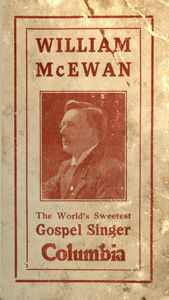
I tried to imagine a museum here which would host this kind of content. But I couldn’t. I suspect the content would be strangled at birth. And yet there is a story, of how the music made the return journey, back to Ulster and Scotland again, with the singing of Ira D Sankey, with recordings by William MacEwan, with recordings by the Carter Family and 'brother duets' of the early 1900s. The music wasn't exported, it just flowed back to the further reaches of the same community rom which it originated, a British Isles distant cousin both connected to and separated from our American kinfolk by the ocean.

I remember once telling a visibly-shocked broadcast presenter that Gospel music isn't primarily a style, or a genre, but a message set to song, across multiple styles and genres. That bit got edited out. Old-time country music - the simplicity of a Blue Sky Boys or Bailes Brothers or McCravy Brothers record - just makes the message even more plaintive and powerful.

SAM 0715SAM 07092016 07 09 17 50 15SAM 0712SAM 0711SAM 0717SAM 07102016 07 09 17 50 242016 07 09 17 51 482016 07 09 17 52 29

2016 07 09 22 58 18

Monday, August 01, 2016

"Folk songs from the British Isles and the Appalachians"

3671078

We were in rural Virginia. We arrived at the venue which was to be our base for the next 3 days. As we checked in, a poster with the title above caught my attention. 

So that evening I went to see the one-man show, expecting a cultural epiphany.

In a sense it was. But rather than ‘Soldier’s Joy’, ‘Boyne Water’, ‘Knoxville Girl’ and many other songs and tunes which have proven Ulster-Appalachian credentials, we got something a lot less interesting:

'My Bonnie Lies Over the Ocean', 'Whiskey in the Jar', even 'What Shall We Do with the Drunken Sailor', a Stephen Foster song or two. ‘Mull of Kintyre' might also have been in there too. I can’t really remember. I went panning for musical and cultural gold - but found nothing.

It was entertaining, it was well played and sung, the artist had the room eating out of his hand. But there was a bigger, better and more compelling opportunity here which was completely missed. Meaning was sacrificed for entertainment. Or perhaps meaning wasn’t really understood in the first place - not transmitted and not sought for.

(PS - pic above is Bill Monroe. He would have done a much better job).

Thursday, July 28, 2016

Obama's Scotch-Irish cultural values

(go to 36:15 in)

" ... And it's got me thinking about the story I told you twelve years ago tonight, about my Kansas grandparents and the things they taught me when I was growing up. See my grandparents, they came from the heartland; their ancestors began settling there about 200 years ago. I don't know if they had their birth certificates, but they were there. And they were Scotch-Irish mostly, farmers, teachers, ranch hands, pharmacists, oil-rig workers. Hardy, small-town folk. Some were Democrats, but a lot of them, maybe even most of them, were Republicans. Party of Lincoln. And my grandparents explained that folks in these parts, they didn't like show-offs. They didn't admire braggarts or bullies. They didn't respect mean-spiritedness, or folks who were always looking for shortcuts in life. Instead, what they valued were traits like honesty and hard work. Kindness. Courtesy. Humility. Responsibility. Helping each other out.

That's what they believed in. True things. Things that last. The things we try to teach our kids.

And what my grandparents understood was that these values weren't limited to Kansas. They weren't limited to small towns. These values could travel to Hawaii; they could travel even to the other side of the world ..."

"the Scotch-Irish were unmatched. No other ethnic group would be as significant in shaping the culture of West Virginia."


Title from this article.

West Virginia state coat of arms illustrated 1876

Tuesday, July 26, 2016

Presbyterian prison cottages

"It is astonishing,” he says, "how little idea Presbyterians have of pastoral beauty; the Catholic has ten times more fancy — but a Presbyterian minds only the main chance. If he builds a cottage, it is a prison in miniature; if he has a lawn, it is only grass ; the fence of his grounds is a stone wall, seldom a hedge. ... A Presbyterian has a sluggish imagination : it may be awakened by the gloomy or terrific, but seldom revels in the beautiful."

– Gamble's Sketches of History, Politics and Manners in Dublin and the North of Ireland in 1810

Refugees Welcome? Not in New England in 1718

A South East View of the City of Boston in North America 1

Above: Boston, 1730

"But what shall be done for the great number of people that are transporting themselves thither from ye North of Ireland?” - Cotton Mather

Mather's family were familiar with Dublin life, his father was at Trinity College and his two uncles were rectors in the city. He wrote letters to 'diverse persons of honour' with the aim of attracting them to the New World. He had a fair idea of the type of people who would come, not urban Dubliners, but northern Presbyterians with the Siege of Derry still in their veins. He hoped they would in some way be similar to Francis Makemie, who had made a huge impact since his arrival in 1683, and whose work he greatly admired. But not everyone was so keen when the Ulster-Scots turned up:

"... The early ties of religious sympathy and common purpose of the two countries were such that it was natural for Ulster emigration to set strongly toward New England. But when the Scotch-Irish began to arrive in Boston in large numbers, they were not entirely welcome. Their ministers were received with marked courtesy by such leading citizens as Cotton Mather and Samuel Sewall, but in general the large arrivals of 1718 appear to have been viewed with anxiety. In July and August Scotch-Irish arrivals in Boston numbered between five and seven hundred. On August 13 the selectmen chose an agent to appear in court, "to move what he shall think proper in order to secure this town from charges which may happen to accrue or be imposed on them by reason of the passengers lately arrived here from Ireland or elsewhere." In the course of the winter a number were warned to leave or find sureties for their support ..."
– Henry Jones Ford, The Scotch-Irish in America (1915)

Thursday, July 21, 2016

Boston, Eagle Wing and the Merrimack River - 1600s, 1700s, 1800s

As I sat in Boston airport last week waiting for our flight back to Dublin, I remembered that less than one hour north was the proposed location of the settlement for the Eagle Wing and her passengers in Autumn 1636.

1636: Eagle Wing’s Ulster-Scots Presbyterians sail for the Merrimack River
Led by 3 or maybe 4 Presbyterian ministers, they planned to become part of the Massachussetts Bay Colony (official seal shown below). Here is the exact site, marked in green on a map of the late 1700s, and a Google Map from today showing the area more accurately. The small city of Newburyport  (population 18,000) now dominates the location.

Merrimack Eagle Wing

Merrimack Boston


"The territory lying between Ipswich and the Merrimack River was well situated, and covered an area of more than thirty thousand acres of upland and marshland. In the summer of 1634 it had been carefully examined by an agent sent over by " divers gentlemen of Scotland," who "wrote to know whether they might be freely suffered to exercise their presbyterial government amongst us ; and it was answered affirmatively that they might."

We received letters from a godly preacher, Mr. Levinston [Livingstone], a Scotchman in the north of Ireland, whereby he signified that there were many good Christians in those parts resolved to come hither, if they might receive satisfaction concerning some questions and propositions which they sent over.

September 25, 1634, the General Court ordered "that the Scottishe & Irishe gentlemen which intends to come hither shall haue liberty to sitt downe in any place up Merrimacke River, not ppossessed by any." The company embarked for New England, "but, meeting with manifold crosses," abandoned the enterprise and returned home. Before the failure of the expedition was known, however, the town of Ipswich, in the exercise of its authority over the unoccupied territory still under its control, made the following conditional grant with the Irish plantation in mind : —

“December 29th 1634 – It is consented unto that John Pirkins, Junior, shall build a ware [fish trap] upon the river of Quasycung [now river Parker] and enjoy the profitts of itt, but in case a plantation shall there settle then he is to submitt himself unto such conditions, as shall by them be imposed.”

- The History of Newbury, Massachusetts, 1635-1902,  John J. Currier (Boston, 1902)


The Parker River mentioned in that quote is just south of the Merrimack and flows into Plum Sound. Today it is a National Wildlife Refuge which each February hosts the Merrimack River Eagle Festival (and here is the website for the Refuge, the map of which shows the Eagle Hill River. Cropped section below).

Newburyport

Parker River crop

Eagle Wing of course failed in her voyage, driven back by hurricanes. I wonder how often her story was told at Ulster firesides in the generations which followed.

1718: Four ships of Ulster-Scots Presbyterians reach the Merrimack River
Nearly a century later it was Presbyterian ministers leading a fresh migration. In summer 1718 four ships arrived in Boston, carrying Ulster-Scots Presbyterian passenger families. They were the first shiploads of the vast exodus of that century, of which you can read more here. These first families grew America’s first white potato, the seed crop of which they had brought with them from Ulster on the voyage. They settled in a few different places in the general area. The settlement of Nutfield became the town of Londonderry, just a few miles from the banks of the Merrimack, which was officially chartered 4 years later in 1722. Presbyterian churches were founded in New England.

1800s: Robert Dinsmoor, Ulster-Scots poet, on the Merrimack River
The eagle-eyed among you will spot that this is the same Merrimack River community where Ulster-Scots poet Robert Dinsmoor the ‘Rustic Bard’ emerged in the early 1800s, at Windham, New Hampshire, (just south of the towns of Derry and Londonderry) with his poems published in Haverhill on the north shore of the river in 1828.

Late 1800s: Opposition from the Merrimack River
NB: The post below – “The Scotch-Irish Shibboleth analyzed and rejected” – mentions Lowell, Massachussetts. Lowell is also on the Merrimack River. It’s pretty remarkable that Joseph Smith airbrushed away the Ulster-Scots history of his adopted home, probably a consequence of the vast demographic change which took place in Boston and other port towns following the arrival of ‘Famine Irish” in the mid & later 1800s.

• Willey’s Book of Nutfield (1895) is online here.
• New England Historical Society article ‘How the Scots-Irish Came to America' is online here. 

(with thanks to Mary Drymon for providing some of these details a while back)

W33

Wednesday, July 20, 2016

"The Scotch-Irish shibboleth analyzed and rejected", Washington DC, 1898

 There has long been opposition to the notion of Ulster-Scots and Scotch-Irish/Scots-Irish identity. This publication by the American-Irish Historical Society is just 30 pages long but has much content that’s worth reading, especially the two poems at the back. To be fair, some of the pro-Scotch-Irish publications of the late 1800s and early 1900s are a bit, as we would say today, “O.T.T.” in places but they also contain much of interest and value. This counter-perspective is also worth reading.

The author, Joseph Smith (1853-1929), was born in Dublin, and emigrated as a young man. He saw military service in the US Cavalry in Mexico from 1873–1878 and spent some years travelling in South America. He later became a journalist. At the time of writing the Scotch-Irish book he was secretary of the police commission in Lowell, Massachussetts.

I am just back from a 3 week break in Washington DC, Virginia, North Carolina, Tennessee and Kentucky. Scotch-Irish heritage is often better understood and appreciated on the other side of the Atlantic than it is here at home. For all of the talk that there’s been over the years, formal links are still to be made to both countries’ mutual benefit.


Saturday, June 25, 2016

Brexit: Samuel Rutherford's "Lex Rex" - the Law is King

Lex Rex

The 'Brexit' vote has taken the world by surprise. A shocked and outraged establishment is, at time of writing, reeling from the vote. The people, the demos, have done the unthinkable. When the polls closed at 10pm news channels were confidently predicting a ‘Remain’ outcome. Within about 30 minutes the tremors were being felt as results started to come through from post-industrial cities like Sunderland. Half way through the night it was clear that ‘Leave’ had won, largely through the votes of the English and Welsh working classes. The people who ‘power’ generally overlooks.

In the 1640s the King (Charles I) was the ultimate authority. And not in a good way. It has sometimes been said that the best form of government would be a benign King. Charles I was anything but. One of the King’s bishops, Kirkcudbrightshire-born John Maxwell (c. 1590–1647), published a booklet in 1643 entitled The Sacred and Royal Prerogative of Christian Kings, asserting the King’s right to do pretty much whatever he wanted to, sometimes referred to as the ‘Divine Right of Kings’.

Another Kirkcudbrightshire man, but with a very different perspective, was Presbyterian minister Samuel Rutherford (who has featured on this blog many times before), who had been minister at the little country hamlet of Anwoth since 1627. The year after Maxwell’s book, Rutherford published his own response – Lex, Rex, or The Law and the Prince; a Dispute for the Just Prerogative of King and People – which argued the very opposite - that the King was subject to God, to the law, and also to the people; that “power is a birthright of the people borrowed [by a ruler] from them … the people may recover this power”. It has been summarised like this:

1) God gives no moral power to the King to commit immoral acts. 2) Kings can and must be justly held to their constitutional oaths, no less so than the people. 3) God stamps no person with the imprint of king, leaving such a designation to the people. 4) All kings owe their offices and powers to Christ. 5) Obedience to kings in unlawful acts is rebellion against Christ.

The British monarchy was overthrown a few years later, but when it was restored again in the 1660s, Lex Rex was burned in public in Edinburgh, St Andrews (where Rutherford had been principal of the University) and London. Anyone found in possession was declared to be an enemy of the state. In England’s last official book-burning, at Oxford University in 1683, Lex Rex was among the flames, a ‘damnable and pernicious book’. Imagine a university campus being a 'safe space'...

It was of course a theological age and the concepts of power and state were being argued within a theological context. But the principles echo down the centuries to today. Should the people be allowed to upset the applecart, bring change, and thereby determine where the civic power is to reside? ReformationScotland.org has a recent article on this theme, available here. It presents the case that power flows from the people to the rulers, not from the rulers down to the people.

The actor/comedian David Mitchell's article in The Guardian argued that Brexit was far too big an issue to be left in the hands of the people, citing Richard Dawkins' comment "we live in a representative democracy not a plebiscite democracy". Frank Furedi's insightful article here is the opposite viewpoint, and in many ways closer to Rutherford - which is fascinating for a founder of the now-defunct Revolutionary Communist Party. His article resonates very strongly with me.

I have good friends on both sides - both Leave and Remain voters. The fallout from the result is throwing up some very interesting dynamics within our society. I have a feeling that the Brexit issue is far from over. I expect it to be  challenged politically, socially and legally from within the UK, and to come under major international pressure, before it is ever implemented. As we in Northern Ireland know well, British governments and civil servants excel in fudge, dilution, ‘constructive ambiguity' and – here’s a big word – obfuscation.

• Various editions of Lex Rex are available online. Here is an 1843 edition, over 300 pages long, on Archive.org. The Preface summarises key themes which show its relevance for today.

Friday, May 27, 2016

I used to be a backwards hillbilly but now I'm okay.

This article in the Financial Times - The Boy who Escaped Trump Country - is almost a tick-box exercise in ‘liberal’ prejudice. I have that in inverted commas because those who claim that title today are amongst the most illiberal and most authoritarian types you can meet. Starting with Ulster and Scotland it centres on Buchanan County in western Virginia, where 70% of people recently voted for the despised Donald Trump. I don’t like Trump, but underlying his success is a deep malaise in American society, which he has given vent to. The aloof tone in the article is typical. But no other people group in the world would be allowed to be repeatedly treated and written about in this way. 

Monday, May 02, 2016

'A Call from the Trenches to Shirkers' - a message from Ballywalter, 20th November 1911

I am very pleased that my good friend Mark Anderson has given me permission to post this poem here. It was recently uncovered during the research phase of a project I was very pleased to work with Mark, and others, on. More about the project in a future post, once it is all public.

If this is how Ballywalter folk spoke at the time, it's also how Ballywalter men in the trenches spoke at the time. And not just Ballywalter - a very great proportion of the Ulstermen who fought would have been from Ulster-Scots communities and so would have spoken like this. I can hardly imagine that they made efforts to use schoolroom English in the trenches of death.

I am aware that there are other Ulster-Scots poems from the Great War. And a number of Ulster-Scots writers have connections with the War.


'Though You Slay Me' - Shane & Shane (with John Piper)