

Robert Wallace Murray was born in Jerusalem, Virginia, on February 9th 1836 (in 1888 the town's name was changed to Courtland). He was educated at home by his father, Dr Robert Murray, who had been born somewhere in Ireland, and who had been a classical scholar. The family lived in a large historic building called Elm Grove which Dr Murray bought in 1832, where he set up a school for local children. One of the pupils was William Walter White (1842-1918) a minister's son who later joined the Confederate Army (see biography here).
On the outbreak of the American Civil War, aged 25, Robert Wallace Murray joined General Robert E. Lee's regiment of the Confederate Army and is said to have 'participated in the brilliant dashes which made the Southern Commander famous in the earlier stages of the war.' (The National Park Service website records a Private Robert W Murray who served in the G Company of the 6th Regiment of the Virginia Infantry which had been raised in Norfolk, Virginia in May 1861. One of the regiment's field officers was Colonel William Mahone who like Murray also came from Jerusalem).
After the War Murray moved to Warrington in Lancashire and then to Ulster. He married Marion Workman at St John's Presbyterian Church, Newtownbreda on 7 June 1866. Marion died of typhoid fever on Boxing Day 1882, aged 37. Murray married again, on 19 March 1884, to Elizabeth Murray at Fisherwick Presbyterian Church.
He prospered in his new homeland and became a J.P. for County Antrim, Chairman of the famous Belfast tobacco firm Murray, Sons & Co, Honorary Secretary of the Royal Victoria Hospital, a Director of the Belfast Ropeworks Co. Ltd. and a member of the Belfast Harbour Board. He stood as a Liberal candidate in the election of 1886 for the constituency of East Belfast.
He penned a number of works - 'Modern Hindrances to Faith', 'General Lee' and 'Eighteen Months in the Confederate Army' a lecture which was published in 1877.
His home was Enniskeen, on the Bryansford Road near Newcastle - the 1901 Census records that he was 65 years old and his wife Elizabeth was 64. They had 4 female servants. The house is now the Enniskeen Country House Hotel (website here, including this overview of the history of the house).
He died on Christmas Eve of December 1904, leaving half of his estate to the London Missionary Society, and large bequests to Forster Green Consumptive Hospital (£75,000), the Belfast Society for Providing Nurses for the Sick Poor, and Belfast Hospital for Sick Children.
The former headquarters of Murray, Sons & Co. on Belfast's Sandy Row, has recently undergone a £5m refurbishment (shown below). I am sure someone out there can do further research into this fascinating man.
................
POSTSCRIPT 1 - The Virginian Pilot newspaper of Norfolk, Virginia reported on 20 May 1900 that Murray's brother was Rev James Murray, a noted Presbyterian minister and then pastor of Hampden-Sydney College. James was planning a trip to Belfast to visit Robert, after which he planned to go to the Paris Exposition. A third brother, Dr William W Murray was a pharmacist based in Suffolk, Virginia.
POSTSCRIPT 2 - This document contains the following details: '...In 1832 Oswin Ricks sold the property to Dr. Robert Murray, an Irish-born physician. Tradition states that Murray operated a school at Elm Grove at mid-century, a belief substantiated by the 1850 census which lists fourteen girls and two boys (in addition to the Murrays's own six children) residing at the house at that time. Murray sold the property to William W. Briggs in 1858. In 1887 Lucius Manry, father of the present owner, bought Elm Grove...'
Elm Grove is on the National Register of Historic Places and is shown below:
POSTSCRIPT 3 - before some looper froths at the mouth about the Confederates, and jumps to all sorts of bonkers conclusions, I am of course aware that there were men of Ulster descent on both sides of the Civil War / War Between the States / etc., including the Union Army's General Ulysses Simpson Grant whose ancestral home is near Ballygawley in County Tyrone. He went on to become US President. Grant visited the Harland & Wolff shipyard in Belfast in January 1879. It's easy to imagine Gustav Wolff greeting the former President, with fellow directors of related companies. I wonder if R.W. Murray J.P. was with the welcoming party, and if he revealed to Grant that just 15 years earlier they had been wartime adversaries? Or if he stood at the back quietly whistling 'Dixie'?
Thursday, June 27, 2013
Robert Wallace Murray - Confederate Army veteran, Belfast entrepreneur and philanthropist & resident of Newcastle, County Down.


Tuesday, June 04, 2013
'he stabbed her in the heart and her heart's blood did flow...'
A new take on the famous Appalachian murder ballad 'Pretty Polly', by Vandaveer. Beautifully shot.
Thursday, April 11, 2013
Multicultural Ulster - introduction
Left: Detail from the Census of Ireland form, 1911.
What if everything you know is wrong? What if the stereotype of 'two tribes' in a state of constant antagonism in Ulster/Ireland is not true? What if it is in fact a relatively recent invention - and what if the actual story of Ulster / Ireland is of a truly multicultural place with thousands of years of comings and goings of different peoples and influences?
It has been said that there is no such thing as Irish history, just Irish mythology. The Census form here shows that 100 years ago efforts were made to avoid 'vague' terminology. Sadly this wisdom has not applied for the past few generations. People have been told that there are just two groups and that they belong to one or the other and never the twain shall meet or have met. But how would this place change for the better if everyone who has been fed that stereotype throughout their lives - and who as a result is boxed in to one of those 'two tribes' - had grown up understanding a bigger, broader and more accurate story?
Maybe rushing back to a selective interpretation of the 17th century, seeking justification to hate your neighbour, (as so many people ultimately seem to do) is a very unhealthy pastime and a very bad idea.
Over a series of posts to follow I am going to attempt to map out a complex, hopefully interesting, Alternative Ulster. The next post will begin with a family trip we made to Newgrange in the Boyne Valley in 2009 - a 5000 year old structure which is older than Stonehenge or the Pyramids...

Tuesday, April 09, 2013

Sunday, April 07, 2013
The Law v The Gospel (by Ralph Erskine, Dunfermline)

One for Sunday. The Bible shows us that the Law of God demands an impossibly high standard of perfection. No-one can achieve it - but many try to do so, and either end up:
a) filled with pride as they admire what they see as their 'successes' - as the poem above says it takes 'boasting' and 'feeds it to my bane', or
b) filled with despair when they experience repeated failure.
Jesus came and raised the bar. To paraphrase, He shocked his listeners one day by telling them 'here's a list of things that the Law says, if you do them, are sins. Well, even if you think about them that's sin too'. Only Jesus meets the perfect standard required the Law - and not only for Himself, but on behalf of all of the failures who trust in Him. I'm not a follower of Jesus because I am a 'good person' or as people in Northern Ireland often say 'good living'. I follow Him because I am a failure, rotten to the core in word, thought, deed and motive - but His perfection covers my failure completely. Ulsterman William McComb put it like this, inspired by these famous words from the Apostle Paul.
And so the Gospel, as the poem says, - 'yields me full relief'. And that relief, and gratitude, I hope is bringing about a change.
Saturday, April 06, 2013
National Tartan Day in the USA
Greetings to my US readers who are celebrating National Tartan Day today. The date of April 6th was chosen as this is the date of KIng Robert the Bruce's Declaration of Arbroath on 6 April 1320 - a document seen as the predecessor of the Scottish Covenants, the US Declaration of Independence, and therefore by default both the Ulster Covenant and the Women's Declaration of 1912. Of the 46 men who signed the Declaration of Arbroath, many had served under Edward (and Robert) Bruce during their campaign in Ulster/Ireland from 1315-1318. The list of signatories is available here.
See the Declaration of Arbroath online here.


Wednesday, April 03, 2013
Multicultural Ulster?
If you take the time to read the great historical volumes published in the 1800s, ie prior to the political turmoils of the various Home Rule crises which began in 1886, what you'll notice is the orthodox view was that Ulster as a province had been, throughout the centuries and millennia, a truly multicultural place. This is not understood today. Will post more here soon to develop this idea.
Sunday, March 31, 2013
New DNA evidence indicates 10% of Scottish men are descended from the Picts; 3% of Northern Irish men too.
Interesting story here. '...The Picts were assumed to have “disappeared”. But this version of history has since been updated and it is now believed they were overtaken by political events becoming assimilated by incoming Scots invading from Ireland...'
(oops - just fixed genuine typo in title - thanks Mick!)
Saturday, March 30, 2013
This Easter, the biggest tv show in America is 'The Bible'
The other night I listened to an interview on BBC Radio Five Live with British-born tv man Mark Burnett, the producer of "Survivor" and "The Apprentice" to name but two examples, discussing his new series "The Bible: A story of God and all of us". It is being broadcast on The History Channel and has already been watched by an estimated 50 million people. See article here. Of course the Guardian hates it.
I have not seen it yet, so am not endorsing it, just letting readers know about it.
Tuesday, March 26, 2013
Roll Away Your Stone
One with a hint of Easter Sunday.
'You told me that I would find a hole
Within the fragile substance of my soul
And I have filled this void with things unreal
And all the while my character it steals...
It seems that all my bridges have been burned
But you say that's exactly how this Grace thing works
It's not the long walk home that will change this heart
But the welcome I receive with the re-start...'
Thursday, March 21, 2013
Wednesday, March 20, 2013
History of Lisburn
'... the town possesses much historic and modern charm. Its old name was Lisnegarvey ("the gamester's fort"). It was laid out in 1609 by Sir Fulkes Conway, of Conway, Wales, and one can glean from its signboards how English, Irish, Scotch and French Huguenots contributed to its making...'
from Belfast and Northern Ireland Illustrated Guide Book by Ward Lock & Co, c. 1945.
Sunday, March 17, 2013
St Patrick and Donaghadee
'... Among favourite short walks from Donaghadee is that to Bangor, by the shore road, and that to St Patrick's Well, a mile southward from the town by the Mill Isle Road, beyond the cable-house. The water is reputed to be a cure for headache ...'
from Belfast and Northern Ireland Illustrated Guide Book by Ward Lock & Co, c. 1945.
St Patrick and Donaghadee (Templepatrick townland to be precise). People used to know this stuff. Nowadays it's implied that only nutters and extremists dare bring this information to public attention. What a strange world we live in.
Thursday, March 14, 2013
Ward Lock and Cos 'Belfast and Northern Ireland' 1940s
A gem of a wee book found yesterday in Bushmills. More excerpts to follow.


Monday, March 11, 2013
An Independent People - The Story of Ulster's Presbyterians.
The first part of this three part series was broadcast here in Northern Ireland last night on BBC2, presented by William Crawley and made by Below the Radar television.
Those of you who know me know that over the years (I think justifiably) I have often been critical of how television companies and broadcasters have got away with stereotyping the story of the Ulster-Scots. There is not enough space here to rehearse all of that, and to hoke it up now would be a distraction.
The first part of 'An Independent People - The Story of Ulster's Presbyterians' dealt with the 1600s, set the 1500s context of both Scotland and Ireland as well as the Reformation in Geneva, and did not shy away from some of the tough stuff around 1641 and of the deceptions around 1690.
I have to commend the production company, William Crawley, and the researchers and scriptwriters. The production values and visual qualities were beautiful in places. There were admittedly a couple of wee wrinkles from contributors - but overall it was an excellent piece of work and judging by emails and phone conversations I have had today, a lot of hard-to-please Ulster folk that I know thought likewise.
Our story is a mighty story and it was refreshing to see it given due respect, treated with depth and substance and not reduced to caricature. I am very much looking forward to the next two episodes.
Click here to see the promo clip

Friday, March 08, 2013
Wednesday, March 06, 2013
Friday, March 01, 2013
Wednesday, February 27, 2013
Newtownards 1613
Ards folk are fond of their history, and tomorrow night the Events Programme for the 400th anniversary celebrations of the borough Charter is being launched. As you can see from the photos below of an antique bass drum from the CLB band, with the town seal hand-painted on the shell, local people here have remembered the date fondly over the centuries and I'm sure this year will be one to remember.

Friday, February 22, 2013
Wooden iPhone conversion kit
So if technology is taking over your life then now at least you can adjust to it in a rustic, natural way. Eden Made is a wooden iPhone self-conversion kit from Germany, costing €89. Nice touch.




Sunday, February 17, 2013
Wednesday, February 13, 2013
The Mandolas (video clip from Irish tv station Balcony TV)
Never heard of these guys before but their sound is great. They describe themselves as a 'four piece folk-pop harmony group' and are from Cork.Website here. They have a page here with some more background info and music.
Tuesday, February 12, 2013
Fishermen's Friends (Port Isaac, Cornwall)
The manager (Paul McMullen) and one of the members (Trevor Grills) of acapella singing group Fishermen's Friends have tragically died as a result of an accident at a concert venue at the weekend. I've enjoyed their style for a few years, and was just re-reading their biography - Sailing at Eight Bells. For those of you who don't know of them here's an introductory video:
Sunday, February 10, 2013
Saturday, February 09, 2013
Join me on Valentine's Night!

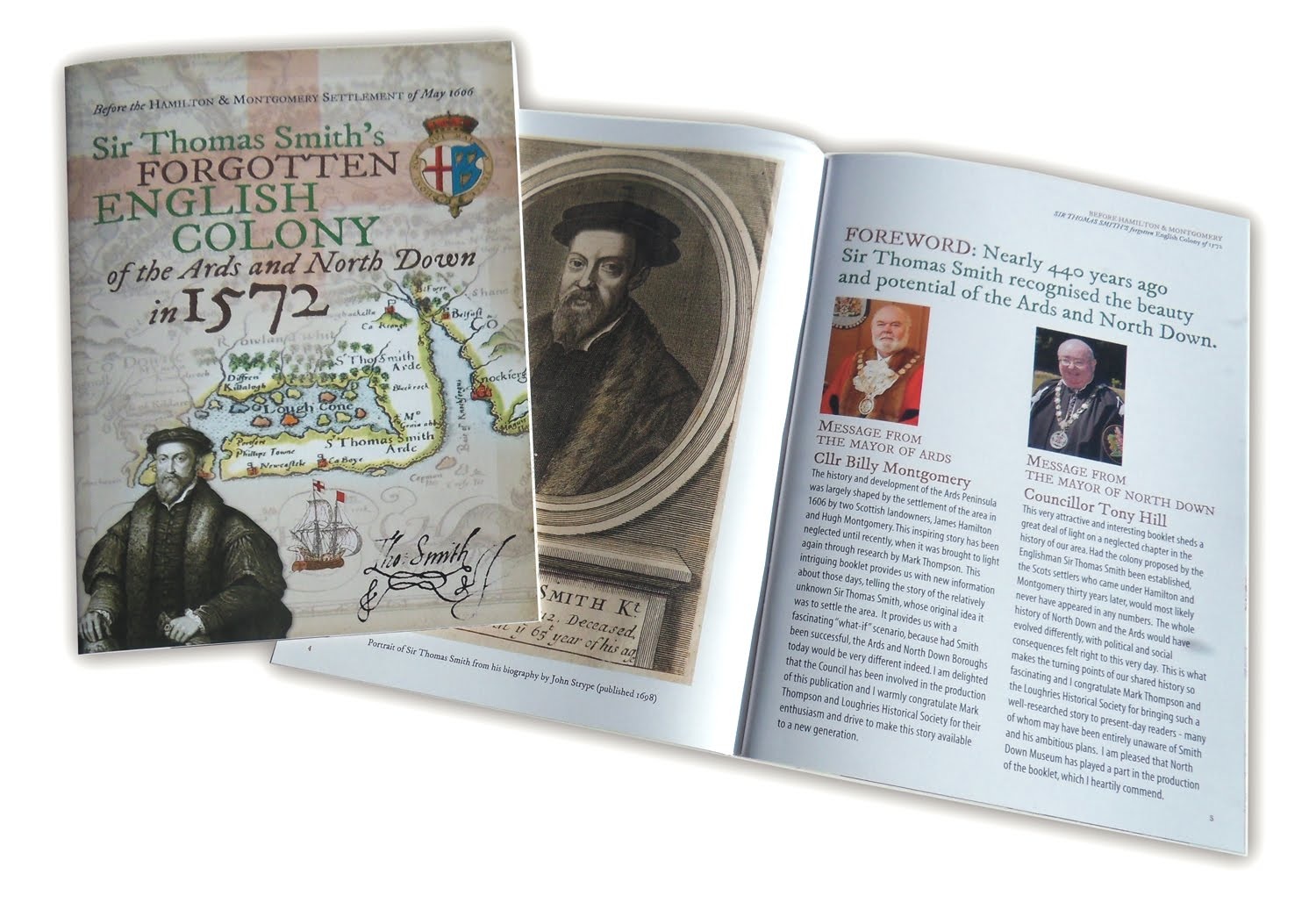
Dr Jonathan Bardon's talk to the Society in January was about the arrival of James Hamilton in 1606, so I'm doing what is sometimes called the 'backstory' or if you're into Star Wars, the 'prequel'. For those of you who don't know, around 1605 Hamilton got a look at the Smiths' old legal papers from 1572 and discovered a golden opportunity which they had missed out on, but which he wanted for himself.
Bangor Abbey was burned down during the Smith campaign, but Hamilton rebuilt it. Hamilton succeeded where Smith failed. When he died he was buried in the Abbey crypt.
Hope to see you there!

Thursday, February 07, 2013
City versus country (Photo: the Scotch-Irish Farm, Frontier Culture Museum, Staunton, Virginia USA)
An idyllic photo of hard work outside an old Ulster farmstead that was taken across the Atlantic to Virginia. I visited it 15 years ago on honeymoon.
It is one of my favourite images and I am posting it here as over the past few days I have been thinking about the enormous social mis-fit there is here in Northern Ireland. It is not the 'two tribes' stereotype. It is the gulf between city people and country folk. It is vast.
The NI media and the majority of NI institutions are dominated by city-minded people. In cultural terms there is a version of Ulster-Scots heritage in the cities - but the authentic and natural form is to be found in the country areas. In landscapes not streets. City issues do not automatically apply to the country; city 'chips on the shoulder' are sometimes irrelevant in the country. City fights should not be assumed to exist in the country.
I have been spending a bit of time over recent months with some city-dwellers who are getting to grips with Ulster-Scots history for probably the first time ever. I think their self-confessed scepticism is starting to melt a wee bit. And fair play to them for being open-minded. But every now and again their urban mindset seems to struggle with things that country folk find natural.
Yes, Scotland is just over the water and we can see it every clear day. Yes, there are lots of folk out here who still use those words. And yes, we do try to get on with our neighbours even if their politics and religion are different than our own - we'll maybe bump into them next week in the shop, or down at the shore, or at the builders suppliers. And our grandparents probably knew their grandparents. And maybe even after all of that, they are our neighbours first and 'different' second.
As a local man once said to me '... d'ye know who it is that causes all the bother roon here? A'll tell ye - oul Bilfast yins...'. Life in much of rural Ulster is far from perfect, but it is not as polarised as in the city.
I know some lovely folk from Belfast, so the observation certainly doesn't apply to everybody. But, the next time you hear people arguing on our radio and tv channels, ask yourself if they are city-minded people. They probably are.

Tuesday, February 05, 2013
So King Richard III of England (1452 - 1485) has been found buried under a car park?
Here's the story. But what's the big deal? The first King of Scotland lies in an unmarked grave on a hillside in the suburbs of Belfast.....

Saturday, February 02, 2013

Thursday, January 31, 2013
In the County Tyrone in the town of Dungannon...
A photo from about 1pm this afternoon, moments before a hail and sleet storm.

Tuesday, January 29, 2013
Friday, January 25, 2013
Yin for Burns Nicht
A 50 year old recording of Psalm 23 in Scots, read by Rev James L Dow, 1963. Mair fillin than haggis...
Thursday, January 17, 2013
R.J. McClean's Double Headed Goat Wool Line - made from the Gossypium fleece of the Blue Ridge Mountain Scotch irish Goat.
Found this photo in the bowels of the computer the other day.

Monday, January 14, 2013

Saturday, January 12, 2013
Sir James Fullerton (d. 1631) - Hamilton's man
I was in London last week and had hoped to visit Westminster Abbey to see the memorial to Sir James Fullerton, but time didn't permit. Fullerton was James Hamilton's right hand man and fellow Ayrshireman, and is an interesting character in his own right:
According to Paterson's History of the County of Ayr (1852), his parents were John Fullerton of Dreghorn and Janet Mure of Rowallan. John was a firm supporter of the Reformation in Scotland. Dreghorn is only about 12 miles from James Hamilton's home of Dunlop, and given that Hamilton's father was the local minister it's possible that James Hamilton and James Fullerton had known each other from childhood. James Fullerton became a pupil of the firebrand Scottish Reformer Andrew Melville.
In 1587 Hamilton and Fullerton left Scotland together and sailed for Dublin, where they established a school and later became founding Fellows of Trinity College. In 1605 when Hamilton got wind of the impending deal between Con O'Neill and Sir Hugh Montgomery to split the O'Neill's Clandeboye estates in half, Fullerton was at the Royal court and got to the King, persuading him to divide the estate into three, with one third for Hamilton (to whom the King owed a lot of favours). For his trouble, James Fullerton is said to have been granted Olderfleet Castle in Larne and other parcels of land in Westmeath, Tipperary, Waterford, Sligo, Donegal, Dublin, Roscommon, Kerry, Kilkenny, Kildare and Cork, including a licence to hold a weekly Saturday market and two fairs in Sligo.
Fullerton however '...loved ready money and to live in Court more than in waste wildernesses in Ulster...' and doesn't seem to have spent much if any time here at all.
Below is Fullerton's modest memorial at St. Paul's Chapel in Westminster Abbey. Official description here.
- some further details on the Ayrshire Fullartons, and their Covenanter connections, can be found here on ElectricScotland. HEre is an excerpt:
'... John Fullarton of Dreghorn, who was served heir to that estate in 1546, and who was the fifth in direct descent from Rankine Fullarton of Fullarton, mentioned previously, took an active part in the Reformation in Scotland, and involved his estate very much on that account. With a view of suppressing the convent of Carmelite friars at Irvine, which the Fullartons of that ilk for centuries liberally supported, he purchased, on 19th May 1558, from Robert Burne, prior of said convent, the lands of Friars Croft and Dyets Temple, on which it was situated. At the meeting of the first General Assembly of the reformed Church of Scotland at Edinburgh, 20th December 1560, Fullarton of Dreghorn was one of the commissioners “for the kirk of Kyle.” On 4th September 1562, with the earl of Glencairn, Lords Boyd and Ochiltree, and a number of the gentlemen of Ayrshire, he subscribed the famous band at Ayr, to support and defend the reformed religion at all hazards, and against all its enemies; and, on Queen Mary’s marriage with Lord Darnley, he went, on 31st August 1565, to Edinburgh, along with the earls of Moray, Glencairn, and Rothes, and Lords Boyd and Ochiltree, at the head of 1,300 horse, in defence of the reformed faith. He was also one of those who, on 25th July 1567, subscribed the articles agreed to in the fifteenth General Assembly, for the punishment of the murderers of the king (Darnley), the defence of King James, and the rooting out of all monuments of popery. In 1570, with the Reformed noblemen and gentlemen of Ayrshire, he signed the letter addressed to Kirkaldy of Grange, desiring to know the meaning of his threats toward John Knox. In the General Assembly of March 1571, he was one of the commissioners appointed to wait upon the Regent, relative to matters pertaining to the jurisdiction of the church. By his wife, Janet, daughter of Mungo Mure of Rowallan, he had three sons and three daughters. His third son, Sir James Fullarton, was educated at Glasgow, under the tuition of the celebrated Andrew Melville, and afterwards went into the court of Charles the First, who knighted him, and appointed him first gentleman of the bedchamber. In this situation he died, and was interred in Westminster Abbey, where an elegant monument was erected to his memory...'

Saturday, January 05, 2013
Wednesday, January 02, 2013


Sunday, December 30, 2012
Three into two won't go
Above: an old embroidered place setting from my own collection, showing Ulster as a combination of Thistle, Rose and Shamrock. Probably circa 1930.
I still have trouble explaining - often to people who really should know better - that the political 'two tribes' Troubles industry is not the only way to view life and history of Ulster and Northern Ireland. Perhaps the Troubles industry is too lucrative, too much of an easy-sell, for those who have grown wealthy, famous or even lazy by perpetuating it. It fills airtime and column inches, it sells books and theatre tickets, keeps people in certain jobs, and consequently fills people's hearts and heads. Politics has its place, but it should not be everything.
I will continue to argue for the cultural three strands story. On Christmas Day I was loaned a book (now that's miserly, eh?!) entitled The Orange Order, written by a Tony Gray, published in London in 1972. I have not started to read it yet, but the short author's bio on the verso caught my eye. It gives some of Gray's background, mentioning that '... his mother comes from an Ulster family of Scots-Irish settlers called McKee, his father was Anglo-Norman in origin and Church of Ireland by persuasion; and he married an Irish Catholic. So, as he says, he has been exposed to three of the main strains in the Irish situation ...'.
Thistle, Rose & Shamrock. Scottish, English & Irish. Presbyterian, Anglican & Catholic. Three cultural sides to the story, not two.
..........
Thanks to the many thousands of you who bother to visit and read here throughout the year. I plan to be offline for a few days, so enjoy your New Year / Hogmanay celebrations and I'll be back in early 2013 (dv) with the same themes and some new thoughts and discoveries along the way.

Friday, December 28, 2012
A message from the Ulster Tourism Development Associations to Americans, 1936
'... A Romantic Holidayland indelibly associated with the history of the great American nation ...'

Thursday, December 27, 2012
The Stories of Robert Burns & St Andrew
Thanks to Robin for sending me the Burns animation below. The same people produced the one about St Andrew. Our distinctive stories could also be treated with this kind of simplicity and creativity. Both are from AboutScotland.
Wednesday, December 26, 2012
Wee words - 'stoon'
Spending time with folk and talking with them always makes great oul Ulster-Scots & Scots vocabulary rise to the surface. My mother has been wracked by deteriorating health for many years now; she was talking this evening about pains in her legs and described them as 'stoons'.
• James Fenton's The Hamely Tongue has 'stoon' as 'a sudden sharp spasm of pain'.
• The Chambers Scots Dictionary has the words 'stound', 'stoun' and 'stund' meaning 'to ache, throb', 'an intermittent throbbing pain' and 'a sharp, sudden pang'.
Monday, December 24, 2012
Sunday, December 23, 2012
Thursday, December 20, 2012
Esso Pictorial Plan of Scotland, circa 1932
With the site of the Covenanters' victorious Battle of Drumclog of 1679 marked. Wikipedia entry here.

The Lone Bellow
This is the hardest way to shoot a film - a single shot with no editing capturing a raw, live performance. Looks great, and the music is pretty good too. Have only watched / listened to it once, I suspect it'll grow on me. Website here.
Friday, December 14, 2012
Charles H Spurgeon on Christmas - '...I wish there were ten or a dozen Christmas-days in the year; for there is work enough in the world, and a little more rest would not hurt labouring people...'
I am often reminded by my more traditionalist friends that Christmas wasn't a public holiday in Scotland for many centuries, an attitude which was carried across the water to Ulster and which continued well into my parents' generation - and remains in some quarters today. Some of the opposition to Christmas (such as the over-indulgence and twee sentimentalisation of the Christmas story) is perfectly valid, and there are sound theological objections as well. But I suspect it's also just an opportunity for miserable graceless killjoys to feel superior to other folk who enjoy the celebrations at the darkest time of the winter.
Charles H Spurgeon had some interesting things to say about Christmas. Thanks to this blog I have found them again:
'...In December of 1855 he preached on "The Incarnation and Birth of Christ" from Micah 5:2. His opening words were these:
THIS is the season of the year when, whether we wish it or not, we are compelled to think of the birth of Christ. I hold it to be one of the greatest absurdities under heaven to think that there is any religion in keeping Christmas-day. There are no probabilities whatever that our Saviour Jesus Christ was born on that day and the observance of it is purely of Popish origin; doubtless those who are Catholics have a right to hallow it, but I do not see how consistent Protestants can account it in the least sacred. However, I wish there were ten or a dozen Christmas-days in the year; for there is work enough in the world, and a little more rest would not hurt labouring people. Christmas-day is really a boon to us, particularly as it enables us to assemble round the family hearth and meet our friends once more. Still, although we do not fall exactly in the track of other people, I see no harm in thinking of the incarnation and birth of the Lord Jesus.
In the same vein Spurgeon preached a message entitled, "Mary's Song," based on Luke 1:46-47 (#606, MTP). In it he says,
Observe, this morning, the sacred joy of Mary that you may imitate it. This is a season when all men expect us to be joyous. We compliment each other with the desire that we may have a "Merry Christmas." Some Christians who are a little squeamish, do not like the word "merry." It is a right good old Saxon word, having the joy of childhood and the mirth of manhood in it, it brings before one's mind the old song of the waits, and the midnight peal of bells, the holly and the blazing log. I love it for its place in that most tender of all parables, where it is written, that, when the long-lost prodigal returned to his father safe and sound, "They began to be merry." This is the season when we are expected to be happy; and my heart's desire is, that in the highest and best sense, you who are believers may be "merry." Mary's heart was merry within her; but here was the mark of her joy, it was all holy merriment, it was every drop of it sacred mirth. It was not such merriment as worldlings will revel in to-day and to-morrow, but such merriment as the angels have around the throne, where they sing, "Glory to God in the highest," while we sing "On earth peace, goodwill towards men." Such merry hearts have a continual feast. I want you, ye children of the bride-chamber, to possess to-day and to-morrow, yea, all your days, the high and consecrated bliss of Mary, that you may not only read her words, but use them for yourselves, ever experiencing their meaning: "My soul doth magnify the Lord, and my spirit hath rejoiced in God my Savior."
Finally, someone sent me this quote several years ago. It certainly sounds like Spurgeon, but I have not been able to document it. If you know where it comes from, please let me know. Whether he said it or not, it expresses the sentiments of my own heart very well.
"Now a happy Christmas to you all; and it will be a happy Christmas if you have God with you. I shall say nothing to day against festivities on this great birthday of Christ. We will to-morrow think of Christ's birthday; we shall be obliged to do it, I am sure, however sturdily we may hold to our rough Puritanism. And so, 'let us keep the feast, not with old leaven, neither with the leaven of malice and wickedness; but with the unleavend bread of sincerity and truth.' Do not feast as if you wished to keep the festival of Bacchus; do not live to-morrow as if you adored some heathen divinity. Feast, Christians, feast; you have a right to feast. Go to the house of feasting to-morrow, celebrate your Saviour's birth; do not be ashamed to be glad; you have a right to be happy. Solomon says, 'Go thy way, eat thy bread with joy, and drink thy wine with a merry heart; for God now accepteth thy works. Let thy garments be always white; and let thy head lack no ointment.'
"Religion never was designed to make your pleasures less."
Recollect that your Master ate butter and honey. Go your way, rejoice tomorrow, but in your feasting, think of the Man in Bethlehem; let him have a place in your hearts, give him the glory, think of the virgin who conceived him, but think most of all of the Man born, the Child given. I finish by again saying, ---
"A HAPPY CHRISTMAS TO YOU ALL"...'
..........
Here's a film of Spurgeon's life -

Monday, December 10, 2012
'...based on an ages-old Scots-Irish murder ballad originally called “The Sisters Twa"...' +++ 'How a movie about murder revived a local musician'
(Article below by Timothy Finn of the Kansas City Star)
(click here for original)
• Wikipedia entry on 'The Twa Sisters' here
• Movie trailer here. (be warned, it's an 18)
• Mile Deep Films website here
• performance of the Scottish folk song here, sung in Scots.
• Gillian Welch's version below (with the story relocated from Scotland to County Clare)
TONY LADESICH'S FILM “Two Sisters” may have found its perfect home.
His award-winning 12-minute movie will be the centerpiece of the fourth annual Murder Ballad Ball, an evening of music that honors songs about love and homicide.
“Two Sisters” has been screened twice in Kansas City and once in Lawrence.
“I really don’t think it has had a real, proper coming-out showing in Kansas City yet,” Ladesich said.
Saturday’s showing could be its grandest yet.
The film is based on an ages-old Scots-Irish murder ballad originally called “The Sisters Twa.”
“There are many versions of it,” Ladesich said. “The first version of that I heard was by Gillian Welch, and I traced that back a few steps that included a version by Jerry Garcia and Vassar Clemens. They are virtually identical. But Gillian Welch’s version is the one that really destroyed me. It was so creepy.”
It also turned out to be a catalyst. For years, Ladesich had been contemplating the idea of making some kind of film about the murder ballad tradition. It was prompted by the cultural uproar that followed release of the Eminem song “Kim,” in which he kills his wife.
“I remember thinking, ‘Have you not been paying attention?’ ” he said. “This tradition goes back hundreds of years. A lot of those objecting the most were country music fans. That’s where this tradition started. I thought it would be interesting to take a traditional murder ballad and visualize and go, ‘Here is what you’re hearing.’ I thought visualizing it would add another layer of creepiness to it.”
He wrote a couple of original verses to the song, added some verses from older versions and made the couple married (they aren’t in the Welch version). He then went looking for cast members, but not in the usual places.
“I wanted all actors to be musicians first and actors second,” he said.
His cast comprises Mark Smeltzer, Richard Alwyn, Kasey Rausch and Erin McGrane. Off-camera he also enlisted singer/songwriter Mikal Shapiro as an executive producer. Fiddler Betse Ellis, formerly of the Wilders, is part of the film’s score.
“Erin is a great actress who is also a musician,” Ladesich said. “Kasey is not an actress; Mark is not an actor; Richard is a musician who is also an actor. It’s kind of an ‘anti-film.’”
Saturday will also be a coming-out of sorts for Ladesich, who is also a musician and songwriter. For the fourth year in a row, he will perform at the ball. This time he will feature his new band, the Secret Liquor Cure with Ben Ruth (bass), Kyle Dahlquist (accordion and pedal-steel guitar) and Sam Platt (drums).
Ladesich has been in a few local bands, including Sandoval, Pendergast and Faster Horses. Several years ago, he withdrew from the music scene to focus on filmmaking and videography.
“I’m able to make a decent living as a filmmaker, which is hard to do as a musician,” he said. “My creativity comes quicker as a filmmaker; its easier to come up with visual ideas than write good songs.”
All the musicians in the film will perform at the ball. So will Ellis and Shapiro. This year’s performance represents a revival of sorts for Ladesich.
“I went to New Orleans for nine days this year to shoot a documentary,” he said. “I’d never been there before. It blew my mind: the city, the people, the culture, the food, the music. It changed me. Music is everywhere. I sat in my hotel room one day lamenting the fact that I’d let the music-making part of me fade away. So I’m going to start playing more music.”
.....................
Sunday, December 09, 2012
From Scotland to Ulster to Virginia and New Zealand - 'Setting the record straight on Betsy Bell and Mary Gray'
Article by Charles Culbertson, published in the Staunton News Leader, Staunton, Virginia.
(click here for original)
One of the questions I’m most frequently asked regarding Staunton history concerns the city’s twin peaks of Betsy Bell and Mary Gray, the imposing and once unspoiled landmarks named after two young Scottish lasses. No other aspect of Staunton’s history — with the possible exception of the pronunciation of the word Staunton itself — is so fraught with misinformation and conjecture.
The tale I’ve heard most often is that the mountains are named after two local girls who were captured and killed by Indians. How it got started, no one knows, but this persistent fable has been around at least since the early 1830s when a Northern periodical printed a detailed account of the alleged tragedy. The author claimed to have gotten the story — which is utterly fictitious — from an old man sitting by the road in the shadow of the hills.
The truth behind Betsy (originally Bessie) Bell and Mary Gray can be found in Scotland in 1666, when two young girls seeking to avoid a plague fled to the Highlands. A young man in love with them both visited often, carrying supplies to the bower they had built. Unfortunately, he carried the plague with him and unconsciously gave it to Bessie Bell and Mary Gray.
The lasses sickened, died and were buried near Perth. Their death gave rise to a ballad, which traveled to Ireland with Scotch immigrants. These immigrants named two hills in the county of Tyrone after the girls (MT: I think this is near Newtownstewart); historians generally believe that Scotch-Irish settlers to Staunton saw a resemblance between the Irish mountains and ours, and bestowed the names on our twin peaks, as well.
As an interesting side note, two adjacent volcanic cones in New Zealand were also named Bessie Bell and Mary Gray by European settlers in the 19th century.
The name “Bessie” had changed to “Betsy” by the time of the Civil War, which saw the trees on its crest cut down for a Confederate observation post. Staunton historian Joseph Waddell once noted that Stauntonians could see smoke from the battle of Piedmont from this viewpoint.
In 1866, one anonymous letter writer to the Staunton Spectator in 1866 lamented the passing of the name “Bessie.”
“I prefer the original Scotch spelling and pronunciation of the former name,” he wrote. “‘Betsy’ as we call it now, is harsh and crabbed, but ‘Bessie’ is soft as is Apollo’s lute.”
The letter writer, who signed himself as “Oldest Inhabitant,” went on to praise the beauty of the mountains, noting that “surely no Staunton boy coming home from his wanderings ever fails to look out for the old familiar hills, and to hail them at first sight with feels akin to rapture.”
In the 20th century the mountains were owned by Staunton resident Charles Catlett, a noted local geologist, chemist and civic booster. He donated the acreage to the city in 1941 with the understanding that each spring the mayor and members of city council travel to the top of Betsy Bell and that the city maintain the crest of the mountain as a perpetual memorial to “the memory of its citizens who have given their lives in protecting the nation.”
Catlett also required that the city cut the shape of a cross out of the woods near the crest.
Both requirements are honored to this day.
.........
• Nelson McCausland's blog has this interesting posting about the story including the words of the ballad.
• Here is a recent story about efforts to restore the burial site.
Friday, December 07, 2012
The Music of Surry County, North Carolina - 'a combination of English, Scotch-Irish and African-American musical traditions'
This short film shows what happens when a community respects its own traditions, doesn't scorn them or turn its back upon them, and when young and old cherish something that's important to everyone. A big part of Northern Ireland's cultural demise is that over say the past 100 years or so people have fixated on so-called 'progress', and in doing so have deeply impoverished our community life. The wholesale grant-aided demolition of vernacular buildings is just one example. As a local man told me recently 'Folk in (village name here) don't care about history, they just care about money'. More to come on this theme in the new year...

Thursday, December 06, 2012
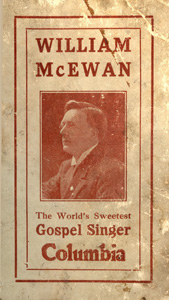
William McEwan, My Ain Countree (usually spelled Countrie)
My grandfathers favourite song. Finally located an original 78. One of 24 pieces recorded by McEwan in London, November 1911 - the first ever gospel recordings in the world.


Wednesday, December 05, 2012

Thursday, November 29, 2012

Tuesday, November 27, 2012
Thomsons / Thompsons and King Robert the Bruce
I like Robert the Bruce. For all sorts of reasons I'll not bother boring you with. So I was pleased a few weeks ago when a certain Mr Anderson was good enough to scan a page from The book of Ulster Surnames by Robert Bell, which he blogged about here.The Thompson/Thomson entry reads -
'...The name Thomson is among the first five in Scotland and in the Lowlands was of the same derivation as in England – 'son of Thom'. It was first recorded in 1318 when John Thomson, 'a man of low birth, but approved valour', was commander of the men of Carrick (in Ayrshire) in Edward Bruce's invasion of Ireland...'
The Bruces also came from Carrick - Turnberry to be precise, where their castle was on the site of today's famous golf course. So I did some checking and it was this same John Thomson who led the Bruce retreat from Ireland in 1318.
In the prolific Rev Thomas Thomson's A History of the Scottish People from the Earliest Times (1895) p 252 it says
'...the handful of Scots who survived the defeat were rallied by John Thomson, the leader of the men of Carrick; and having extricated them from the throng he effected a dangerous retreat to Carrickfergus, where they embarked for Scotland...'
I'm sure if I look at Barbour and other early texts I'll find the same Thomson. Our family tradition is that our Thompsons also came from Ayrshire, between Kilmarnock and Troon. The paper records we know of only go back to the mid 1700s, and even that early there was a Thompson family living in the townland where we still live today. I have no idea if I am descended from this much earlier Ayrshire John Thomson, and I expect there's no way to be sure.
But while there's doubt there's always hope - I'm glad he was a Bruce man and came to Ulster with them.

Sunday, November 25, 2012
John Knox, died 440 years ago on 24 November 1572
Did anyone mark this anniversary? I doubt it. Wikipedia entry here
Saturday, November 24, 2012
Newtownards 1613
These two artefacts probably date from 1913, the 300th anniversary of the town Charter which was granted by King James I to Hugh Montgomery's blossoming Newtownards in 1613. The crescent/hand/fleur-de-lis symbol is from the Montgomery family coat of arms. It was quite an achievement for a place which (apart from a ruined Priory, a ruined castle next to it, and a ruined Movilla Abbey - all of which had been torched in 1572 by Sir Brian O'Neill to stop the Thomas Smith expedition using the buildings as garrisons) didn't exist until Montgomery and his crew arrived from Scotland in May 1606. Up to 40 towns across Ireland were chartered in 1613; I am aware of some plans to mark the Newtownards 400th anniversary next year. More info to follow in due course.


Friday, November 23, 2012
Tabletalk magazine - free offer for iPad edition
it's also available as a printed publication, but the free offer is only for the iPad version.
> Click here for the iTunes store.
> Click here for more info.
'...When you enter the sanctuary of Saint Andrew’s Chapel, you cannot help but notice the majestic pulpit that rises from the chancel and towers above the congregation. Although the pulpit is relatively plain in its structure and design, there is one unique feature to the pulpit that is noticed only upon a closer look. In the very center is an ornately carved emblem of a cross surrounded by rose petals. The emblem is a replica of the Luther Rose—the crest of the sixteenth-century Reformer Martin Luther. Luther designed the crest to teach the gospel to others, particularly the illiterate and children. The focal point of the Luther Rose draws our eyes to the central tenet of Luther’s theology—the cross.
The cross is set against the backdrop of a heart to remind us that we must believe in Christ with our hearts, which God graciously makes alive by the Holy Spirit. Rose petals surround the heart and the cross to highlight that faith in Christ results in joy, comfort, and peace on account of the finished work of Christ. The rose petals are fixed in a sky of blue to symbolize that our joy in the Holy Spirit by faith is our present hope of the future heavenly joy awaiting us. On the outer edge of the Luther Rose, encompassing the entire emblem, is a gold ring symbolizing the heavenly riches awaiting us in the eternal glory of heaven...'
