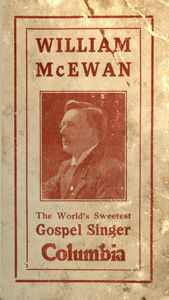


In an era of slick branding (which is my day job and once I get my new blogfolio finished I'll post a link here for you all to see and judge), hand painted typos have a certain charm.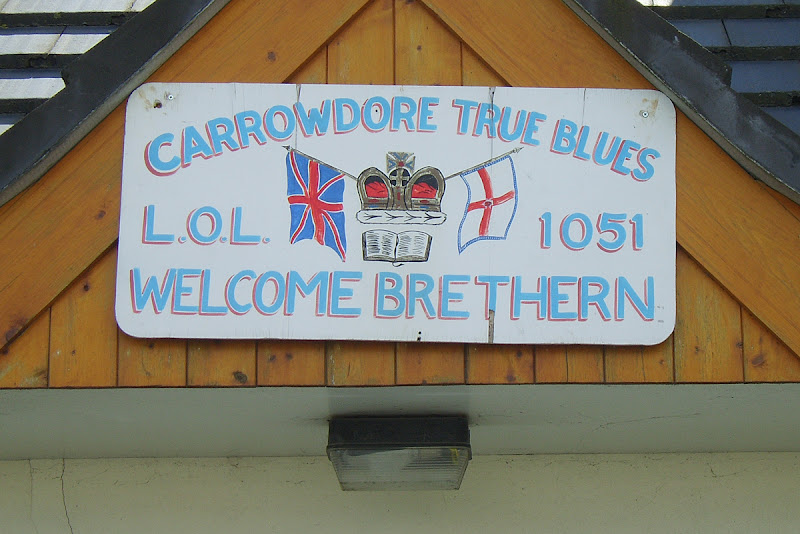
Compare and contrast:
Tuesday, July 15, 2008
The Twelfth Part Three: It may be a typo, but that's how it's pronounced


Red Hand Guinness
Carrying on from the oyster post, I bought three of these old Guinness bottles a few years ago on eBay - I'd been trying to track one down for years. Bet they don't produce this brand any more!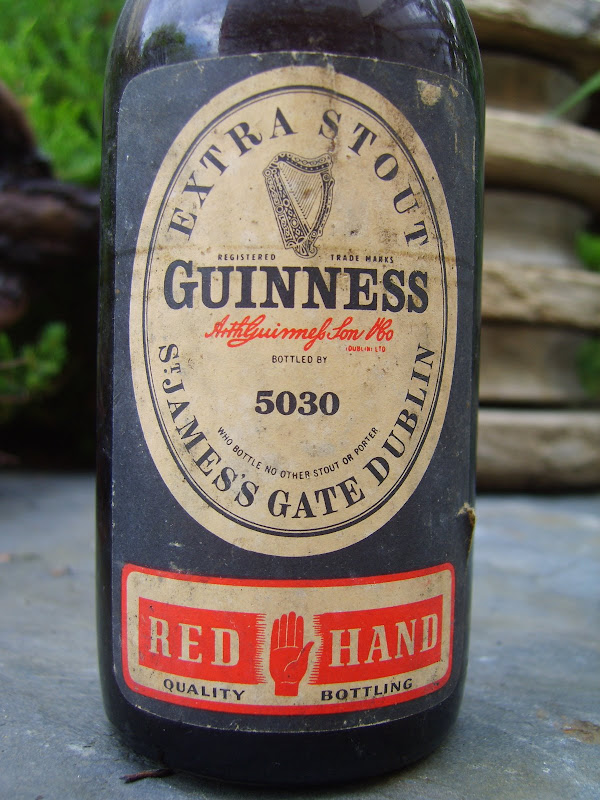
I also found this old pub sign in Belfast, but sadly long since gone. If anyone knows anything about this brand, get in touch.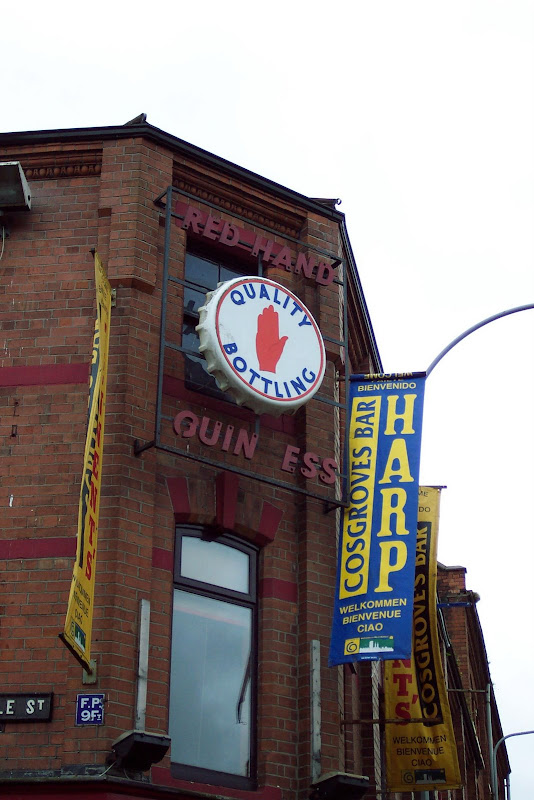
Hillsborough Oyster Festival
Is the Hillsborough Oyster Festival the stupidest-ever idea and location for an event? It has been going now for years, a corporate platform created by Guinness to give the rich and aspirational something to do for a weekend, bringing to life one of their corporate photo library images that appears in every Oirish tourist publication produced these days.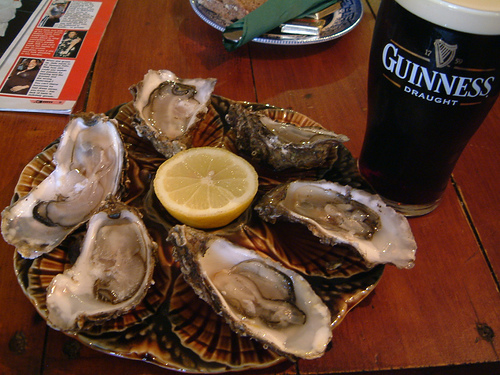
The irony is that you can't actually get oysters in Hillsborough. Or fish. Or crab. Or lobster, or any other kind of seafood. Because Hillsborough, as most people know, (according to GoogleMaps) is far inland - about 15 miles from Belfast and about 20 miles from the nearest sea inlet (Strangford Lough). And as for the nearest oyster farm where the things are actually available, it could be as far away as Donegal!
They must have a really tough time landing all those baskets of fresh oysters at the quayside in Hillsborough.
The Twelfth Part Two: Ulster's National Dish
Some will claim that the Ulster Fry is our national dish. Partial as I am to a good fry from time to time (a real one has fried pancakes and vegetable roll*, none of this hash browns and black pudding nonsense - be wary of people who seek to deviously subvert and internationalise the Fry), I have long believed that there is one other food, an unsung hero, to whom the title of Ulster's National Dish truly belongs.
It's not yellow man. It's not Tayto crisps. It's not even Bushmills whiskey. No ladies and gentlemen, I give you (drum roll.....) the egg and onion sandwich!
No church tay meetin, Sunday School social, family picnic or Twelfth day can be considered truly complete without some egg and onion. It has been the staple of Ulster Protestants for many generations. I was delighted to see one of the food vans in the field at Portavogie had restored egg and onion to its rightful position - jostling for orangey-yellow attention with the modern day bacon & cheese burger, and placed above the chilli chicken burgers! This particular van owner was obviously a man of considerable insight, as he was also selling tea and buns. You'll never get that at a McDonalds franchise.
So impressed was I, that I was even prepared to tolerate the (frankly unnecessary) innovation of the egg and onion bap, as a substitute for the standard egg and onion sandwich, on the basis that he had described it using the traditional term "bap", not a roll, and that he hadn't overstepped the boundary by going for something as poncey or elitist as a baguette, panini or (sharp intake of breath) a wrap!
So I paid my £1.50 and took a bite - boysadear, the perfect egg and onion! Hard boiled egg (not scrambled) raw white chunky onion (not the scallion substitute, and not finely chopped), and real butter (not mayonnaise or salad cream). All's well in the world when traditional egg and onion still exists as a menu option for Ulstermen.
(* for those of you who don't know, the humble vegetable roll is about 99% sausage "meat". Ah, the Northern Ireland sense of irony and humour!)
The Twelfth Part One: It's not what it used to be...
Had some conversations recently about the changing face of Orangeism and the 12th celebrations. Lots of articles have been published in the last few days, mostly in two camps: a) things are changing and it's great, or b) so much for the supposed change, the Lisburn Road was still swimming in alcopops.
The third position is Rev Stephen Dickinson's, which has been explained here, here and here. At great risk of sounding like a fence sitter, I have sympathy with all three views - yes some good moves are being made, but sadly there is still an alcohol culture at some stretches of some parades (as is the case generally in society), and be very wary about dumbing down, losing authenticity, and losing the core values. (I didn't see none of that fancy Orangefest branding in Portavogie!).
Maybe I should have a caption competition for the pic below, photographed a while back outside the Orange Hall in Newtownabbey up near Mossley Mill...
...I wonder if Heather got much trade from the Lodge members?
Saturday, July 12, 2008
The Eleventh Night Beacon
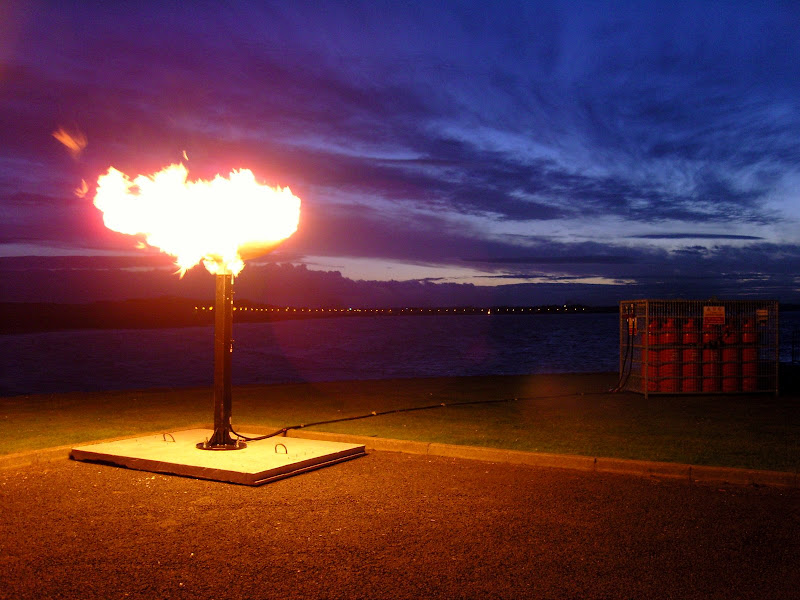
Went down to the harbour last night, where the local community association had organised a (gas powered) beacon to be lit, a short performance by the flute band, and a firework display for the traditional 11th Night celebrations.
It was a beautiful evening, and the intention was that the beacon could be seen in Scotland. A nice simple event, plenty of local folk to yarn with, but Maggie couped and skint her wee knees so there were some tears and yelling, but all in all a nice evening with no drink or nonsense.
(Apart from some fancy folk who had wandered over from their houses, large glasses of wine in hand. Very posh for wee Ballyhalbert!)
The lighting of beacons on the facing coasts of Ulster and Scotland has happened many times over the centuries, including during the Covenanters period:
"...1641: The “Scotch Rising” in Ulster
In April 1641, the authorities in Ulster reported ‘disorders lately attempted by some of the inferior sort of the Scottish nation in the Counties of Down and Antrim’. Copies of Scotland’s National Covenant were circulating in Ulster - one of the suspects who had been arrested reported that ‘that there was such a scroll, and that it had been carried through the country and signed by 1,000 people and more’. Ulster Scots also protested at parish churches, and rumours abounded that the ‘rowtes’ (riots) in Antrim and Down had been instigated by ‘beacon fires on the Scotch Mountains’. As events escalated King Charles I acknowledged that he had heard news of ‘the Scotch rising in Antrim and Down… in contempt of the State and Established Church’ , ordering his forces in Ulster ‘to stop outrages, you shall declare martial law wherever you use troops’..."
(See the full story here)


Thursday, July 10, 2008
The Real McCoy
I was invited to speak in Portavogie Community Association on Tuesday night on an Ulster-Scots subject of my choosing. So, true to form, I opted for Hamilton & Montgomery.
I've delivered versions of that talk in nearly 30 places across Ulster (NI and RoI), but this was only the second time in the Ards Peninsula, which was the epicentre of the Hamilton & Montgomery settlement of 1606.
(For the US readers of this blog, the Scots arrived in large numbers in Ulster starting in May 1606 - the English began to arrive at Jamestown exactly one year later in May 1607, and the two projects were deeply connected - visit UlsterVirginia.com for more background info)
There were nearly 50 people out, and I spoke for about 45 minutes. I knew a good few of them, mostly familiar faces from our rural Ulster-Scots community. My friend and neighbour John Adair was there (Stephen - you can tell him he's now been mentioned on my blog!), David McKee from Kirkistown Pipe Band, Wullie Palmer the local mechanic, Emma Graham, Bert McMaster, the Birches from Bishopmills, Hilary Donnan - all good down-to-earth local folk. Probably all descended from Scottish settlers, maybe even the original people that came with Hamilton & Montgomery. They told me they enjoyed the talk, especially when I showed them the 1625 Thomas Raven map of Hamilton's settlement at Portavogie, along with the rabbits on the Warren (it's still called that even today).
What was refreshing was that in the middle of all the bureaucracy, the Irish News and BBC Radio Ulster "Talkback" hype and nonsense and attacks on Ulster-Scots, the ongoing need to justify the existence and validity of Ulster-Scots to the chattering classes - these folk in Portavogie need no convincing. And when I explained that in other places some audiences need to be convinced of Ulster-Scots, they thought that was ludicrous!
These people ARE Ulster-Scots, as are similar communities across Co Down, Co Antrim and other places too. I'm glad to see the folks in Portavogie improving their 12th calendar this year with simple but good quality events, a historical photographic exhibition in the Orange Hall. I hope it grows into something regular - not bigger, just regular. Because big usually becomes trivial and gimmicky; small is authentic. The community is where the real Ulster-Scots exists.
Pray for sunshine on the 12th and Portavogie will be buzzing! The picture below, from the Portavogie 12th of 1935, shows that the locals have never lacked creativity or imagination!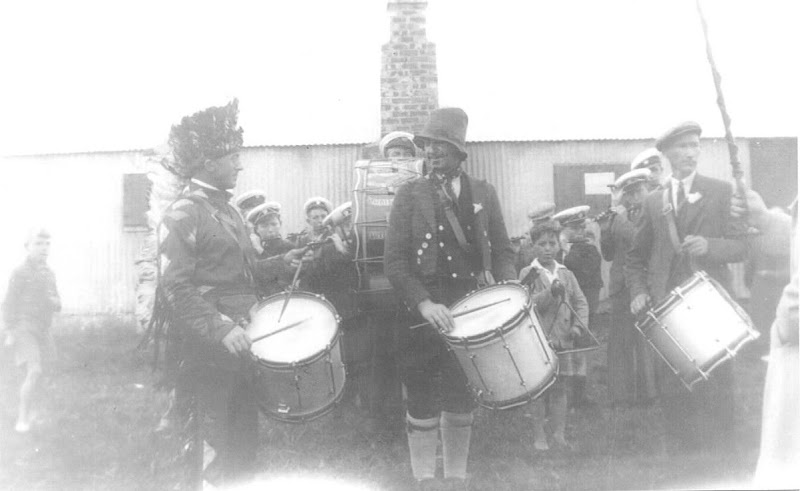
Tuesday, July 08, 2008
Me and Hilary
Hilary has learned to play the guitar and has bleached her hair. I need to lay off the Mars bars.
Saturday, July 05, 2008
Early Release Scheme
It's not all Covenanters and Ulster-Scots in our house!
Back in March I took our two boys to a secret location in the heart of County Antrim to gather as much frog spawn as we could. (pic below from Saturday 8th March)
For some reason, in my lifetime, the frog population of the Ards Peninsula has diminished massively. But as you might expect, once the excitement of gathering the spawn was over, the following 4 weeks of peering at a mass of jelly with wee black dots in it to see if any had hatched was pretty boring stuff, so the boys lost interest and left the whole project to me.
Earlier this week, we released our first 10 "froglets" into the wild, in a damp corner of a field on the family farm at Ballyfrench, close to a well that's been there for at least 100 years, so they should stay well hydrated (never mind the torrential rain we've had this week). Here's a picture of them in the jampot we transferred them in, with a 50p to give you an idea of size. They're so small they could perch on your fingertip. Already they can leap pretty big distances - when we took the lid off the jampot they were scrambling over yin anither tae get oot, doing big leaps from the rim of the pot into the damp grass.
Just this afternoon we released another 10. In total, we still have another 30 adult tadpoles swimming about, so by the time the rest are released we'll be repopulating Ballyfrench with a new frog colony of 50. It's like the frog version of the Hamilton & Montgomery Settlement of 1606!
Hopefully they'll thrive, survive the winter, and breed next spring.
Selfridges and the Ulster-Scots?
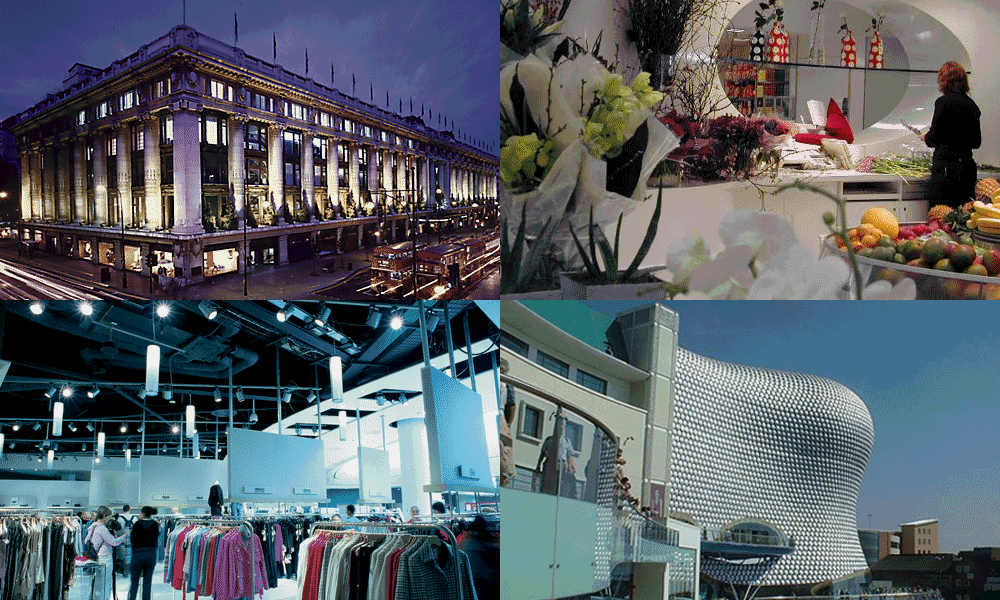 Another BBC programme which was broadcast recently was Shopping for England, a documentary presented by the cultural historian Mica Nava about the rise of the retail revolution in the British high streets of the early 20th Century, specifically Selfridges and Woolworths.
Selfridges is perhaps the uber-retailer of this generation, a style mecca that guarantees commercial kudos for any company that manages to have a product listed there. I didn't see the programme, but I'm told that the current generation of the Selfridge family were interviewed, and during the interview they repeatedly referred to Gordon Selfridge's (1858-1947) Ulster-Scots roots and work ethic being what gave him the drive to succeed in business.
They've only got four stores, with a possible fifth to be opened in Dubai. Perhaps (some day) one in Belfast?!
Sunday Schools: Reading, Writing and Redemption
Thanks to Nelson McCausland for this tip - a 2 hour BBC4 documentary that was broadcast last week on the history of Sunday Schools. I haven't watched it yet - here on the BBC iPlayer. I think they might remove this after seven days, so watch it quick!
Wednesday, July 02, 2008
"A Covenanter"
This poem is from the booklet "Poetry of Avondale", No. 4 in the Avondale Guides series by William D Howat. I bought this at the John Hastie Museum in picturesque Strathaven when we were away. The museum has a room dedicated to the Battle of Drumclog with interpretive panels, scale models and artefacts. And, the added bonus is that it's on the edge of a superb park with big lawns, boating lake, bowling green, playground - all the stuff to tempt the weans with, and to use when striking a bargain of "now, be good in the museum with your Da for half an hour and I'll take you to that great park afterwards!"
A Covenanter
I'se never uphaud I was a saint
I've had my daft days like the lave;
An' de'il be in't, can I repent;
I's bear the wyte o't yont the grave.
But when the State, wi' murderous dirk
Held to my breist, threeps doun my thrapple
That I maun lea' auld Scotland's Kirk,
Sit under Prelates in the chapel;
Forsweer the sacred Covenant
Oor faithers made in bygane years,
An' worship as the King does want!
Shall this be tholed? Na, damn the fears!
Kings may be Kings by richt divine;
The King shall hae his richts; but dod!
He'll get them when he gies me mine
An' mells na wi the things o' God.
The men o' wrath gaed forth to kill;
The red dragoons were at their posts;
I left my yowes upon the hill,
An' listed wi' the Lord o' hosts.
For Cov'nant folk the sword had drawn
To meet the oppressors front to front;
Gin they be dour, weel, we'se be thrawn
We'll up an' gi'e them dunt for dunt.
I saw the tulzie at Drumclog,
Whaur mony gat the wage o' sin;
We drave them ram-stam through the bog,
An' faith! They werena sweer tae rin.
Claver'se himsel' was gar'd to ride -
Oh! prood were we that day an' big -
Wae's me! wae's me! for sinfu' pride
We gat oor paiks at Bothwell Brig.
Sae hunted like the tods an' brocks
Ower muir an' moss by sodgers driven,
Oor kirk is 'mang the roofless rocks
Oor prayers gang stracht to God in Heaven.
He sees the creatures through an' through;
He kens He made us o' the dust;
He kens oor he'rts, though steeve, are true;
He kens oor Cov'nant's cause is just
...................
The author of the poem is unknown, but in the booklet it says it may have been written by William Cleland. I'm no expert, but I doubt it was Cleland - the language looks more like late 18th / early 19th century, rather than the late 17th / early 18th when Cleland wrote his poetry. But I could be very wrong!
Oor Weans at Wigtown
As my parents did with me, Graeme, Marianne, Helen and June, I took our three weans to Wigtown in south west Scotland last week to see the graves and monument stake to the two Margarets (a change in tidal patterns mean that the sea doesn't come in there any more, it's a large grassy marshy plain now). There's also a small display panel in the museum there which tells their story. Wigtown is just about an hour from Stranraer - everybody travelling by ferry to and from Stranraer should take some time to visit Wigtown
The weans' reaction was interesting. I have told them the story of the drowning of the two Margarets many times, but being there, seeing the Solway Firth, standing by the graves, really brought it home for them.
After seeing the graves we were heading back to the car, and Charlie spontaneously said "Dad, we have to leave flowers on the grave!" and he dashed off to a big clump of wild daisies. He tugged a few out and went back to the graves. I ran after him.
By this time Jacob had arrived too; Charlie looked up at me, almost seeking approval, and then (because he's wee) slipped through a gap in the railings that surround the graves and laid the flowers on the flat gravestone. It was a lovely moment with the two boys joined in a simple, instinctive, childlike act of remembrance at that most special of places.
Here are the photos.


Richard Cameron's birthplace, Falkland


Took these pics in Falkland, in Fife, last Saturday morning at about 7am. The Lion of the Covenant, Richard Cameron, was born here.
Tuesday, July 01, 2008
John Welsh plaque, Ayr


Spotted this on the Bank of Scotland building in Ayr High Street. John Welsh (1568 - 1622) was married to John Knox's daughter, and their son Josias Welsh was minister at Templepatrick in County Antrim from about 1622 onwards.
Links:
"Life of John Welsh, Minister of Ayr" by Rev James Young, (Edinburgh, 1866) on GoogleBooks here
Biography here
Wikipedia entry here
Alexander Peden Primary School, Harthill
When are our local primary schools going to have names like this?!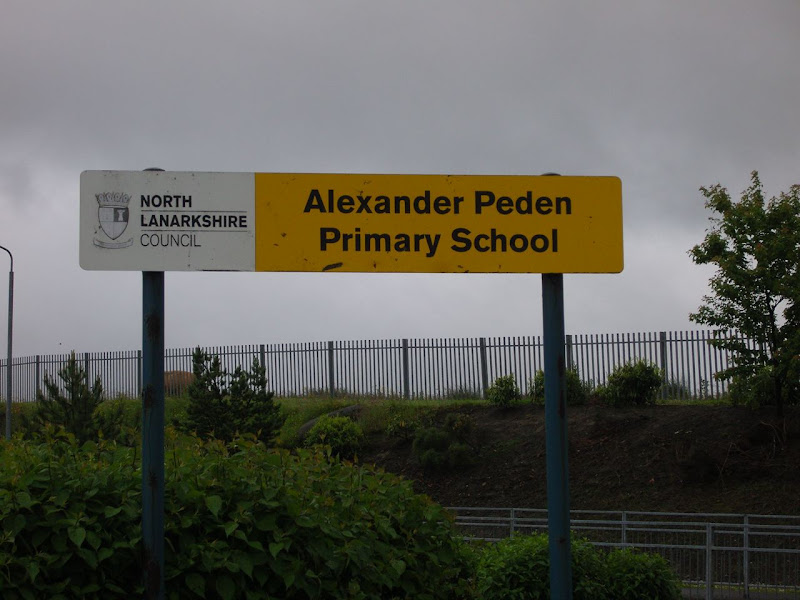
Visiting the Rullion Green monument
Arguably the most important event in the Covenanters in Ulster story is the Pentland Rising, also known as the Battle of Rullion Green. Back in February I spent most of a morning trying to locate the monument. Last weekend I went back with the sole purpose of taking my children there - part of the cultural education programme.
Fought on 28 November 1666, the Covenanters were led at Rullion Green by Colonel James Wallace, a veteran of the Covenanter Army in Ulster during the 1640s, during which time he was Governor of Belfast for about 2 and a half years. He married one of the Edmonstones of Ballycarry in County Antrim. However, for all his military skills, the Covenanters were greatly outnumbered by a heavily armed Royalist force led by General Tam Dalyell, who was also a veteran of the Covenanter Army in Ulster but who had conspicuously been the only man to refuse the Covenant at the great public event at Carrickfergus in April 1644. The Covenanters were cut down, and of the fifty-odd who were killed, only two are named on the small monument - Rev John Crookshanks of Raphoe and Rev Andrew McCormick of Magherally near Banbridge. 80 Covenanters were taken prisoner and soon after were executed.
If you want to go to see the monument at Rullion Green, I hope these instructions are of some help - they're about as accurate as I can make them. Hopefully this will save you time and frustration in trying to track it down.
1. Follow the A702 from Edinburgh to Biggar. Just behind the town of Penicuik is Flotterstone Visitor Centre (part of the Pentland Hills Regional Park). There's a good wee restaurant/pub nearby with a garden that can sell you a good family feed!
[Jacob at the Flotterstone Inn where we all had our lunch last Friday]
[Closeup of the map at the Flotterstone Visitor Centre. The site of the monument is marked just above the word "Glencorse"]
2. You can either park the car here, and walk up the footpath along the roadside uphill towards Silverburn, or else drive up the hill. On the left hand side you'll pass Mauricewood Road which leads into Penicuik - just a few yards further up the hill, on the opposite side, you'll see a lane leading towards Rullion Green Cottage. My advice is to drive up to the cottage and park there (introduce yourself to the locals and tell them you're there to visit the monument - lots of people do it)
[Entrance to the lane leading to the cottage]

3. Standing in the yard of the Cottage, look uphill towards a small copse of trees. In the middle of these you'll be able to pick out a red shape - these are the railings that surround the small monument.
[View of the copse and railings from the cottage yard]

4. Then set off up the hill, it's about a 10 minute walk and pretty straightforward. The monument is modest, but well worth seeing, along with the interpretive plaque that was erected there in 1966.
[series of pics of the monument - click to enlarge]


The views from the monument sweep down the Pentland Hills towards Edinburgh, and are spectacular on a clear day. There must be a good argument for the relevant public authorities to create better access and a small car park / viewpoint close to the monument.
[the view towards Edinburgh]
2016 will be the 350th anniversary of the Pentland Rising. For those who read this blog and are interested, I know that's eight years away, but with eight years of planning time available, something very special could be done in 2016, on an "east-west" basis, to mark the anniversary.
Here's a link to GoogleMaps - click on the marker near Edinburgh for a pinpoint location that's about as accurate as GoogleMaps will provide.
David Hackston Gravestone, Cupar, Fife

David Hackston suffered probably the most brutal execution recorded during The Killing Times. He was captured, taken to the market cross at Edinburgh, had his hands cut off, was raised on the gallows and dropped to the ground three times, then his still-beating heart cut from his chest - the executioner shouted "Here is the heart of the traitor!" - which was then thrown onto an open fire. He was finally beheaded and quartered. One of Hackston's hands is buried under this ornate gravestone at Cupar in Fife, along with the severed heads of two other Covenanters.
During his trial, Hackston said:
"...It was cast up to me both at the council and here, that here were not two hundred in the nation to own our cause. I answered, at both times, that the cause of Christ had been often owned by fewer..."
Cupar is a beautiful historic village en route to St Andrews - worth a visit if you're in the area. You can read a fuller bio of Hackston here
Sunday, June 22, 2008
Killaughey Mission Hall
David Gilmore and I were speaking there tonight (it's beside Ballycopeland Windmill, the only working windmill in Northern Ireland). Some pics attached from after the meeting - a wee window into mission hall life in the Ards Peninsula.


Saturday, June 21, 2008
Tulchan
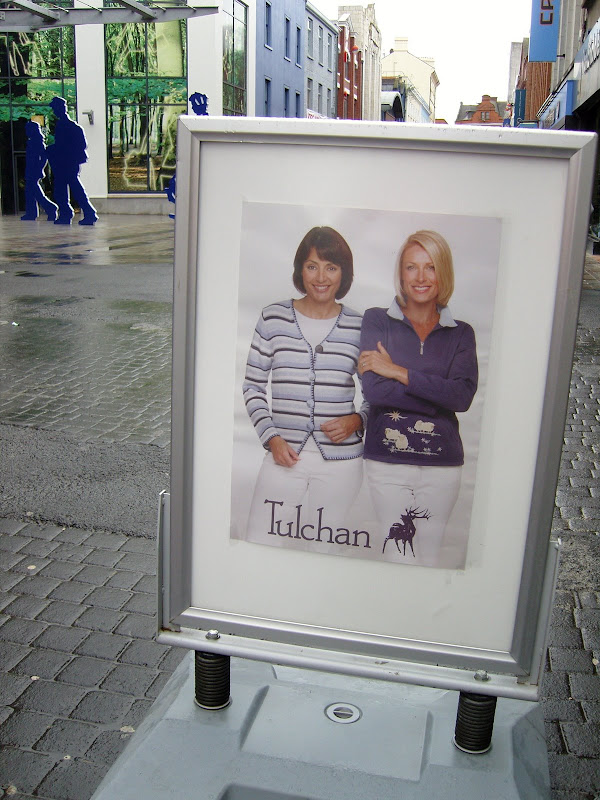
Took this photo outside the fancy new multi-million-pound-cathedral-of-retail Victoria Square centre in Belfast recently. "Tulchan" was once a term of abuse that the Ulster-Scots used in the mid 1600s to describe their enemies - the "Tulchan Bishops" of the established church. Now it's a cardigan brand for middle aged women!
Thursday, June 19, 2008
Irish News at it again

Of course it just again shows the intellectual laziness and ignorance of both Ian Knox and the Irish News. The Ulster-Scots Agency has said nothing negative about the additional funding for Irish - but once again, Ulster-Scots is the default whipping boy of choice for these people.
The Perfect Name for an Ulster-Scots Festival Weekend
"Festival" is an odd thing - suggests lots of people having lots of fun, bright colours and happiness. Perhaps a bit shallow, but well intended. All of which is not very Ulster-Scots. Here's the one we need!
Wednesday, June 18, 2008
Willie Drennan - Big Lang Danner

Willie's new book, Big Lang Danner, is out next week. It's record of a two week walking trip he made from Stranraer through south west Scotland to Dumfries, then north west through Moniaive, Sanquhar and Cumnock to Ayr. An amazing series of stories and discoveries unfold in the pages - plenty of encounters with Covenanter tales and monuments forbye! He asked me to write the foreword for it. Here it is, and it might (perhaps) get me into a wee spot of bother:
Foreword
by Mark Thompson, Chairman, The Ulster-Scots Agency
Forget government agencies and public bodies. The real face and heart of Ulster-Scots is not the suited “professionals” and bureaucrats that trip over themselves to get their photographs as big as possible in the newspapers, it’s Willie Drennan. Go up to anybody in the street in Northern Ireland, and they’ll at the very least say “the wee man with the Lambeg”!
I have the utmost respect for Willie and for what he has done in lifting Ulster-Scots from being a fringe interest of the dedicated few, to many new audiences - in schools, at mainstream festivals, on radio and of course television. I have even had the privilege of playing mandolin onstage and recording music with him over the years. “Big Lang Danner”, his second book, takes his work to another level.
If you’ve never read the 1998 worldwide bestseller “A Walk in the Woods” by the famous American author Bill Bryson, you should get a copy. It’s his personal experience of walking the Appalachian trail from Maine to Georgia, and describes the people and places he meets along the way. “Big Lang Danner” is just as good, and for an Ulster-Scots or Scottish readership, it’ll open your mind. I’ve spent a bit of time travelling the roads that Willie walks in this book, and reading his unique fusion of history, humour, culture and people has honestly made me want to retrace his steps (although I might skip the part where he sleeps in the phone box!).
1.5 million people travel by ferry between Ulster and Scotland each year - but virtually all of them just hurtle through south west Scotland - that triangle from Stranraer to Dumfries to Ayr, on their way to somewhere else. This needs to change. I would encourage everyone to plan some extra time into their journey, to turn off the A77 or the A75, to visit the places and meet the people that Willie talks about in this book. Go to Glen Trool, go to Moniaive, spend a day in Kirkcudbright, and take “Big Lang Danner” with you. There’s no better introduction to the Ulster-Scots connections - the pages will come to life as you walk through the villages and landscapes that Willie has described so well.
Finally, I want to draw your attention to Willie’s conclusion - he poses some big questions, challenges and ideas at the close of this book that we would all do well to consider. There is so much more yet to be done for Ulster-Scots. Government might think it will deliver, but in actual fact, it’s the ordinary people who will. In "Big Lang Danner", Willie shows us the way.
..............
Willie's new "A Danner Wi Drennan" tv series is due to be broadcast on BBC Northern Ireland during July. Meanwhile,you can pre-order your copy of "Big Lang Danner" here, for just £10.00.
Tuesday, June 17, 2008
Paisley and the Covenanters

"...Knowing about the covenanters and seeing graves of people who lost their lives because of their beliefs made the word heritage understandable..."
(Thanks to Jack Greenald for this article)
In his farewell speech, Ian Paisley paid tribute to his father, a Baptist Pastor, and his mother, who he said was ‘of Covenanter pedigree’. According to Ian Paisley, the Covenanters have been a central influence in his life and career. One commentator speaks of a religious ideology which Paisley imbued in his youth which originates ‘in the bleak Scottish Borders and the lush meadows of Ayrshire with the seventeenth century Covenanters’.
Paisley makes numerous references to the Covenanters in his preaching. In a sermon preached in 1982, he said: ‘We as Presbyterians today rejoice in the Covenanting struggle. We thank God for Richard Cameron the Lion of the Covenant. We bless God for the galaxy of the Covenanting martyrs. What did they do? They opposed the King. They opposed his Parliament. They opposed the Magistrates. They opposed the soldiers in the Army. They opposed the authority - the constituted authority law forces of the Crown’.
In another sermon he said: ‘There is in my heart a wonderful affinity with Richard Cameron’. And he described the Covenanters as ‘bold, courageous, strong men ... these were not the putty paper men of the 20th century – these were the rugged men of the Reformation’.
At the Wigtown Book Festival in 2007, Paisley spoke of the Wigtown martyrs, and said that their deaths had ‘influenced his life’. He was reported as saying: ‘Margaret Wilson and Margaret McLauchlan have obtained in our time and in the time of our fathers a celebrity such as their accusers, their judges, their persecutors and their cruel murderers never dreamed of ... I believe that the blood of the martyrs is the seed that has brought a blessing to my country and to yours ... Ulster, the Province that I love and you in Scotland owe our freedoms to these women and others who fought the battle in their day and who refused to bow the knee to false religion, and were determined to do as God would have them do’.
In 1988 Paisley republished a copy of the National Covenant of 1638. In the introductory notes he wrote: ‘The binding of ourselves under God in solemn and holy covenant to resist the tyranny of Rome and to stand true to the principles of the Protestant Reformation is our task today as it was the Covenanters task in their day ... All who accept the Scriptures as the Word of God, must renounce the errors condemned by the Covenants and contend for the truths those who subscribed them pledged themselves to maintain’.
When his children were growing up Paisley took them on holidays to Scotland to visit Covenanter graves. In her biography of her father, Rhonda Paisley wrote: ‘Many a holiday we spent trekking over the moors to be photographed at some covenanter’s grave in Scotland. It was always cold and blowy and the ground uneven and difficult to walk over. There were cowpats galore, and the occasional bull to navigate gingerly – all just to look at some weathered, green, moss-covered stone with a railing around it... I do appreciate the sacrifice made for religious freedom and I am thankful for those men and women of the past who died because of their faith... Knowing about the covenanters and seeing graves of people who lost their lives because of their beliefs made the word ‘heritage’ understandable’.
(Illustration above is an oil painting I found one day when clearing out an old cupboard in the GCAS Design studio in Belfast - don't know who the artist was, but it's a great piece of work)
Monday, June 16, 2008
Bush breezes by Belmont in Belfast

Sitting in traffic this evening at the roundabout at the end of the Belmont Road, gazillions of PSNI traffic cops everywhere, holding the flow of traffic. I couldn't work out why until I realised that the motorcade of President Bush must be about to sweep past on its way back to the airport.
It was obvious we were going nowhere for a while, so I turned off the ignition and turned on Radio Ulster, where the usual Northern Ireland battalion of complainers were emailing and texting like billyo, giving off about what a nasty man George W is, and how outrageous it was that his visit was delaying them getting home on time. This place is FULL of people who do nothing but gurn.
So the motorcade eventually drove past, with about 30 police motorbikes in front, then the three or four big sleek black American cars with flags on the front (a Union Flag and a US Flag) carrying the President and First Lady, followed by sinister looking black trucks that were probably carrying enough weaponry to shoot everybody in the world at least twice over, and a few dozen police cars behind. In about 3 minutes it was all over and we were on our way, up the hill towards Craigantlet and back hame.
I did think it was kind of ironic that when I was down at the front of Belfast City Hall today there were protestors with posters which had a picture of Bush along with the headline "World's No. 1 Terrorist" - to then come home and see him on the news having met at Stormont Castle with... ahem.
(illustration above from The Scotch-Irish in History by James Shaw, 1899)
Car parking in Belfast

Car parking is very expensive. So today, as I was handing over my £6.30 to the elderly attendant in the pay booth of the multi storey car park behind the Holiday Inn, I couldnt help but smile at the PostIt note he'd stuck on the glass, to fend off the impatient customer or two. (click the photo to enlarge)
Sunday, June 15, 2008
Jacob's Pillow / the "Stone of Destiny"... it's a fake!
 So says Scotland's First Minister Alex Salmond. It's one of the most potent symbols of Scottish Independence, and was the stone that many Scottish Kings were crowned upon. It was nabbed by King Edward I of England in 1296 during one of his many invasions of Scotland, making the crowning of King Robert the Bruce the first one not on the stone. It was kept under the Coronation Chair in Westminster Abbey, London, and was returned to Scotland in 1996. It's now on public display in Edinburgh Castle. Salmond says that what was taken in 1296 wasn't the real stone, but a replica. The real stone must therefore still be out there somewhere... (cue Scooby Doo-like suspense music clip) da, da, DAAA!
The timing of Salmond's announcement will be great news for the movie industry with a film about the Stone due to hit cinemas in the Autumn (starring Robert Carlyle and the brilliant but always-typecast-as-the-mysterious-or-enigmatic-scary-old-man, Christopher Lee)
The legends of the stone are many; here's a summary from the article:
According to mythology the Stone of Destiny, also known as the Lia Fail, originated in Palestine and was transported through Egypt, Sicily, Spain and Ireland before arriving in Scone in the 9th century where it was used when Scottish monarchs were crowned.
Legend has it that it was used by Jacob as a pillow in biblical times. According to others, it was used as a coronation stone by early Gaels in Ireland, and as a travelling altar by St Columba. It has even been linked to Robert the Bruce and to the Blarney Stone.
I'm not impressed at all by the veneration of relics like this, it doesn't sit that comfortably with the rural Ulster-Scot evangelical Prod mentality - Old Testament connections or not! It all strays a bit too close to British Israelite theory for me, which some people I know seem to be into, and which some, let's just say, eccentric websites try to explain.
The story goes that the Old Testament prophet Jeremiah left the Holy Land and brought Princess Tea Tephi with him from Jerusalem, fleeing from King Nebuchadnezzar of Babylon whose armies had just taken control of the city. Tephi was the daughter of King Zedekiah, the corrupt last King of Judah. Having stopped off at a number of locations en route, they ended up in Ireland - on the 18th June 583 BC to be precise, with a precious cargo that included the Stone and also King David's Harp (which later became one of the national symbols of Ireland). She later married the High King of Ireland, and when she died was buried inside Tara hill. The stone remained in Ireland for about 1000 years before being taken to Scotland around 500AD.
From 1899 - 1902, the British Israelites carried out some excavations at Tara in County Meath, believing that the Ark of the Covenant was buried in there too. There's an excellent book about the whole episode, published by the Royal Irish Academy.
I have a solution to it all:
• A huge 10 year project, seed-funded by the Ulster-Scots Agency (to cover the cost of the taxi fares for kilt-wearers to visit Tara, well it's cheaper than a taxi to Dublin) and submitted as a proposal to INTERREG IV European funders, for
• Alex Salmond to come across with a shovel to personally dig up Tara, leading a workforce of Scottish Nationalists and British Israelites. (First to find the Stone gets to keep it)
• clearing the controversial route for the proposed M3 motorway, thereby improving North/South relations, and
• giving the Orangemen a new place to walk along close to the new Battle of the Boyne visitor centre at Oldbridge...
However these people may not be so happy about that!
Wednesday, June 11, 2008
The Stuart Kings
(this is a working draft I'm going to come back to)
Over the past few years I've changed my mind about a lot of things. One of them is about King James I. I was brought up - like many people in the western world during the 20th century - with the highest regard for the King James Version / Authorised Version of the Bible, and by association King James VI of Scotland / I of England benefitted from that. It was probably something of a backlash against the dodgy modern translations that caught on like wildfire around the same time.
These days I have a different view about him, although I still think the KJV is a masterpiece. King James I and his three successors are collectively known by the term "The Stuart Kings". Here's an overview (which needs further refinements):
...............
King James I of Scotland
• Born 19 June 1566
• Crowned 24 July 1567
• Became King of Scotland 1585
• Became King of England and Ireland 24 March 1603
• Died 27 March 1625
George Buchanan (1506 - 1582): was King James VI of Scotland's personal tutor during his childhood years; John Knox had preached at his coronation service in 1567. Buchanan published De Jure Regni in 1579, in which he wrote that the source of all political power is the people, and that it is lawful to resist, even to punish, tyrants. However when he "properly" took the throne in 1585, aged 19, James dumped the beliefs that Buchanan had worked to instil in him, and took on the notion of the "Divine Right of Kings" - that he was God's man and could do whatever he wanted to.
Next was Andrew Melville (1545 - 1622), who in 1596 had an audience with the increasingly arrogant King James VI. Melville told him:
"Sir, ye are God's silly vassal; there are two kings and two kingdoms in Scotland: there is king James, the head of the commonwealth; and there is Christ Jesus, the King of the Church, whose subject James the Sixth is, and of whose kingdom he is not a king, not a lord, not a head, but a member."
You can imagine the reaction of King James. Melville was later imprisoned for four years in the Tower of London. When James became King of England and Ireland in 1603, his earthly ambitions expanded rapidly. He set about "planting" new colonies in America, the Carribbean and of course in Ulster too.
He also set about creating his own version of the Bible. Why? Well, the Bible that most people used at this time was the Geneva Bible. It was first published in 1560, and first printed in Scotland in 1579; its footnotes included over 400 references to "tyrants" and encouraged the people to rise up and overthrow them. King James couldn't have his subjects getting any ideas, so he commissioned his own "King James Version" or "Authorised Version" replacing the word "tyrant" with the more innocent "king". He outlawed the Geneva Bible and then swamped the country with thousands and thousands of copies if his own "authorised" version.
...............
King Charles I of England, Scotland and Ireland
• Born 19 November 1600
• Crowned 27 March 1625
• Executed 30 January 1649
James' son, Charles I, succeeded him and he inherited his father's furious ambition - many historians say he was even worse. So another Scottish scholar and minister, Samuel Rutherford (1600 - 1661), stepped up to the plate and in 1644 wrote "Lex Rex", following in exactly the same approach as Buchanan and Melville. It was a brilliant assault on the "Divine Right of Kings". Charles demanded that it should be burned - and that anyone who owned a copy was a traitor.
---------------
King Charles II of England, Scotland and Ireland
• Born 29 May 1630
• Crowned 29 May 1660
• Died 6 February 1685
Charles I's son, Charles II, was the man who unleashed the brutal fury of "The Killing Times" in Scotland in an attempt to finally finish off the opposition to the King's authority. 18,000 people (Covenanters) were either executed or deported overseas. During his reign, Rev John Crookshanks of Raphoe translated De Jure Regni into English and manuscripts of it were in circulation. Then in 1664, the Privy Council of Scotland banned Buchanan's De Jure Regni, and ordered it to be burned in 1683. On 22 June 1680, the Covenanter Richard Cameron published his Sanquhar Declaration - a declaration of war on Charles II. Cameron was killed one month later, his head and hands were cut off and were delivered to his father.
---------------
King James II of England, Scotland and Ireland
• Born 14 October 1633
• Crowned 23 April 1685
• Deposed (by the arrival of William of Orange) 13 February 1689
• Died 16 September 1701
Charles II's brother, James II, again banned Buchanan's De Jure Regni in 1688.
---------------
DOWNLOADS:
De Jure Regni (1579) English translation
Geneva Bible (1560) as a PDF
Lex Rex (1644) as a PDF on GoogleBooks
Sanquhar Declaration (1680) website
Tuesday, June 10, 2008
My great uncle Hugh Wilson and Mister Noah
My great uncle and I met only once, when I was about 9. He moved to the Isle of Man to be Baptist pastor in Douglas.
When he was a younger man, he wrote a new verse to the chorus "Mister Noah", which as I'm sure some of you know goes like this:
Mister Noah built an ark
The people thought it such a lark
Mister Noah pleaded so
But into the ark they would not go
Down came the rain in torrents
Down came the rain in torrents
Down came the rain in torrents
And only eight were saved
The animals went in two by two
Giraffe and the bear and the kangaroo
All were safely stored away
Against that great and awful day
Down came the rain in torrents
Down came the rain in torrents
Down came the rain in torrents
And only eight were saved
(here's Hugh's bit:)
Midst the storm of that great day
The ark it safely sailed away
When the judgement hour was past
It safely came to land at last
So whenever you see a rainbow
Whenever you see a rainbow
Whenever you see a rainbow
Remember God is love
Sunday, June 08, 2008
Covenanters Weekend in Carrickfergus
For those of you who weren't there, or who don't visit the Covenanters in Ulster blog, you can see some photos of last weekend's events here, and also a couple of (blustery) video clips on YouTube
Subscribe to:
Posts (Atom)