Personal blog of Mark Thompson. Formerly Managing Director of GCAS Design in Belfast, Northern Ireland (from 1999 - 2006) and Chairman of the Ulster-Scots Agency (from June 2005 - June 2009). Thoughts on Ulster-Scots heritage, identity, evangelical Protestant faith, music and other stuff I stumble upon.
Thanks to the friend who told me about this recently. Above - Leopold I, Holy Roman Emperor, from this website
"The Grand Alliance was the anti-French coalition formed on 20 December 1689 between the Dutch Republic, England and the Holy Roman Empire. It was signed by the two leading opponents of France: William III, Stadtholder of the Dutch Republic and (since April 1689) King of England, and Emperor Leopold I, on behalf of the Archduchy of Austria.
With the later additions of Spain and Savoy, the coalition fought the Nine Years' War (1688–1697) against France that ended with the Peace of Ryswick (1697)"
Leopold I of Austria was Holy Roman Emperor, a title of enormous historical and religious significance to the Roman Catholic Church across Europe (back in 2019 there were large celebrations in Austria to mark the 500th anniversary of the first of them, Maximilian I, with the hashtag #FollowMax500).
That the Holy Roman Emperor and King William III of Orange signed this formal military alliance in December 1689 will be a surprise to many. My recent post on the notorious Conrad Von Rosen and his persecutions in both France and Ireland show just how vicious the era was. But this 'Grand Alliance' shows that there was also great complexity to the period and widespread European Catholic opposition to the imperial ambitions and persecuting extremes of King James II and his cousin, France's King Louis XIV.
Pope Innocent XI and Pope Alexander VIII's support for William are better known, as is the infamous painting by Pieter van der Meulen which was vandalised in 1933 and today is in the art collection of the Northern Ireland Assembly.
........
Another interesting source is John Mitchel's History of Ireland, from the Treaty of Limerick to the Present Time (published 1864, available on GoogleBooks here).Mitchel's pro-slavery stance has brought some pressure to remove his statue in Newry, but his History is a fascinating read, in particular his account in Chapter II of King William III – here is a quote that Mitchel reprints, originally from Matthew O'Conor who was author of History of the Irish Catholics (1813, on GoogleBooks here):
"In matters of religion, King William was liberal, enlightened, and philosophic. Equally a friend to religious as to civil liberty, he granted toleration to dissenters of all descriptions regardless of their speculative opinions. In the early part of his reign, the Irish Catholics enjoyed the full and free exercise of their religion. They were protected in their persons and properties; their industry was encouraged; and under his mild and fostering administration, the desolation of the late war began to disappear, and prosperity, peace, and confidence to smile once more on the country."
Mitchel lays most of the blame for what he calls "the most disastrous epochs of Ireland" not solely at the feet of King William III, but rather the Dublin Parliament and Lord Henry Capell the Lord Deputy of Ireland who failed to implement the 1691 Treaty of Limerick. Mitchel writes that Capell "was desirous of doing all in his power to infringe that treaty".
Mitchel also refers to Dublin-born William Molyneux's 1698 pamphlet attacking the Dublin Parliament, entitled The Case of Ireland being Bound by Acts of Parliament in England (which he is said to have conferred with his friend John Locke about the content of. Here's the whole thing online, and here's an extract from the Preface:
And of course, for generations, the Dublin Parliament was no friend to the Ulster-Scots.
These are just a few references. It's a very complicated time and there are thousands of other sources.
I don't know how to reconcile all of this information with the popular assumptions and misrepresentations. But the more I have read the more I have come to understand that much of what our generation perceives about the past, through inherited simplifications and even sectarianisations, is wrong.
Other writers, like Frank Hugh O'Donnell (1846–1916), have unexpected things to say about that era (see previous post here). History has always been appropriated by later movements and organisations to advance their own agendas. Perhaps there is a need to radically rewrite our history.
(Photo below is one of my own of John Mitchel's statue in Newry. One of the GAA clubs located near me was named after him, and their ground is Mitchel Park.)
This video, released in 2004 by American band Bowling For Soup, is a risqué comedy-rock send-up of a whole collection of 1980s music clichés. This was the era when MTV made the imagery of music just as important as the sound - Robert Palmer, breakdancing, RUN DMC, George Michael, Motley Crue and Whitesnake - images burned into the memory of a generation.
In 2017 I had a business encounter with a man who was, in a different way, also very much stuck in a 1980s mentality. He was the owner of a large private sector company in NI who I was invited to meet, with a view to me doing a brand refresh with them. He was a little older than me, and during a group meeting he went off on an incensed rant about one of his London customers who had that day invited him to a Chelsea FC match, corporate hospitality package and all. He spun off into a great diatribe about Chelsea fans being racists and how outraged he was to be asked, and how he would never darken the door of Stamford Bridge and how he might stop supplying that particular customer in future.
But this was a company boardroom in 2017. He knew very little, but had outdated yet vehement opinions. I was pretty shocked, as I've been following Chelsea since the 1986-87 season (Northern Ireland international striker Kevin Wilson joined the next season) and I knew that all of that stuff was long-gone.
By the time of this 2017 outburst a huge number of black players had been Chelsea heroes. I was at Stamford Bridge in August 1996 for black Dutch icon Ruud Gullit's first match as manager – Gullit became the first black manager in top-flight football in England, and at the end of that season he was the first black manager to win a trophy in England when he guided Chelsea to victory in the FA Cup in May 1997, beating Middlesborough 2-0, with one of Chelsea's black players, Eddie Newton, scoring the second goal.
The explosion of the mass media in the 1980s created images and forged enduring memories. But the world has moved on.
Never mind the music and the football – Northern Ireland is nothing like what it was in the 1980s, but many people seem to still be stuck there. Look around. Everything is different now. The way people think, the values they have, the way they receive information, the outlooks they have. All different. As W.B. Yeats wrote in 'Easter 1916' (with another Motley Crue inference):
Above: a detail from this painting by Huguenot artist François Dubois (1529–1584), depicting events that he had personally witnessed.
It's an ominous skillset for a new recruit. "Who's experienced in rounding up Protestant civilians?". This is the candidate that King James II was looking for in 1689. The very man for the job was in France. Having been in Inishowen a few weeks ago, recent reading has introduced me to Conrad Von Rosen (Wikipedia here). His portrait is shown below. He is described here by Nick Garbutt as "an exponent of the darkest arts of war".
He was born in today's Latvia, and was a Lutheran by birth. However, a career fuelled by bloodlust and ambition saw him become a monster, a 'French butcher'. Protestantism was made illegal in France in 1685, and the full force of the French state was unleashed against civilians of the Reformed faith, known as Huguenots, a community who have been described as 'London's first refugees'. Similar to the Presbyterian Covenanter experience in Scotland in the same era, it was an unimaginably horrific time. Von Rosen was very good at his job. The Languedoc area was particularly persecuted, culminating in the War of the Camisards (Wikipedia here).
In the 1716 book Memoirs of Ireland from the Restoration, to the Present Times .... By the Author of the Secret History of Europe by John Oldmixon, Von Rosen's notorious, horrific, actions in France and Ireland are described as this –
"... But nothing will give us a more lively and terrible idea of King James's barbarity to his Protestant subjects, and his disposition to govern himself by the maxims of France, than his giving the command of the army before Derry, which had been commanded by the traitor Hamilton, to Monsieur Rosen, a French man, who had in his own country been employed to dragoon the Protestants of Languedoc.
This officer immediately put in practice, the military execution of the French papists against the Huguenots; and issued out an order for all the Protestants from Inishowen and the sea coasts to Charlemont - men, women, and children - to be driven before the walls of Londonderry, that the garrison might be distressed by the taking of them in, or their friends be destroyed by the cannon of the besieged. The words of this French butcher's orders are these;
That from the Barony of Inishowen, and the sea coast round about, as far as Charlemont, the faction be gathered together, whether protected or not, and immediately brought to the walls of Londonderry, where it shall be lawful for those that are in the town (in case they have any pity for them) to open the gates and receive them into the town, otherwise they shall be forced to see their friends and near relations all STARVED for want of food; he having resolved not to leave one of them at home, nor any thing to maintain them; and that all hope of succour may be taken away by the landing of any troops in these parts from England, he further DECLARE, that in case they refuse to submit, he will forth with cause all the said country to be destroyed, that if succours should hereafter be sent from England, they may perish with them for want of food.
Pursuant to this order, the dragoons and soldiers first stripped them, and then drove the whole country for thirty miles about before them, not sparing nurses with their sucking children, women big with child, nor old decrepit creatures; some women in labour, some that were just brought to bed, were driven among the rest . The very popish officers who executed these orders, confessed that it was the most dismal sight they ever had seen, and that the cries of the poor people seemed to be still in their ears. They gathered 6 or 7000, and kept many of them for a week together, without meat or drink. Several hundreds died in the place before they were dismissed … the generality of them perished afterwards for want, and many were knocked on the head by the soldiers. The officers who had the charge of seeing these orders executed, were the Duke of Berwick, Colonel Sutherland, and Colonel Sarsfield, for which notable exploit they ought to be remembered with infamy..."
...................
Corralling thousands of civilians to use them either as a human shield, or as bait. This order by Von Rosen was issued on 30 June 1689 - the full version is online here. The rounding up, and attempted extermination, of a minority. This is what the 'French state' and the 'British state' did to their own civilians in the 1680s. The civilians did not break. This is why Revolution was the only alternative.
A few pics from last week's road trip, of the remains of the castle that has been called 'Edward Bruce's Northern Court'. Strategically positioned at the mouth of Lough Foyle, Greencastle (also known as Northburgh), was built by Richard de Burgh, Earl of Ulster, in 1305 at a time when he was extending his authority in the north of Ireland. It was captured by Edward Bruce in 1316, and his army held it until his death in battle in 1318.
The Ulster Journal of Archaeology said:
'... Edward Bruce "remained quiet" for a year, or, as it was said, "reigned" in Ulster. The historian Moore observes that the Scots, "taking possession of Northburgh castle, sat down quietly in their quarters, and Bruce kept his court, and took cognizance of all pleas, as composedly as if it were in times of profound peace." The mention of Northburgh seemingly implies that this fortress was Bruce's head quarters. Our annalist, Grace, states that the Scots had previously taken this place, which is better known as "Greencastle", situated on the further point of Inishowen; a situation so remote that it could not have served as a central post, for which the principal town in Eastern Ulster, namely Carrickfergus, was most suitable; and here, at this period, the metrical narrative says "Schyr Edward the worthy, with all hys chivalry, was Hand ...'
(Magilligan Point and Binevenagh in County Londonderry are visible across the lough.) Re: my previous post, Brian Richmond enjoyed working with me on the Bruce project in 2007 as Northburgh/Greencastle was just a few miles from his own house.
Brian Richmond was a colleague and friend, our offices both separated and connected by two short flights of stairs back in our days at GCAS, in the former Russell Court Hotel building on Belfast's Lisburn Road. Brian was one of the Creative Directors of GCAS Advertising - a copywriting wordsmith, a highly gifted and intelligent man, and great crack too. I joined GCAS Design in early 1997, and somehow became its managing director around 2000. Brian and I would banter about music, history, faith, politics, all sorts of stuff. We had a kind of 'fantasy' about one day doing an ad campaign for IKEA, using the Gram Parsons version of 'Dark End of the Street'. It's a long story...
Around 2005/2006 Brian had an opportunity to relocate to Bredagh Glen outside Moville in Inishowen, and work remotely from there. He emailed me on 27 March 2007 to say that the backache he'd recently developed might be a hernia or gallstones. Then on 9th April he emailed me to say it was pancreatic cancer. Knowing his time was short, he started to write his experiences on a blog he entitled Captain Pancreas. His first post was 19 April 2007 and his final post 22 August 2007. Only 125 days.
He makes mention of me a few times in those blog posts. I was Chair of the Ulster-Scots Agency at the time (which was just a 3 days per month commitment - at least that's what the officials said...) and we had a board meeting in Letterkenny on Friday 27 April 2007, after which I drove to see Brian. I visited him a few other times too during those 125 days – he took me to visit beautiful Stroove Beach on one of those, with his wife and son – and I was in frequent email communication with him as his fading strength and hospitalisations allowed.
Brian had some Ballywalter ancestry but was very much a Belfast boy, still bearing echoes of the influence (and perhaps theological scars) of mission hall Sunday Schools and the vocabulary that they use. He was wary and sceptical of aspects of typical Northern Ireland conservative evangelicalism. You can see some of that in the blog posts.
At first Brian was very hostile to Ulster-Scots concepts – there was a notorious incident involving him sticking an 'anti' newspaper cutting on the notice board in the GCAS kitchen, to which I counter-stuck something in response, He went berserk and stormed up the stairs verbally lambasting me in front of my design team! – but to be fair to him, his only knowledge of Ulster-Scots then was the politically-driven current affairs media caricature coverage. This was back in the old days when people could disagree, and discuss, and differ, and still remain good friends. Over time and conversation, he came to better understand.
In those last months he helped me on the 'Robert The Bruce 700' project that I was leading (in a sense) at the Ulster-Scots Agency – I did the raw research and writing, and Brian polished it into proper sentences, for a series of articles in the Agency's monthly newspaper. Sadly the subsequent standalone reprint tabloid editions removed both of our names from the authoring of those, I don't know why, but we were both 'expunged'. Brian also helped me with some of the Belfast/Nashville publications as the 'Sister Cities' relationship was being revived at that time. He was also working on a self-motivated screenplay called "Billy Antrim", about Billy the Kid's reputed Ulster roots.
Brian has been on my mind in recent weeks, so with the long days now here, one bright morning last week I set off early on the long drive to visit his grave, at St Columba's Church, Ballincrae, outside Moville. I left here at 6:00am, made a few stops, and got there bang on 9:00am. It was good to be there and to remember our times together. To see his name etched in stone.
At the bottom of his gravestone inscription are the words "A pilgrim on his journey", I expect purposely reminiscent of the beautiful track "Pilgrim" by Steve Earle which I have posted above. Brian and I were both at an acoustic concert that Steve Earle did in the Ulster Hall in March 1997, not long after I had joined GCAS. We spotted each other, and bonded.
Brian's funeral was an ecumenical service, reflecting his family set-up. The first hymn sang was Psalm 23. The other one was 'There Is A Redeemer, Jesus God's Own Son'. I had the honour of saying a few words about Brian during the service, as did two other friends. Some were there from Sandown Road Baptist Church – if memory serves me correctly they included an uncle of Brian's called Harry Hawthorne who also took part. That contingent chatted with me for a while at McGrory's Hotel in Culdaff, a renowned local hotel and music venue where everyone went after the service and committal. Brian was thrilled to be living so close to McGrory's, and the potential gigs he'd get to experience there.
I really hope that Terry and Matthew are well. He loved them both very very much.
It's hard to believe it's been more than 15 years.
In memory of Brian.
(PS - I have mentioned Brian here a few times, and have had some emails from people who knew him, who found those posts via Google searches, and then made contact with me. I hope this post is helpful for those who are searching)
Below: a detail from the artwork of the Bruce project, dated 9th April 2007. This was the very same day that he emailed me with his diagnosis.
This article on Middle East Eye is really interesting - just one of a series on there – on the appearance of what it calls 'controlled spontaneity'. Government policy, PR agencies, message-makers. Here is another one. Do a search there and see what else comes up.
A relative, now very elderly, worked at GCHQ but has never breathed a word about it. It's unhealthy to go too far down these kinds of 'rabbit holes' but the activities and principles are worth being aware of.
This poster is in the collection of the National Library of Ireland (link here), a meeting held in April 1848, months before the 'Young Ireland Rebellion' of July 1848. The colour scheme is not accidental. The Young Irelander Thomas Francis Meagher had unveiled his proposed tricolour flag for Ireland on 7th March 1848 (which had a Red Hand of Ulster in the white third) – soon after, one of his friends created an amended one – which was widely used at large public rallies for some years after.
Classic rhetoric has the 'three part list', eg Julius Caesar's "Veni, Vidi, Vici" (I came, I saw, I conquered), or even in our era "Snap, Crackle & Pop". Or dare I say, post-Covid, "Build Back Better".
We remember threes. Brand names should be no more than four syllables. Advertising headlines should never have more than nine words. There are patterns in our culture.
This one – "Conditional Loyalty, Limited Monarchy, Maximum Liberty" – seems to me to be a decent summary of the Ulster-Scots ideological philosophical community experience, from the Biblical covenants right through the era of revolutions to modern democracy. In Scotland, Ulster and America.
Somebody needs to write a book.
......................
PS - in a similar vein, in November 2002 I came up with "Mined in Scotland, Forged in Ulster, Exported Worldwide" as a slogan for the Ulster-Scots Heritage Council. You can search this blog for previous references to it.
Recently a friend - unaware that it was one of mine - relayed to me an alternative theory for where it came from. For anyone looking in, I can assure you 100% it was me who came up with it! I remember some sniffy condescending journalist saying that it was a message about manufacturing, which was appropriate as Ulster-Scots was a manufactured identity. Welcome to the age of the wisecrack.
Actually, it was an attempt to improve on the older "Brewed in Scotland, bottled in Ulster, uncorked in America", which itself seems to have been a development from the 1906 "distilled in Scotland, decanted in Ireland, uncorked in America" which I have blogged about before, here.
Digital community is now part of life, and in many ways it has a power far beyond real physical community, in that it can instantly connect like-minded people from around the world. Since the early 1990s at least there has been a community-led ambition to form a scholarly Ulster-Scots Academy. Despite numerous governmental announcements to fund such a thing, 'the system' has not yet enabled that to actually happen. (Over the decades, it transpired that behind the scenes a few, now deceased, individuals had set up private companies awaiting the flow of funding, but these schemes all came to nothing, which was probably the best outcome).
The 'community Academy' concept is still the right one. So, some years ago, a Facebook group of a similar name - Friends of the Ulster-Scots Academy - was set up and ever since it has consistently been the best online 'space' for Ulster-Scots related sharing and discussion. It presently has over 1400 members, from all over the world. One of the things I enjoy most there is where individual researchers post their latest finds and discoveries for others to see and comment upon.
In particular, DrPhilip Robinson is doing outstanding work on the 1631 sea voyage poem by John Bonar and is occasionally posting fresh information about it – the poem is an important discovery that I have some connection with. Just over three years ago, in April 2020, I posted this short article on this blog about Bonar. In October of that year, an academic in Canada contacted me as she had actually found the 'missing' 1631 poem when researching an archive in New Zealand. She Googled it, found my blog post, 'checked me out' via a mutual friend in Scotland who thankfully vouched for me. She then made direct contact with me and supplied pristine digital images of the original manuscript.
On the Friends of the Ulster-Scots Academy group, Philip has described the Bonar poem as “the most important 17th century discovery of our generation”. I'm busting to see his final work on it.
There are people around the world who understand the importance of Ulster-Scots heritage. Hopefully one day 'the system' here will finally get it.
I spotted this on an auction website recently. The motto is interesting, an articulation of 'conditional loyalty'. Intriguing flag designs and arrangement - paradoxically showing three flags whereas the motto says just one. Below, the framed print of similar design can be seen in The Dark Horse in Cathedral Quarter in Belfast. (the motto features on the statue of John Hampden in Aylesbury, Buckinghamshire).
Above: the famous Brown, Corbett & Co's 'The Ulster' Old Irish Whisky. (Image from an auction website).
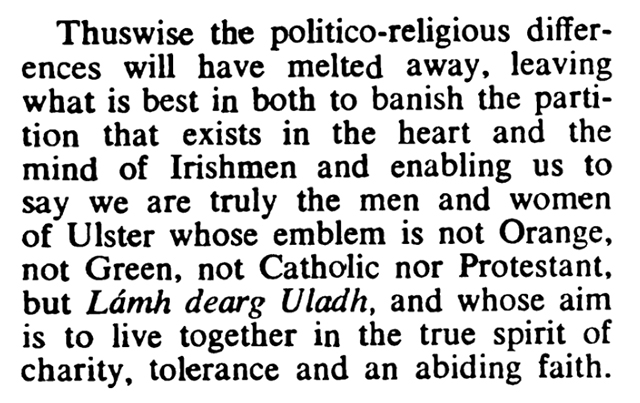
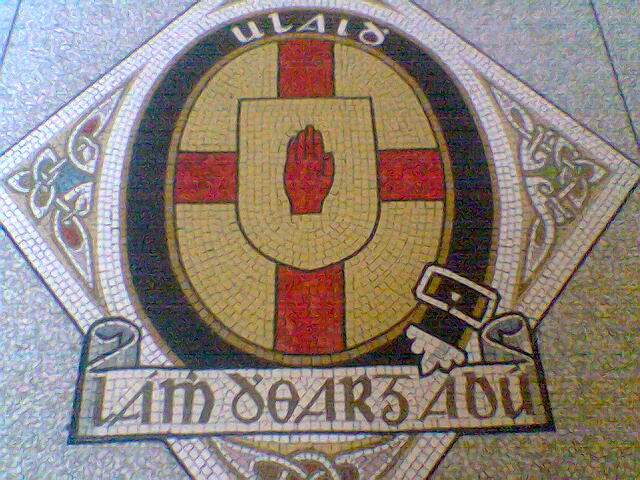
I came across the quote below when looking for something else. I've not had a hoke yet for more information about Dr J. P. Donaghy (Wikipedia here) but his entire address about the Ulster Museum is really interesting and worth a read – it is online on HathiTrust here, from page 720 onwards. Here is his conclusion, with the Red Hand as his ultimate emblematic representation of the possibility of 'together' -
For some time I thought that the term 'The Turn Oot", said to be the Ulster-Scots for the 1798 Rebellion, was a neologism. Not at all. It can be found by searching the British Newspaper Archive, and in this important source too –
"... We talked much of the Rebellion or 'turn-oot', taking pride in the part which some of our
forefathers had played in it. Nothing could have
made us so angry as hearing our ancestors jeered
at and called “pike men”, or to be reminded that
the gallant patriots had gone to battle provided
with grindstones for the occasional sharpening of
their spears. It was a base calumny and unworthy
of credence – almost as insulting as to be told that
the brave men had fired on the soldiers from the
insides of houses and shops..."
- Archibald McIlroy, When Lint Was In the Bell, page 9 (1897).
This book is set in Ballyclare, it uses a line from Robert Burns as its title, and it's about as socially conservative and theologically orthodox as it's possible to be.
The 1798 Rebellion has its 225th anniversary this June. The best way to understand it, and its complexity and contradictions, is through the lens of bottom-up community, not top-down nationality.
Some years ago Cavan County Museum published a book of their collection of banners, entitled Banner, Emblem, Flag or Symbol: The Marching Banners of Cavan County Museum. It includes this one, of Killmore Royal Black Preceptory RBP No 362, Bedell's Mourners.
Bishop William Bedell (1571-1642; Wikipedia here) is best remembered for translating the Old Testament into Irish during his time as Bishop of Kilmore and Armagh (William O'Donnell had already produced a translation of the New Testament, commissioned by Queen Elizabeth I, and completed in 1602, with 500 copies printed - further information here from the 400th anniversary in 2002).
For all of the praise the Bedell translation receives, few ever mention what he experienced at the hands of Irish 'rebels' in 1641, and his death from the pestilence which swept Ulster (see previous post here) due to the piles of unburied corpses.
His life story was written by the Scotsman Bishop Gilbert Burnet in 1685, who became one of the closest allies of Prince William of Orange, and was with him when he landed at Brixham in 1688.
PS: around the same time as Bedell's 1634-40 translation into Irish Gaeilge, just across the water in Scotland translations into Scottish Ghàidhlig emerged. These were by Alexander Munro (1605-53) of Durness, who had been converted to the reformed faith under the preaching of exiled Edinburgh minister Rev Robert Bruce, and have been colloquially called Sandy Monroe's Verses. In 1685 around 80 copies of Bedell's translation were sent to the Scottish Highlands for use in parishes there (see here for more info), but they had limited relevance due to the linguistic differences.
• James Seaton Reid's account of Bedell's life and death is here from page 320 onwards. On the preceding pages, Reid includes a mind-boggling list of ministers and clergy who were all killed by 'rebels' and the barbaric methods used – as well as a list of 20 other ministers who all died of the same 'pestilential fever' that took Bedell.
This is an article I assembled during the various lockdowns and slowdowns, and was published in the most recent edition of the Portavogie Culture and Heritage Society booklet, entitled Rocks of Ages.
.............................
Below: a postcard from my collection showing Portavogie (postmark on the reverse is dated 1902) with some small boats visible at McCammon Rocks in the background.
“During the past week there was a large number of Scotch and other craft engaged on this part of the coast … those engaged in the fishing trade on this part of the Ards coast feel keenly the want of a harbour at Portavogie, both for the accommodation of fishermen and others”.
– Newtownards Chronicle 18 June 1881
1. INTRODUCTION Portavogie developed in the late 1800s and early 1900s, from a scattered collection of cottage homes to a thriving fishing port. Originally, the natural shelter of McCammon Rocks was ideal for small boats and was a major reason for a community to settle on our coast. But as time passed, the number of boats increased and the usefulness of McCammon was limited. There was a need for a proper harbour.
However, the government of the day, perhaps caught up in the ‘big politics’ of Home Rule for Ireland, charged ahead with a construction project without consulting any experienced local fishermen about what they actually needed, or what type of harbour was suitable.
The result was a “practically useless” harbour that local boats refused to use, which wasn’t fit for purpose, and which was severely damaged in its first storm. This is some of the story.
Below: Portavogie near 'Stable Hole', circa 1900
2. BACKGROUND In September 1884, a delegation of Her Majesty’s Irish Fisheries Piers and Harbours Commissioners, comprised of Colonel John Philip Nolan (MP for Galway North), Sir Samuel Hercules Hayes (High Sheriff of Donegal), Sir Thomas Francis Brady and William Johnston (both of Her Majesty’s Inspector of Fisheries) – toured the coastal towns of Ireland to assess the needs of the industry.
They visited the Ards Peninsula to investigate the potential for “a pier and harbour on this dangerous part of the coast, where so many wrecks are annually reported”. They held public meetings at Ballyhalbert and Cloughey where they met with local community leaders and fishermen.
Newspapers of the time paint a helpful picture of our village back then. On 25 July 1885 The Belfast Weekly News published an anonymous letter by ‘An Experienced Fisherman’ stating that there were “forty boats with seven men and a boy in each” at Portavogie, but that there was no harbour “save the lee of a rock”. He also said that 20 years before, both Ballywalter and Portavogie had tried to have the government build suitable harbours, but these efforts were unsuccessful.
A few months later, on 26 October 1885, a special correspondent for the Belfast News-Letter visited Portavogie. He interviewed a local fisherman called Jemmy Hughes who said “there were twenty first class boats and from thirty to forty luggers … giving employment during the summer season to upwards of 400 men, all belonging to the village or its neighbourhood”, fishing as far north as the Shetland Islands and as far south as Kinsale. Their only shelter was at “M’Cammon’s Rock”. The village “contains a population of considerably over one thousand” but “the great want, likely soon to be remedied, is harbour accommodation. Had fishermen shelter for their boats they could fish and even trade during the winter”.
The need for a harbour was a constant factor in community life. In 1896, the Twelfth demonstration was held in Portavogie, on Monday 13th July, in a field provided by James Palmer, in which 14 local lodges participated. Rev A W Whitley, the minister of Cloughey Presbyterian Church, used his platform address “to call upon the Government to push forward the work of constructing fishery piers where needed along our coasts”. Having been minister to the fishermen of the area for 19 years, he said he “would also like to see a harbour at Portavogie”.
3. THE FIRST HARBOUR IS BUILT After years of lobbying, work eventually began on a pier at Portavogie in spring 1901, paid for by the government’s Board of Works in Dublin. However there were problems from the outset – the budget and tender of £7500 did not allow for the removal of some large rocks, and proposed to build the pier around them instead. To make things worse, the Board and their contractors didn’t consult with any local fishermen.
Soon, cracks between central government in Dublin and local government in County Down started to appear.
Concern over this led to the setting up in August 1901 of a new Portavogie Harbour Committee of Down County Council, chaired by General William Montgomery of Greyabbey, with members Henry McGrath of Portaferry, Robert B. Caughey of Portaferry and George Dickson of Newtownards. They wrote to the Board of Works in Dublin to insist on the problem rocks being taken away. The Board refused. In November 1901 and February 1902 General Montgomery tried again, but still with no success. The Board of Works carried on with construction regardless, and in early 1904 they handed the new harbour, and responsibility for it, over to Down County Council.
No locals had been consulted and so in June 1904 when the work was complete, a report by Down County Council "condemned the structure, the best proof of its inutility being the fact that it was not being used by the fishermen of Portavogie".
The ‘blame game’ then began. On 29 July 1904 the Northern Whig published a lengthy, devastating, report by General Montgomery’s Committee, saying that when the Board of Works transferred responsibility to the Council, the Board had failed to follow “bylaws, rules or regulations respecting this work”. The rocks which had not been removed meant that the fleet was not using the new harbour. There were:
“some 50 or 60 sail at anchor at some distance to the north of the pier … the fishing fleet did not use the new pier … as it would be dangerous for them … grave objections have been made by the owners of fishing boats in consequence of the absence of a projecting arm to prevent swell in the harbour, as the strength of the incoming tide renders its use by small boats very dangerous to both boats and fishermen … the fishermen will not avail themselves of the use of the harbour until these defects are remedied, and they cannot advise the Council to undertake responsibility for its use as it at present exists”
The report got worse. The harbour was too small, a boat had already been damaged on the rocks, the top surface was too low and already disintegrating, and no access road or footpaths had been provided:
“the Committee found two trading vessels discharging cargoes at the harbour … the space at present available for berths was barely sufficient for the two vessels lying there, and, as above stated, there were about 60 boats outside in the roadstead”
“injury appears to have already occurred to a boat by grounding on a projecting spur of rock, opposite the pier face”
“the Committee found the state of the roadway on the pier to be very unsatisfactory, the concrete breaking up even under such traffic as has occurred during the short time the pier has been in use”.
“the roadway on the upper surface of the pier had not been carried to a sufficient height, and that the high water spring tides flow over it … the difficulty of using the pier is also accentuated by the absence of approaches from the pier entrance to the public roads”
The issue attracted more and more attention. Glasgow-born Thomas Lorimer Corbett had been the MP for North Down since 1900, and retained the seat in the elections of 1906 and 1910. He became involved in the stand-off between the Council and the Board of Works. In August 1904 he reported that:
"the new harbour works at Portavogie are practically useless for the fishermen for whom they are intended ... during the construction of the harbour the attention of the Commissioners of Works was repeatedly called to the defects in their plans".
4. A NATURAL STORM - AND A POLITICAL STORM The very next spring, nature put an end to the speculation about the unsuitability of the harbour. On 15th March 1905, a “terrible south-east gale” hit Portavogie and "the new pier was absolutely covered with the sea, nothing but the wooden bridge was visible".
The storm smashed up nine boats of the local fleet which had been lying at anchor inside McCammon Rocks. A newspaper report said that
"had these boats been inside the pier, nothing would have been left of them but the moorings. This is another example (if one were needed) of how public money is wasted, owing to the refusal to consult local opinion on matters of this kind”.
In a debate in Parliament two weeks later, Scotland-born Thomas Wallace Russell MP for Tyrone South spoke on behalf of his party colleague James Wood MP for East Down. Russell raised the Portavogie harbour issue with Victor Cavendish, the Chief Secretary to the Lord Lieutenant of Ireland:
“is he aware that the new pier at Portavogie, County Down, erected by the Board of Works in Ireland, has been destroyed by the recent storm; what steps he proposes to take to rectify the injury done, and will he consult and be guided by the advice of local opinion as to what should be done”.
Cavendish shrewdly dodged the issue, and replied that “The Board of Works have no advice of any damage to Portavogie Pier, which is not in their charge, but in that of the county authority”.
5. DELEGATION AT MOUNT STEWART It was now time for the government to hear directly from the fishing community. On 25 April 1905 a delegation of two local fishermen, Mr Cully and Mr Mahood, and two members of Newtownards Rural District Council, Mr William Gowan (Ballyhalbert) and Robert B. Caughey J.P. (Portaferry), met with the Chief Secretary for Ireland, Walter Long.
Long was in Ulster on a trip to Mount Stewart, to stay with the 6th Marquess of Londonderry, and the delegation met him there to tell him in person about what had happened. Mr Gowan said that “the new pier had been found of little value to the local fishermen. It was frequently submerged and afforded very little shelter to fishing boats. It had been computed that it would require upwards of £800 to repair the damaged boats”.
Mr Caughey advised that the Council proposed to meet with the County Surveyor and the engineer for the Board of Works, which the Chief Secretary agreed with. In return, the Chief Secretary also said he would make contact with the Department of Agriculture and Fishing.
After the meeting the Chief Secretary for Ireland wrote to Thomas Lorimer Corbett MP and said that he was
“greatly impressed with the businesslike, moderate, dignified way in which they presented their case. Nothing could possibly have been better done. I am very hopeful I shall be able to do something for them, they have done their best to help themselves”.
6. FINAL FUNDING SECURED The public embarrassment, and the grassroots community pressure, paid off. By July 1905, the government had allocated a further £6216 for the improvement of Portavogie harbour.
However, the procurement and paperwork was slow, but thanks to the intervention of prominent Comber businessman Thomas Andrews, who was then the Chairman of Down County Council, it was approved in November 1907.
In the Northern Whig of 10 June 1908, the Council congratulated itself that it had secured a total of almost £15,000 for Portavogie harbour (which was the original inadequate cost, and the subsequent improvement cost added on top).
By May 1909 the work was well advanced, to the satisfaction of the locals and the Council, with the expectation that it would be finished by the end of the summer. In the end, it was summer 1910 before it was complete.
7. CONCLUSION Portavogie’s first harbour took 3 years to build, and then 6 years to fix. The harbour has had many upgrades over the years, especially for the major three year project from 1952–55, and again in 1978.
More improvements are planned for the coming years. The big lesson from the story of the village’s very first harbour is that it is essential for government agencies to always consult with the community and residents.
..........
Here's a YouTube video of someone's cine film of the 1955 reopening of the harbour. Bowler-hatted gents, 'dunchered' men and Sunday best women – celebrating and signalling the end of the previous age, and the start of something new. For them it was a bright new era, but which itself is now long gone.
The government of the Republic of Ireland looks set to implement some of the most far-reaching and 'shockingly draconian' 'hate speech' laws in the western world. But who gets to define 'hate'? The current government? A future one? A recently unsuccessful candidate for the leadership of the SNP, Kate Forbes, wrote this tremendous article today in defence of free speech in Scotland. Some years ago, conservative evangelicals I know took great delight when a play they objected to was 'cancelled' by a local council here in Northern Ireland. I did what I could to explain to them why free speech for everyone, including those they disagreed with, was far more important than 'winning' through the temporary numerical strength of representation on a sub-committee.
John Stuart Mill's On Liberty (1859; Wikipedia here) is regarded as 'one of the most celebrated defences of free speech ever written'. In 1868, he wrote England and Ireland. Over 50 years before 'partition'. A century before the Troubles. Long before the EU. Long before Brexit. Have a look at this extract: –
"... In all this I am supposing that Ireland would succeed in establishing a regular and orderly government: but suppose that she failed? Suppose that she had to pass through an interval of partial anarchy first?
What if there were a civil war between the Protestant and Catholic Irish, or between Ulster and the other provinces? Is it in human nature that the sympathies of England should not be principally with the English Protestant colony, and would not she either help that side, or be constantly believed to be on the point of helping it?
For generations it is to be feared that the two nations would be either at war, or in a chronic state of precarious and armed peace, each constantly watching a probable enemy so near at hand that in an instant they might be at each other's throat. By this state of their relations it is almost superfluous to say that the poorer of the two countries would suffer most. To England it would be an inconvenience; to Ireland a public calamity, not only in the way of direct burthen, but by the paralysing effect of a general feeling of insecurity upon industrial energy and enterprise...
... Ireland might be invaded and conquered by a great military power. She might become a province of France. This is not the least likely thing to befall her, if her independence of England should be followed by protracted disorders, such as to make peaceably disposed persons welcome an armed pacificator capable of imposing on the conflicting parties a common servitude. How bitter such a result of all their struggles ought to be to patriotic Irishmen..."
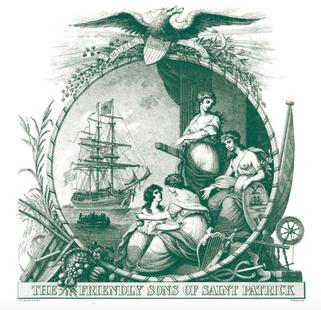
One of the curiosities of the history of Ireland is how concepts of Irishness became monocultural. One example is The Friendly Sons of St Patrick, founded on St Patrick's Day in 1771 in Philadelphia by various men who were close allies of George Washington.
Among the early members were men like General William Irvine (born Enniskillen) General William Thompson (claimed by Co Meath but I have my doubts; would appreciate more evidence*) and Colonel Ephraim Blaine (born in Donegal or Londonderry). Presbyterians all.
On 12 July 1774, Irvine and Blaine were among those who gathered 100 miles west of Philadelphia, at First Presbyterian Church in Carlisle, Pennsylvania, to agree the Carlisle Resolves in support of political reforms which would eventually become Independence. A William Thompson - perhaps the same one - was also there. Carlisle was a renowned centre of Scotch-Irish settlement. Do a search on this blog for some examples. And take a spin through this 1857 publication by the church's minister, Rev George Duffield.
The Scotch-Irish Presbyterians had imbibed the spirit, and understood the power, of that famous instrument which contributed so much, in Scotland, for the Protestant Reformation and Religious Liberty, viz : "The Solemn League and Covenant." It was their attachment, as Protestants, to the cause of civil and religious liberty, that brought them to this Western world. At an early period in the history of British oppression, as practiced in these Colonies, the same patriotic and religious spirit was kindled in them. Nowhere was it more vigorous, active and efficient than in Carlisle and Cumberland County.
However....
In the 1892 History of the Friendly Sons by John C Campbell, who is presented on the title page as "Historian of the Hibernian Society"(on GoogleBooks here), Campbell spends the entire first chapter denying the validity of Scotch-Irishness. Have a read through for yourself.
This 'narrowing' of concepts of Irishness between the society's founding 1771 until this 1892 publication is probably just a reflection of what had also been happening on this side of the Atlantic. A far cry from Wolfe Tone's famous acknowledgement in 1798 of Ireland having three faith denominations, three cultural traditions.
Ireland is an island of cultural variety.
* William Thompson was the first Colonel in the US Army, leading the first battalion authorised by Congress in June 1775. Wikipedia says he was born in Scotland. In 1896, the Ulster Journal of Archaeology published an article by M.I. Murphy of Bay City, Michigan, which said William Thompson was born in Maghera, and was the brother of Charles Thomson. A fanciful story, but untrue.
The Ancient Order of Hibernians had held an annual tribute event at his grave site at Old Carlisle graveyard for some decades. In 1988 the Donegal Society of Wilkes-Barre, and the Gobin Guards of Carlisle, had an eight feet stone Celtic cross memorial made in Ireland which was helicoptered onto his grave. The inscription claims him for County Meath.
The memorial was consecrated in May 1988 and a special service was held in the First Presbyterian Church – the building where he probably was present on 12 July 1774, preparing for independence.
These illustrations are famous depictions of two seminal events.
Firstly, and engraving entitled 'The swearing and subscribing of the National Covenant in Greyfriars Churchyard, Edinburgh', published in The History of Protestantism by James Aitken Wylie (1878). Greyfriars Kirk is in central Edinburgh, just off the historic Grassmarket and the George IV bridge.
Secondly, "Give Me Liberty or Give Me Death! Patrick Henry delivering his great speech on the Rights of the Colonies, before the Virginia Assembly, convened at Richmond, March 23rd, 1775. Concluding with the above sentiment, which became the war cry of the Revolution', published by Currier & Ives (1876). This event – the Second Virginia Convention – took place at St John's Episcopal Church in Richmond, Virginia. Patrick Henry's father was from Aberdeen; his sister Elizabeth was married to Ulster descended William Campbell.
I have been buried in a pile of books for the past month or so, for a very large and important project. In doing so, I have come across some really interesting stories which are new to me.
"John Rosbrugh was not a native born American but belonged to that sturdy class known as the Scotch-Irish, who have furnished so large a proportion of the brains, backbone and muscle which have been indispensable in shaping and maintaining our nationality. He was of the number of those who, for conscience sake, left Scotland and went to the North of Ireland, and who have made that part of Erin's Isle present socially, religiously and politically so marked a contrast with its more southerly portion. He was born in the year 1714, shortly before the family left Scotland, or shortly after they arrived in the North of Ireland, the exact date of the migration not being now attainable. Of the family to which he belonged we have no definite information further than that lie had an older brother, William. It seems that the same impulse which constrained the family to migrate from Scotland to the North of Ireland, impelled this William Rosbrugh, together with his brother John — though the latter was young in years — to take their departure for a land more inviting, beyond the sea, in America"... (1880 source here)
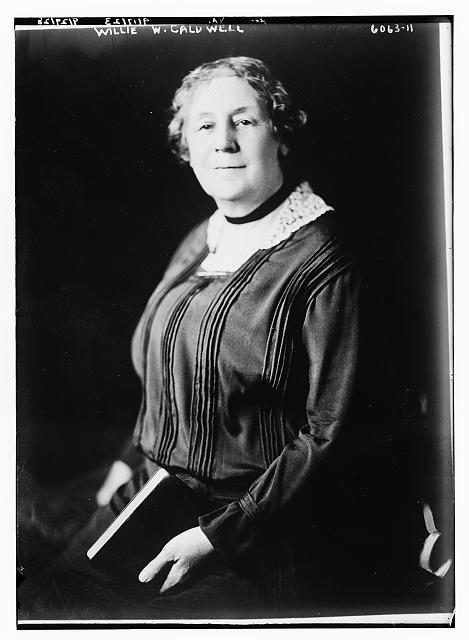
John Rosbrugh's Wikipedia page (link here) says he was born in Enniskillen, of Ayrshire parents. He graduated from the College of New Jersey at Princeton in 1761, along with David Caldwell, later of North Carolina, who would famously cite the ancestral memories of "Londonderry and Enniskillen" in a sermon in support of American independence. Back to Rosbrugh:
"... a call was presented to him to take charge of the Allen Township Presbyterian Church, in connection with Greenwich. Thus he was to be provided with a home in the Irish Settlement, Northampton county, Pennsylvania, among the Scotch-Irish, the stock from which he himself had sprung, as well as his wife. He was now called to the congregation in which his father-in-law, James Ralston, was an elder, and his wife's family were members".
Evidently this was also a Scots-speaking community:
"Mr. Rosbrugh, in making his pastoral visits, once came to a widow living alone. He found her at her devotions and did not disturb her until she was through. She read the Scripture, then lined a Psalm as she sang it, before prayer. He asked her why she lined the Psalm, as there were none to hear her when she was alone. "Ah!" said she, "it is sa quiet I fain would 'dight my gab twice wi'it."
A more accurate spelling might be "it's sae quate I fain wud dicht ma gab twice wi' it". In 1776, Rosbrugh's brother-in-law, John Ralston (link here), was appointed as a member of the Constitutional Convention for Pennsylvania. That same year, John Rosbrugh became Moderator of the Presbytery of Pennsylvania. Revolution was coming.
"These were Revolutionary times, and Mr. Rosbrugh was filled with the spirit of freedom. It was the heavy yoke, politically and religiously, which the Mother Country had imposed upon her people, that drove him and many of his class from the heather, hill and dale of Scotland, to their new homes in America. That the same yoke should be imposed upon them in their new home, seemed to him like the pursuit and oppression of the innocent..."
Rosbrugh became a military chaplain in the American revolutionary army. Aware of the risk, he wrote his last will on 18 December 1776. Less than two weeks later, on 2 January 1777, aged 63, during the Battle of Assunpink Creek, near Trenton, New Jersey, Rev. John Rosbrugh was stabbed to death. A total of 17 bayonet wounds ended his life – inflicted upon him after he had surrendered to a small company of British 'Hessians' who he encountered in a grove of trees. They gave him five minutes to pray. Apparently, he prayed for them (additional source here).
His body was buried near where he died by Captain John Hays, who according to one source had been born in west Donegal. He was later re-buried, some say in the Old First Presbyterian Church graveyard in Trenton.
Jane Rosbrugh raised their five children, with some financial support from the state of Pennsylvania. She died in 1809.
• Gravestone photo above from the excellent All Things Liberty website: "Once it was discovered that he was a Presbyterian minister, he was stabbed repeatedly and left to die".
This came up at auction over the Easter Weekend, I didn't bid on it but maybe should have. This is the Scottish regiment that was in Lisburn during the 1798 Rebellion, and which took the executed United Irishmen leader, the linen merchant, 'General' Henry Munro's decapitated head down from Lisburn Market House - one source says "taken down to gratify the Scotch soldiers, as Munro was of Scotch descent”. The regiment also had Grand Orange Lodge of Ireland warrant number 340.
Munro's 'Scotch descent' has been explored by TGF Patterson, the noted Curator of Armagh County Museum, and also Colin Johnston Robb who was a respected authority on the 1798 Rebellion era.
On the cusp of the new millennium, Steve Earle joined forces with the Del McCoury Band to release "The Mountain" on 23 February 1999. Hilary and I went to see them play at the Ulster Hall on 17 May - it was one of the best concerts I've ever been to - we were up in the balcony, overlooking the stage, marvelling at the 3 piece suits and the single microphone, and the acoustic volume being operated through skilful choreography. From an era when cameras and recording devices were not allowed in venues, and could get you ejected if caught, I've not been able to find any pics or videos online. So, this grainy tv performance will have to do.
"The Scotch Irish of America, through the commendable habit of that race, so it be not carried too far, to put their strength into deeds rather than into words, have missed their meed of credit for the important work they did in our struggle for liberty.
Now, our honored fellow-countrymen and co-patriots, the Puritans, have not made this mistake; they took their part in action nobly, and also they have taken care to record in history, song, and story the might and glory of their deeds.
The "Boston Tea Party" and the "Boston Massacre" will go down emblazoned on the page of history, but the fight at Alamance, and the vehement petitions urging resistance to tyranny sent up to state conventions, and the first Congress, by the Scotch Irish counties of Virginia, North Carolina, and Pennsylvania have scarcely been heard of.
It is my hope not only to show what the Scotch Irish have done for the cause of liberty, but also to give a just idea of the character of this people, a true picture of their home life, and a correct estimate of that religion which is so dear to them, and which has had so much to do with making them the freedom-loving, and withal broad-minded patriots they are.
Few men, I flatter myself, are better equipped to tell a Scotch Irish story than I, Donald McElroy, who in blood am pure blue Scotch Irish, who have been instructed by Scotch Irish divines in things temporal and spiritual, have fought under Scotch Irish leaders, and lived all my life among them"


-1.jpg)









.jpg)