Sunday, July 30, 2023

"an old grudge against a government, which ... had never done them justice ... inflexible devotion to popular liberty" – Rev Daniel Eagle Nevin of Pittsburgh (1851)


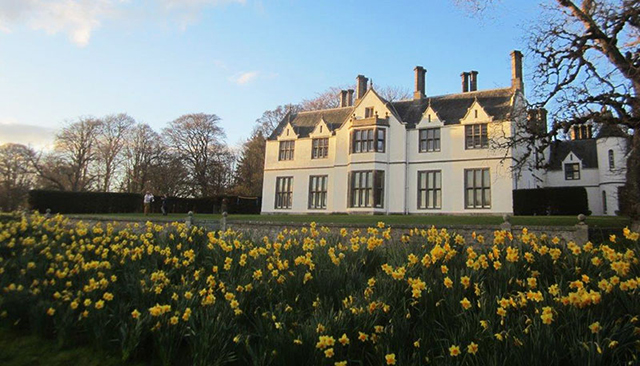
Rev. Daniel Eagle Nevin was the minister of Sewickley Presbyterian Church, Pittsburgh, Pennsylvania (shown above). His family ancestry included McCrackens on his mother's side, and Williamsons on his father's side. Nevin was a great-nephew of Hugh Williamson, the son of Ulster emigrants who was a witness to the Boston Tea Party and who was quizzed about it in London, and who wrote his famous The Plea of the Colonies*Wikipedia here.

Here is how Nevin understood and expressed the Scotch-Irish community story, undoubtedly passed down to him by his family -

religious liberty ... democratic ideas ...

... It was the amplification of these twin doctrines, aided by an old grudge against a government, which, – notwithstanding their prowess at Londonderry and the Boyne – had never done them justice, that furnished them with sufficient reasons for assuming in their adopted country the initiative in the American Revolution – by resisting on the banks of the Alamance the militia of Gov. Tryon in 1771, and promulgating from Mecklenburg Courthouse, North Carolina, in May 1775, the first bold manifesto looking firmly at the scheme of colonial independence.

The same doctrines endeared yet more and, consecrated through conflict and trial, drew from the mountains and valleys of Pennsylvania, Virginia and North Carolina, to meet the demands of the Revolutionary contest, a hardy intelligent yeomanry whose inflexible devotion to popular liberty has justly won for the Presbyterian Bluestocking the highest grade of canonisation in the temple of freedom....

...It was their glory to be the great champions in America of the rights of the soul. Paul before Agrippa, or Luther at Worms, furnished not to Italian or Flemish artists a purer or more elevated study in moral aesthetics than is presented in Makemie's trial at New York, 1707, for preaching without Lord Cornbury's license the gospel of the Lord Jesus Christ ..."

– Rev Daniel Eagle Nevin (1813-1886) of Sewickly Presbyterian Church, Pennsylvania, writing in The Mercersburg Review, 1851 (online here)


• Look at his four key reference points - the Bible (Paul and Agrippa), the Reformation (Luther at Worms), the Glorious Revolution (Londonderry and the Boyne), and individual liberty (Francis Makemie). These fuelled the Scotch-Irish community's justification for revolution in America, shown at Alamance and expressed at Mecklenburg.


LINEAGE

The lineage here is interesting too. Hugh Williamson was born in 1735 and died in 1819. His great-nephew Daniel Eagle Nevin was born in 1813 and died in 1886. Their lives span 150 years and overlapped by six years. Potentially, Hugh's parents or grandparents would have endured the Siege of Derry, which is the port that his mother had emigrated from. In The Plea of the Colonies, Hugh made the blockade of Boston of 1774 sound a lot like the Siege of Derry of 1689:

“the whole town of Boston, unheard and untried, was immediately condemned to suffer that kind of extreme, inadequate punishment which savours of revenge … a fleet and army sent to intimidate and distress the inhabitants … like beasts and not like men … you then cut off their fishery and lest starvation should make them more refractory, you sent more troops”. 

Daniel had a brother who was another Presbyterian minister in Pennsylvania, called Rev Alfred Nevin (1816-1890). Alfred wrote numerous books, including this one - Churches of the Valley: Or, an Historical Sketch of the Old Presbyterian Congregations of Cumberland and Franklin Counties, in Pennsylvania, which is online here.


"WHAT COULD TEMPT SUCH PEOPLE TO BECOME INDEPENDENT?"

*Again, in The Plea of the Colonies (1775) Hugh Williamson shows that, rather than being anti-British, right up to the 11th hour the colonists' campaign was that, in terms of rights and liberties, they should be fully British

“whoever was best acquainted with the colonists had the least reason to believe that they were looking toward a state of independence. As members of the British empire, they have enjoyed, till the beginning of the present controversy … as much liberty as was consistent with civil government, or as much as they could possibly expect … they were conscious of the blessing, they prayed for its continuance. They esteemed Great Britain as a parent, they loved her with more than filial affection; they loved every thing that was British; they were to a man zealously attached to his Majesty, if we except a few individuals who migrated to that country in the year forty-five. What could tempt such people to become independent?”


• the 1926 Historical Sketch of Sewickley Presbyterian Church is online here.

Friday, July 28, 2023

Withdraw the "sacred guarantee of their liberties" // 20 May 1774 – the London government's retaliation for the Boston Tea Party


• BOSTON AND NEW YORK, 1689
On the very same day that the Siege of Derry began - 18 April 1689 - on the other side of the Atlantic Ocean the Boston Revolt happened. 2000 colonists took up arms, an orange flag was raised on Beacon Hill overlooking Boston Harbour (highlighted on the 1722 map above, and on the detail of this 1689 map below). A public Declaration of the Gentlemen, Merchants, and Inhabitants of Boston, and the Countrey Adjacent was made in the market square, including this reference – 

... the Almighty God hath been pleased to prosper the noble undertaking of the Prince of Orange, to preserve the three Kingdoms ...


Around the same time a German emigrant, Jacob Leisler, and 400 men seized control of the Province of New York, making a declaration in the name of William and Mary. He named himself Lieutenant Governor of New York, but then seems to have gone rogue. Lots more detail here.


• THE MASSACHUSETTS CHARTER, 1691
On 7 October 1691, during the joint reign of King William III and Queen Mary II, the Province of Massachusetts Bay was granted its Charter. It was based upon William and Mary's Bill of Rights of 1689, which was their very first law, passed at their Coronation. In The Minutemen and Their World (published 2001) Robert A Gross described it as follows – "the Massachusetts Province Charter of 1691, which the inhabitants treasured as a sacred guarantee of their liberties". Shown above is the original manuscript, from this website.


• REVOKING THE CHARTER, 1774
Jump forward 80-ish years and Boston Harbour was probably still a delicate infusion with a tinge of brown from the 342 chests of tea that the Sons of Liberty had thrown into it in December 1773.

One of the responses by the government came on 20 May 1774 when the Massachusetts Charter was 'abrogated' or withdrawn by the London Parliament (see Wikipedia here). Massachusetts had its autonomy scrapped, and it was made a royal colony, with a new governor installed - military man Thomas Gage. His job was to implement four punitive new laws, known to the 'colonists' as the Intolerable Acts.

Son of Ulster emigrants Hugh Williamson, in his The Plea Of The Colonies which was published the next year in 1775, wrote that “the charter of Massachusetts was changed without necessity, without provocation ... by that single stroke every other province was informed that nothing was sacred or secure"

.......

• News of William Prince of Orange's arrival at Torbay had reached Boston a few weeks before all of this kicked off, on 4 April 1689, when a young Bostonian called John Winslow returned from the Caribbean island of Nevis with news of William's Declaration of October 1688. Winslow was arrested and imprisoned for bringing a 'traitorous and treasonable libel into the country', with an astronomical bail of £2000 offered. The Declaration was reprinted in Boston around that time by "R.P." Richard Pierce. See full account here.

• 1985 article Communicating an English Revolution to the Colonies, 1688-1689 by Ian K. Steele is on Jstor here.

• The full quote from The Minutemen and Their World, by Robert A Gross (2001): "Parliament contemptuously abrogated the Massachusetts Province Charter of 1691, which the inhabitants treasured as a sacred guarantee of their liberties".

• Another quote: "After the “Glorious Revolution”, William III issued Massachusetts Bay “and all the adjacent territories” which they united, a new Royal charter in 1691, which reflected all the political progress brought by the English Bill of Rights. The tone, style and intent of that colonial charter, echoed the original 1606 first charter as well as previous royal charters going back to Magna Carta, as the document insisted on the solemnity and contractual form of the grant of freedom and political liberties given by the King to his subjects..." - from this pdf on www.magnacarta800th.com

• Neighbouring Connecticut had its charter revoked by King James II in 1687, in his attempt to merge various colonies in America into a new 'Dominion of New England'. It was reinstated by King William III and Queen Mary II in 1689. Summary here.

• Image below from this website


"the Machiavellian policy of a British ministry" "to this Province in particular"

This was posted on the Liberty Pole flagstaff in Taunton, Massachusetts, by the Sons of Liberty, in October 1774 under a new red ensign flag design bearing the motto 'Liberty And Union'. A few months earlier they had published their Solemn League and Covenant for the province of Massachusetts. 


Thursday, July 27, 2023

"a colony distant from the parent state cannot possibly enjoy all the liberty of the parent state."

So wrote Governor of Massachusetts Thomas Hutchinson to the government in London, in private correspondence in 1768-69. Twenty of the letters were found, given to Benjamin Franklin, and were published in the Boston Gazette newspaper in June 1773.  More info here.


Wednesday, July 26, 2023

"Ex-vangelicals" who never heard the Gospel properly

I have a number of friends who grew up in evangelical churches (when there was less to do of an evening or weekend) but who have left it all behind. They are part of a phenomenon which has been labelled "ex-vangelicals". Some have closed that door and don't want to talk about it, but some others do.

A theme I have observed is that they were misled and mistaught. Presentations and sermons that they were told were the Gospel were actually the Law. As one of the reformers, Theodore Beza, wrote “Ignorance of this distinction between law and gospel is one of the principal sources of the abuses which corrupted and still corrupt Christianity.”

If the next generation are drifting, the previous generation didn't anchor them securely.


Wednesday, July 19, 2023

Another Revolution – "the old institutions are quite literally smashed to pieces"


As a brief departure from the flow of American Revolution 1776 era posts, here is a far more recent revolution which shows that change doesn't always need muskets and battlefields, or kings, or politics, or even the accountability of elections. 

"It is no news to anyone to point out that during the generation since the First World War, sovereignty has been slipping away from parliaments... In four of the major nations of the modern world (Germany, Russia, Italy, France) sovereignty has already altogether departed from parliament; in two (Japan and England) parliament retains a small shred; and even in the last refuge, the United States, parliamentary (Congressional plus Supreme Court) sovereignty is more than half way into its grave".

So wrote James Burnham (Wikipedia here) in his 1941 book The Managerial Revolution: What Is Happening in the World, in chapter 10 entitled 'The Managers Shift the Locus of Sovereignty'.

Burnham argued that - even in the midst of World War 2 - the concept of national sovereignty, as had been understood "from the Middle Ages to 1914", was effectively over. Administrators had taken over the world.

Online here on Archive.org
• Here is the intro to George Orwell's critique 'Second Thoughts on James Burnham' (1946)

"... Capitalism is disappearing, but Socialism is not replacing it. What is now arising is a new kind of planned, centralised society which will be neither capitalist nor, in any accepted sense of the word, democratic. The rulers of this new society will be the people who effectively control the means of production: that is, business executives, technicians, bureaucrats and soldiers, lumped together by Burnham under the name of ‘managers’. These people will eliminate the old capitalist class, crush the working class, and so organise society that all power and economic privilege remain in their own hands..." 


Tuesday, July 18, 2023

Sweet Hame Appalachia - "The principal element is Scotch and especially Ulster-Scotch, more familiarly known as Scotch-Irish"


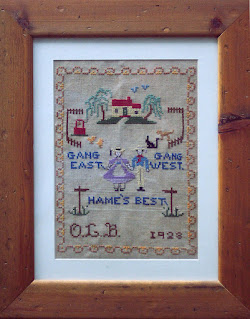
Image: this cross-stitch sampler is one that I first saw in the Museum of Appalachia in Norris in east Tennessee, when we were there on our honeymoon in 1997. "Gang East, Gang West, Hame's Best" - Hame in the Appalachian Mountains, with the town of Maryville just about half an hour away.


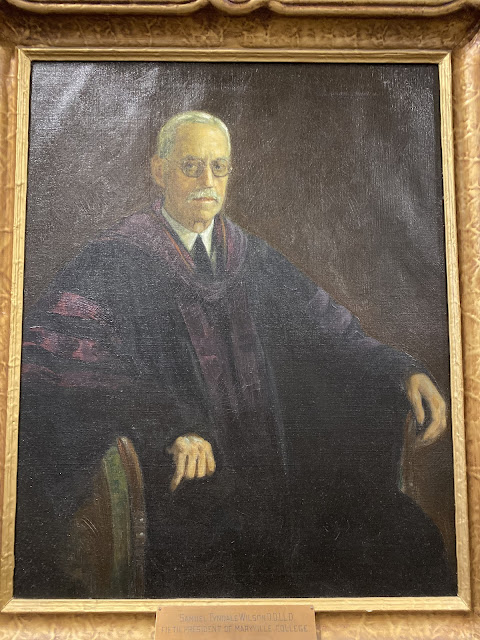
The book The Southern Mountaineers was written by Samuel Tyndale Wilson (1858–1944) and first published in 1906. He was the President of Maryville College in east Tennessee, and was a prominent Presbyterian as clerk of the Synod of Tennessee. Here are some quotes from the book:

"... While it is undeniable that the mountain people of the South are a composite race, the fact remains that they are probably of about as pure a stock as we can boast in America. Almost all their ancestors came from the British Isles. The principal element is Scotch and especially Ulster-Scotch, more familiarly known as Scotch-Irish ... 
... It may be added, too, that there still survive most interesting phases of life and idioms of language that are Scotch or Scotch-Irish in origin...

... They were possessed by a fierce love of liberty, and so the birthplace of American liberty very appropriately was in the mountains. In Abingdon, Virginia, at the junction of the valleys of the Blue Ridge and East Tennessee, as early as January 20, 1775*, a council met that, as Bancroft says, "was mostly composed of Presbyterians of Scotch-Irish descent." "The spirit of freedom swept through their minds as naturally as the wind sighs through the fir trees of the Black Mountains. There they resolved never to surrender, but to live and die for liberty."


Samuel Tyndale Wilson was born in Syria in 1858 where his parents (Rev David Morrison Wilson and Emeline Tomlinson Wilson) were Presbyterian missionaries for a time.

...............

Online here 

• His grandfather, Samuel Wilson (1787–1857), was an 'abolitionist and educator' (see here). He was born in Acworth in New Hampshire, which had been founded in 1768 by families from Londonderry, New Hampshire.

* This is a reference to The Fincastle Resolutions which I have blogged about here before.


Monday, July 17, 2023

'The Rest Is History' podcast - The American Revolution - 4x1hr audio discussion series by Tom Holland and Dominic Sandbrook

 Available on Spotify here; embedded below too.

Sunday, July 16, 2023

Ciara Kelly, Ricky Gervais and Nick Laird


This clip from NewstalkFM from 14 July has gone viral, with almost 1 million views on Twitter alone. What does liberty look like in our international, multinational, some might say postnational and increasingly borderless, digital, era? It looks something like this from Ciara Kelly - a liberty which transcends  'nationality'. This piece includes a prescient warning from the poet and writer Nick Laird (who I had the pleasure of meeting a few years ago for a BBC radio programme he was working on) about the danger of identity politics – "the rest of the world has turned into Northern Ireland".


Saturday, July 15, 2023

Nationality - a mechanism for Liberty; John Dickinson of Pennsylvania


'... All drafts also included one form or another of the proposition "that his Majesty’s Liege Subjects in these Colonies, are entitled to all the inherent Rights and Liberties of his Natural born Subjects, within the Kingdom of Great Britain.” The resolves of the Congress on the relationship between the colonies and the King were clear and unequivocal. The Stamp Act Congress fully recognised and declared its allegiance to the King in his executive capacities and as personal symbol of the union of colonies and home country. ...'

- from John Dickinson and the Revolution in Pennsylvania, 1764-1776 (published 1965)


John Dickinson
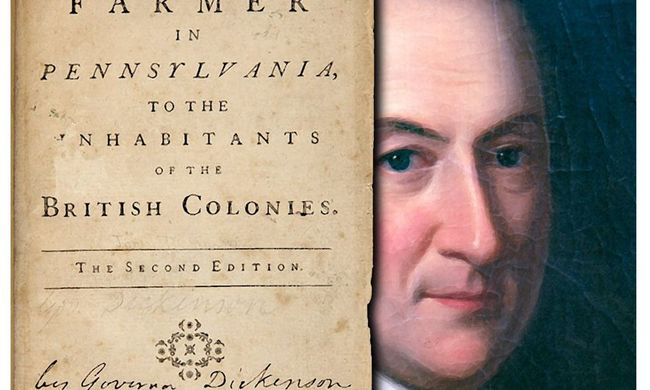
(pictured above, 1732-1808; Wikipedia here) was a pupil of renowned Donegal-born Presbyterian Francis Alison, and also of William Killen, who had been 'born in North Ireland in 1722, of Scotch Presbyterian heritage' and who went on to become the first Chief Justice of the first US Supreme Court in 1776.

A very wealthy man, Dickinson became one of the signers of the US Constitution. In 1767-8 he wrote a series of anonymous articles entitled Letters from a Farmer in Pennsylvania (Wikipedia here) explaining how various laws were unconstitutional and how Americans should resist them. French philosopher Voltaire was so impressed that he compared Dickinson with the orator statesman of Rome, Cicero. The Letters were a sensation and outside of America they were also printed in Dublin, London and France. In their day they were more popular and influential than even Thomas Paine's writings. (Paine was a relatively late arrival to the party, only landing in Philadelphia on 30 November 1774, and his Common Sense being published on 10 January 1776).


Perhaps Alison and Killen had seeded a chronology of earlier liberty in Dickinson's mind. Perhaps their parents had handed down memories to them both. Dickinson's biographer pointed out that the first of the Letters from a Farmer was penned on "the date of the fifth of November, 1767, the seventy-ninth anniversary of the day on which the landing of William the Third at Torbay gave constitutional liberty to all Englishmen" (online here).

The Sons of Liberty gathered at the Greyhound Tavern in Roxbury, Massachusetts on Monday 15 August 1768 and among their 45 toasts was one "To the immortal Memory of that Hero of Heroes William the Third". And Dickinson's sixth letter included this reference – "It is sufficient to remind the reader of the day on which King William landed at Torbay".

.................

With the 4th July having recently come round again, I had a couple of opportunities to speak briefly on the general topic, from an Ulster-Scots perspective. In our era and context we often get bogged down in two competing concepts of nationality, and consequently many here try to retro-fit those present day concepts upon the past. Which causes all kinds of bafflement. "Why did Ulstermen try to end British rule in America? Are you all not meant to be loyal?" and so on.

For our forefathers, nationality was not an end in itself, but was a mechanism for liberty. In pre-Revolutionary America, rather than being anti-British, in terms of rights and liberties the colonists demanded to be fully British – as the quote above says "that his Majesty’s Liege Subjects in these Colonies, are entitled to all the inherent Rights and Liberties of his Natural born Subjects, within the Kingdom of Great Britain.” 

Of course, those appeals fell on deaf ears in London, and in late 1775 & 1776, Independence became the only remaining route to liberty.

.................

Here is a famous illustration done by Paul Revere in 1766, depicting a celebratory obelisk which locals created and installed under the Liberty Tree in Boston, after King George III had withdrawn the despised 'Stamp Act' law. Revere entitled the illustration "A view of the obelisk erected under liberty tree in Boston on the Rejoicings for the Repeal of the —— Stamp Act 1766 ... To every Lover of Liberty this Plate is humbly dedicated by her true born Sons in Boston, New England." A full description is online here. Portraits and poetry, it was quite a statement:


The fourth panel says –

“And has her Liberty restored by the Royal hand of George the Third;”

Our Faith approv’d, our Liberty restor’d,

Our Hearts bend grateful to our sov’reign Lord;

Hail darling Monarch! by this act endear’d,

Our firm affections are thy best reward—

Sh’d Britain’s self against herself divide,

And hostile Armies frown on either side;

Sh’d hosts rebellious shake our Brunswick’s Throne,

And as they dar’d thy Parent dare the Son.

To this Asylum stretch thine happy Wing,

And we’ll contend who best shall love our King.


Even the Ulster Solemn League and Covenant of 1912 echoes with the very same ideas - Thomas Sinclair's words were that a 'Home Rule' parliament in Ireland would be '... subversive of our civil and religious freedom, destructive of our citizenship ... to stand by one another in defending, for ourselves and our children, our cherished position of equal citizenship in the United Kingdom'.

The nationality that each individual chooses is of course up to that individual. In Northern Ireland we have a duality of options, and I know quite a few people of other nationalities who live here. But would anyone choose a nationality which restricts their liberty?

There are many dimensions to nationality – such as a sense of continuity, of endurance, of tradition, of quelling internal differences to achieve something greater. But power corrupts. Nations can exploit their own populations, silence dissenters and exploit minorities. And absolute power corrupts absolutely. These are the pitfalls of human nature.

Nationality should not be an end it itself –  it should be a mechanism to protect and ensure liberty of all of its people. When liberty is threatened, nationality can be jettisoned. This is why liberty comes before loyalty.

.................


• More info on Dickinson and his Letters from a Farmer here, on Libertarianism.org

• Also worth looking at is James Otis Jr's 1764 tract The Rights of British Colonies Asserted and Proved , printed in Boston, in which he refers back to the 1688 Revolution for precedent (online here / further article online here)

On William of Orange: "... we should have heard nothing of the oppressions and misfortunes of the Charles’s and James’s; The revolution would never have taken place; the genius of William the third would have languished in the fens of Holland, or evaporated in the plains of Flanders ... Great-Britain to this day might have been in chains and darkness ..." 

On slavery: "The Colonists are by the law of nature free born, as indeed all men are, white or black … It is a clear truth, that those who every day barter away other mens liberty will soon care little for their own… That the colonists, black and white, born here, are free born British subjects, and entitled to all the essential civil rights of such, is a truth not only manifest from the provincial charters, from the principles of the common law, and acts of parliament; but from the British constitution, which was reestablished at the revolution, with a professed design to lecture the liberties of all the subjects to all generations.


Monday, July 10, 2023

Colonel Thomas Buchan's rampage through East Down in April 1689 - "to reduce the people of Down to due subjection to his authority".


Another "most violent persecutor" who King James II recruited to Ulster in 1689 was Colonel Thomas Buchan (1641-1724, Wikipedia here), a Scot from Auchmacoy near Aberdeen (shown above) and a professional soldier who had fought on the continent.

• BUCHAN IN AYRSHIRE, 1678–1689
According to The Covenanter Encyclopedia by Dane Love, in 1678 during the Killing Times in Scotland, the Duke of York (the future King James II) deployed Buchan to the village of Dalmellington in rural east Ayrshire with a garrison of 900 'Highland Host' soldiers, to suppress the local Covenanter Presbyterians. Buchan seems to have been a Scottish equivalent of Conrad Von Rosen (see recent post here), the Latvian-born Frenchman who King James II recruited around the same time, and for the same purpose – to terrorise the civilian population.

• THE KILLING OF JOHN SMITH OF MUIRKIRK, 1685
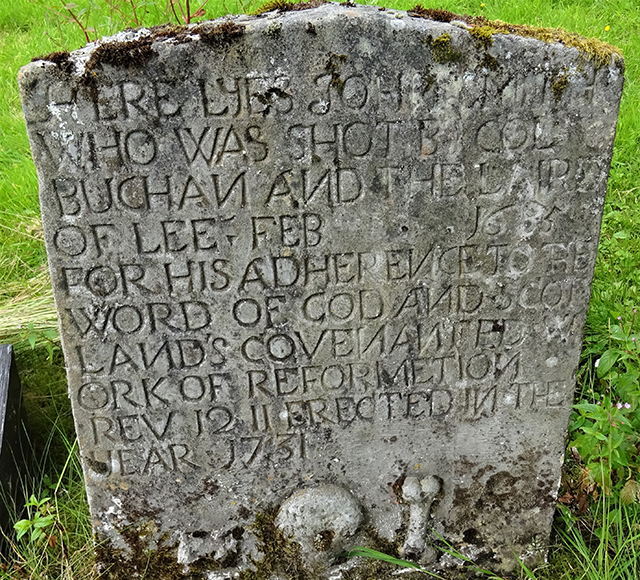
Buchan was a sidekick of the notorious persecutor John Graham of Claverhouse, aka Bluidy Clavers (Wikipedia here). In February 1685, during the reign of King Charles II, it was Buchan who personally shot dead John Smith - Smith's crime was to have attended an open-air religious service known as a conventicle. Smith fell ill on his way home from it, Buchan found him prostrate on the ground and shot him where he lay. Smith's gravestone in Muirkirk was erected in 1731 and is shown below - 'shot by Col. Buchan'.

HERE LYES JOHN SMITH

WHO WAS SHOT BY COL

BUCHAN AND THE LAIRD

OF LEE FEB–––––1685

FOR HIS ADHERENCE TO THE

WORD OF GOD AND SCOT
LAND’S COVENANTED W

ORK OF REFORMATION

REV 12.11 ERECTED IN THE

YEAR 1731


The stone also has an epitaph on the reverse side.

That Duke of York became King James II on 23 April 1685. After William Prince of Orange landed at Brixham in Devon on 5 November 1688, Buchan remained loyal to King James II. Less than a month later, on 3rd December 1688, the 'Comber Letter' was found in the streets of the town – it has been regarded as a hoax, but the threats that it predicted were very real. County Down people knew exactly what was already happening to their kinfolk in Scotland. (Bishop William King drew a comparison between the Comber Letter, and the letter which had exposed Guy Fawkes and the Gunpowder Plot in London in 1605 – "In England the Gunpowder Treason was revealed, and the destruction of the Three Kingdoms prevented by a letter as insignificant as that directed to the Lord Mount Alexander.").

• CORONATION IN LONDON; SIEGE IN LONDONDERRY
William and his wife Mary were crowned as joint monarchs on 11th April 1689, and things escalated further. In the north west, the Siege of Derry began a week later on 18 April. (A published 'Declaration of the Gentlemen of Derry' is online here on page 43)

"...when on the 5th (December 1688) part of the Earl of Antrim's forces advanced to take possession of this place, though we looked on ourselves as sheep appointed for slaughter, and on them as the executioners of vengeance on us, yet we contrived no other means of escape than by flight, and with all precipitation to hurry away our families into other places and countries. But it pleased GOD, who watches over us, so to order things, that when they were ready to enter the city, a great number of the young∣er, and some of the meaner sort of the inhabitants, run happily to the gates and shut them...

... We began to confider it as an especial instance of God's mercy towards us, that we were not delivered over as a prey unto them, and that it pleased Him to stir up the spirits of the people so unexpectedly to provide for their and our common safety and preservation: wherefore we do declare and remonstrate to the world, that as we have resolved to stand upon our guards, and defend our walls... "

 • BUCHAN IN COUNTY DOWN, 1689
James II had retreated to Ireland the month before, and he brought the Covenanter persecutor Colonel Thomas Buchan from Scotland to Ulster. Buchan's brief was to 'reduce the people of Down to due subjection to his authority'.

Presbyterian historian James Seaton-Reid said that, on 23 April 1689, King James II arrived in Newry and ordered Colonel Thomas Buchan to gather up soldiers from the garrisons at Carrickfergus, Lisburn and Antrim and to get to work on the County Down population.

Another of King James II's soldiers, a Colonel Mark Talbot, was wary of going near the Ards – one source says he, "fearing this rabble and the great number of Scots there, durst not attack them. This commotion gave great disturbance to the country people".

A Mourne man, Captain Henry Hunter, had already been organising County Down farmers into local militias awaiting an attack from King James II's experienced army. Hunter gathered them at Killyleagh and within the castle walls. (pic below from John Clarke Photography on Facebook)


• THE KILLING OF THE CUFFIE(S) OF SHRIGLEY, APRIL 1689

Buchan organised 'three troops of horse' and on 30 April marched them from Lisburn to Killyleagh. Hunter had a reported 2000 men ready for them, somewhere between Comber and Killyleagh. When Buchan's force attacked, an estimated 300 of Hunter's local men were killed in 'the Break of Killyleagh' - 'break' apparently being a Scots language word for 'rout'.

Two of those killed – farmers John and William Cuffie – were in the corner of a field in Tullymacnous townland outside Shrigley just north of Killyleagh, which perhaps was part of their rented tenant farmland. A 'plain headstone' was later erected in their memory. According to the Ulster Journal of Archaeology (in the April 1853 edition, p. 140; and also in Vol IV, 1898, p 182) it bore this inscription:

HERE LIES YE BODYS OF
JOHN & WILLIAM CUFFEYS
WHO WAS KILLED YE 2D OF APRIL 1688
IN DEFENCE OF YE PROTESTANT CAUSE

However the footnotes of The Hamilton Manuscripts (1867, p 145) give it as:

HERE LYS YE
BODYS OF JOHN
& WILLIAM CUFFIES
WAS KILLD APRIL
YE 30TH 1688 IN DEFENCE
OF THE PROTESTANT
CAUSE

... including an additional note re: the stonemason's year error, which should have been 1689, not 1688. The UJA article says that the Cuffeys 'were of Scottish descent'. (Over 200 years later, the Census of Ireland of 1911 recorded a couple called Cuffey still living nearby). 

Having 'broken' Killyleagh, Colonel Thomas Buchan then –

'... proceeded to Newtownards, Donaghadee and Portaferry, driving before him the flying Protestants who had been in arms ... the presbyterian ministers ...mostly withdrew to Scotland ... till they should be enabled to return to Ireland ... nearly fifty Irish ministers had taken refuge in Scotland and were settled in various parts of the kingdom, where they attentively observed the progress of events in their native country, and awaited with anxiety the issue of the momentous struggle around the walls of Derry'.

 
• MASS DROWNING ATTEMPT AT DONAGHADEE, 1689
When King James II's troops reached Donaghadee, led by Buchan and Lord Duleek (John Bellew), they drove a group of around 78 civilians into the sea in an attempted mass drowning. They were all rescued by a Captain Andrew Agnew of Portpatrick, whose ship happened to be just offshore, and he took them to safety in Scotland. (see previous post here).

• Buchan eventually returned to Scotland, was promoted to General, and became overall leader of King James II's armies in Scotland. A bio of Buchan is online here on page 180.

................

NB: A full list of the Presbyterian ministers who fled to Scotland in 1689 is here
NB: A Captain Patrick Savage of Ballygalget was on King James II's side at Killyleagh. There are more details in A Genealogical History of the Savage Family in Ulster by George Francis Savage-Armstrong, which is online here (p 213)
NB: Bishop William King of Londonderry, and Charles Leslie of Raphoe, wrote slightly differing contemporary accounts of the 'Break of Killyleagh'. Their statistics for Hunter's local militia range from 400 - 4000, with 61 - 600 of them killed by Buchan's troops. A tenfold margin of error.
NB: Famous Presbyterian minister Rev Henry Cooke said he was descended from a boy who had survived the Break of Killyleagh by fleeing to refuge within the walls of Derry (source here)

................

POSTSCRIPT: THE SEARCH FOR THE CUFFIES' 1689 GRAVE

• Map 1 – the 1846-62 Ordnance Survey Map for Tullymacnous townland shows a grave in a corner of a field.


• Map 2 – Here it is on Google Maps today


• Map 3 – and here are the two maps merged together.


• Maps 4, 5 and 6 - Google Earth current satellite images are from April 2021, on which you can follow the shapes of the pond and the hedge boundaries. On the last of the images below you can see an object in pretty much the exact location of the grave. So maybe the grave existed in April 2021 – and perhaps even exists still today. 


Sunday, July 09, 2023

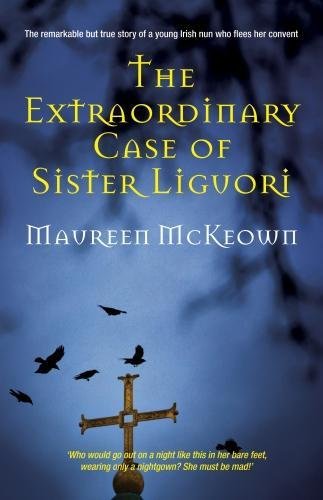
Bridget Partridge and 'The Extraordinary Case of Sister Liguori'


Bridget Partridge was a nun from Ireland (entry here on the Australian Dictionary of Biography). A friend told me about the 2017 novel of her story which was written by her grand-niece, Maureen McKeown, of Downpatrick.

It was 1920 when Bridget, who took the religious name Sister Mary Liguori, fled from convent life at Mount Erin (see pic below) in the town of Wagga Wagga in New South Wales in Australia and was taken in by a Protestant family called Thompson. Eventually she was discovered and Bishop Joseph Dwyer had an arrest warrant issued for her on the grounds of alleged insanity.

The two week trial became a celebrated legal issue in the newspapers of Australia and Ireland – Bridget's case was taken up by the barrister Edmund Alfred Barton (1879–1949; bio here), who was the son of Australia's first Prime Minister, and also the Grand Master of the Loyal Orange Institution of New South Wales. It's quite a tale, with the issues of a dividing Ireland playing out on the other side of the world.

website here


Sunday, July 02, 2023

Tim Wise

Tim Wise was mentioned to me recently – I hadn't heard of him before, so I dug around online. I found this particular clip to be very powerful. In this 2008 talk he treads ground that Senator James Webb was also hinting at that very same year (see previous post here), but Nashville-born Wise does so in a far more impassioned way.

Friday, June 30, 2023

William Cowan Limited, Belfast - Irish and Scotch Whisky - 1910 billhead

Very thankful to the kind man who passed this beauty on to me recently.


Thursday, June 29, 2023

William's Catholic allies - the 'Grand Alliance' and the 'League of Augsburg', 1689


Thanks to the friend who told me about this recently.
Above - Leopold I, Holy Roman Emperor, from this website

"The Grand Alliance was the anti-French coalition formed on 20 December 1689 between the Dutch Republic, England and the Holy Roman Empire. It was signed by the two leading opponents of France: William III, Stadtholder of the Dutch Republic and (since April 1689) King of England, and Emperor Leopold I, on behalf of the Archduchy of Austria.

With the later additions of Spain and Savoy, the coalition fought the Nine Years' War (1688–1697) against France that ended with the Peace of Ryswick (1697)" 

– from Wikipedia here.


Leopold I of Austria was Holy Roman Emperor, a title of enormous historical and religious significance to the Roman Catholic Church across Europe (back in 2019 there were large celebrations in Austria to mark the 500th anniversary of the first of them, Maximilian I, with the hashtag #FollowMax500).

That the Holy Roman Emperor and King William III of Orange signed this formal military alliance in December 1689 will be a surprise to many. My recent post on the notorious Conrad Von Rosen and his persecutions in both France and Ireland show just how vicious the era was. But this 'Grand Alliance' shows that there was also great complexity to the period and widespread European Catholic opposition to the imperial ambitions and persecuting extremes of King James II and his cousin, France's King Louis XIV.

Pope Innocent XI and Pope Alexander VIII's support for William are better known, as is the infamous painting by Pieter van der Meulen which was vandalised in 1933 and today is in the art collection of the Northern Ireland Assembly.


........

Another interesting source is John Mitchel's History of Ireland, from the Treaty of Limerick to the Present Time (published 1864, available on GoogleBooks here). Mitchel's pro-slavery stance has brought some pressure to remove his statue in Newry, but his History is a fascinating read, in particular his account in Chapter II of King William III – here is a quote that Mitchel reprints, originally from Matthew O'Conor who was author of History of the Irish Catholics (1813, on GoogleBooks here):

"In matters of religion, King William was liberal, enlightened, and philosophic. Equally a friend to religious as to civil liberty, he granted toleration to dissenters of all descriptions  regardless of their speculative opinions. In the early part of his reign, the Irish Catholics enjoyed the full and free exercise of their religion. They were protected in their persons and properties; their industry was encouraged; and under his mild and fostering administration, the desolation of the late war began to disappear, and prosperity, peace, and confidence to smile once more on the country."

Mitchel lays most of the blame for what he calls "the most disastrous epochs of Ireland" not solely at the feet of King William III, but rather the Dublin Parliament and Lord Henry Capell the Lord Deputy of Ireland who failed to implement the 1691 Treaty of Limerick. Mitchel writes that Capell "was desirous of doing all in his power to infringe that treaty".

Mitchel also refers to Dublin-born William Molyneux's 1698 pamphlet attacking the Dublin Parliament, entitled The Case of Ireland being Bound by Acts of Parliament in England (which he is said to have conferred with his friend John Locke about the content of. Here's the whole thing online, and here's an extract from the Preface:


(Ian McBride has analysed Molyneux in this paper, freely available online).

........

And of course, for generations, the Dublin Parliament was no friend to the Ulster-Scots. 

These are just a few references. It's a very complicated time and there are thousands of other sources.

I don't know how to reconcile all of this information with the popular assumptions and misrepresentations. But the more I have read the more I have come to understand that much of what our generation perceives about the past, through inherited simplifications and even sectarianisations, is wrong.

Other writers, like Frank Hugh O'Donnell (1846–1916), have unexpected things to say about that era (see previous post here). History has always been appropriated by later movements and organisations to advance their own agendas. Perhaps there is a need to radically rewrite our history.

(Photo below is one of my own of John Mitchel's statue in Newry. One of the GAA clubs located near me was named after him, and their ground is Mitchel Park.)


Monday, June 26, 2023

Stuck in the 1980s

This video, released in 2004 by American band Bowling For Soup, is a risqué comedy-rock send-up of a whole collection of 1980s music clichés. This was the era when MTV made the imagery of music just as important as the sound - Robert Palmer, breakdancing, RUN DMC, George Michael, Motley Crue and Whitesnake - images burned into the memory of a generation.

In 2017 I had a business encounter with a man who was, in a different way, also very much stuck in a 1980s mentality. He was the owner of a large private sector company in NI who I was invited to meet, with a view to me doing a brand refresh with them. He was a little older than me, and during a group meeting he went off on an incensed rant about one of his London customers who had that day invited him to a Chelsea FC match, corporate hospitality package and all. He spun off into a great diatribe about Chelsea fans being racists and how outraged he was to be asked, and how he would never darken the door of Stamford Bridge and how he might stop supplying that particular customer in future.

In the 1980s these accusations were true, and the attitudes weren't limited to fringe fans groups, but according to former players were evident within the club itself. Other football clubs in England were similar.

But this was a company boardroom in 2017. He knew very little, but had outdated yet vehement opinions. I was pretty shocked, as I've been following Chelsea since the 1986-87 season (Northern Ireland international striker Kevin Wilson joined the next season) and I knew that all of that stuff was long-gone.

By the time of this 2017 outburst a huge number of black players had been Chelsea heroes. I was at Stamford Bridge in August 1996 for black Dutch icon Ruud Gullit's first match as manager – Gullit became the first black manager in top-flight football in England, and at the end of that season he was the first black manager to win a trophy in England when he guided Chelsea to victory in the FA Cup in May 1997, beating Middlesborough 2-0, with one of Chelsea's black players, Eddie Newton, scoring the second goal. 

The explosion of the mass media in the 1980s created images and forged enduring memories. But the world has moved on.

Never mind the music and the football – Northern Ireland is nothing like what it was in the 1980s, but many people seem to still be stuck there. Look around. Everything is different now. The way people think, the values they have, the way they receive information, the outlooks they have. All different. As W.B. Yeats wrote in 'Easter 1916' (with another Motley Crue inference):

Being certain that they and I   
But lived where motley is worn:   
All changed, changed utterly:   


Saturday, June 24, 2023

Marshall Conrad Von Rosen - rounding up Protestant civilians in France and Ulster, 1686-1689: "orders to give no quarter, or spare either age or sex"


Above: a detail from this painting by Huguenot artist François Dubois (1529–1584), depicting events that he had personally witnessed.


It's an ominous skillset for a new recruit. "Who's experienced in rounding up Protestant civilians?". This is the candidate that King James II was looking for in 1689. The very man for the job was in France. Having been in Inishowen a few weeks ago, recent reading has introduced me to Conrad Von Rosen (Wikipedia here). His portrait is shown below. He is described here by Nick Garbutt as "an exponent of the darkest arts of war".

He was born in today's Latvia, and was a Lutheran by birth. However, a career fuelled by bloodlust and ambition saw him become a monster, a 'French butcher'. Protestantism was made illegal in France in 1685, and the full force of the French state was unleashed against civilians of the Reformed faith, known as Huguenots, a community who have been described as 'London's first refugees'. Similar to the Presbyterian Covenanter experience in Scotland in the same era, it was an unimaginably horrific time. Von Rosen was very good at his job. The Languedoc area was particularly persecuted, culminating in the War of the Camisards (Wikipedia here).


In the 1716 book Memoirs of Ireland from the Restoration, to the Present Times .... By the Author of the Secret History of Europe by John Oldmixon, Von Rosen's notorious, horrific, actions in France and Ireland are described as this –

"... But nothing will give us a more lively and terrible idea of King James's barbarity to his Protestant subjects, and his disposition to govern himself by the maxims of France, than his giving the command of the army before Derry, which had been commanded by the traitor Hamilton, to Monsieur Rosen, a French man, who had in his own country been employed to dragoon the Protestants of Languedoc.

This officer immediately put in practice, the military execution of the French papists against the Huguenots; and issued out an order for all the Protestants from Inishowen and the sea coasts to Charlemont - men, women, and children - to be driven before the walls of Londonderry, that the garrison might be distressed by the taking of them in, or their friends be destroyed by the cannon of the besieged. The words of this French butcher's orders are these;

That from the Barony of Inishowen, and the sea coast round about, as far as Charlemont, the faction be gathered together, whether protected or not, and immediately brought to the walls of Londonderry, where it shall be lawful for those that are in the town (in case they have any pity for them) to open the gates and receive them into the town, otherwise they shall be forced to see their friends and near relations all STARVED for want of food; he having resolved not to leave one of them at home, nor any thing to maintain them; and that all hope of succour may be taken away by the landing of any troops in these parts from England, he further DECLARE, that in case they refuse to submit, he will forth with cause all the said country to be destroyed, that if succours should hereafter be sent from England, they may perish with them for want of food.

Pursuant to this order, the dragoons and soldiers first stripped them, and then drove the whole country for thirty miles about before them, not sparing nurses with their sucking children, women big with child, nor old decrepit creatures; some women in labour, some that were just brought to bed, were driven among the rest . The very popish officers who executed these orders, confessed that it was the most dismal sight they ever had seen, and that the cries of the poor people seemed to be still in their ears. They gathered 6 or 7000, and kept many of them for a week together, without meat or drink. Several hundreds died in the place before they were dismissed … the generality of them perished afterwards for want, and many were knocked on the head by the soldiers. The officers who had the charge of seeing these orders executed, were the Duke of Berwick, Colonel Sutherland, and Colonel Sarsfield, for which notable exploit they ought to be remembered with infamy..."

...................

Corralling thousands of civilians to use them either as a human shield, or as bait. This order by Von Rosen was issued on 30 June 1689 - the full version is online here. The rounding up, and attempted extermination, of a minority. This is what the 'French state' and the 'British state' did to their own civilians in the 1680s. The civilians did not break. This is why Revolution was the only alternative.

• Source on GoogleBooks here, starting on page 217


Tuesday, June 20, 2023

Edward Bruce's 'Northburgh' Castle (Greencastle, Inishowen, Donegal)

A few pics from last week's road trip, of the remains of the castle that has been called 'Edward Bruce's Northern Court'. Strategically positioned at the mouth of Lough Foyle, Greencastle (also known as Northburgh), was built by Richard de Burgh, Earl of Ulster, in 1305 at a time when he was extending his authority in the north of Ireland. It was captured by Edward Bruce in 1316, and his army held it until his death in battle in 1318.

The Ulster Journal of Archaeology said:

'... Edward Bruce "remained quiet" for a year, or, as it was said, "reigned" in Ulster. The historian Moore observes that the Scots, "taking possession of Northburgh castle, sat down quietly in their quarters, and Bruce kept his court, and took cognizance of all pleas, as composedly as if it were in times of profound peace." The mention of Northburgh seemingly implies that this fortress was Bruce's head quarters. Our annalist, Grace, states that the Scots had previously taken this place, which is better known as "Greencastle", situated on the further point of Inishowen; a situation so remote that it could not have served as a central post, for which the principal town in Eastern Ulster, namely Carrickfergus, was most suitable; and here, at this period, the metrical narrative says "Schyr Edward the worthy, with all hys chivalry, was Hand ...'

(Magilligan Point and Binevenagh in County Londonderry are visible across the lough.) Re: my previous post, Brian Richmond enjoyed working with me on the Bruce project in 2007 as Northburgh/Greencastle was just a few miles from his own house.


Sunday, June 18, 2023

My friend Brian Richmond (1961–2007)


Brian Richmond was a colleague and friend, our offices both separated and connected by two short flights of stairs back in our days at GCAS, in the former Russell Court Hotel building on Belfast's Lisburn Road. Brian was one of the Creative Directors of GCAS Advertising - a copywriting wordsmith, a highly gifted and intelligent man, and great crack too. I joined GCAS Design in early 1997, and somehow became its managing director around 2000. Brian and I would banter about music, history, faith, politics, all sorts of stuff. We had a kind of 'fantasy' about one day doing an ad campaign for IKEA, using the Gram Parsons version of 'Dark End of the Street'. It's a long story...

Around 2005/2006 Brian had an opportunity to relocate to Bredagh Glen outside Moville in Inishowen, and work remotely from there. He emailed me on 27 March 2007 to say that the backache he'd recently developed might be a hernia or gallstones. Then on 9th April he emailed me to say it was pancreatic cancer.  Knowing his time was short, he started to write his experiences on a blog he entitled Captain Pancreas. His first post was 19 April 2007 and his final post 22 August 2007. Only 125 days.

He makes mention of me a few times in those blog posts. I was Chair of the Ulster-Scots Agency at the time (which was just a 3 days per month commitment - at least that's what the officials said...) and we had a board meeting in Letterkenny on Friday 27 April 2007, after which I drove to see Brian. I visited him a few other times too during those 125 days – he took me to visit beautiful Stroove Beach on one of those, with his wife and son – and I was in frequent email communication with him as his fading strength and hospitalisations allowed.  

Brian had some Ballywalter ancestry but was very much a Belfast boy, still bearing echoes of the influence (and perhaps theological scars) of mission hall Sunday Schools and the vocabulary that they use. He was wary and sceptical of aspects of typical Northern Ireland conservative evangelicalism. You can see some of that in the blog posts.

At first Brian was very hostile to Ulster-Scots concepts – there was a notorious incident involving him sticking an 'anti' newspaper cutting on the notice board in the GCAS kitchen, to which I counter-stuck something in response, He went berserk and stormed up the stairs verbally lambasting me in front of my design team! – but to be fair to him, his only knowledge of Ulster-Scots then was the politically-driven current affairs media caricature coverage.  This was back in the old days when people could disagree, and discuss, and differ, and still remain good friends. Over time and conversation, he came to better understand.

In those last months he helped me on the 'Robert The Bruce 700' project that I was leading (in a sense) at the Ulster-Scots Agency – I did the raw research and writing, and Brian polished it into proper sentences, for a series of articles in the Agency's monthly newspaper. Sadly the subsequent standalone reprint tabloid editions removed both of our names from the authoring of those, I don't know why, but we were both 'expunged'. Brian also helped me with some of the Belfast/Nashville publications as the 'Sister Cities' relationship was being revived at that time. He was also working on a self-motivated screenplay called "Billy Antrim", about Billy the Kid's reputed Ulster roots.


Brian has been on my mind in recent weeks, so with the long days now here, one bright morning last week I set off early on the long drive to visit his grave, at St Columba's Church, Ballincrae, outside Moville. I left here at 6:00am, made a few stops, and got there bang on 9:00am. It was good to be there and to remember our times together. To see his name etched in stone. 

At the bottom of his gravestone inscription are the words "A pilgrim on his journey", I expect purposely reminiscent of the beautiful track "Pilgrim" by Steve Earle which I have posted above. Brian and I were both at an acoustic concert that Steve Earle did in the Ulster Hall in March 1997, not long after I had joined GCAS. We spotted each other, and bonded.

Brian's funeral was an ecumenical service, reflecting his family set-up. The first hymn sang was Psalm 23. The other one was 'There Is A Redeemer, Jesus God's Own Son'. I had the honour of saying a few words about Brian during the service, as did two other friends. Some were there from Sandown Road Baptist Church – if memory serves me correctly they included an uncle of Brian's called Harry Hawthorne who also took part. That contingent chatted with me for a while at McGrory's Hotel in Culdaff, a renowned local hotel and music venue where everyone went after the service and committal. Brian was thrilled to be living so close to McGrory's, and the potential gigs he'd get to experience there. 

I really hope that Terry and Matthew are well. He loved them both very very much.

It's hard to believe it's been more than 15 years. 

In memory of Brian. 

(PS - I have mentioned Brian here a few times, and have had some emails from people who knew him, who found those posts via Google searches, and then made contact with me. I hope this post is helpful for those who are searching)


Below: a detail from the artwork of the Bruce project, dated 9th April 2007. This was the very same day that he emailed me with his diagnosis.